Shoe Storage Ideas · Listicle
30 Stylish Shoe Storage Ideas to Copy Now

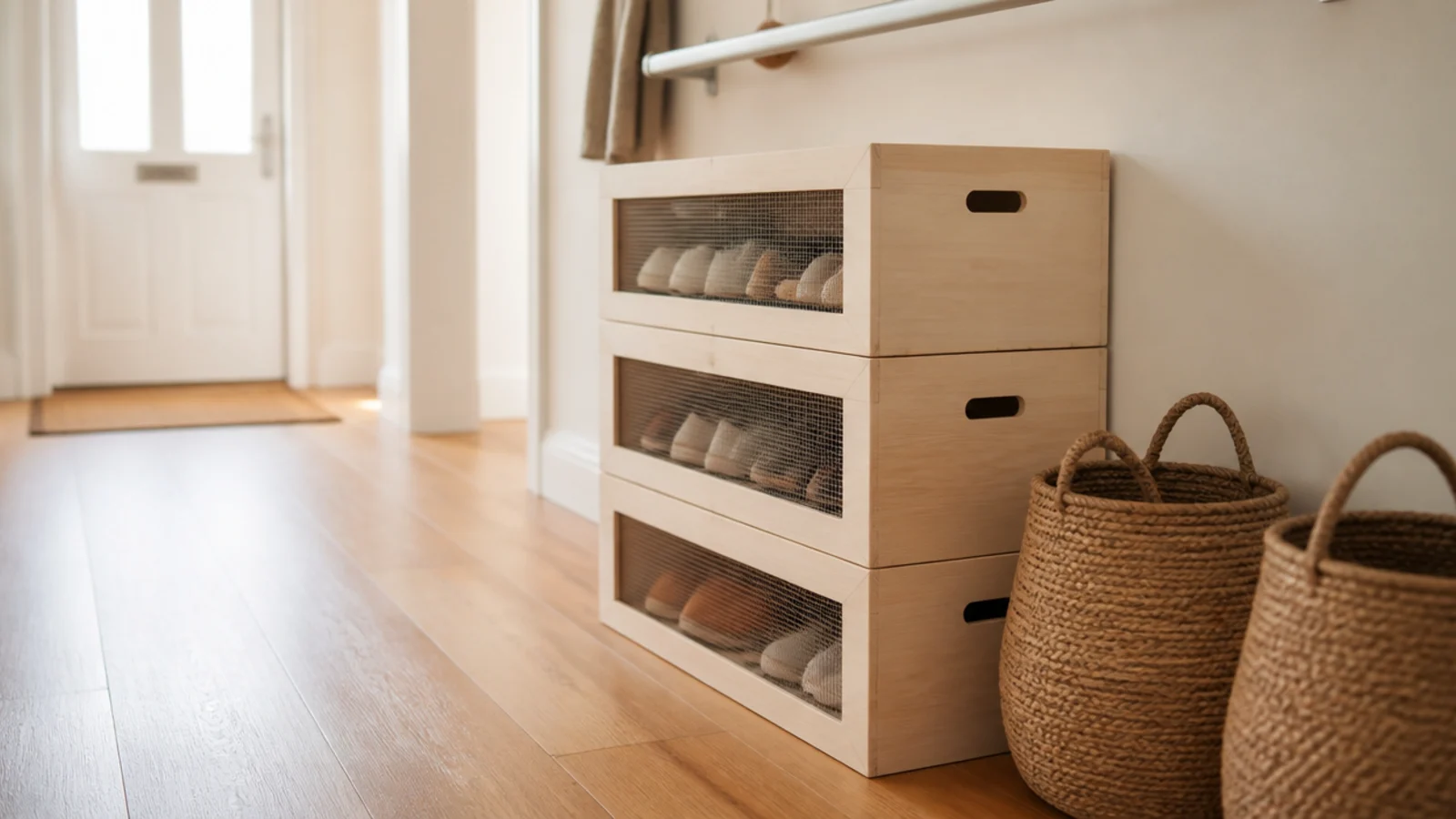
Shoe storage on a budget usually fails for the same reason expensive shoe storage does: it gets sized for a photograph rather than a household. A $20 rack that fits your actual pairs beats a $200 cabinet that does not. Every idea below names what it holds, what it costs and whether a landlord would ever notice, and several of them cost nothing at all.
In this guide32 sections — tap to openHide
- 1.Where shoe storage on a budget is worth spending and where it is not
- 2.Sealed crates turned on their sides
- 3.A plank laid across two crates
- 4.A thrifted bookcase laid on its back
- 5.Tension rods doubling a closet shelf
- 6.An over-the-door pocket organizer
- 7.A garden drip tray as a boot tray
- 8.Wire cube grids you build to fit
- 9.Towel bars used as shoe rails
- 10.A copper pipe rail you cut to length
- 11.Rolling boxes that live under the bed
- 12.Magazine files as flat-shoe slots
- 13.A repainted secondhand metal rack
- 14.One basket per person, tagged
- 15.Clear boxes with a photo on the front
- 16.A curtain across an open rack
- 17.A shallow shelf above the baseboard
- 18.An angled rack from scrap plywood
- 19.Secondhand lockers for the back door
- 20.A rolling utility cart under a console
- 21.A peg rail with wire baskets hung on it
- 22.A spice rack for small shoes
- 23.A thrifted ladder leaned against the wall
- 24.Pull-out bins on a closet floor
- 25.A capped landing zone by the door
- 26.Cardboard dividers inside a deep drawer
- 27.A flat-pack tilt-out cabinet on sale
- 28.A crate bench with a cushion on top
- 29.Adhesive heel rails for flats
- 30.Shelf risers that double a closet shelf
- 31.A seasonal duffel under the bed
- 32.Mistakes to Skip
Where shoe storage on a budget is worth spending and where it is not
After a lot of cheap experiments, my rule is simple: spend on mechanisms, save on boxes.
Worth paying for. Hinges, drawer runners and castors. A tilt-out cabinet is genuinely hard to build because the hinge geometry does the work, so buying one under $80 is good value. Full-extension runners on anything deep, too — half-extension means the back third never gets used.
Not worth paying for. Shelves, cubbies, benches and racks are flat pieces of wood at right angles. Sealed crates, plywood offcuts and thrifted bookcases do the same job for a fraction of the price.
Then measure before you buy anything. A men's size 12 sneaker is about 12.5 inches long, so flat storage needs 13 inches of depth and 45-degree tilted storage needs nine. Six inches of tier height clears flats and sneakers, but boots want 14 to 16, and almost every cheap rack has evenly spaced six-inch tiers.
Keep the honest pair count in mind as well: two to three pairs per person at the door plus one seasonal set. Anything closed needs ventilation holes or it will smell within weeks.
Budget tiers below: $ under $25, $$ $25–$60, $$$ $60–$120.
1. Sealed crates turned on their sides
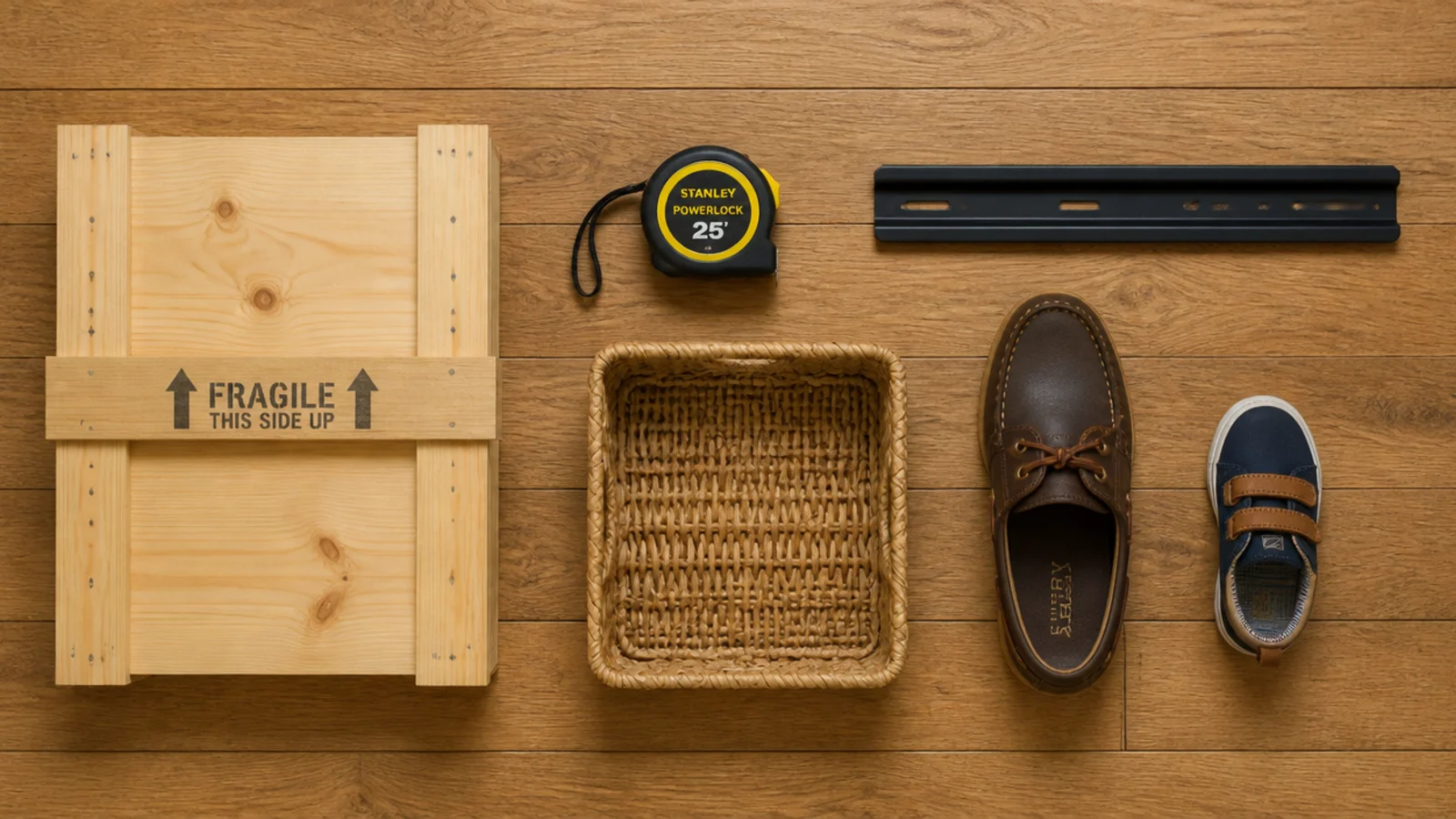
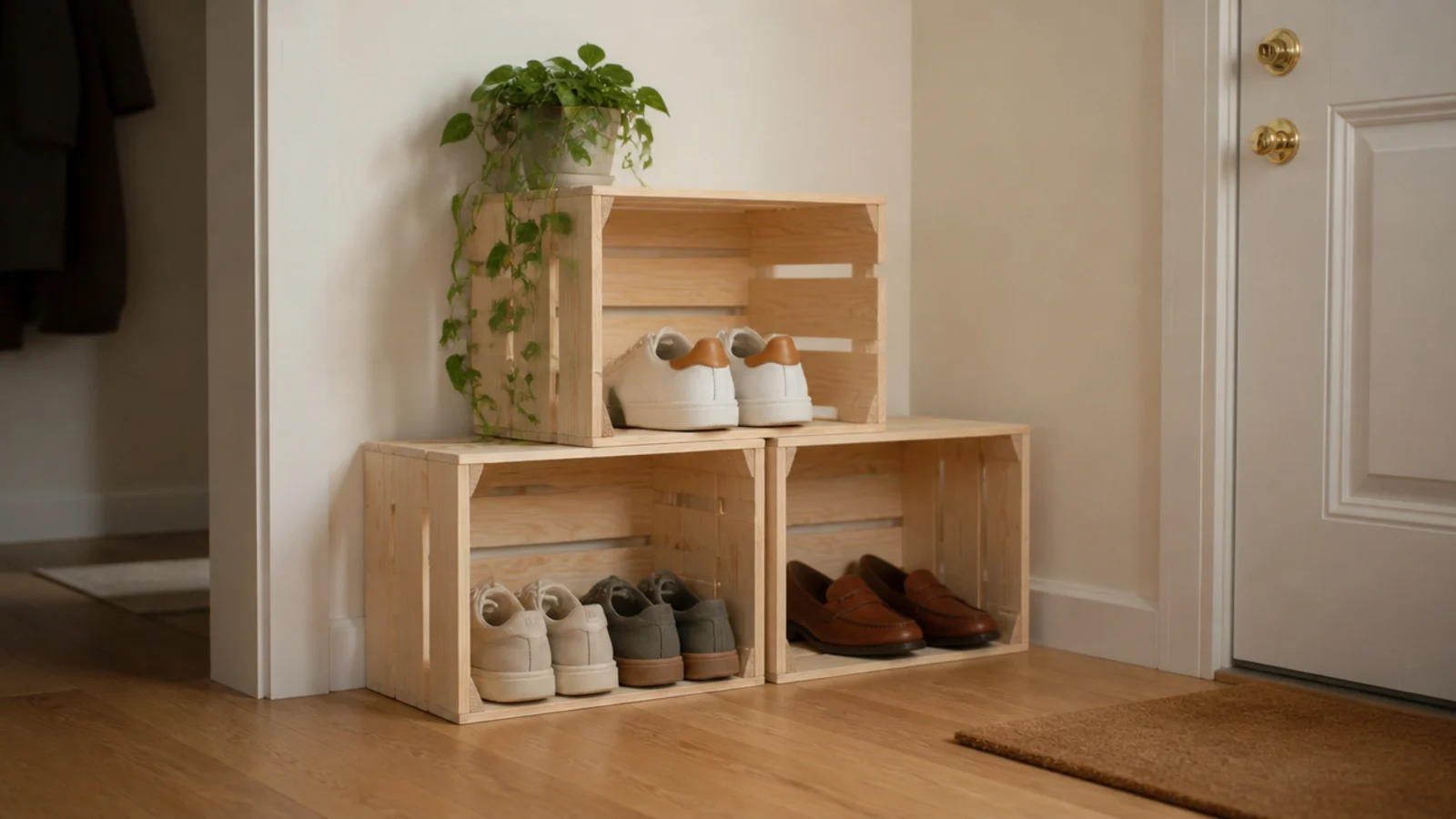
Three crates on their sides, staggered rather than stacked square, give you real cubbies for about $25 and come apart flat when you move.
Seal them first — most crates are raw pine and wet soles stain untreated timber within a season. Screw the crates to each other, and the top one to the wall if there are children. $$
2. A plank laid across two crates
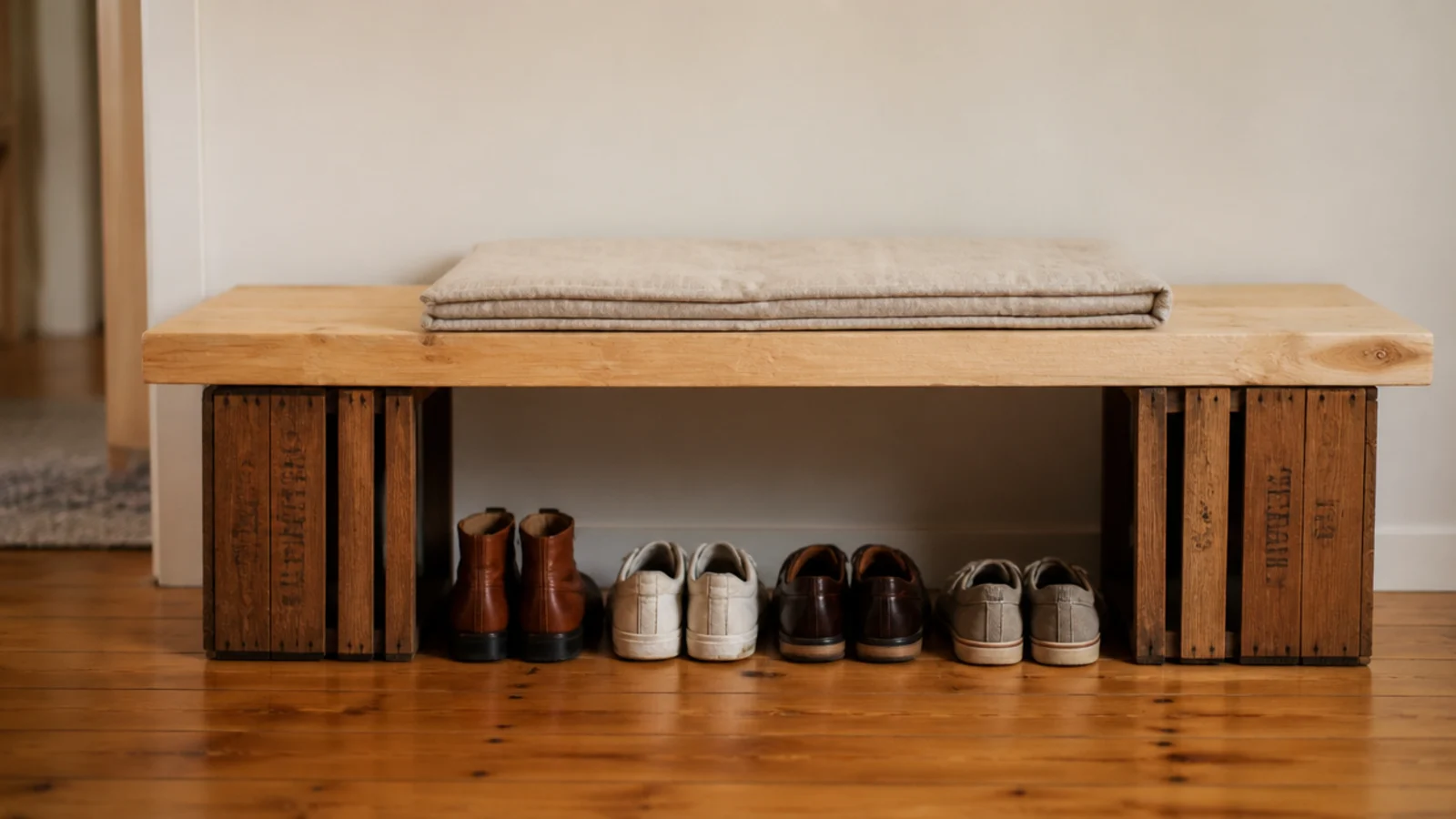
A sanded pine plank resting across two upturned crates makes a bench at roughly the right height with no joinery at all.
Aim for 18 inches to the top of the cushion. Screw the plank down from underneath so it cannot slide, and store shoes in the open crate fronts. Total cost around $30 including a cushion. $$
3. A thrifted bookcase laid on its back
A small secondhand bookcase turned horizontal becomes a run of shoe cubbies at ankle height for whatever the thrift store charges.
Check the shelf depth is at least 11 inches before you buy. Paint it the wall colour and it reads as fitted joinery rather than a rescued bookcase. Mine cost $15 and holds ten pairs. $
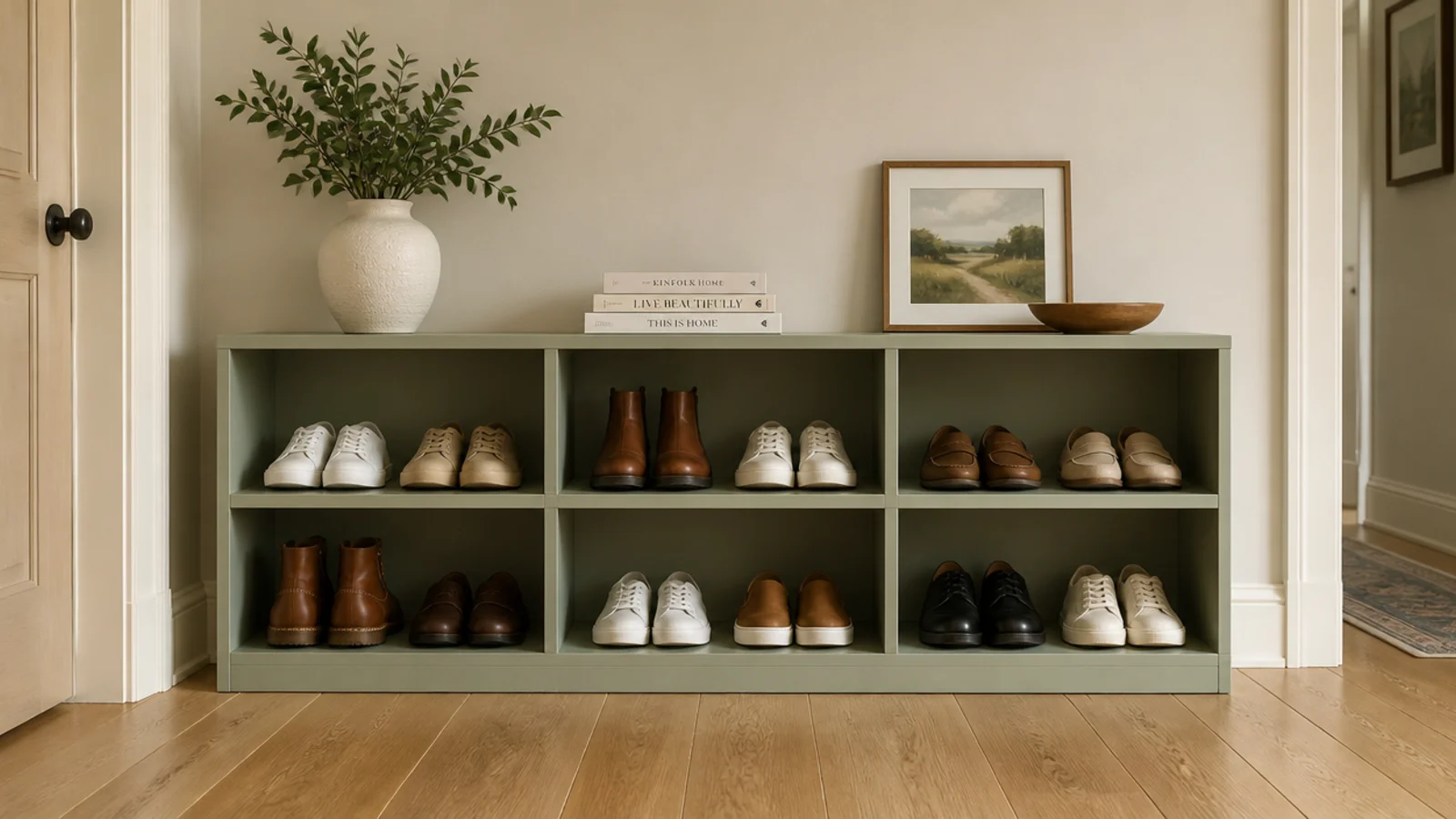
4. Tension rods doubling a closet shelf
Two slim tension rods sprung across a closet at different heights hold a dozen pairs of flats hooked by their heels, in space that was holding air.
Set the rods 10 inches apart vertically so one row does not brush the pair below. Flats, loafers and sneakers only — boots pull rods straight out of the wall. $
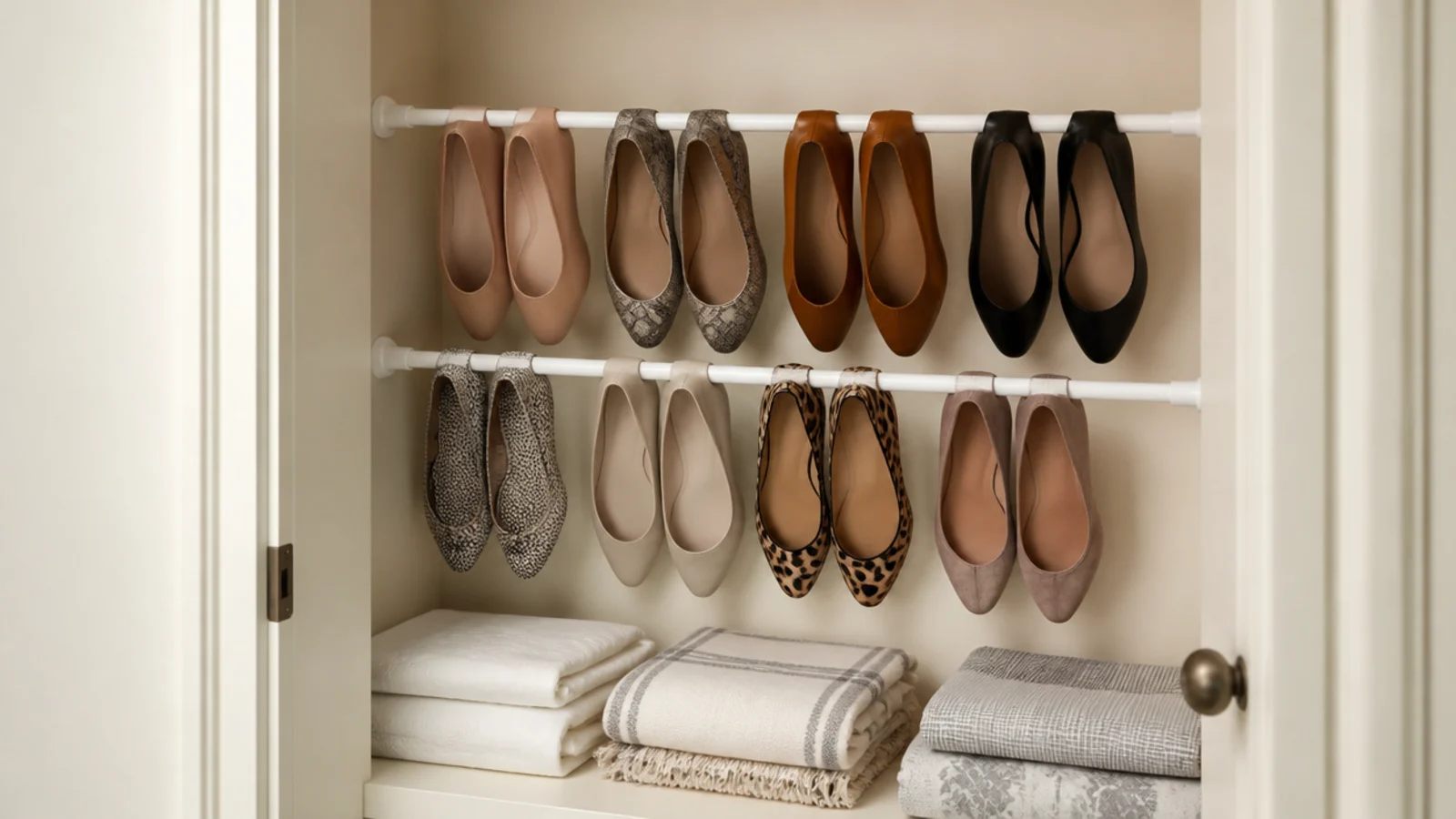
5. An over-the-door pocket organizer
A canvas organizer on the back of a closet door holds a dozen pairs on a surface that was doing nothing whatsoever.
Choose canvas or felt over clear vinyl, which yellows and cracks within two years. Check the door still closes with it fitted, because some interior doors have almost no clearance. Best for out-of-season pairs. $$
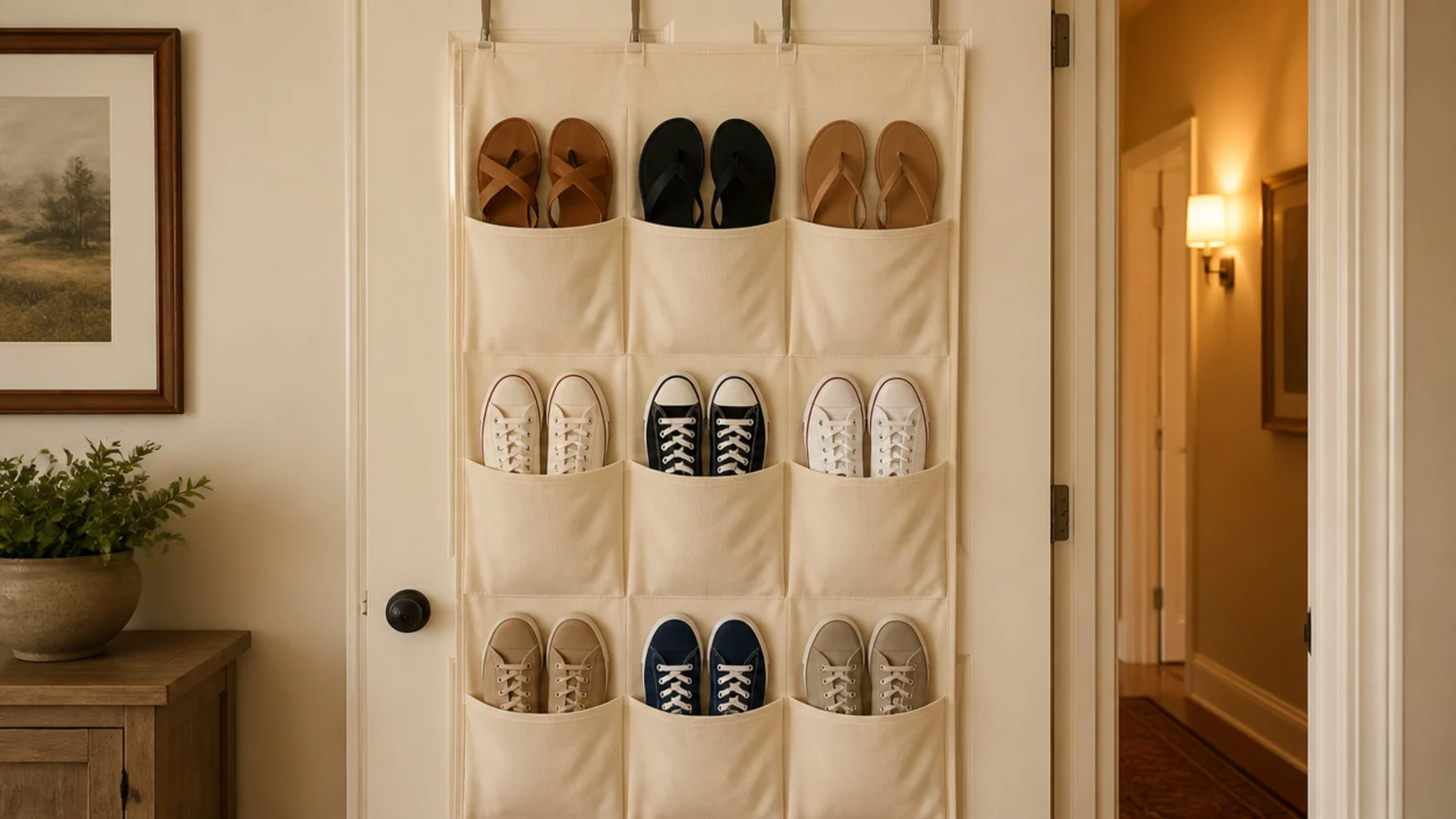
6. A garden drip tray as a boot tray
Hallway boot trays and garden drip trays are the same object at different prices. The garden aisle version is usually half the cost and often deeper.
Look for at least 15 inches of depth and a raised lip. Heavy rubber or galvanised metal, not thin plastic that cracks in cold weather. Wet boots need a drip zone, never a closed cabinet. $
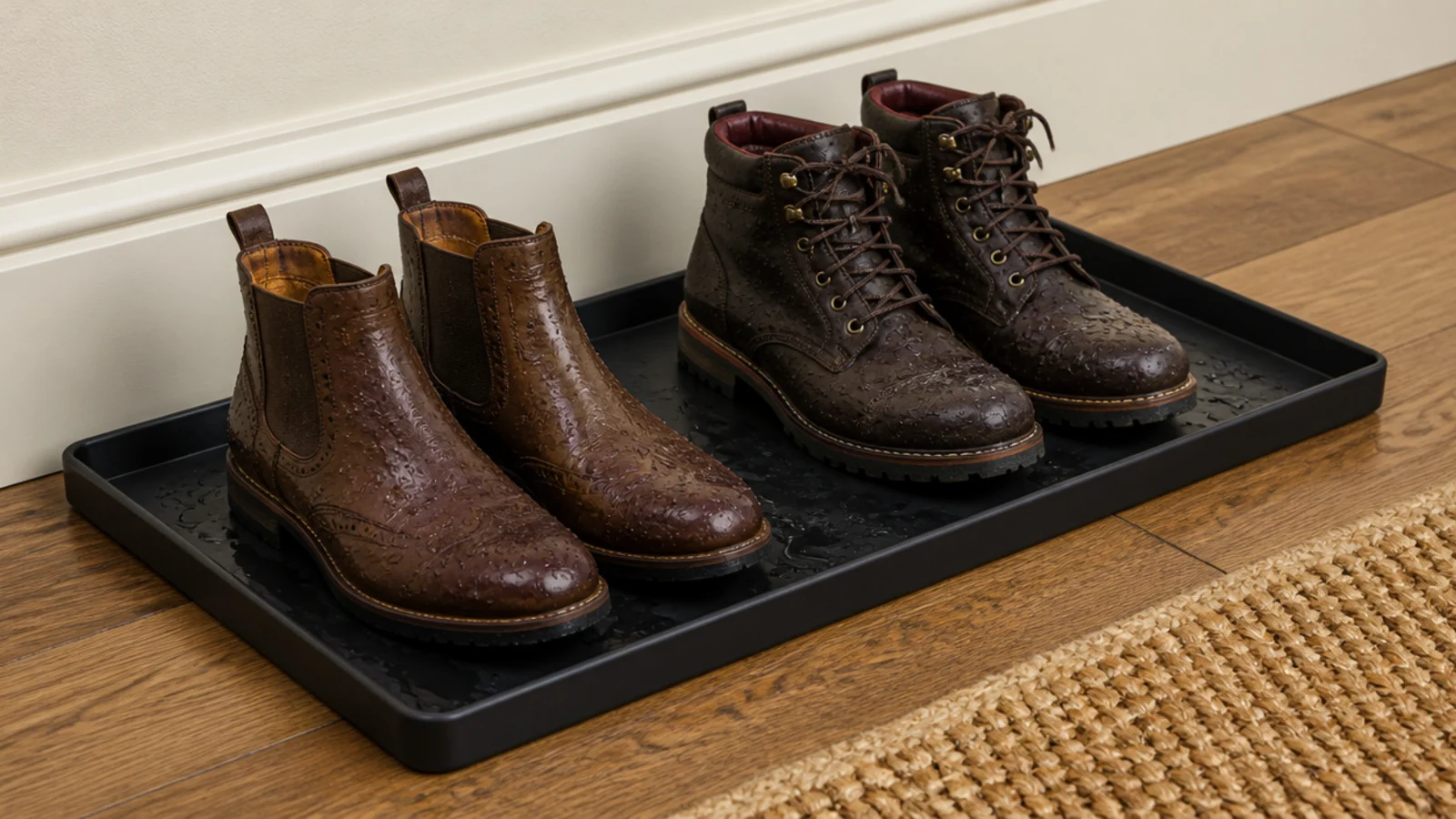
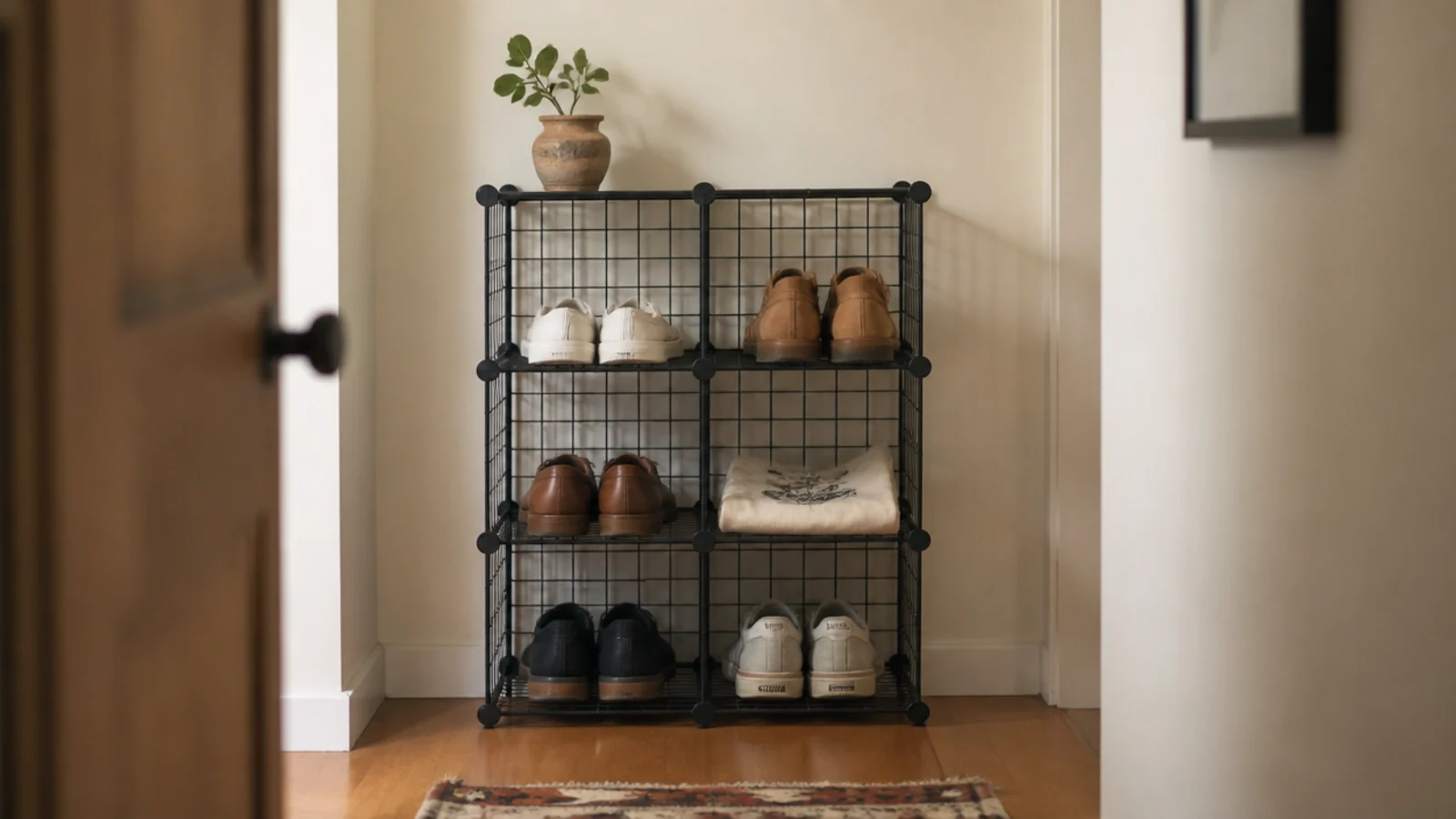
7. Wire cube grids you build to fit
Modular wire cube panels clip into whatever footprint your hallway actually has, which beats buying a unit and hoping.
Each cube is about 14 inches, so a single cube takes two pairs of adult shoes or four pairs of kids'. Build no more than three high without wall fixing. Around $40 for a six-cube run. $$
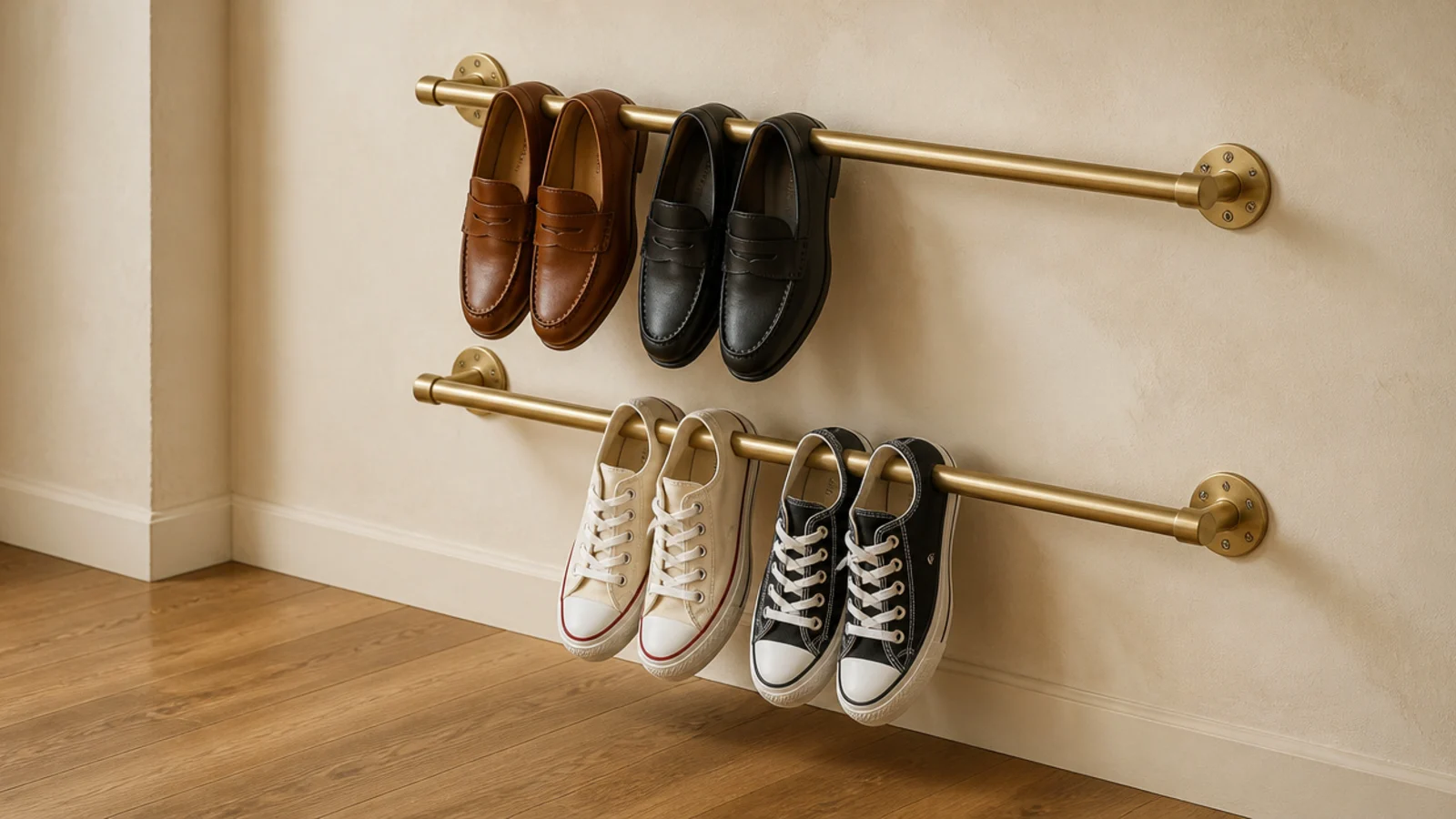
8. Towel bars used as shoe rails
A plain towel bar mounted horizontally holds four pairs of flat shoes hooked by their heels, using four inches of depth and no floor at all.
Mount the lowest bar at 12 inches so a vacuum passes underneath. Two bars on a 36-inch wall hold eight pairs for around $12 total. Flats and sneakers only. $
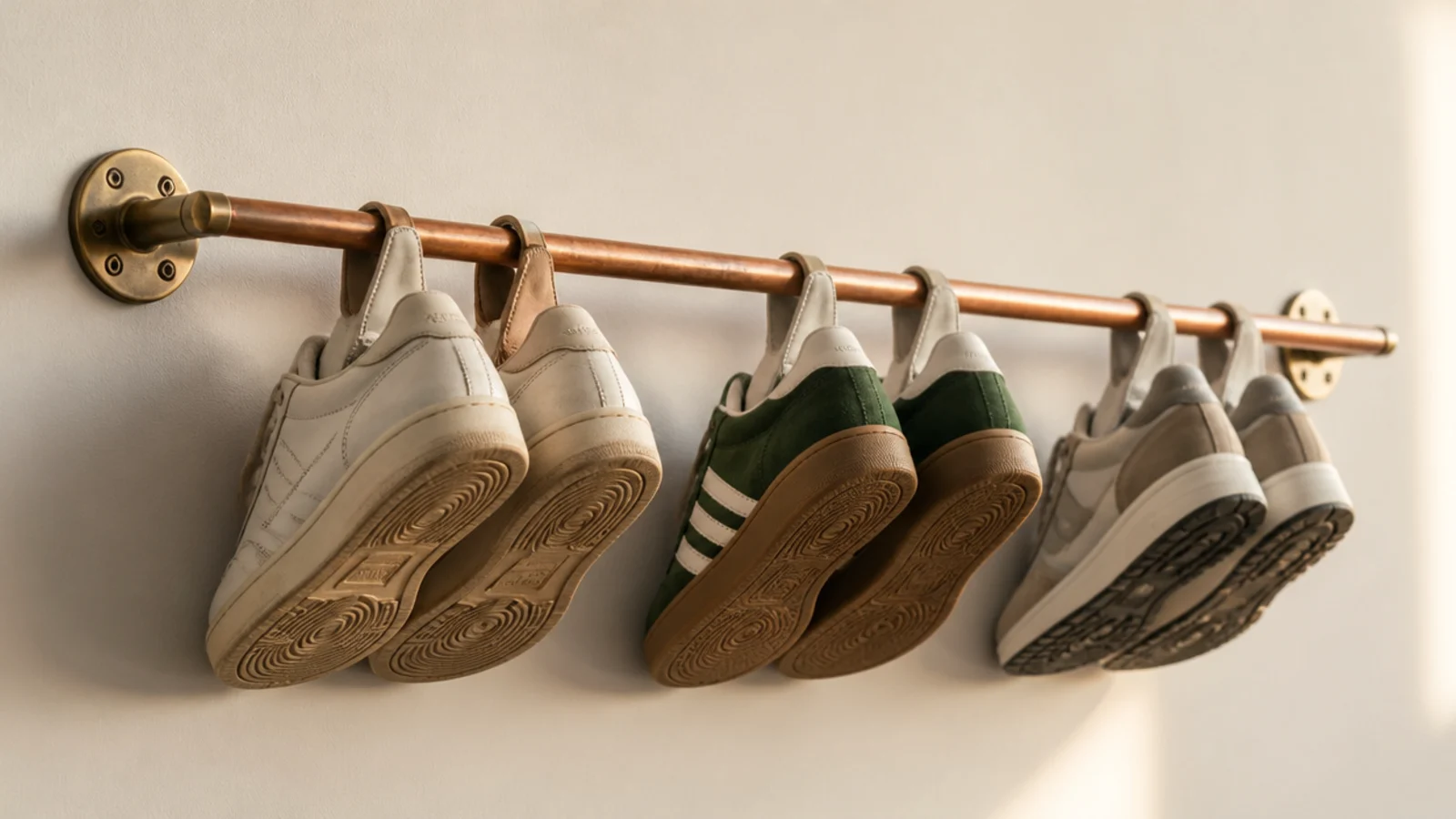
9. A copper pipe rail you cut to length
Half-inch copper pipe and two simple brackets make a rail cut to the exact inch, which is why it reads as deliberate rather than improvised.
Hardware stores cut pipe free. Leave the patina rather than lacquering it — copper warms up beautifully against cream walls. About $15 for a three-foot run holding six pairs. $
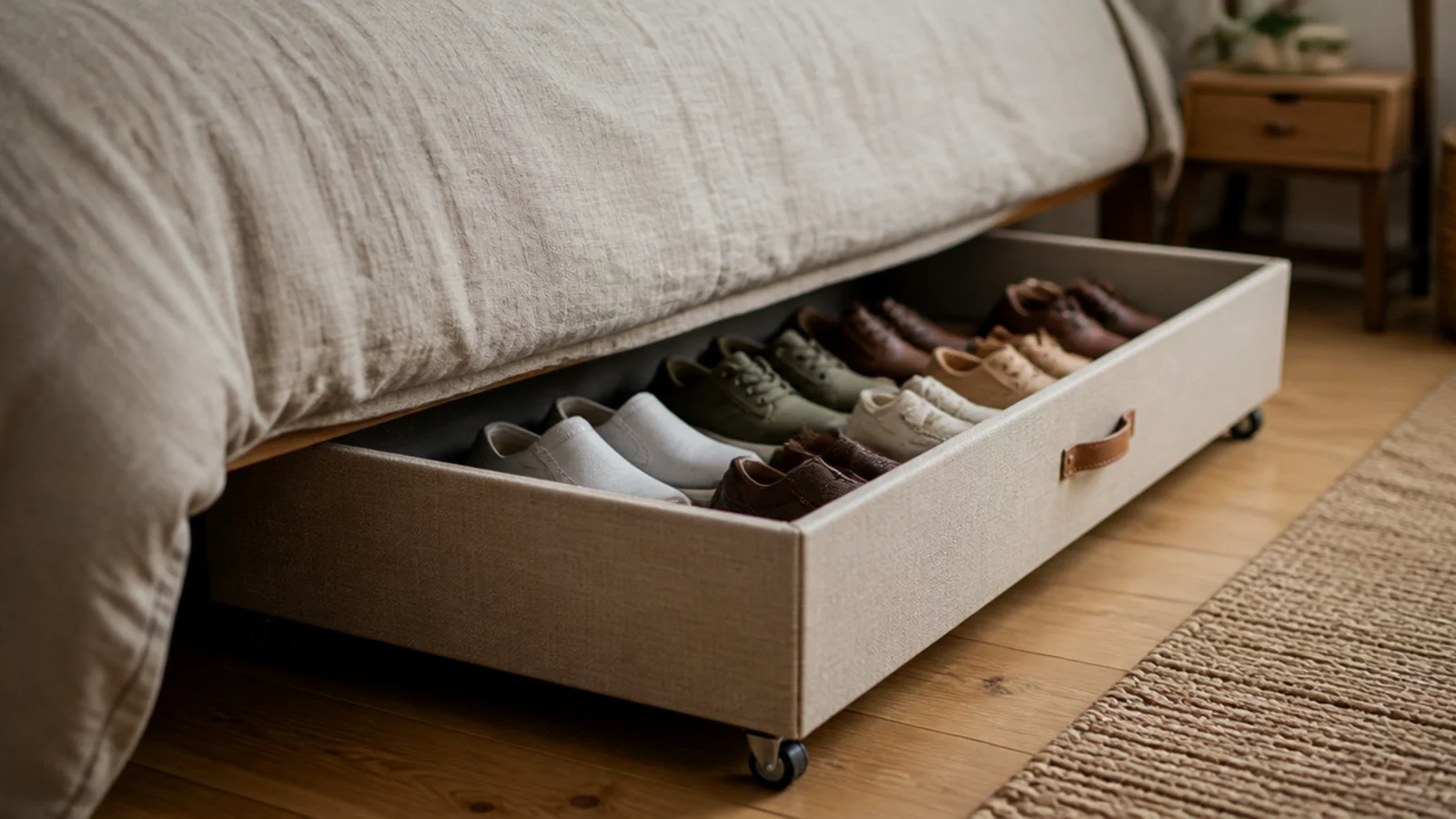
10. Rolling boxes that live under the bed
Most beds have six inches of clearance doing nothing. Low fabric boxes on castors turn that strip into a dozen pairs of stored shoes.
Measure the frame clearance first and subtract an inch. Castors matter more than the box does — without them, anything under a bed stops being retrieved by February. $$
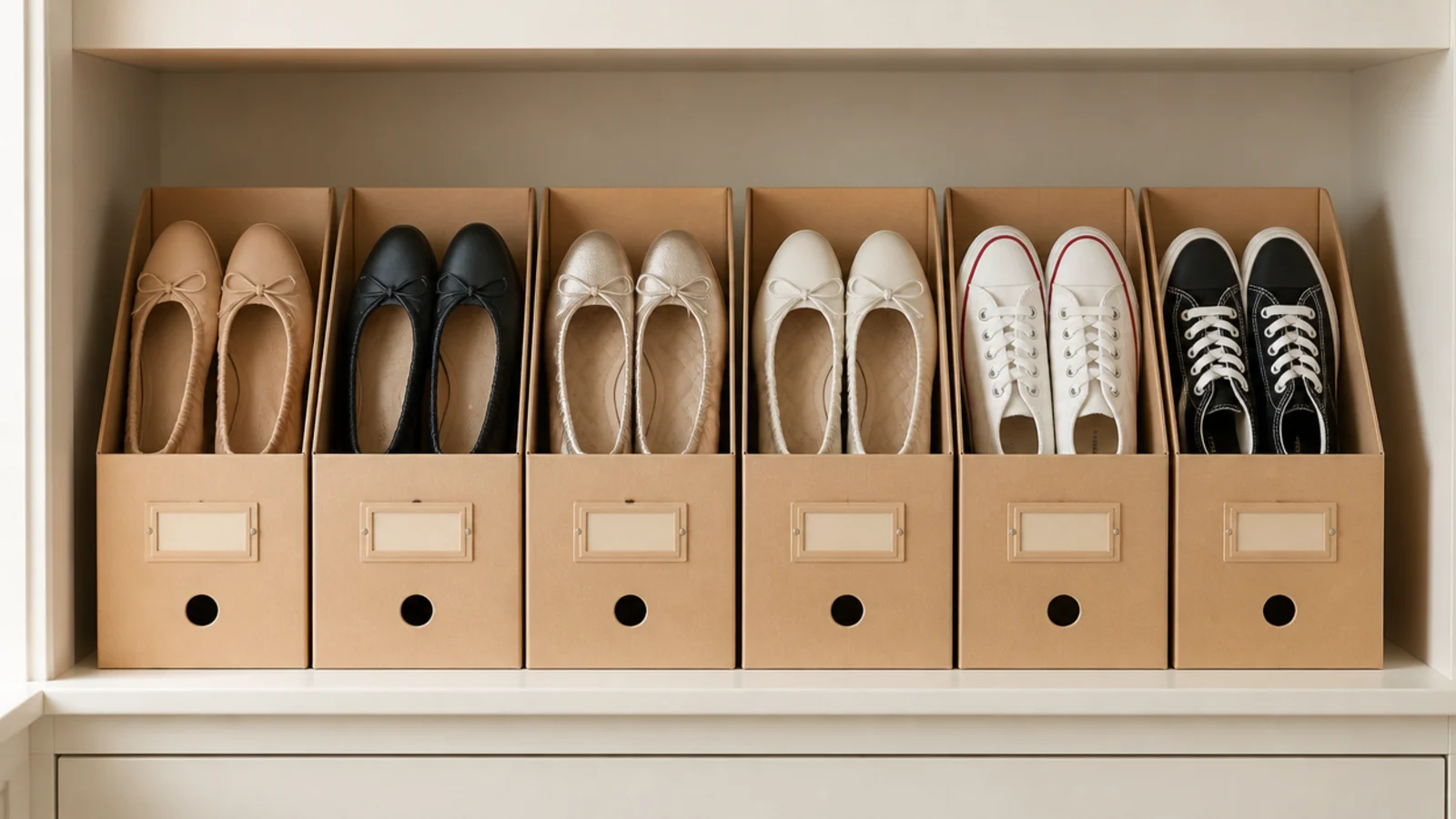
11. Magazine files as flat-shoe slots
Upright card magazine files hold ballet flats, canvas shoes and sandals standing on edge, which stops a closet shelf turning into a heap.
Each file takes two to three pairs of flats. It works on a shelf, in a drawer, or in the bottom of a wardrobe. Six files run about $12 and they weigh nothing. $
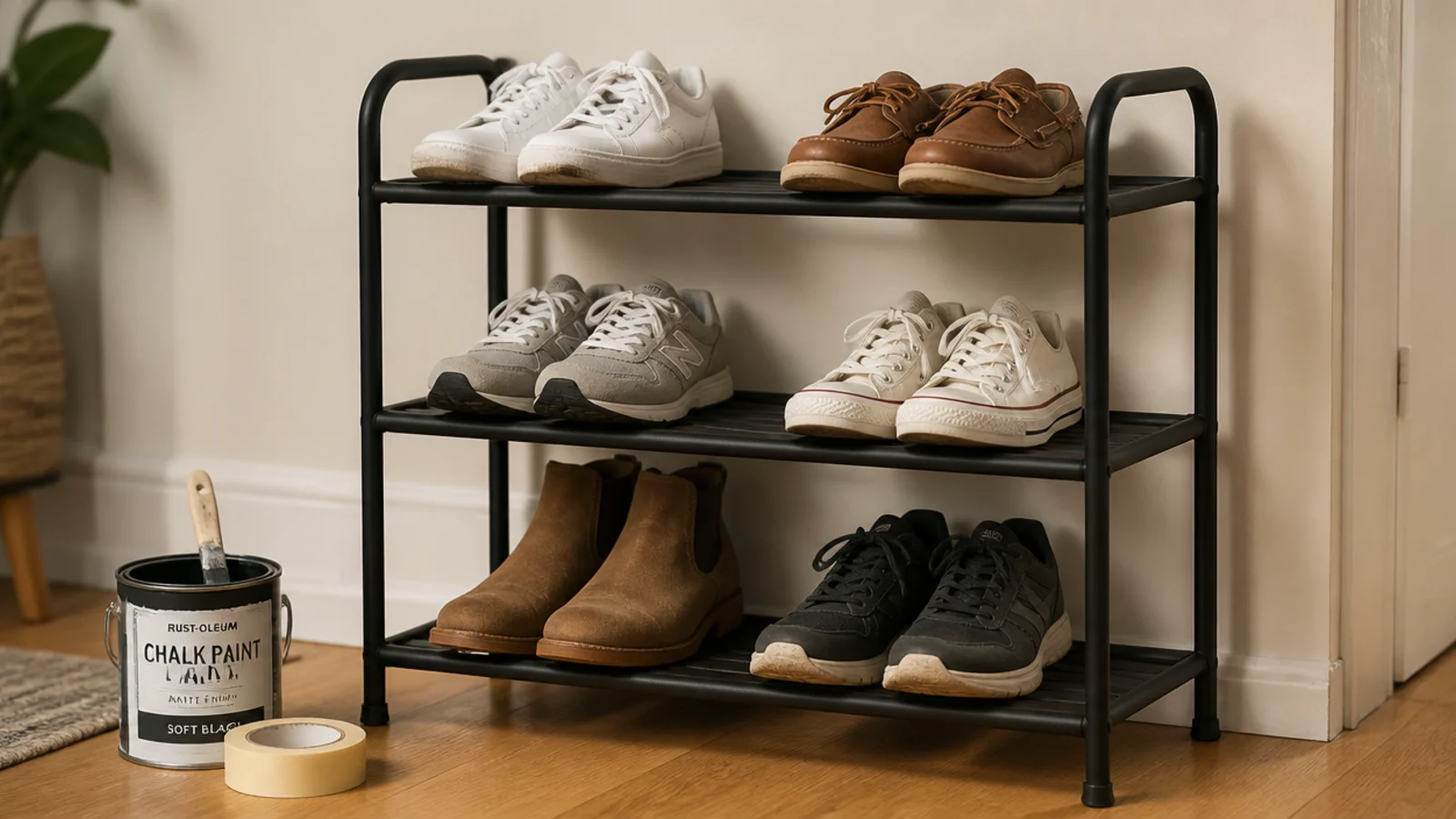
12. A repainted secondhand metal rack
A tired metal shoe rack from a resale site is $5 to $10, and one can of matte spray paint makes it look like a $70 one.
Degrease first with rubbing alcohol, then two thin coats rather than one thick one. Soft black or warm sand both disappear against cream walls. This is the highest visual return per dollar on the list. $
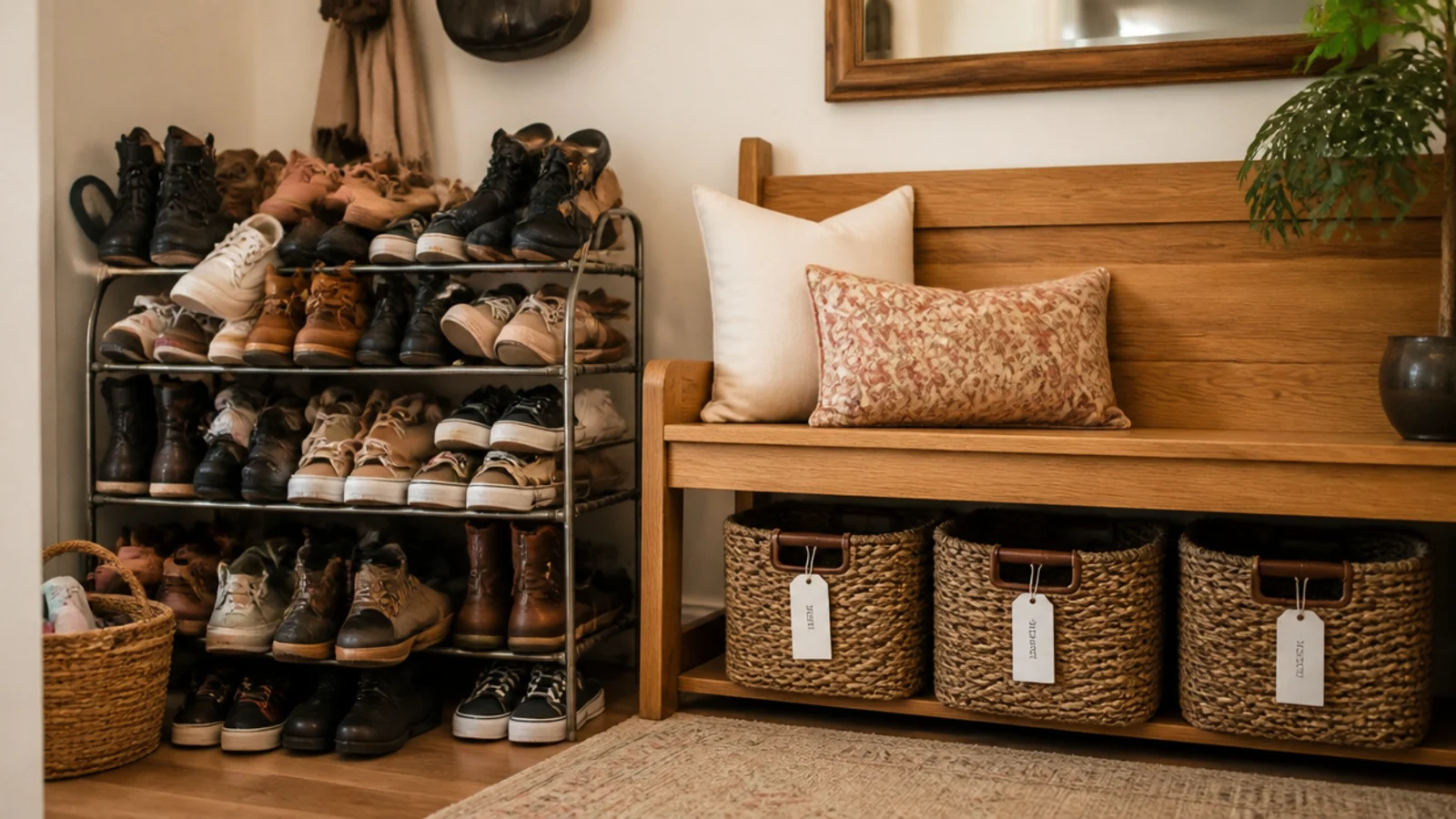
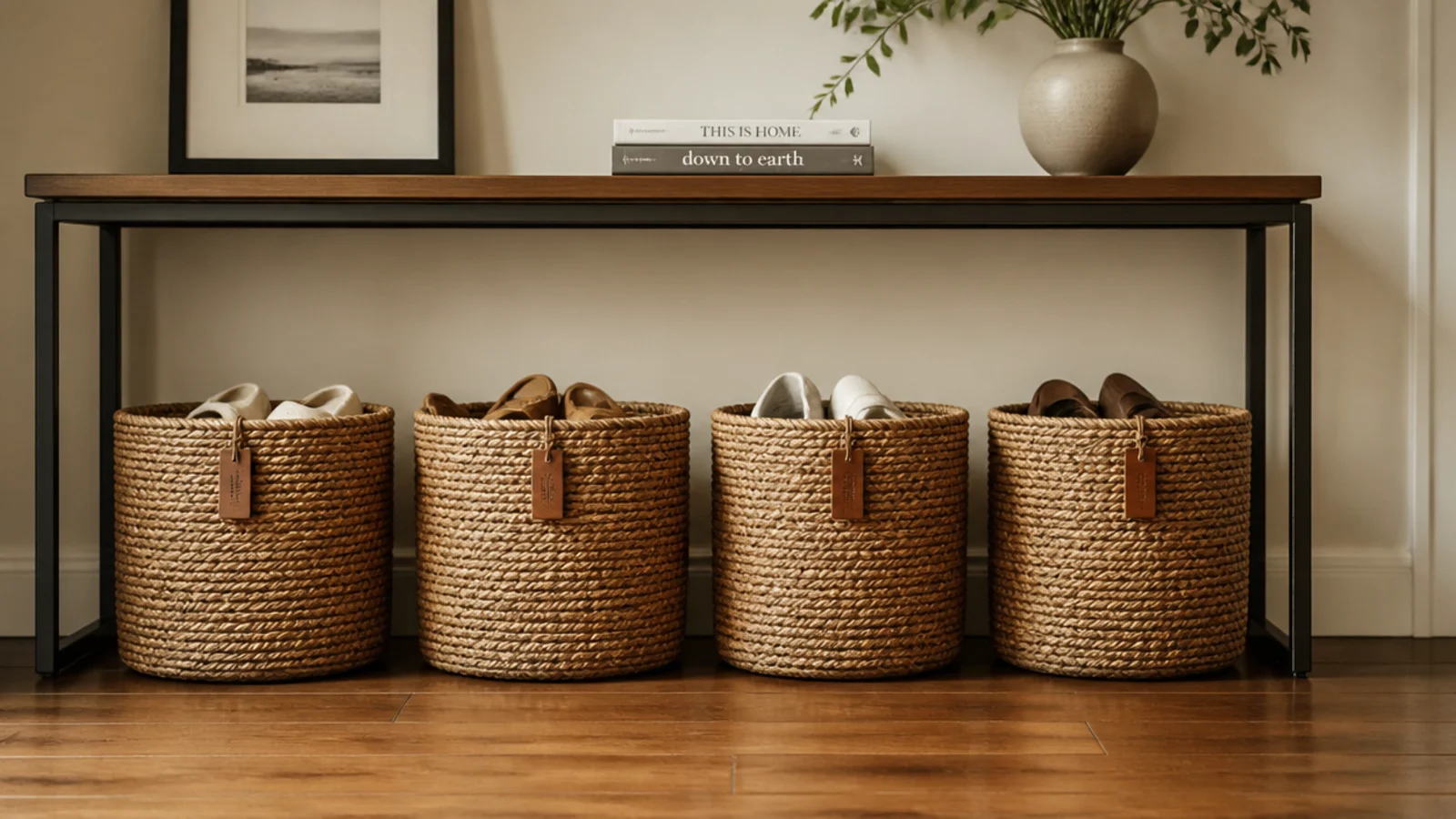
13. One basket per person, tagged
Named individual space is the change that makes any system stick, because shared storage means nobody owns the overflow.
Give each person one basket sized for a 13-inch shoe, tag it, and cap it at what fits. When your basket is full, the extra pairs go to a closet. This works better with children than any amount of asking. $$
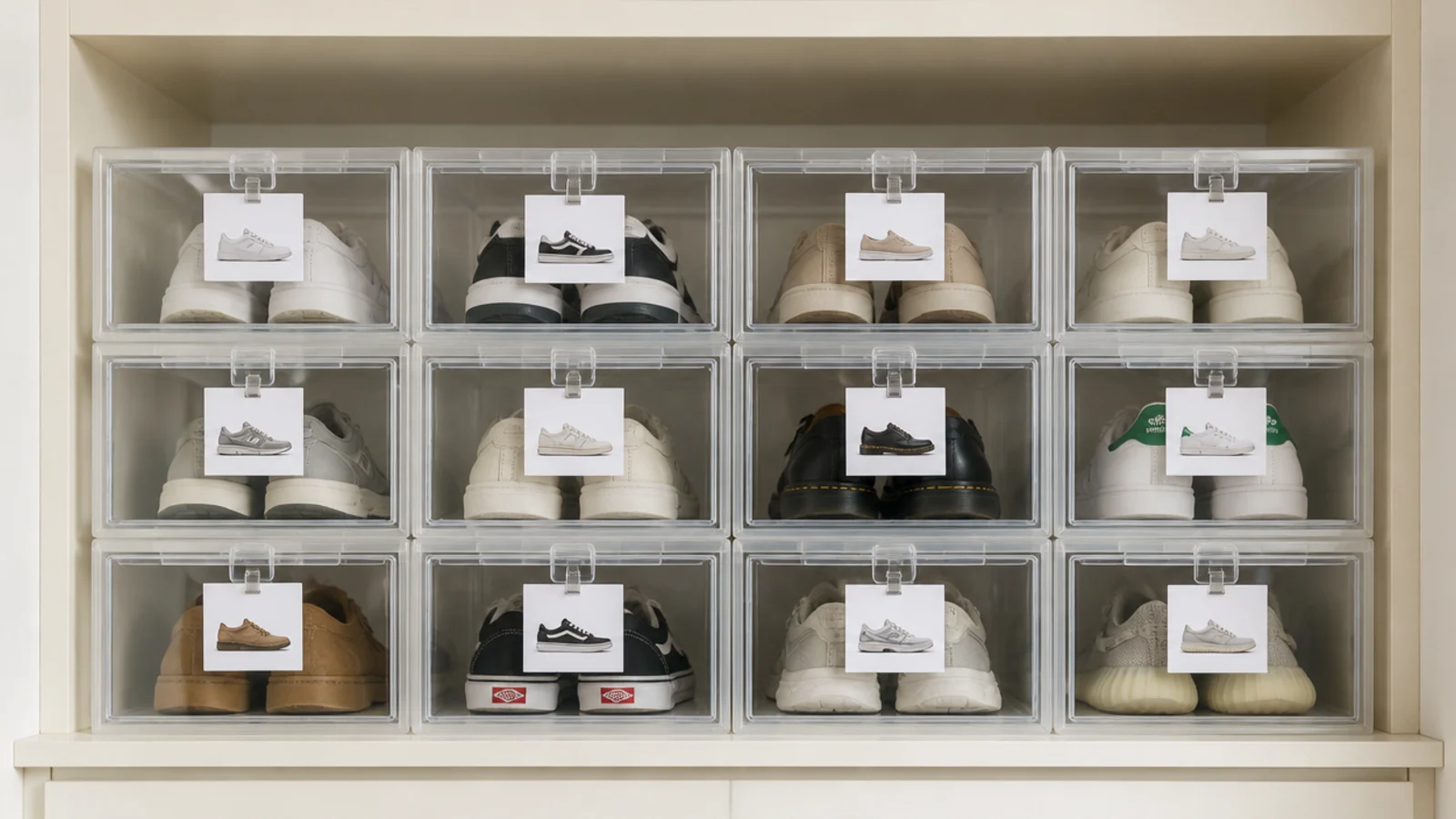
14. Clear boxes with a photo on the front
Stacked boxes always become mystery boxes. A small printed photo clipped to the front fixes that instantly and costs nothing but ink.
Photo labels beat written ones because you read them at a glance from across a room. Use them for out-of-season and rarely worn pairs so daily shoes never end up boxed. $$
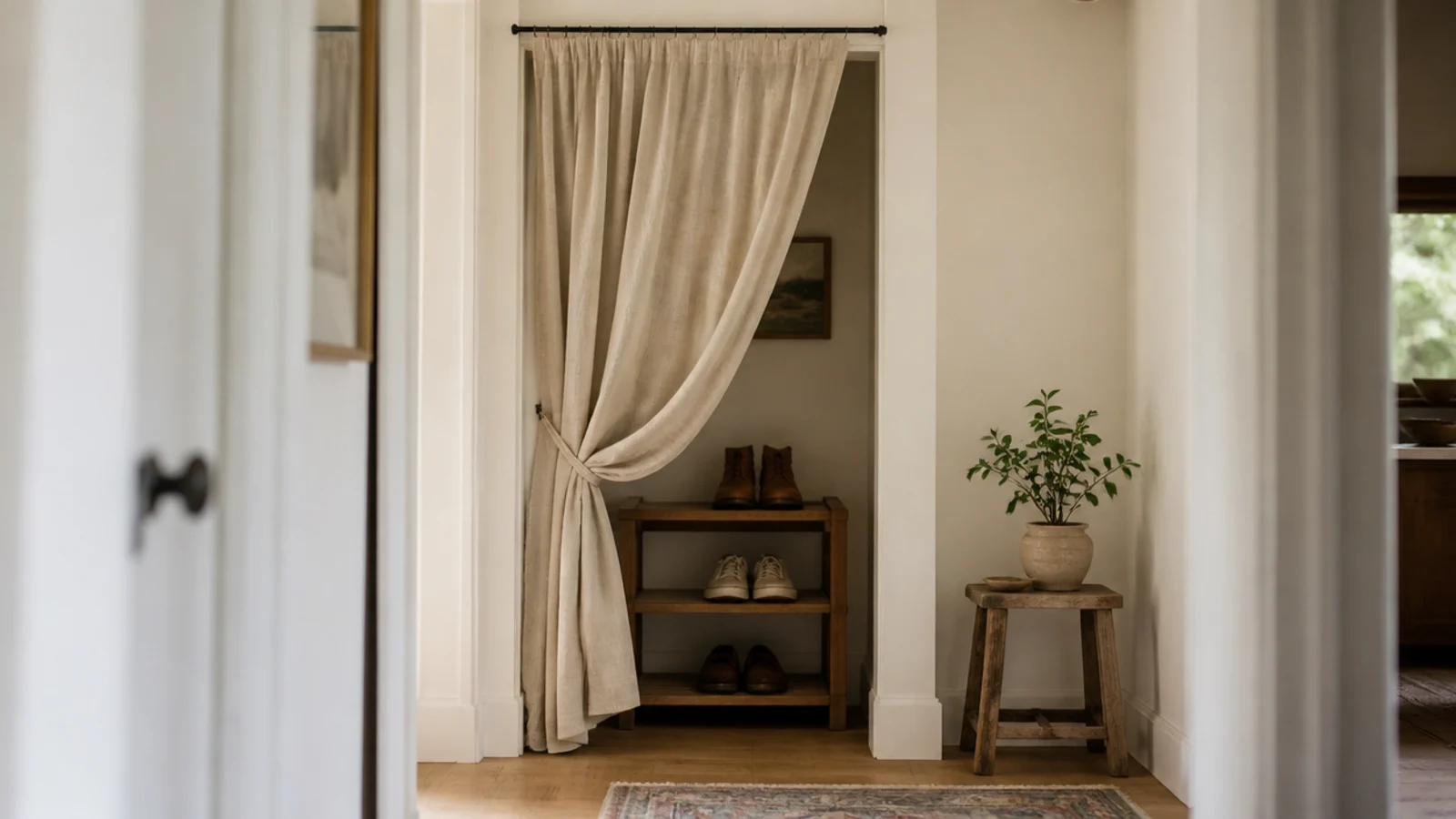
15. A curtain across an open rack
The fastest way to hide a cheap rack is to stop looking at it. Linen or canvas on a tension rod costs about $12 and leaves no holes.
Hang it half an inch off the floor so it clears the sweep. Fabric breathes, so unlike a solid door the shoes behind it stay fresh. There is more of this thinking in hidden shoe storage. $
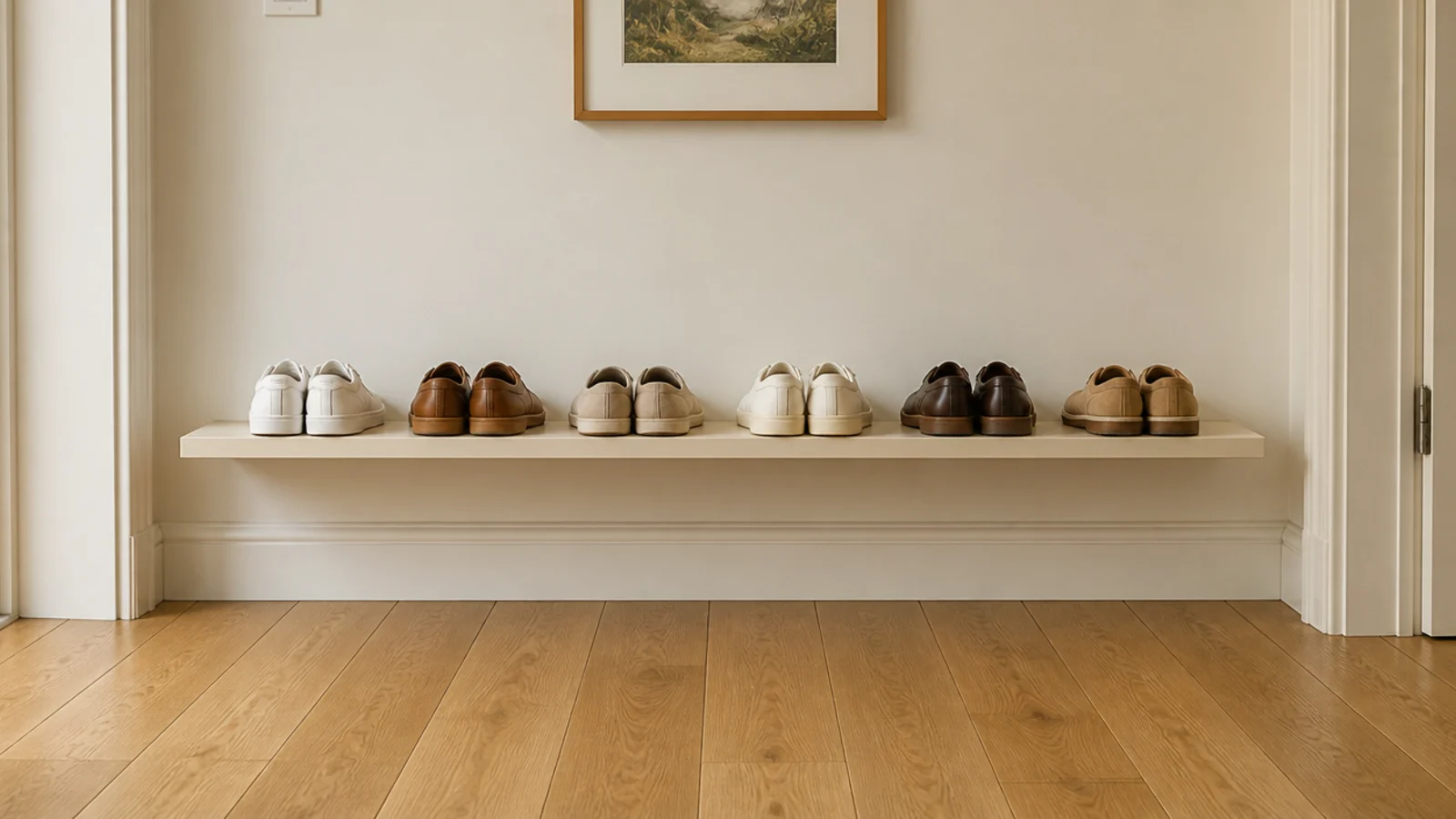
16. A shallow shelf above the baseboard
One shallow shelf mounted 10 inches off the floor holds six pairs and leaves the floor clear for cleaning.
Ten inches is the number: high enough for a vacuum head, low enough that shoes go on with a foot rather than a bend. Ten inches deep, toes overhanging slightly, painted the wall colour. $
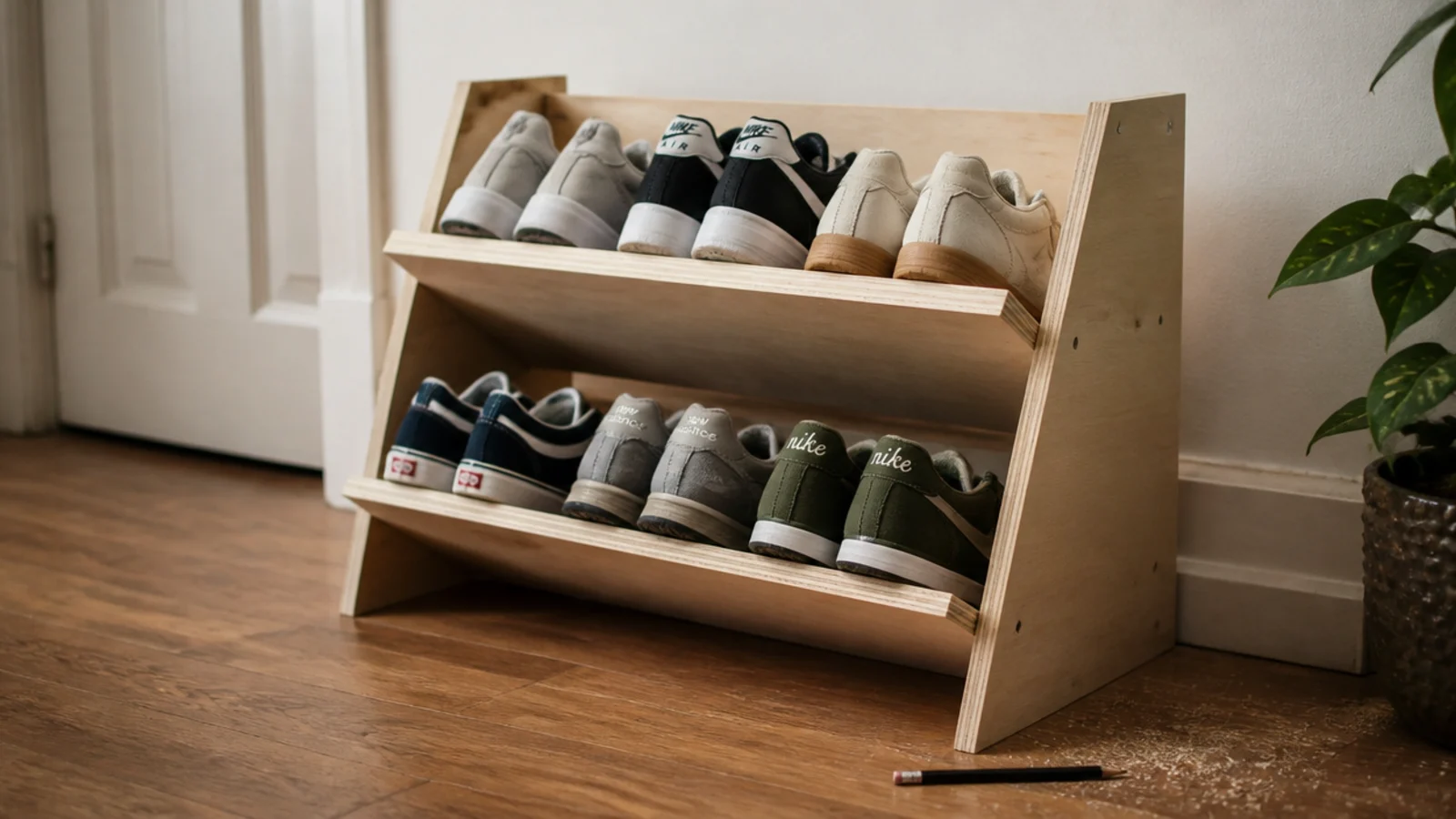
17. An angled rack from scrap plywood
Two shelves set at 45 degrees hold a 12.5-inch shoe in nine inches of depth, which is the whole trick behind slim shop-bought cabinets.
A half sheet of plywood makes a two-tier rack for about $20. Sand the front edges properly and paint it — cheap builds give themselves away at the edges, never in the middle. Full method in the DIY shoe storage guide. $$
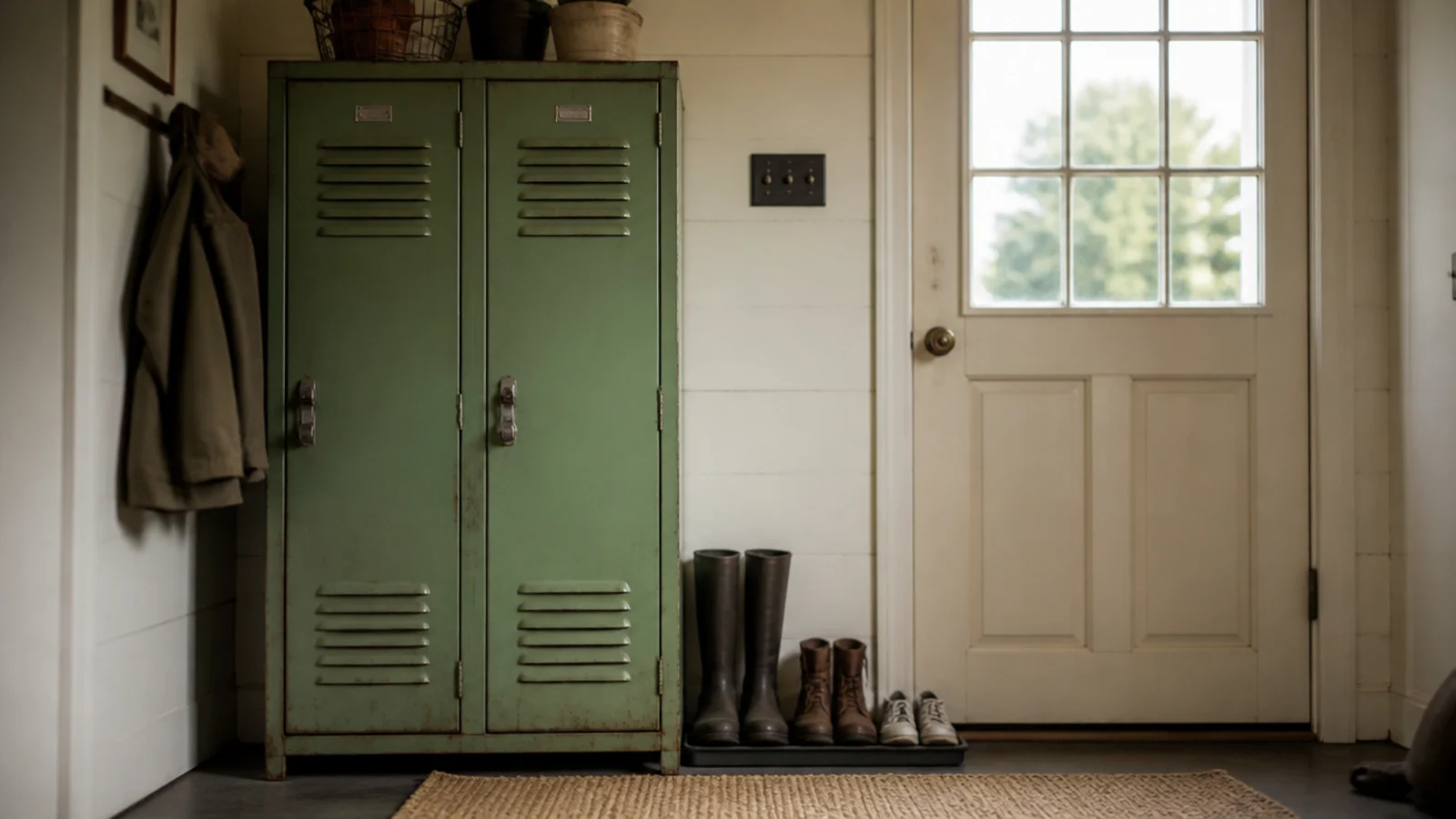
18. Secondhand lockers for the back door
Old school or gym lockers turn up on resale sites for $30 to $60, and they are effectively indestructible.
The slatted vents are the point — closed shoe storage without airflow smells, and lockers were designed for exactly this problem. Repaint in muted sage or soft black, and add felt pads underneath to protect the floor. $$$
19. A rolling utility cart under a console
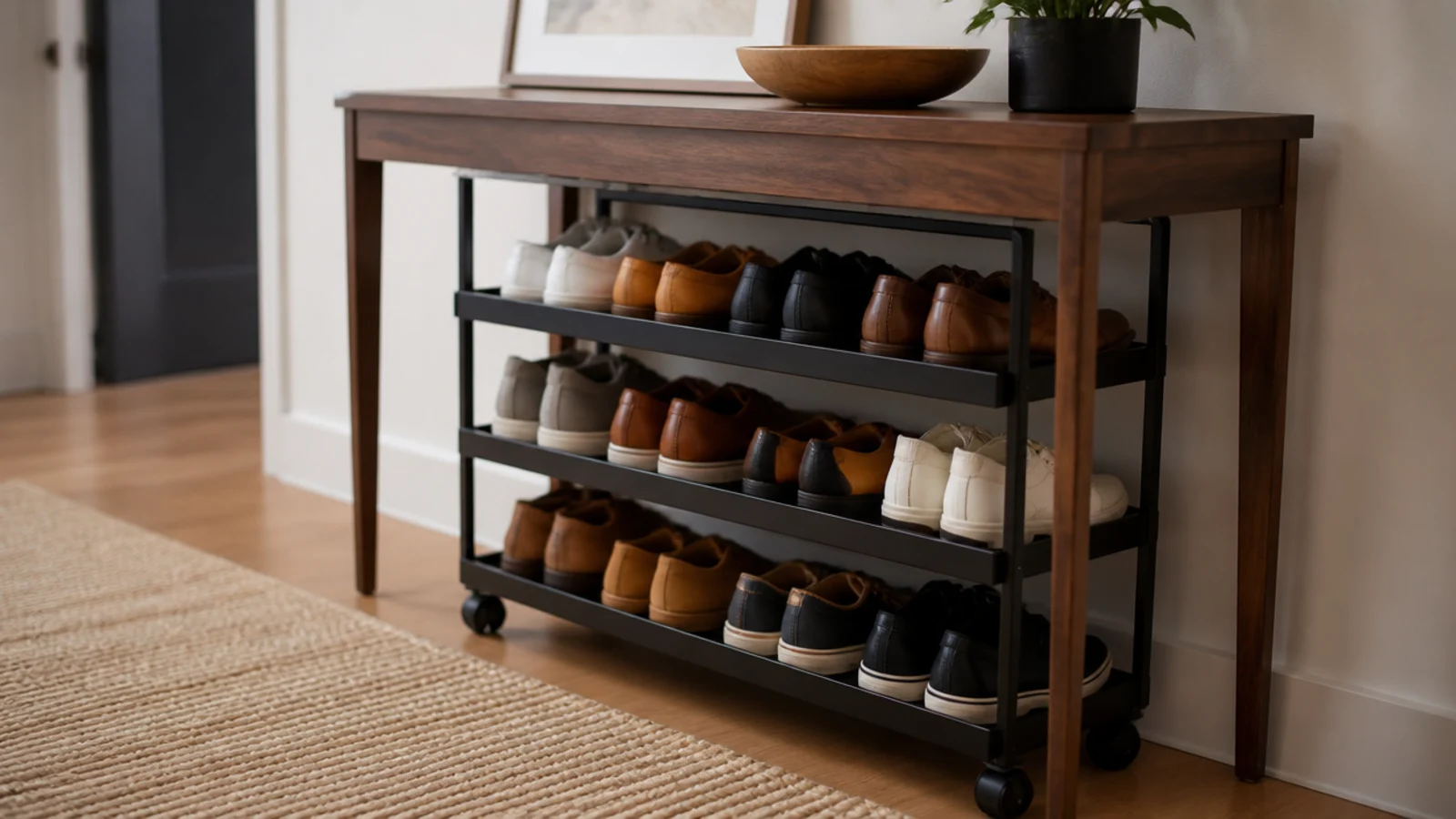
A three-tier cart on castors tucked under a console holds a dozen pairs and rolls out so you can sweep underneath.
Measure the clearance under the console before buying — an inch matters. Powder-coated steel rather than chrome wire, which rusts where wet soles sit. Look for these on sale at around $35. $$
20. A peg rail with wire baskets hung on it
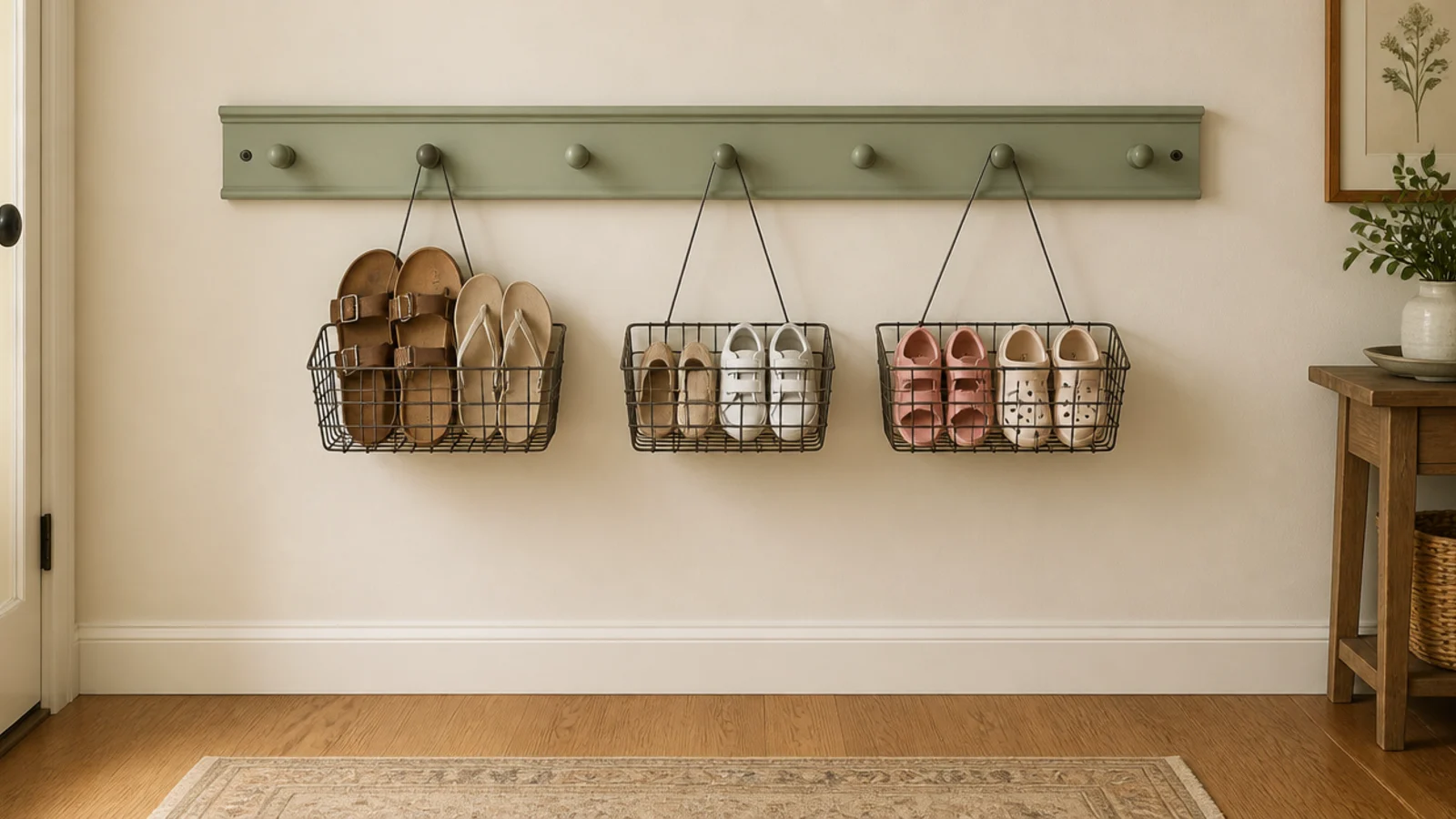
Shallow wire baskets hung from a painted peg rail hold sandals and small shoes, and lift straight off when you want to clean.
Keep the rail at 30 inches for children and 48 for adults. Baskets no deeper than five inches, or they become a place things disappear into. Rail and three baskets, about $35. $$
21. A spice rack for small shoes
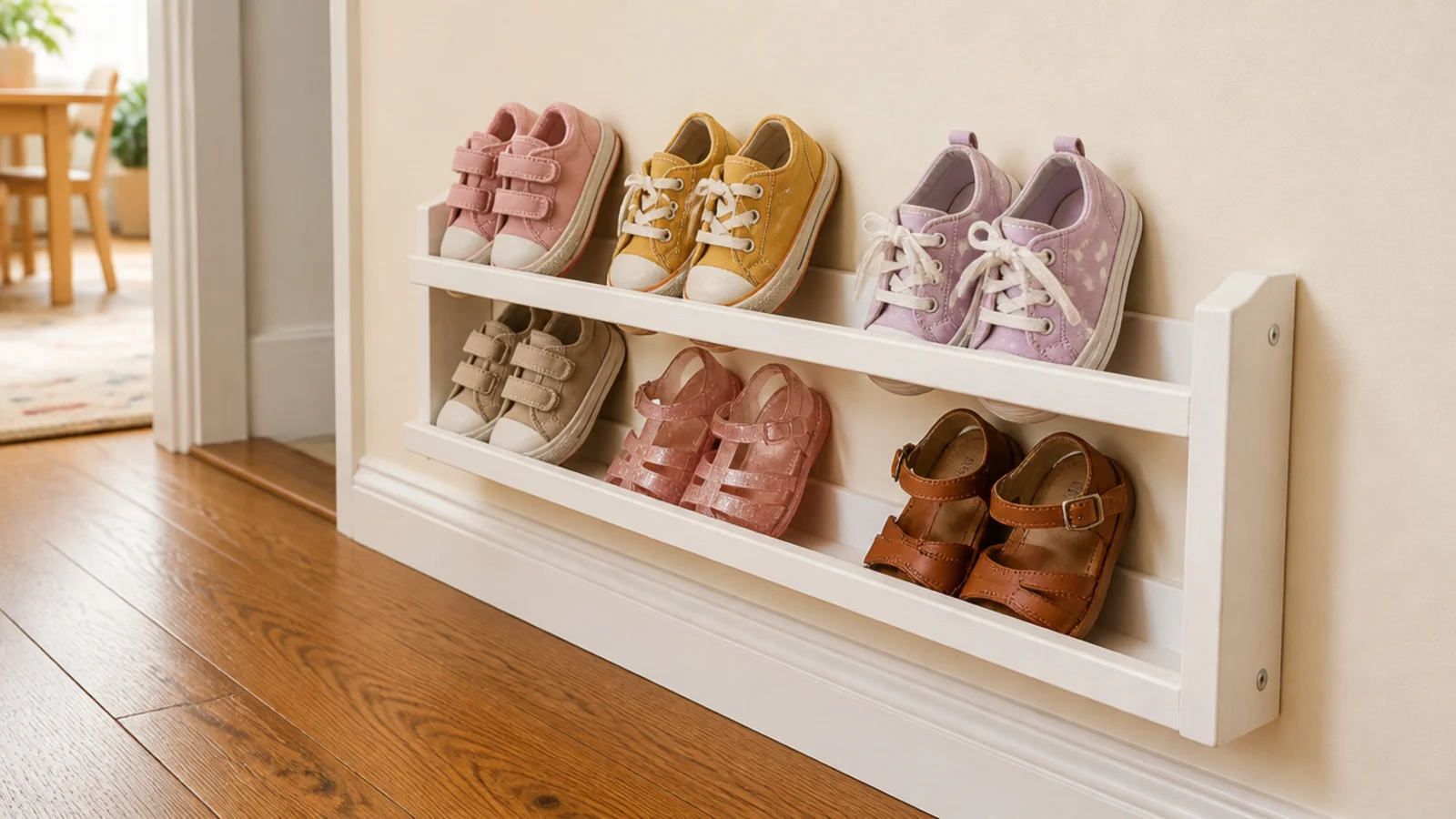
A narrow spice rack mounted low holds a toddler's whole collection at a height where they can actually reach it.
Set the lowest rail at 8 inches and the second at 16. Four dollars each, and the difference between shoes on a rack and shoes on the floor at that age is entirely about reach. $
22. A thrifted ladder leaned against the wall
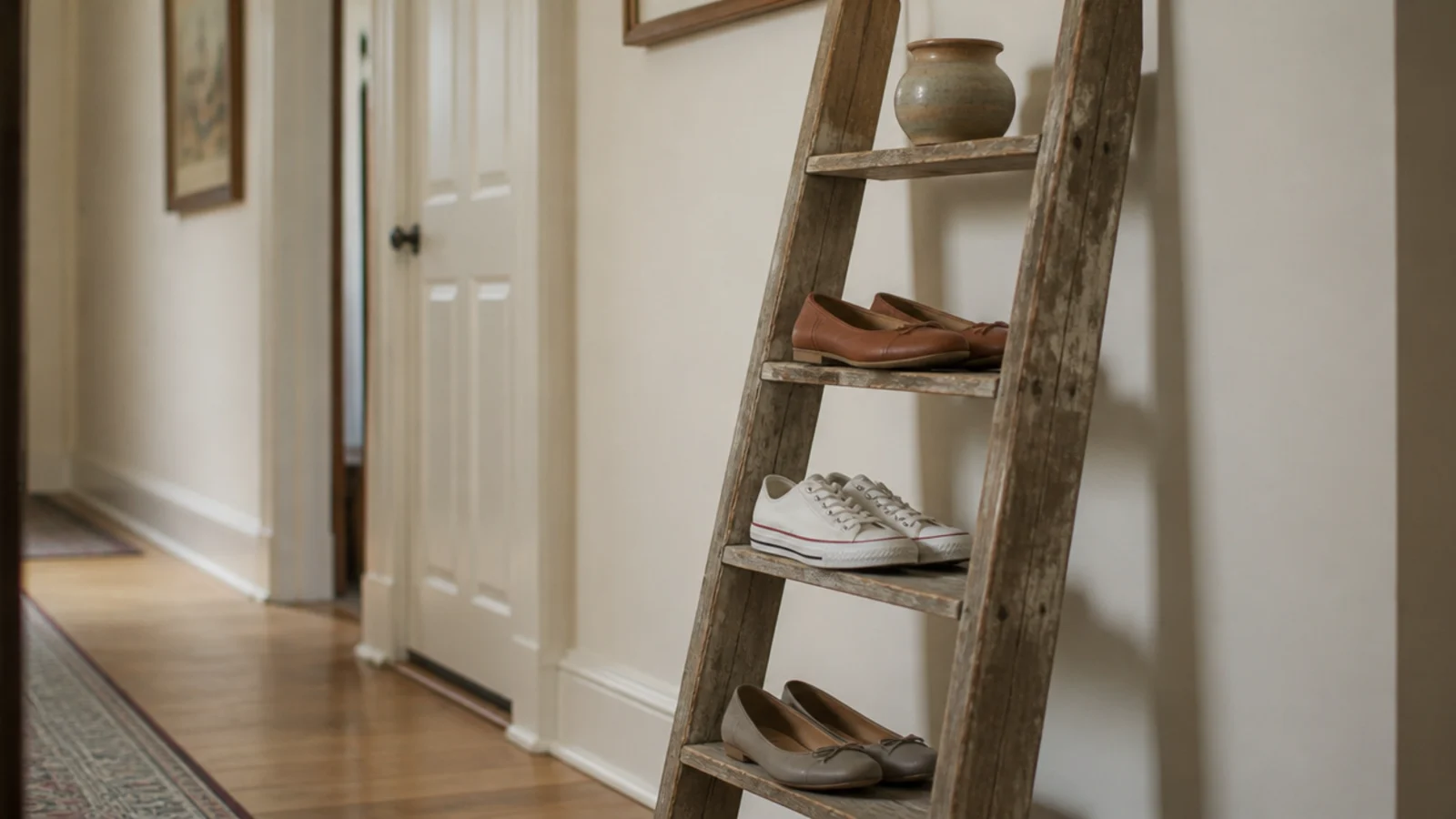
Angled rungs hold flats and sneakers with no fixing at all, which makes a leaned ladder the easiest renter answer here.
Lean at roughly 15 degrees and add felt pads under the feet so it does not walk on a wood floor. Heaviest shoes on the lowest rung, always. Eight to ten pairs of flats, no boots. $–$$
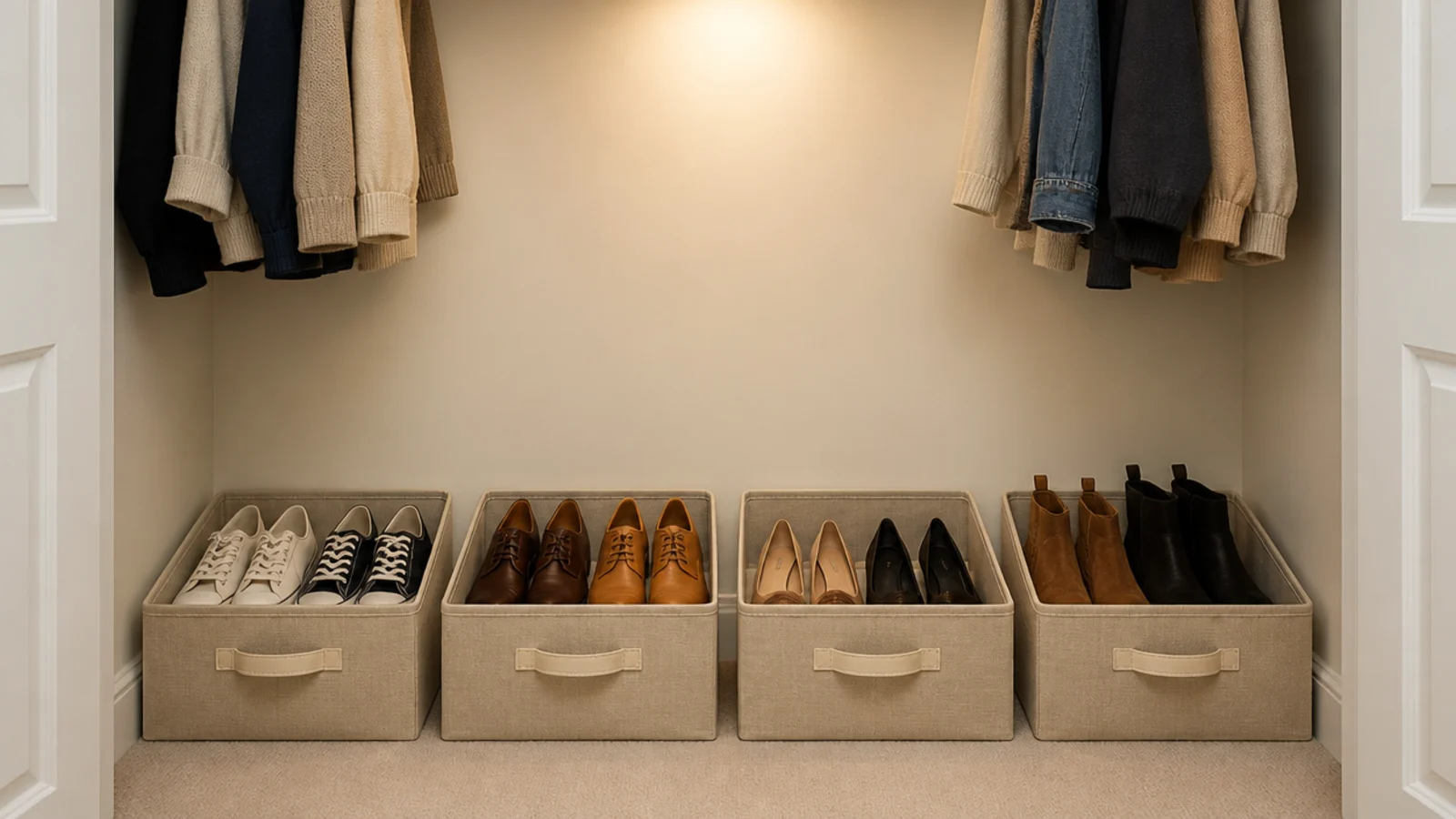
23. Pull-out bins on a closet floor
A closet floor is where shoes go to be forgotten. Four low fabric bins with handles turn it into categories you can pull out and see.
Sort by type rather than by owner — trainers, smart, sandals, boots — because that is how people actually search. Bins with webbing handles beat handleless ones by a mile. $$
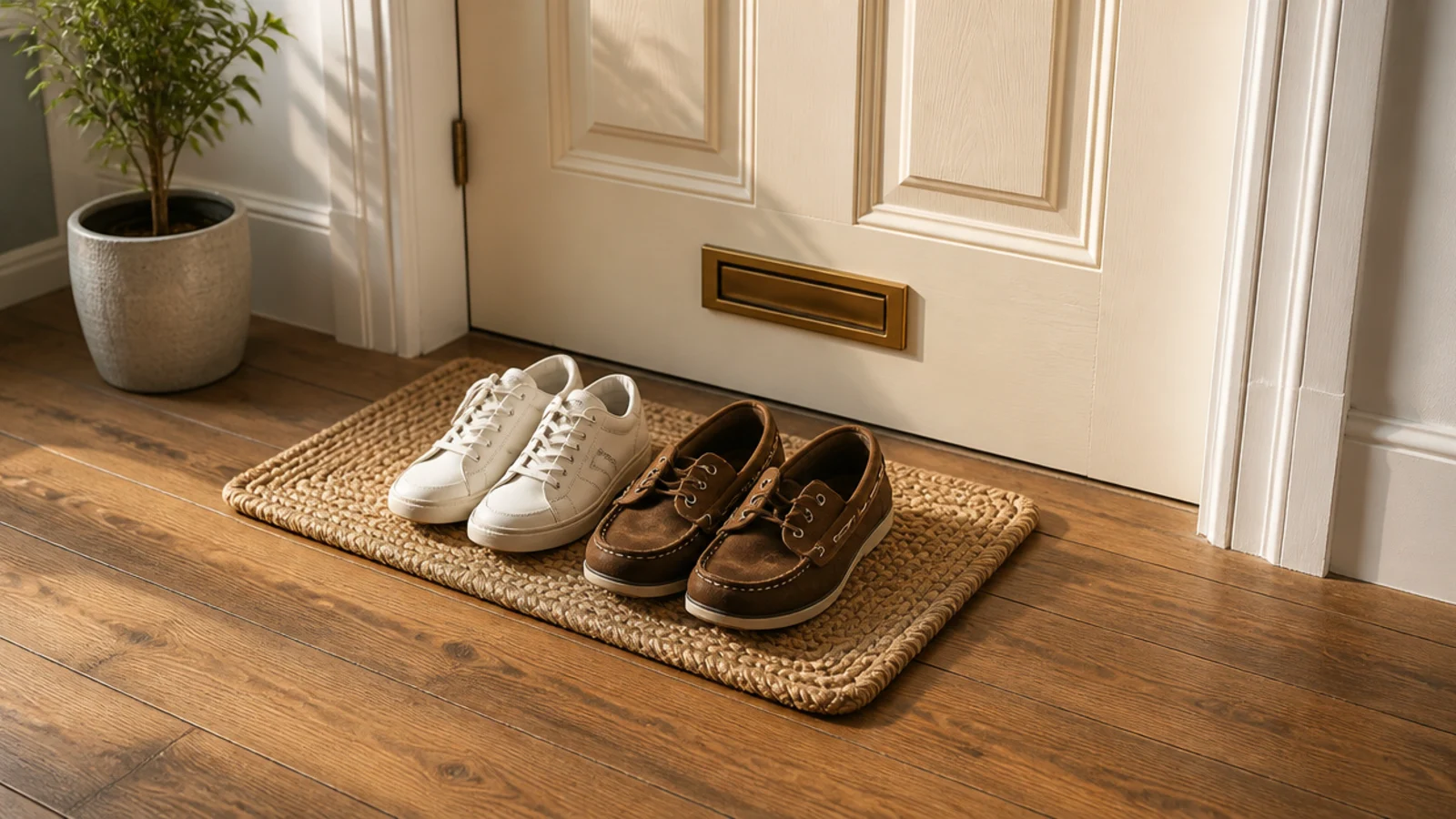
24. A capped landing zone by the door
The idea that costs nothing. A small jute mat sized for exactly two pairs per person, with everything else treated as overflow that lives elsewhere.
Constraining the zone is what stops it growing. A mat with room for eight pairs will hold eight by Thursday; a mat with room for two holds two. Free
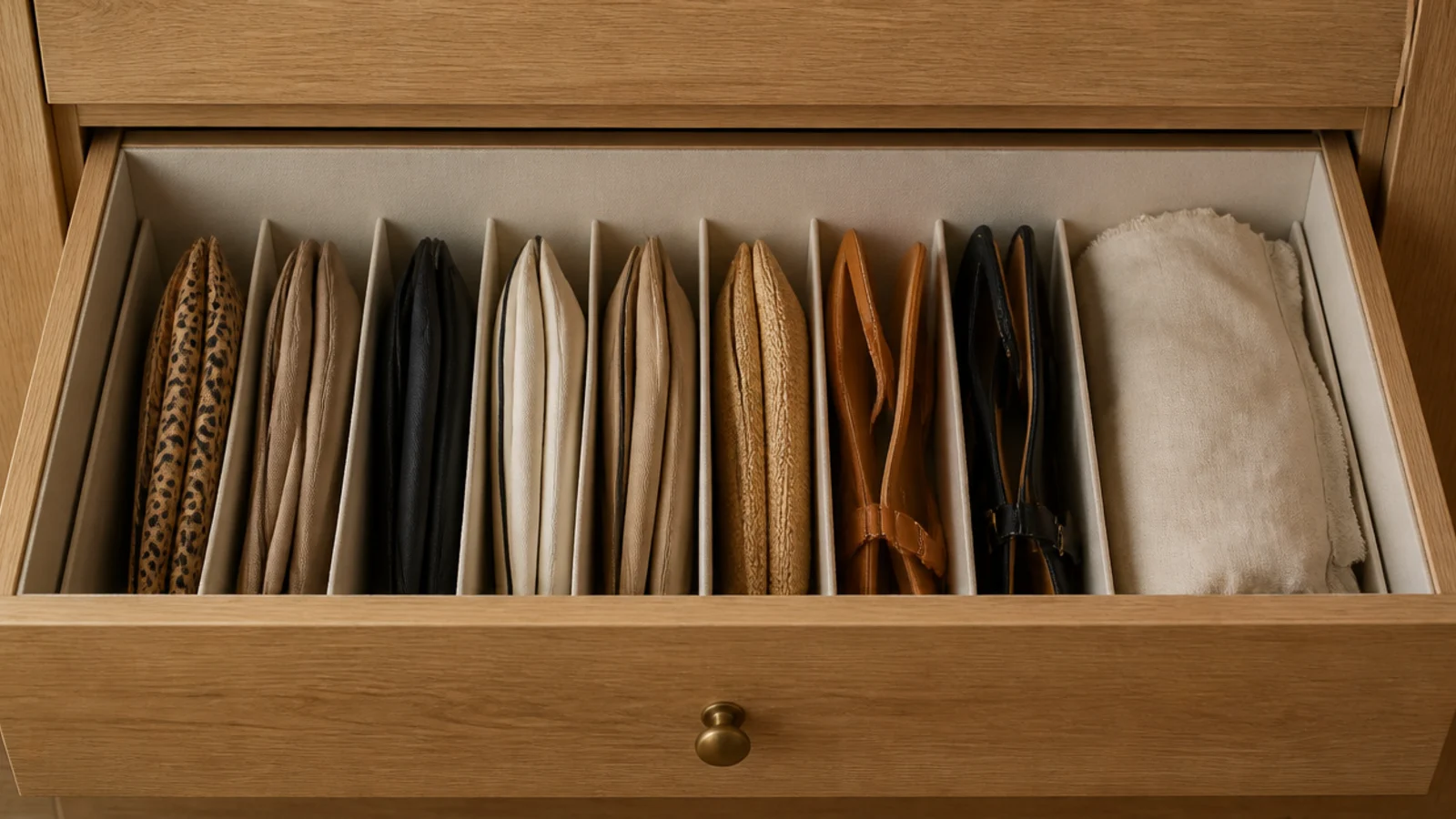
25. Cardboard dividers inside a deep drawer
A deep drawer without dividers is a pit. Stiff card cut into slots holds flats and sandals upright so you can read the whole drawer at once.
Cut the dividers an inch shorter than the drawer depth so they lift out for cleaning. Free if you have a delivery box, and it doubles the usable capacity of any deep drawer. Free
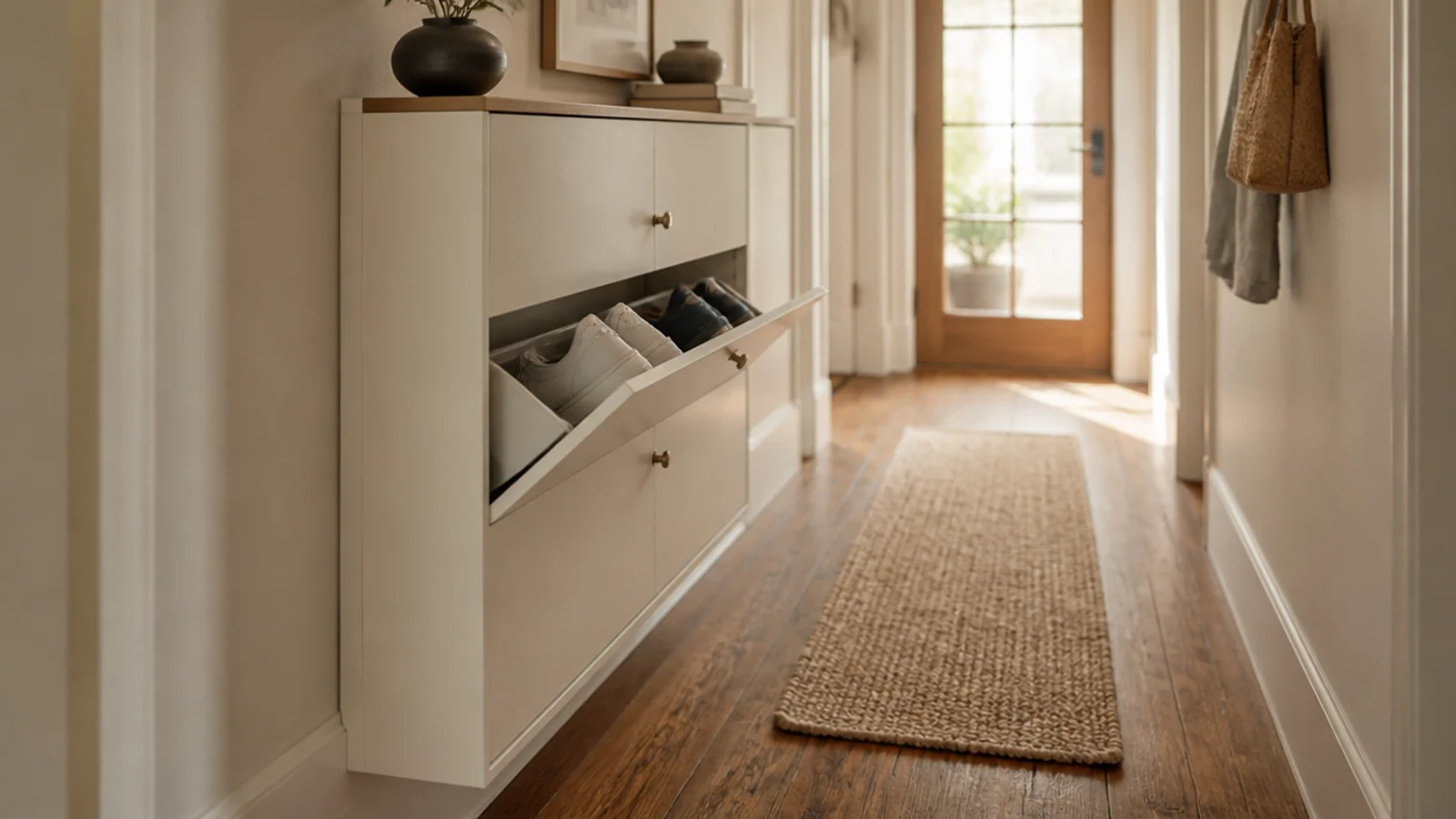
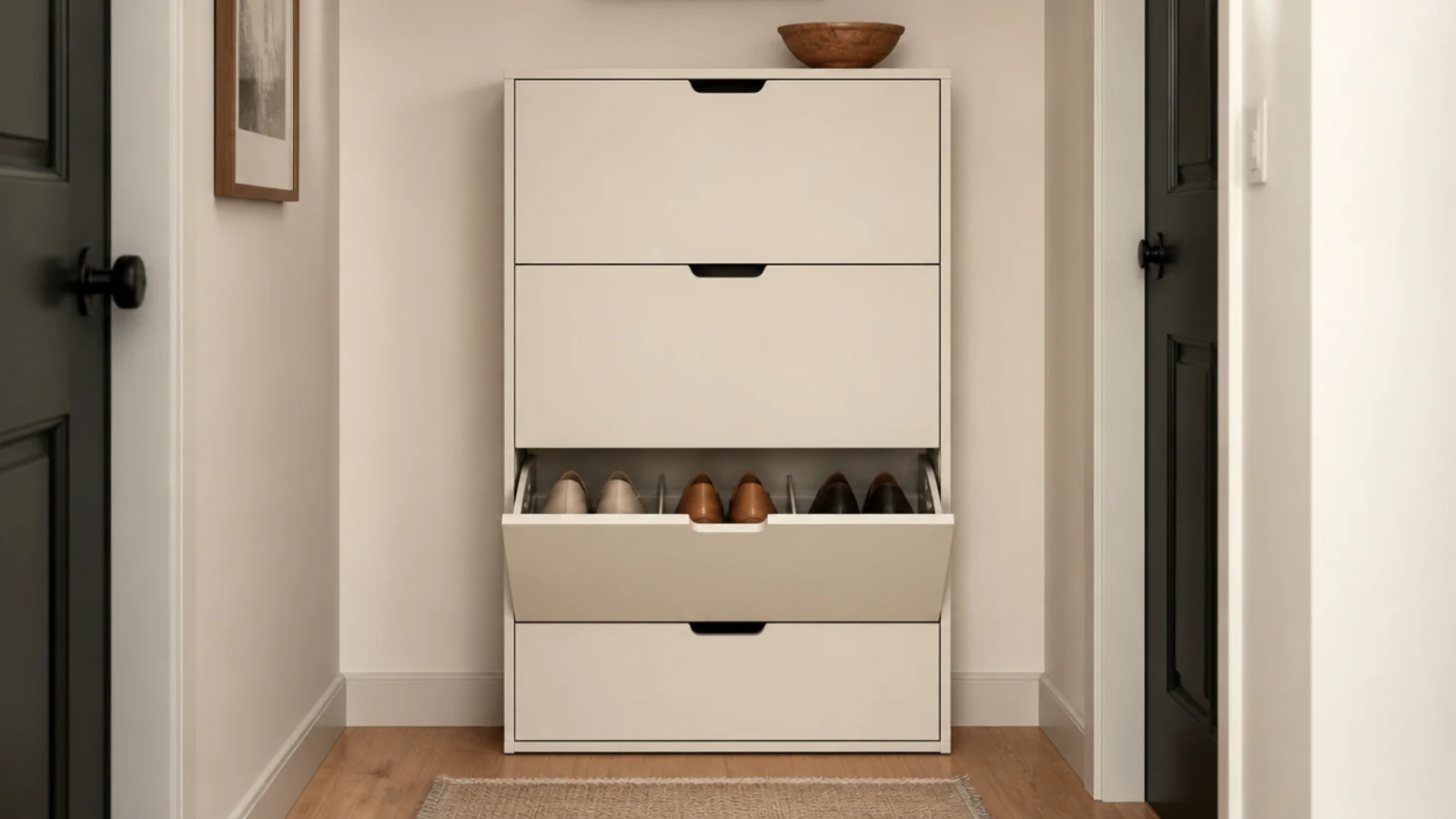
26. A flat-pack tilt-out cabinet on sale
The one thing on this list worth buying rather than building. Shoes rest at an angle inside, so a nine-inch cabinet swallows a 12.5-inch shoe.
Two drawers hold six to eight pairs of flats and sneakers, and no boots. Drill ventilation holes in the back panel before you load it. Wait for a sale and these land around $70. $$$
27. A crate bench with a cushion on top
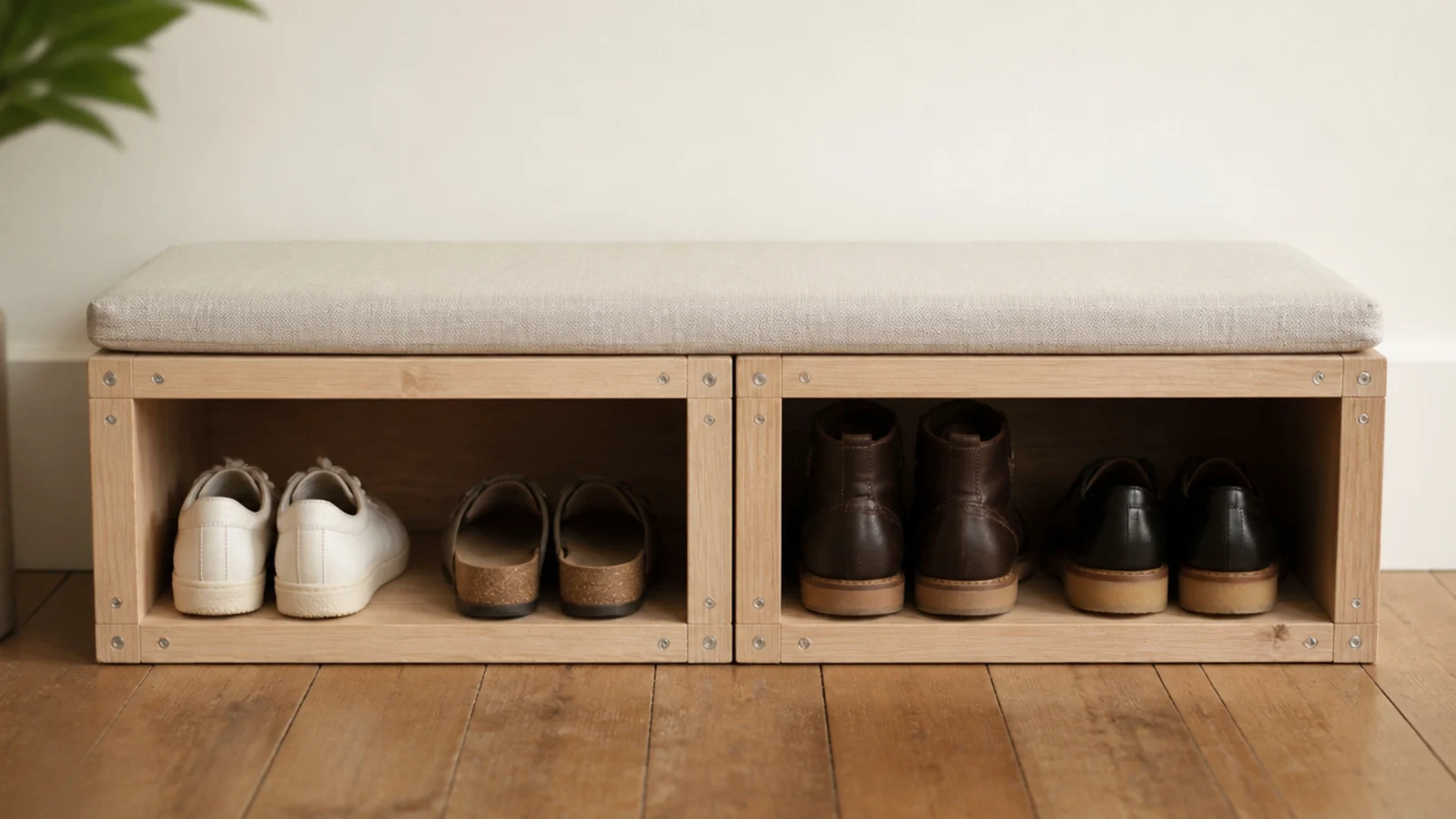
Two sealed crates screwed side by side, topped with a plywood lid and a cushion, gives a seat and storage for well under $50.
Build to 18 inches at the cushion top. Add felt pads underneath, and load the shoes so the heaviest pairs sit at the ends where the structure is stiffest. See shoe storage benches for the sizing detail. $$
28. Adhesive heel rails for flats
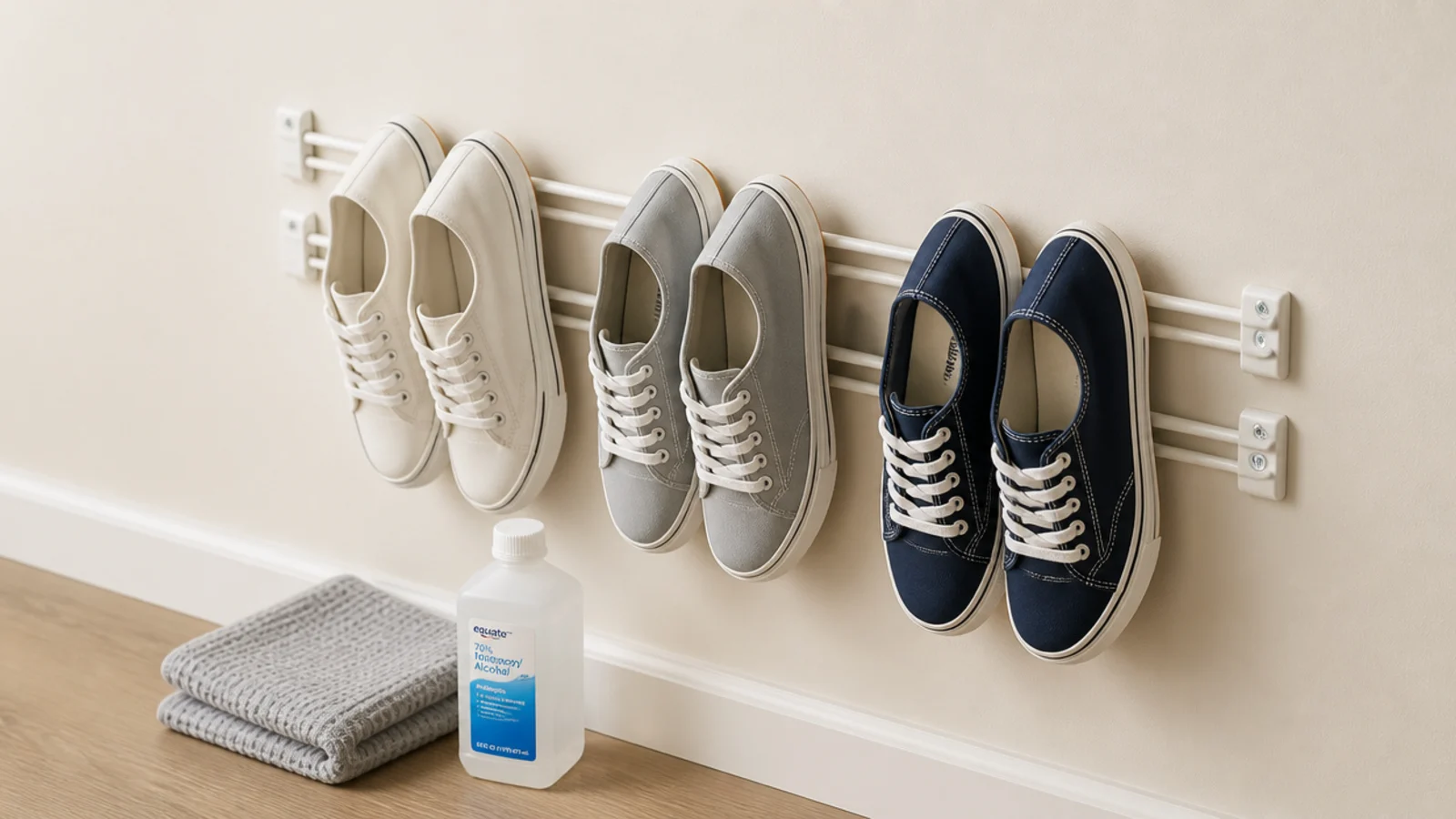
The genuine zero-hole option, and the one most often oversold. Heavy-duty strips carry about 15 pounds a pair, which is flats and nothing heavier.
Clean the wall with rubbing alcohol, press for 30 seconds, and wait an hour before loading. Test on hidden paint first — flat builder-grade paint peels off with the strip. $
29. Shelf risers that double a closet shelf
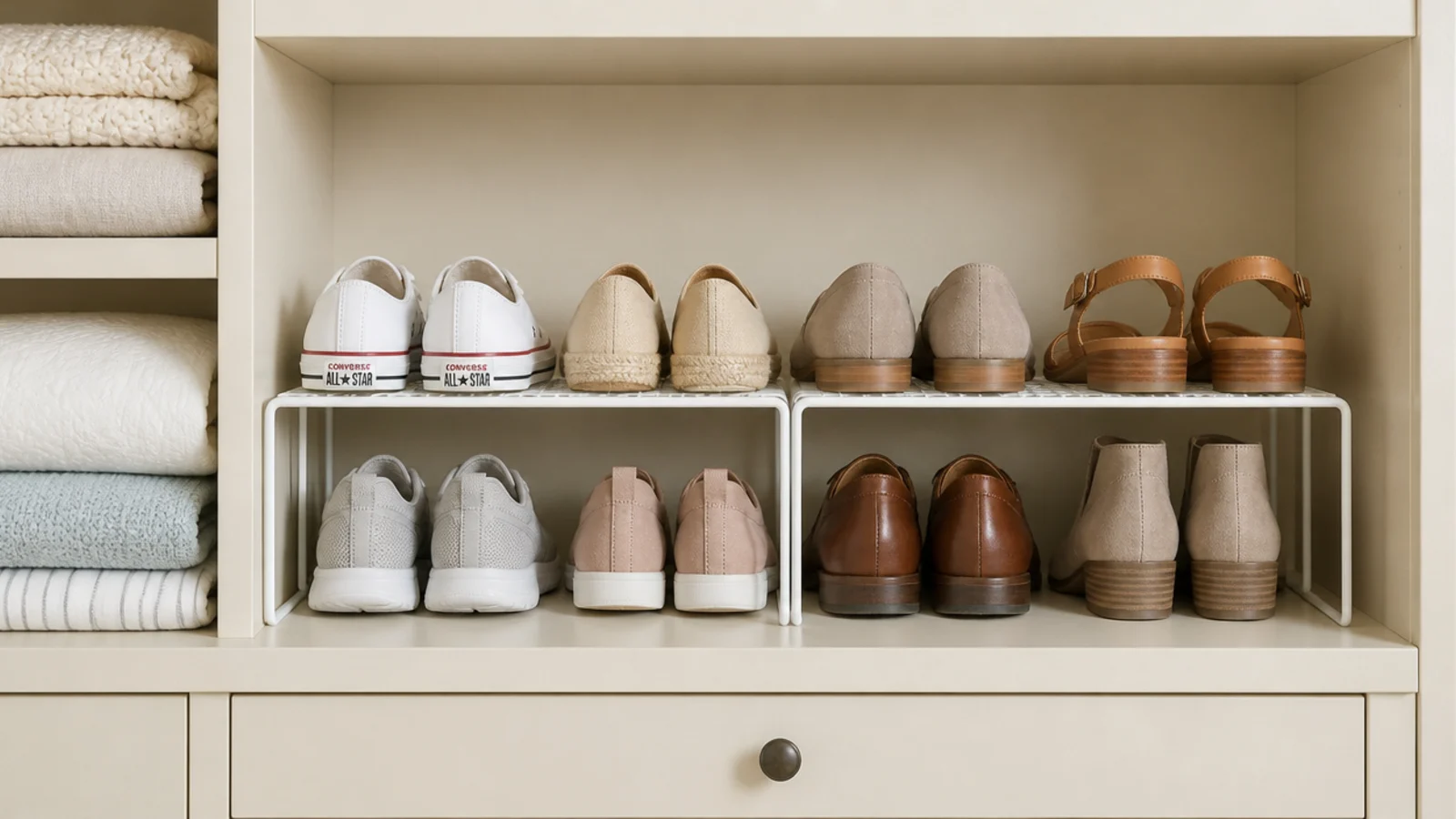
A wire riser turns one closet shelf into two layers, which in a small closet is the cheapest capacity you will ever buy.
Check the riser height clears your tallest stored shoe with an inch to spare. Adjustable legs beat fixed ones — 7 inches takes sneakers, 5 inches takes only flats. Two risers cost about $16 and add roughly six pairs of storage. $
30. A seasonal duffel under the bed
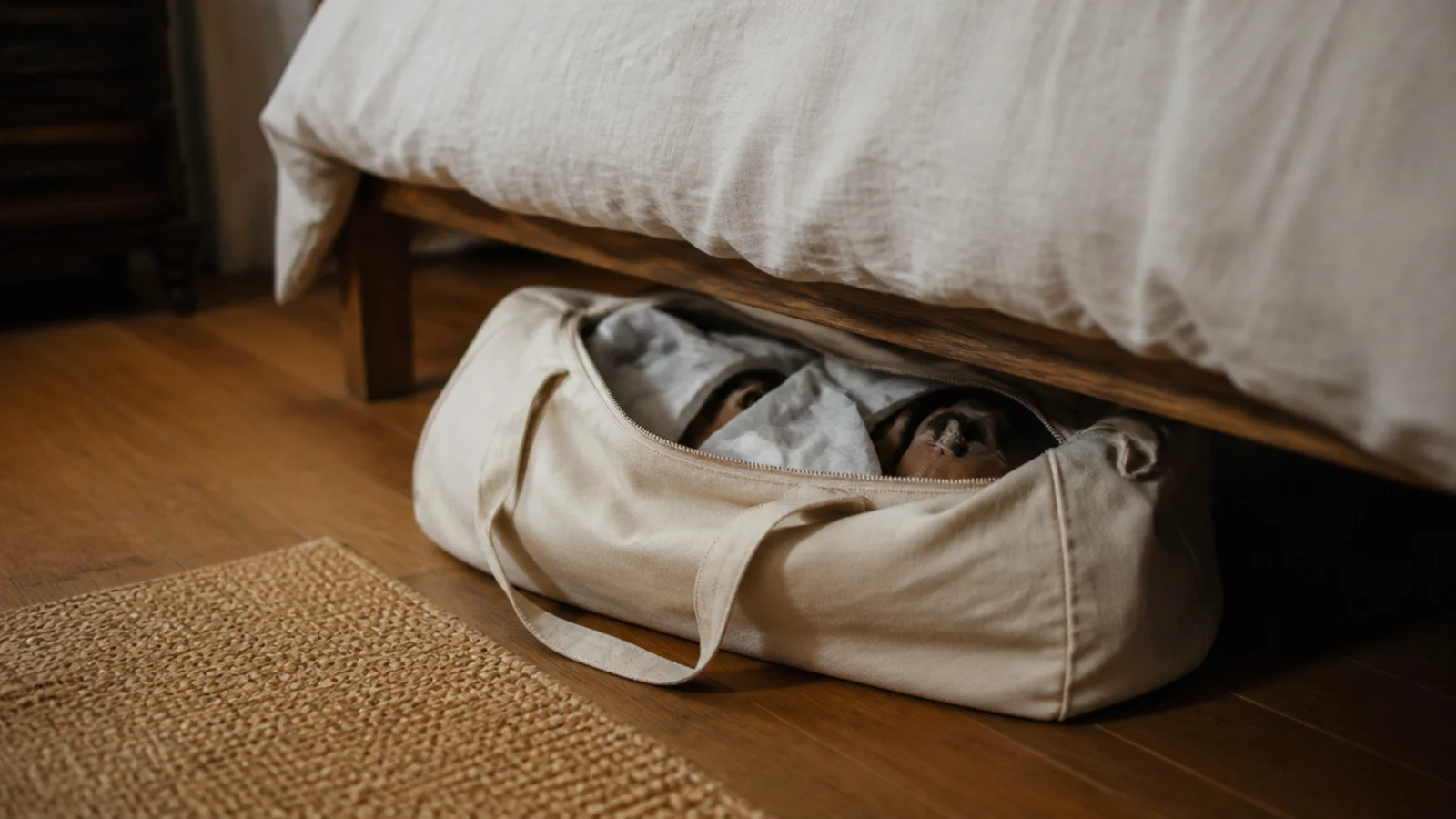
Half the shoes in most hallways are wrong for the current weather. Packing them into a canvas duffel under a bed costs nothing and halves the problem.
Wrap each pair in an old pillowcase so nothing scuffs, and swap when the clocks change. It is the only idea here that makes every other idea work better. Free
Mistakes to Skip
- Buying a rack with evenly spaced six-inch tiers because it is cheap. Boots need 14 to 16 inches, so the tall pairs stay on the floor and the pile never actually goes away.
- Using raw untreated crates or plywood. Wet soles stain bare pine within a season, and a stained cubby cannot be rescued without sanding the whole thing back.
- Sealing shoes into a closed flat-pack cabinet with no vents. Cheap cabinets are often airtight boxes, and a hallway that smells is not a saving.
Frequently asked questions
What is the cheapest shoe storage that actually works?
Capping the landing zone. Put down a mat sized for exactly two pairs per person and treat everything else as overflow that lives elsewhere. It costs nothing and it works because storage grows to fill whatever you give it. After that, three sealed crates turned on their sides give you real cubbies for about $25.
How do I store shoes cheaply without drilling into the wall?
Leaned and freestanding pieces do almost everything a mounted rack does. A thrifted ladder at a 15 degree lean holds eight pairs of flats, crates stack into cubbies, and a tension rod pair inside a closet carries a dozen. Adhesive heel rails are the only stick-on option worth trusting, and only for flats.
Is cheap shoe storage worth buying or should I build it?
Build anything that needs to hold boots or take a seat, and buy anything slim and closed. Flat-pack tilt-out cabinets are hard to beat under $80 because the hinge geometry is fiddly to make. Open racks, benches and cubbies are simple carpentry, and scrap plywood costs a fraction of the assembled version.
How many pairs should budget shoe storage hold?
Two to three pairs per person at the door, plus one seasonal overflow set stored elsewhere. For a family of four that is ten to fourteen pairs in winter. Sizing cheap storage for every pair anyone owns is why it ends up too big for the hallway and gets abandoned within a month.
Will budget shoe storage make the hallway smell?
Only if it is closed. Any enclosed shoe storage needs ventilation holes or slatted fronts, and cheap flat-pack cabinets are often sealed boxes. Drill a row of one-inch holes near the top and bottom of each door before you load it. Open racks and baskets never have this problem in the first place.
Start with the two free ideas — cap the landing zone and pack the out-of-season pairs away — because they shrink the problem before you spend anything. Then buy the mechanism and build the box. For tight hallways see shoe storage for small spaces, for the full entry system see shoe storage ideas for the entryway, and for the wider hallway on a budget, entryway ideas on a budget covers the rest of the room. Save the pin for the next thrift run.
Want more like this? Browse all 15 shoe storage ideas guides — they all use the same measurements and budget tiers.
Pin it for later
Save this to your Shoe Storage Ideas board
Pin it now so it is waiting for you when the tape measure comes out — and so the next person hunting for this idea can find it too.
Save this pinKeep going
More ideas worth saving while you have the tape measure out.