Entryway & Foyer Ideas · Listicle
20 Creative Entryway Ideas Anyone Can Do

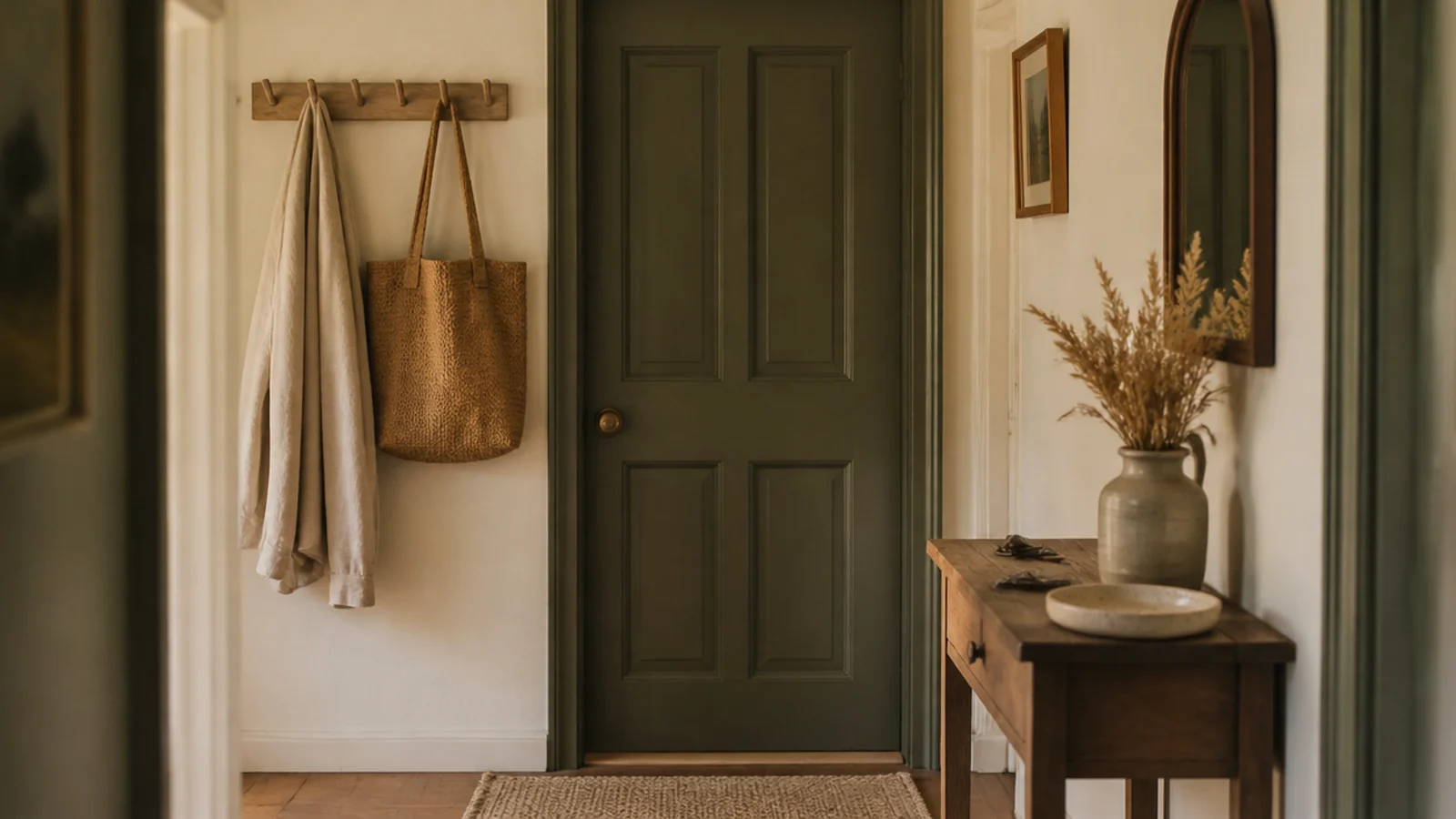
An entryway on a budget goes wrong in one specific way: the money goes on objects instead of on the two or three things people actually see. I have redone this room in four homes for well under $200 each time, and the winning pattern is always the same — paint, one good mirror, and hardware that matches. These 20 projects each cost under $40, and most cost under $15.
In this guide22 sections — tap to openHide
- 1.Where an entryway on a budget should spend its money
- 2.Paint the inside face of the front door
- 3.Build a shaker peg rail from one board
- 4.Cut a thrifted console down to 12 inches deep
- 5.A crate bench with a fabric remnant cushion
- 6.A paint block behind the console instead of panelling
- 7.Thrifted door knobs turned into coat hooks
- 8.Spray the hooks, plate and hardware one finish
- 9.A twenty dollar mirror rehung at the right height
- 10.A picture ledge cut from a single six-foot board
- 11.One tray you already own for keys and mail
- 12.A clip-on lamp and a warmer bulb
- 13.Discount baskets, one per person
- 14.A runner cut from a rug remnant
- 15.Dried grasses in a thrifted jug
- 16.A mail sorter made from a picture frame
- 17.Hooks screwed under the console
- 18.A drop-leaf shelf for halls under 36 inches
- 19.Repaint the baseboard and door frame crisp
- 20.A hat wall on small cup hooks
- 21.A doormat swap and a boot tray
- 22.Mistakes to Skip
Where an entryway on a budget should spend its money
An entryway has five jobs: somewhere to sit, somewhere for shoes, somewhere for coats, a landing surface, and a mirror. A working entry does at least three of them, and a tight budget is mostly a question of which three you pick first.
Hooks and a tray come first because they fix daily friction. Hooks go at 52 inches for adults, with a second rail at 40 inches if children live here, because a coat hung above a child ends up on the floor. One tray with a raised edge is what stops mail and keys spreading across every surface in the house.
Then the surface. A console sits 30 to 32 inches high and 12 inches deep, which is the maximum most halls will take. Under 36 inches of walkway, skip the console and go wall-mounted instead — a folding shelf costs less than a table anyway.
The mirror is the one place I would spend properly, though a thrifted frame handles it fine. Centre it at 57 to 60 inches, and leave 6 to 8 inches between a console top and the mirror bottom.
Budget tiers below: $ under $15 · $$ $15–$40 · $$$ $40+.
1. Paint the inside face of the front door
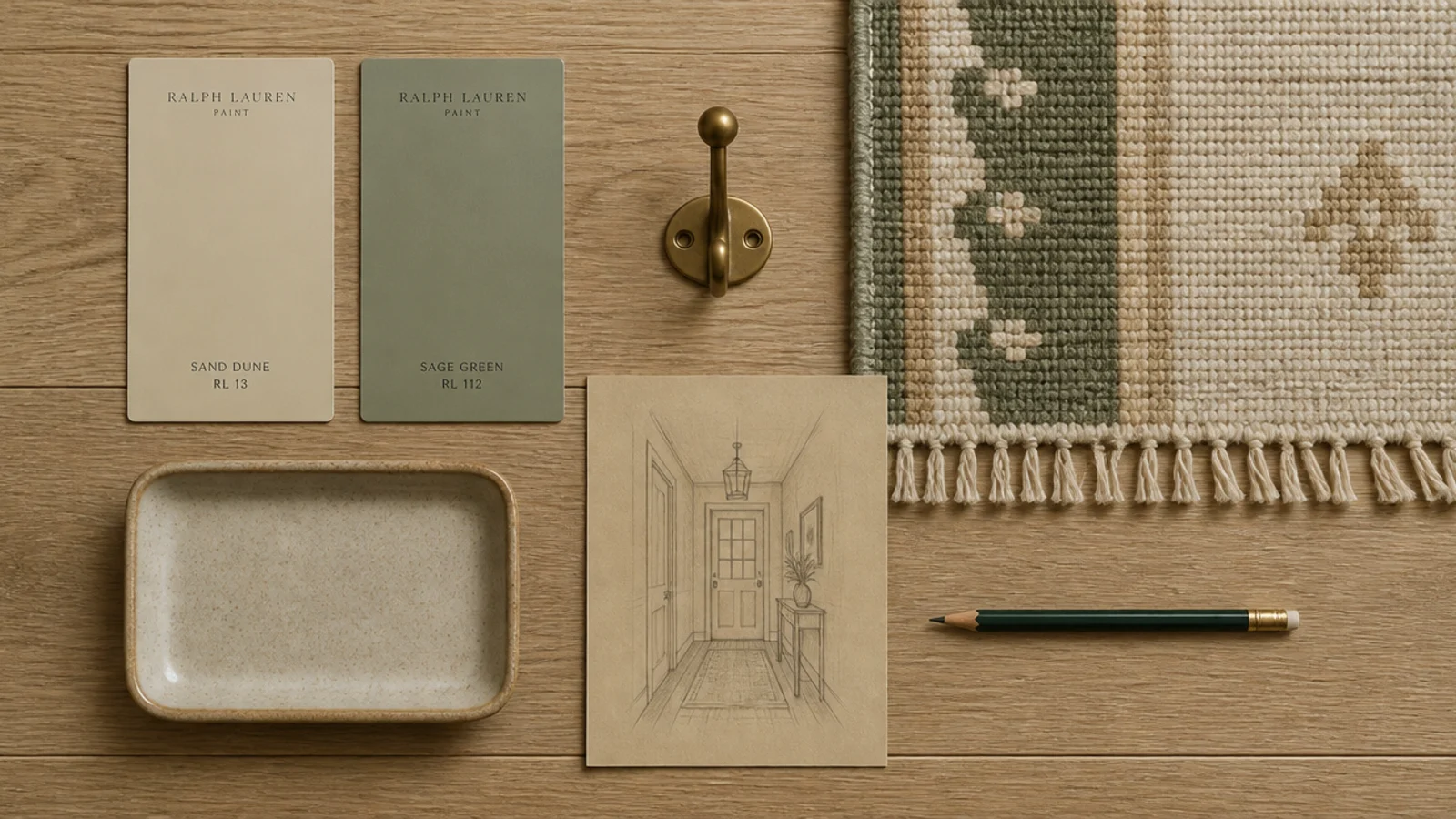
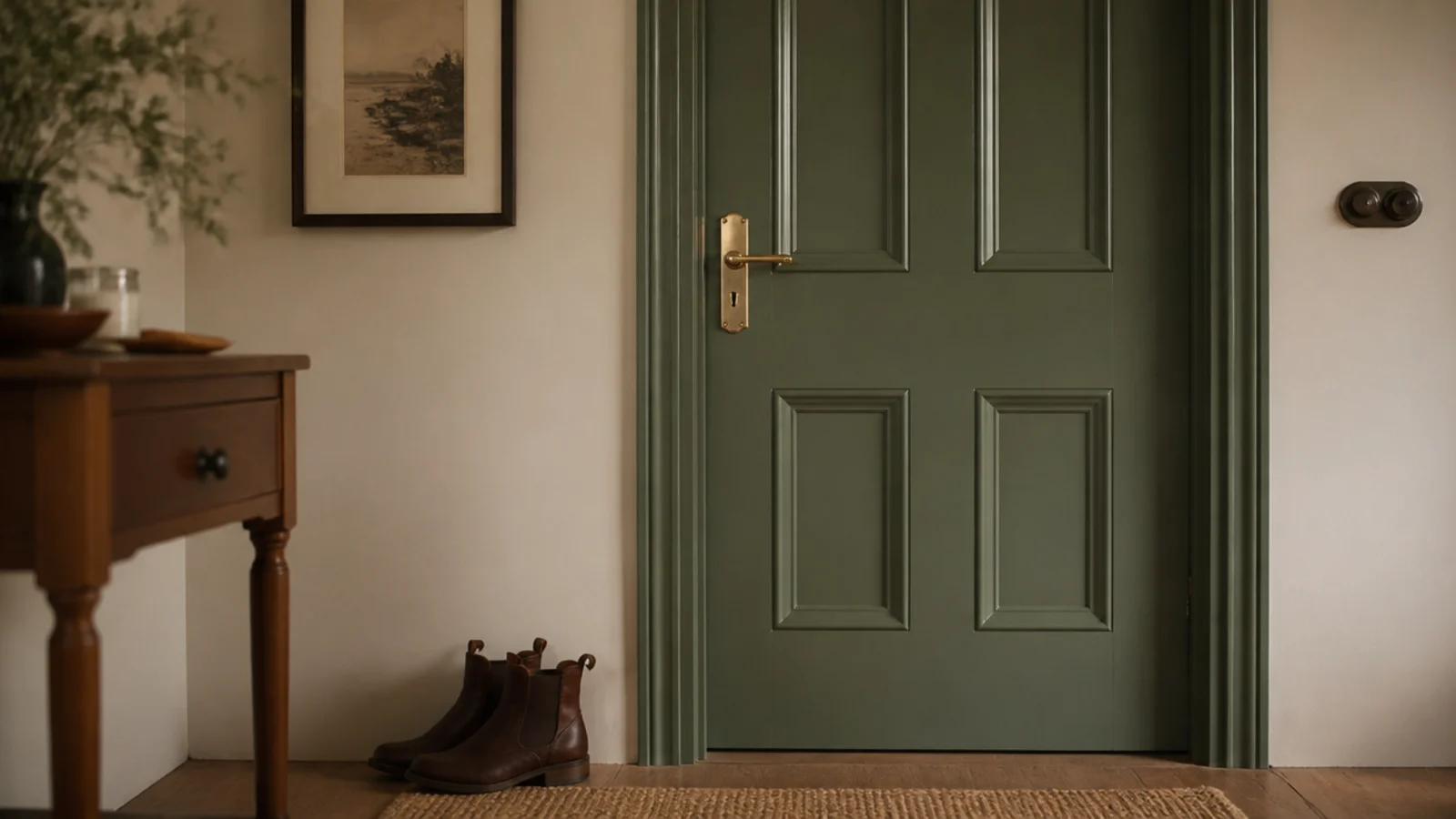
The one surface everybody sees and almost nobody paints. A quart of satin in a deep sage, clay or charcoal costs about $22 and covers a standard door in two coats.
Paint the inside face only and leave the outside to the landlord or the street. Take the handle off rather than taping around it, which takes ten minutes and is the difference between neat and obviously home-done. Let it cure a full week before anything leans against it. $$
2. Build a shaker peg rail from one board
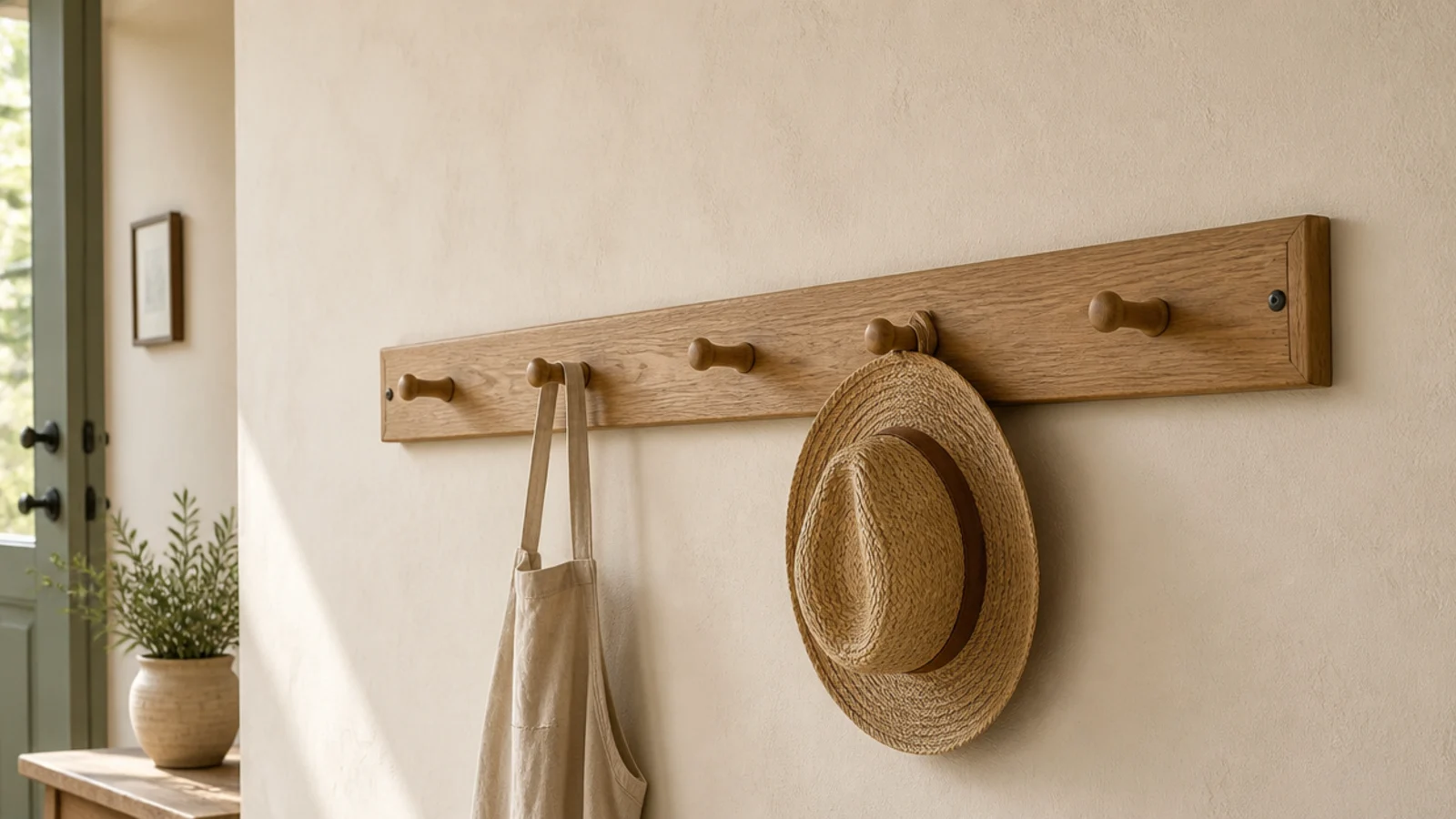
A 1x4 board, five turned pegs and two screws into studs makes a peg rail for around $15. It is the single highest-value hour in this article.
Cut the board to length, drill 5/8-inch holes at 7-inch centres, glue the pegs in, and paint the whole thing one color. Mount the board so pegs land at 52 inches. Pegs beat hooks for a household with children because a coat slides on from any angle. $
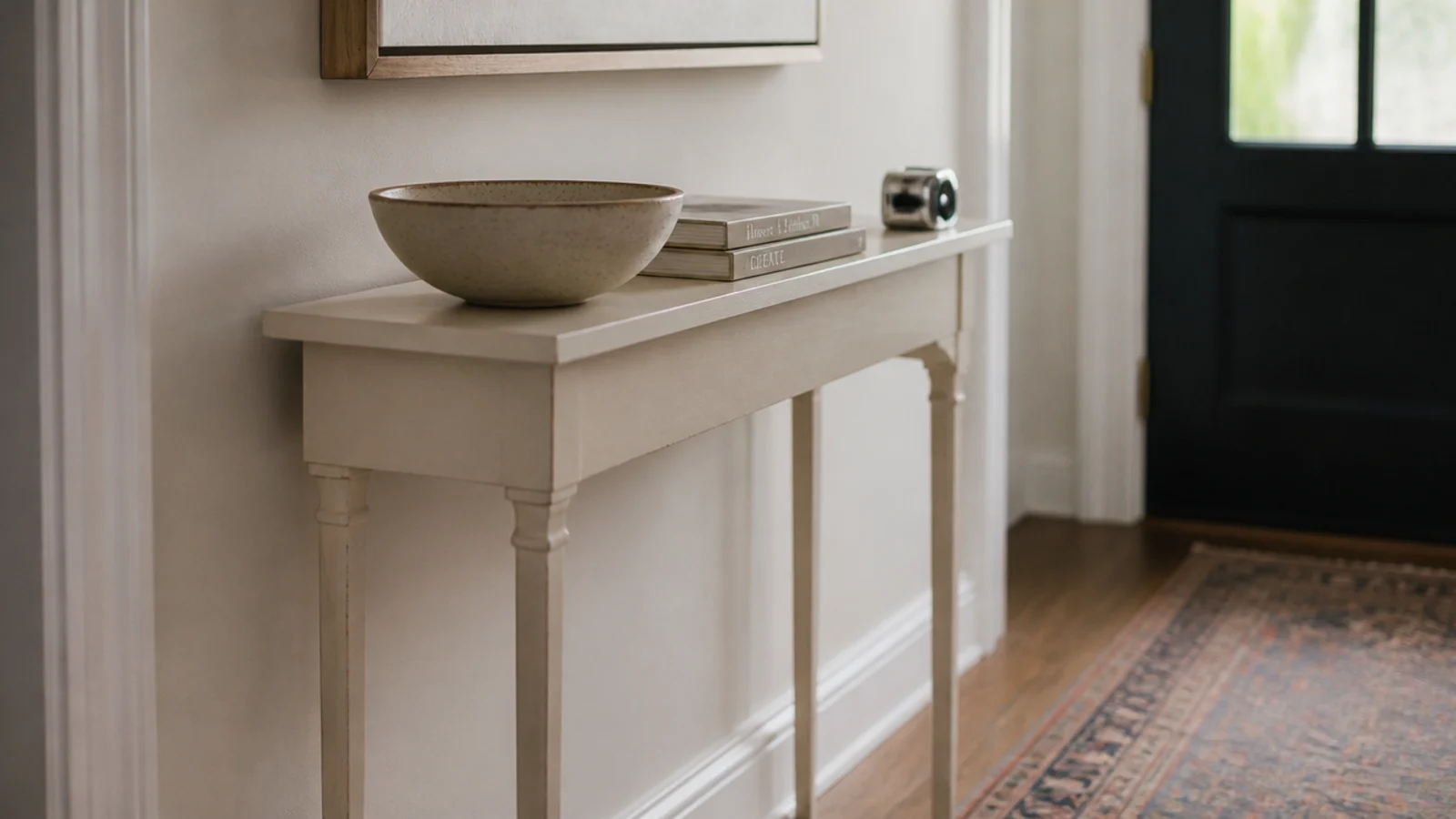
3. Cut a thrifted console down to 12 inches deep
Secondhand consoles and desks are almost always 16 to 18 inches deep, which is exactly why they stick out into a hall. Ripping the top down to 12 inches takes about an hour.
Mark a straight line, run a circular saw against a clamped straight edge, then re-glue the top to the frame and sand the cut. Paint rather than stain so the fresh edge disappears completely. A $30 table becomes a console that fits. $$
4. A crate bench with a fabric remnant cushion
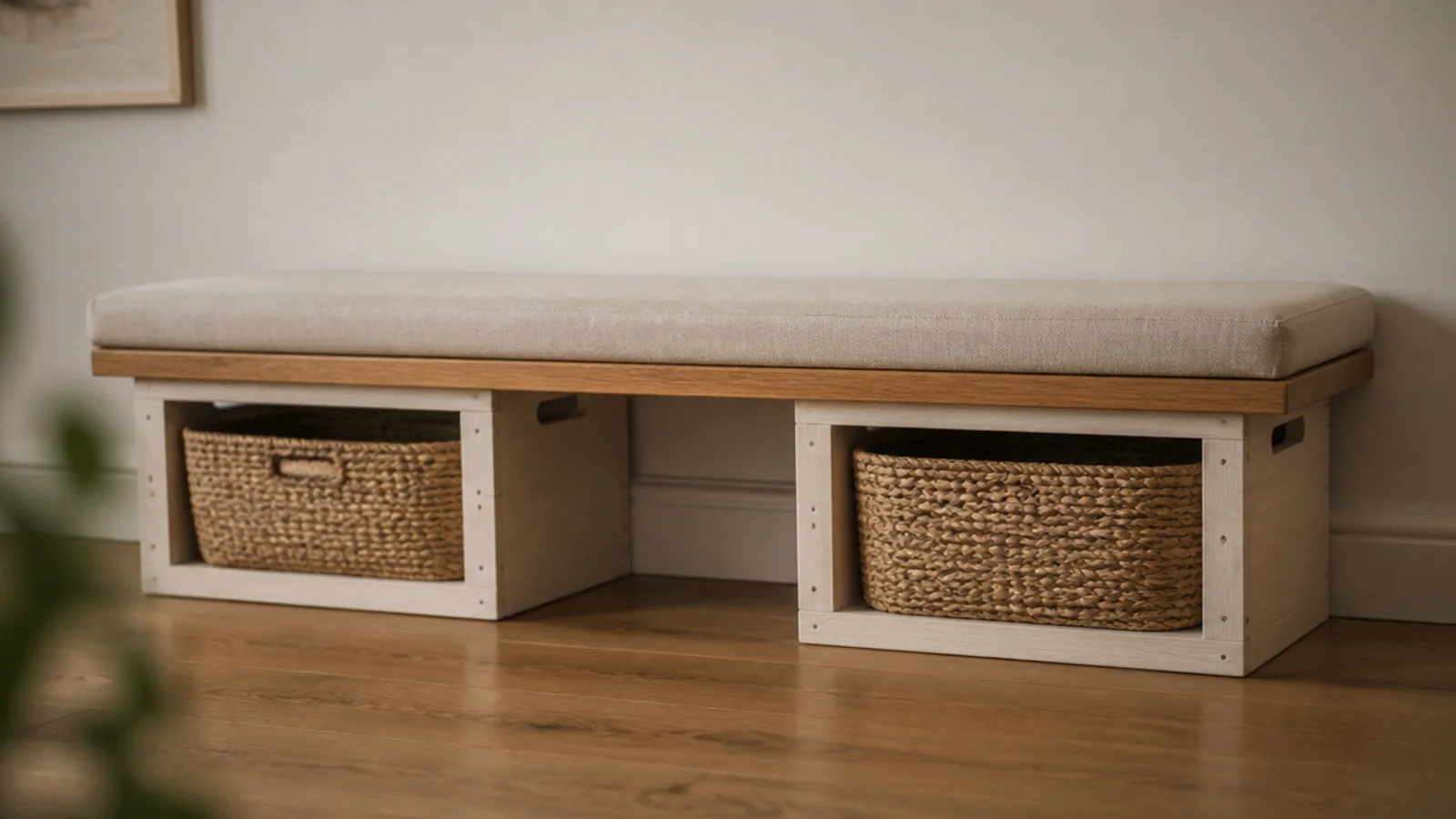
Two sealed crates on their sides, a single board across the top and a cushion made from a $6 remnant gives you the seat that most small entries never get.
Seal the crates properly first — raw pine stains within a season where wet shoes touch it. Screw the crates to the board and to each other, keep the seat height at 18 inches, and the openings underneath take a basket each. $$
5. A paint block behind the console instead of panelling
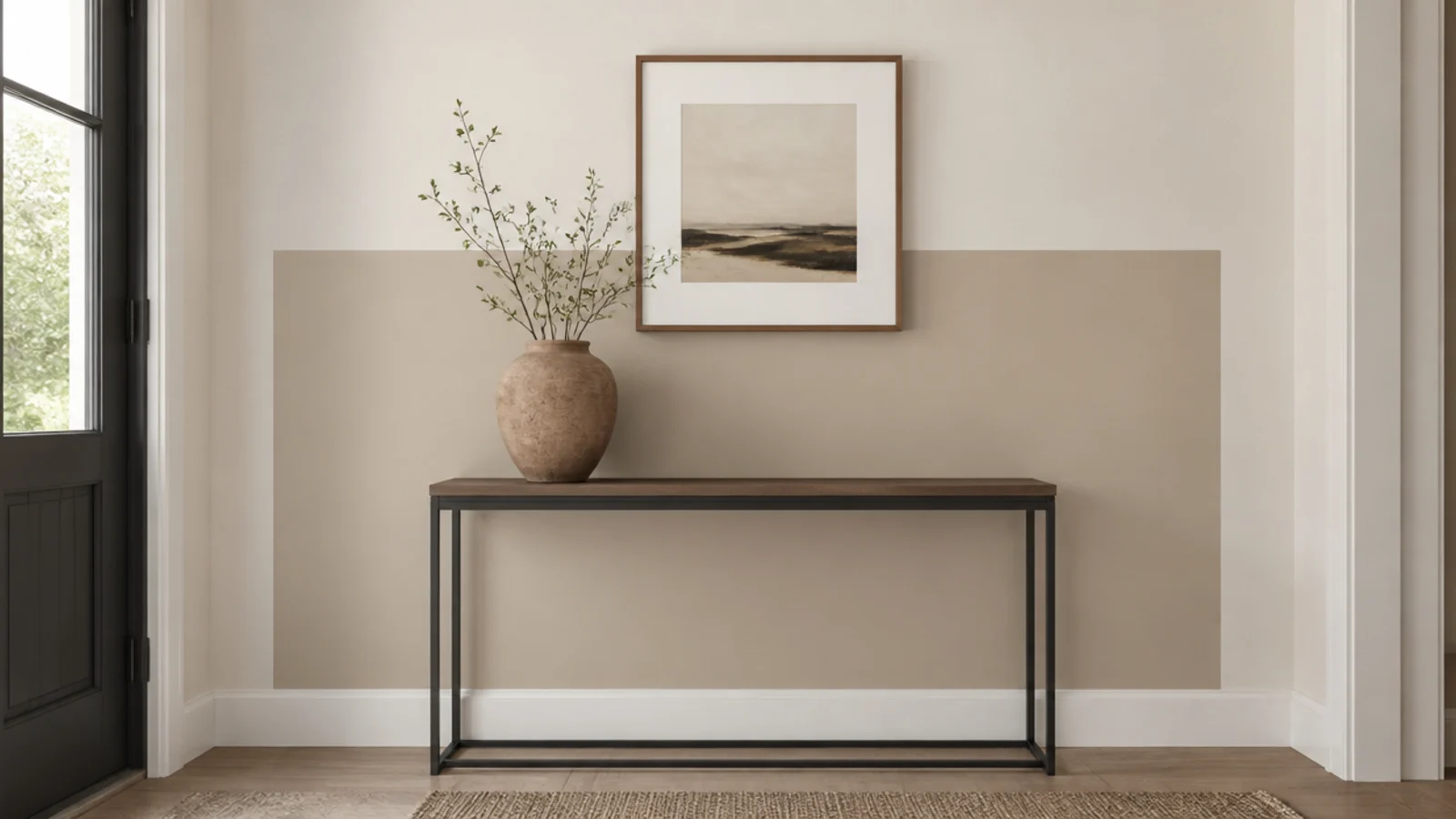
Wainscoting is the look people want and the budget rarely allows. A painted rectangle running from baseboard to about 48 inches does most of the same work for the price of a sample pot.
Mask it with good tape, run a finger along the edge to seal it, then peel while the paint is still slightly wet for a crisp line. Keep the block 6 inches wider than the console on each side. $
6. Thrifted door knobs turned into coat hooks
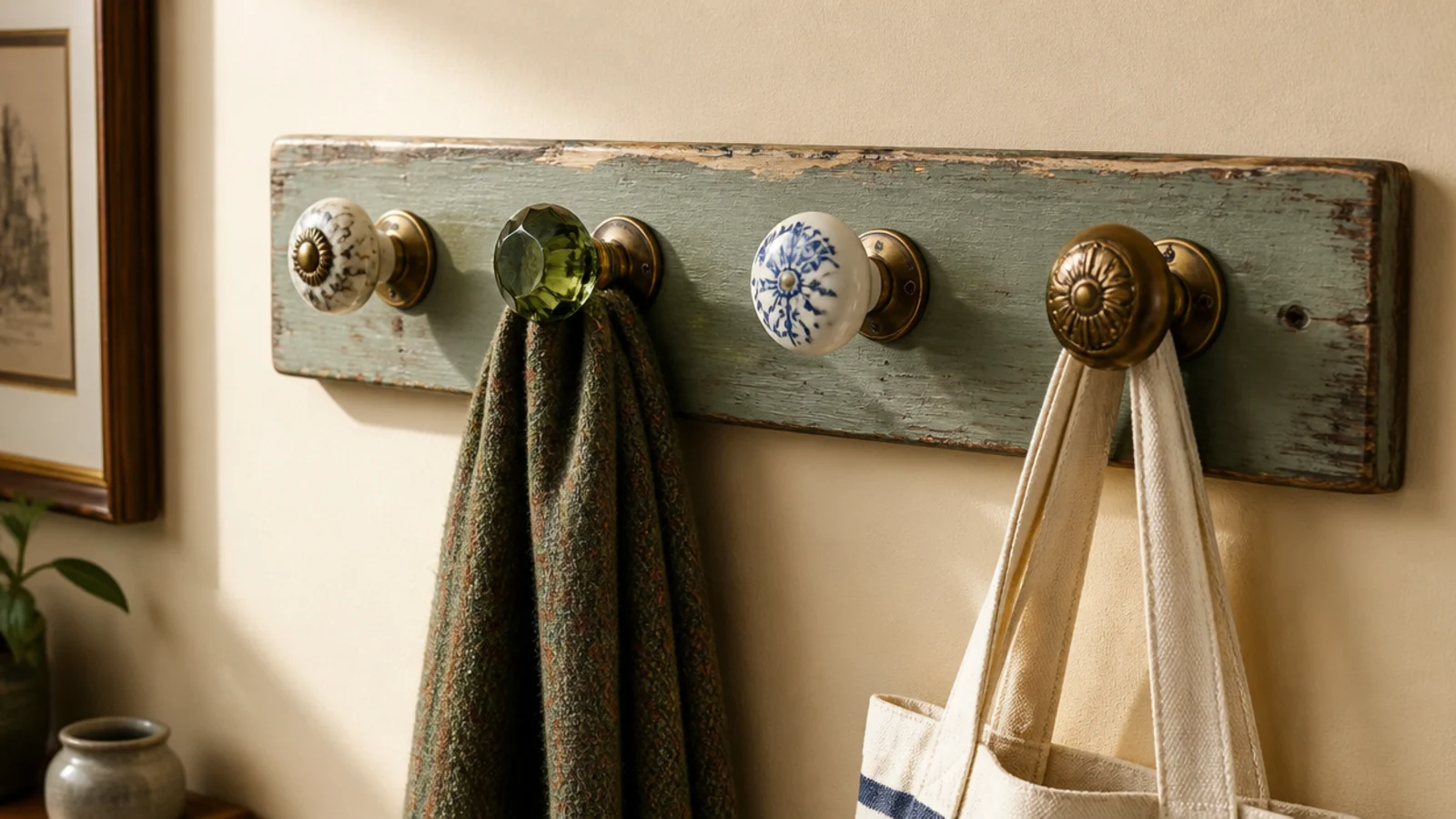
Old ceramic and brass door knobs cost a few dollars each at flea markets and turn into the best-looking hooks in the house with a threaded rod and a nut.
Mount them all on one painted board rather than straight onto the wall. On a board, four mismatched knobs read as a collection; scattered across bare plaster, they read as random. Good for scarves and bags, not for heavy wet coats. $$
7. Spray the hooks, plate and hardware one finish
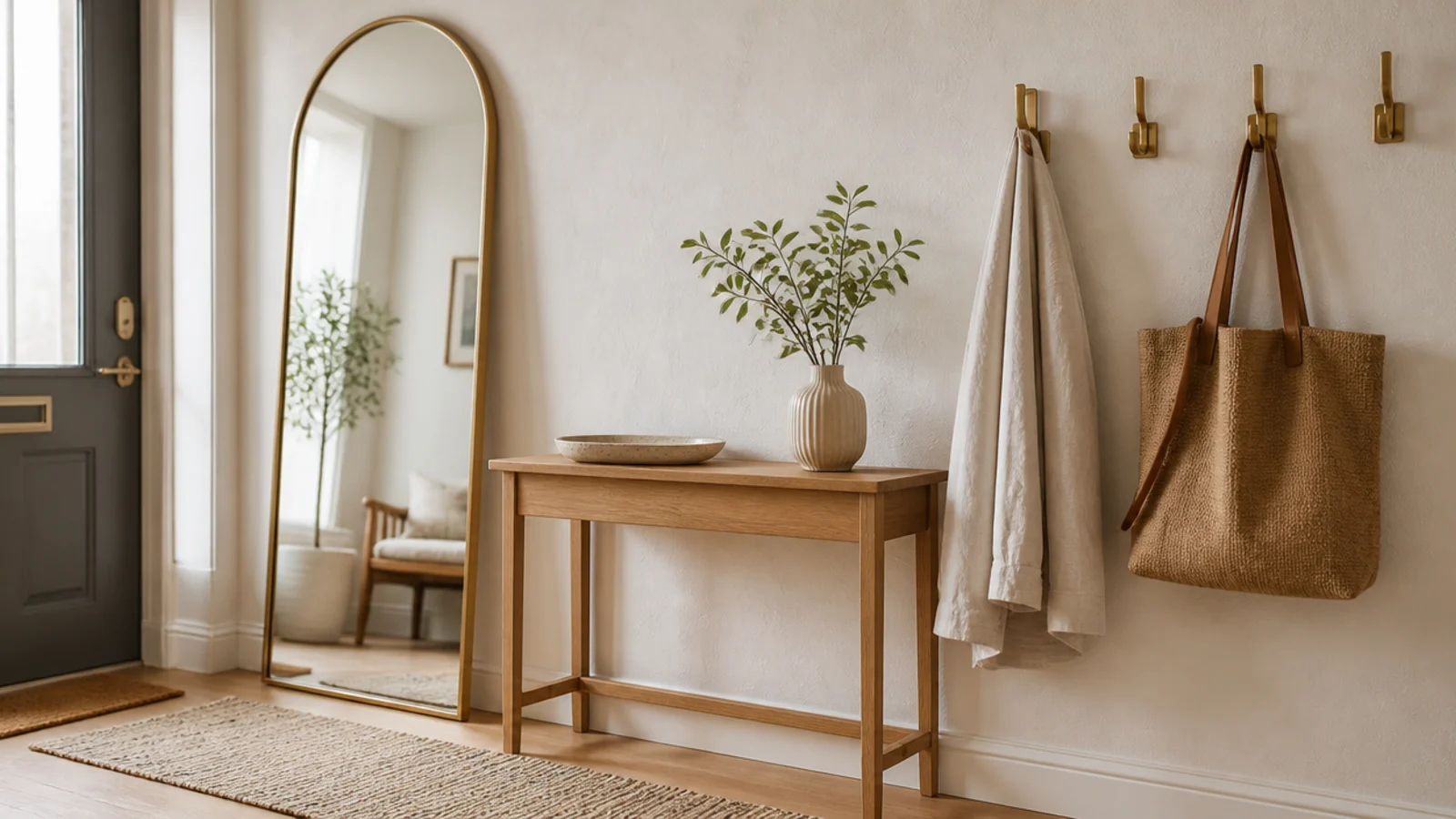
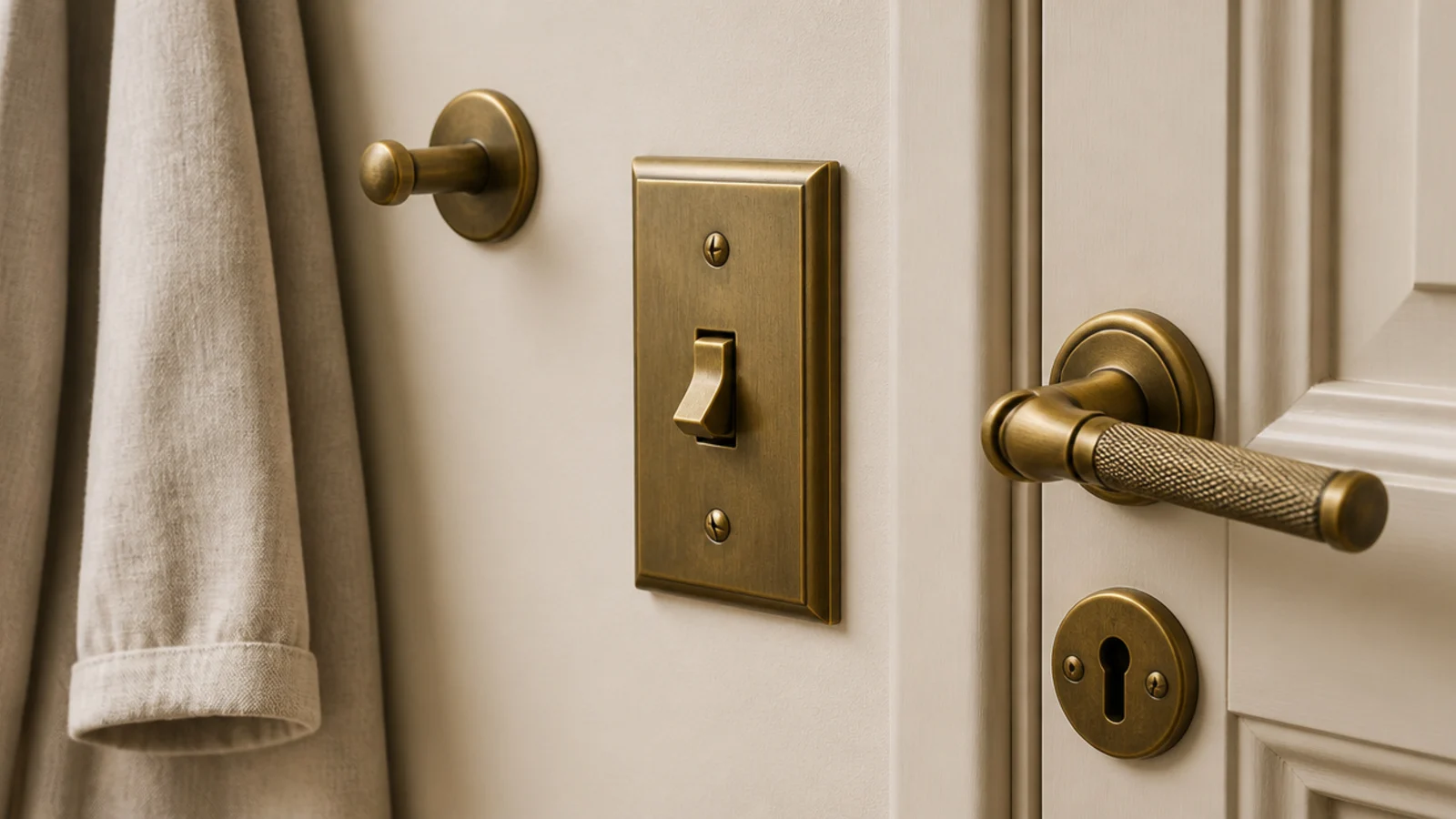
Three small metal things in one finish is the cheapest way to make an entry look considered. Hooks, the light switch plate and the door handle, all in aged brass or matte black.
Degrease everything, use a metal primer, and build three light coats rather than one heavy one. A can costs $8 and does an entire entry with paint left over. The eye compares hardware to hardware, not to furniture. $
8. A twenty dollar mirror rehung at the right height
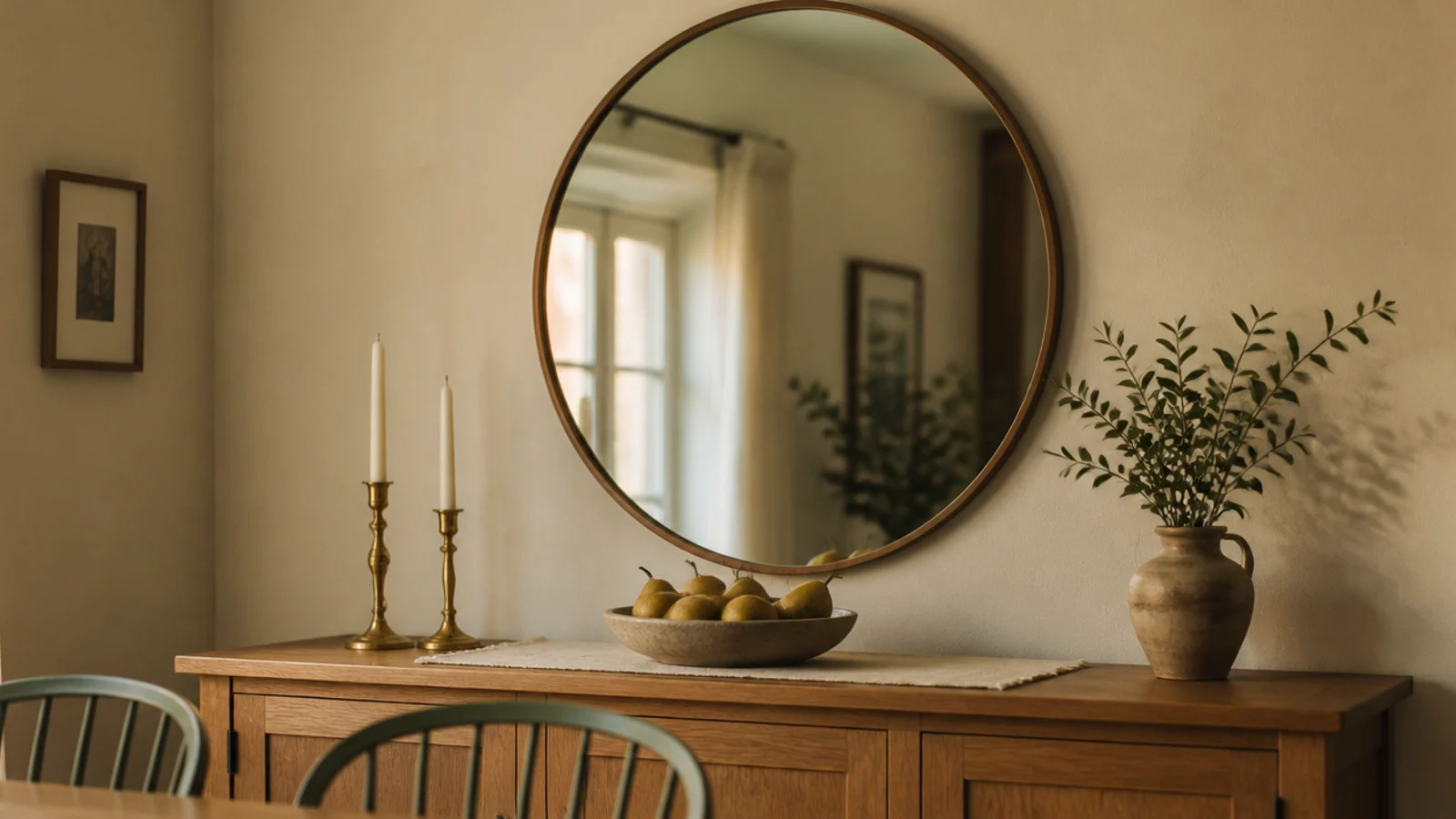
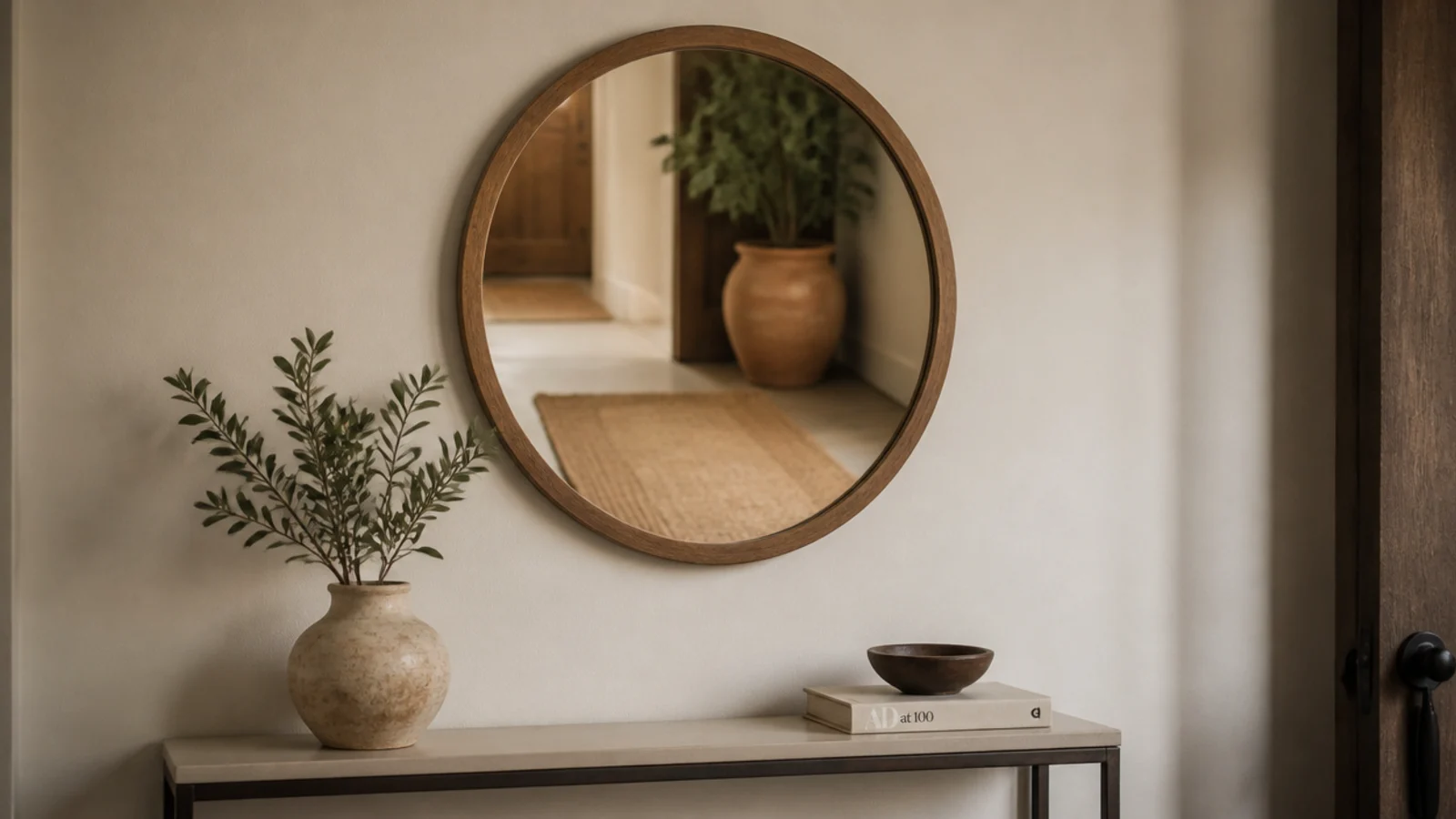
Most secondhand mirrors look cheap because of where they were hung, not what they cost. Centre the glass at 57 to 60 inches and the same mirror reads completely differently.
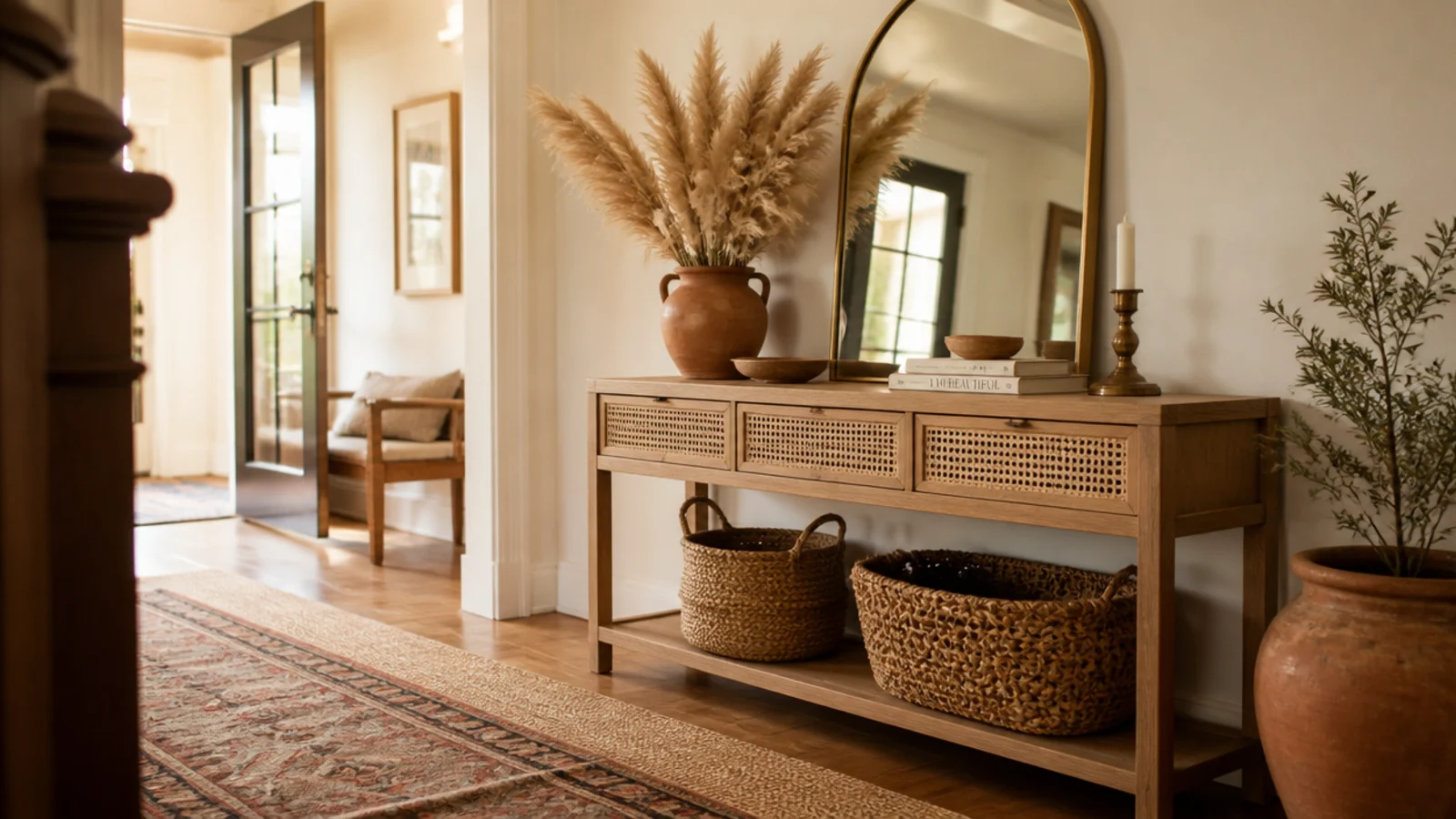
Above a console, leave 6 to 8 inches between the table top and the mirror bottom. A wood frame can be painted or waxed; a dated gold frame takes matte black spray beautifully. For sizing the reflection properly, entryway mirror walls covers the proportions. $$
9. A picture ledge cut from a single six-foot board
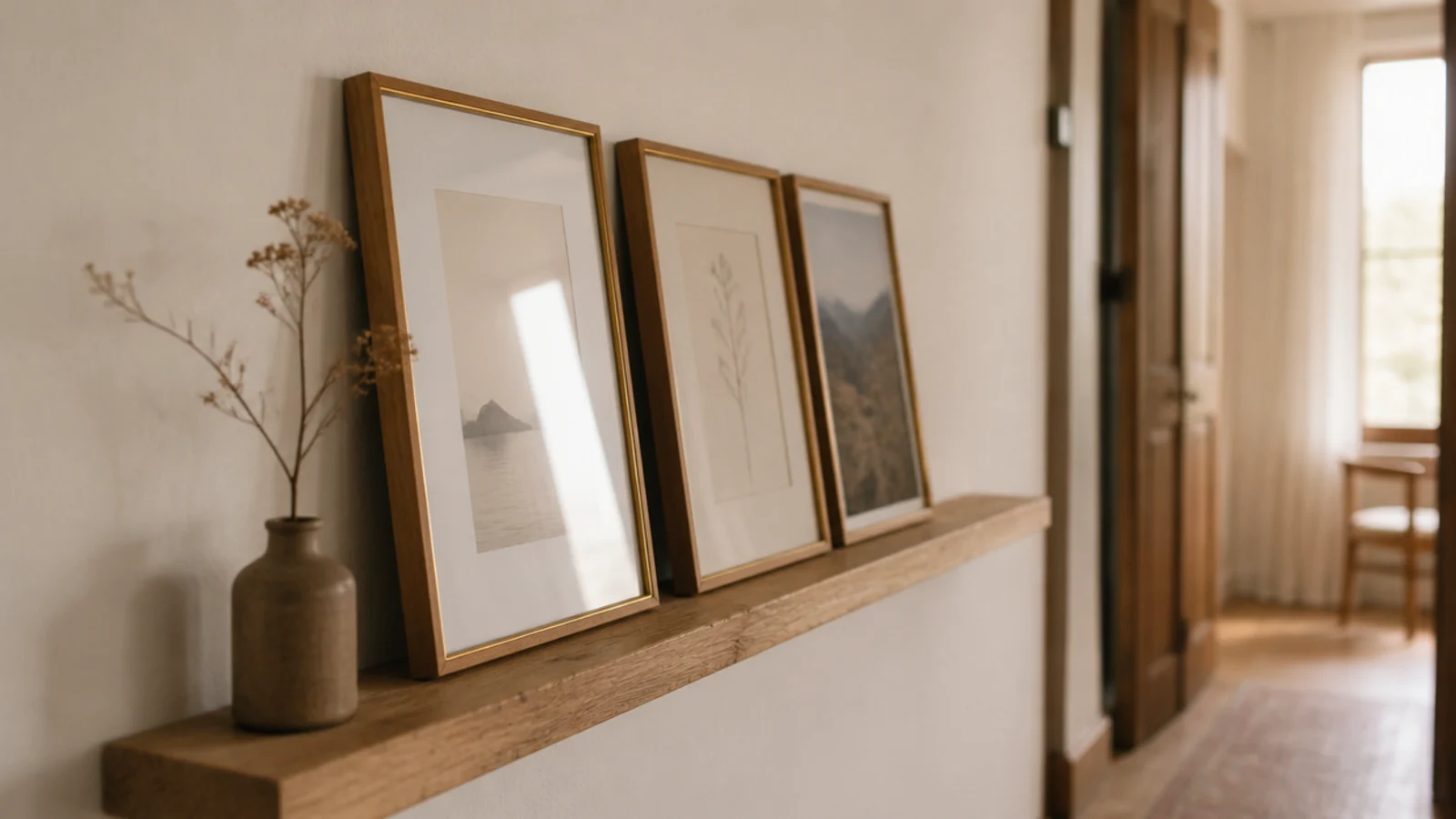
One 1x4 and one 1x2 make a 6-foot ledge with a front lip for about $12 in lumber. Glue and pin the lip along the front edge, sand, paint, mount into studs.
Hang it at 60 inches so leaning art sits at eye level as you walk in. Frames overlap slightly and change in five minutes. It is the one wall treatment that never needs a new hole again. $
10. One tray you already own for keys and mail
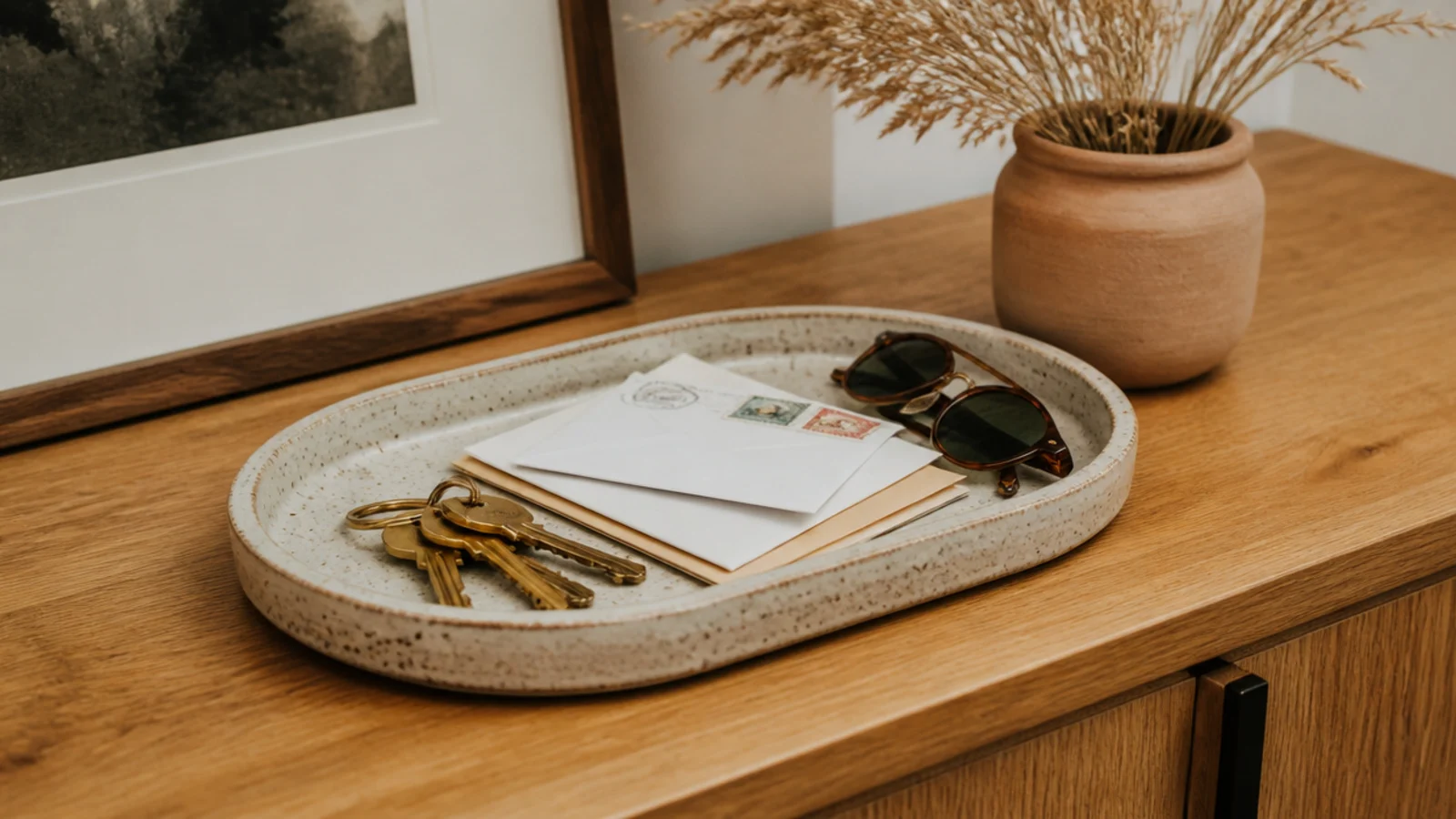
The free fix that outperforms most purchases. Find a shallow dish, a stoneware plate or a small wooden tray with any kind of raised edge and put it on the console.
The raised edge is the entire mechanism. Flat plates let things slide off and small items migrate to the floor. One tray, not three — multiple containers just distribute the mess more elegantly. Free–$
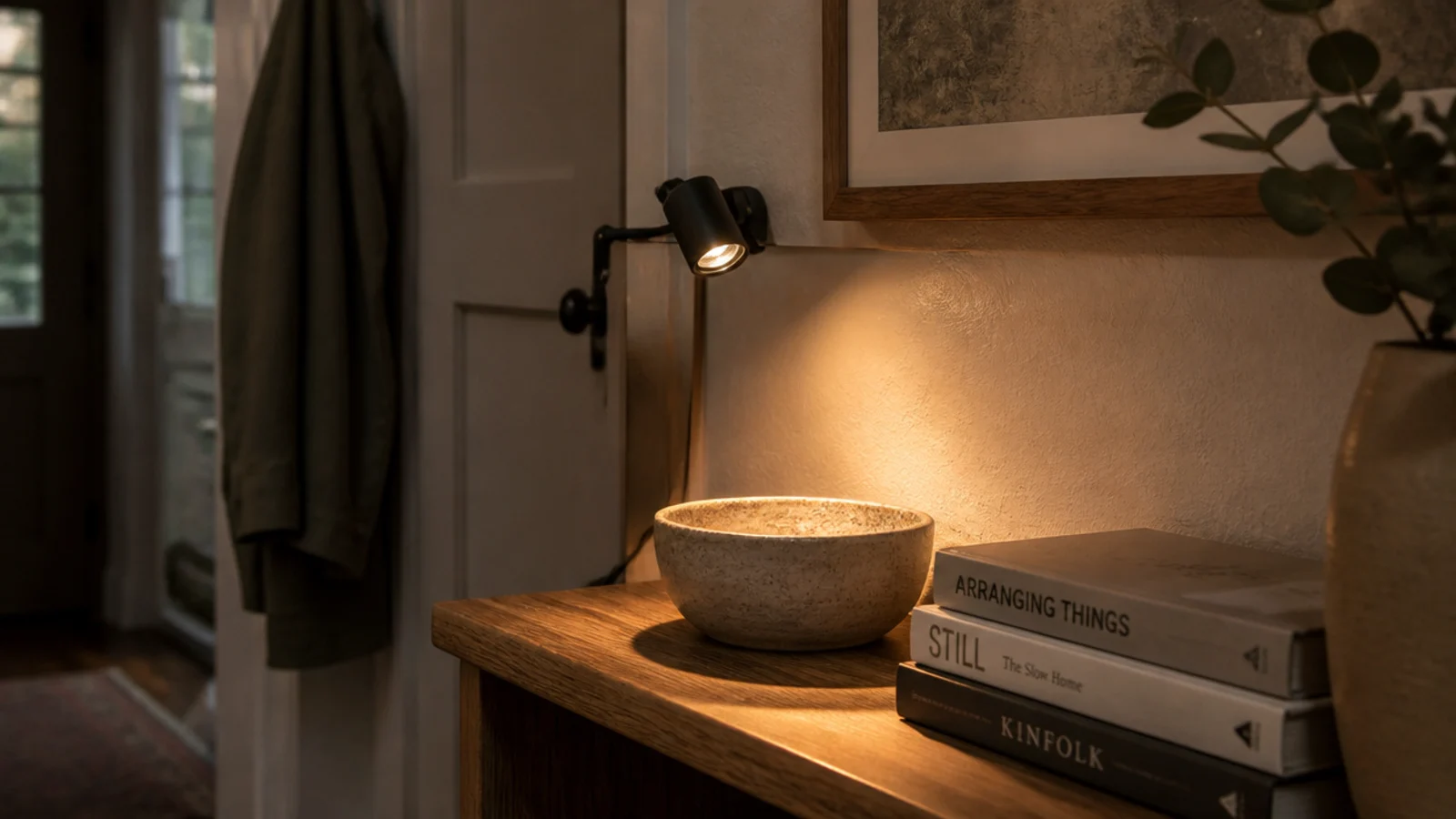
11. A clip-on lamp and a warmer bulb
One ceiling fixture flattens an entry completely. A $12 clip-on lamp on a shelf edge, with a 2700K bulb, puts warm light at eye level and gives the space depth.
Swap the overhead bulb to 2700K at the same time. Oak, jute, clay and brass all read rich at 2700K and grey at 4000K, which is why some entries look cheap in photographs and fine in person. $
12. Discount baskets, one per person
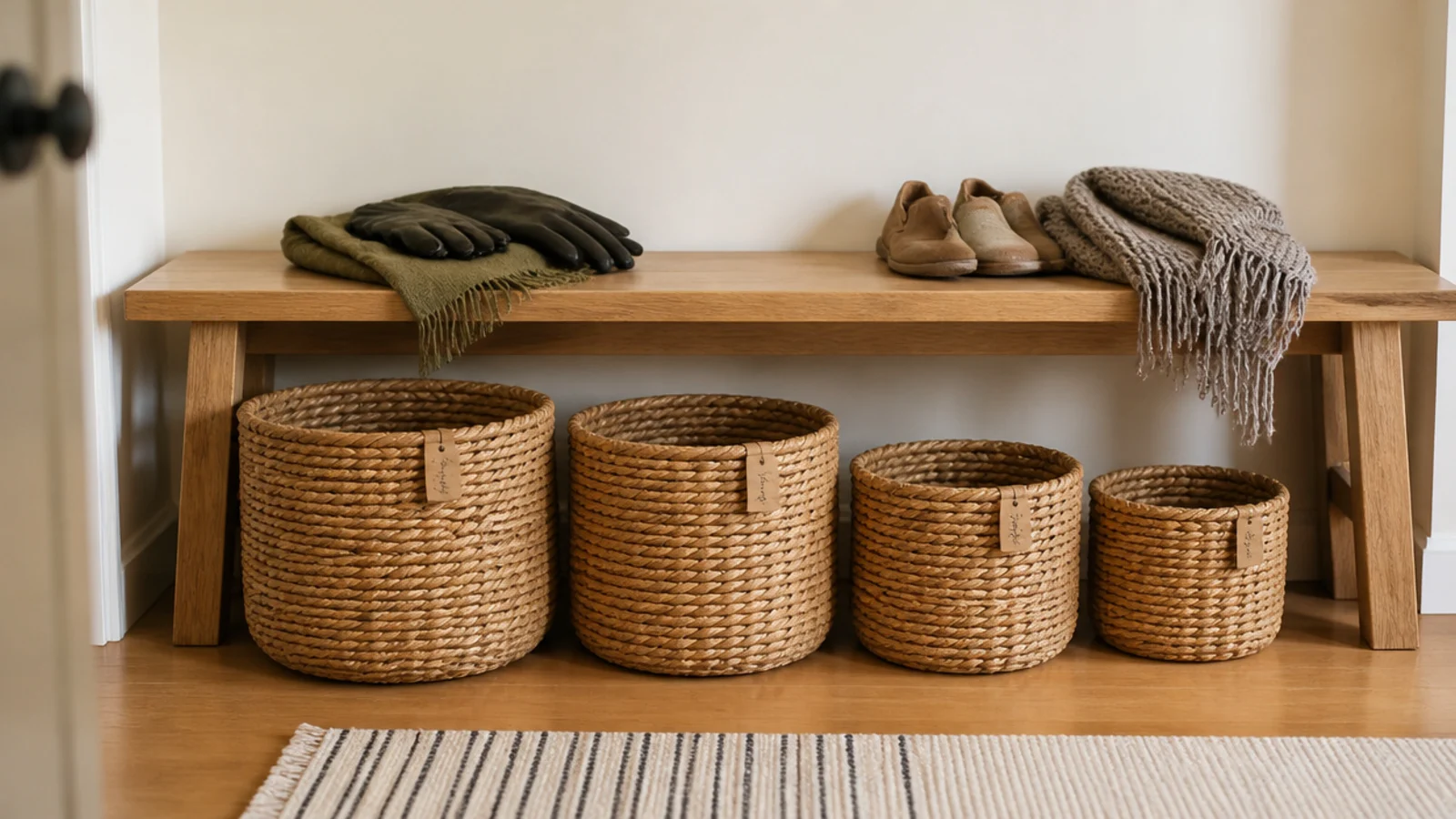
Baskets from the discount aisle run $6 to $12 and solve gloves, hats and small chaos — provided each person gets their own with their name on it.
Shared containers fail because nobody owns the overflow. Named ones work with children better than any amount of asking. Cap the count: one basket per person plus one spare, and everything else goes to a closet. $–$$
13. A runner cut from a rug remnant
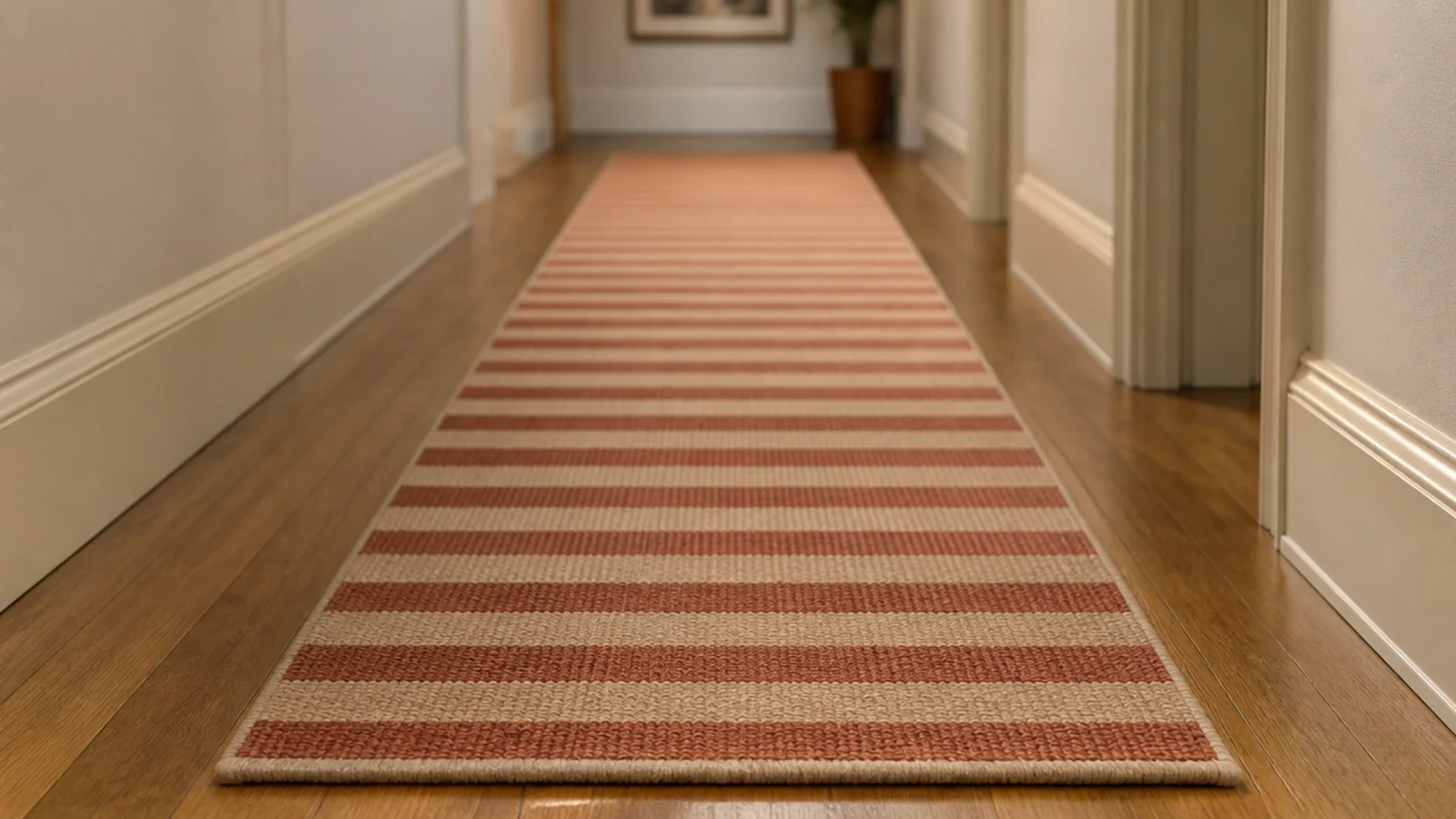
Carpet shops sell remnants for a fraction of a finished runner, and binding the edges costs about $12 at the same counter. Choose a flat weave.
Flat-weave washable runners survive the grit an entry brings in; deep pile does not and never recovers from it. Size it to leave 4 to 6 inches of bare floor each side, and put a thin non-slip pad underneath. $$
14. Dried grasses in a thrifted jug
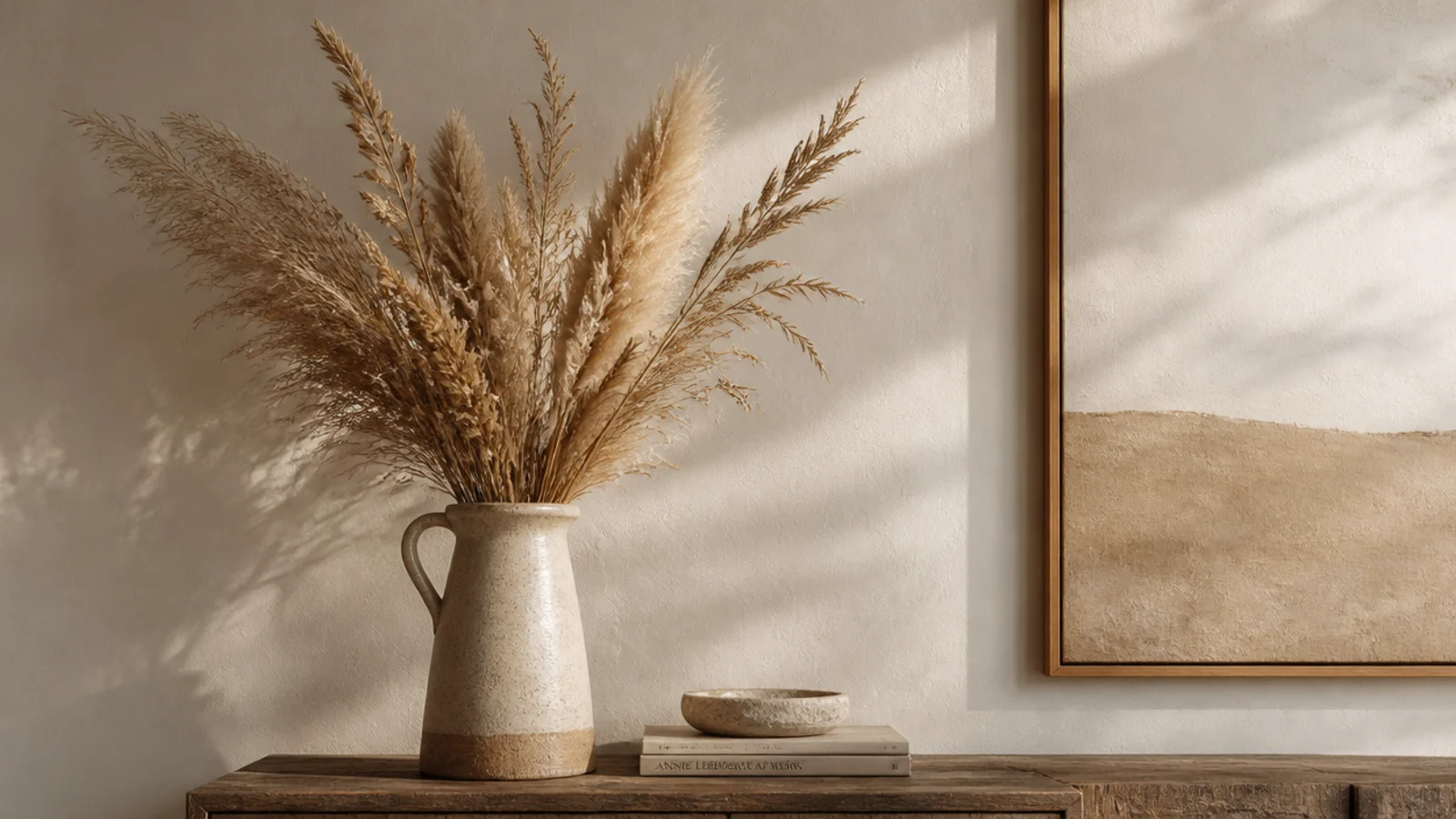
Fresh flowers in an entry last four days and get knocked over twice. Dried wheat, pampas or garden stems last a year and cost nothing if you cut them yourself.
Keep the bundle loose and asymmetric, roughly 1.5 times the height of the jug. A $4 stoneware jug from a charity shop does more here than a new vase, because the slight irregularity is the part that looks collected. Free–$
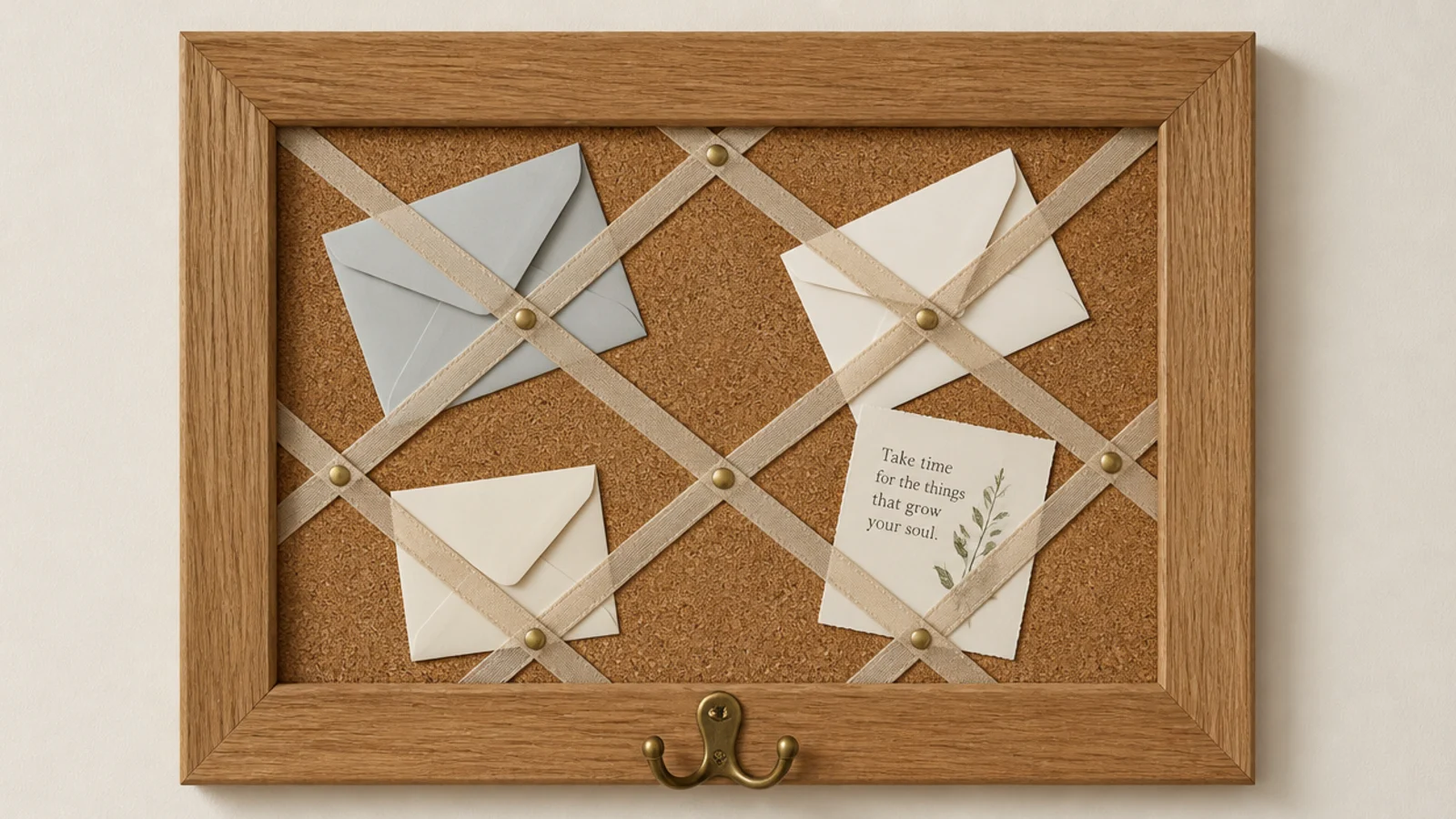
15. A mail sorter made from a picture frame
Take an old frame, drop in a cork or foam board backing, and criss-cross linen ribbon across it. Envelopes slide behind the ribbon and stay visible.
Add a small brass hook to the bottom edge of the frame for keys and the whole system lives in one object. The frame is what makes this read as decor rather than office equipment. $
16. Hooks screwed under the console
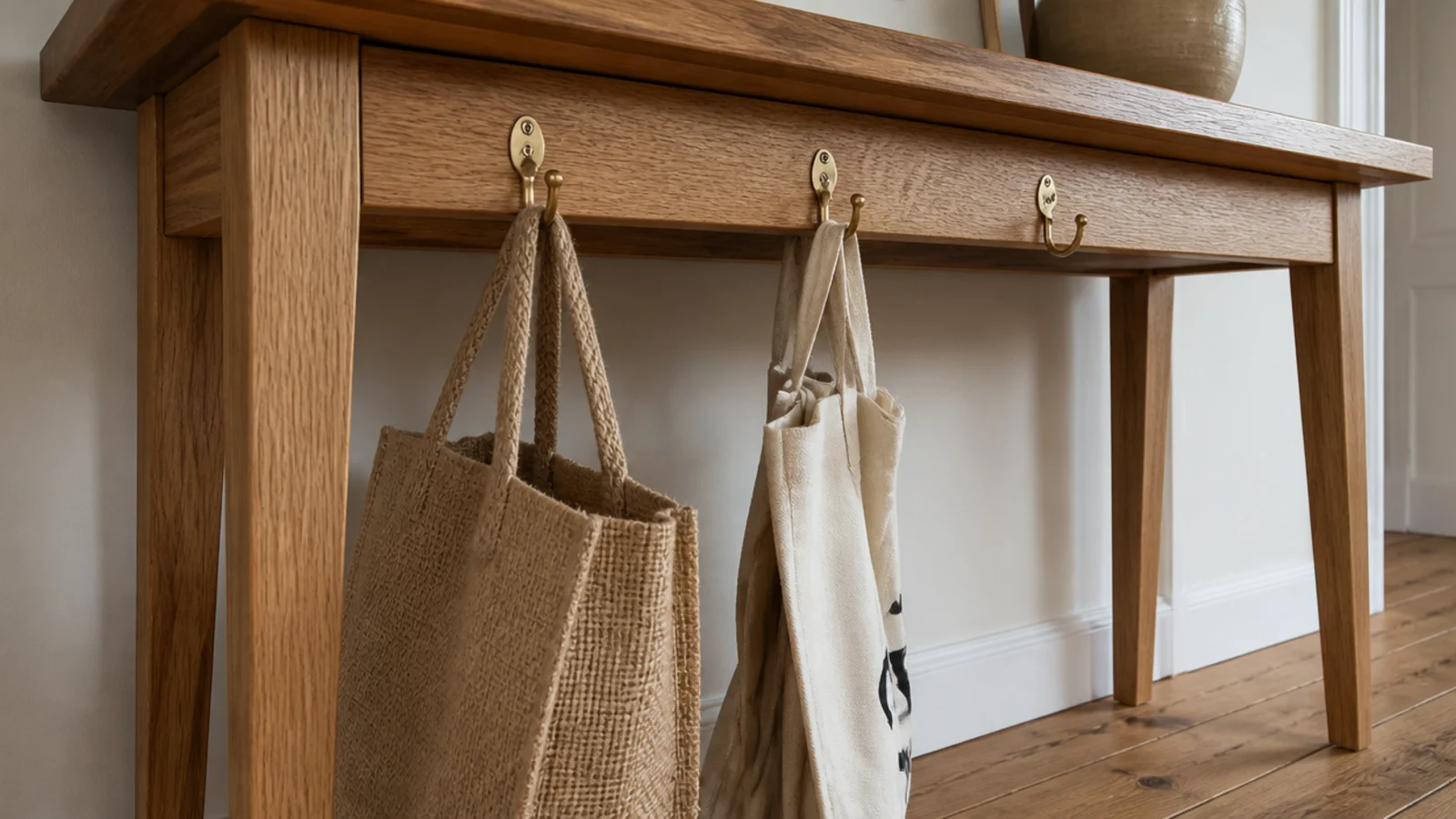
The underside of a console front apron is free storage nobody uses. Three small hooks there hold totes, dog leads and the bag you carry daily.
Keep the hooks within 3 inches of the front edge so the bags hang clear of your knees, and only hang soft items — anything rigid knocks the table leg every time you pass. Screws must go into the apron, not the tabletop. $
17. A drop-leaf shelf for halls under 36 inches
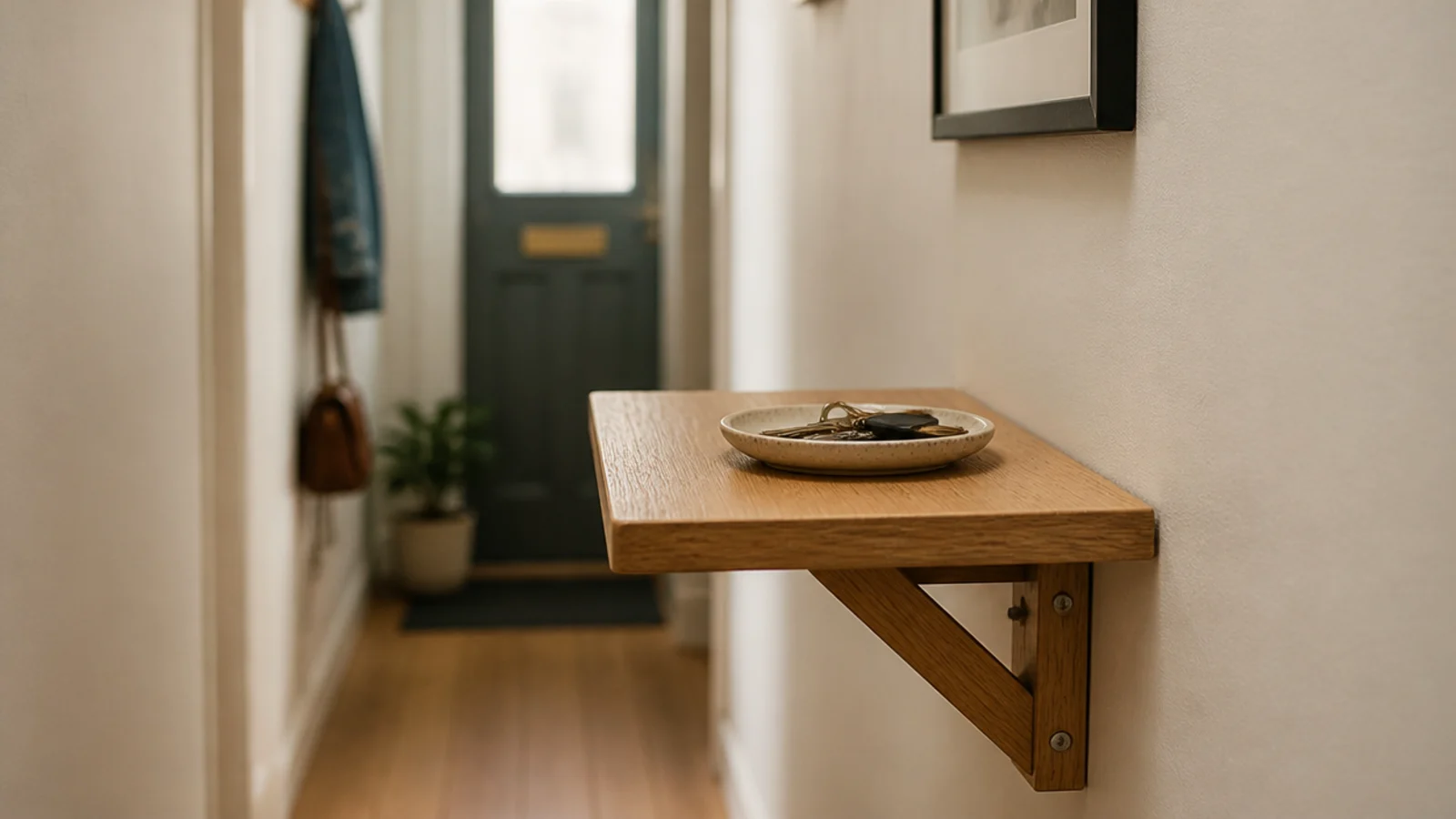
If the walkway is under 36 inches, a console is the wrong answer no matter how slim. A wall-mounted drop-leaf shelf gives you a landing surface that folds flat.
Mount it at 30 to 32 inches, keep the leaf at 10 inches deep, and use two hinged brackets into studs. Open it for keys and parcels, fold it when you need to carry a suitcase through. More layouts like this live in narrow entryway ideas. $$
18. Repaint the baseboard and door frame crisp
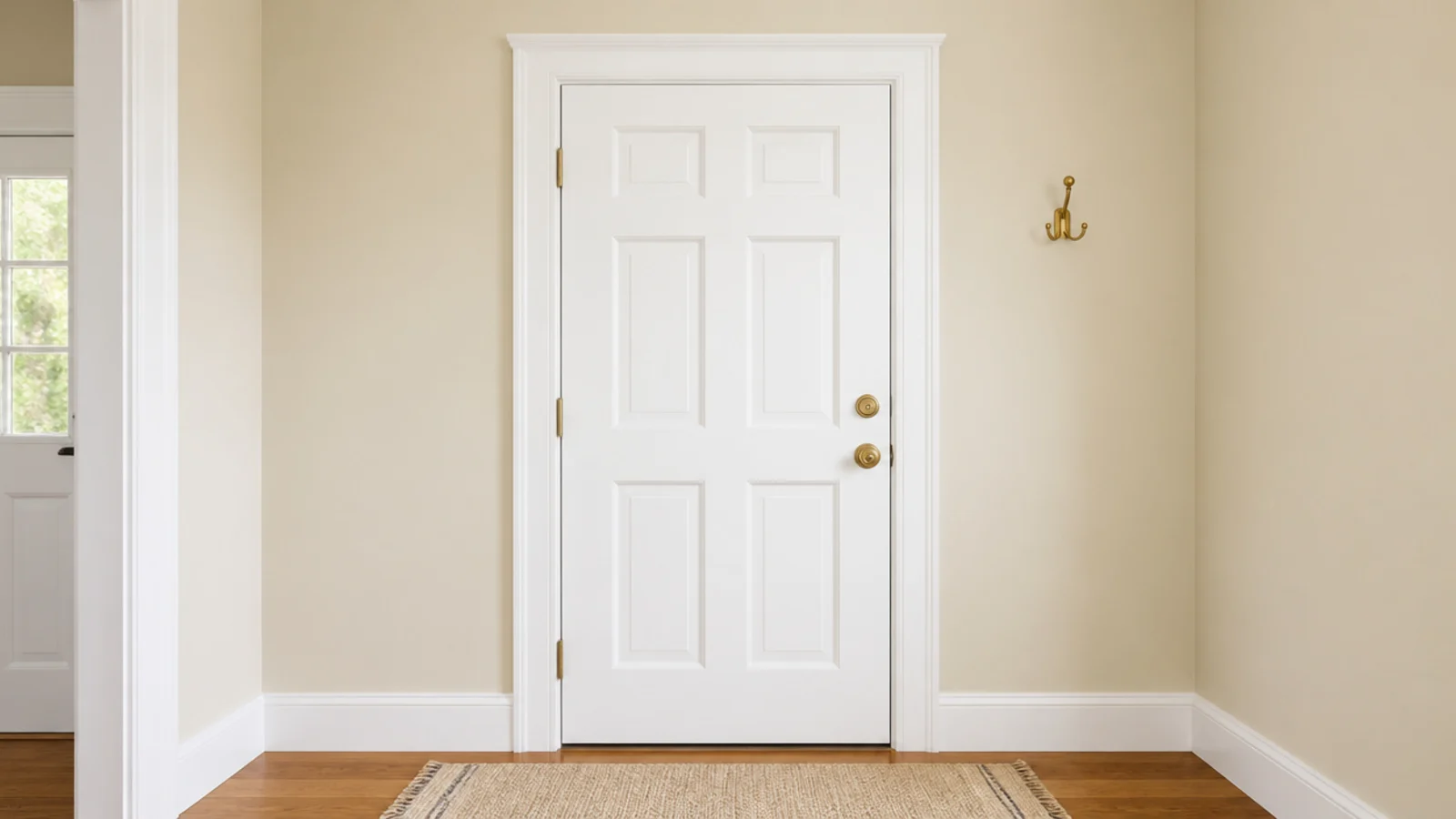
Nothing makes secondhand furniture look intentional faster than clean trim behind it. Scuffed baseboards drag the whole entry down and cost about $18 in trim paint to fix.
Fill dents with filler first, sand, then two thin coats of satin. Do the door frame at the same time. This is the least exciting job in this article and the one people notice most when it is done. $$
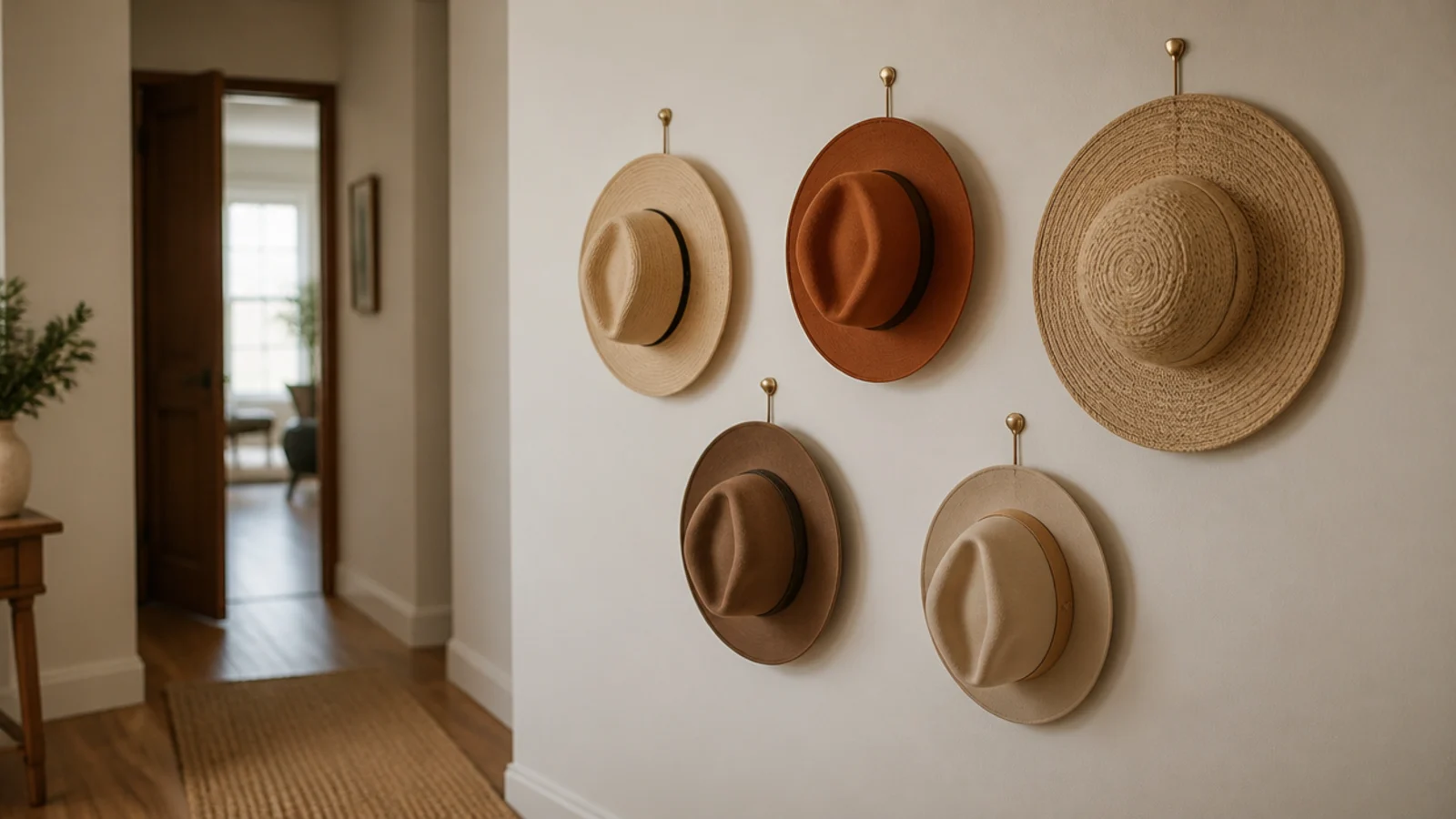
19. A hat wall on small cup hooks
Hats you already own become wall decor for the price of a packet of brass cup hooks. Five hats in sand, clay and cream tones, hung in a loose arrangement rather than a grid.
Space them 8 to 10 inches apart and vary the heights so it reads as an arrangement, not a shop rack. Keep it off the wall directly above the coat hooks — coats fill that space daily. $
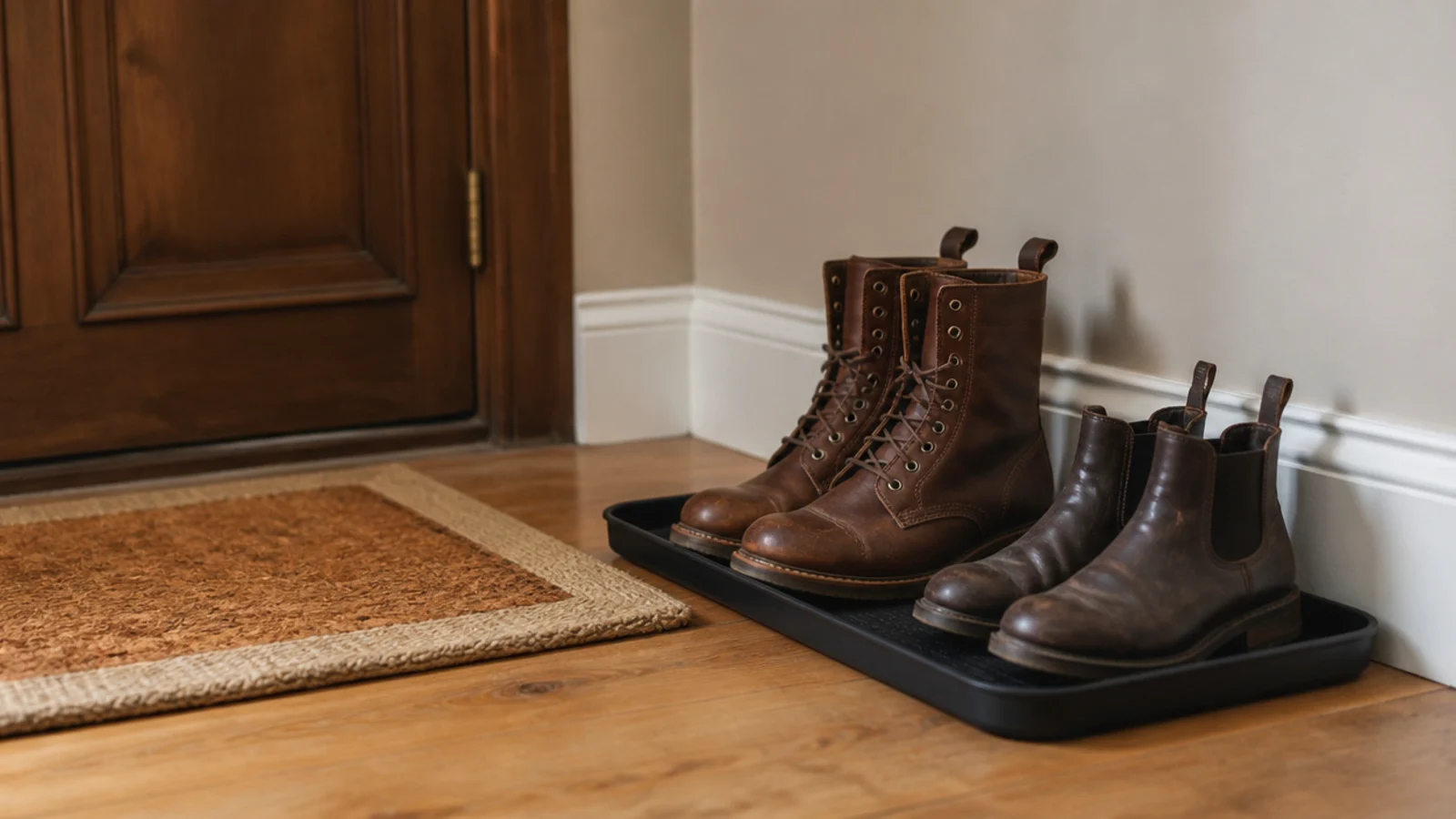
20. A doormat swap and a boot tray
The last few dollars go on the floor by the door. A coir mat outside and a raised-lip boot tray inside stop most of the dirt before it reaches the runner.
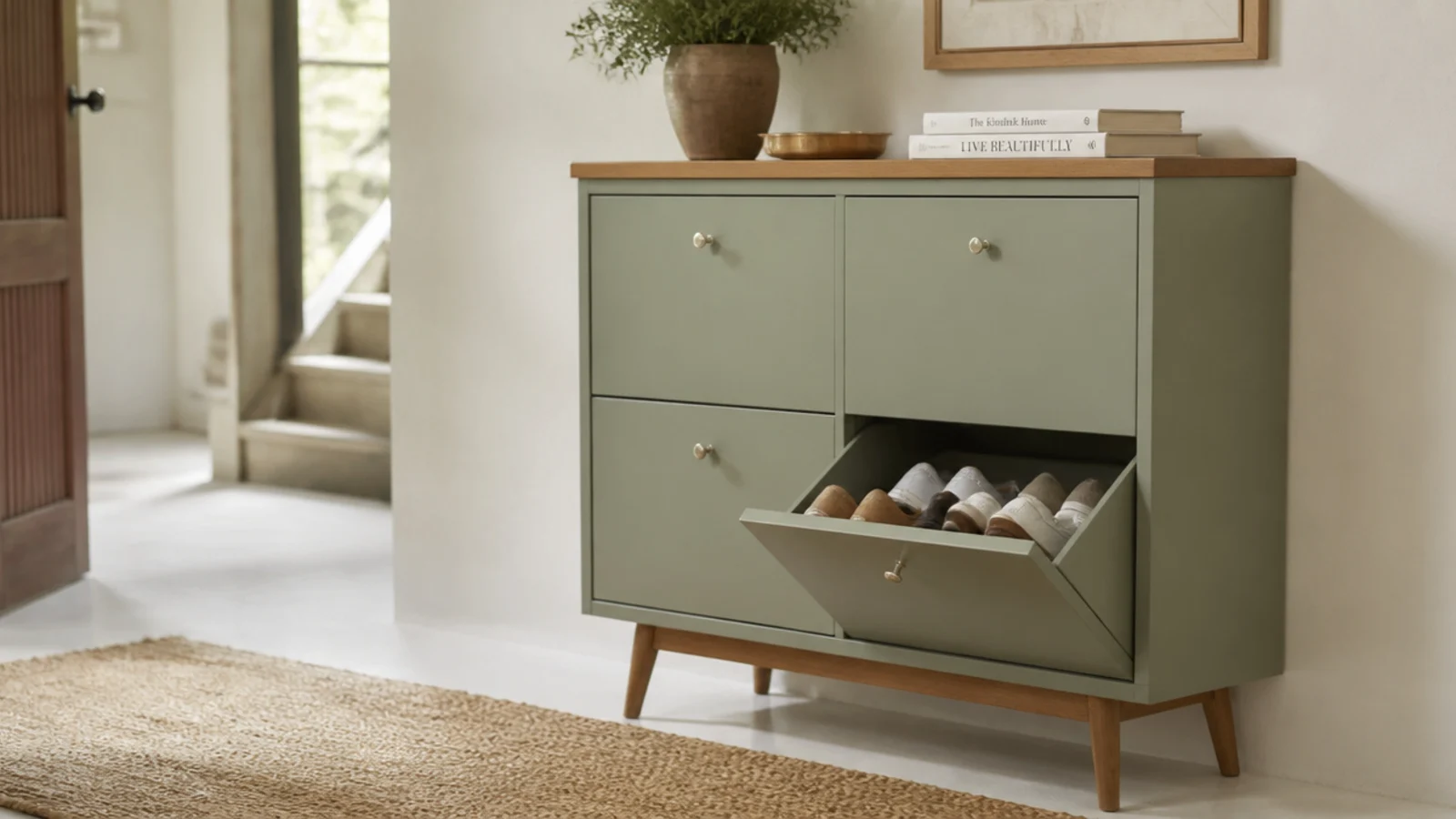
Get a tray at least 15 inches deep so adult boots sit fully inside, in metal or heavy rubber rather than thin plastic that cracks in the cold. For where the rest of the shoes go, shoe cabinets for small entries covers the closed options. $$
Mistakes to Skip
- Buying a matched entryway furniture set. It eats the entire budget on the least important layer and still leaves you with the wrong depth for your hallway.
- Hanging a small mirror high to fill wall space. A mirror centred above 60 inches reflects the ceiling and shows nobody their face, which is the one job it has.
- Choosing a cheap deep-pile runner because it feels softer underfoot. Entry grit works into the pile within a month and no wash brings it back.
Frequently asked questions
What is the cheapest way to make an entryway look finished?
Paint, in two places: the inside face of the front door and the baseboard and door frame around it. Together they cost a sample pot and a quart, roughly $35, and they change how every other object in the entry reads. A crisp frame makes a thrifted console look chosen rather than leftover, which no accessory can do.
How much should an entryway makeover cost?
A genuinely good small entry lands between $80 and $200 if you thrift the console and build the peg rail yourself. The biggest single costs are the mirror and the runner, and both come down hugely secondhand. Anything above $400 is usually buying a matched furniture set, which is the least important part of a working entry.
Can I make an entryway table myself instead of buying one?
Yes, and cutting down a thrifted table is easier than building from scratch. Most secondhand consoles and desks are 16 to 18 inches deep, and ripping the top down to 12 inches with a straight edge and a circular saw takes about an hour. Re-glue the top, sand the cut edge, and paint rather than stain so the joint disappears.
What should I buy first for a small entryway?
Hooks and a tray, in that order, for under $30 total. Hooks at 52 inches take the coats off the floor immediately, and one tray with a raised edge stops keys, mail and sunglasses spreading across every surface. Both fix daily friction. The mirror, the runner and the bench are comfort layers that come after.
How do I make a cheap entryway not look cheap?
Match the metal finishes and warm the light. Hooks, switch plate and door hardware in one finish reads deliberate even when each piece cost $4, and a 2700K bulb makes oak, jute and clay look rich where a 4000K bulb makes them look grey. Those two changes cost about $20 and do more than a bigger budget spent badly.
Do the paint and the hooks in one weekend and stop there for a fortnight — you will know exactly what the space still needs, and it is rarely what you would have bought on day one. For more layouts, small entryway ideas covers tight footprints and entryway table decor handles what goes on top once the console is in. Save the pin for your next thrift run.
Want more like this? Browse all 15 entryway & foyer ideas guides — they all use the same measurements and budget tiers.
Pin it for later
Save this to your Entryway & Foyer Ideas board
Pin it now so it is waiting for you when the tape measure comes out — and so the next person hunting for this idea can find it too.
Save this pinKeep going
More ideas worth saving while you have the tape measure out.