Small Walk-In Closet Ideas · Listicle
30 Stylish Small Walk-In Closet Ideas to Copy Now

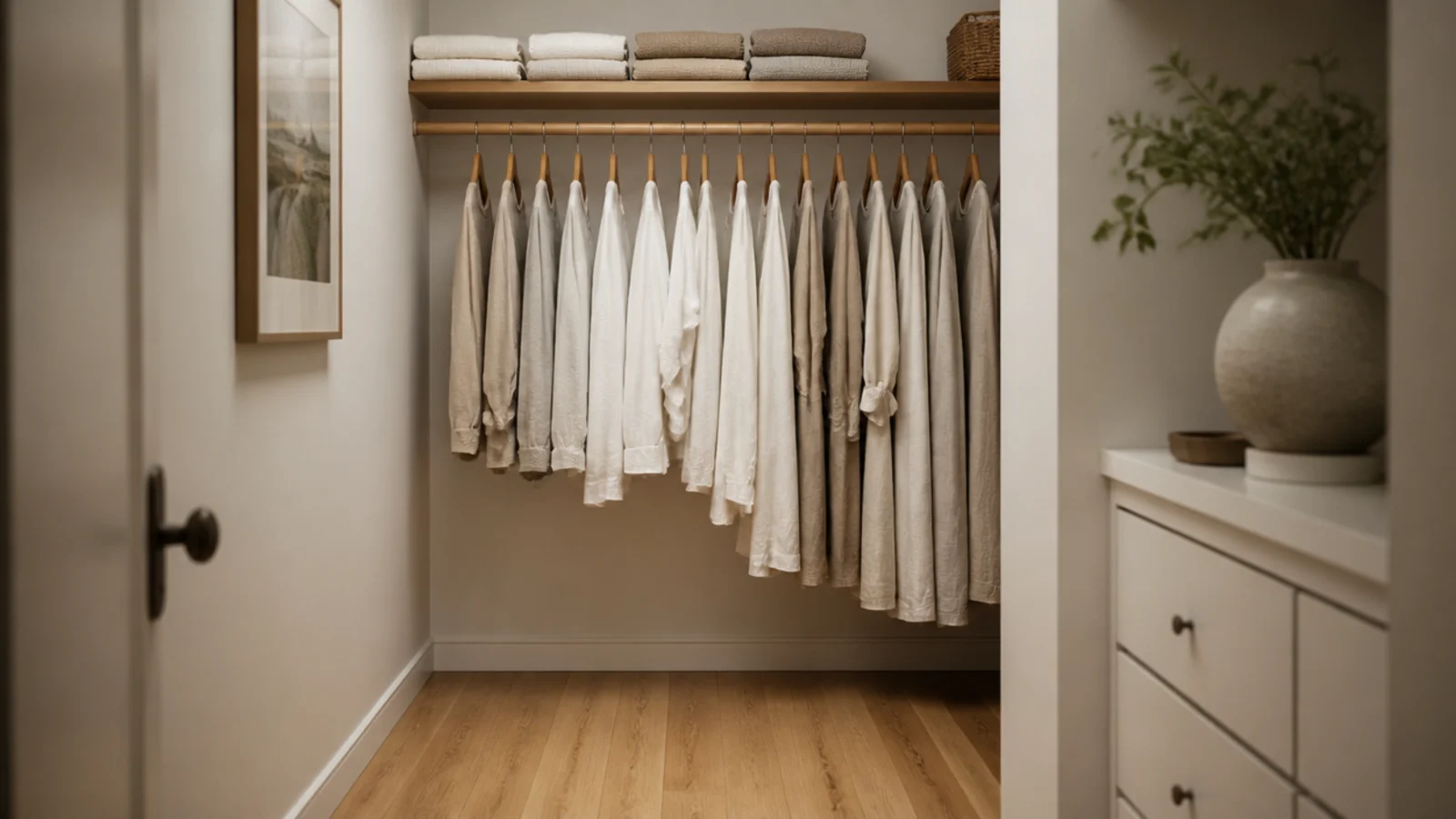
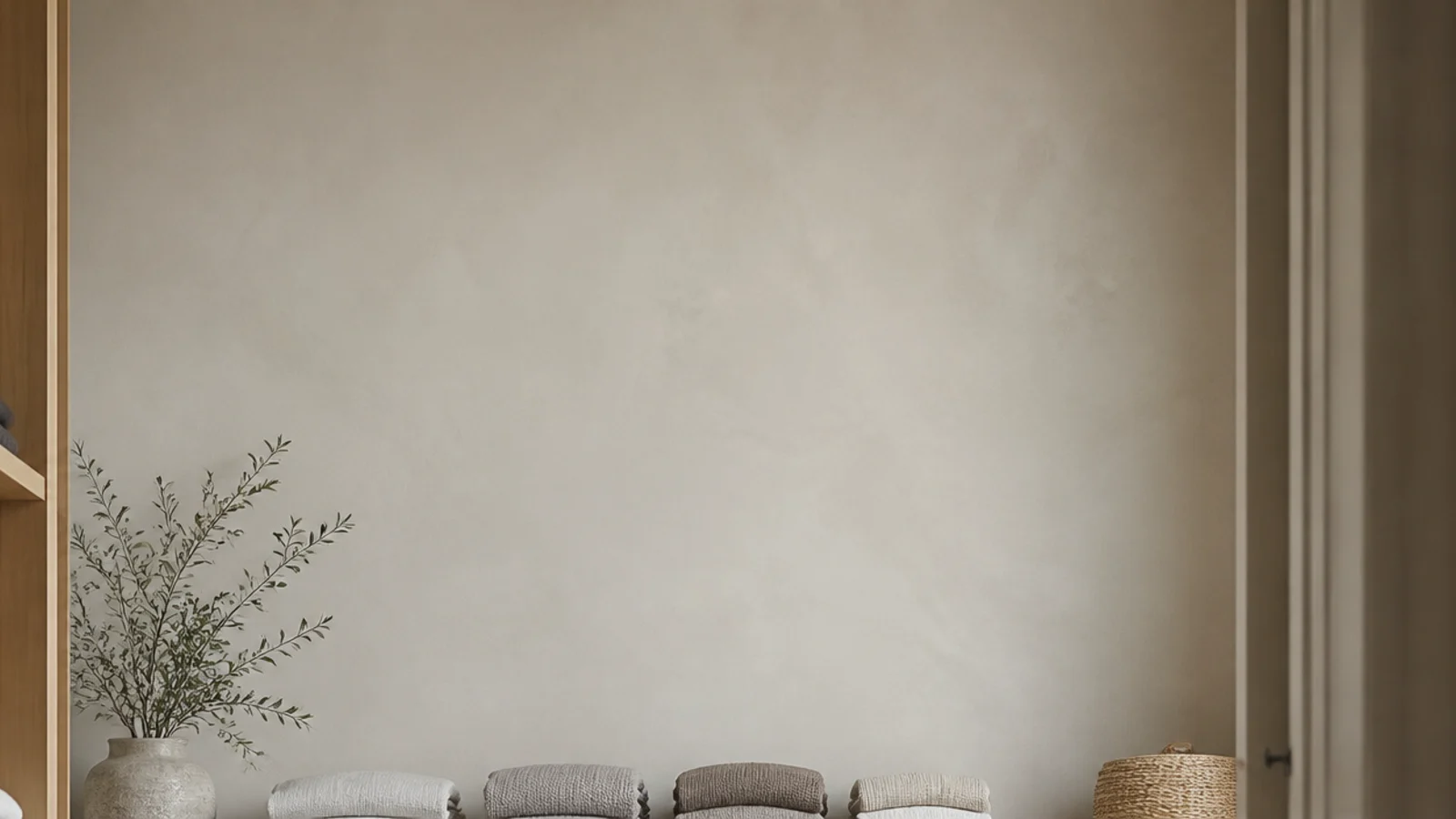
A minimalist walk-in closet is not an empty one. It is a closet where every hanger matches, every container is the same material, and the floor is completely clear. I have built two of these for myself and reset a lot of them for other people, and the calm always comes from repetition rather than from owning less. Here are thirty ideas, with the measurements that make restraint actually work in a small room.
In this guide32 sections — tap to openHide
- 1.What makes a minimalist walk-in closet work in a small room
- 2.Strip it back to one wall of hanging
- 3.Double-hang one side at 42 and 84 inches
- 4.One long-hang bay at 66 to 70 inches
- 5.Keep 24 inches of clear rod depth
- 6.A 36-inch walkway with nothing in it
- 7.Shelves at 12 to 14 inches, never deeper
- 8.One wood tone for every surface
- 9.Matching hangers with no exceptions
- 10.Handleless fronts or one finish of pull
- 11.Paint the closet the bedroom white
- 12.Open shelves instead of doors
- 13.One tray for everything small
- 14.One full-length mirror
- 15.Warm 3000K light and nothing cooler
- 16.Hidden light sources only
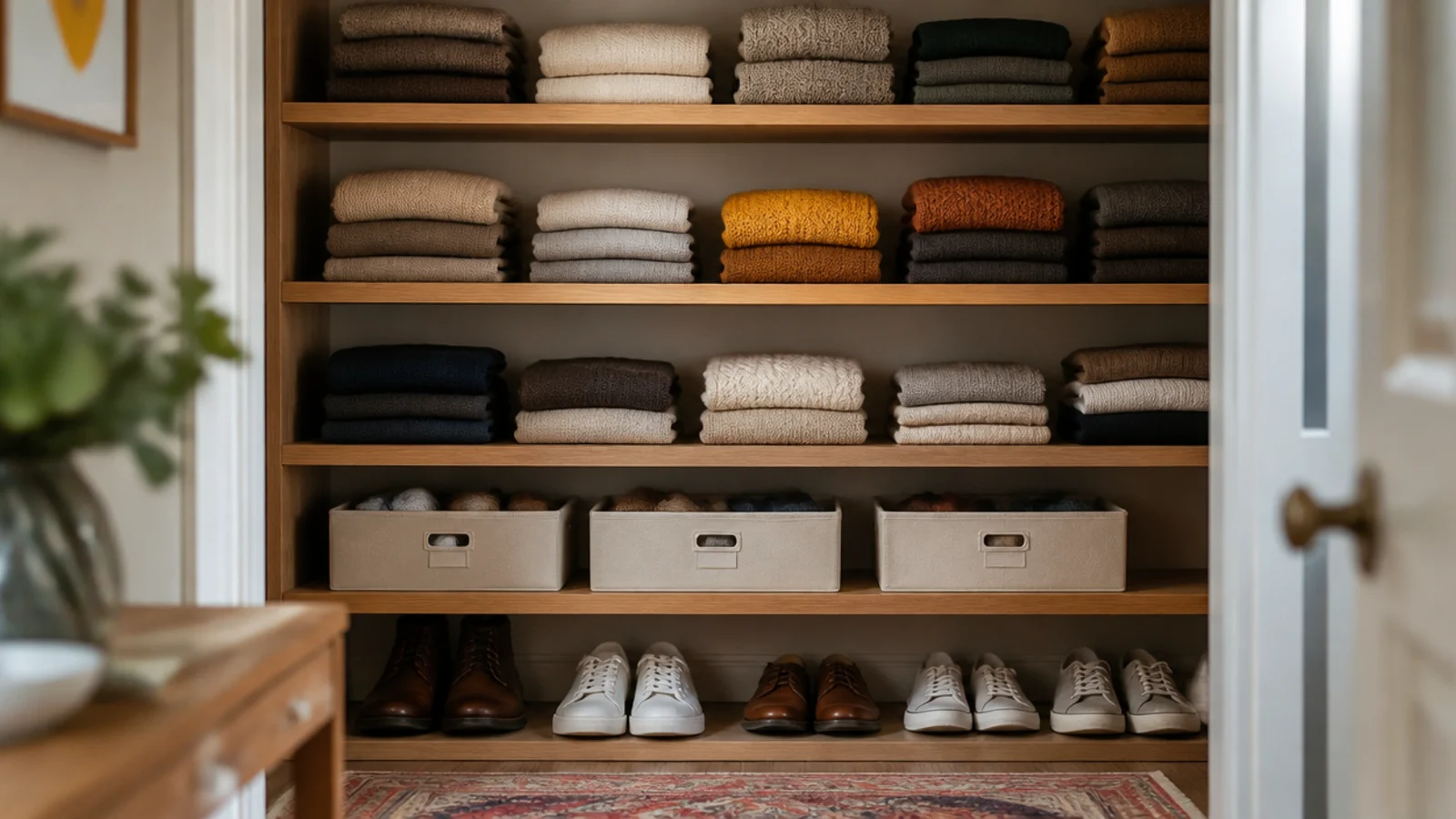
- 17.Fold knits, hang the rest
- 18.Uniform bins in one material
- 19.Clear-front shoe boxes in one size
- 20.Shoes in a single row
- 21.A hidden hamper
- 22.A donation basket that lives there
- 23.Off-season storage above the rod
- 24.Keep 20 percent of the rod empty
- 25.Run the rod from light to dark
- 26.A bench, not an island
- 27.One hook, mounted properly
- 28.One flat runner, or none
- 29.A single scent
- 30.One beautiful object at the end wall
- 31.A ten-minute monthly reset
- 32.Mistakes to Skip
What makes a minimalist walk-in closet work in a small room
Three numbers do most of the heavy lifting, and none of them are about style.
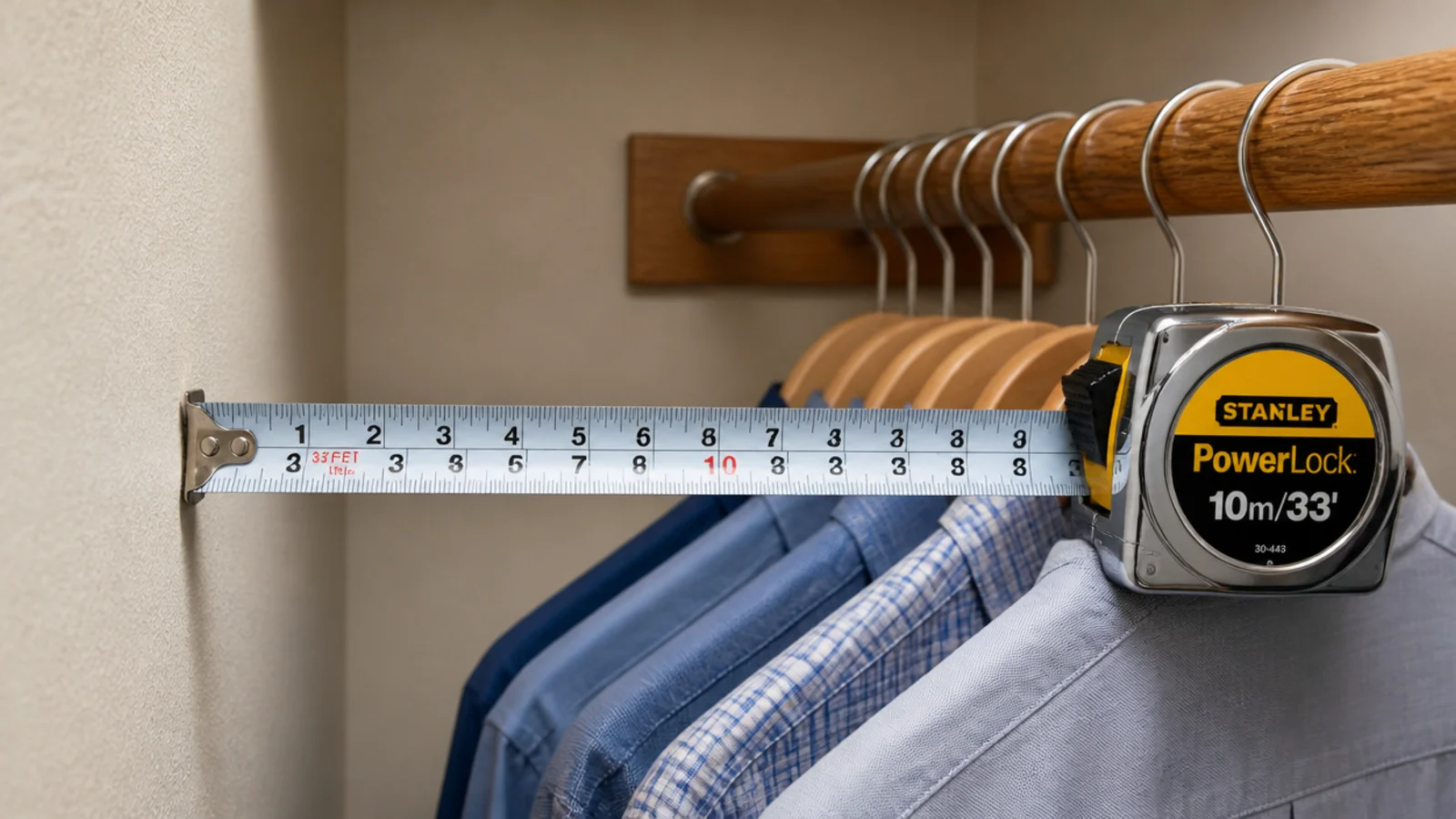
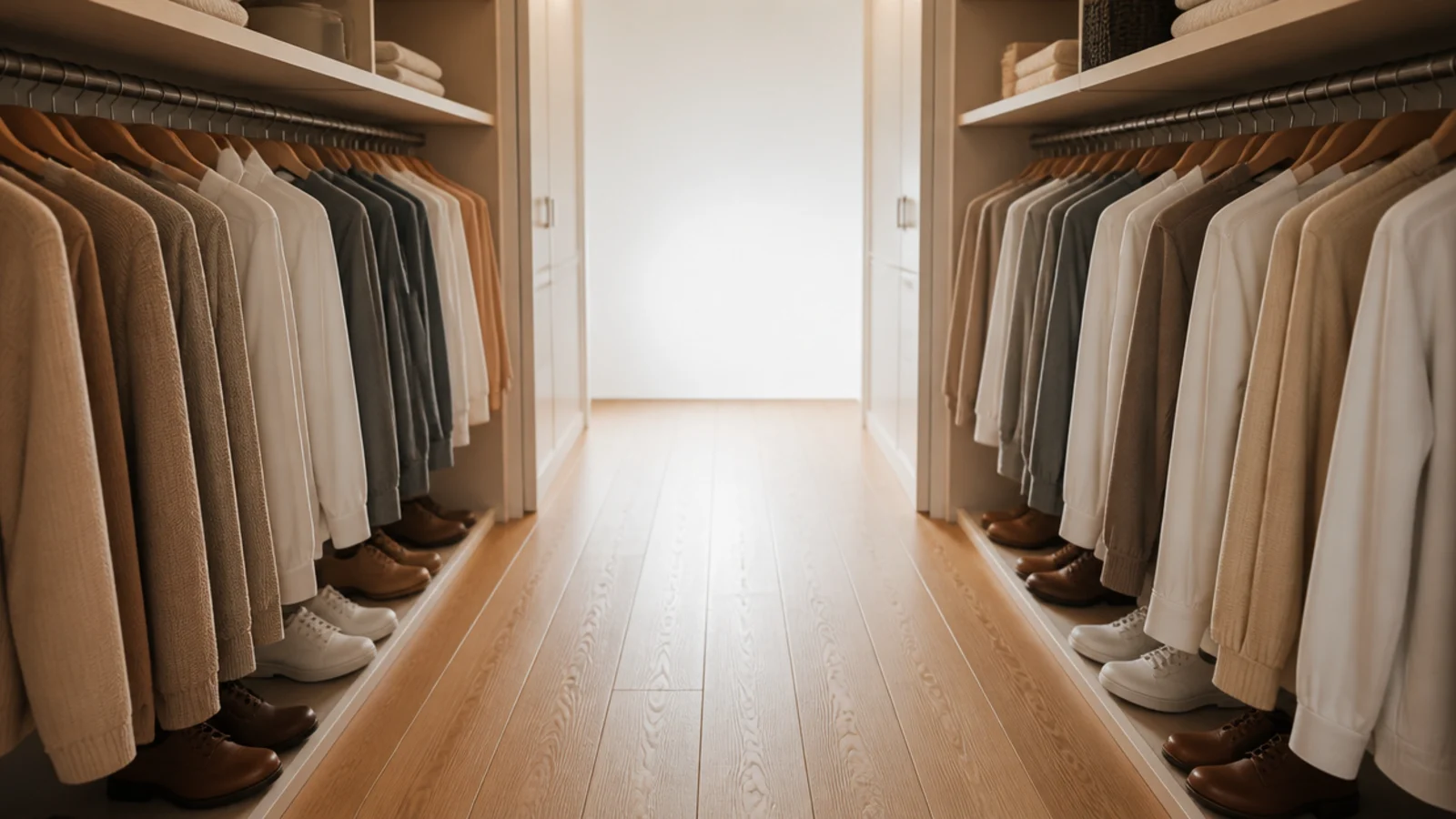
A hanging rod needs 24 inches of clear depth, because shoulders measure roughly 22 inches across. Anything shallower presses sleeves into the back wall and puts a crease down them every day. Between two facing hanging walls, keep 36 inches of walkway; 30 is the absolute squeeze and you will feel it in a coat.
Rod heights: single-hang sits at 66 to 72 inches, double-hang splits into 42 and 84, and long-hang needs 66 to 70 inches of clear drop. Shelves want 12 to 14 inches of depth for folded knits and no more, because deeper shelves only build a back row you forget.
Then the light. Stay at 3000K or warmer with a CRI of 90 or above, or camel reads grey, navy reads black, and a carefully edited wardrobe looks flat.
Budget tiers here: $ under $75, $$ $75 to $250, $$$ $250 and up. Most of what follows costs nothing at all.
1. Strip it back to one wall of hanging
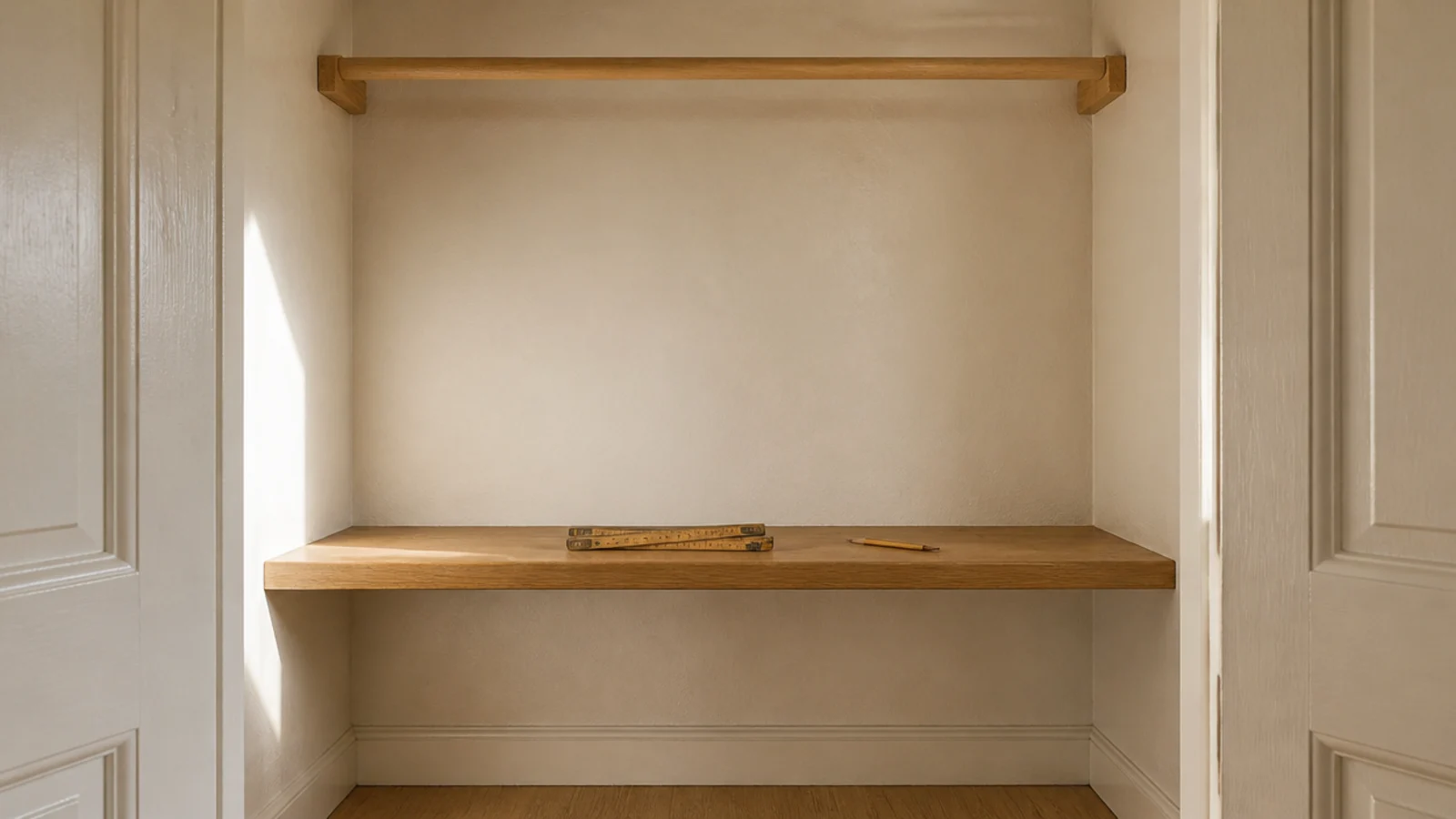
In a closet under seven feet wide, hanging on both walls is what makes it feel like a corridor. Put all the hanging on one side and shelving on the other.
You lose less capacity than you expect because double-hang recovers it, and you gain a walkway you can turn around in. Free, and it takes an afternoon.
2. Double-hang one side at 42 and 84 inches
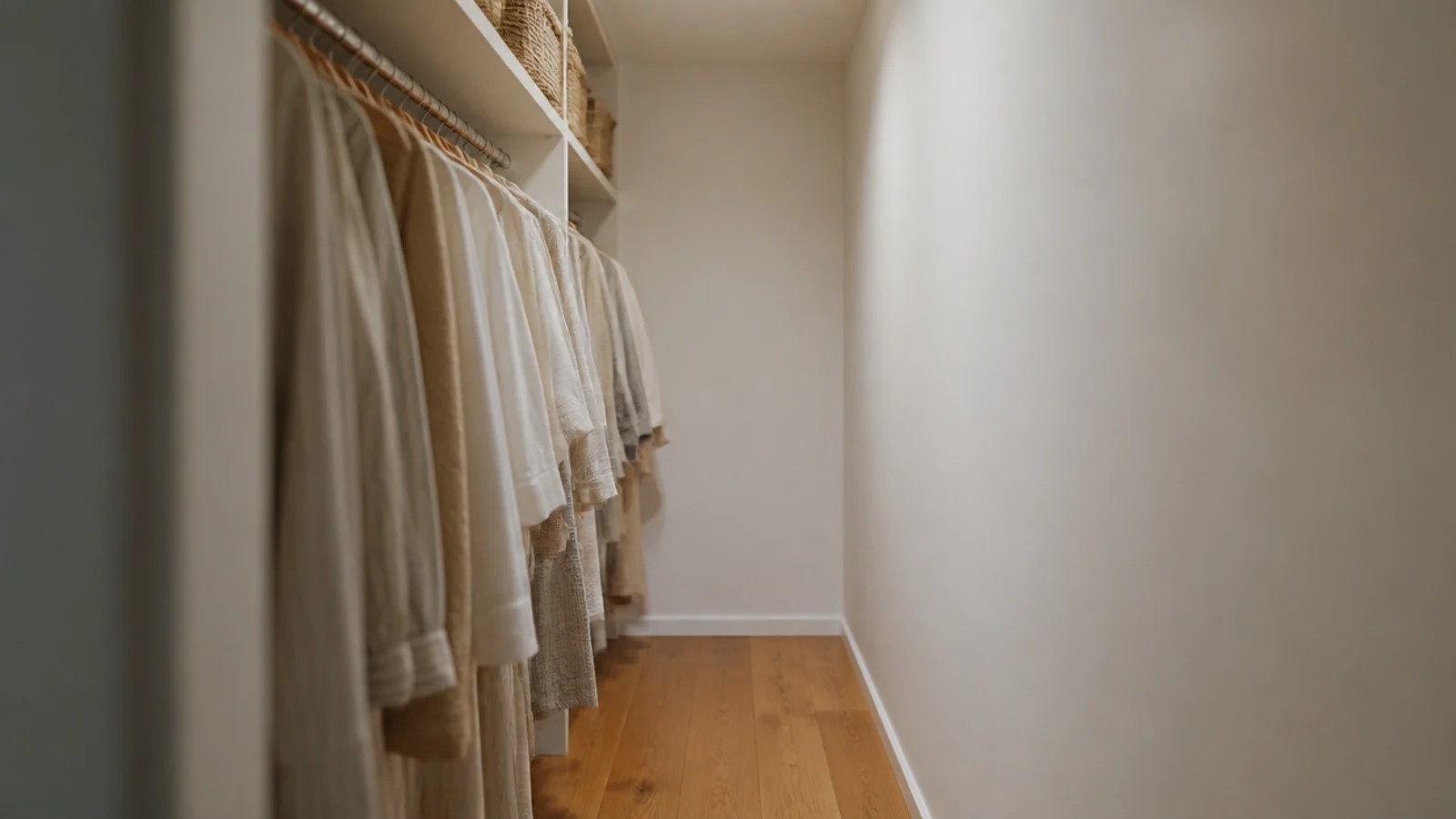
The lower half of a single-hang wall is usually storing air. Split it.
A rod at 42 inches with a second at 84 doubles what that wall carries, and it is the single change that lets a minimalist closet stay minimalist without a purge. Rail hardware runs $30 to $60; a tension rod does it for $20.
3. One long-hang bay at 66 to 70 inches
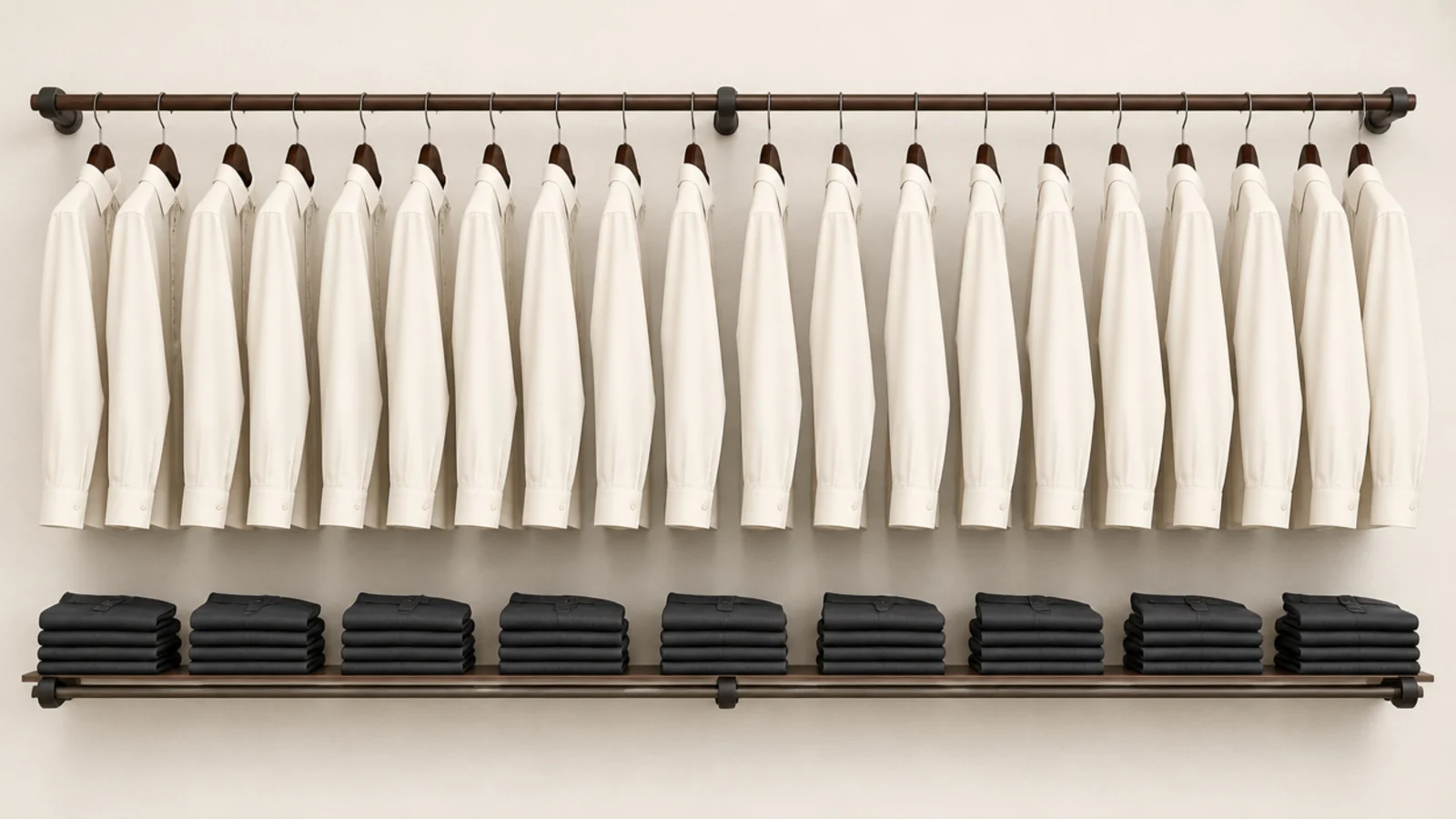
Double-hang everywhere is a mistake the moment you own a coat or a dress.
Keep one bay at full length with 66 to 70 inches of clear drop, and put it at the far end so the longest line of fabric closes the view. Thirty to thirty-six inches of width covers most wardrobes.
4. Keep 24 inches of clear rod depth
This is the number people skip and then live with forever.
Measure from the back wall to the front of the shoulder line. Under 24 inches, garments touch plaster and crease along the same line daily, and the rail looks permanently untidy no matter how well you fold everything else. Costs nothing to get right at the planning stage.
5. A 36-inch walkway with nothing in it
The clear floor is the whole aesthetic. Everything else is supporting it.
Thirty-six inches between facing hanging walls is comfortable, 30 is a squeeze. Whatever the number, put nothing on that floor: no baskets, no shoes, no laundry. A closet with a clear floor reads generous even when the rails are full.
6. Shelves at 12 to 14 inches, never deeper
Deep shelves feel generous and behave badly, because everything past 14 inches becomes a second row you stop seeing.
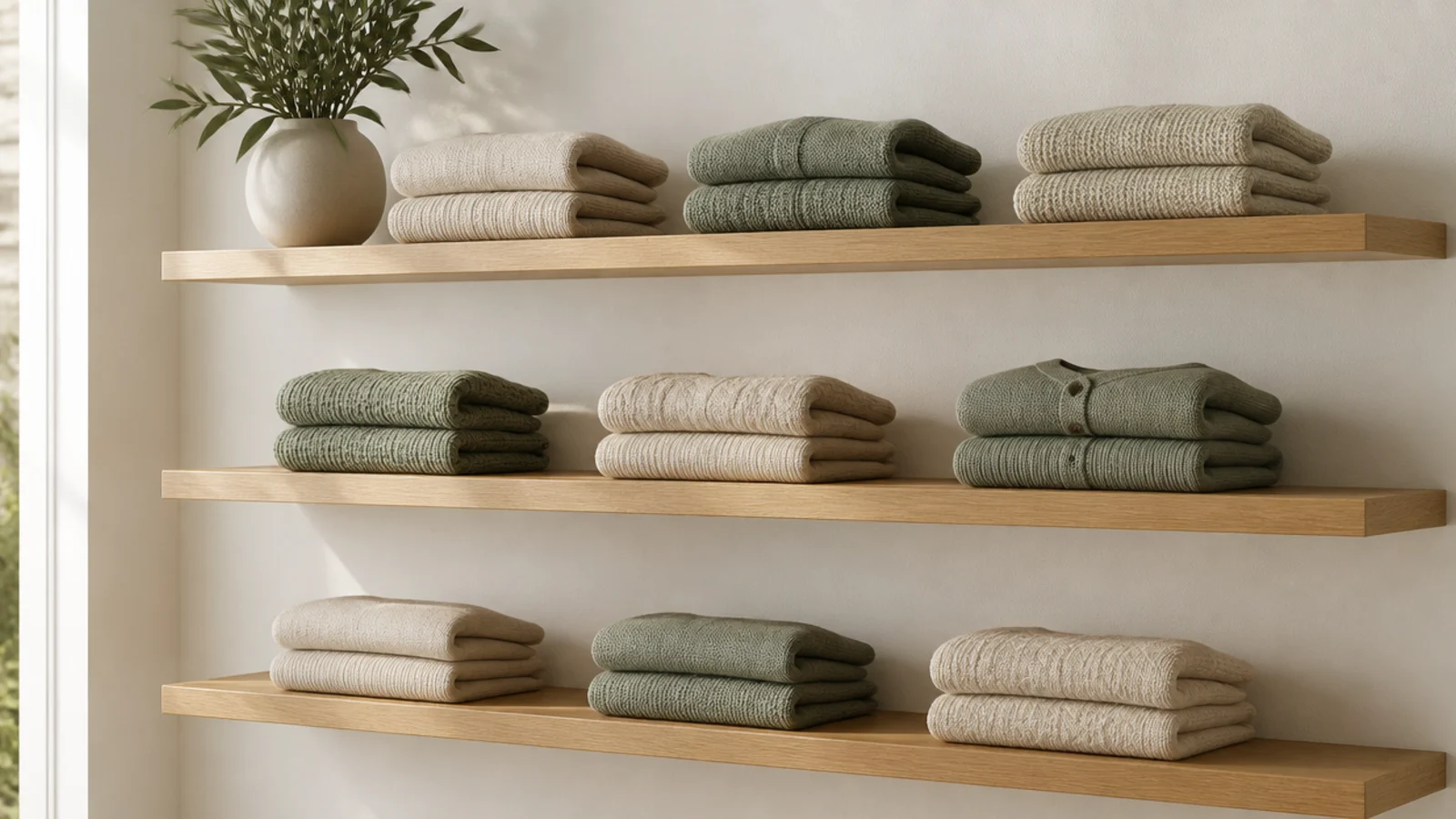
Twelve to fourteen inches takes a folded sweater, a stack of jeans or two rows of shoes and nothing gets lost. If your existing shelves are 20 inches deep, use bins to define the front section rather than filling to the back.
7. One wood tone for every surface
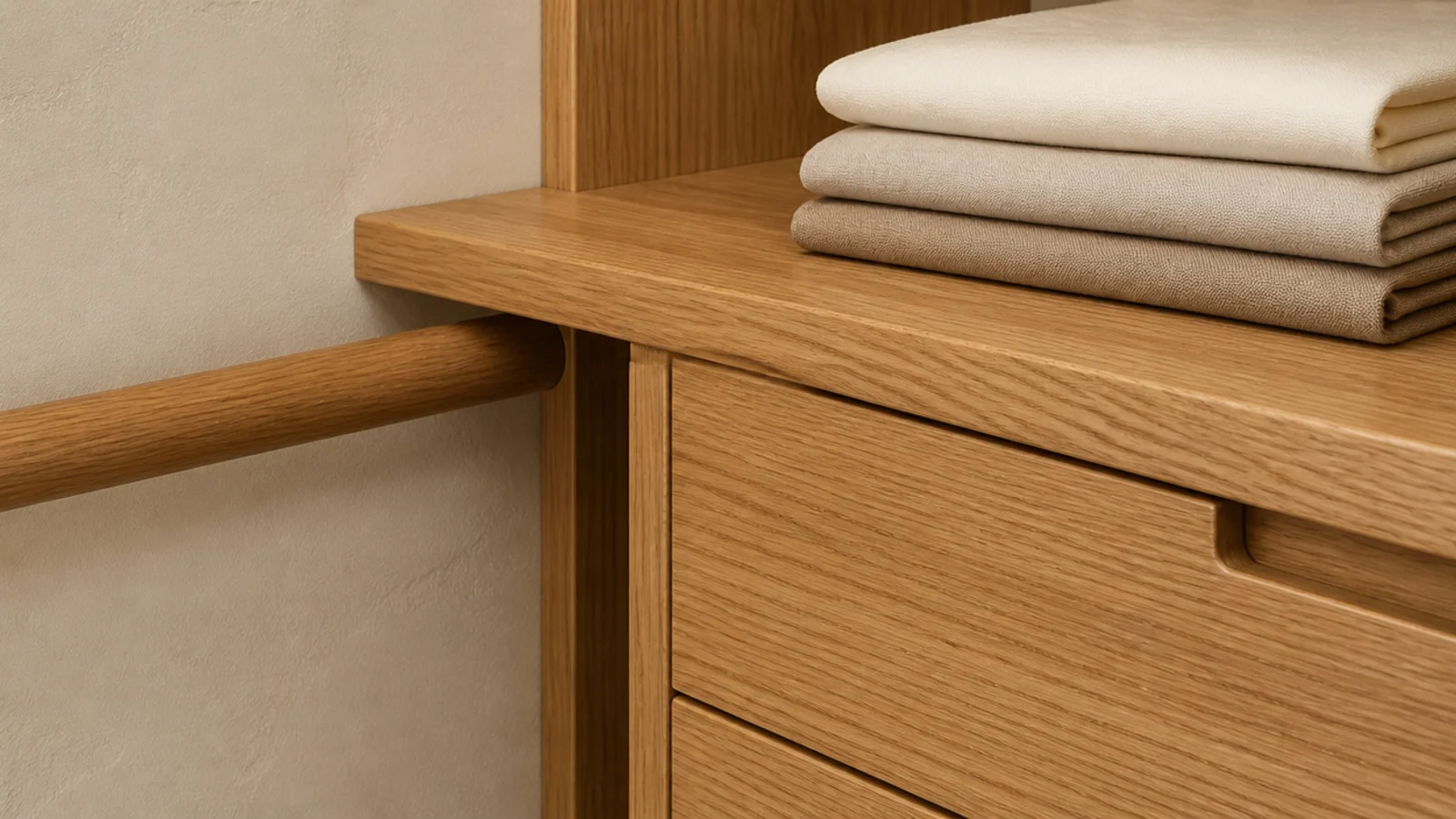
Mixed woods are the fastest way to make a small closet feel busy, and they are also the cheapest thing to fix.
Pick one species or one paint colour and apply it to rails, shelf edges and drawer fronts. Painting mismatched pieces the same warm white achieves this for the price of a sample pot.
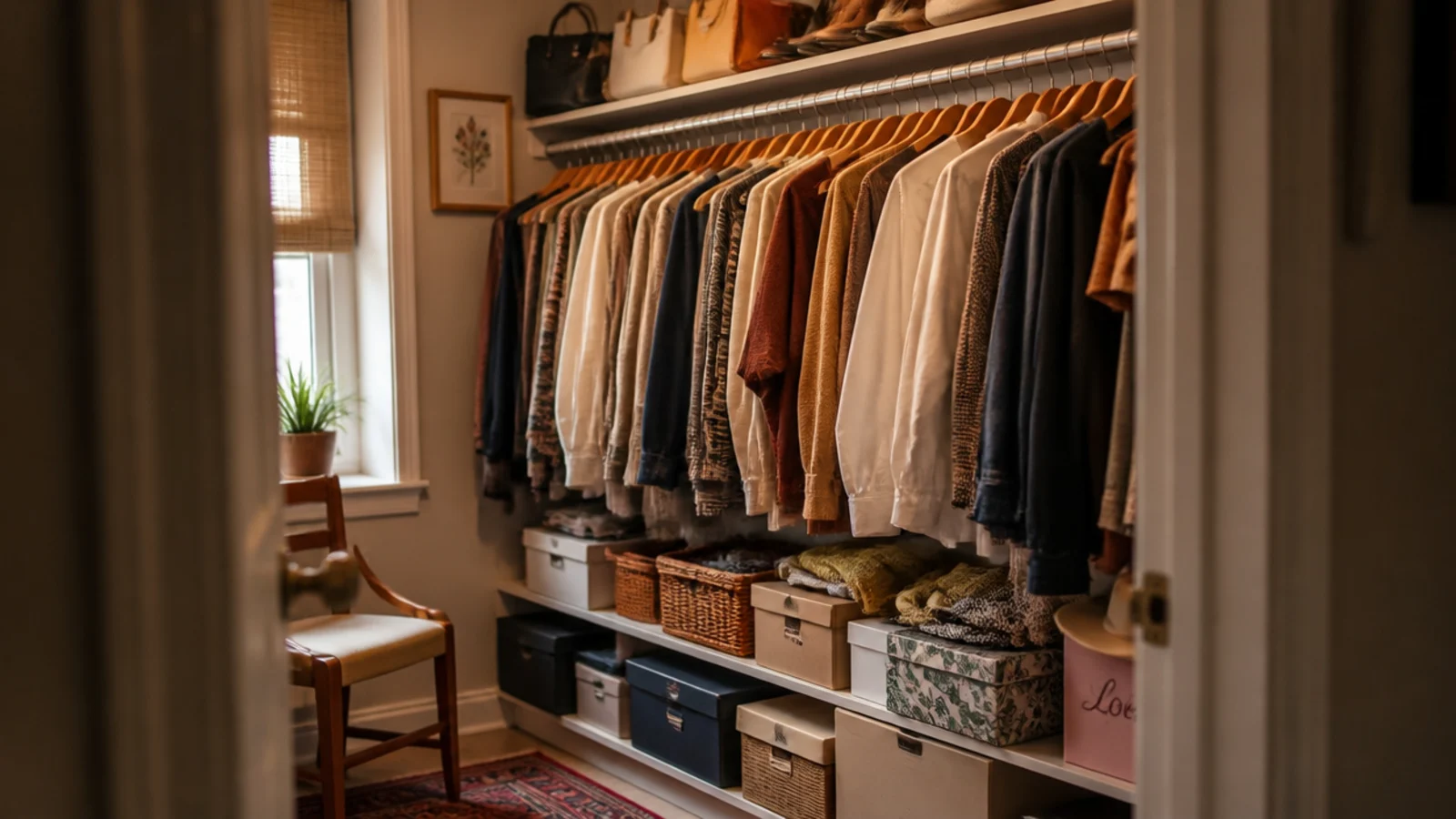
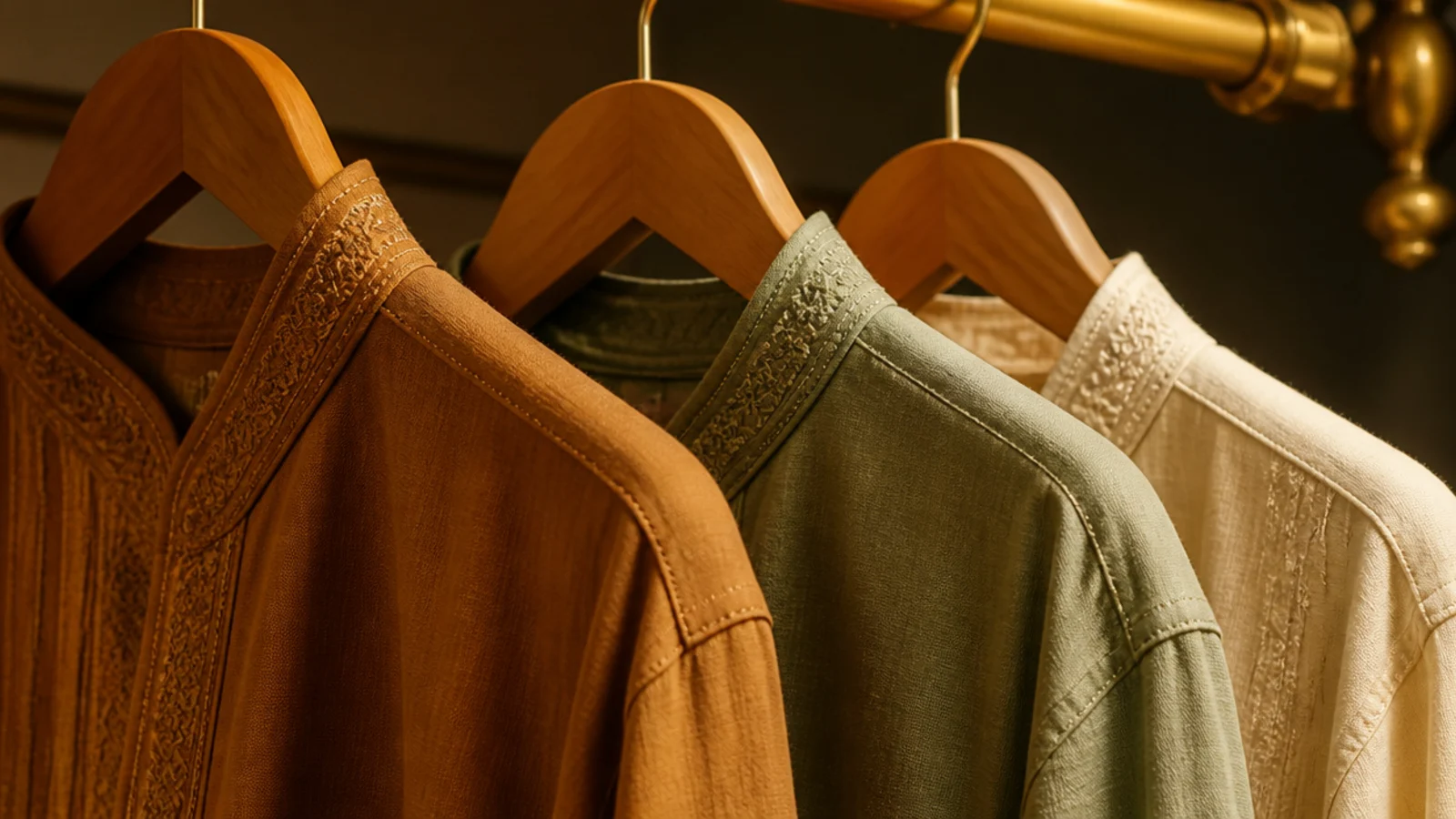
8. Matching hangers with no exceptions
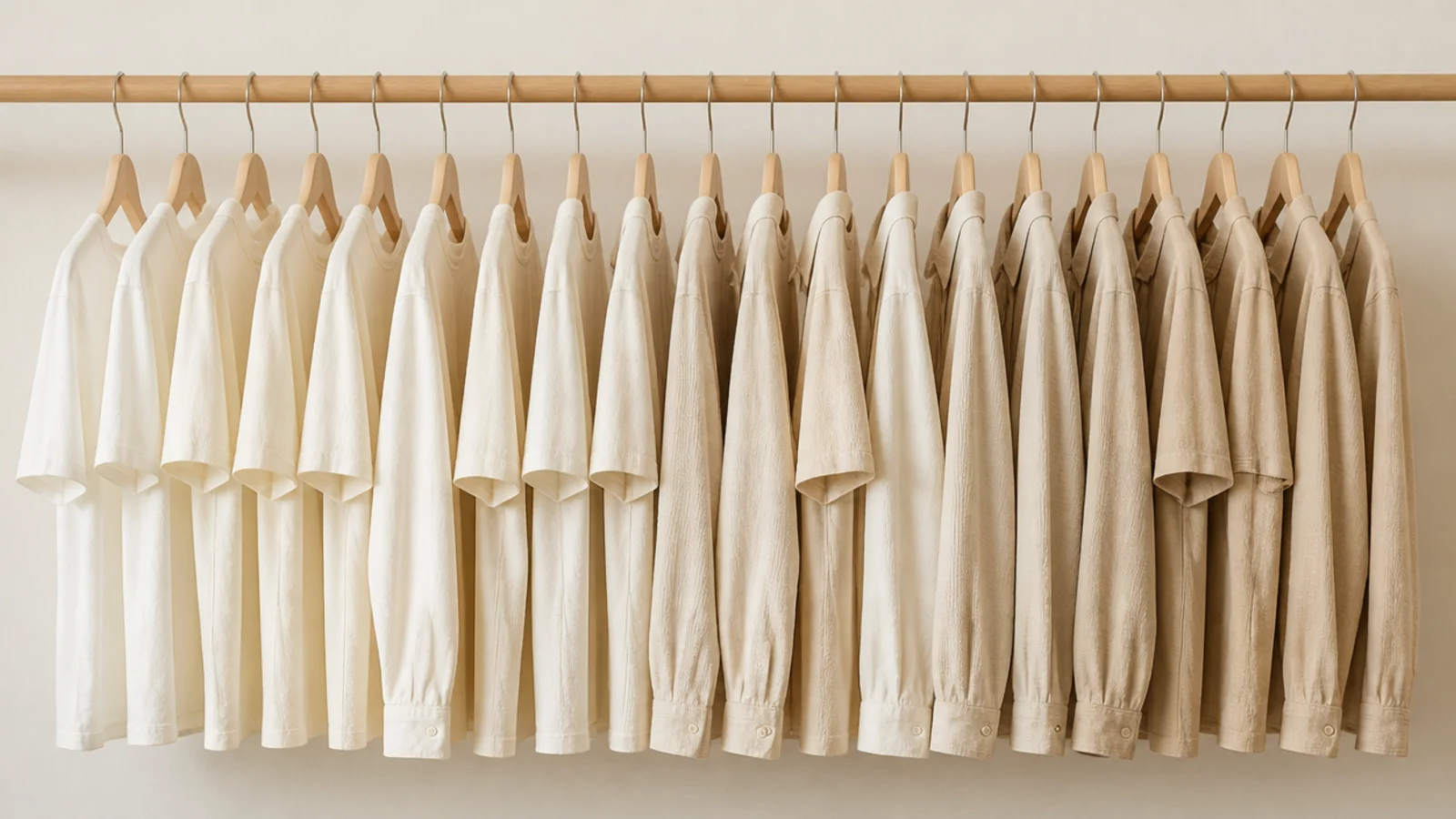
Nothing changes how a closet reads more for under $30. Mixed hangers break the shoulder line, and a broken shoulder line is what your eye registers as clutter.
Fifty slim velvet or natural wood hangers cost $20 to $35 and gain roughly a foot of rod. Keep one set of wide wooden hangers for coats, which slim hangers cannot support.
9. Handleless fronts or one finish of pull
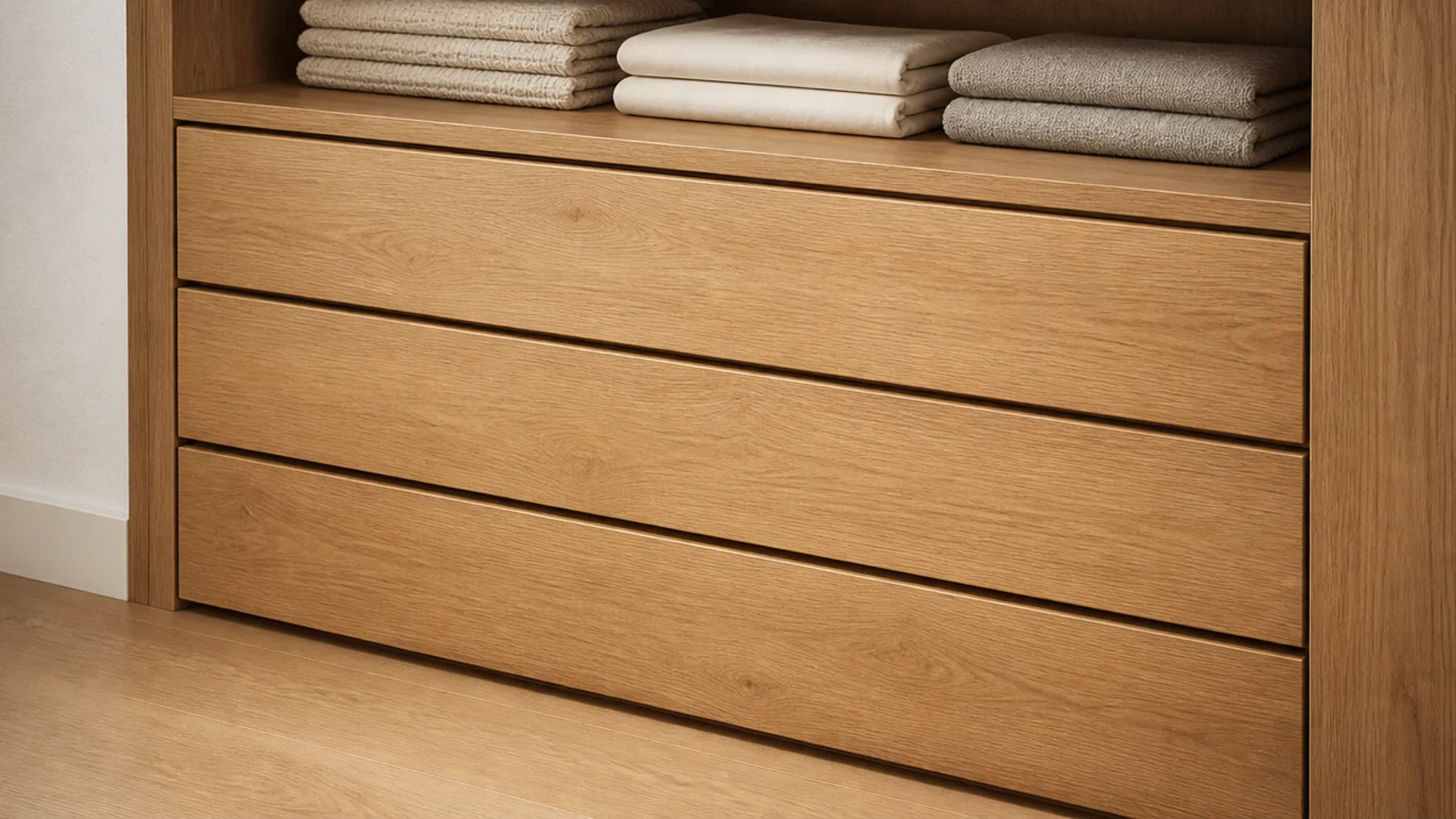
Every handle is a small visual event. In a closet under eight feet wide, six of them is a lot of events.
Push-to-open drawer fronts remove the layer entirely. If you want pulls, use one shape in one finish across every drawer, including the ones you rarely open. Retrofit pulls run $6 to $15 each.
10. Paint the closet the bedroom white
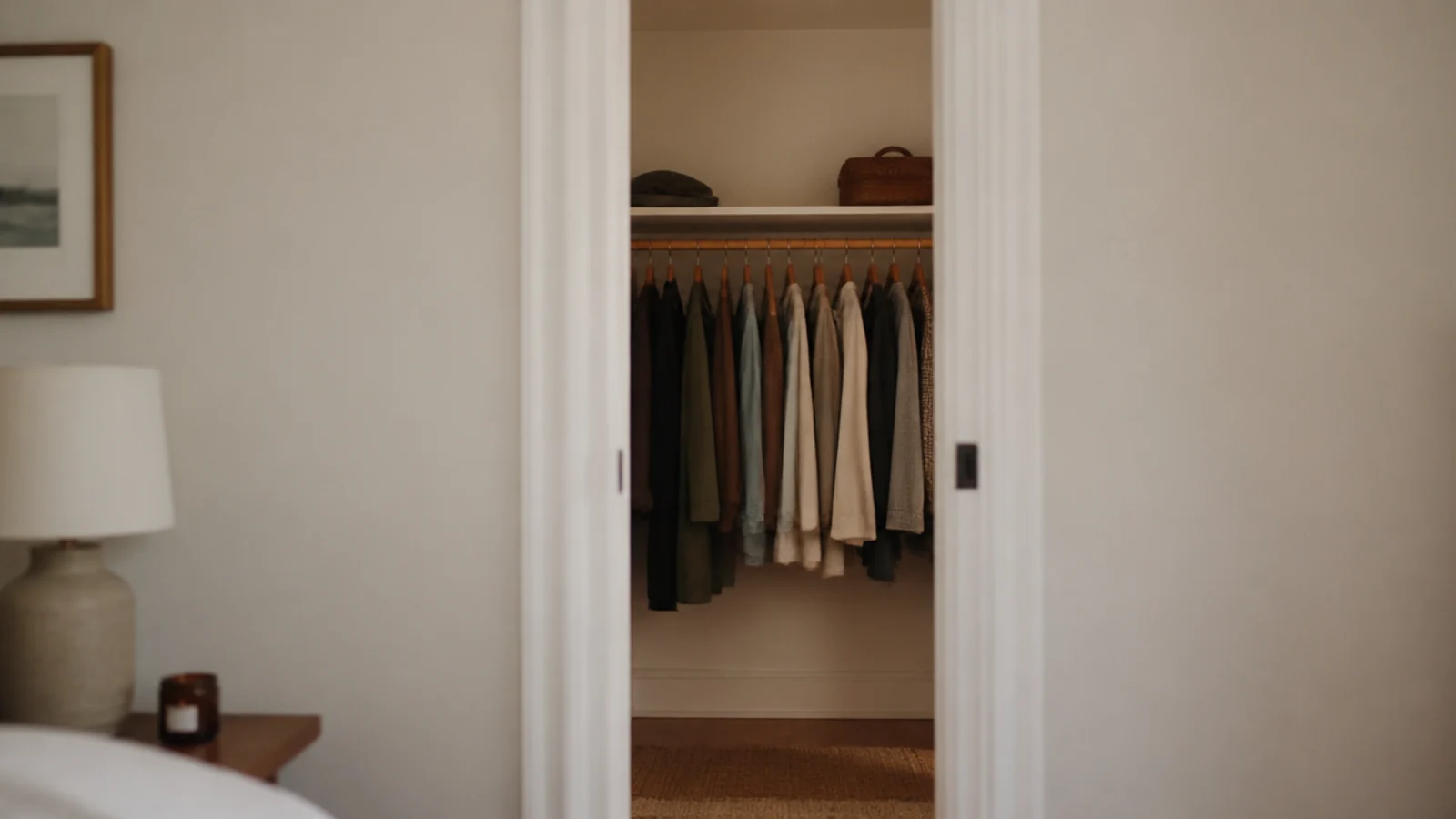
A closet in a different colour from the room it opens off always reads as a separate box.
Use the same warm white, and carry it across the ceiling too. Warm whites flatter clothing under warm light; cool greys drain it. One gallon covers a small walk-in for about $35 and improves every other decision in the room.
11. Open shelves instead of doors
Doors hide mess and also hide what you own, which is how three identical grey sweaters happen.
Open shelving forces a weekly reset and makes the closet read architectural rather than fitted. Keep doors only for the genuinely unattractive: laundry, cleaning things, chargers.
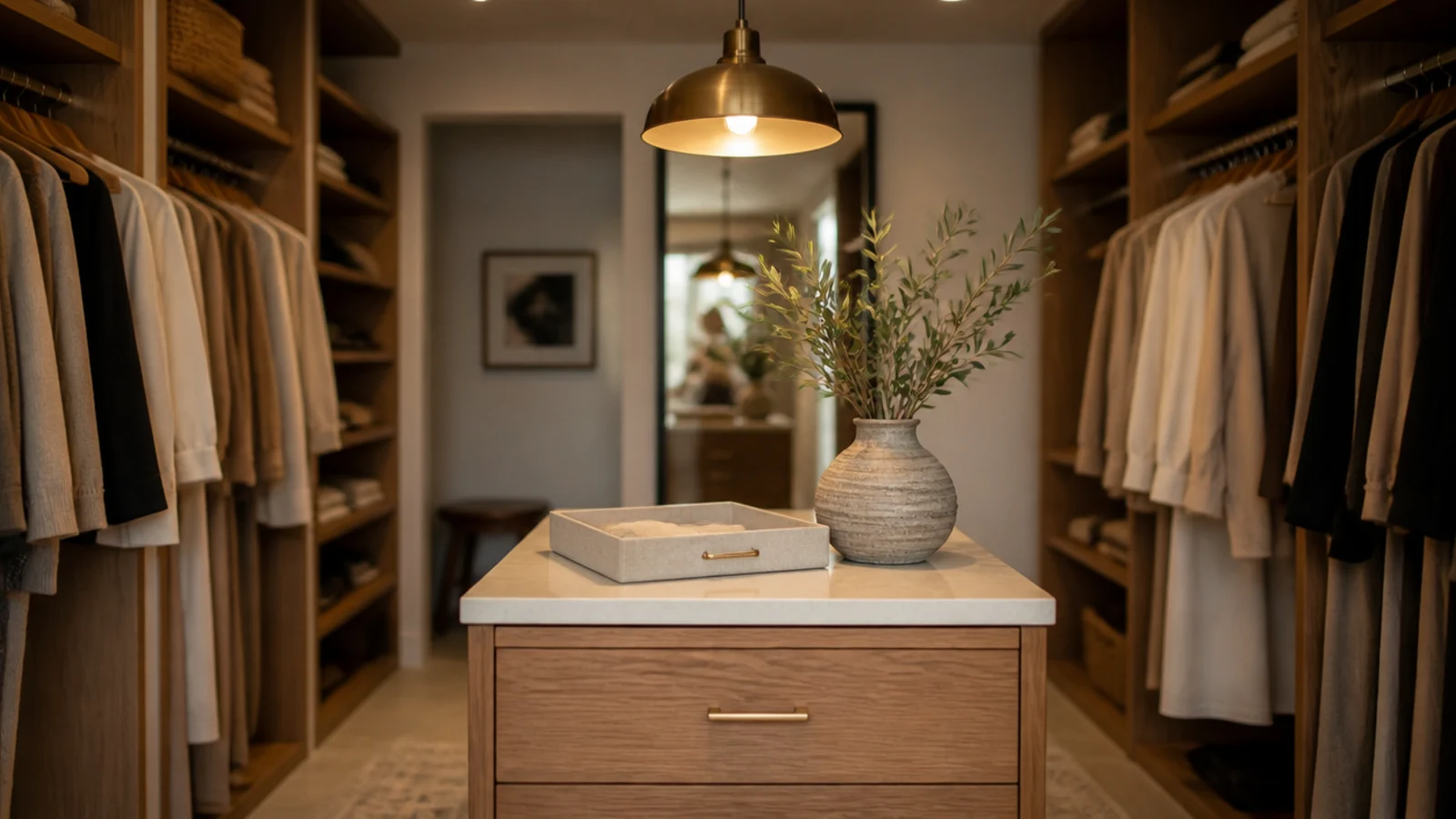
12. One tray for everything small
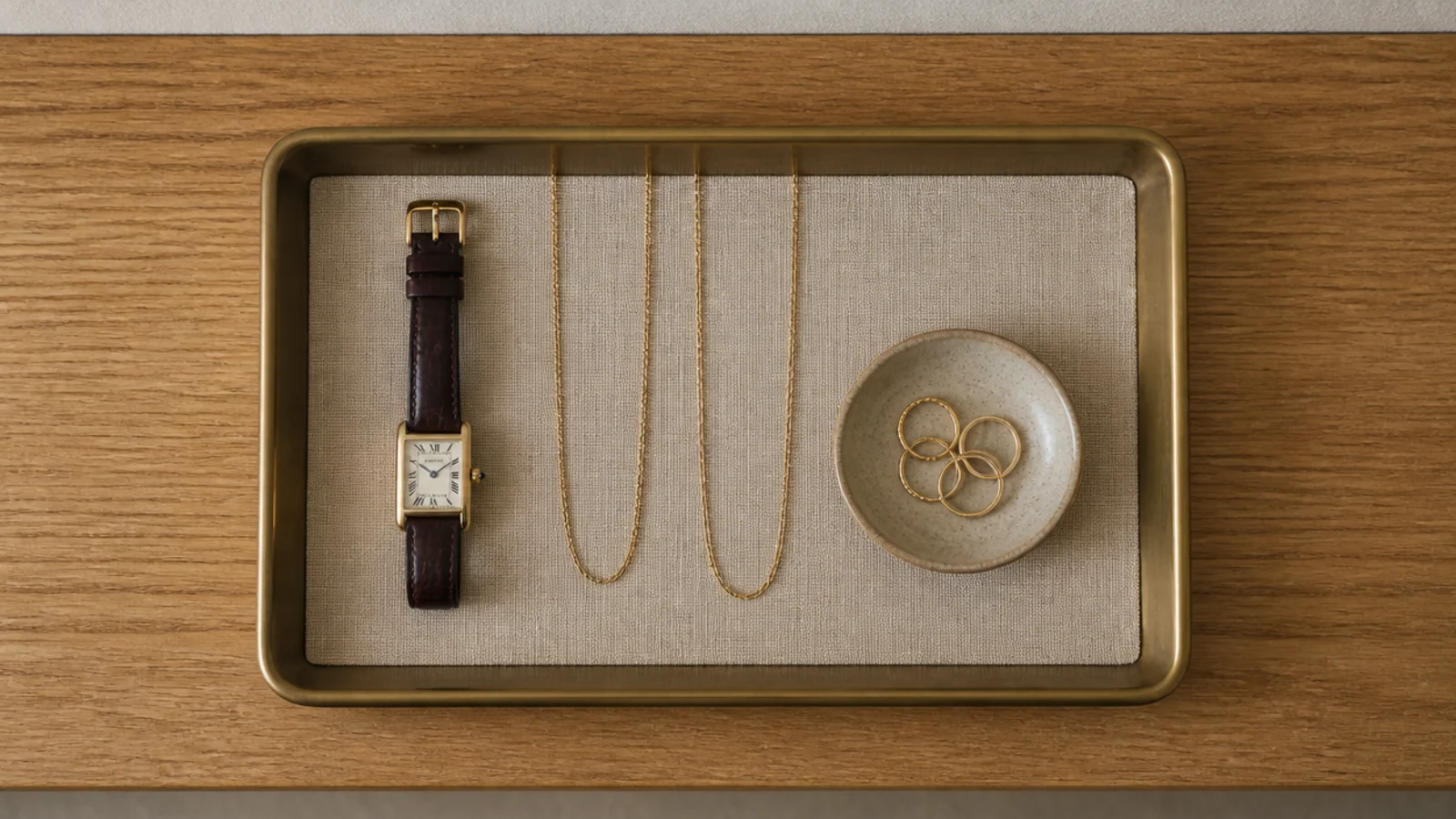
Every surface in a closet collects. A single tray decides where.
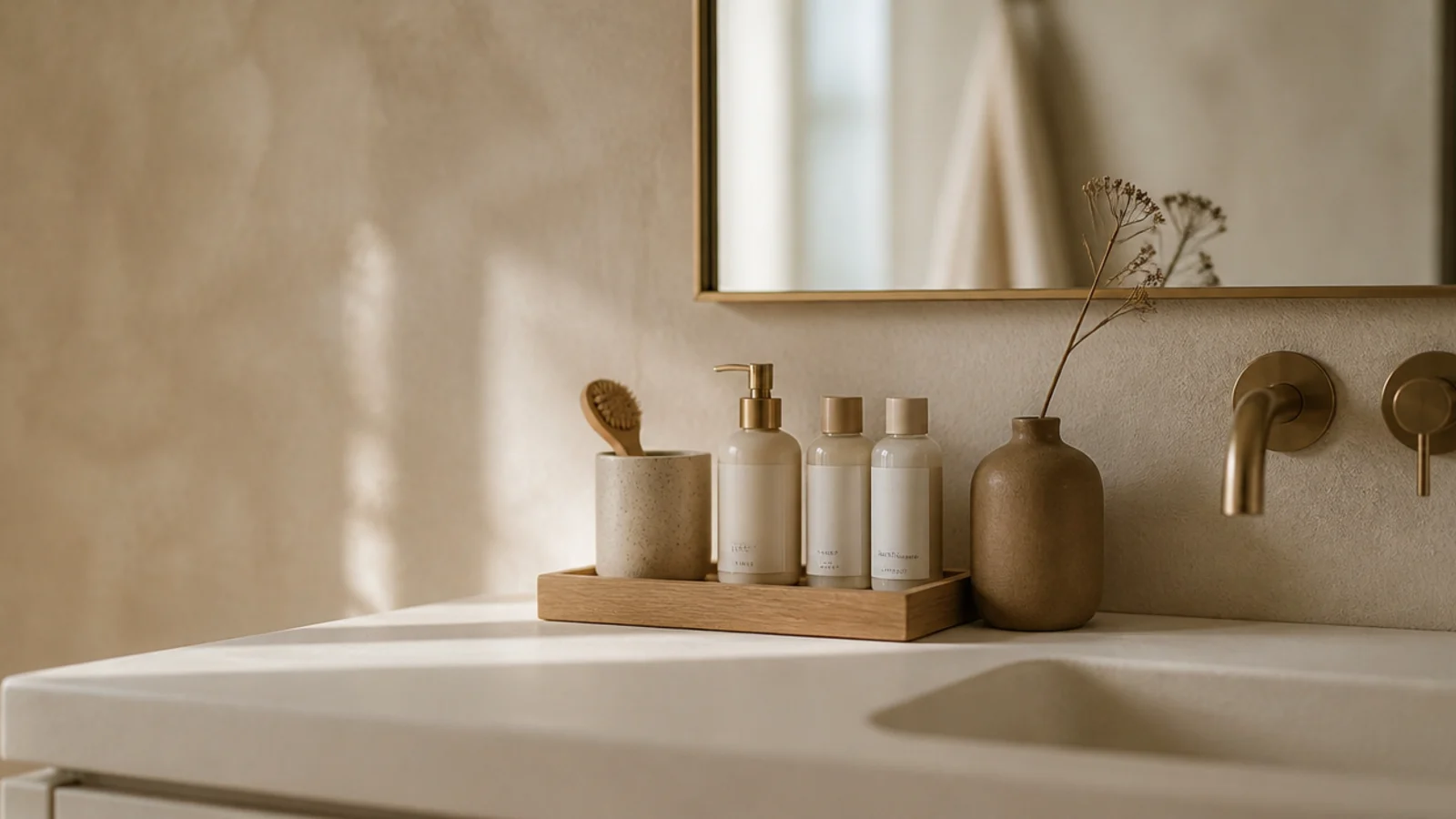
A brass or lacquered tray around 12 by 18 inches, lined in linen, holds perfume, rings and yesterday's pocket contents. Anything inside it reads as styled, anything outside reads as mess, and that boundary does the work. Around $30 to $80. The same logic runs through minimalist vanity organization.
13. One full-length mirror
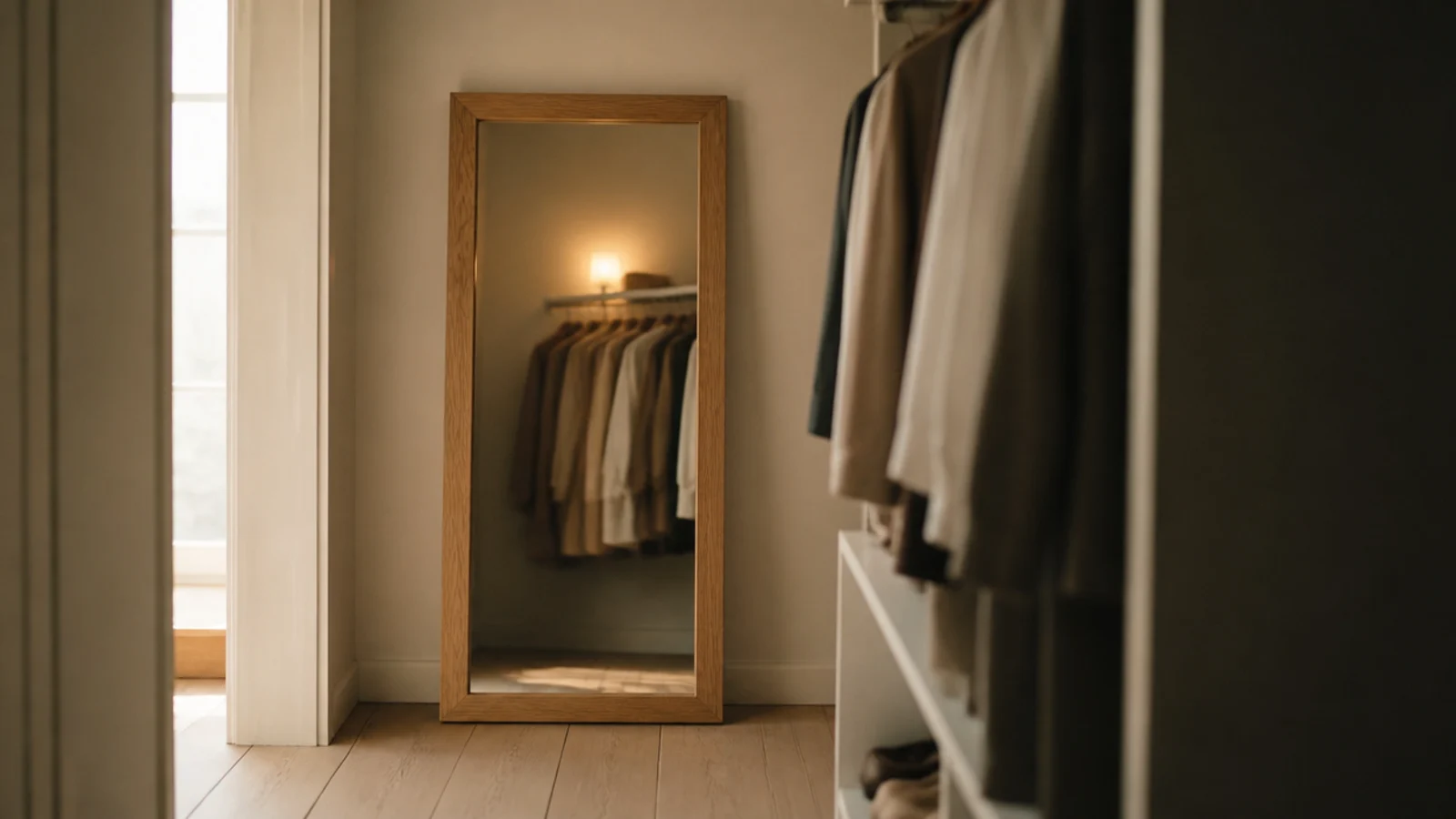
Not three mirrored surfaces, not mirrored doors. One good mirror at 60 to 70 inches tall, where the light falls on your face rather than your shoulders.
Lean it on the end wall so the reflection continues the line of the floor and the closet reads twice as long. $80 to $250, plus one anti-tip strap.
14. Warm 3000K light and nothing cooler
The most common reason a beautifully edited closet looks flat is the bulb.
Stay at 3000K or warmer with a CRI of 90 or above. Cooler light makes camel read grey and navy read black, so you dress in one palette and step outside in another. Four dollars a bulb, and it is the first thing I change anywhere.
15. Hidden light sources only
You want to see the light, never the fitting. That single rule separates expensive-looking closets from bright ones.
Run warm tape under the shelf lip, set back an inch, or use recessed pucks with a diffuser. Anything with visible diodes reads as a workshop. A 6-foot reel costs $12 to $18. Hardwired fixtures are electrician work.
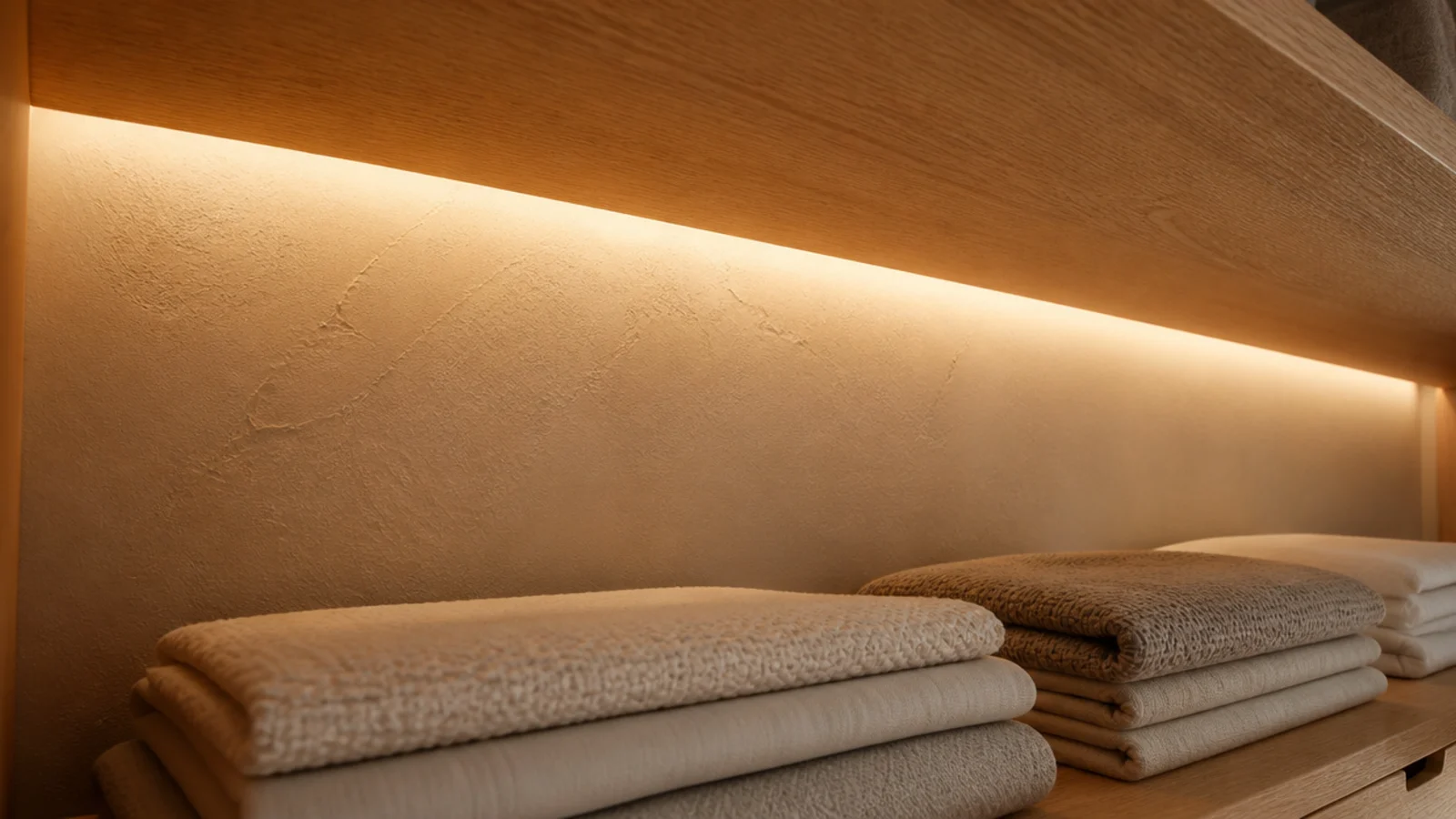
16. Fold knits, hang the rest
Wool and cotton knits stretch at the shoulder within a season on a hanger, and a stretched sweater is the definition of visual clutter.
Fold everything knitted onto shelves at 12 to 14 inches deep, hang everything woven. This also balances the closet, because folded stacks give your eye somewhere flat to rest between rails.
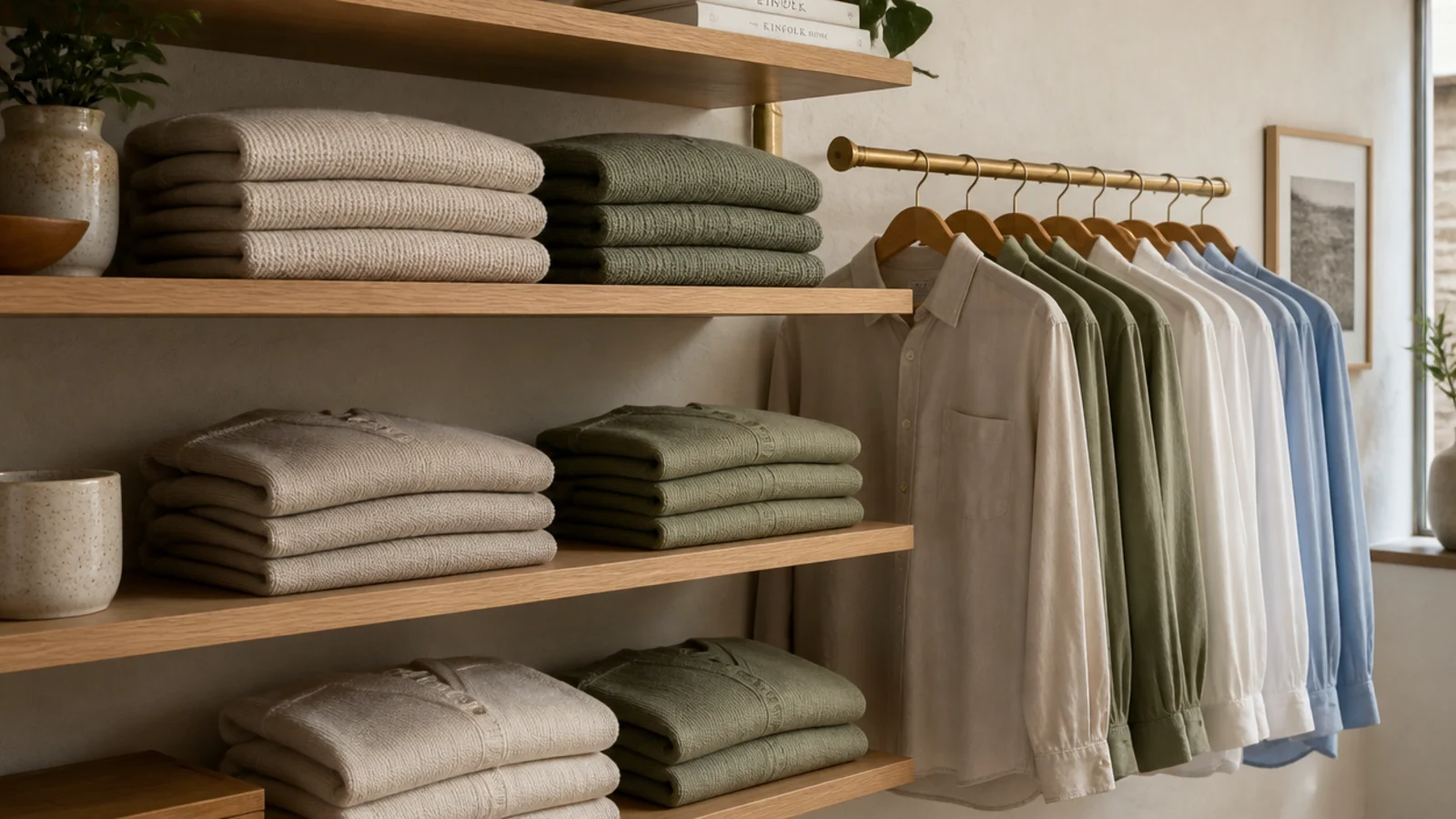
17. Uniform bins in one material
Five identical canvas bins look intentional. Two canvas, two plastic and a cardboard box looks like a closet mid-move, and the difference costs about fifteen dollars.
Buy bins sized to the shelf depth rather than eyeballed, with a stiff frame so they hold shape half empty. $8 to $15 each.
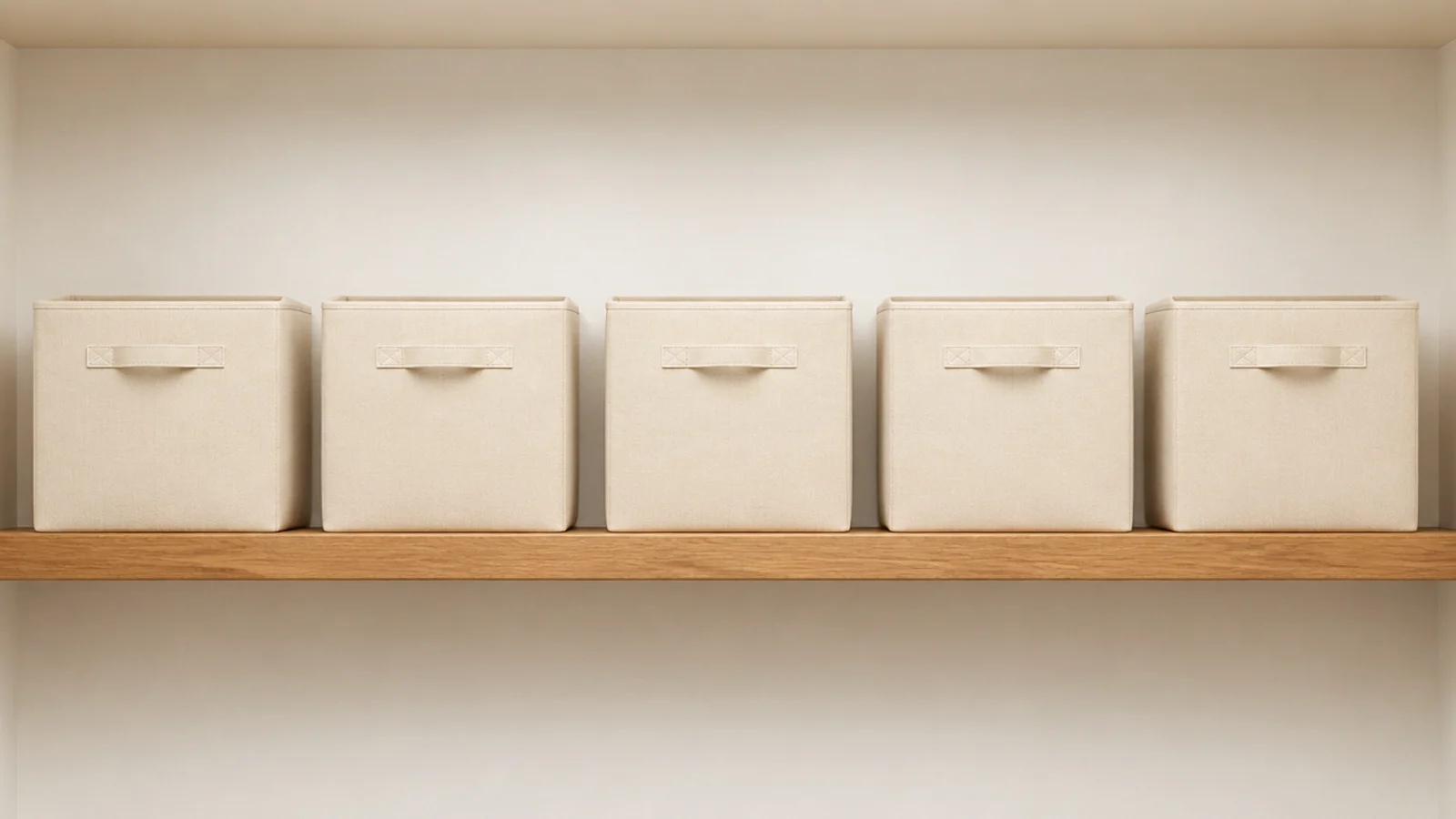
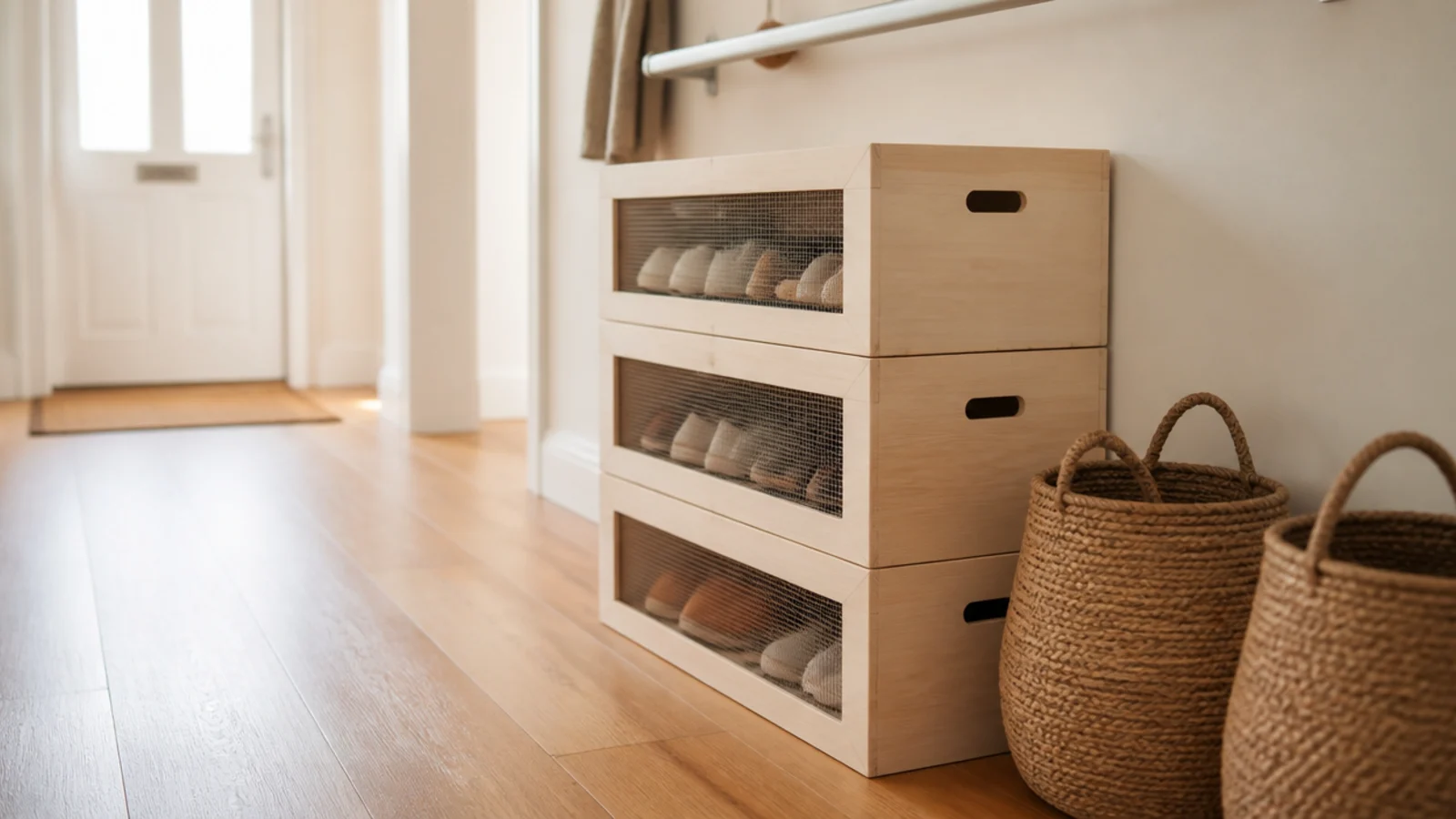
18. Clear-front shoe boxes in one size
Shoe boxes only work if they stack, and they only stack if they match.
Pick one size in a clear or frosted front, around 13 by 9 by 6 inches for most pairs, and buy a few more than you need. Mixed original boxes are the most common source of visual noise on a closet shelf. $4 to $8 each.
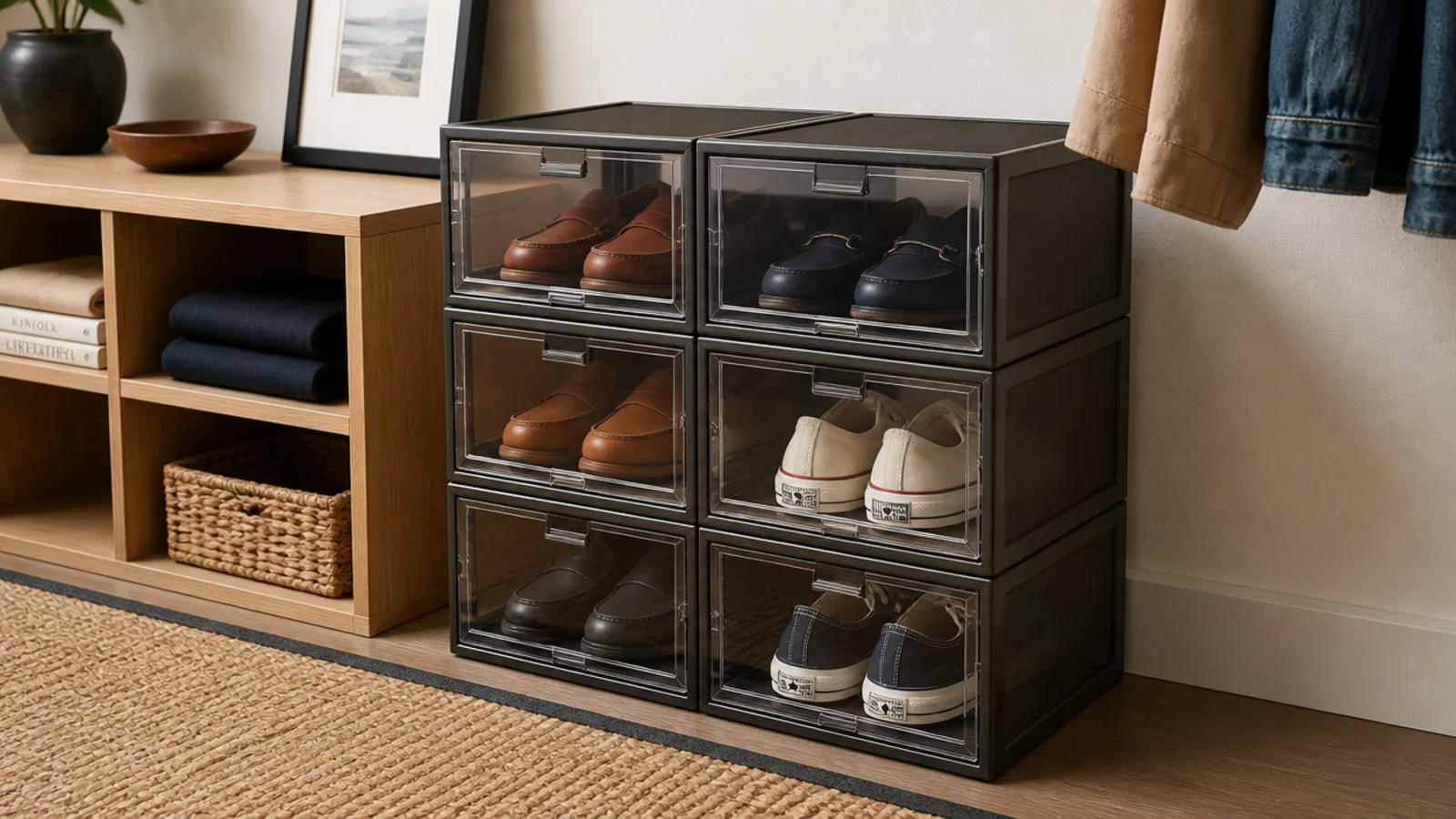
19. Shoes in a single row
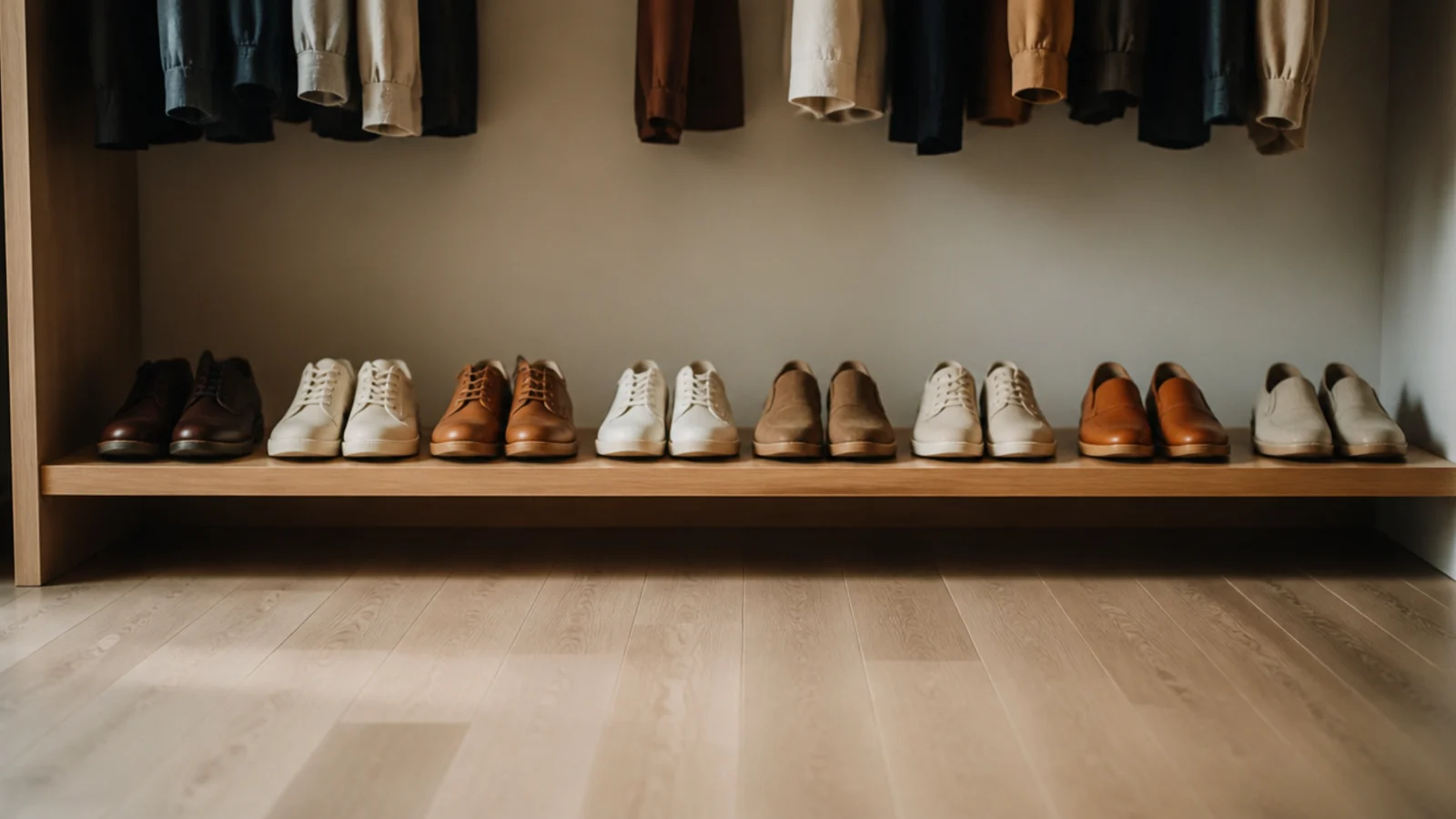
Two rows of shoes means the back row never gets worn, which makes it storage rather than a wardrobe.
Cap yourself at whatever a single visible row holds, usually eight to twelve pairs on a four-foot shelf. The rest goes into off-season storage above the rod. There is more on rise heights in closet shoe storage that works.
20. A hidden hamper
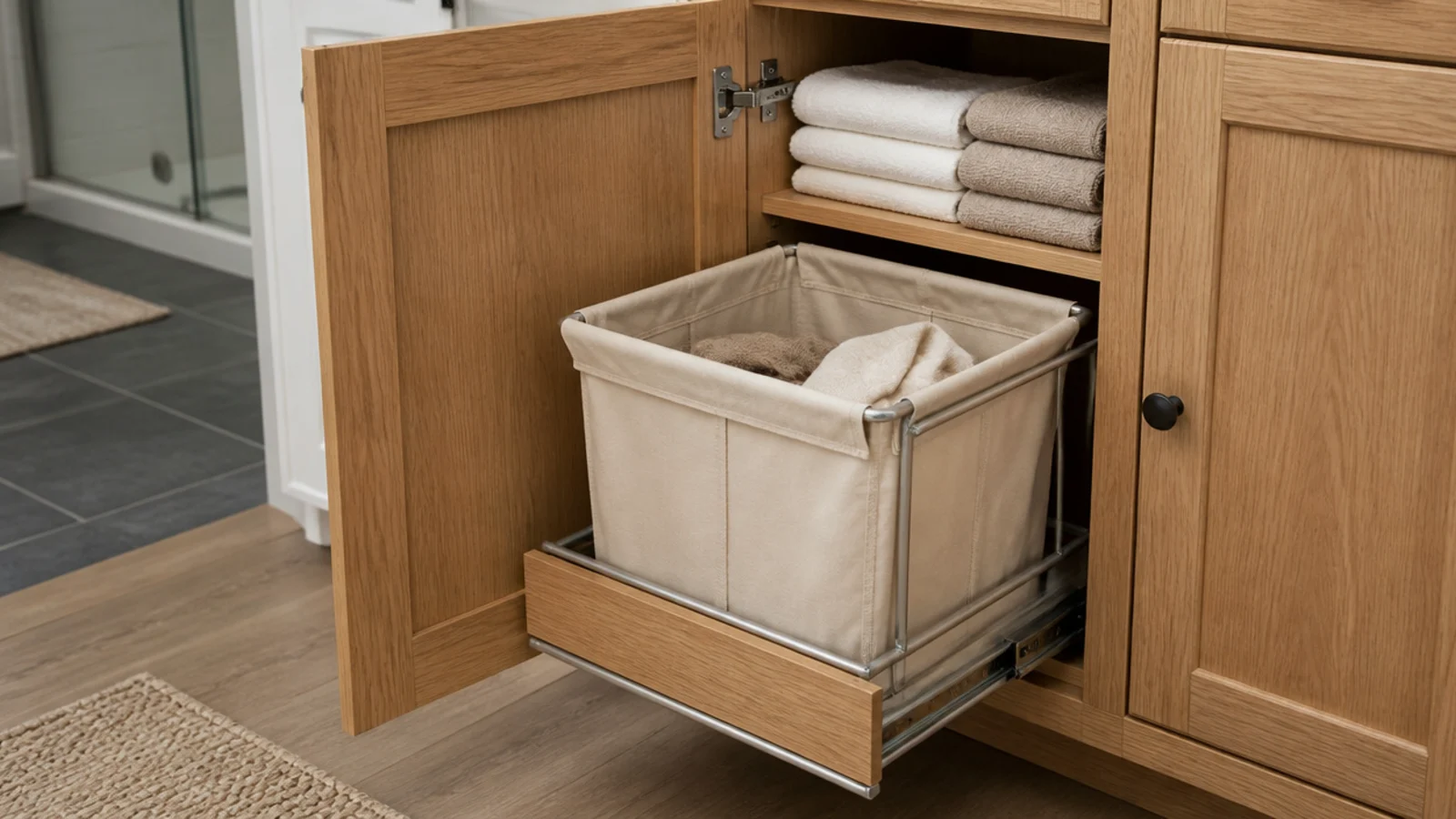
Laundry on a closet floor undoes every other decision in this list.
Give it a pull-out or a lidded basket behind a door, sized at least 14 by 18 inches inside or it overflows in two days. Two smaller bins for lights and darks work better than one large one. $60 to $150 as a retrofit.
21. A donation basket that lives there
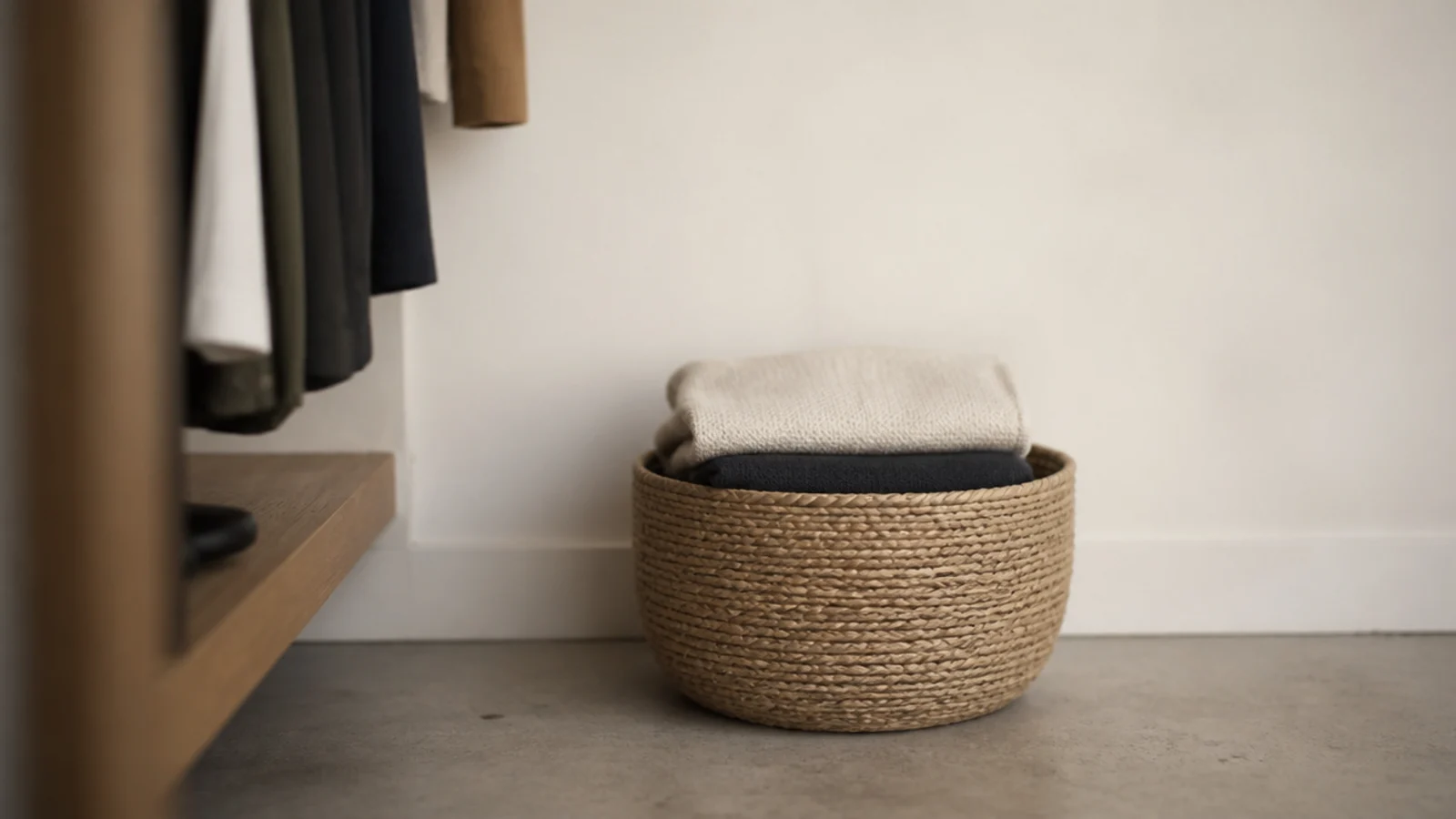
An annual purge is a project. A permanent basket is a habit, and habits are what keep a closet minimal.
One small seagrass basket by the door, roughly 14 inches across. When it fills, it goes. Around $25, and it removes the decision-making from decluttering entirely.
22. Off-season storage above the rod
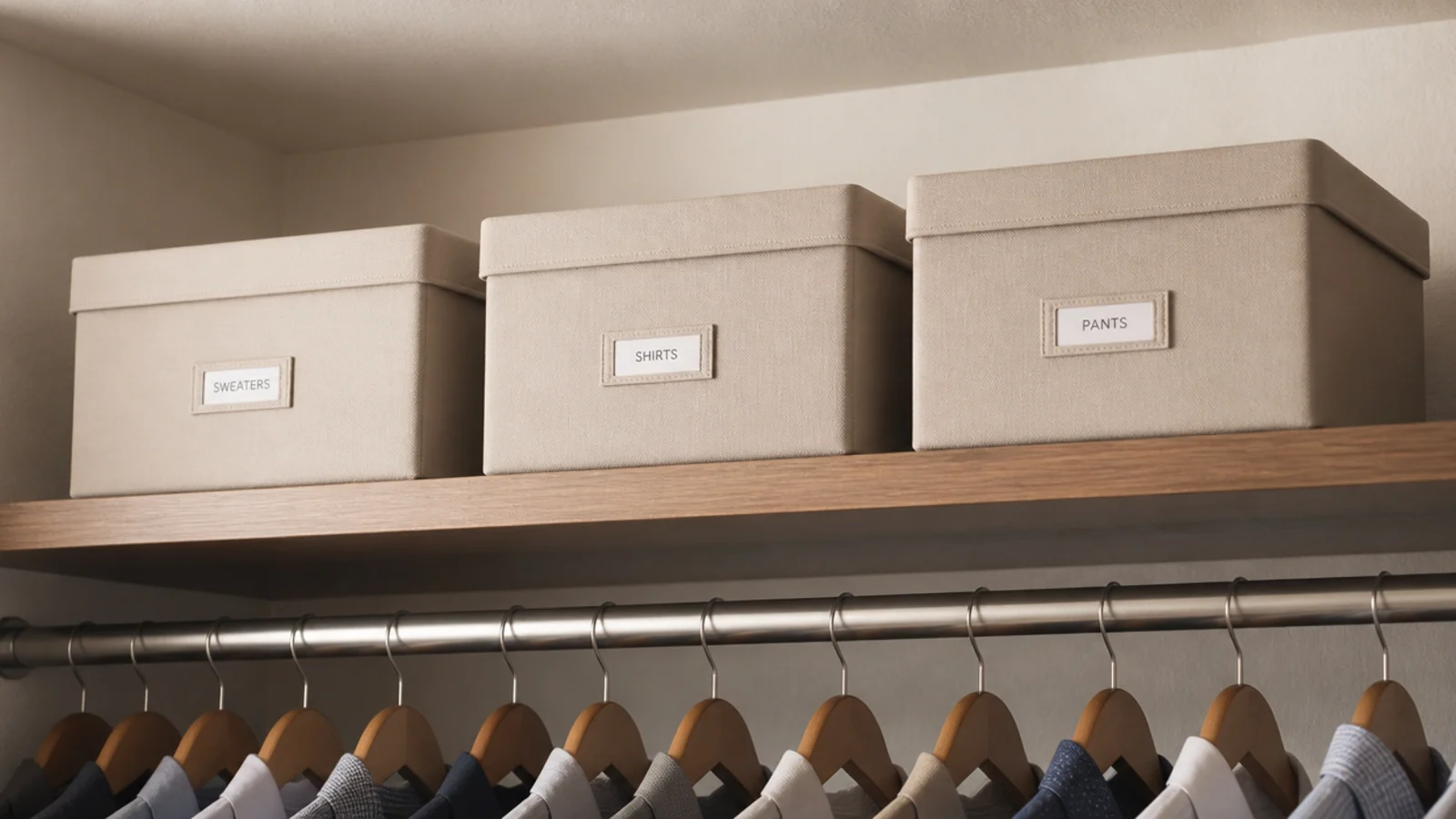
Anything above 84 inches is out of comfortable reach, which makes it perfect for the half of your wardrobe that is wrong for the season.
Matching lidded boxes with small label tags, swapped twice a year. Keeping off-season clothes on the main rail is the most common reason a small closet feels full.
23. Keep 20 percent of the rod empty
A rail packed to the last inch has nowhere for clean laundry to go, which is exactly how folded piles end up on a chair.
Leave a hand-width of bare rod at one end of every rail and treat it as structural. It is also the buffer that makes one-in-one-out possible without a purge.
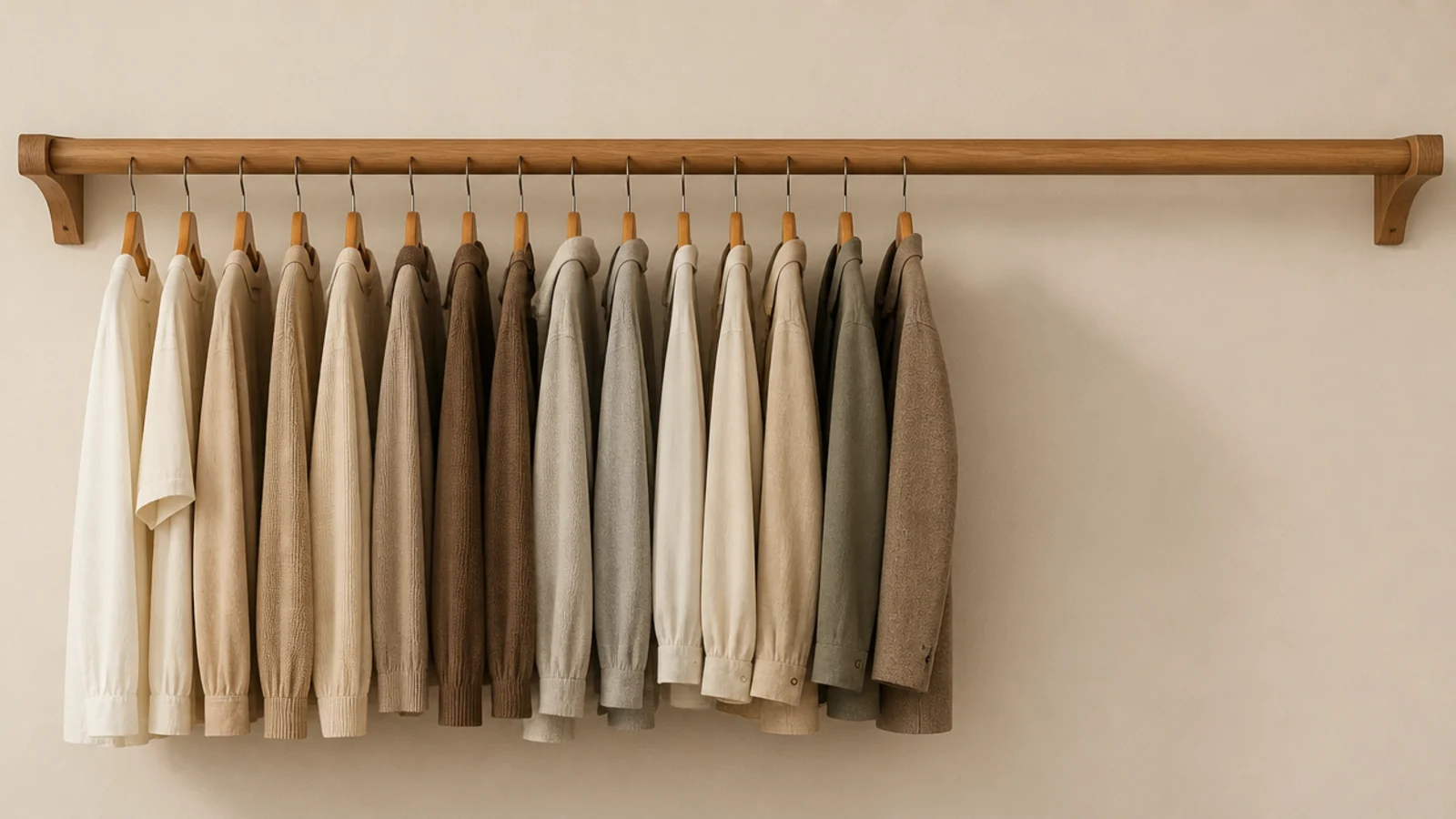
24. Run the rod from light to dark
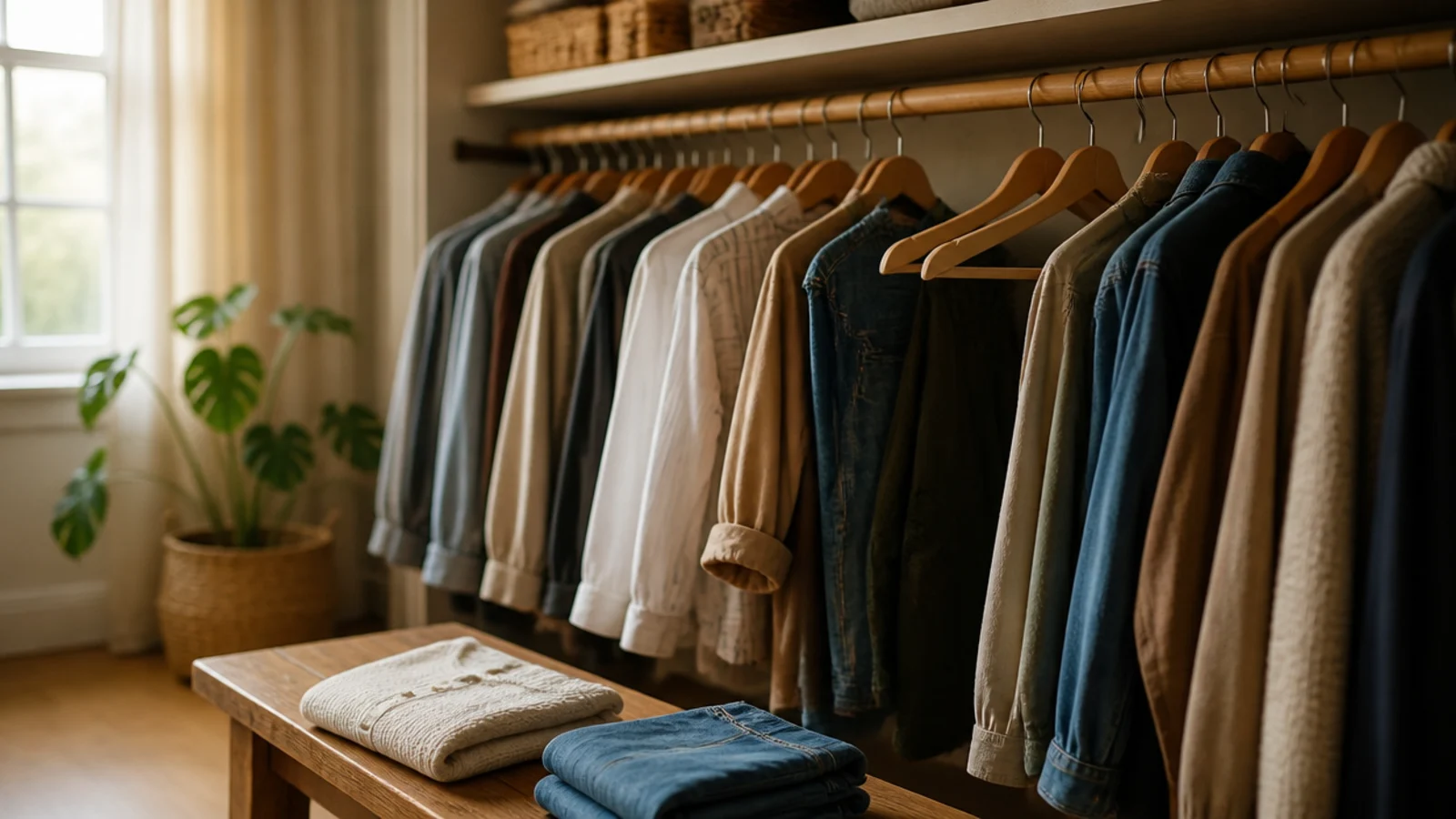
Colour ordering is the free version of a styling budget, and in a neutral wardrobe it is remarkably effective.
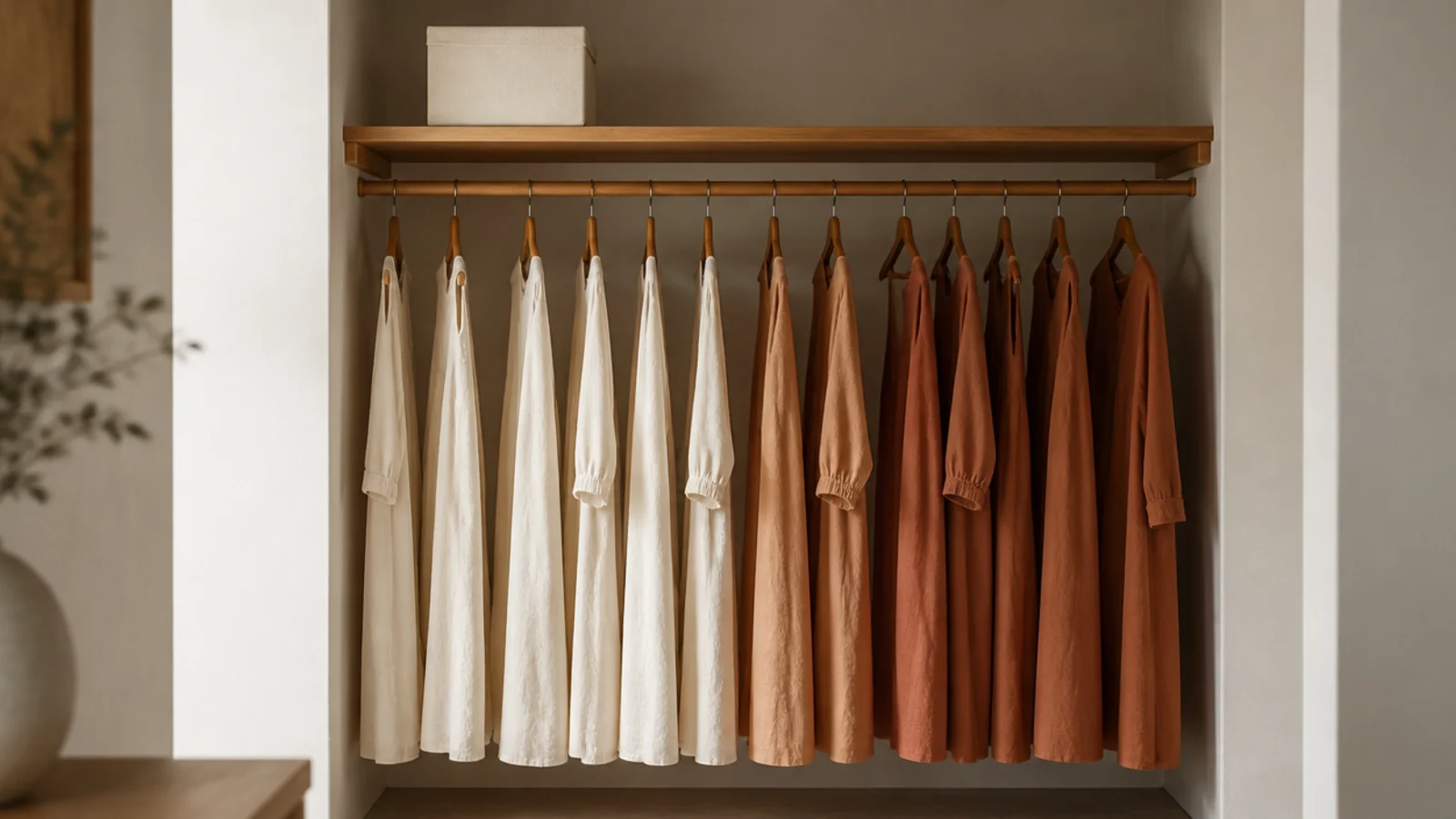
Run cream through oatmeal, sand and clay to charcoal, left to right, on matching hangers. Your eye reads a gradient as deliberate. It also makes getting dressed faster, because you go to a zone rather than scanning.
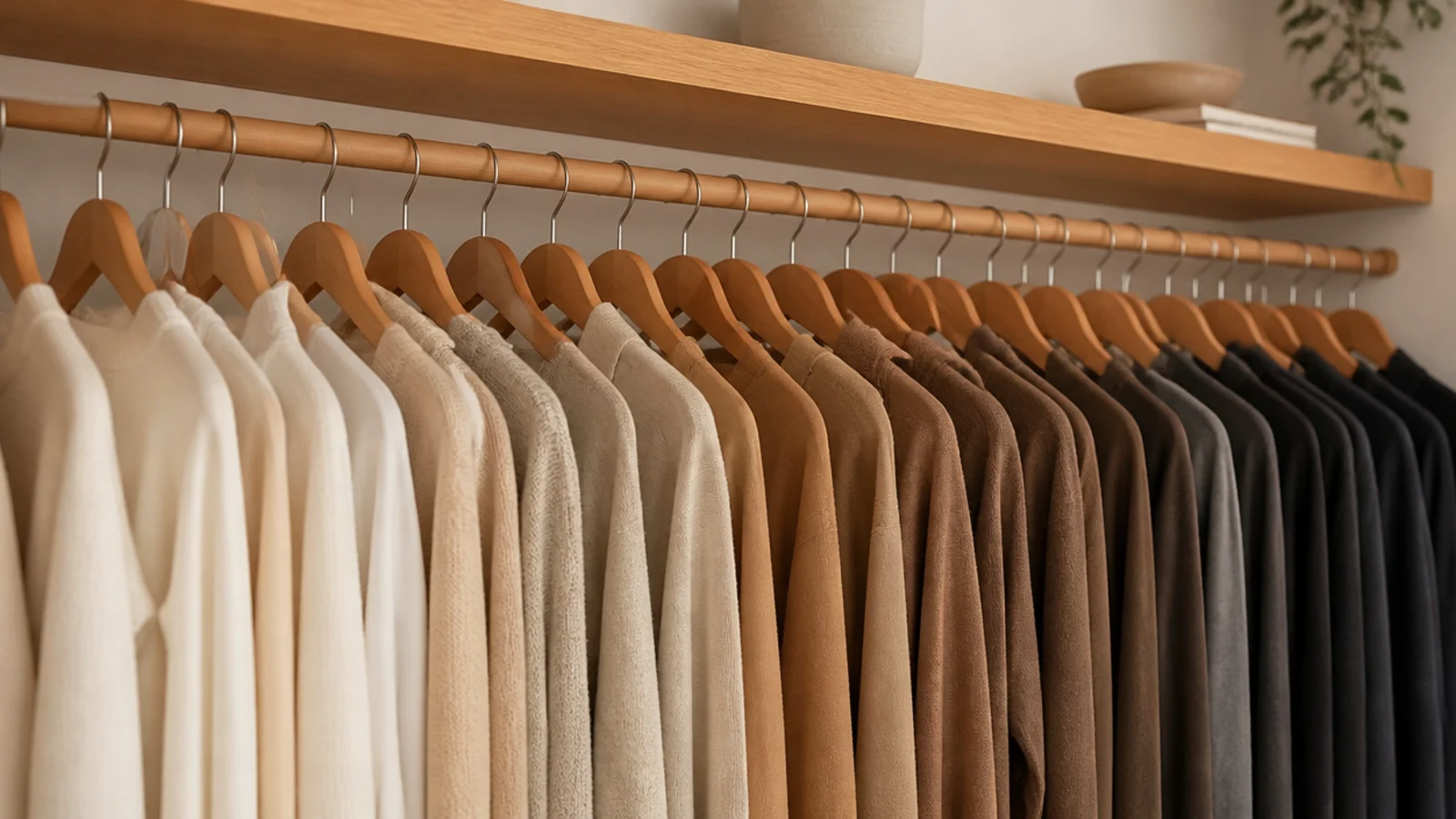
25. A bench, not an island
An island needs 36 inches of clearance on every side, which is why it only works past about 10 feet of width. Below that it becomes an obstacle.
A bench 18 inches deep and 36 to 48 long against the end wall gives you the seat and the folding surface without touching the walkway. $120 to $300.
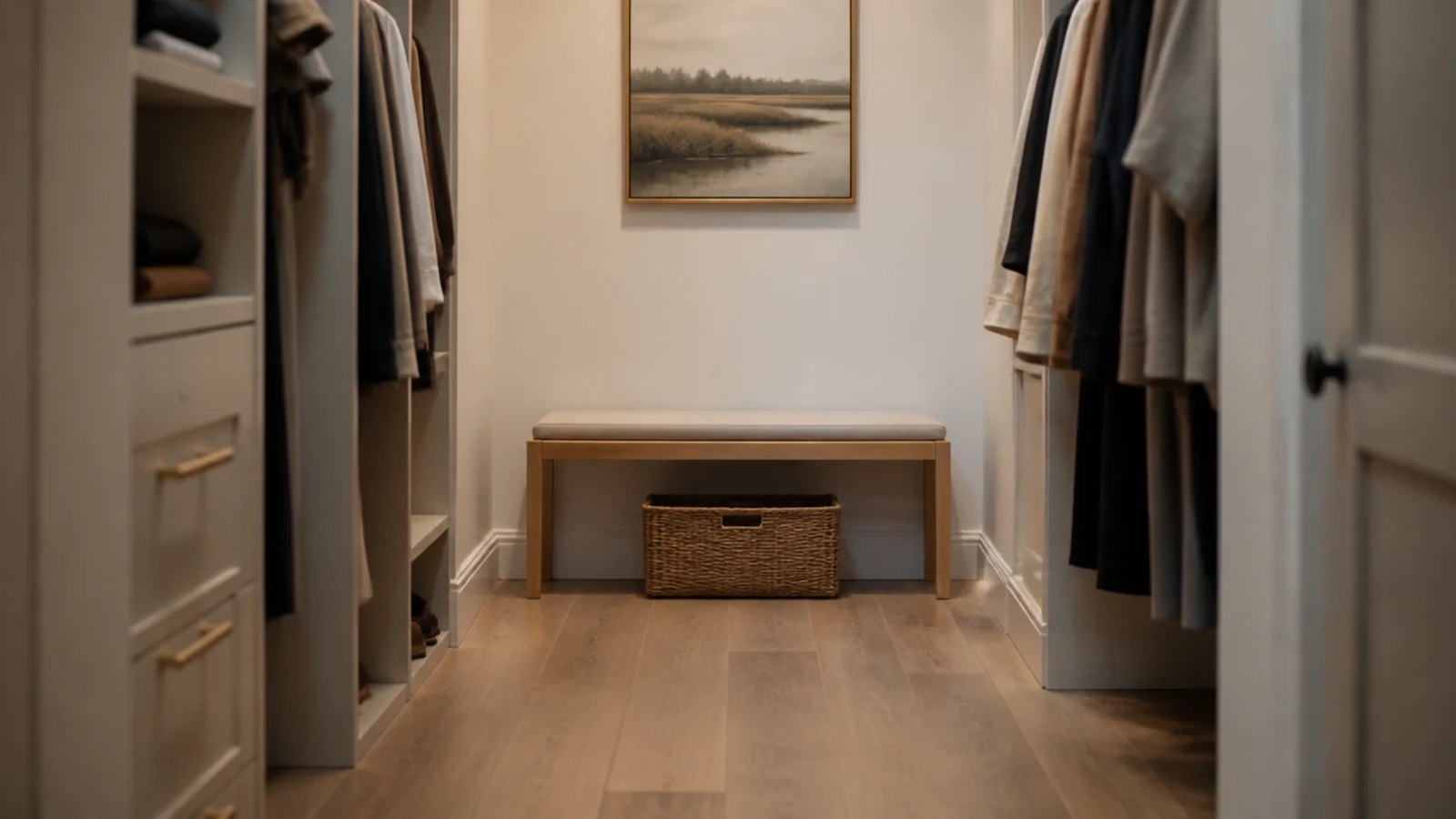
26. One hook, mounted properly
A row of six cheap hooks holds the same robe as one good hook and adds five objects to a bare wall.
Choose one solid brass or matte black hook, mounted at 60 to 66 inches into a stud or a toggle rated over 25 pounds. Bags get heavier than people plan for. Around $12.
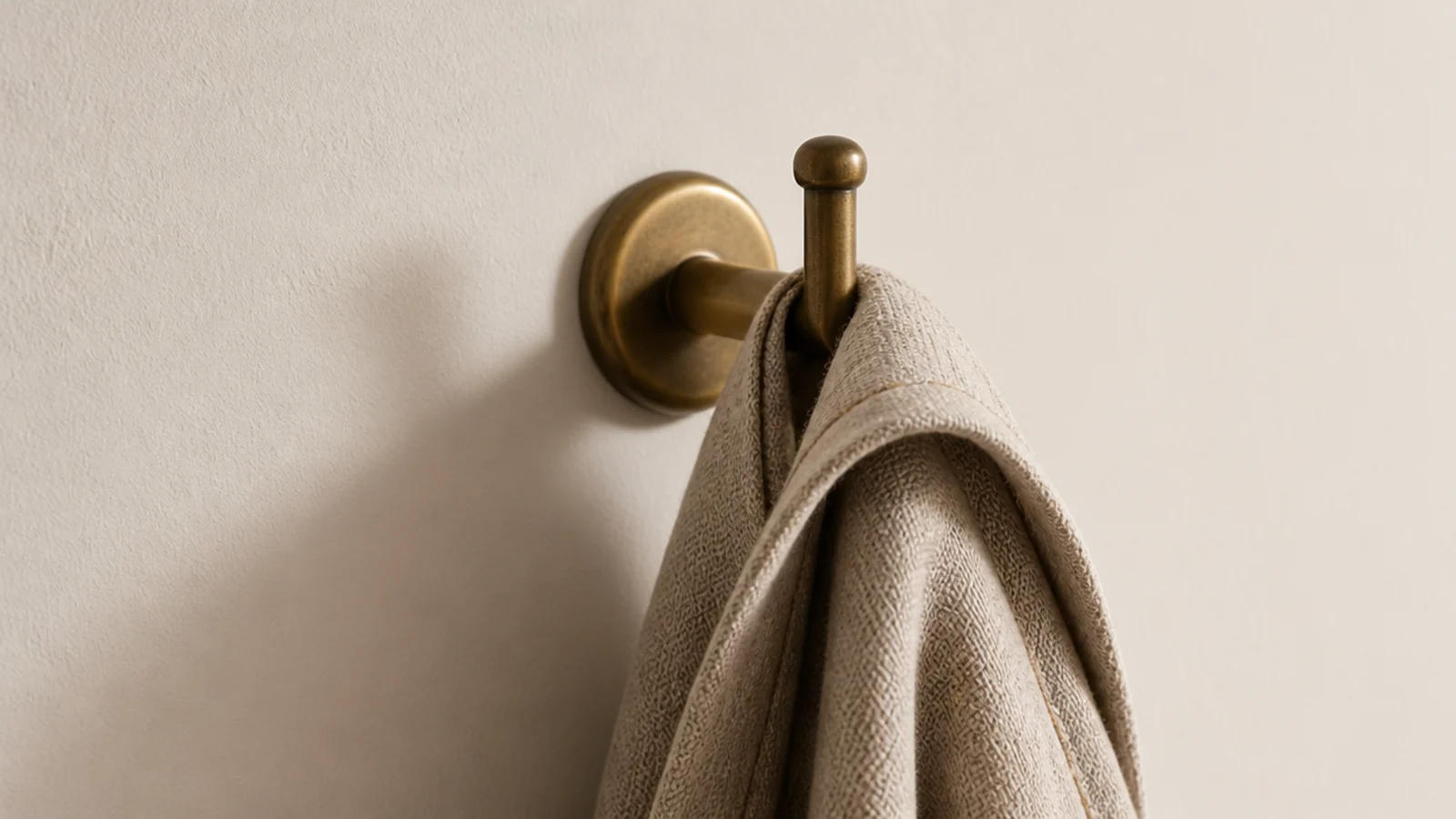
27. One flat runner, or none
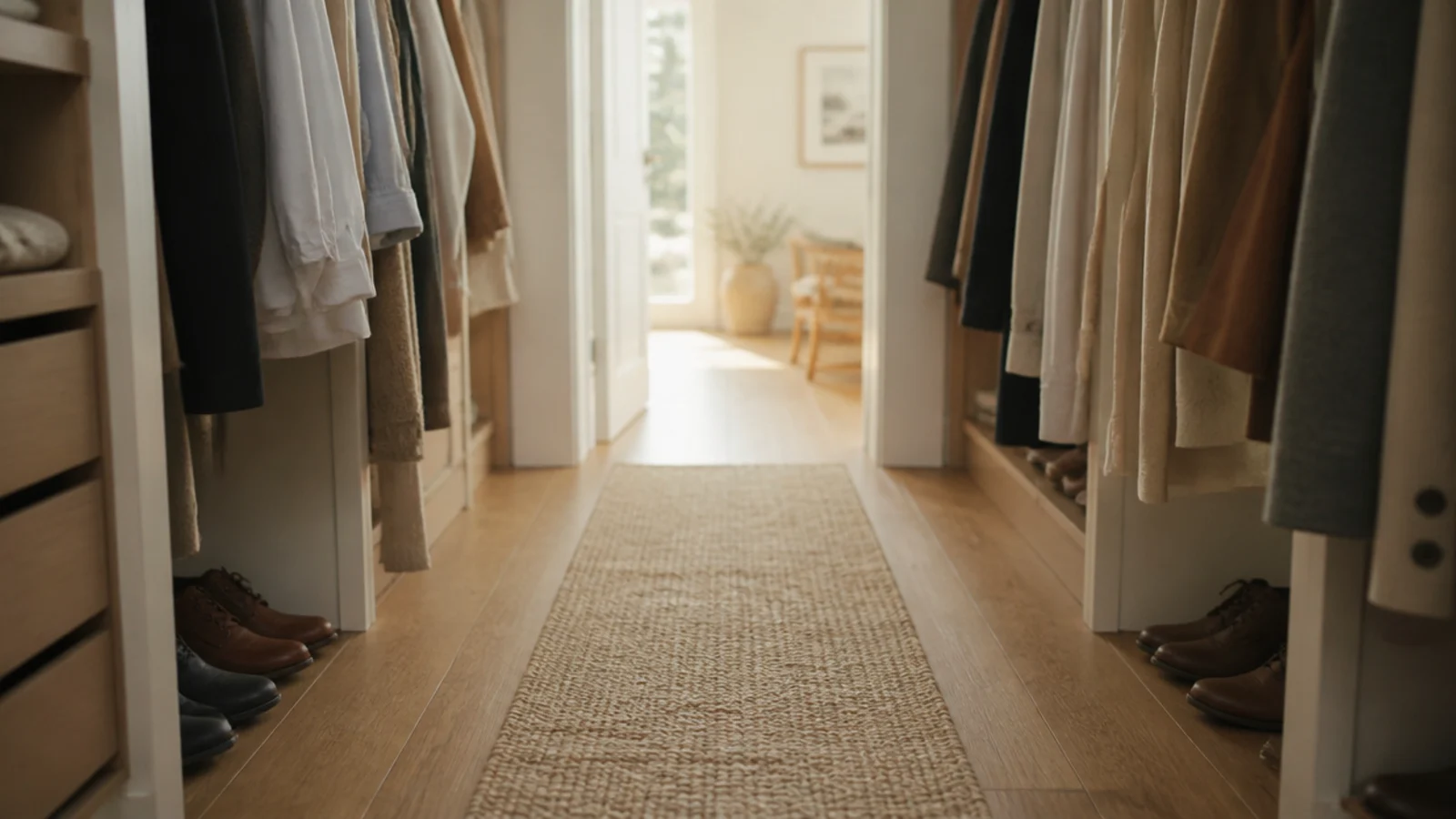
A closet floor can stay bare, and in the most pared-back versions it should. If you want warmth, keep it flat.
A flatweave wool or jute 24 to 30 inches wide sits inside the walkway without curling, and a low pile clears the door swing. Anything thicker catches every time you open the door. $60 to $180.
28. A single scent
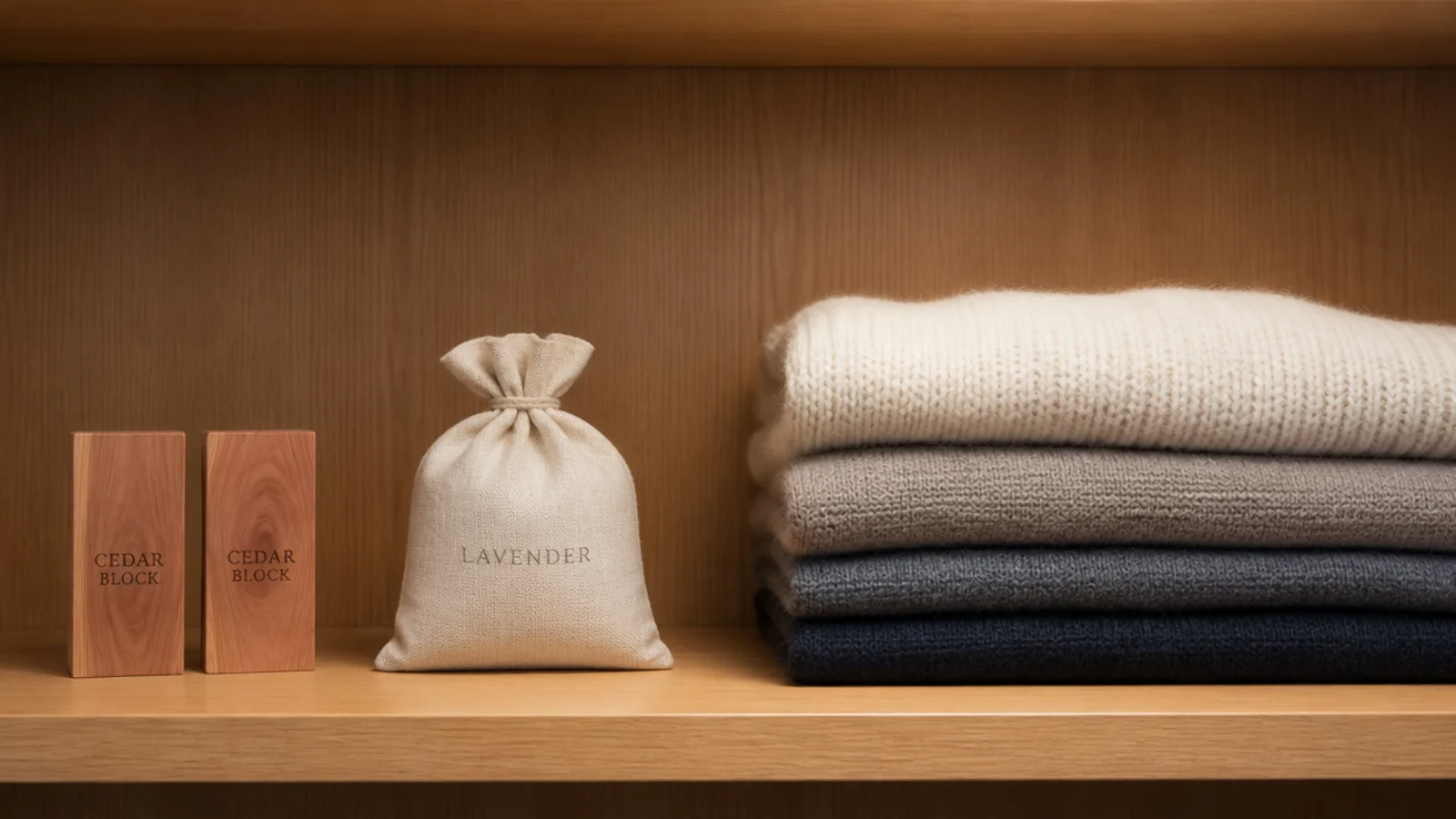
Three competing scents read as chaos in a small enclosed space, the same way three container materials do.
Cedar blocks plus one lavender sachet, and nothing else. Sand the cedar lightly once a year to bring the oils back rather than replacing it, and skip anything heavily perfumed, which transfers to clothing. Under $20.
29. One beautiful object at the end wall
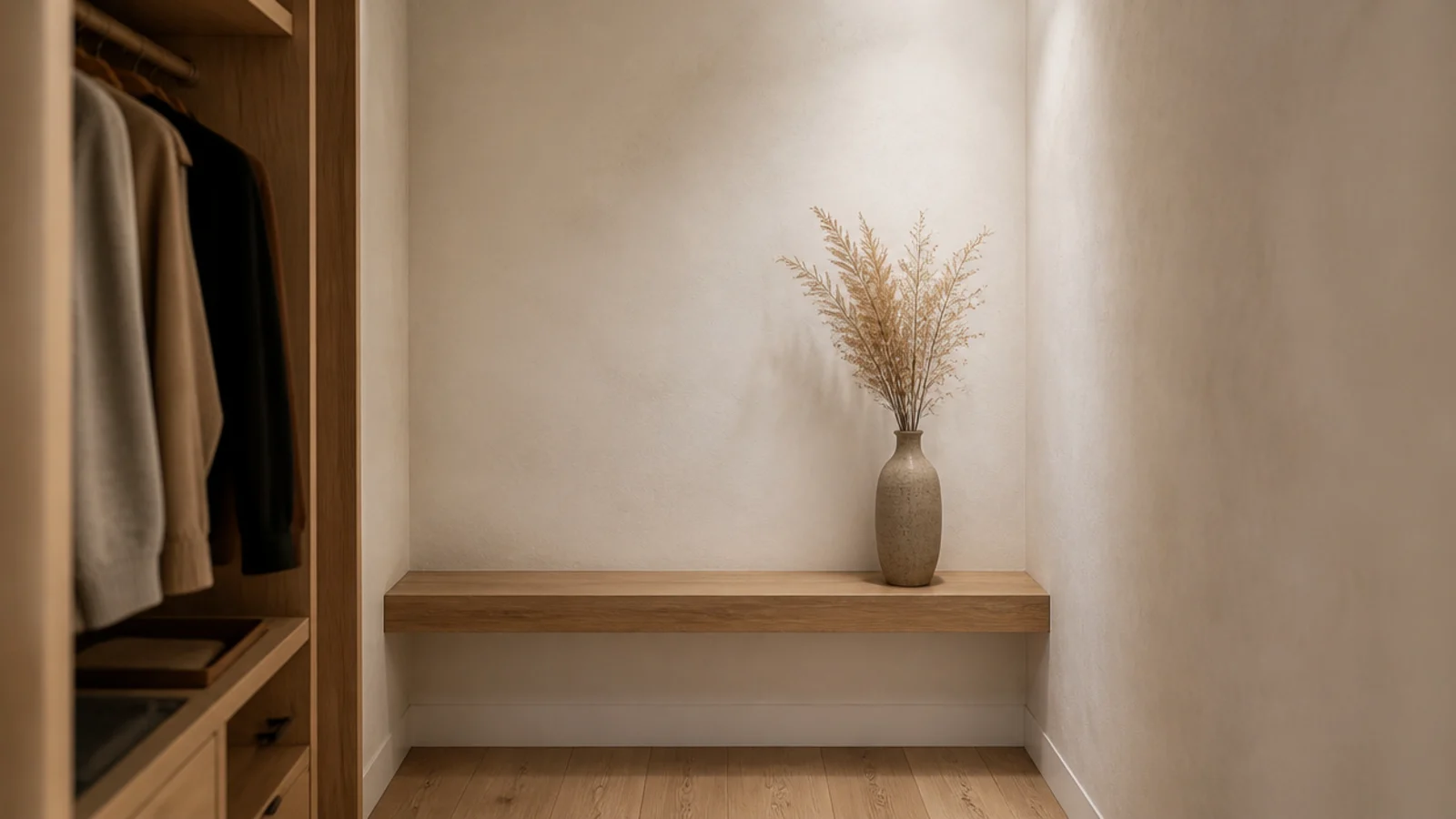
Restraint needs one place for the eye to land, or the closet reads as a utility corridor rather than a room.
A single stoneware vase with dried grasses, on the end shelf, with real empty space around it. One object, generously spaced, does more than a shelf of five. Around $30 to $60.
30. A ten-minute monthly reset
Minimal closets drift, quietly, and always in the same direction.
Once a month: straighten hangers, refold the top shelf, empty the donation basket, and put back anything that migrated. Ten minutes catches the drift before it becomes a Saturday. The organization guide has the full routine.
Mistakes to Skip
- Buying storage before editing. Containers bought for a full closet lock the volume in place, and you end up with beautiful bins holding things you were going to donate anyway.
- Going all-white with a cool bulb. Cool light on white shelving makes a closet feel like a clinic, and it makes every warm neutral you own look faded on the rail.
- Filling every inch of rod because the space exists. A closet at capacity has nowhere for laundry to land, which is how the chair in the bedroom becomes permanent.
Frequently asked questions
What makes a closet look minimalist rather than empty?
Repetition and restraint, not emptiness. One hanger type, one container material, one wood tone and one metal finish will make a full closet read as calm. An empty closet with five kinds of plastic bin still looks cluttered, which is why the edit matters less than the consistency you apply to what stays.
How many clothes fit in a small walk-in closet?
A four-foot double-hang bay holds roughly 60 to 80 shirts and trousers on slim hangers, and a four-foot long-hang bay holds about 25 to 30 dresses or coats. Plan for 20 percent of every rod to stay empty. A closet packed to the last inch is where laundry stops getting put away.
Should a minimalist closet have doors or open shelving?
Open shelving, if you are willing to keep it tidy. Doors hide mess but also hide what you own, which is how duplicates happen. Open shelves force a weekly reset and make the closet read architectural rather than fitted. Choose doors only where the contents are genuinely unattractive, like laundry and cleaning supplies.
What color should a minimalist walk-in closet be?
The same warm white or soft neutral as the bedroom it opens off. A closet painted a different color reads as a separate box you left open. Warm whites also flatter clothing colors under warm light, while cool greys drain them. Keep the ceiling the same color as the walls for the calmest result.
How do I keep a minimalist closet from filling up again?
Keep a donation basket permanently in the closet and use the one-in-one-out habit at the hanger level rather than the item level. If every hanger is occupied, something leaves before something arrives. A ten-minute reset once a month catches the drift before it becomes a weekend project.
Start with the hangers, the light and the floor, in that order. Those three take an afternoon and under $60 together, and they do most of what people are actually asking for when they say minimalist. The small walk-in closet layout guide covers the wall plan, and if you want warmth rather than restraint, boho walk-in closet ideas goes the other direction. Save the pin so the rod heights are with you when you start.
Want more like this? Browse all 15 small walk-in closet ideas guides — they all use the same measurements and budget tiers.
Pin it for later
Save this to your Small Walk-In Closet Ideas board
Pin it now so it is waiting for you when the tape measure comes out — and so the next person hunting for this idea can find it too.
Save this pinKeep going
More ideas worth saving while you have the tape measure out.