TV Unit Decor · Review
15 Entertainment Unit Decor Styles Compared

Some links on this page may become affiliate links in future. I only recommend pieces I would put in my own home — see the affiliate disclosure.
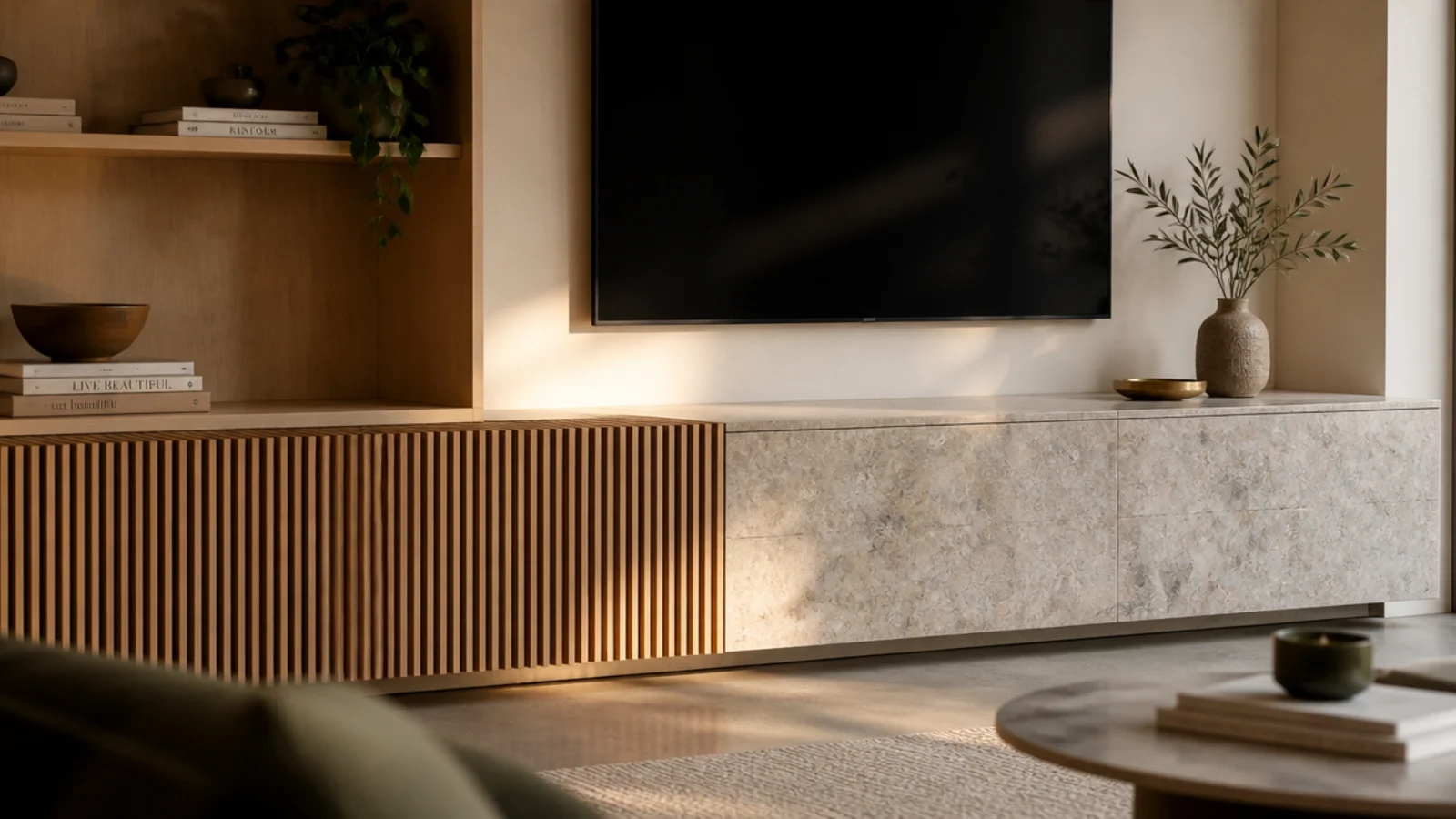
The style of a media unit is the last thing that decides whether it works and the first thing everyone shops for. Entertainment unit decor divides much more usefully by internal depth, ventilation and span than by finish, because those three numbers determine whether your gear fits, stays cool and stays level. Below is every style worth considering, compared on the criteria that actually rule things out, followed by the eight I keep specifying.
In this guide11 sections — tap to openHide
- 1.How I Chose These Entertainment Unit Decor Styles
- 2.The Full Comparison: 15 Entertainment Unit Styles
- 3.The low solid-timber console
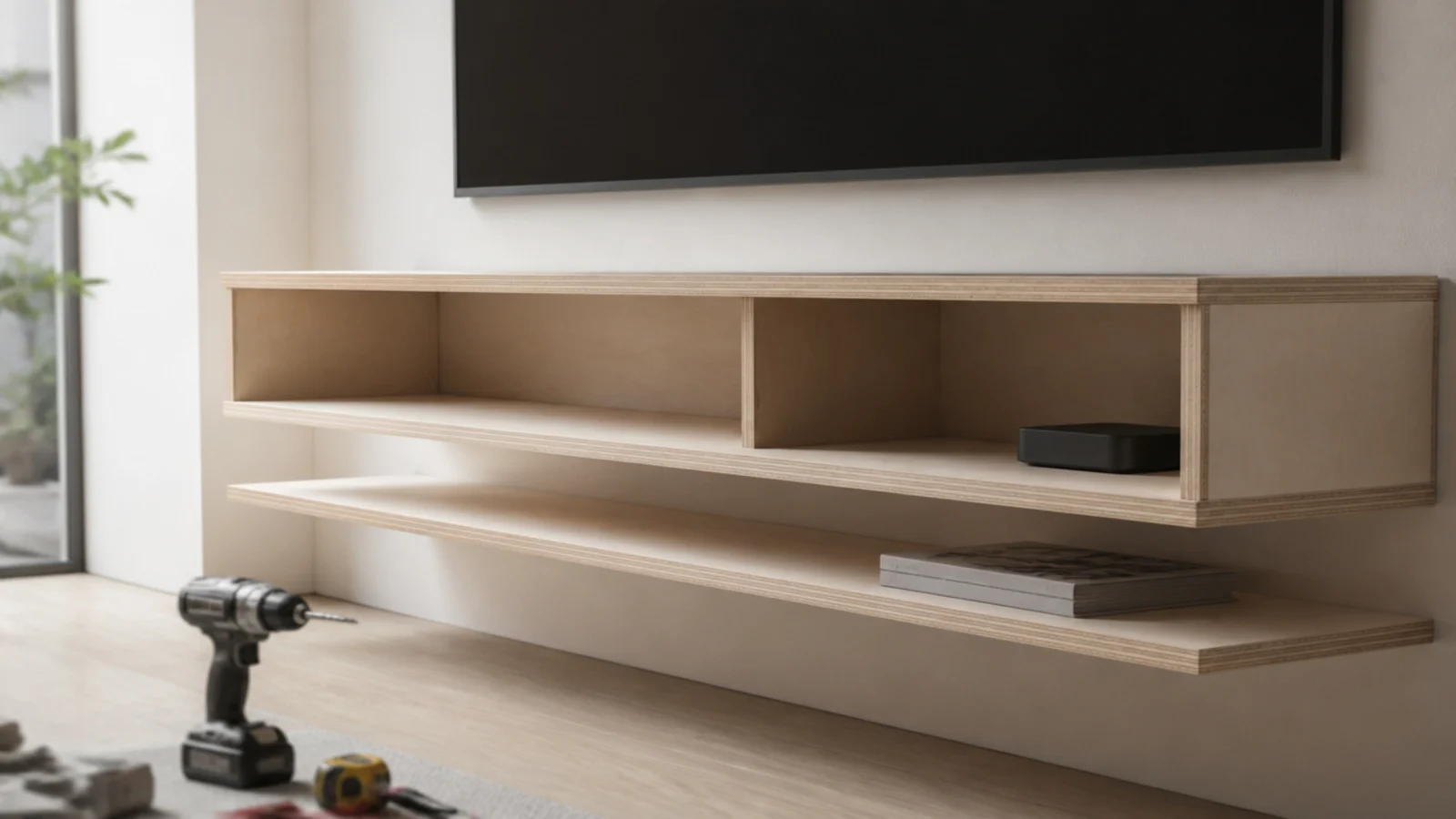
- 4.The wall-hung floating cabinet
- 5.Full-wall built-in joinery
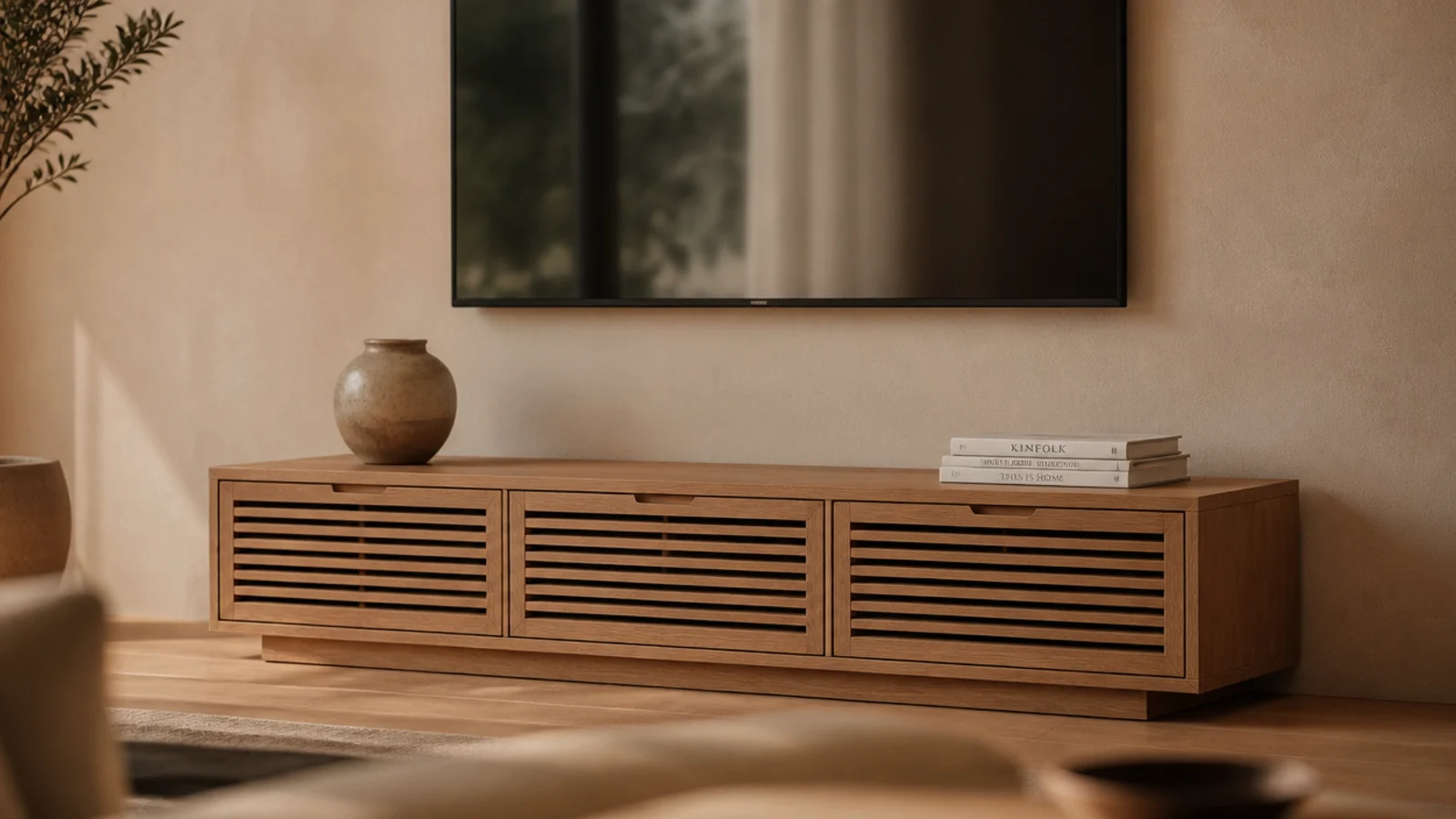
- 6.The slatted-front cabinet
- 7.Open steel-and-plywood shelving
- 8.The stone-topped console on a steel base
- 9.The vintage mid-century sideboard
- 10.A single floating shelf and nothing else
- 11.What to Check Before You Buy
How I Chose These Entertainment Unit Decor Styles
Four tests, applied in this order.
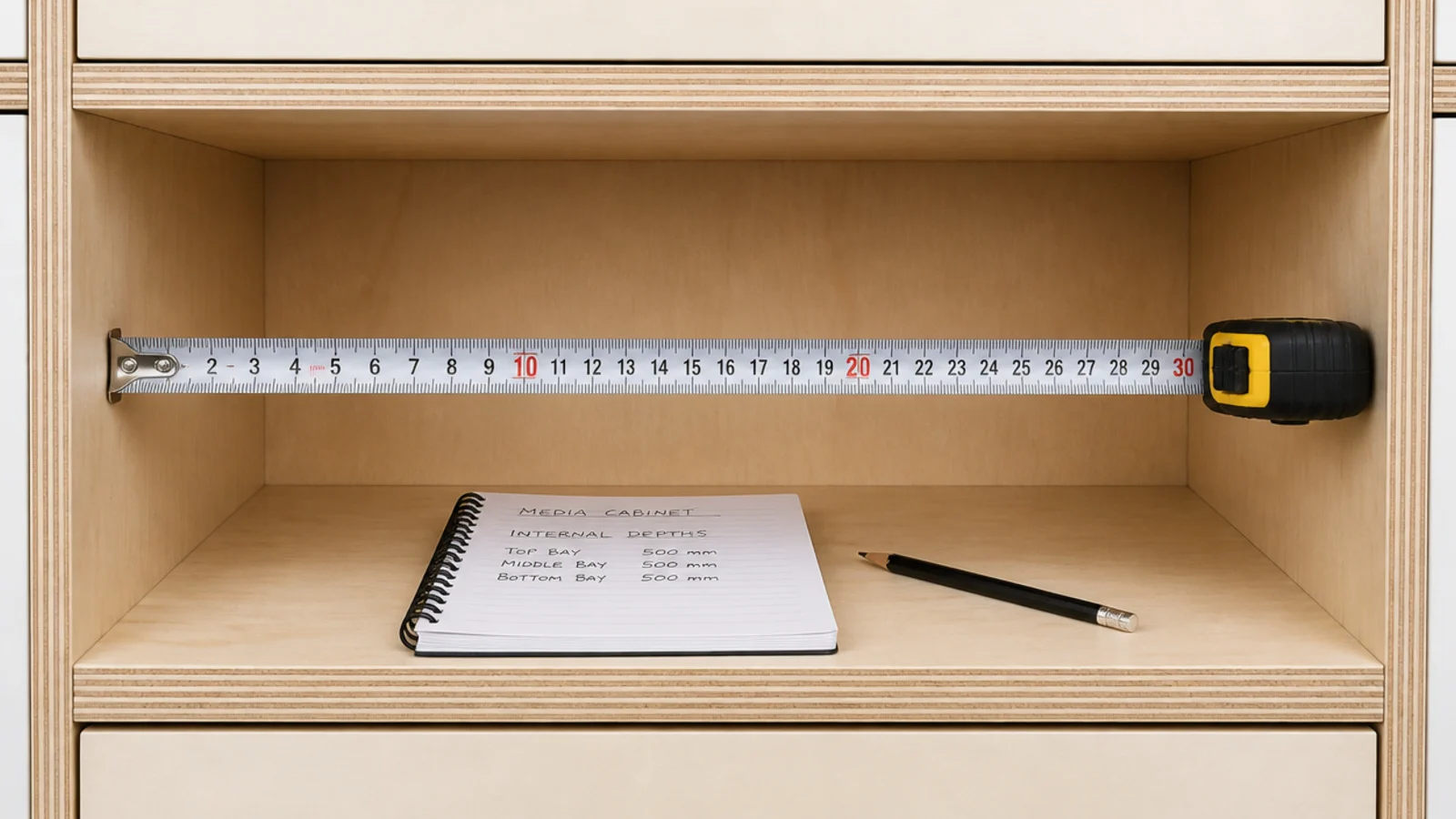
- Internal depth against real equipment. A receiver chassis runs 13 to 17 inches and needs 3 to 4 inches behind it before stiff HDMI will turn without straining the port. Anything under 20 inches of internal depth rules itself out for that job, however good it looks, and 15 to 18 inches is the honest limit for streaming boxes and a slim console.
- Whether the bay can vent. A mid-range receiver sheds 100 to 200 watts as heat and a games console adds up to 200 more under load. Above roughly 40 degrees Celsius inside a cabinet, equipment throttles and eventually shuts down. I looked for open backs, slats, cane or a genuine vent cutout rather than a sealed box with a nice front.
- Span before deflection. Eighteen millimetre plywood and solid timber both carry about 30 pounds across 30 to 32 inches without a visible dip. Longer runs need a divider or a thicker section. Sag appears in the middle of a shelf, which means no end fixing corrects it afterwards.
- What it costs against what it holds. A cheap cabinet you have to cap at a soundbar and a streaming stick is not cheap. I weighted anything that carries real equipment and real weight at a modest price very highly, and discounted anything priced for its finish alone.
I did not weight trends, colour or how a unit photographs on an empty wall. Everything below is described by construction rather than brand, because the same carcass appears under a dozen labels and construction is what you are actually buying.
The Full Comparison: 15 Entertainment Unit Styles
Price tiers: $ under $300 · $$ $300–$900 · $$$ $900 and up. Depths are internal, and loads assume correct installation.
| Style | Best for | Depth and span | Price | Why it wins |
|---|---|---|---|---|
| Low solid-timber console | Almost any living room | 15–18 in deep, spans 60–90 in | $$$ | Flat tops, real load capacity, repairable for decades |
| Wall-hung floating cabinet | Small and rented rooms | 12–16 in deep, cleat over 100 lb | $$ | Clear floor makes the room read wider |
| Full-wall built-in joinery | Long-term homes, awkward walls | Any depth to order, wall to wall | $$$ | Scribed edges and matched plinth read as architecture |
| Modular box system | Rooms that keep changing | 14–16 in deep per box | $$ | Add or move boxes as the room evolves |
| Open steel-and-ply shelving | Warm gear and turntables | 14–18 in deep, 30 in per span | $$ | Nothing traps heat on an open frame |
| Slatted-front cabinet | Hiding gear that runs hot | 18–20 in deep, third open area | $$ | Hides the boxes and still vents properly |
| Cane-front cabinet | Softening a hard media wall | 15–18 in deep, breathable fronts | $$ | Best airflow of any closed door type |
| Reeded glass cabinet | Display without clutter | 15–18 in deep, needs a vent gap | $$ | Blurs the equipment and passes infrared |
| Corner unit with angled back | Rooms seated toward a corner | 16–20 in at the deepest point | $$ | Uses the triangle a square unit wastes |
| Stone-topped console on steel | Rooms wanting weight and calm | 14–18 in deep, over 150 lb assembled | $$$ | Heat and spill proof top on a light base |
| Lift-top cabinet | Rooms not mainly for watching | 20 in deep minimum for the panel | $$$ | The screen disappears completely when off |
| Vintage mid-century sideboard | Character on a budget | 15–18 in deep, solid carcass | $$ | Built better than most new furniture |
| Rolling cart on castors | Studios and shared rooms | 12–16 in deep, 60–100 lb rated | $ | One screen serves two parts of a room |
| Single floating shelf | Minimal setups and tight walls | 10–12 in deep, 30 in per span | $ | Frees the entire floor for under fifty dollars |
| Panelled niche with no cabinet | Wall-mounted, gear elsewhere | Recess 2 in deeper than the panel | $$ | Nothing on the floor and nothing to dust |
Eight of those are the ones I keep specifying.
1. The low solid-timber console
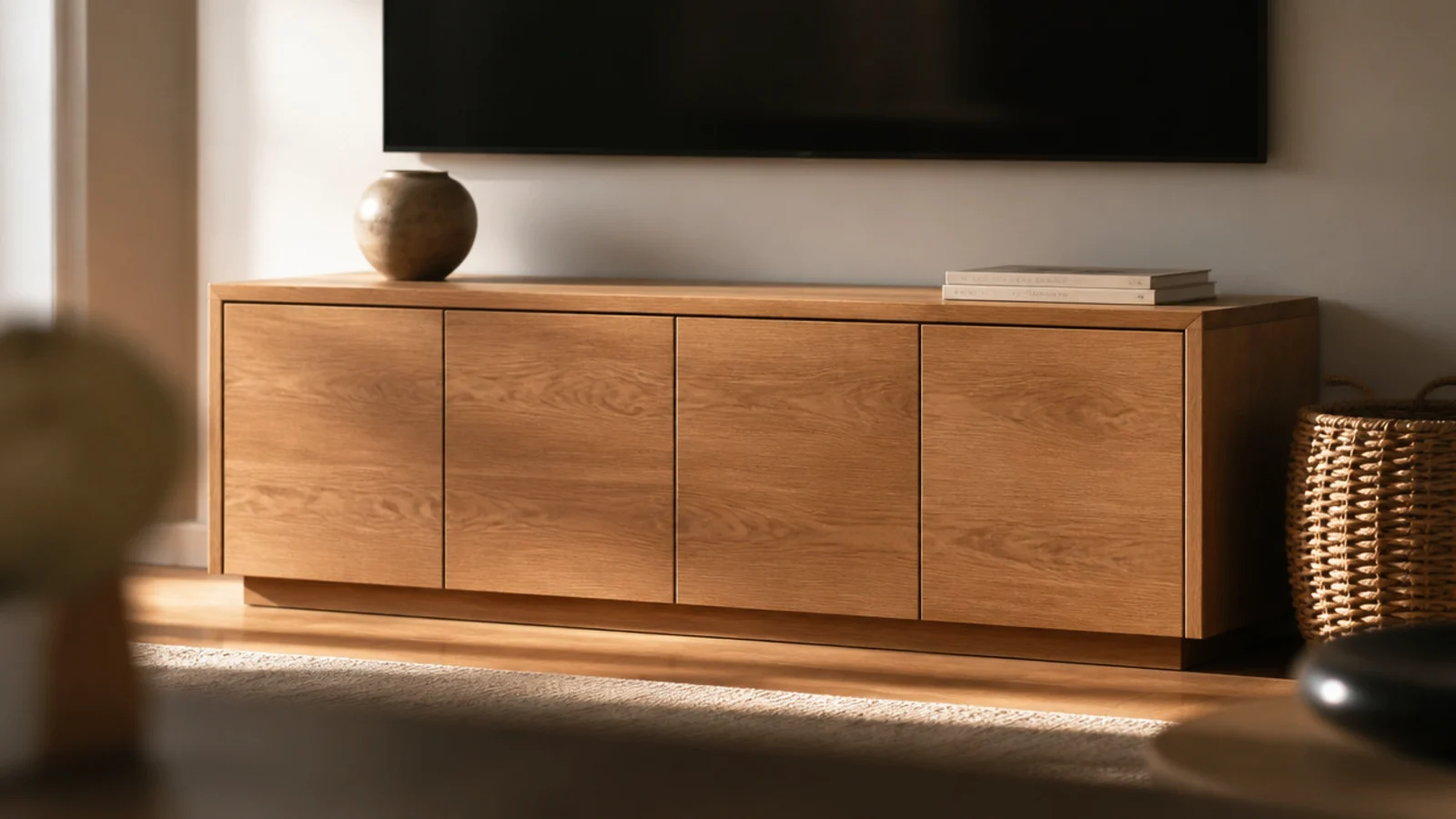
The most reliable purchase available. At 16 to 20 inches tall it puts the centre of a 55 inch panel near 41 inches, which is seated eye level on a normal sofa, and a solid top will not bow under a heavy screen.
Look for 18 mm minimum carcass stock, a top load rating of 200 pounds or better, and slotted fasteners under a solid timber top so it can move seasonally. White oak and ash at around 1,300 Janka resist dents; walnut at about 1,010 is softer but reads warmer in a dark room. The catch is depth — many are only 15 inches, which suits streaming boxes but not a receiver.
2. The wall-hung floating cabinet
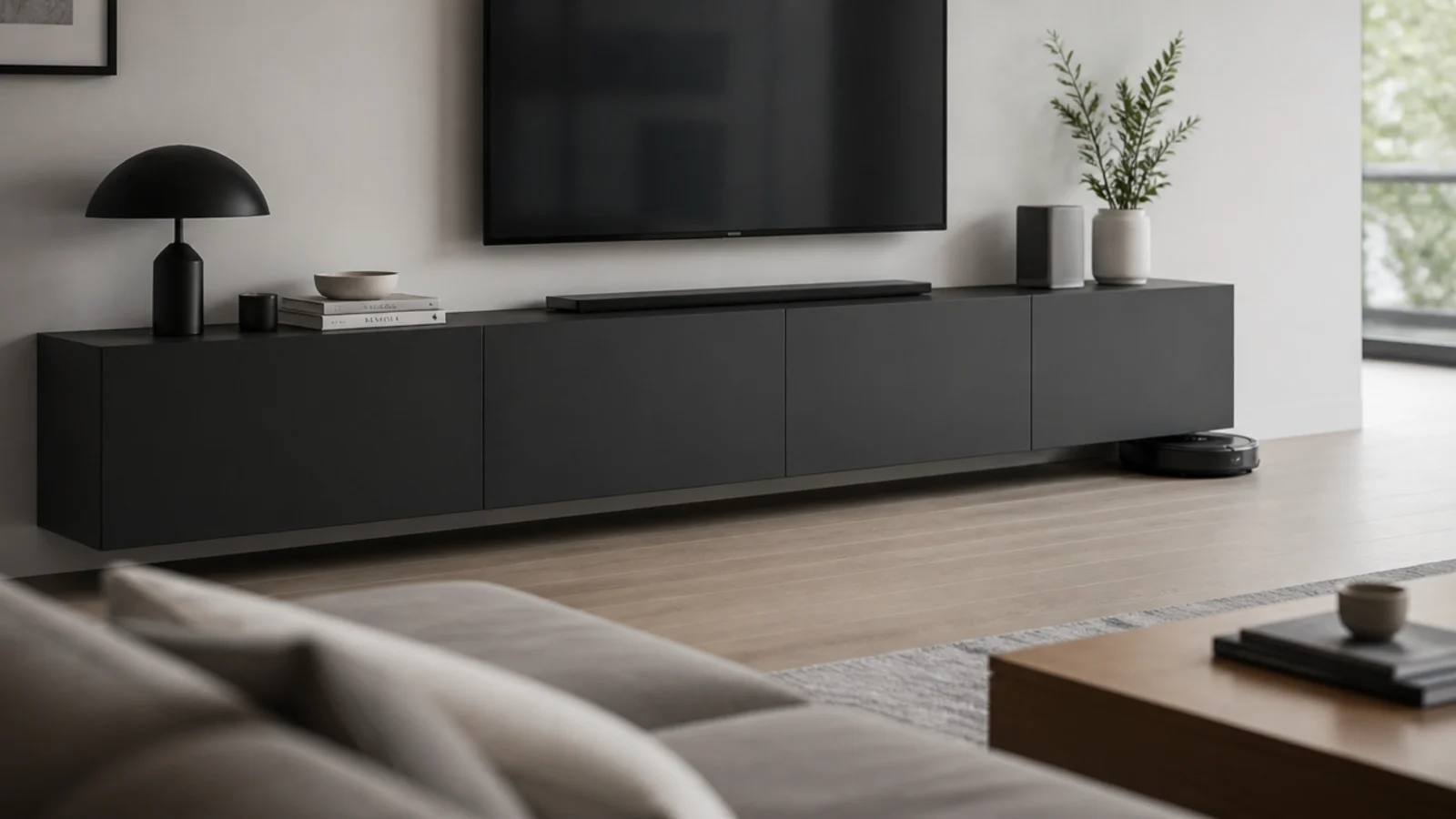
The best answer for a small room, because keeping 12 to 16 inches of clear floor under the carcass lets the eye read the floor all the way to the wall. It also clears the 3.5 to 4 inches most robot vacuums need.
It has to reach framing. A French cleat across two studs at 16 inch centres carries well over 100 pounds, comfortably more than a loaded cabinet, while drywall anchors are not the right tool for this load. Keep the depth at 12 to 16 inches and put anything deep, hot or heavy in a different piece.
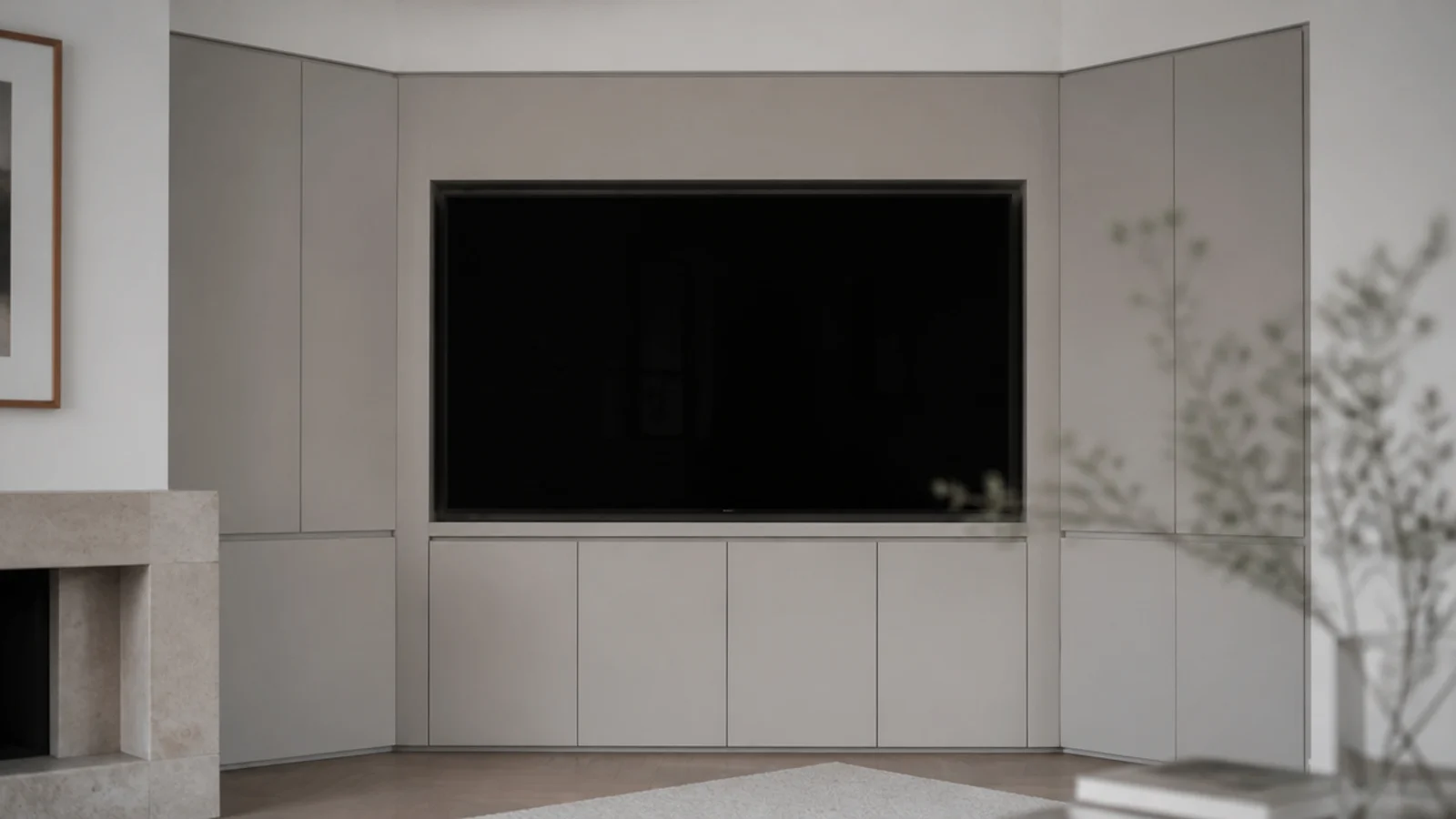
3. Full-wall built-in joinery
The most expensive option and the only one that genuinely stops reading as furniture, because it reaches both corners and there is no visible end panel. It also lets you specify exact depths — 20 inches for the gear bay, 12 for the display half.
The details that earn the money are scribed edges against uneven plaster, a plinth matched to the existing skirting height, and a consistent 3 mm gap on every door. Ask for vents in the closed bays at the drawing stage, because retrofitting them into finished joinery is genuinely awkward. There is more in the custom-built TV wall guide.
4. The slatted-front cabinet
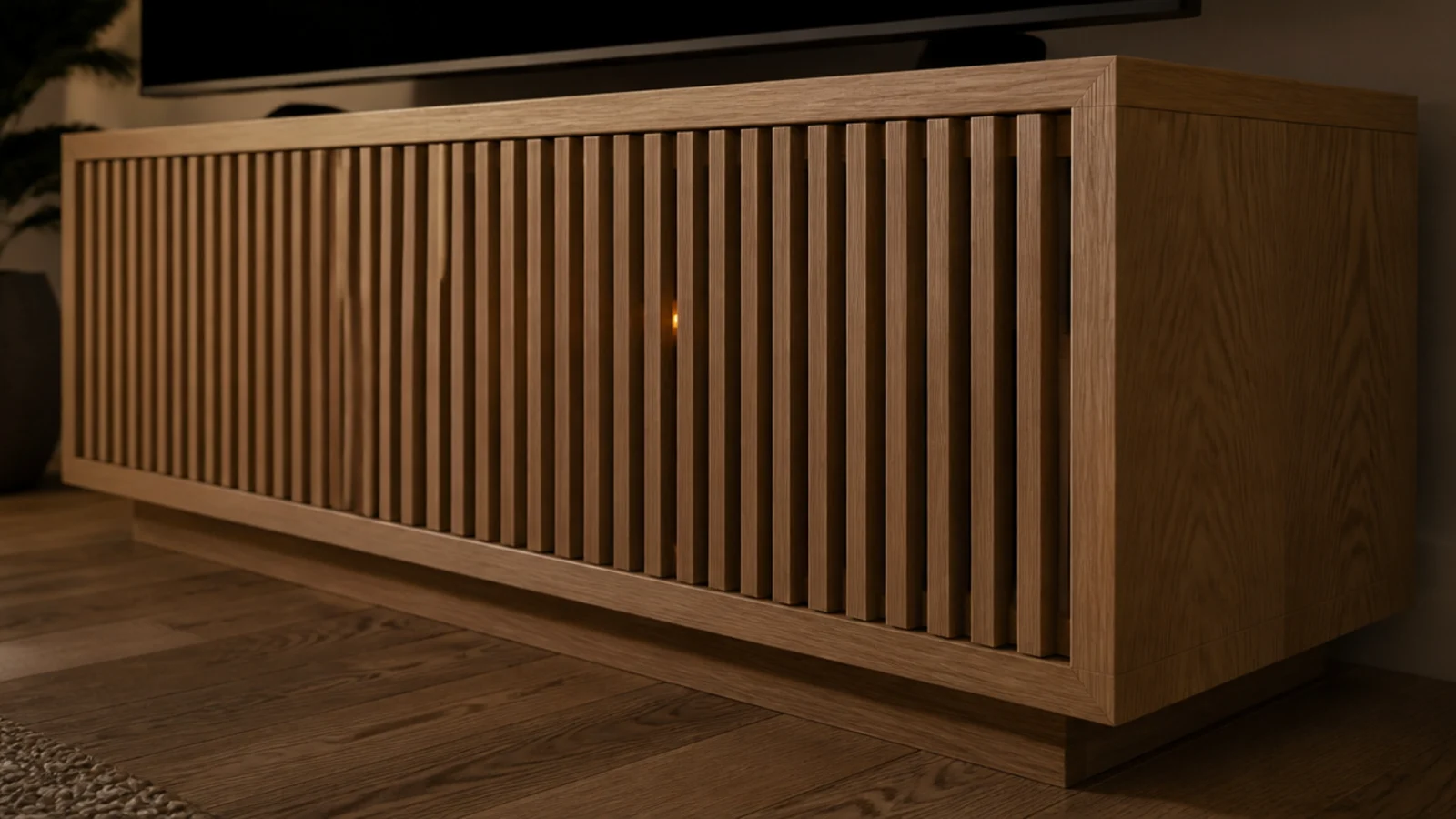
The best compromise on this list. Battens at roughly 20 mm with 10 mm gaps give about a third open area, which hides the equipment from a seated eye while venting a bay that holds a console and a set-top box, and infrared passes straight through so remotes keep working.
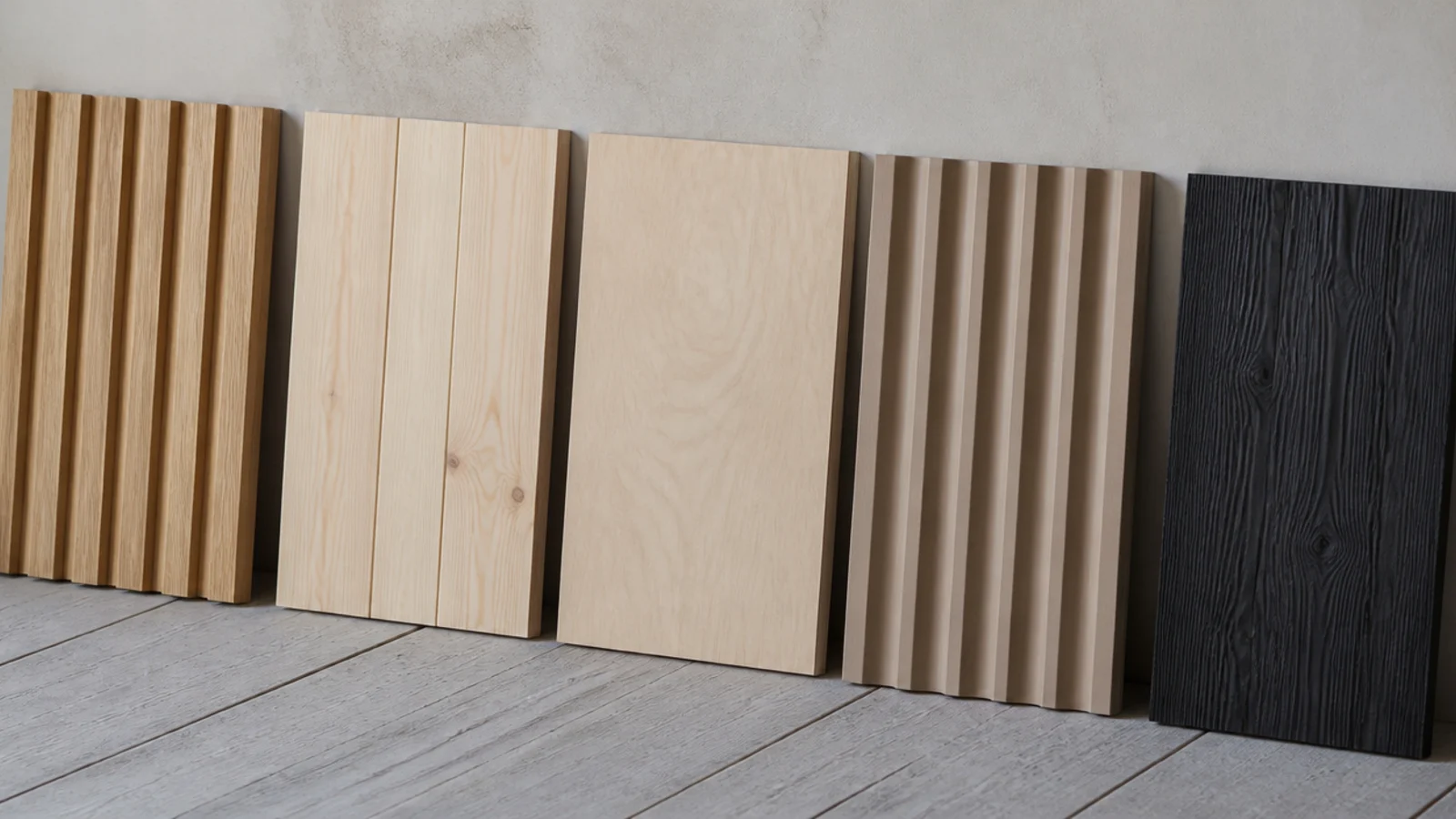
Buy solid timber slats rather than veneered board, which cups above a warm device within a season. Check the slats are fixed to a proper frame rather than glued to a backing panel, since the backing is what turns a ventilated door back into a solid one.
5. Open steel-and-plywood shelving
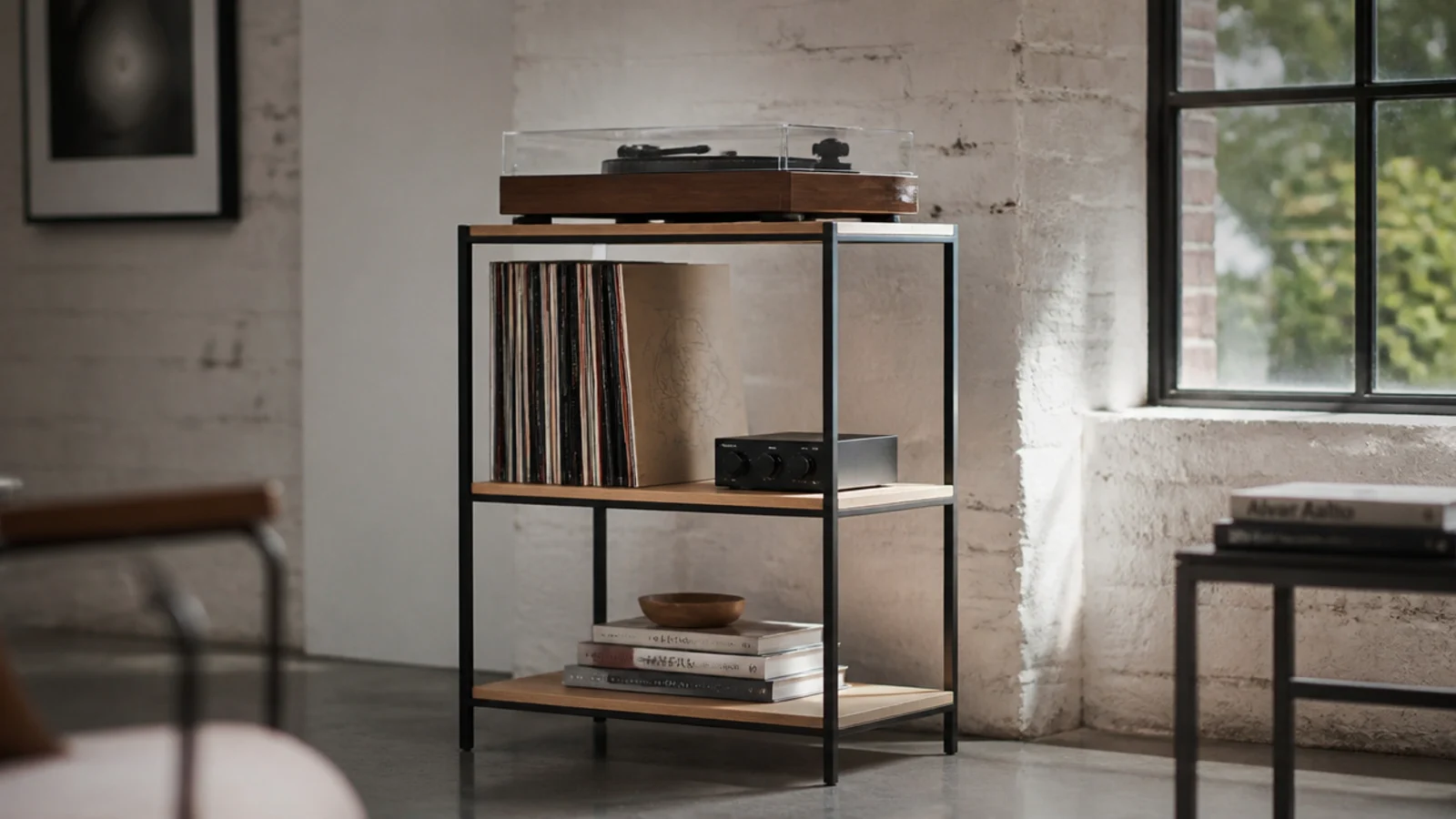
The right answer if the gear runs hot or if a turntable is involved, since nothing traps heat and nothing rattles. A powder-coated steel frame with 18 mm ply shelves also carries far more than its visual weight suggests.
Watch the span: 18 mm ply runs 30 to 32 inches under 30 pounds before it dips, so a 48 inch shelf needs a centre support. The trade is honesty — every box, cable and standby light stays visible, so this style only works if you are willing to route and label the cables properly.
6. The stone-topped console on a steel base
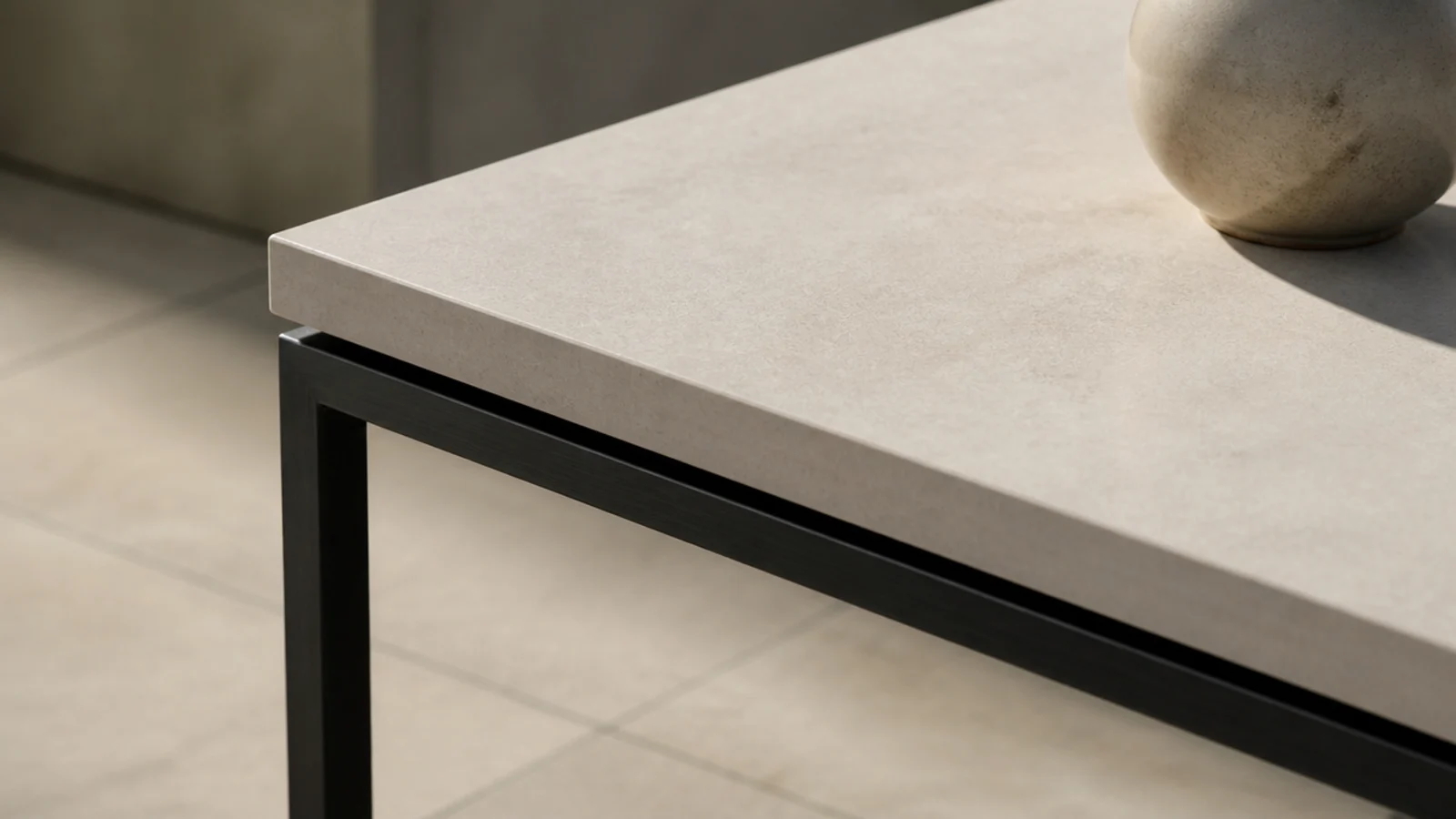
A 20 mm porcelain or sintered stone top gives a surface that never rings from a wet glass, never stains and shrugs off heat, on a base slim enough to keep the piece visually light. Real marble is porous and wants sealing every year, which is a poor match for a surface holding drinks.
The assembled weight passes 150 pounds easily, so it needs a level floor and a strap into a stud. Do not float this one on anchors. Expect fabricated stone at $60 to $140 a square foot on top of the base.
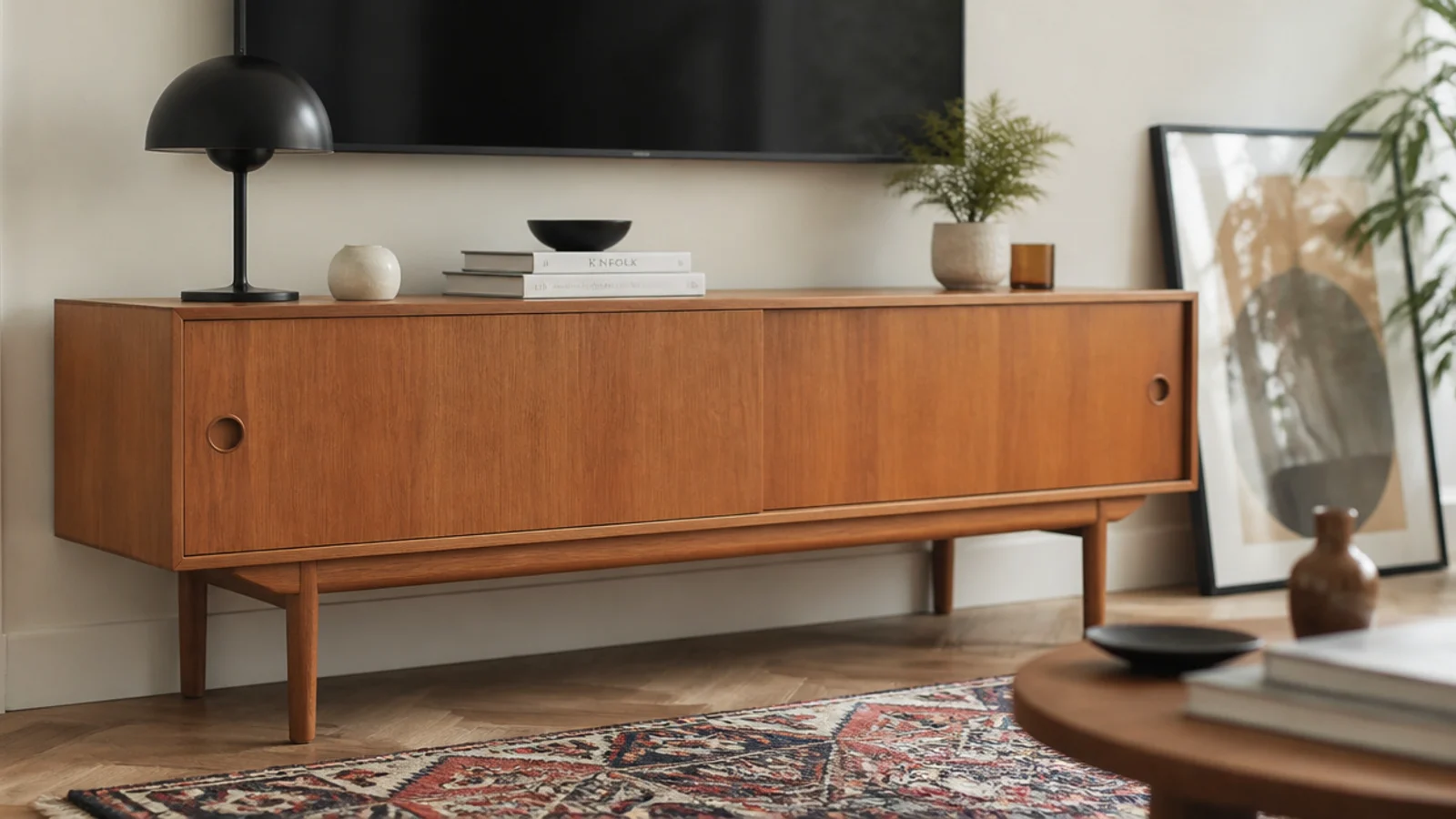
7. The vintage mid-century sideboard
Teak and rosewood sideboards from the 1960s and 70s turn up at $150 to $600 and are built to a standard new furniture rarely matches: solid carcasses, dovetailed drawers and tops that are still flat sixty years on.
Check three things before buying. Depth, which is often only 15 to 17 inches; whether the back panel can take a cable cut without weakening the carcass; and the veneer around any old heat source, which is where bubbling shows. Sliding doors are a bonus in a tight room, since nothing swings into the walkway.
8. A single floating shelf and nothing else
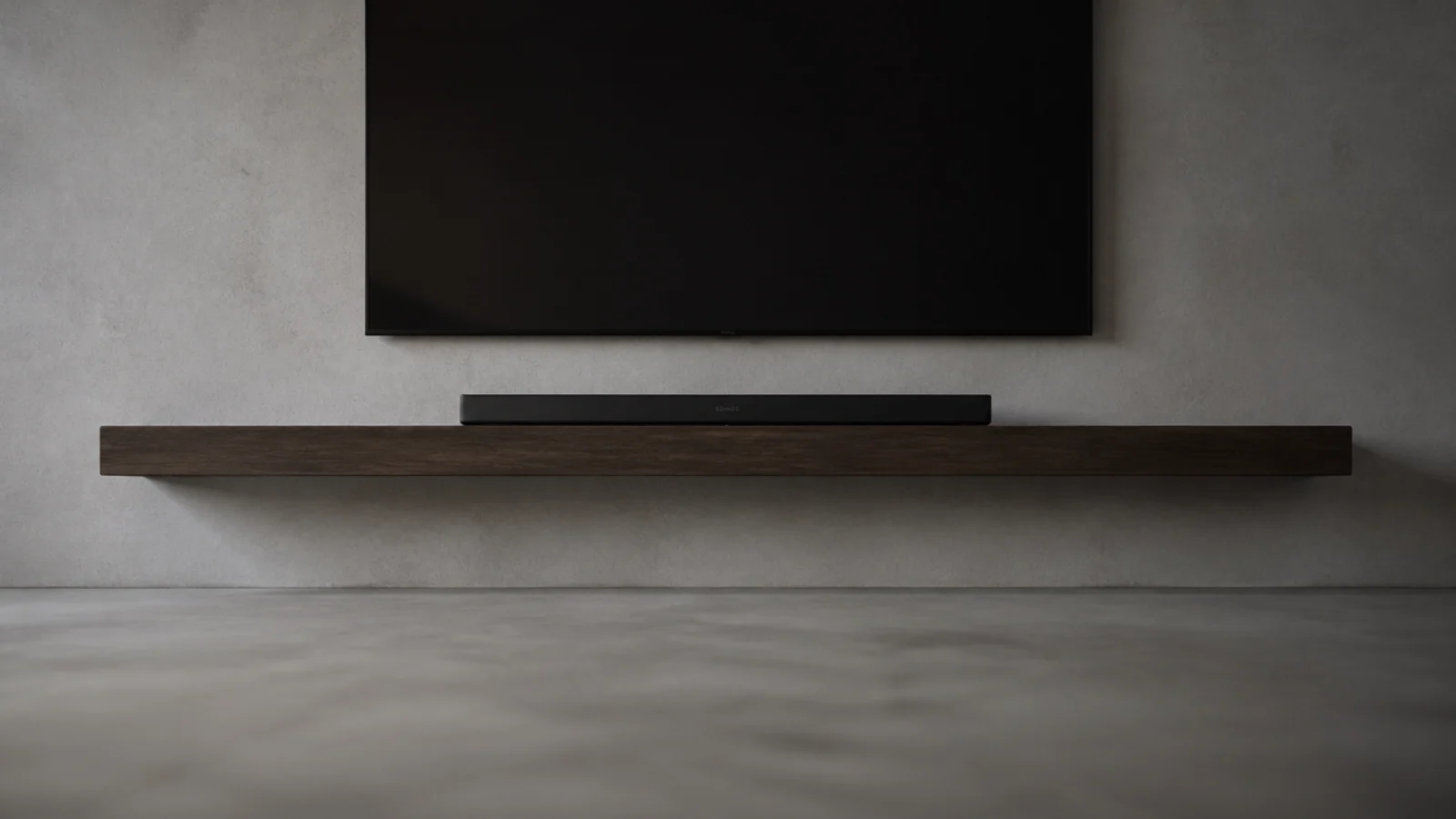
The most restrained option and, in a small flat, often the best one. One 10 to 12 inch deep shelf fixed into studs carries a soundbar and a streaming box, and the entire floor stays clear.
Materials come in under $50. Eighteen millimetre ply spans 30 to 32 inches under 30 pounds without visible dip, which covers most rooms, and there is no cabinet to ventilate because there is no cabinet. The bracket and span numbers are worked through in full in floating shelf ideas. It only fails when a receiver, a console and a stack of discs need a home, at which point you are buying furniture again.
What to Check Before You Buy
Measure your deepest device first. A receiver at 17 inches plus 3 to 4 inches of cable clearance rules out most 15 inch cabinets. This single number eliminates more of the market than any other, and it cannot be styled around afterwards.
Look at an exposed carcass edge. Eighteen millimetre board and 12 mm board look identical in a photograph. Twelve millimetre sags across a 60 inch span under gear and will not hold a hinge screw after two removals.
Pull the sample away from the wall in the shop. A back panel with real cutouts and a recessed plinth is what allows a closed bay to hold anything warmer than a streaming stick. A sealed box needs vents cut, about 40 square inches per bay.
Ask for the top load rating in writing. Particleboard units are typically 100 to 150 pounds across the whole top; solid timber and 18 mm ply reach 200 to 250. A 75 inch television weighs 65 to 90 pounds, and that load belongs over a divider rather than mid-span.
Check the width against the screen, not the wall. The unit should beat the panel by at least 12 inches in total, so 60 to 72 inches for a 55 inch screen that measures about 48 inches across. Narrower always looks unstable.
Confirm the shelves adjust. A vertical row of holes at 32 mm centres keeps a cabinet useful for a decade, because the next console will be a different height. Fixed shelves are the most common reason a sound media unit gets replaced early.
Decide about doors and infrared before you commit. Solid timber blocks remote signals, which is why so many beautiful cabinets live permanently half open. Slats, cane and reeded glass all pass infrared; a repeater kit at $20 to $40 solves the rest.
Frequently asked questions
Which entertainment unit style suits a small room?
A wall-hung cabinet or a single floating shelf, because both keep the floor visible and neither needs a walkway allowance for a plinth. Keep the depth to 12 to 15 inches and hang the underside 12 to 16 inches up so a vacuum can pass beneath it.
What internal depth should I look for?
Twenty inches if a receiver or a full-size console lives inside, since the chassis alone runs 13 to 17 inches and stiff cable needs another 3 to 4 inches behind it. Fifteen to 18 inches is enough for streaming boxes, a slim console and a soundbar on top.
Are open shelves a bad idea for media gear?
They are the best option for heat and the worst for visual calm. Nothing traps warmth on an open shelf, but every box, light and cable stays visible. The compromise most people want is slats or cane, which hide the equipment from a seated eye while still passing air.
Is built-in joinery worth the money?
It is if the wall is awkward, if you need the run to reach both corners, or if the room is a long-term home. It buys scribed edges, a matched plinth and exact depths. For a rental or a room that will change in three years, a good freestanding piece is the better decision.
What should I check on a unit before buying it?
Carcass thickness at an exposed edge, internal depth against your deepest device, whether the back panel has any vent openings, and the top load rating in writing. Those four answers rule out most of the market faster than any amount of looking at finishes.
Buy for depth, heat and span, and the finish becomes the easy decision it should be. The modern cabinets guide goes further into carcass construction and hardware, the clutter-hiding ideas cover cables and ventilation once the unit is home, and for the coffee table that sits in front of it, the luxury center table guide has the clearances. Save the pin for the next showroom visit.
Want more like this? Browse all 15 tv unit decor guides — they all use the same measurements and budget tiers.
Pin it for later
Save this to your TV Unit Decor board
Pin it now so it is waiting for you when the tape measure comes out — and so the next person hunting for this idea can find it too.
Save this pinKeep going
More ideas worth saving while you have the tape measure out.