Kitchen Shelf Ideas · Listicle
25 Budget-Friendly Kitchen Shelf Ideas for Small Spaces

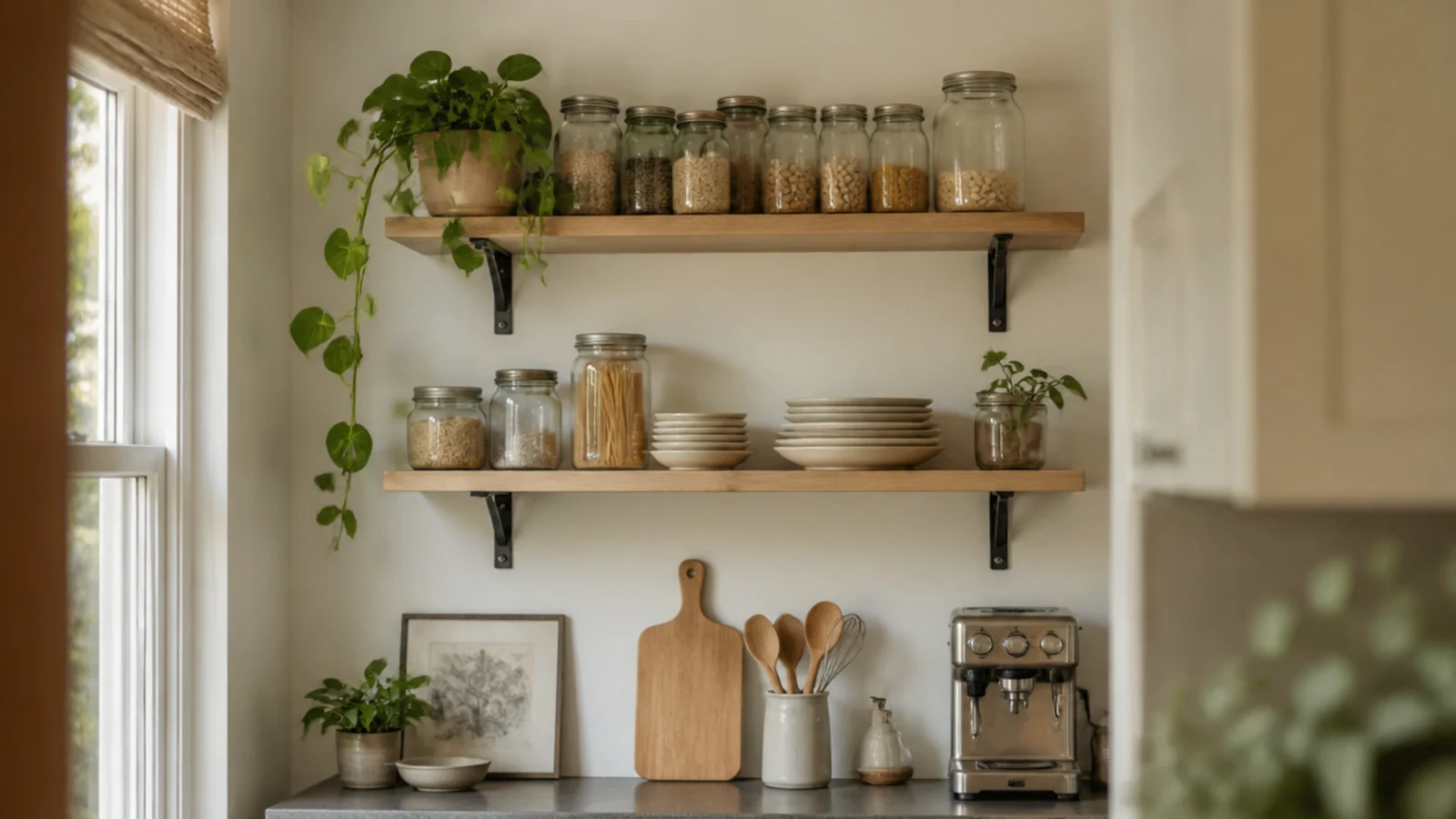
Open kitchen shelves have a reputation for being expensive and impractical, and both come from the same mistake: treating them as decor rather than storage. A shelf holding the plates you eat off every night stays clean and costs about $25. A shelf holding a styled arrangement of things you never touch collects grease and costs you a weekend. These 25 setups are cheap, small-kitchen-sized, and built to be used.
In this guide27 sections — tap to openHide
- 1.What open kitchen shelves cost when the kitchen is small
- 2.Take one cabinet door off and leave the box
- 3.One pine board and two brackets under $25
- 4.Scaffold board offcuts from a builders yard
- 5.A cleat rail instead of brackets
- 6.A six-inch shelf for a galley kitchen
- 7.Picture ledges as spice shelves
- 8.Reclaimed pallet boards, planed and sealed
- 9.A countertop offcut as a thick shelf
- 10.Recycled jars instead of matching canisters
- 11.Paint the shelves the wall color so they vanish
- 12.Hang a shelf under the wall cabinets
- 13.Use the end panel of a cabinet run
- 14.A shelf above the washer in an apartment kitchen
- 15.Two shelves in a studio kitchenette
- 16.One shelf plus a hook strip underneath
- 17.Baskets on the top shelf for the ugly things
- 18.A shelf over the sink in a windowless kitchen
- 19.Painted plywood shelves at $8 a board
- 20.Solid wood shelves from a salvage yard
- 21.A French cleat run you can patch in an hour
- 22.A shelf across the top of a galley run
- 23.Wire shelving sprayed matte black
- 24.A tension pole shelf unit for renters
- 25.Stop the shelf short so the fridge door clears
- 26.Start with one shelf and a two-week test
- 27.Mistakes to Skip
What open kitchen shelves cost when the kitchen is small
The board is rarely the expensive part. Fixings are, and they are the part worth spending on.
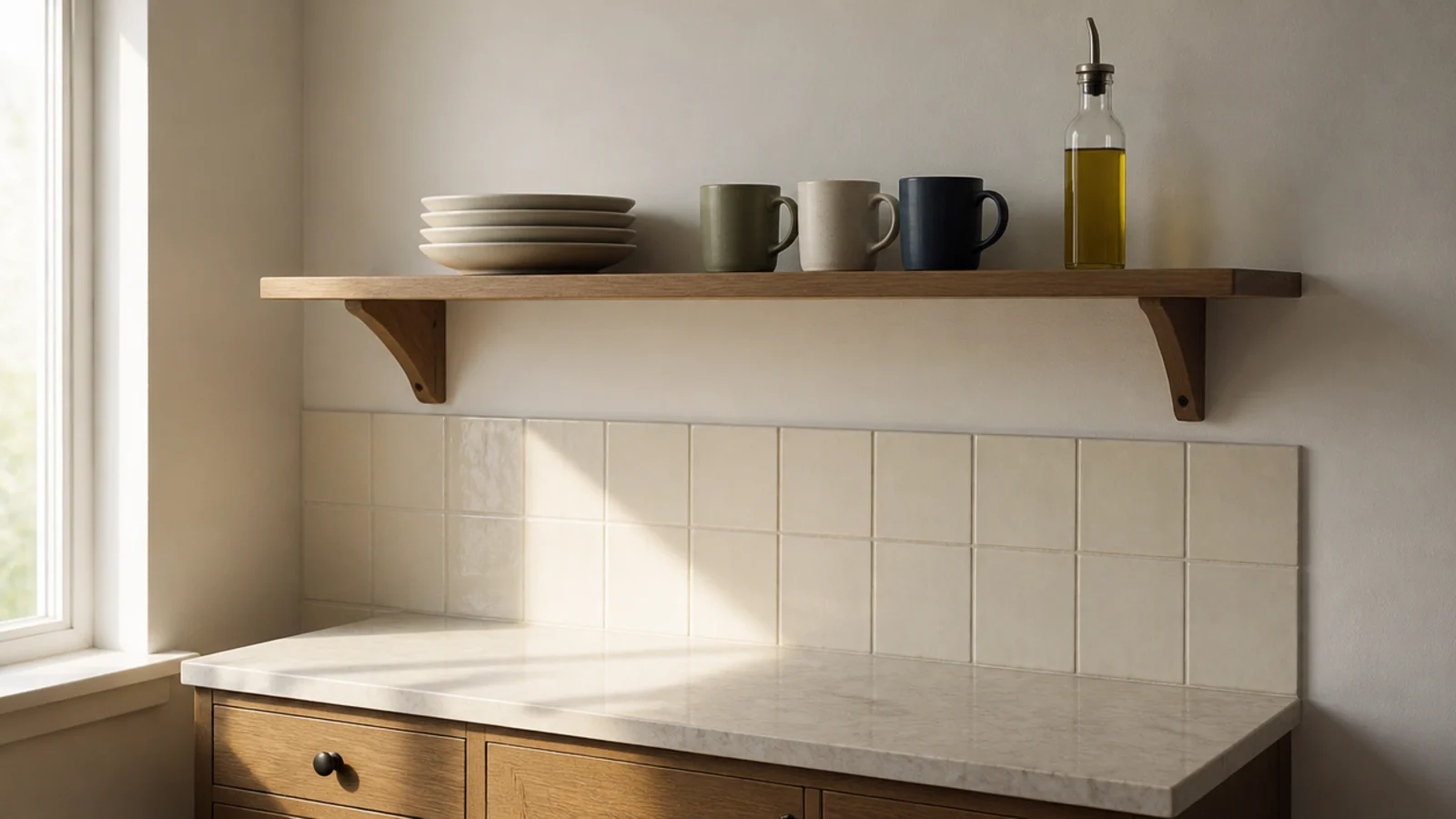
Height first. The first shelf goes 18 inches above the countertop, which clears a stand mixer and most small appliances. The second sits 12 to 14 inches above that. In a small kitchen with a clear counter you can drop the first to 14 and win a whole extra tier.
Then the stove distance. Anything within about four feet of a burner picks up an airborne grease film. Put the things you wash weekly in that zone and keep decorative pieces at the far end of the run. Above a range hood, ceramic, metal or glass only — never wood, never anything wax-based.
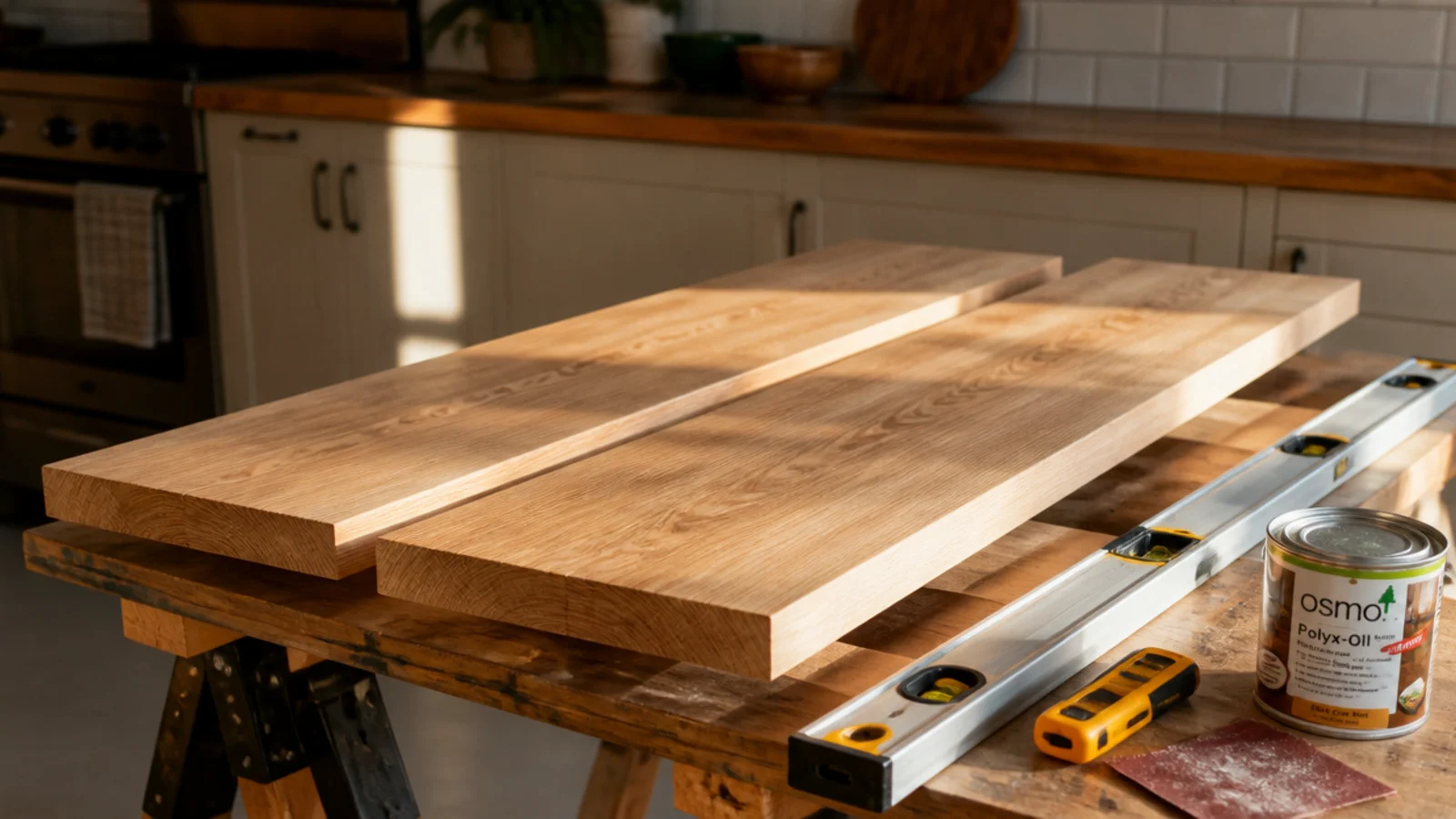
Then the finish. Water-based polyurethane or hardwax oil, never clear wax. Seal every face including the underside and the cut ends or the board cups.
Then the weight. A stack of ten dinner plates is around 12 pounds, so anything holding dishes wants at least one bracket in a stud and three-quarter-inch stock minimum.
Budget tiers: painted plywood or pine with basic brackets, $22 to $35 a shelf ($). Sealed solid poplar or ash, $45 to $75 ($$). White oak with concealed hardware, $90 to $140 ($$$).
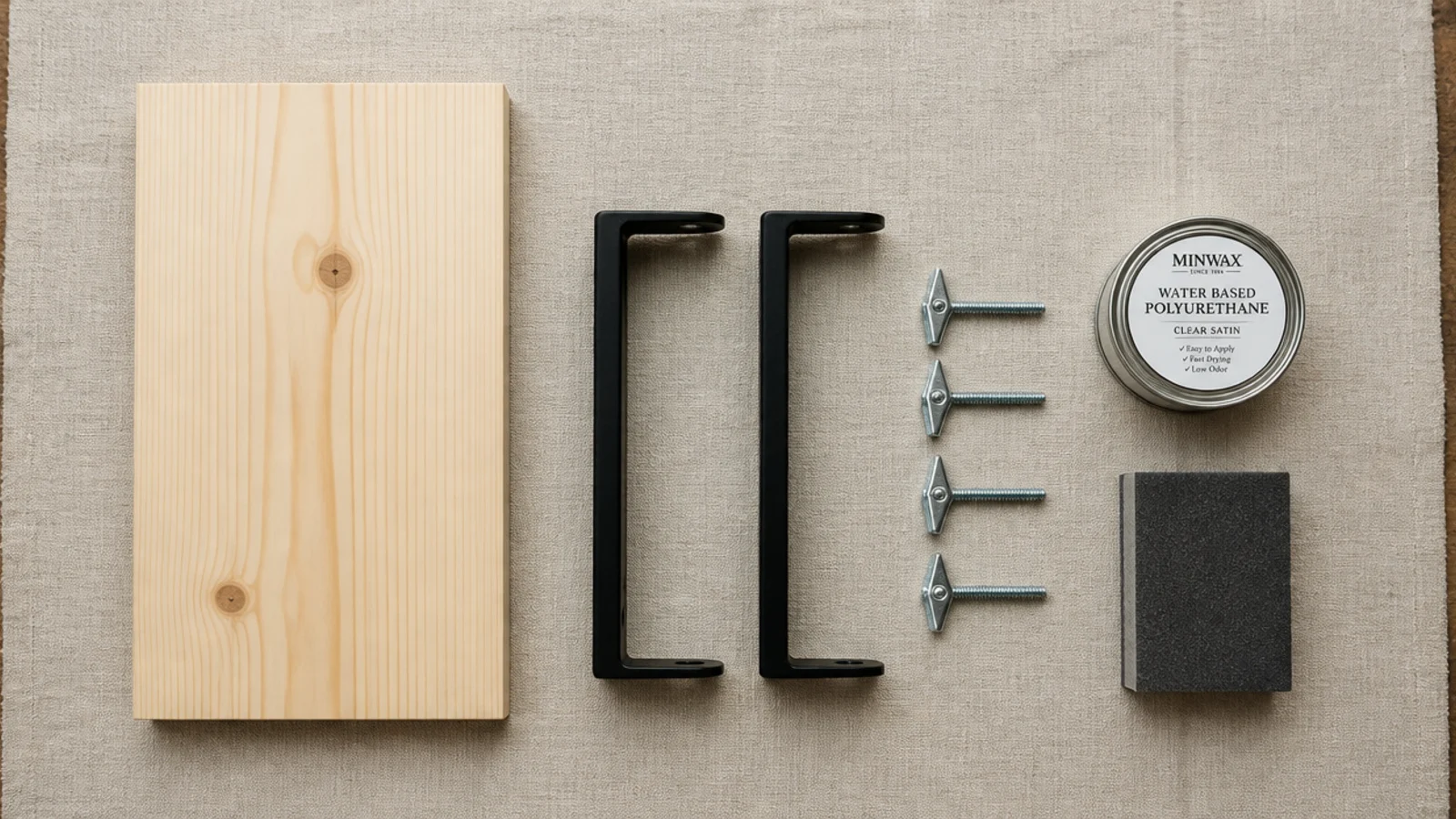
1. Take one cabinet door off and leave the box
The cheapest open shelf in any kitchen is one you already own. Unscrew a door, fill the hinge holes, paint the interior a soft contrast color, and you have open shelving for the price of a sample pot.
It is also completely reversible, which matters in a rental. Keep the door and hinges in a bag taped inside the cabinet.
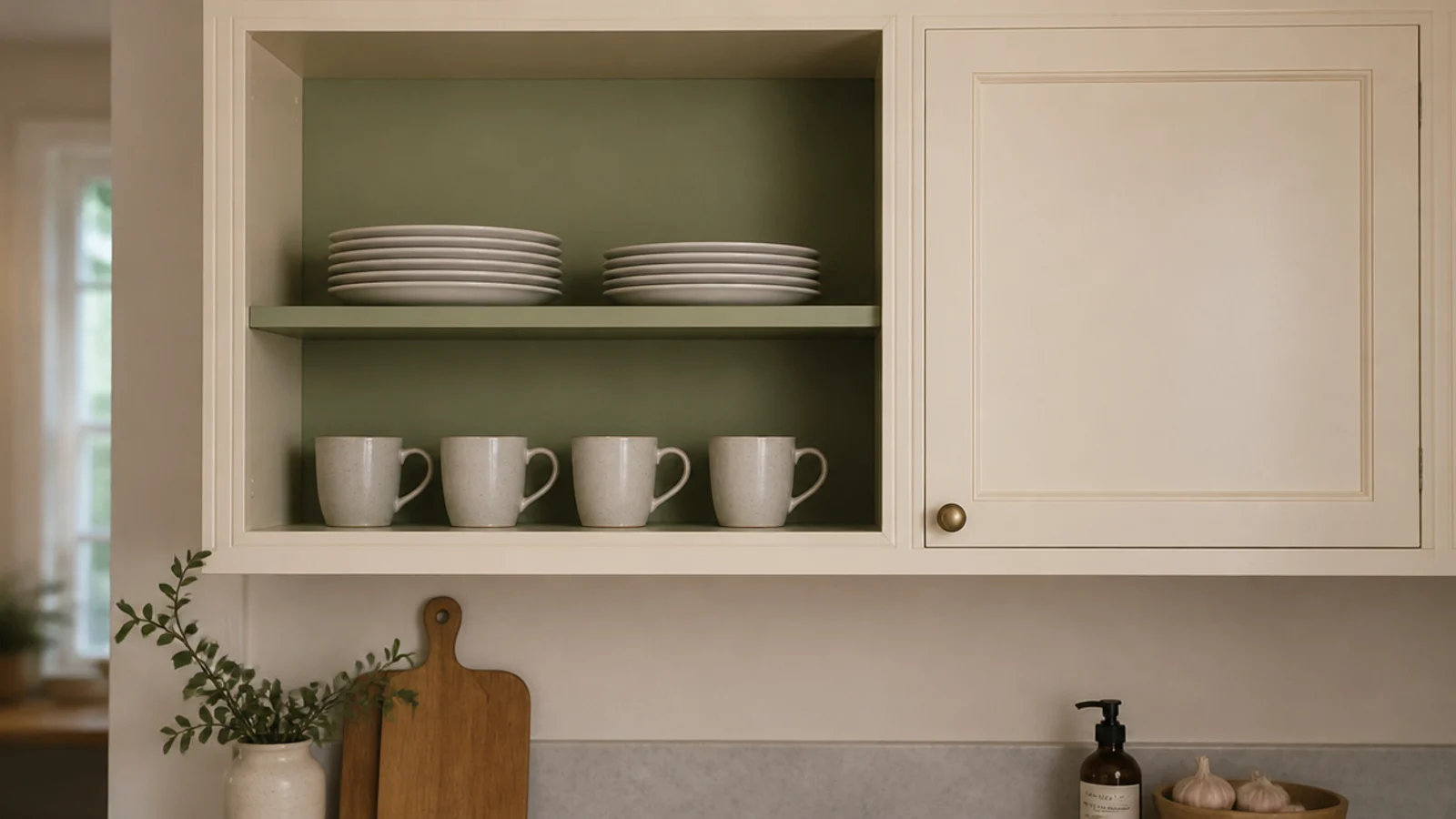
2. One pine board and two brackets under $25
A three-foot length of knot-free pine, two slim black brackets and an hour is a real shelf. Sand the front edge round before you seal it — that single step is what stops it reading as raw lumber.
Pine dents, so keep it for jars and mugs rather than heavy stoneware. Two coats of water-based poly, all faces.
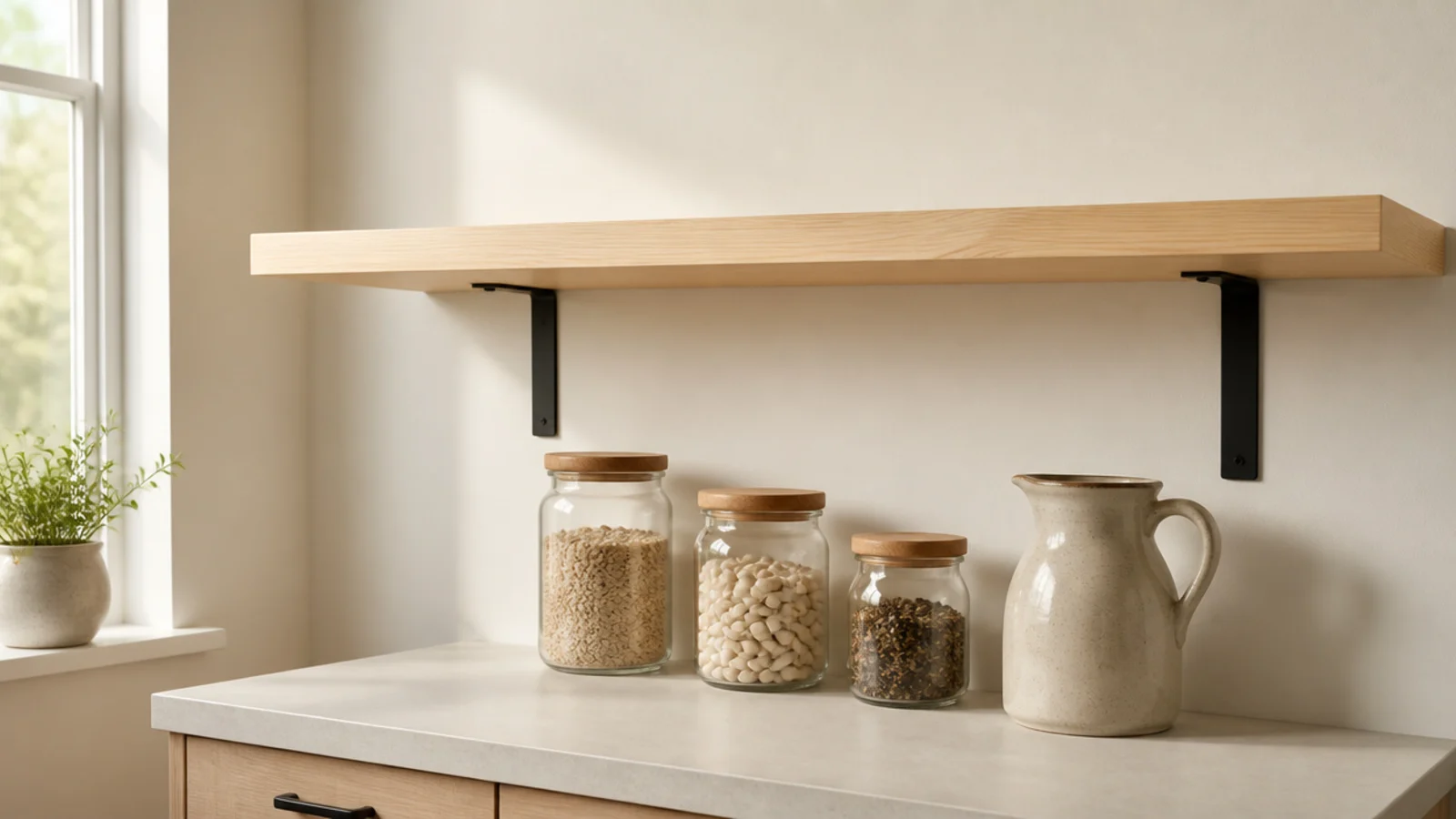
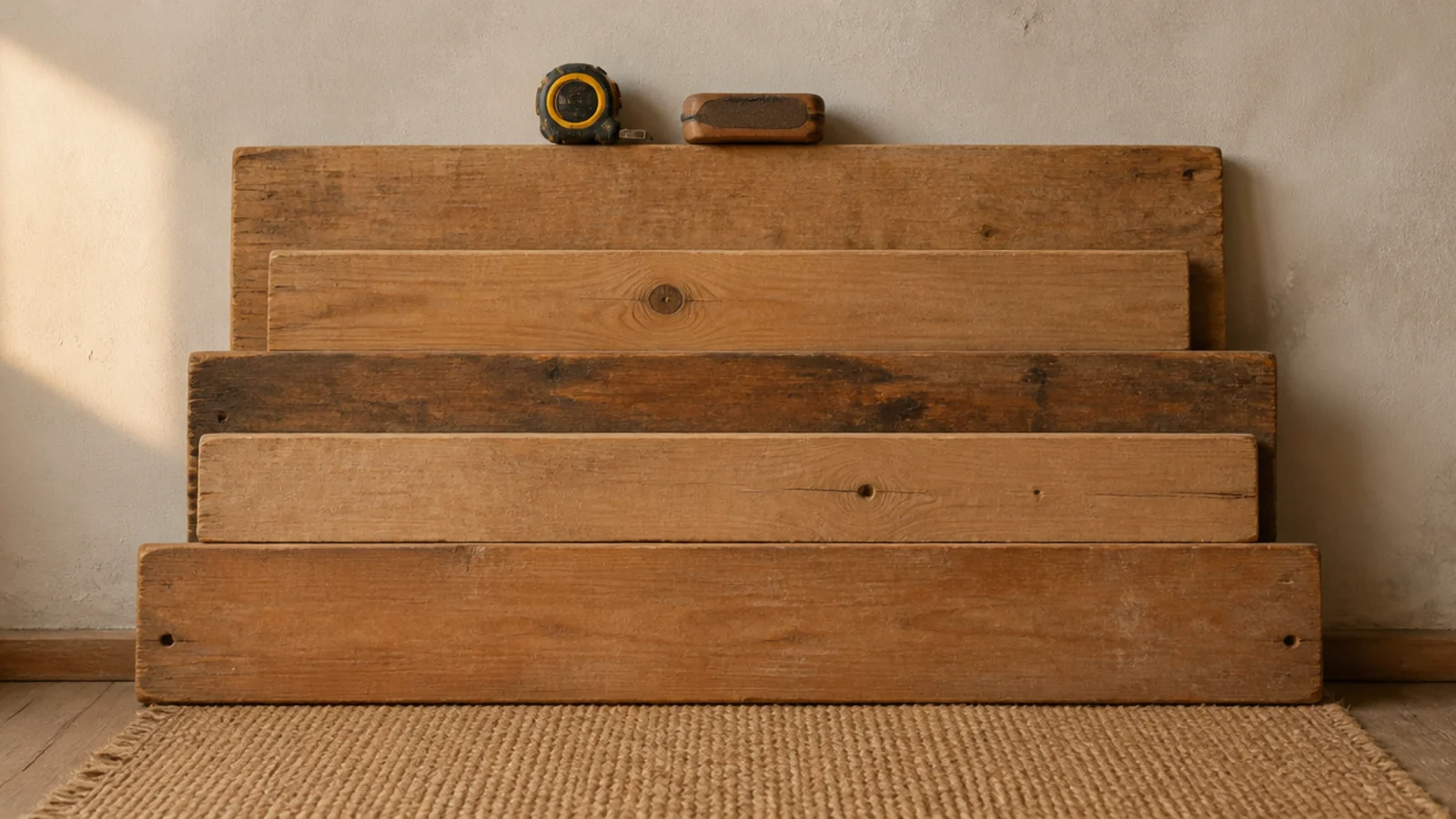
3. Scaffold board offcuts from a builders yard
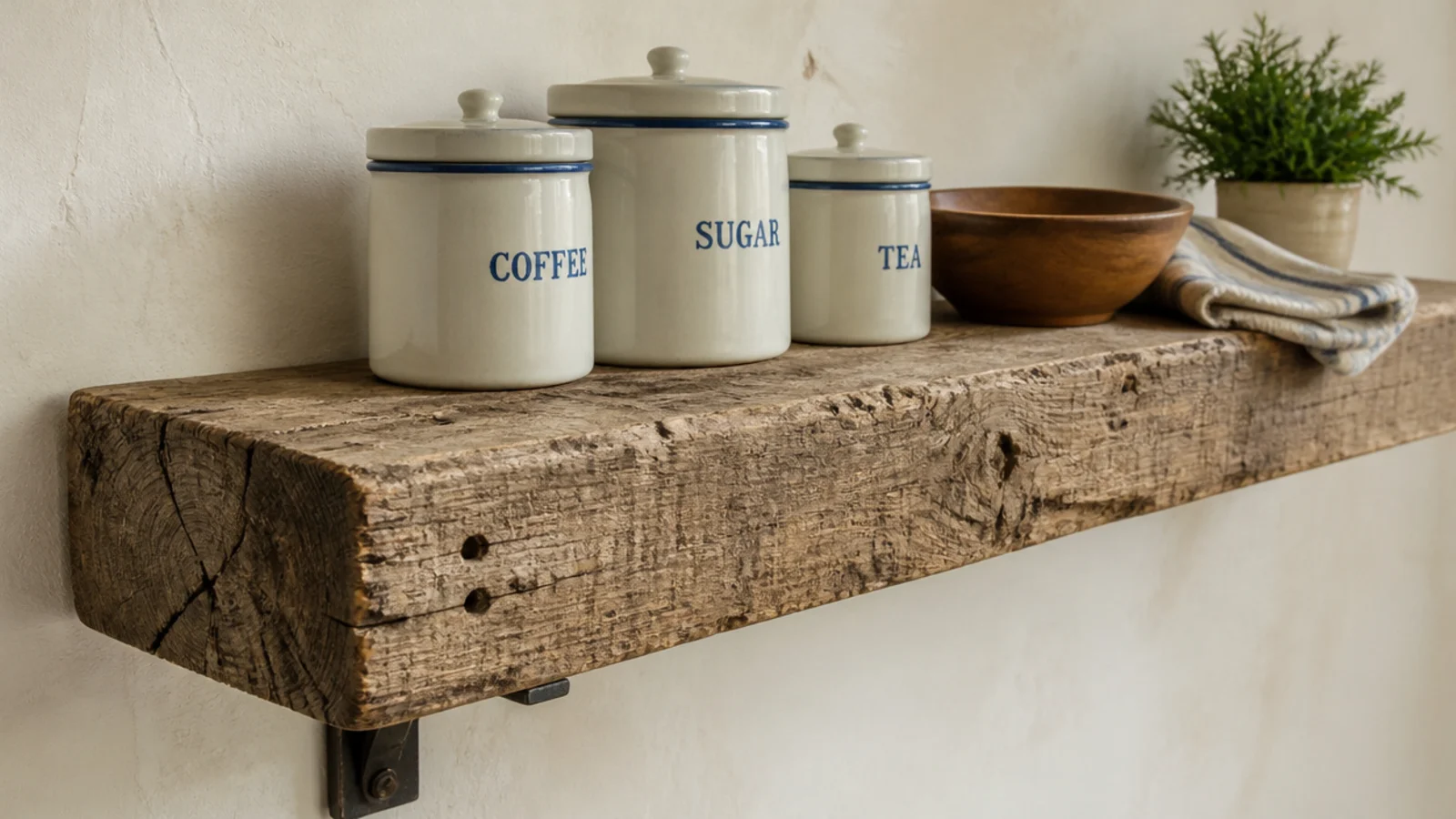
Used scaffold boards sell for a few dollars a foot and arrive at nearly two inches thick with saw marks and nail holes already in them.
Sand to 120 only — going finer erases the character you paid for. Seal with hardwax oil rather than poly, which suits the rough grain better. This is the most texture per dollar available in a kitchen.
4. A cleat rail instead of brackets
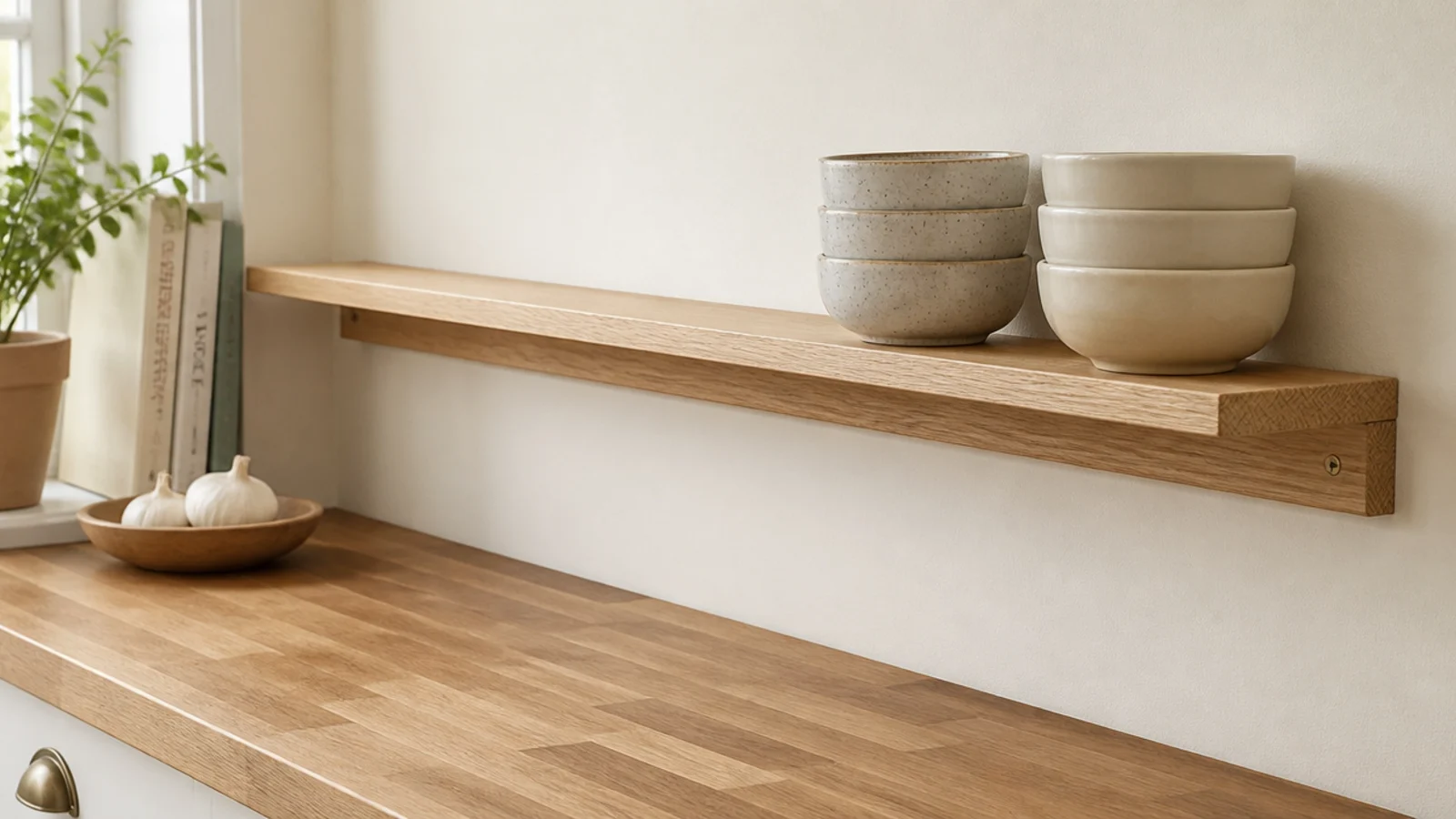
Screw a length of one-by-two into the studs, sit the shelf board on it and skip brackets entirely. Materials come to about $18 for a four-foot shelf.
It carries more than budget brackets, reads cleaner from the side, and leaves two or three holes to patch instead of eight. Pin the board down with two short screws from underneath so it cannot shift.
5. A six-inch shelf for a galley kitchen
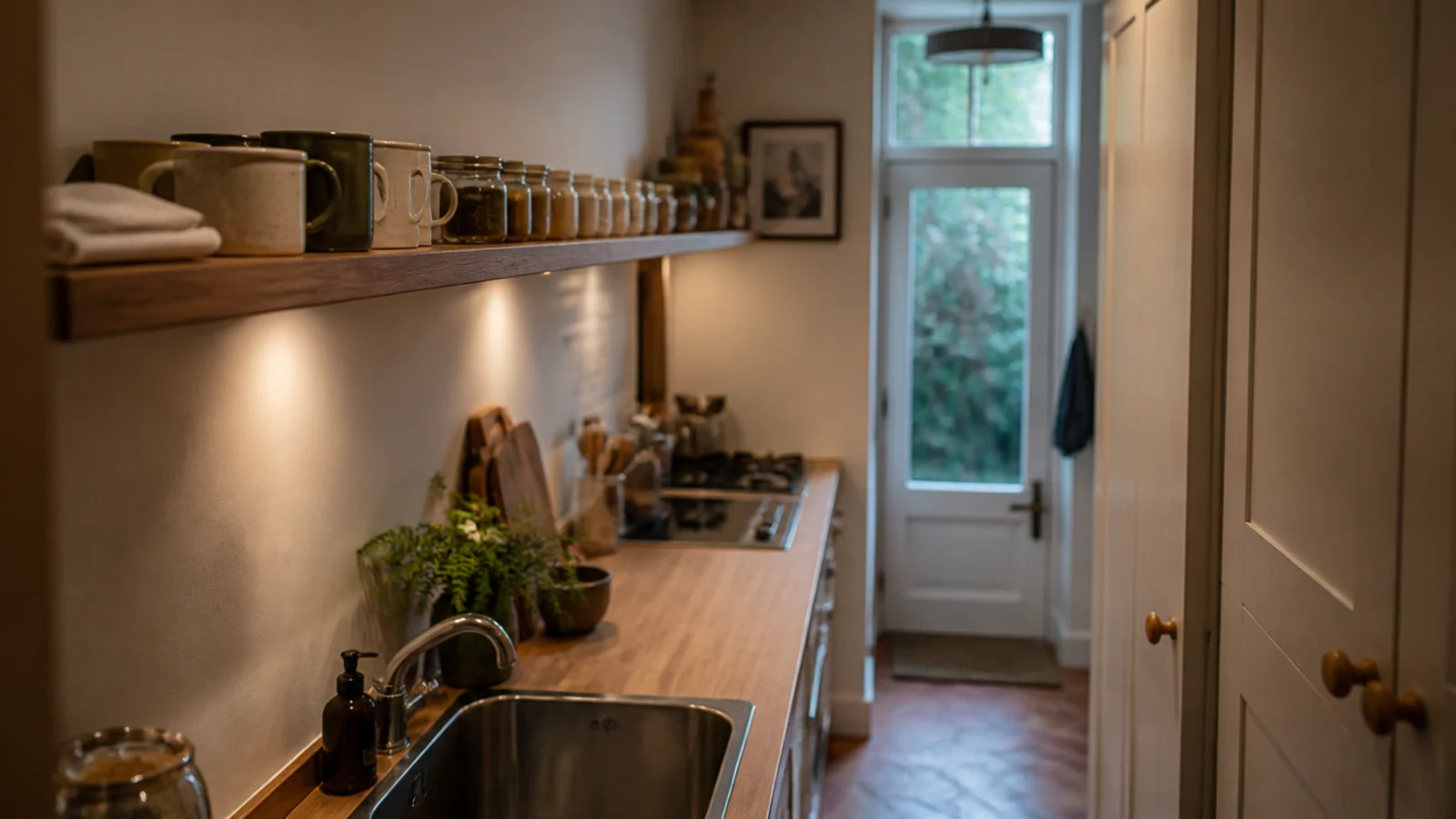
In a galley, depth is the enemy. Six inches holds mugs, small jars and side plates without narrowing the walkway that both people need.
Measure the gap between counters first. Under 42 inches and you want six-inch shelves on one wall only, never both. Everything on it should be single-row, so nothing hides behind anything.
6. Picture ledges as spice shelves
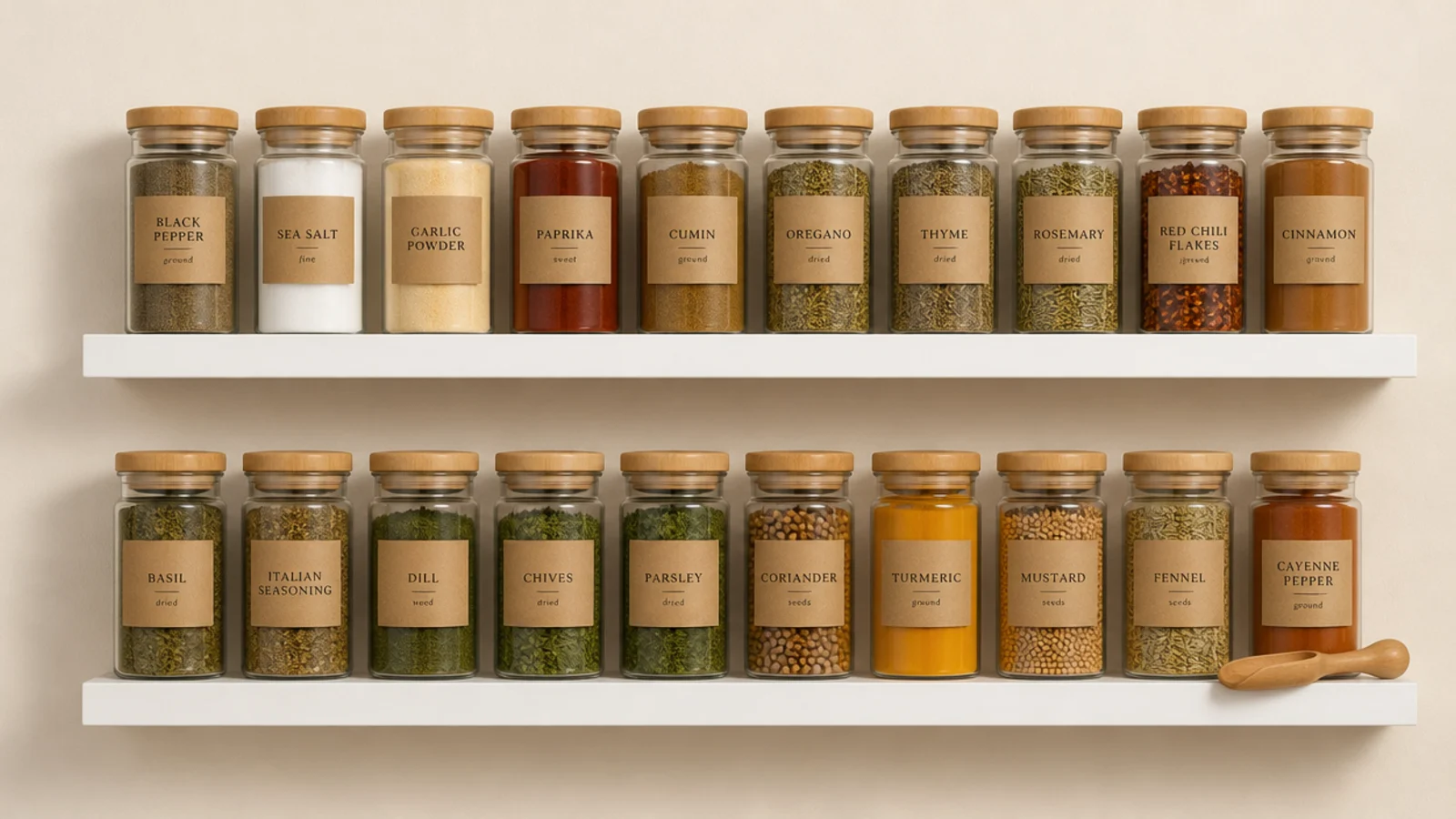
A slim picture ledge costs $8 to $12 and holds a full spice rack against a wall that was doing nothing.
Mount two, 7 inches apart, and the whole spice cupboard comes out into the open where you can see it. The lip means nothing slides off when a cupboard door slams. Keep it to the spices you actually cook with weekly.
7. Reclaimed pallet boards, planed and sealed
Free wood is only free if you plane it. Pallet boards arrive cupped, splintery and often damp, and none of that is fixable with sandpaper alone.
If you can borrow a planer, they make genuinely lovely pale shelves. Seal every face, including the ends, and never use pallet wood marked MB — that stands for methyl bromide treatment.
8. A countertop offcut as a thick shelf
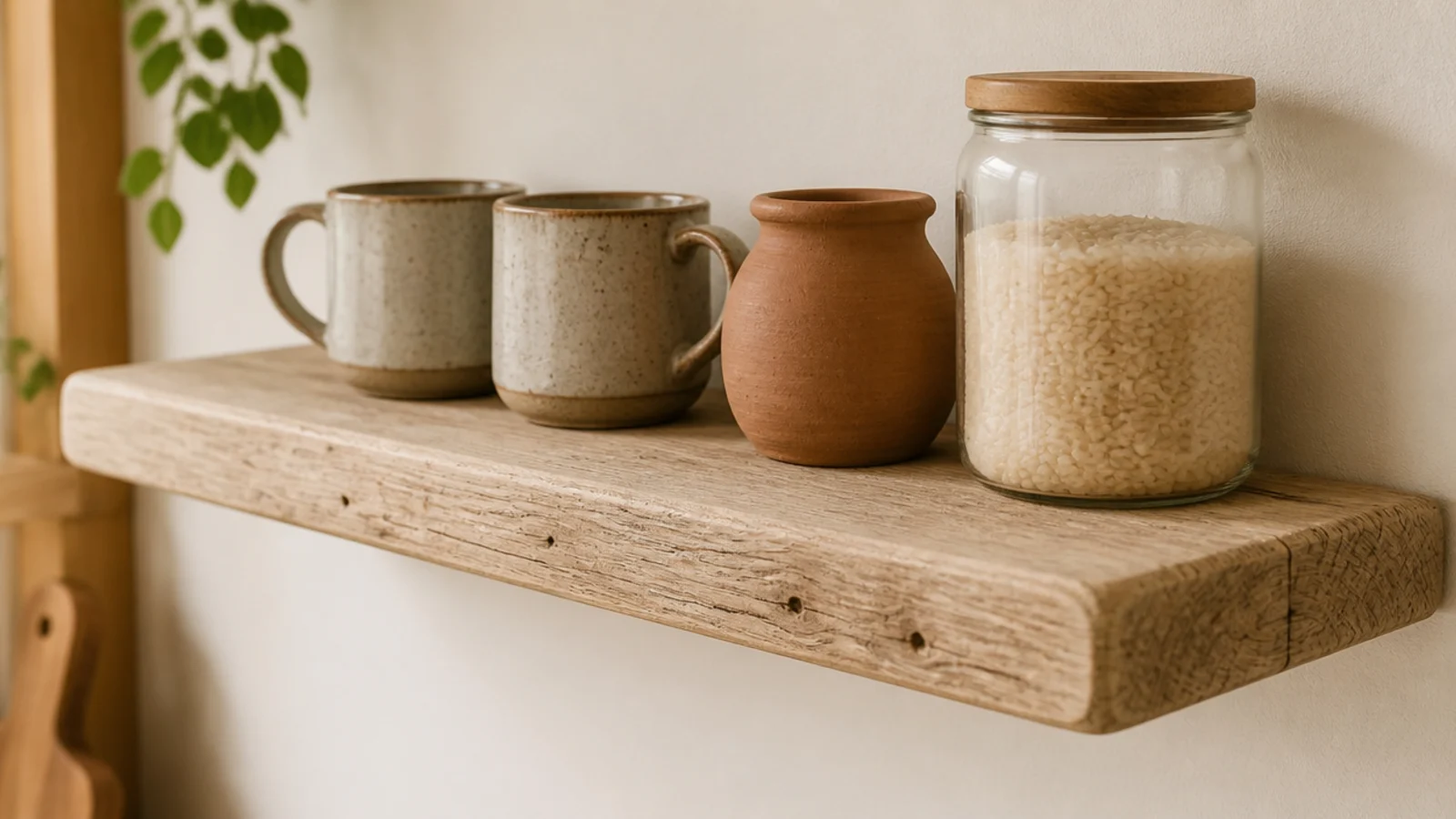
Worktop suppliers sell butcher block offcuts at a steep discount, and they arrive already an inch and a half thick with the front edge finished.
A thick shelf reads as expensive in a way a thin one never does. Match your existing counter species if you have wood, or deliberately contrast it — the half-match is what looks accidental.
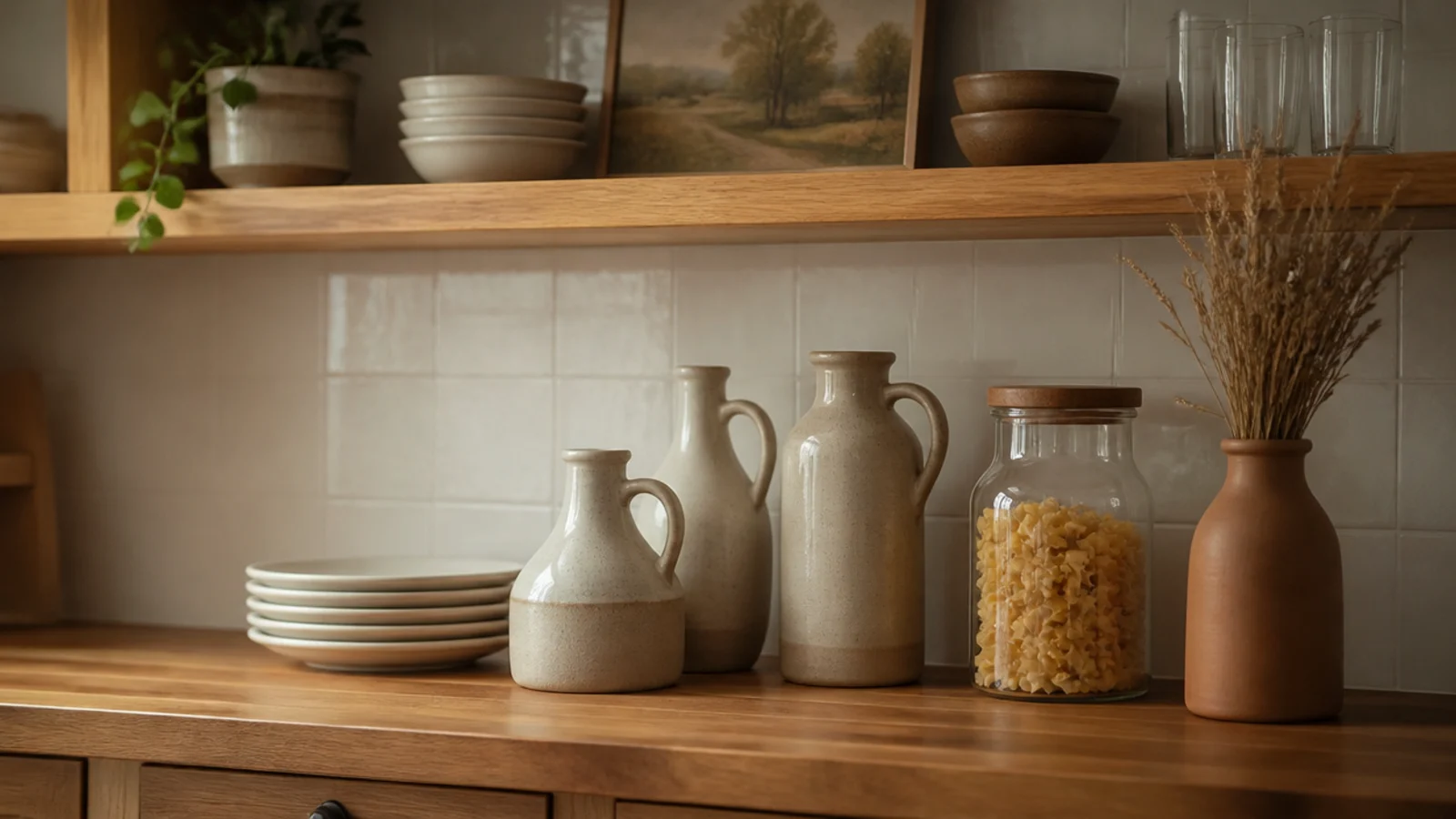
9. Recycled jars instead of matching canisters
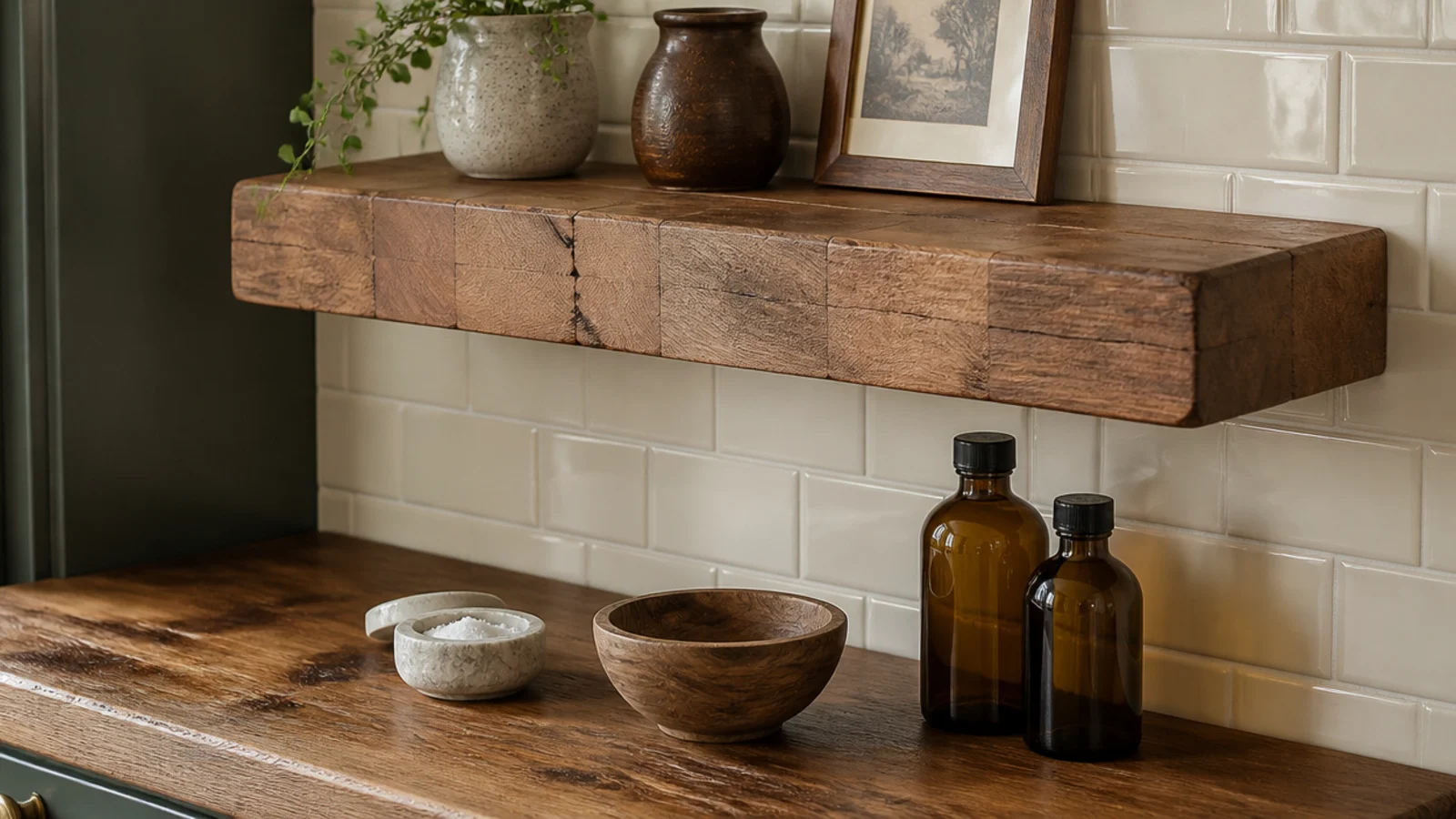
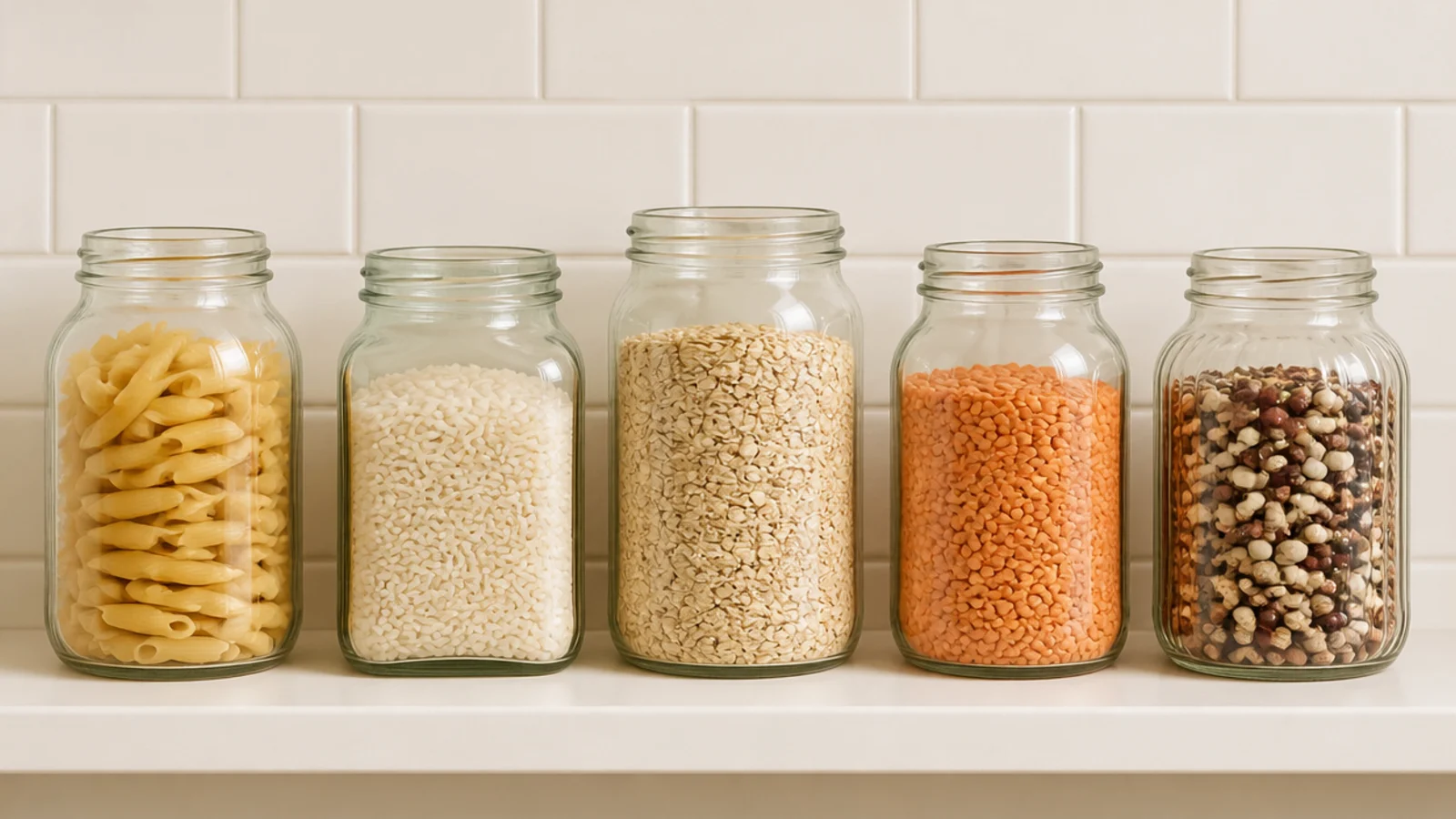
Matching canisters cost $80 for a set. Soaked-clean sauce jars cost nothing and read almost identically once the contents are the star.
Stick to four or five, group them by height, and keep the contents warm and neutral: pasta, rice, oats, lentils. A whole wall of jars stops reading as texture and starts reading as a bulk store.
10. Paint the shelves the wall color so they vanish
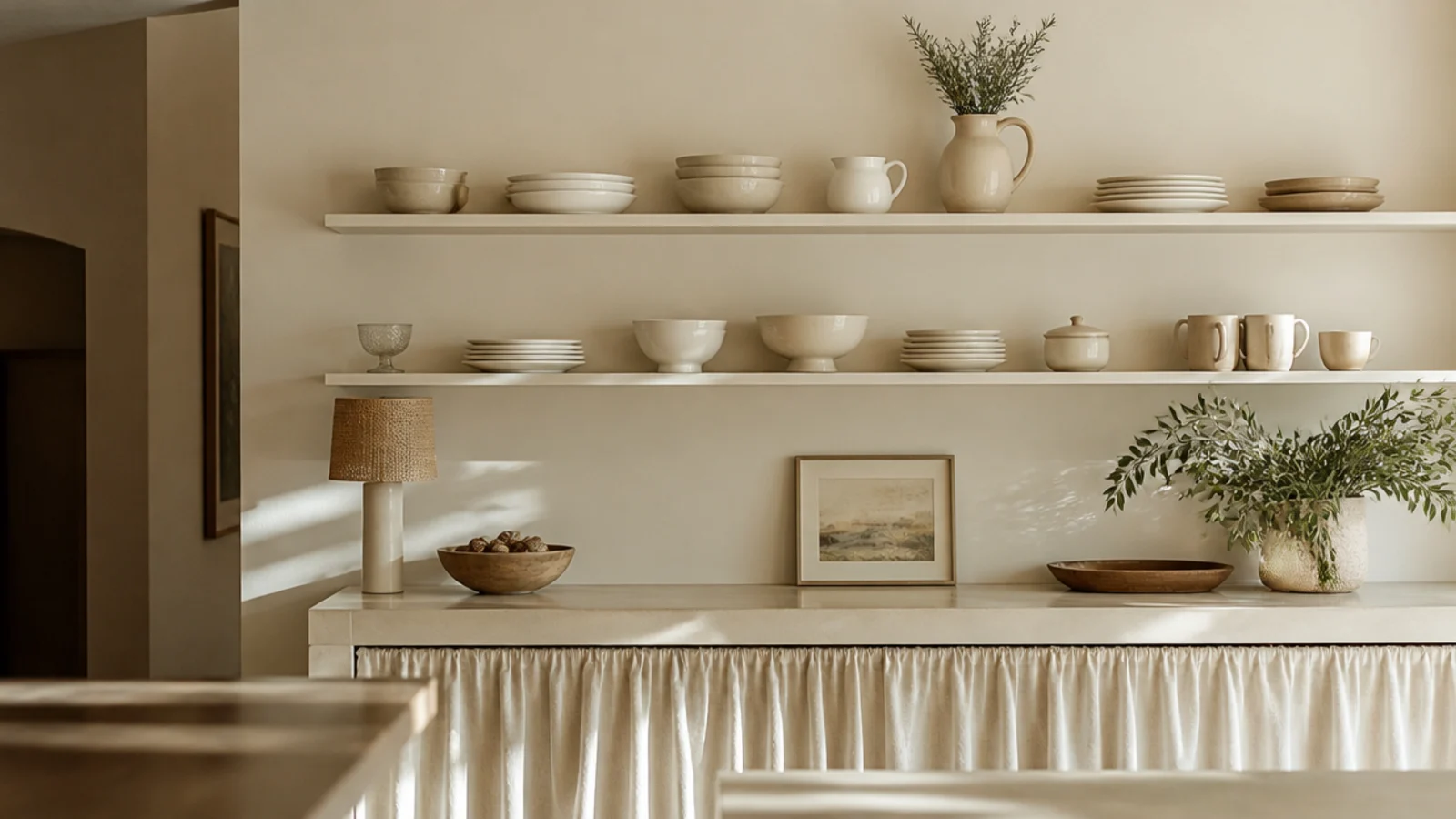
In a small kitchen, contrast eats space. Shelves painted the exact wall color — brackets included — let your eye run past them and the room keeps its depth.
This is the cheapest way to make budget materials look deliberate, because paint hides plywood edges, pine knots and mismatched brackets all at once.
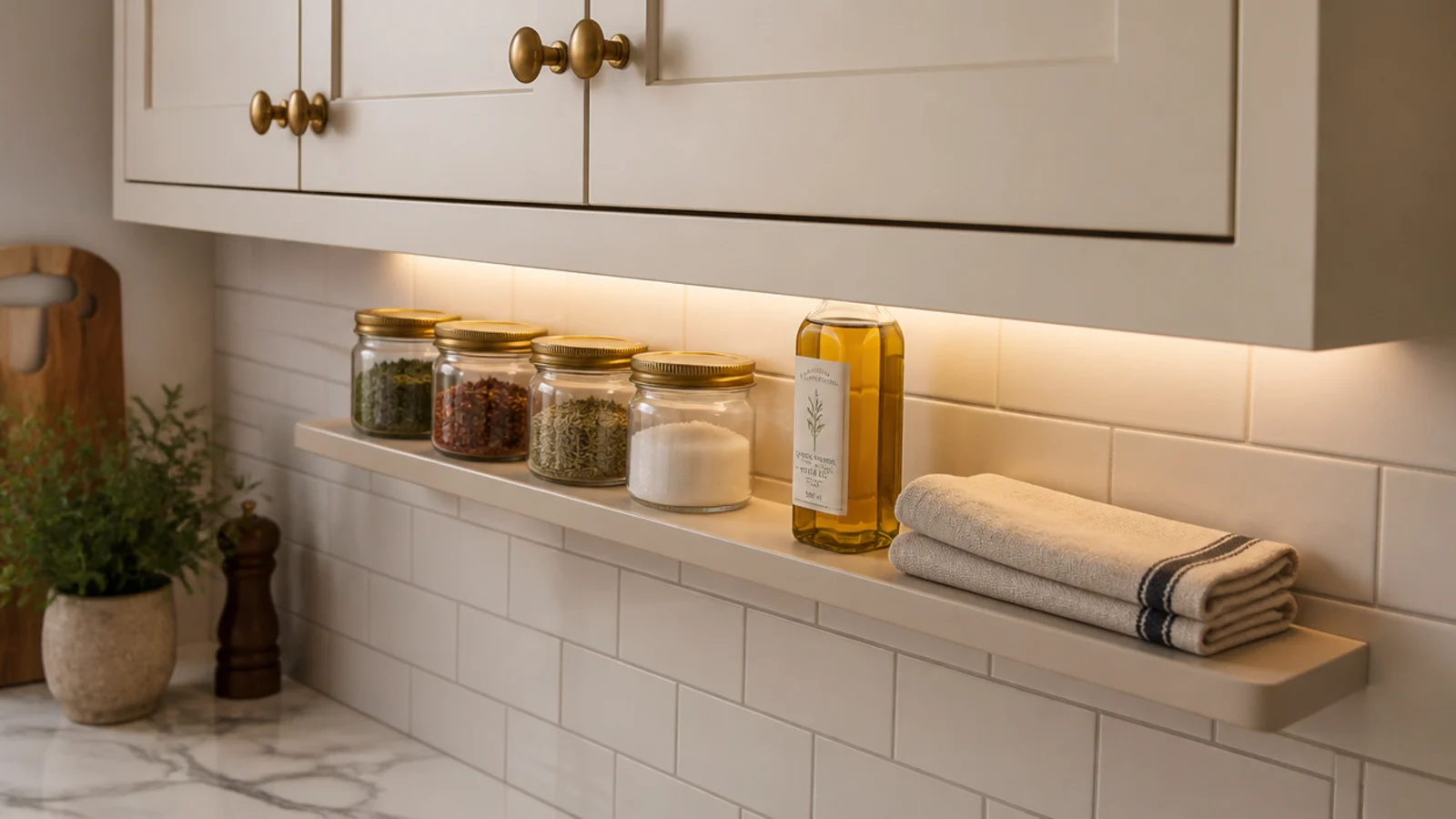
11. Hang a shelf under the wall cabinets
The 18 inches between the underside of a wall cabinet and the counter is real estate nobody claims. A slim shelf fixed to the cabinet underside holds daily jars and oils.
Keep it to 3 or 4 inches deep so the counter stays workable, and mount into the cabinet bottom rather than the wall for the cleanest result.
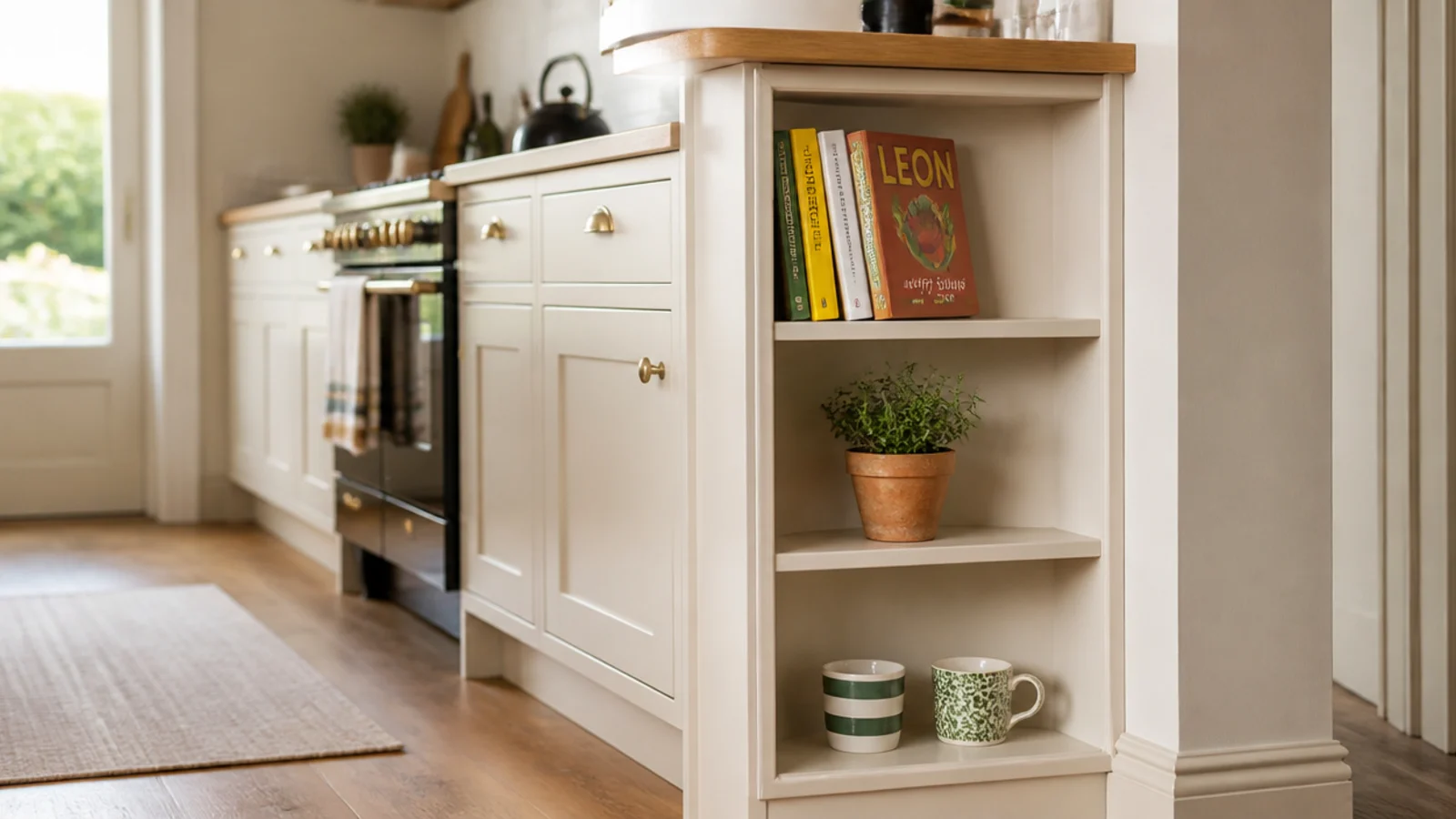
12. Use the end panel of a cabinet run
Where a run of cabinets stops, there is a blank vertical panel doing nothing. Three small shelves there hold cookbooks, herbs or mugs.
Screw into the panel from inside the cabinet where possible so no fixings show. This is prime space in a small kitchen because it sits outside the working triangle entirely.
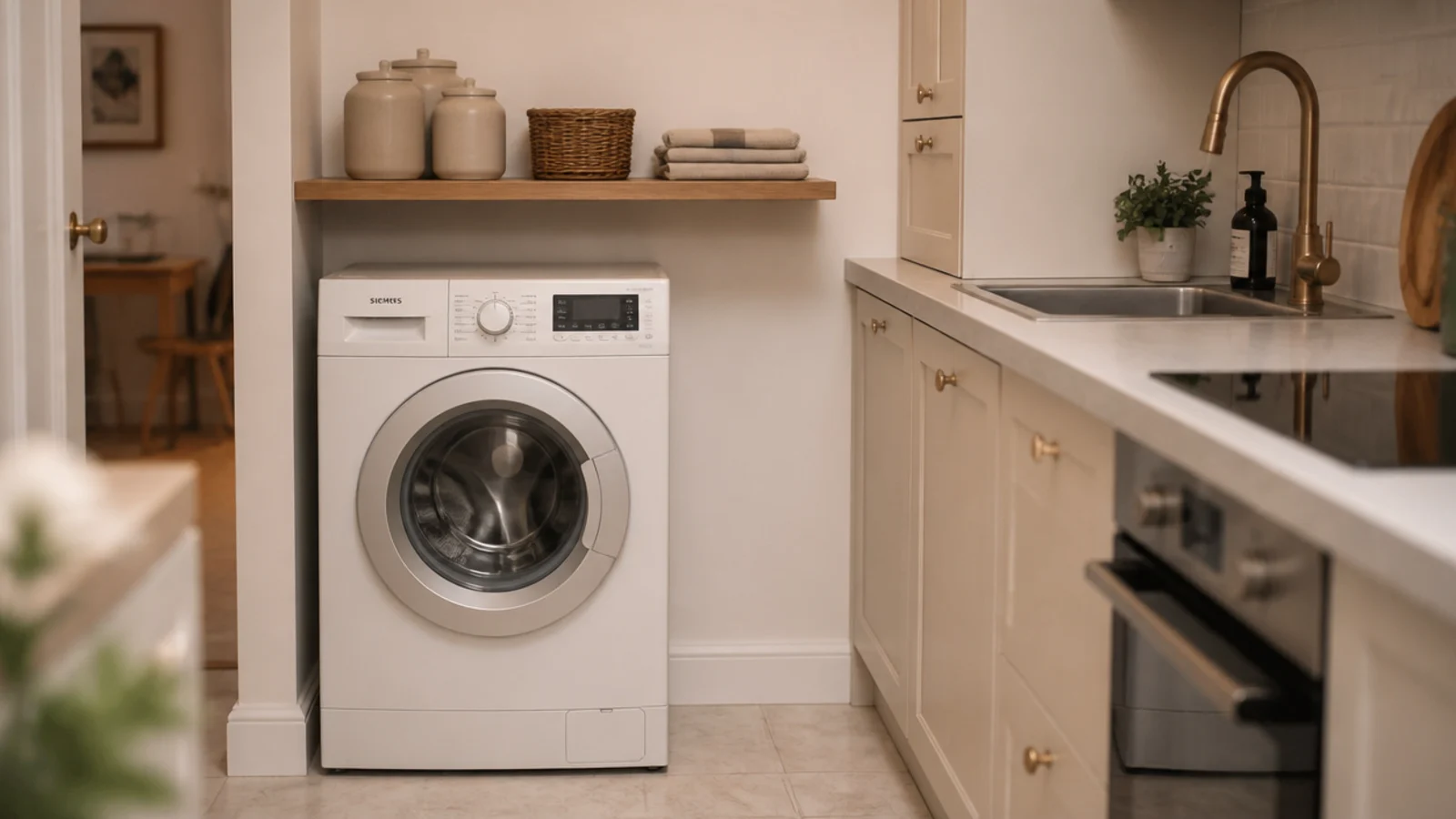
13. A shelf above the washer in an apartment kitchen
Apartment kitchens often swallow a washing machine, and the wall above it is usually wasted.
Vibration is the only real constraint. Use lidded containers and baskets, nothing loose, nothing glass at the front edge. Mount into studs rather than drywall anchors, because the whole wall gets a low hum every spin cycle.
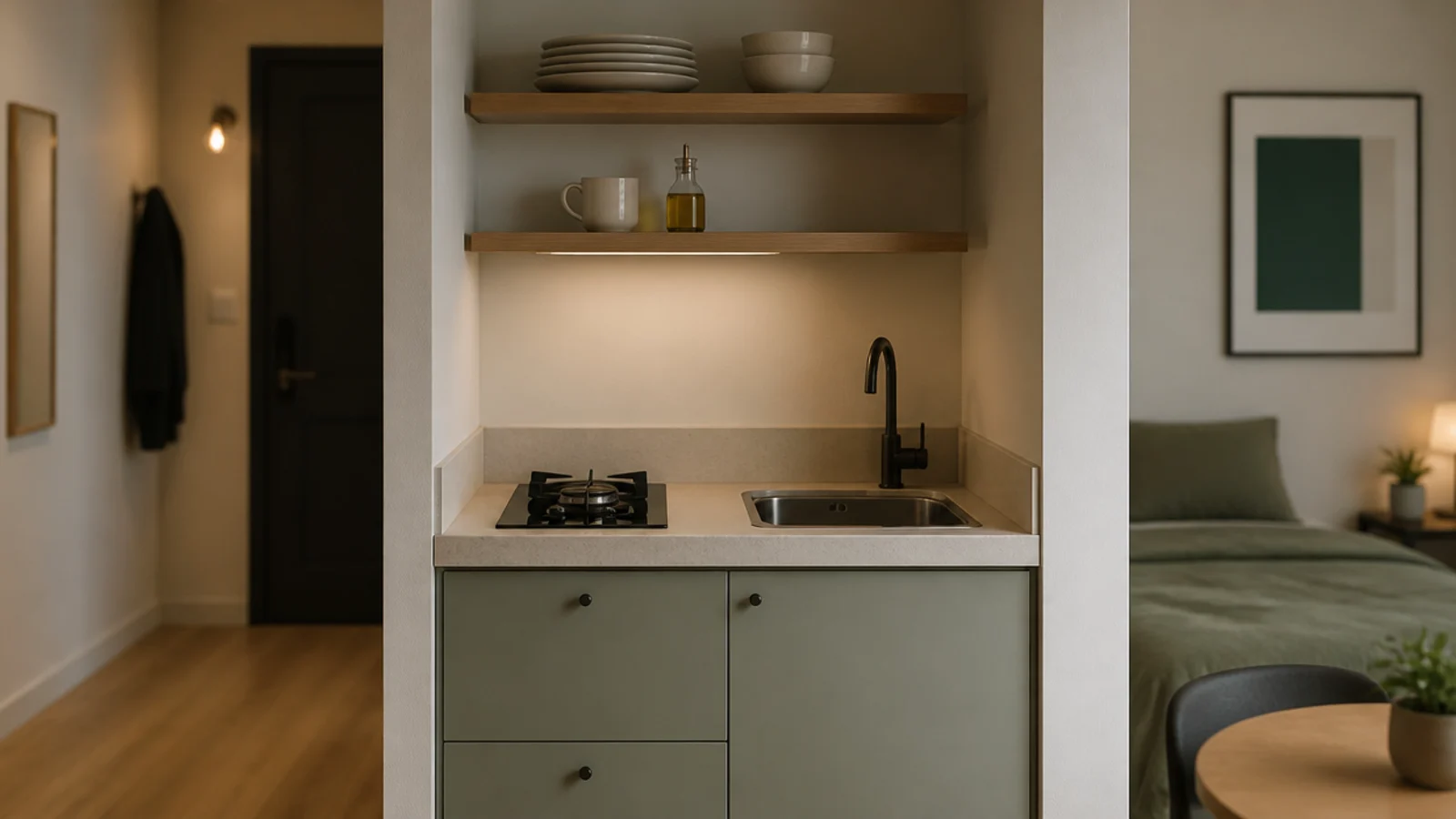
14. Two shelves in a studio kitchenette
A kitchenette with two burners and three feet of counter still supports two short shelves, and they usually replace a cabinet you do not have.
Hold it to one setting of dishes plus the oil and salt. Everything for one meal within a single reach. Anything beyond that has nowhere to go and starts living on the counter.
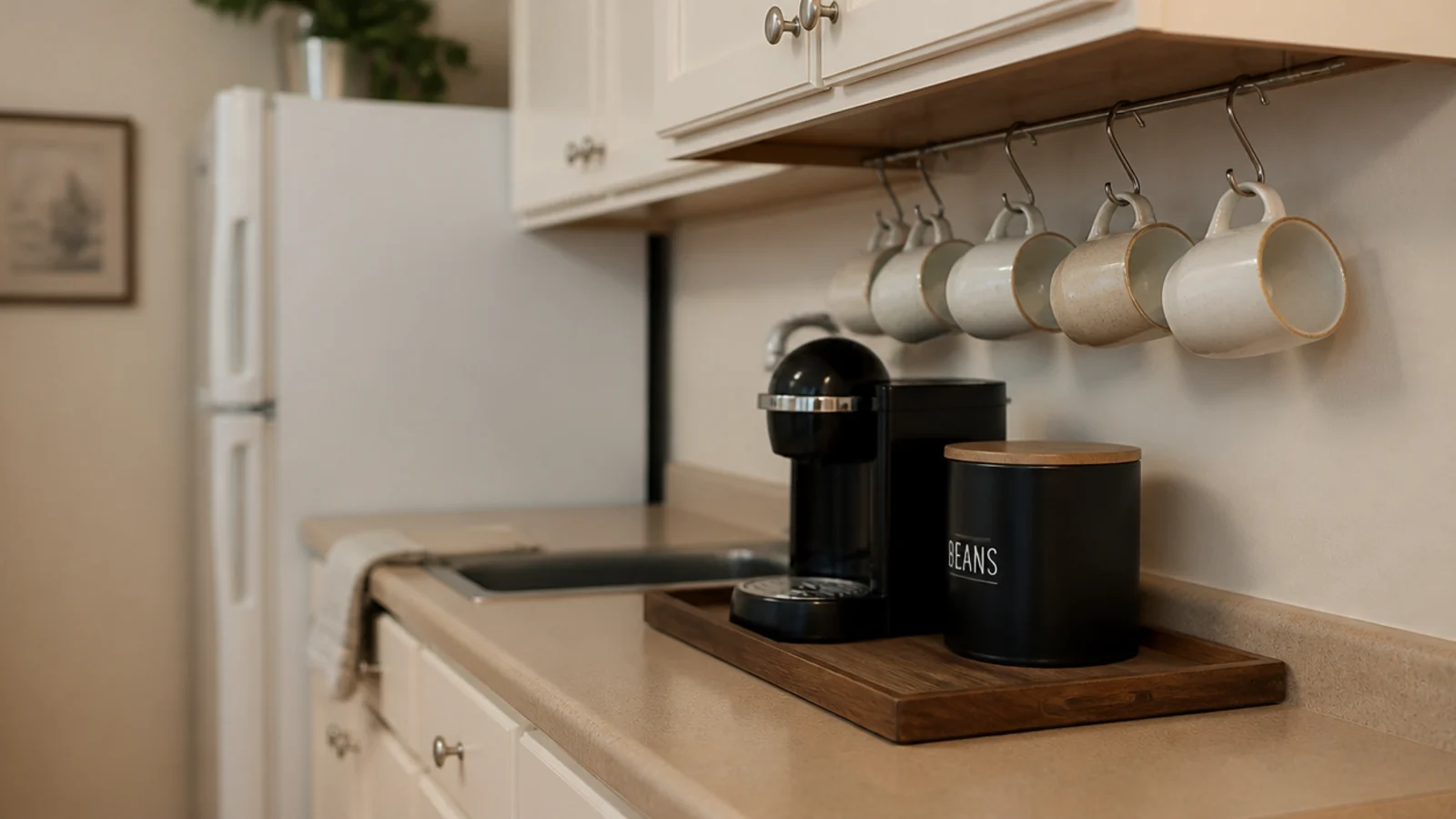
15. One shelf plus a hook strip underneath
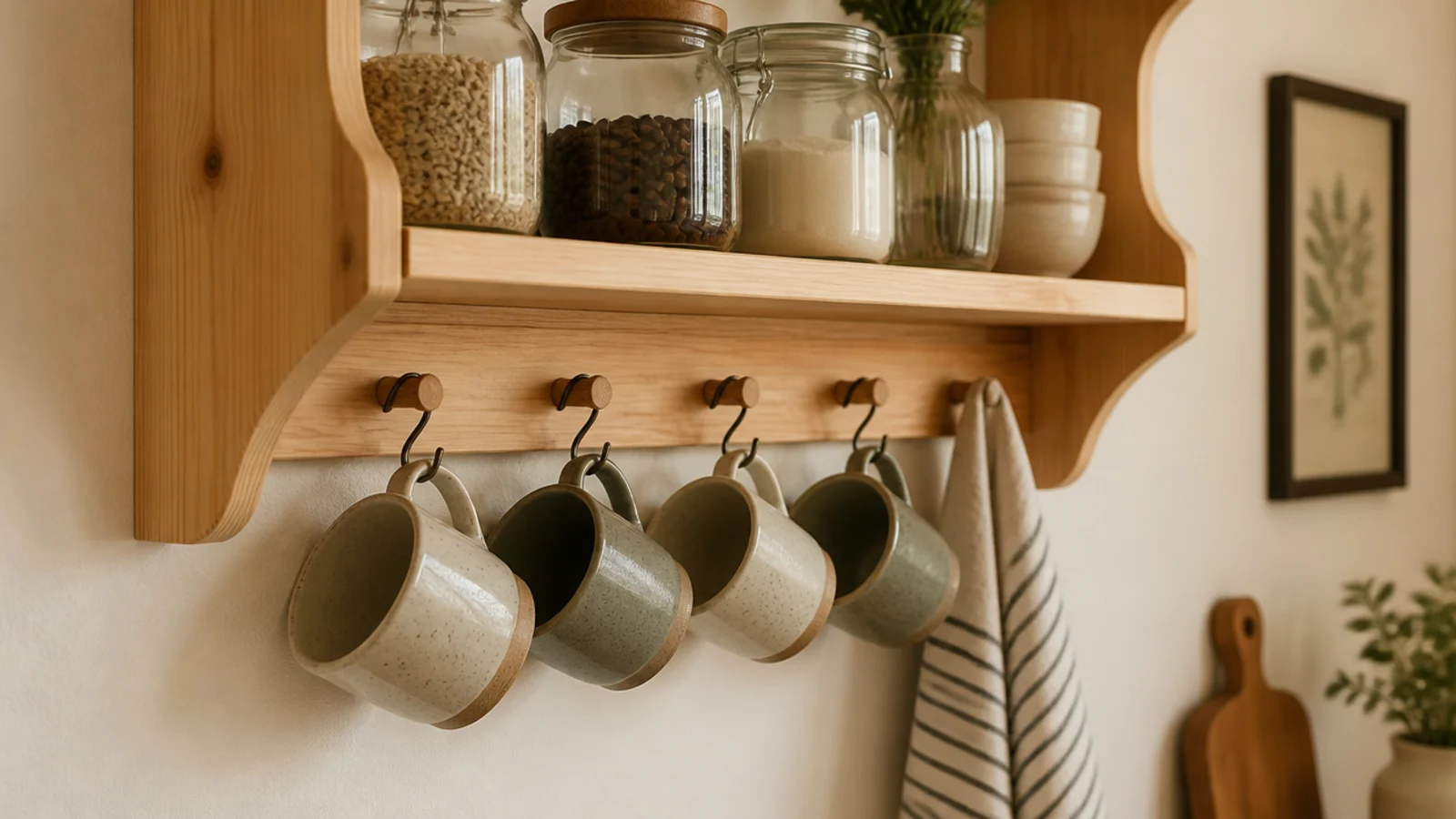
A wooden hook strip fixed to the underside of a shelf holds six mugs in the space one takes on a counter, and costs about $10.
Space the hooks at least 4 inches apart or the mugs knock. Use three-quarter-inch screws going upward, or they come through the shelf top face.
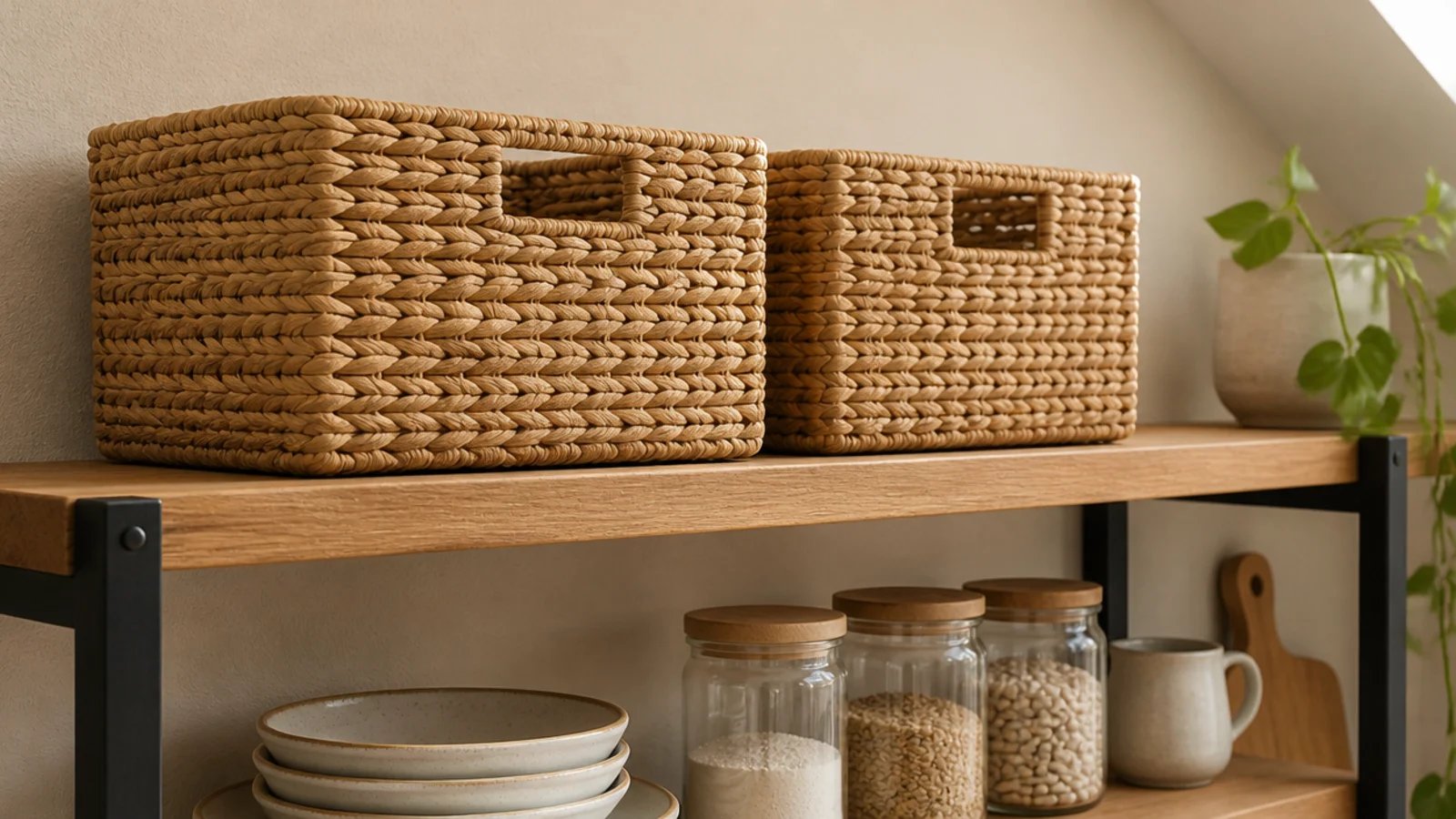
16. Baskets on the top shelf for the ugly things
Every kitchen has plastic that has to live somewhere. Two woven baskets on the top shelf absorb it without the shelf becoming a shelf of lids.
Baskets read as texture from across the room, which is exactly what you want above eye level. Keep them the same material and roughly the same tone.
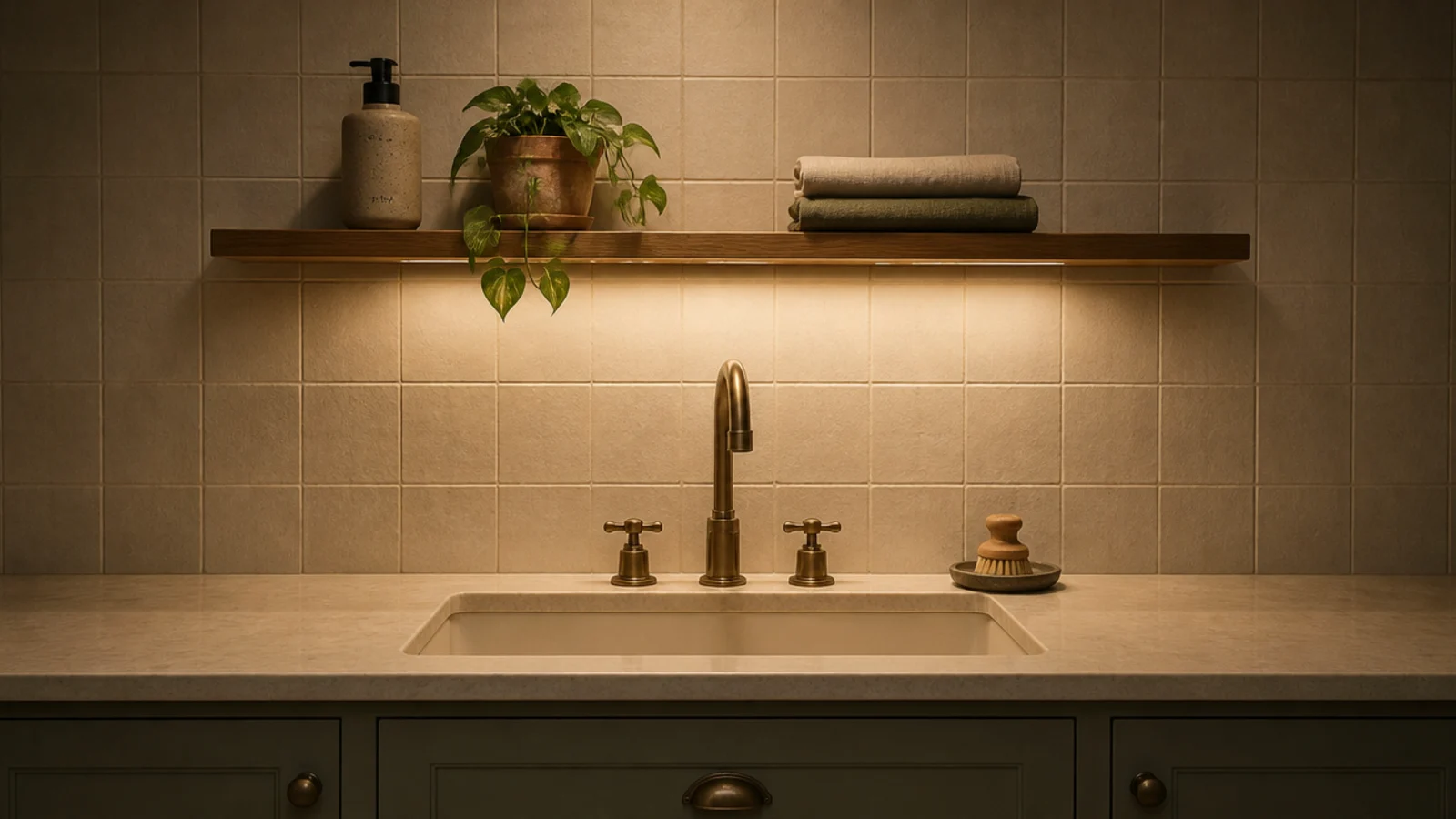
17. A shelf over the sink in a windowless kitchen
Above a sink is the one place a kitchen shelf gets splashed instead of greased, and in a windowless kitchen it is often the only free wall.
Stock it accordingly: stoneware, a soap bottle, a plant that likes humidity. Nothing paper, nothing that stains, and nothing you have to lift down to wash a roasting tin.
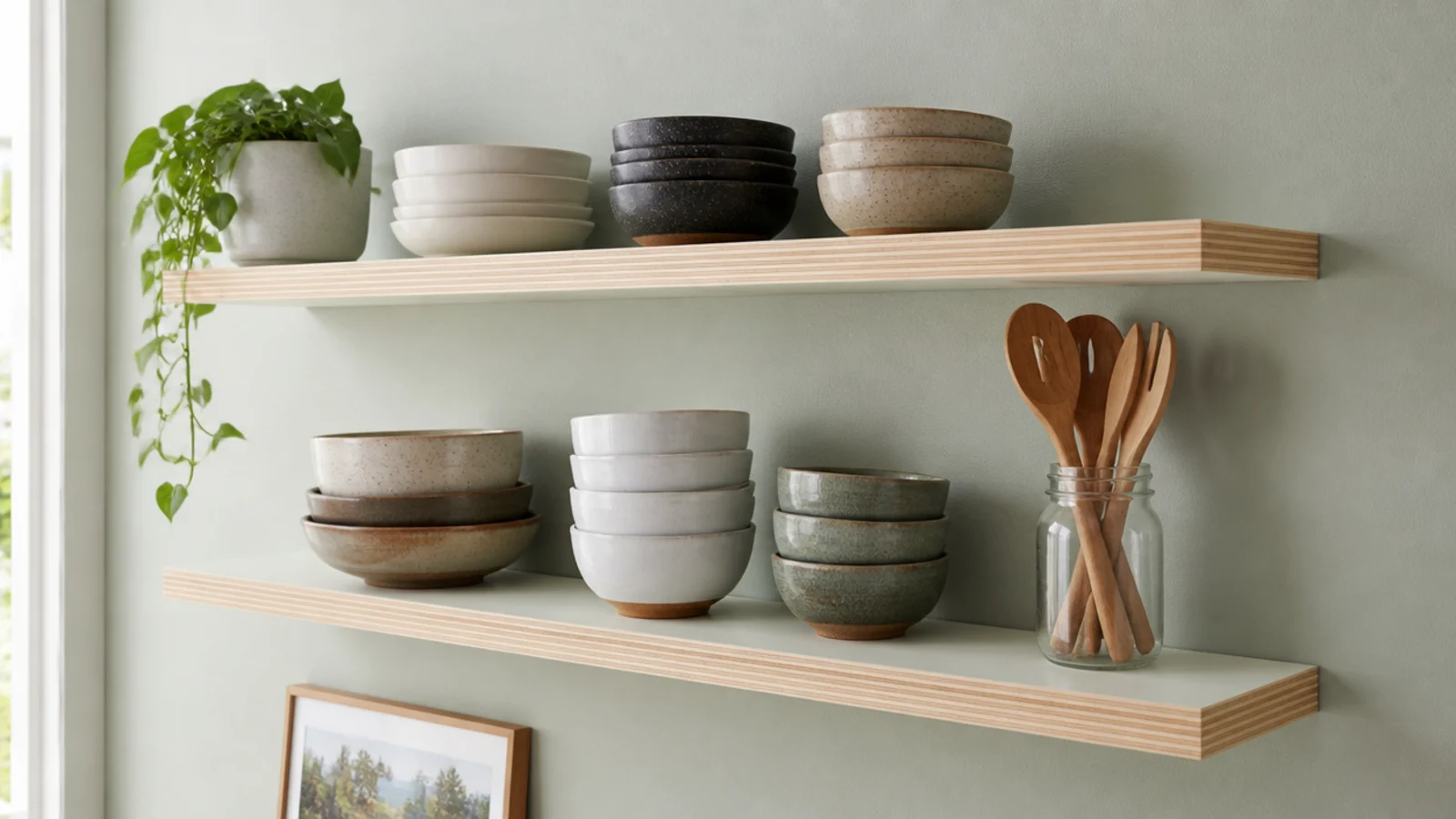
18. Painted plywood shelves at $8 a board
Three-quarter-inch birch ply cuts into shelves for a fraction of solid timber and carries real weight without sagging.
Leave the layered front edge exposed and seal it clear — it reads as a deliberate detail rather than a compromise. Paint the faces, seal the edge, and nobody will guess the cost.
19. Solid wood shelves from a salvage yard
Habitat ReStores and architectural salvage sell old solid timber shelving for a third of new prices, usually in species you cannot buy at a home center.
Check for woodworm holes and old finish before you buy. A sanding and two coats of hardwax oil takes an hour and gives you something with depth that new pine cannot fake.
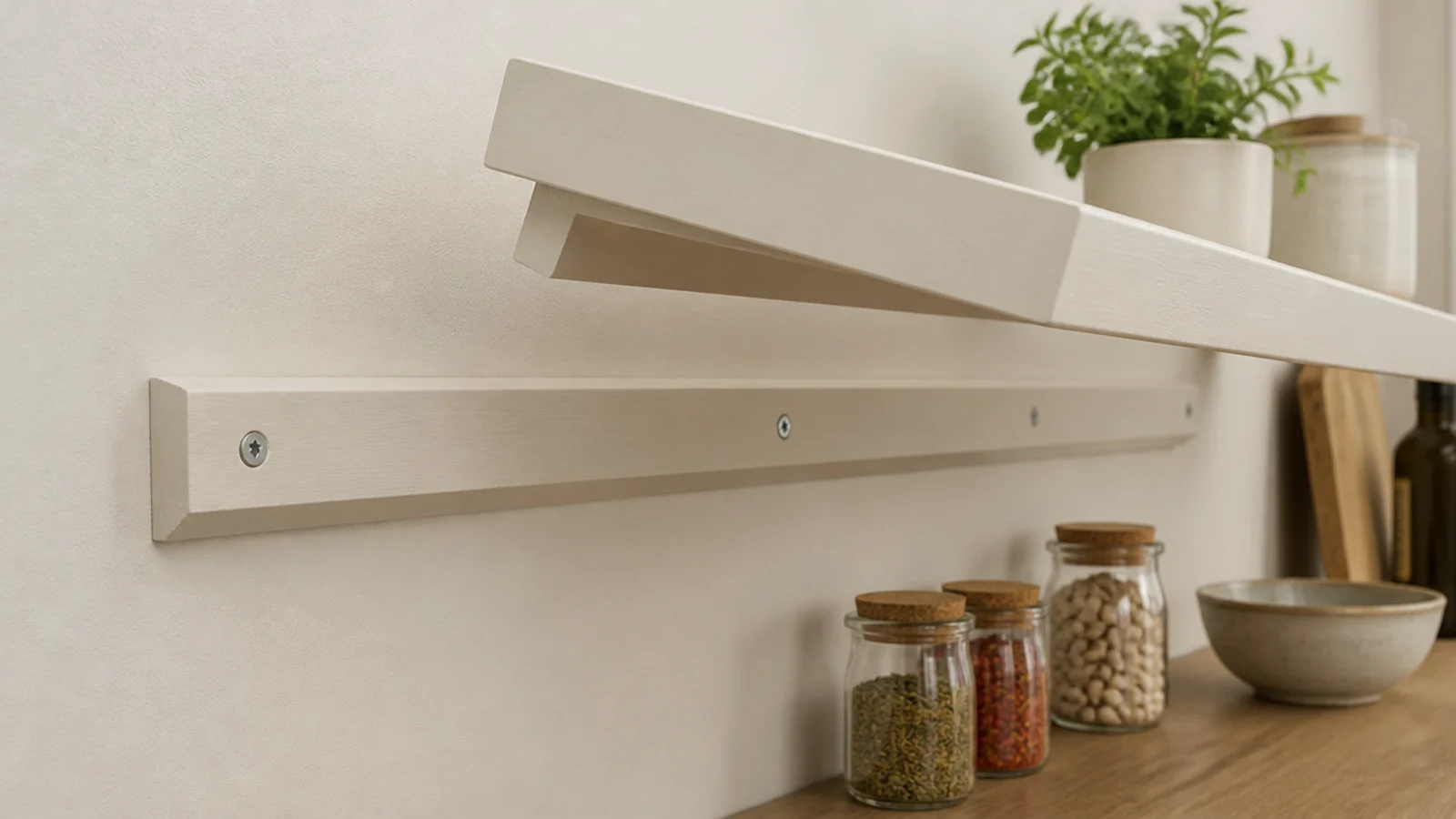
20. A French cleat run you can patch in an hour
Two matching 45-degree bevels — one on the wall, one on the shelf back — let the shelf hook on and lift straight off.
It is the most renter-friendly permanent-looking option there is: three screws into studs, no visible hardware, and the whole thing comes down in seconds on moving day. A rental-first version lives in kitchen shelf decor.
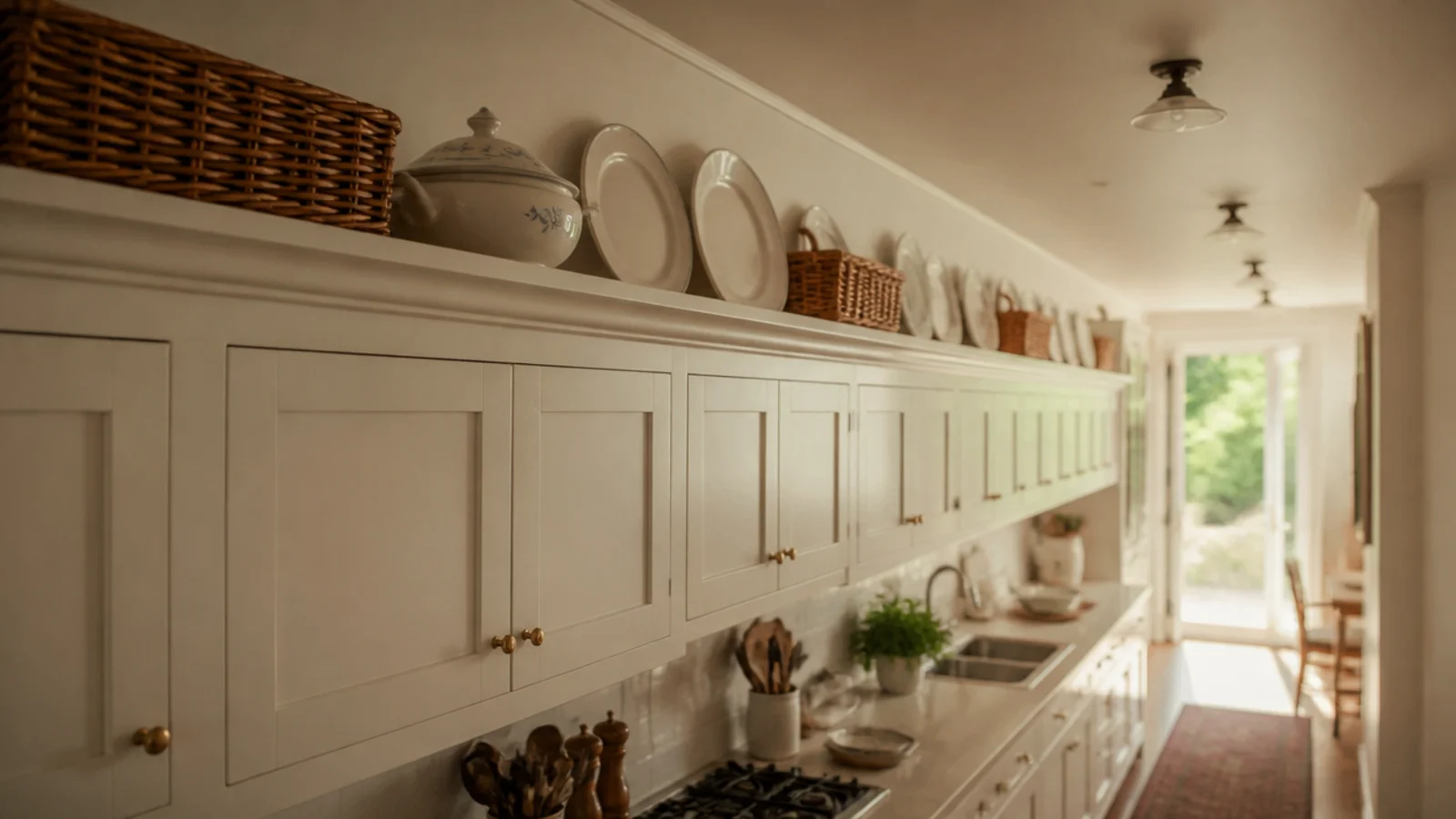
21. A shelf across the top of a galley run
The band of wall above the cabinet line in a galley is dead space, and a long shelf up there absorbs everything you use monthly.
Platters, the tureen, the spare baskets. Keep the shapes large and simple, because small objects at that height turn into clutter you cannot even identify from the floor.
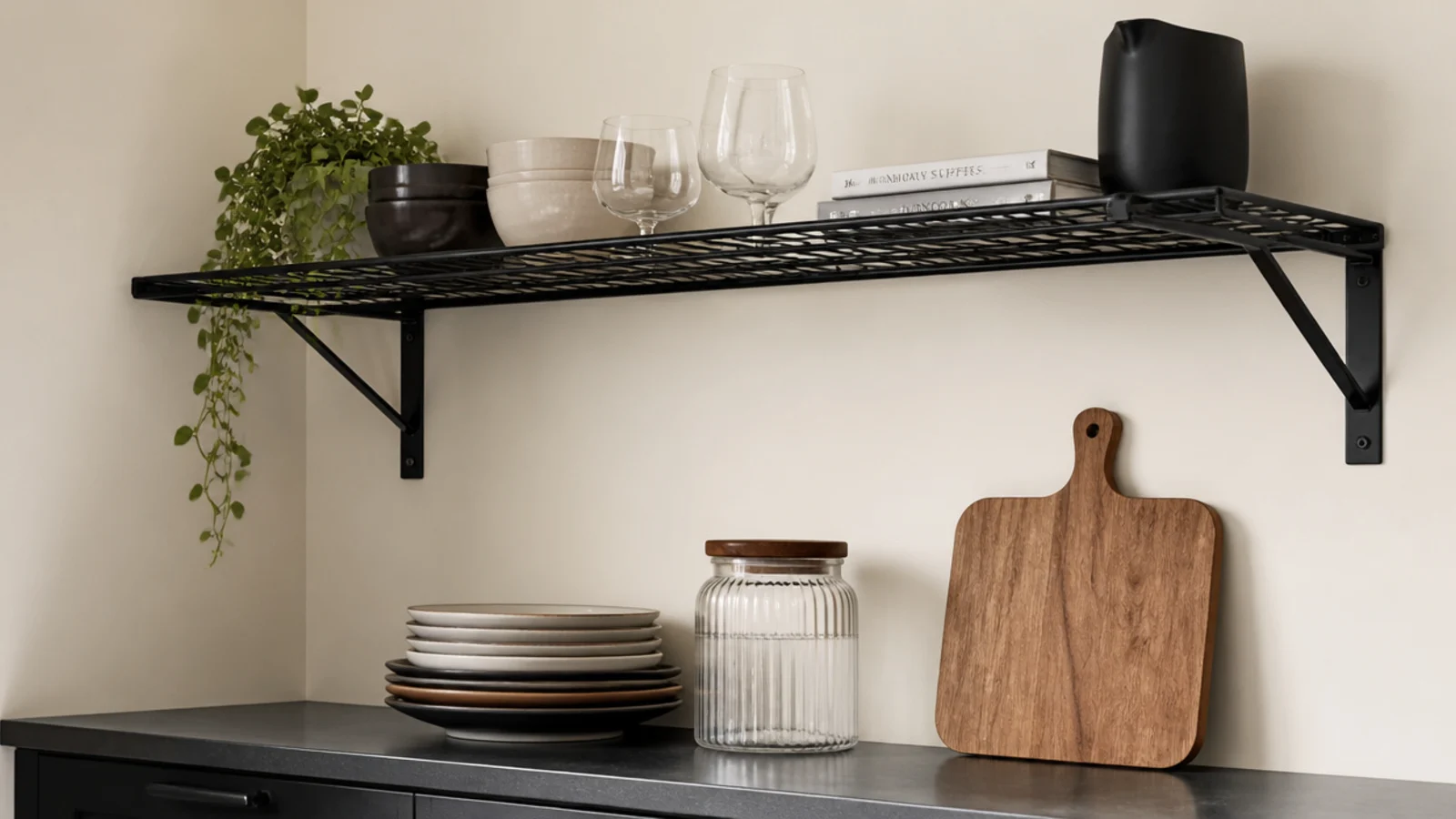
22. Wire shelving sprayed matte black
Builder-grade wire shelving is in a lot of rented kitchens and looks exactly like what it is. Two coats of matte black spray change that completely for about $12.
Clean it with degreaser first or the paint will not key. Add a thin ply or bamboo panel on top so small jars stop tipping through the wires.
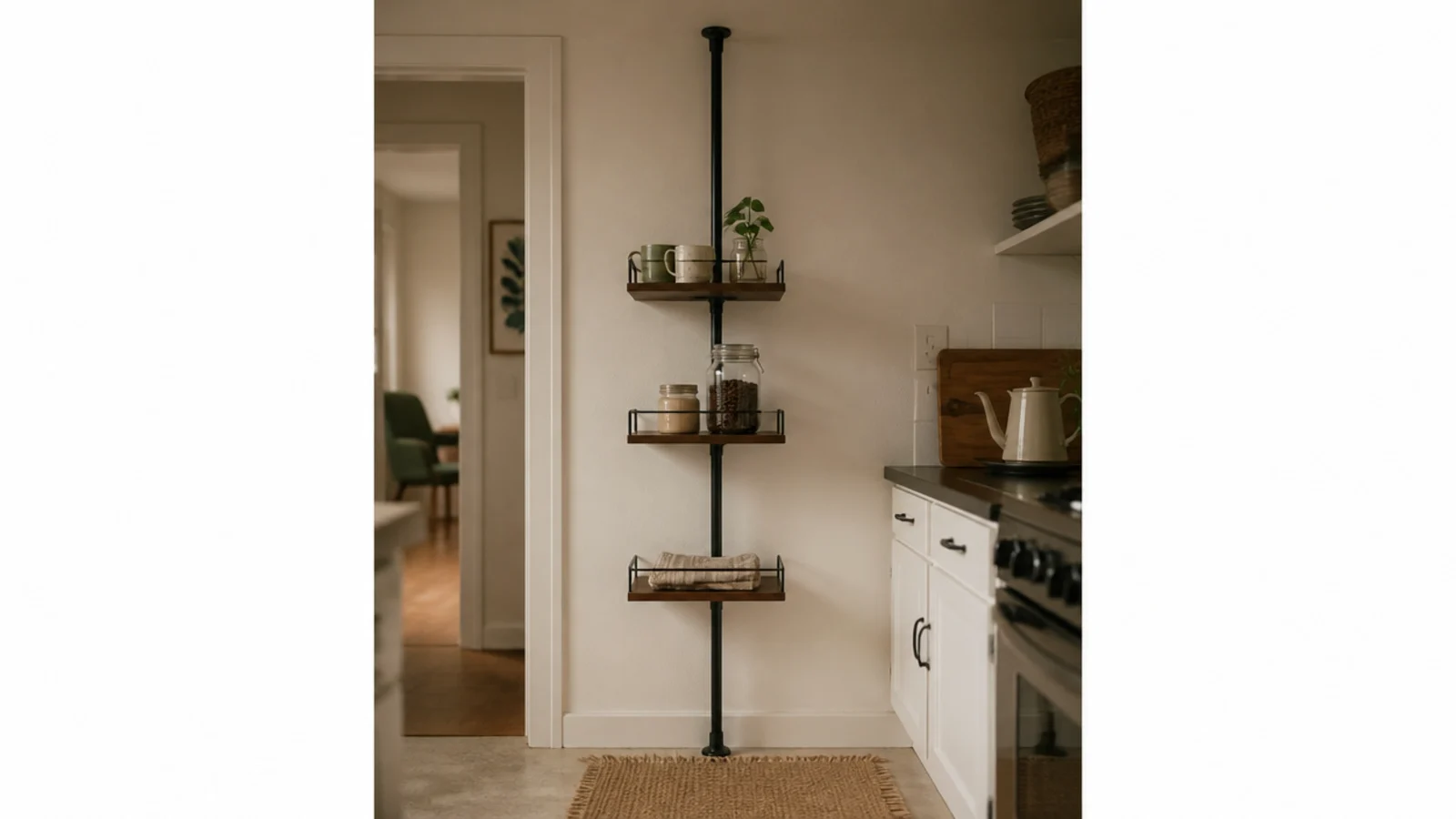
23. A tension pole shelf unit for renters
Floor-to-ceiling tension units carry more than any adhesive strip and leave zero holes, which makes them the honest answer when drilling is genuinely banned.
Check the ceiling is solid, not a suspended tile grid. Keep heavy stoneware on the lowest shelf and treat the stated load rating as generous rather than conservative.
24. Stop the shelf short so the fridge door clears
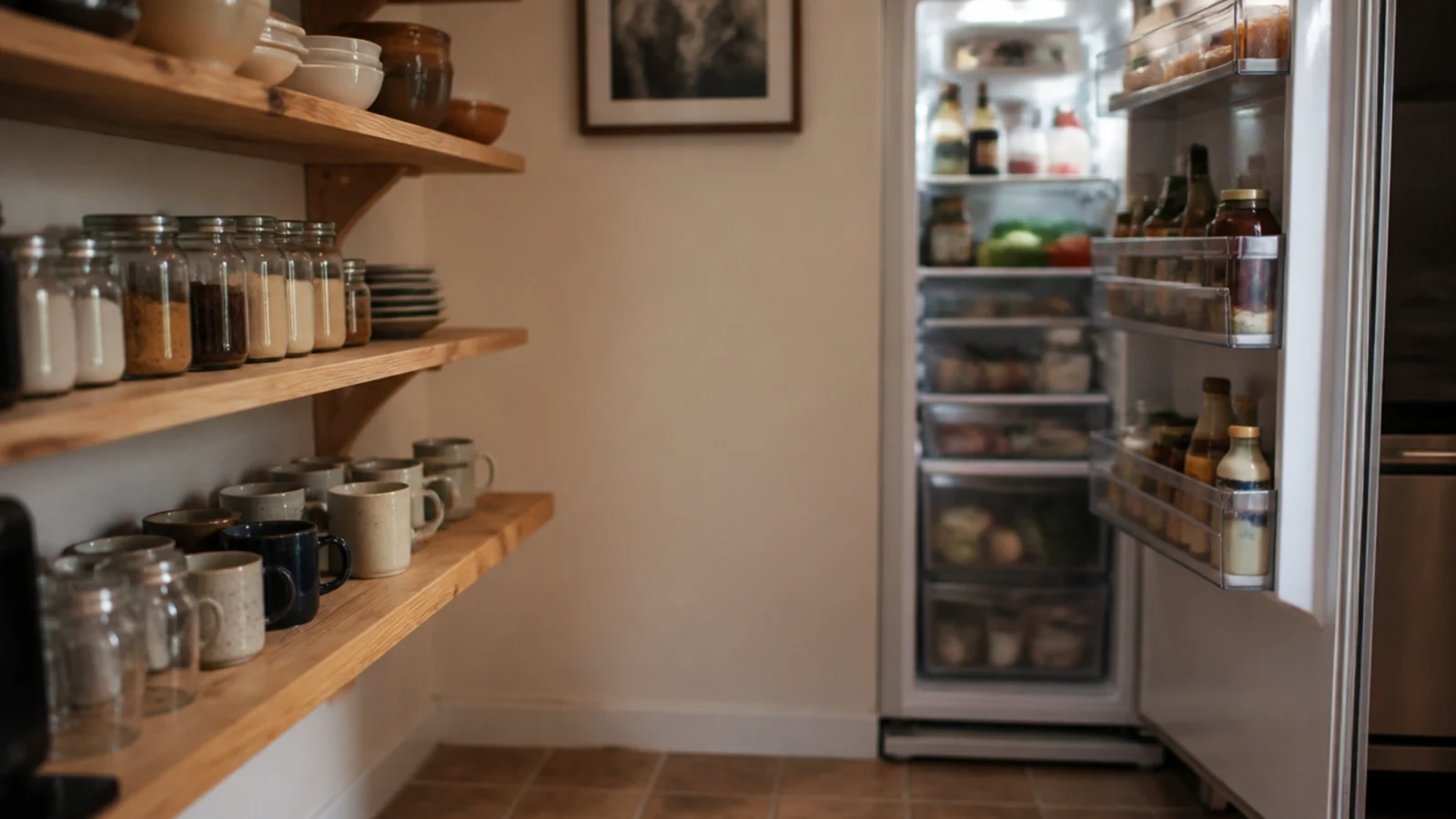
In a tight kitchen the fridge door swing is what catches people out. Open the door to its full stop and mark where the corner lands before you mark a single bracket hole.
The same applies to wall cabinet doors that open past 90 degrees. Two minutes of checking saves a shelf you have to move.
25. Start with one shelf and a two-week test
Put up one shelf, load it only with things you touch weekly, and cook normally for a fortnight.
You will learn whether you reach past it, whether it gets greasy, and whether you like looking at your own plates. That answer is worth more than any plan. If it works, twenty small-kitchen setups covers what to do next.
Mistakes to Skip
- Filling budget shelves with things you use twice a year. Use is what keeps open storage clean, so anything rarely touched just collects grease in full view.
- Buying cheap brackets and expensive boards. The bracket and the anchor carry the load; the species is decoration. Spend the other way around.
- Running shelves down both walls of a narrow galley. You lose the walkway and both people end up turning sideways to pass each other every evening.
Frequently asked questions
Are open kitchen shelves a good idea in a small kitchen?
They are, because they remove the visual bulk of cabinet doors from a room that has very little wall to spare. The catch is honesty about contents. Open shelving only works for things you use weekly, since use is what keeps them clean. Shelve the everyday plates and mugs, and leave the twice-a-year appliances behind a door.
How much do open kitchen shelves cost to install?
A single pine board with two visible brackets runs $22 to $35 for a three-foot shelf. Painted plywood is cheaper still at around $8 a board. Solid white oak with concealed hardware climbs to $60 to $110 per shelf. The fixings matter more than the board, so spend on brackets and toggles rather than on species.
Do open shelves make a small kitchen look bigger?
Yes, when they are shallow and the same color as the wall. Cabinet doors read as a solid block that stops the eye, while a slim shelf lets you see the wall behind it and the room keeps its depth. Keep the shelves to six or eight inches deep and paint the brackets to match the plaster.
What is the cheapest way to put up kitchen shelves?
A cleat rail. Screw a length of one-by-two into the studs, sit the shelf board on top of it, and skip brackets entirely. Materials come in around $18 for a four-foot shelf. It reads cleaner than budget brackets, carries more weight, and leaves only two or three holes to patch when you move out.
How high above the counter should open kitchen shelves go?
Eighteen inches above the countertop for the first shelf, which clears a stand mixer and most small appliances. The second sits 12 to 14 inches above the first. In a very small kitchen where nothing large lives on the counter, dropping the first shelf to 14 inches gains you a genuinely useful extra tier above.
The cheapest good shelf is a planed board on a cleat rail, sealed on all six faces, holding only the plates and mugs you use every week. Start there and add a second tier once you know the height is right. For arranging what goes on them, kitchen shelf styling covers thirty setups, and the same brackets on a bare living room wall appear in budget floating shelf ideas. Save the pin for the next hardware trip.
Want more like this? Browse all 15 kitchen shelf ideas guides — they all use the same measurements and budget tiers.
Pin it for later
Save this to your Kitchen Shelf Ideas board
Pin it now so it is waiting for you when the tape measure comes out — and so the next person hunting for this idea can find it too.
Save this pinKeep going
More ideas worth saving while you have the tape measure out.