Entryway & Foyer Ideas · Listicle
30 Beautiful Entryway Ideas to Steal Today

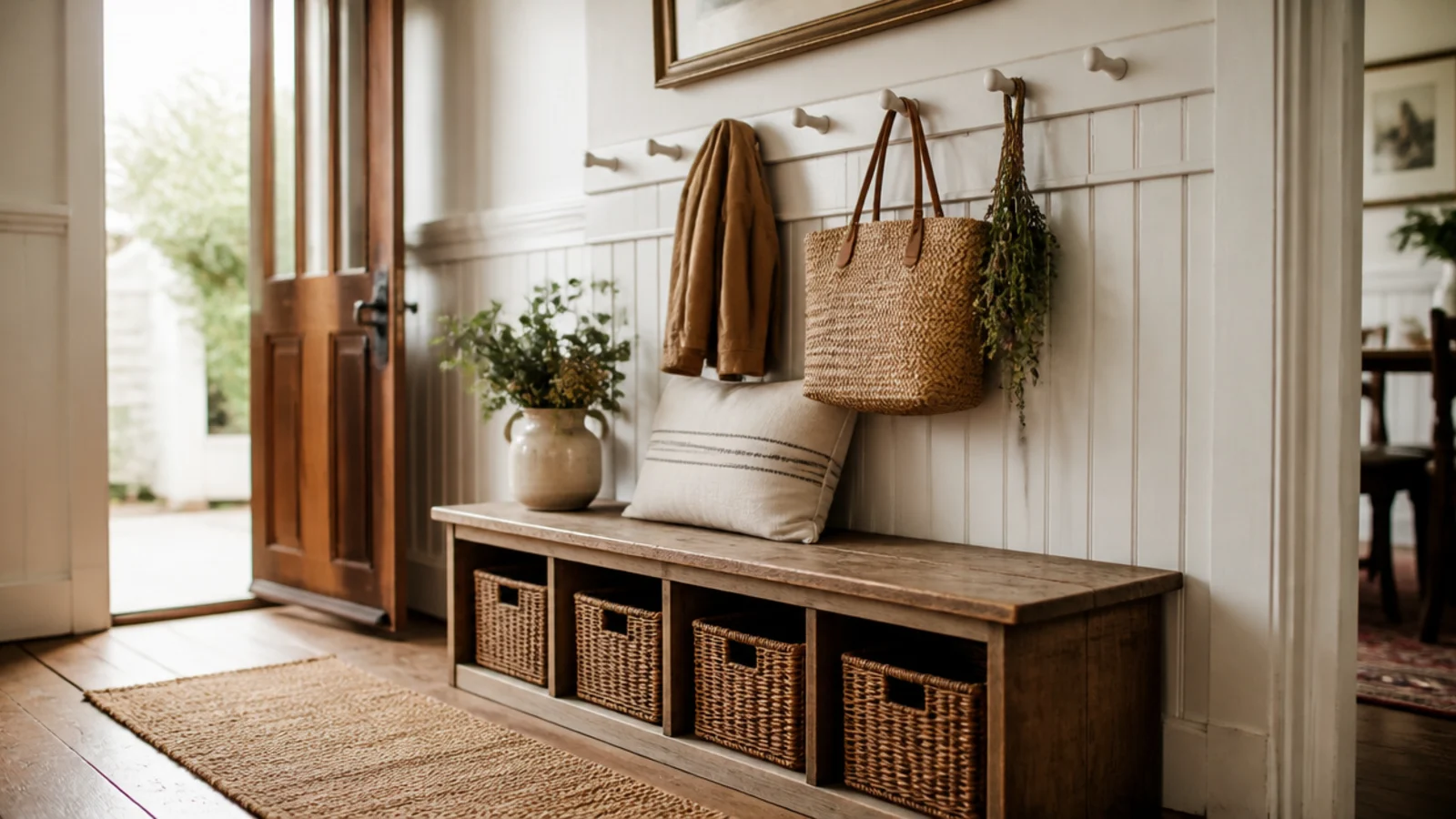
Farmhouse entryway ideas go wrong at exactly one point: the moment the space starts explaining itself. A printed sign, a galvanised bucket that holds nothing, four different plaid textiles. The entries that actually feel like farmhouses are quieter than that — worn wood, honest hardware, and storage that gets used hard every single day. Here are thirty that stay on the right side of that line.
In this guide32 sections — tap to openHide
- 1.What makes farmhouse entryway ideas read as real, not themed
- 2.A shaker peg rail instead of decorative hooks
- 3.Beadboard capped at chair height
- 4.A bench with a real patina
- 5.Cubbies under the bench, one per person
- 6.Woven baskets instead of bins
- 7.A galvanised boot tray by the door
- 8.A stoneware crock for umbrellas
- 9.A ticking stripe cushion on the bench
- 10.A flat-weave runner in natural fibre
- 11.Black iron hardware throughout
- 12.A vintage mirror with a chipped painted frame
- 13.A wall-mounted wooden mail sorter
- 14.An old ladder as a blanket rack
- 15.Antique doorknobs turned into hooks
- 16.A schoolhouse pendant overhead
- 17.A wooden bowl for keys
- 18.Oil-rubbed bronze on the front door
- 19.A slate or chalkboard for notes
- 20.Dried wheat or eucalyptus in a crock
- 21.Painted floorboards at the door
- 22.A dutch door for light and air
- 23.A reclaimed wood floating shelf
- 24.A shoe cubby column beside the bench
- 25.A basket hung on a peg
- 26.Linen instead of anything shiny
- 27.Layer a small runner over a jute base
- 28.Warm white walls, warm wood trim
- 29.One wreath, on the inside of the door
- 30.Three tones and no more
- 31.Let one thing be genuinely old
- 32.Mistakes to Skip
What makes farmhouse entryway ideas read as real, not themed
The look comes from wear and utility, not from motifs. A bench with softened edges, a peg rail that holds four coats and a basket with a frayed handle do more than any decorative object you can buy new.
So buy fewer things, and let one of them be genuinely old. One real antique — a milking stool, a chipped enamel crock, a set of glass doorknobs — carries an entry that is otherwise entirely modern.
The structure underneath is the same as any entry. An entry has five jobs: a place to sit, a place for shoes, a place for coats, a landing surface for small items, and a mirror. A working entry does at least three. Farmhouse style just handles them in wood and iron.
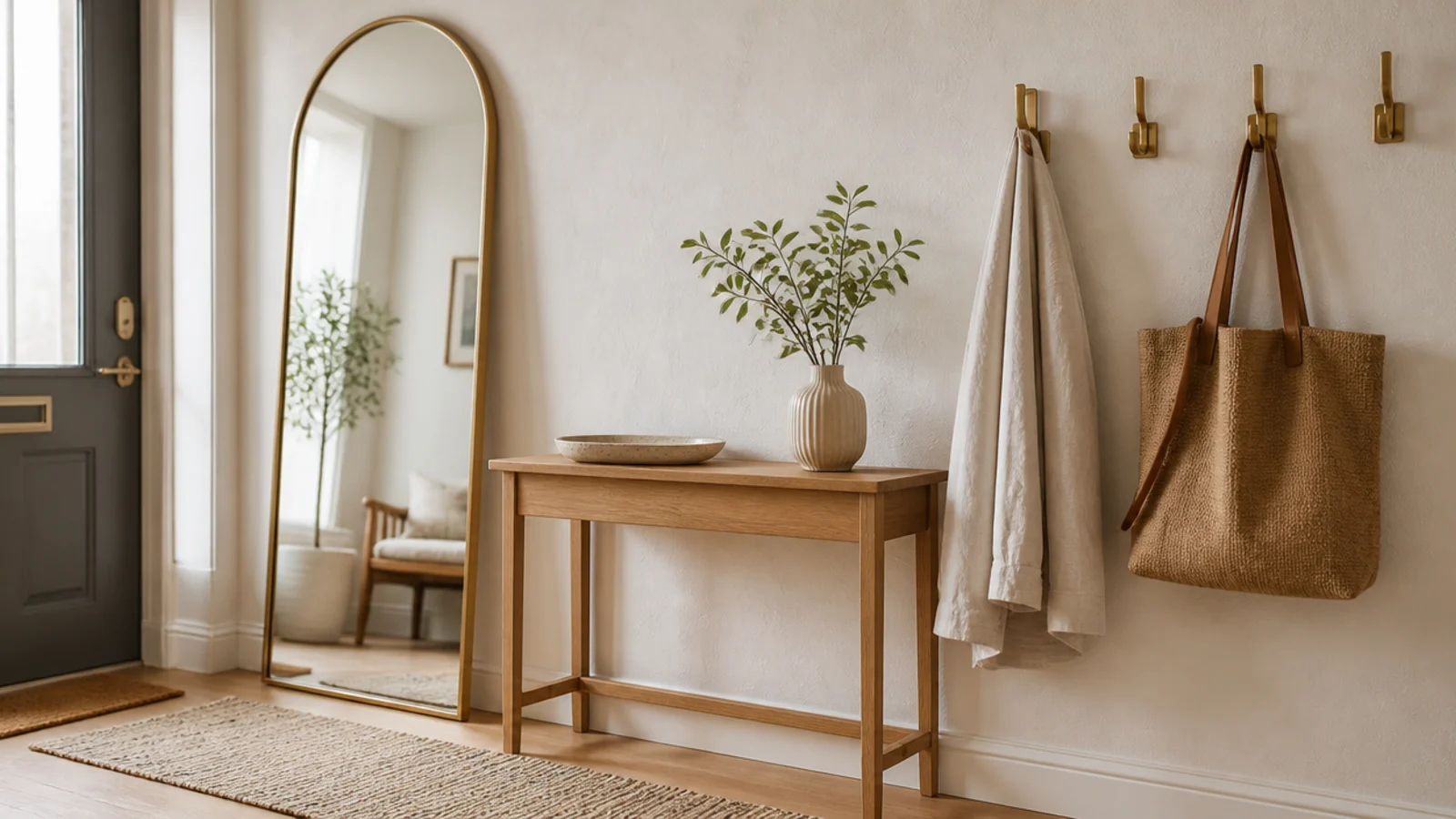
The heights do not change either. Pegs at 52 inches, a second rail at 40 for children, a bench seat at 18, a console at 30 to 32 and no deeper than 12, and a mirror centred at 57 to 60 with 6 to 8 inches of wall beneath it. Under 36 inches of walkway clearance, skip the bench and go wall-mounted.
Budget tiers: $ under $60, $$ $60–$150, $$$ $150 and up.
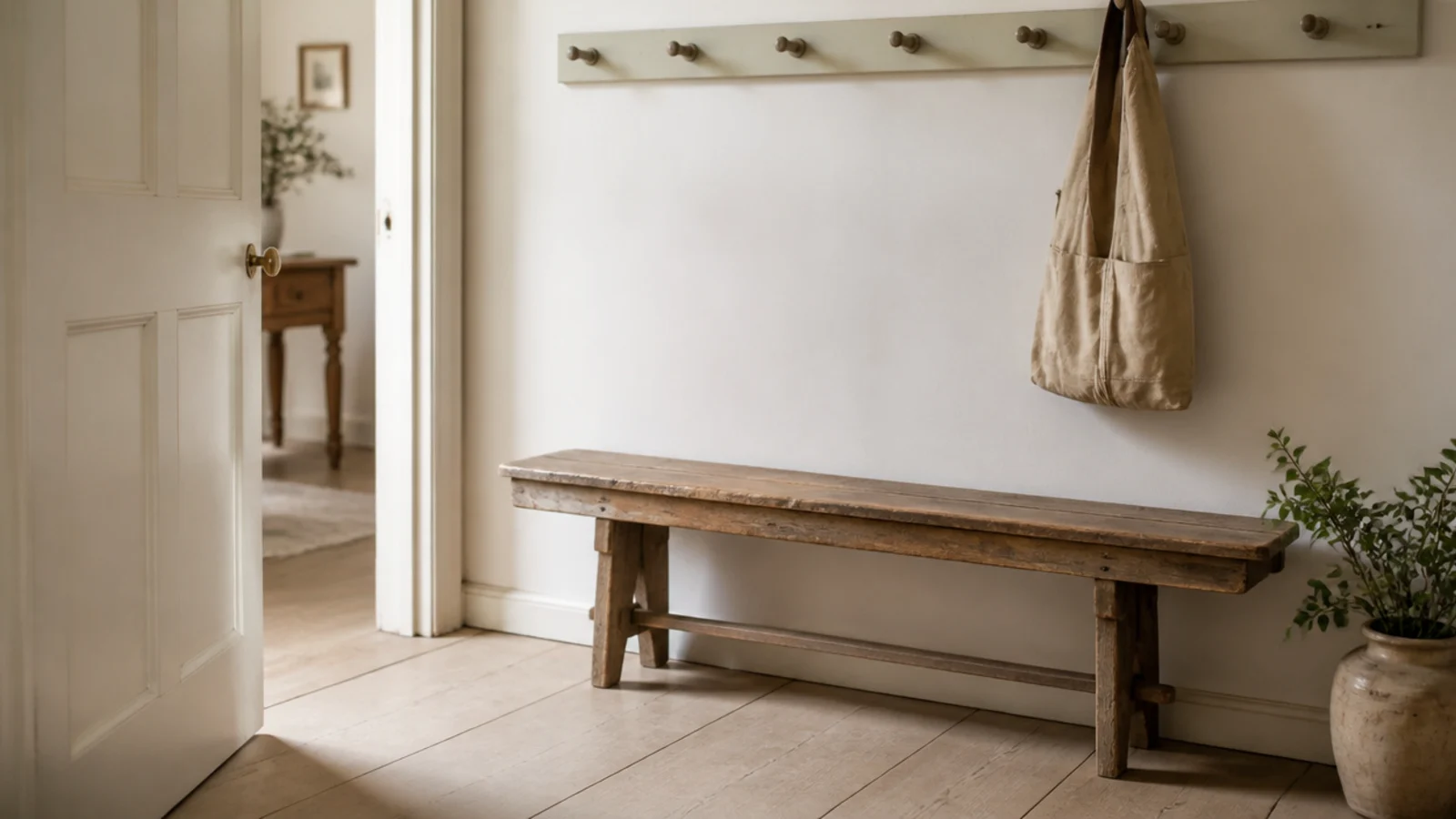
1. A shaker peg rail instead of decorative hooks
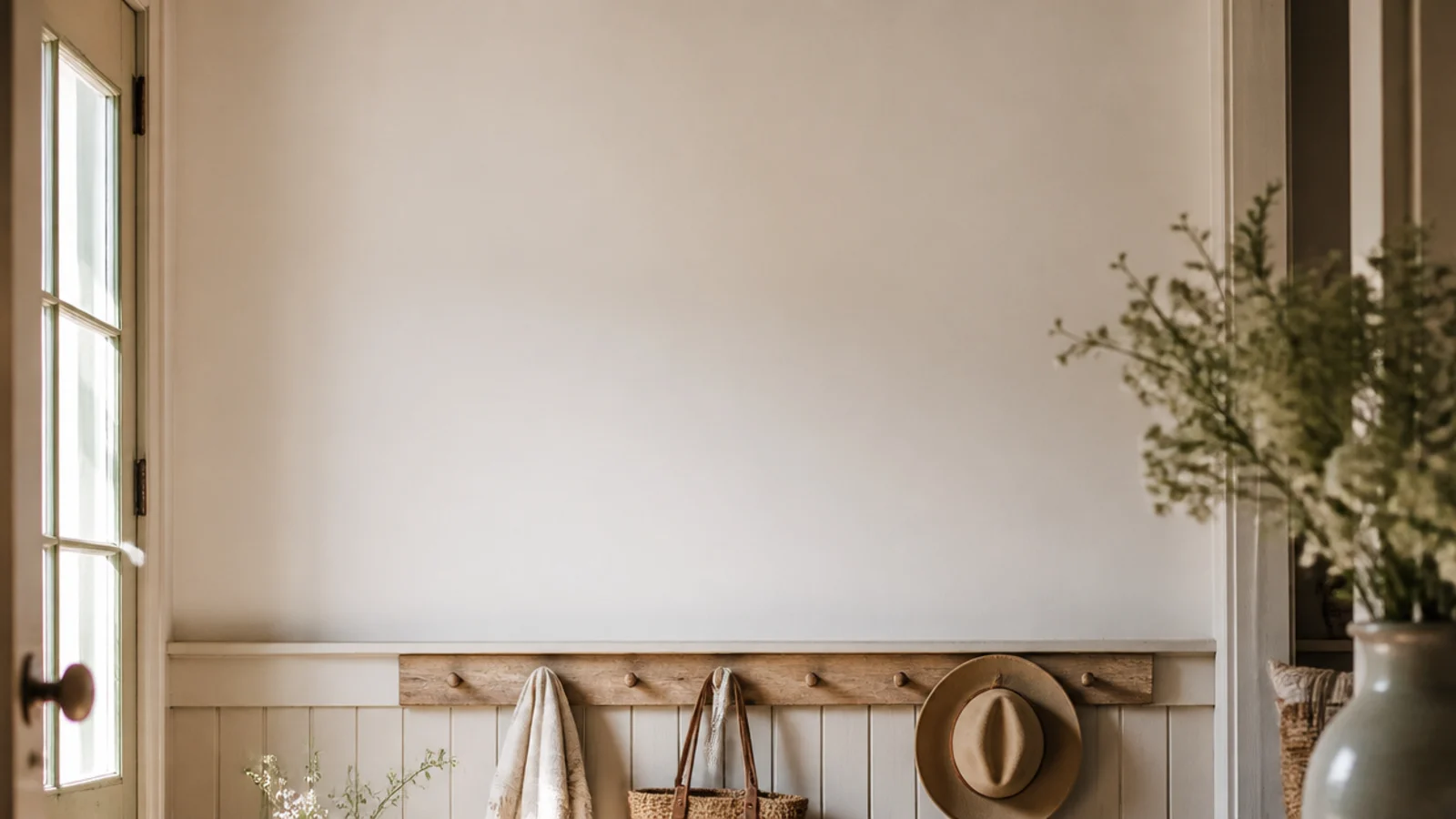
The single most useful farmhouse piece. A painted pine peg rail costs about $20 to $40, holds coats, bags and hats, and projects roughly 2 inches where most decorative hooks project 4.
Mount it at 52 inches into studs — a loaded rail carries 20 to 30 pounds. Space the pegs 8 to 10 inches apart. $
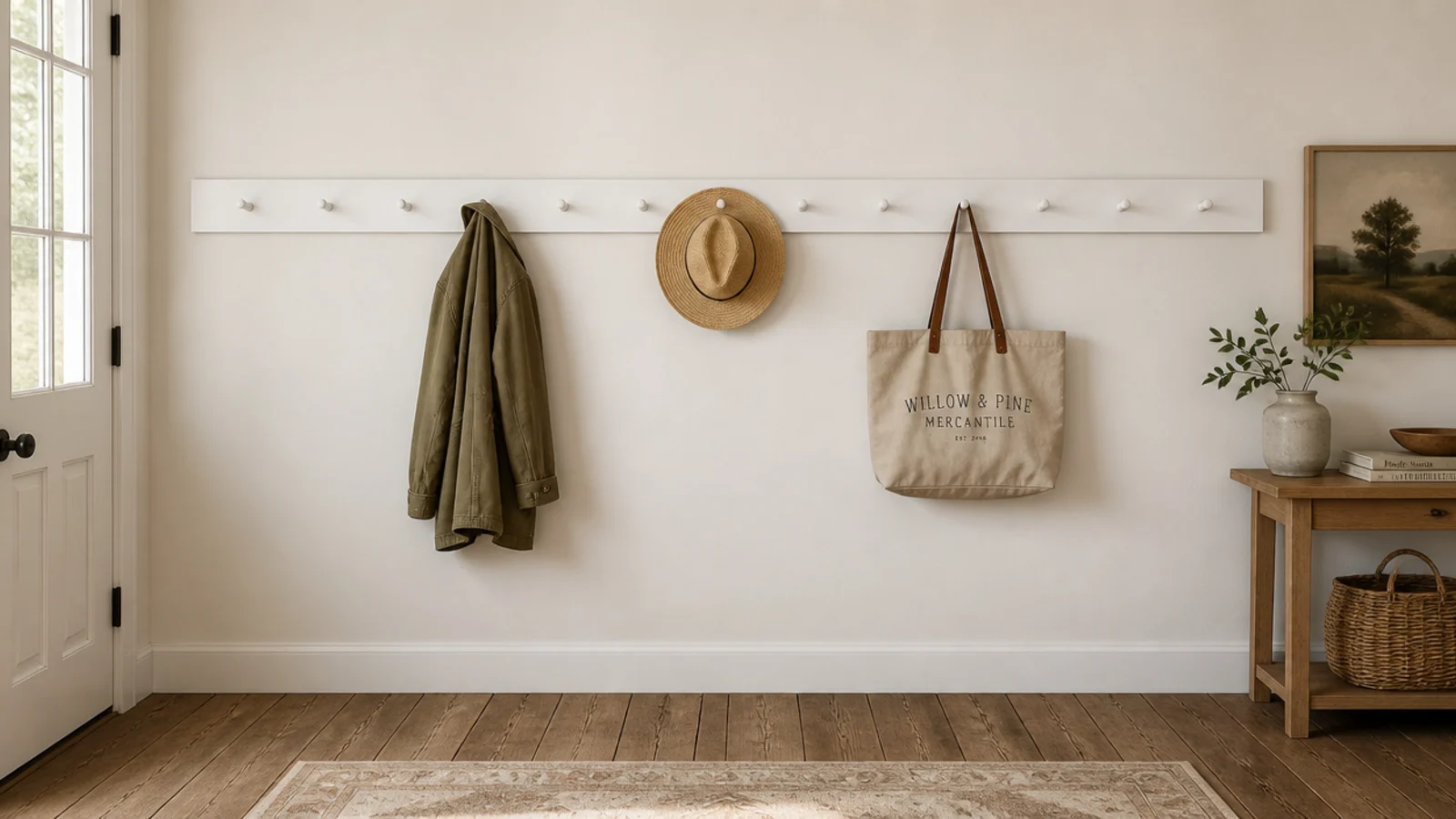
2. Beadboard capped at chair height
Beadboard or shiplap running to 48 inches with a simple capped rail on top is what makes an entry look built rather than decorated.
Cap height matters: keep it between 42 and 52 inches so it relates to the peg rail above. Sheet beadboard runs $25 to $40 a panel and goes up with adhesive and a few brads. Paint it the wall colour or one shade warmer. $$
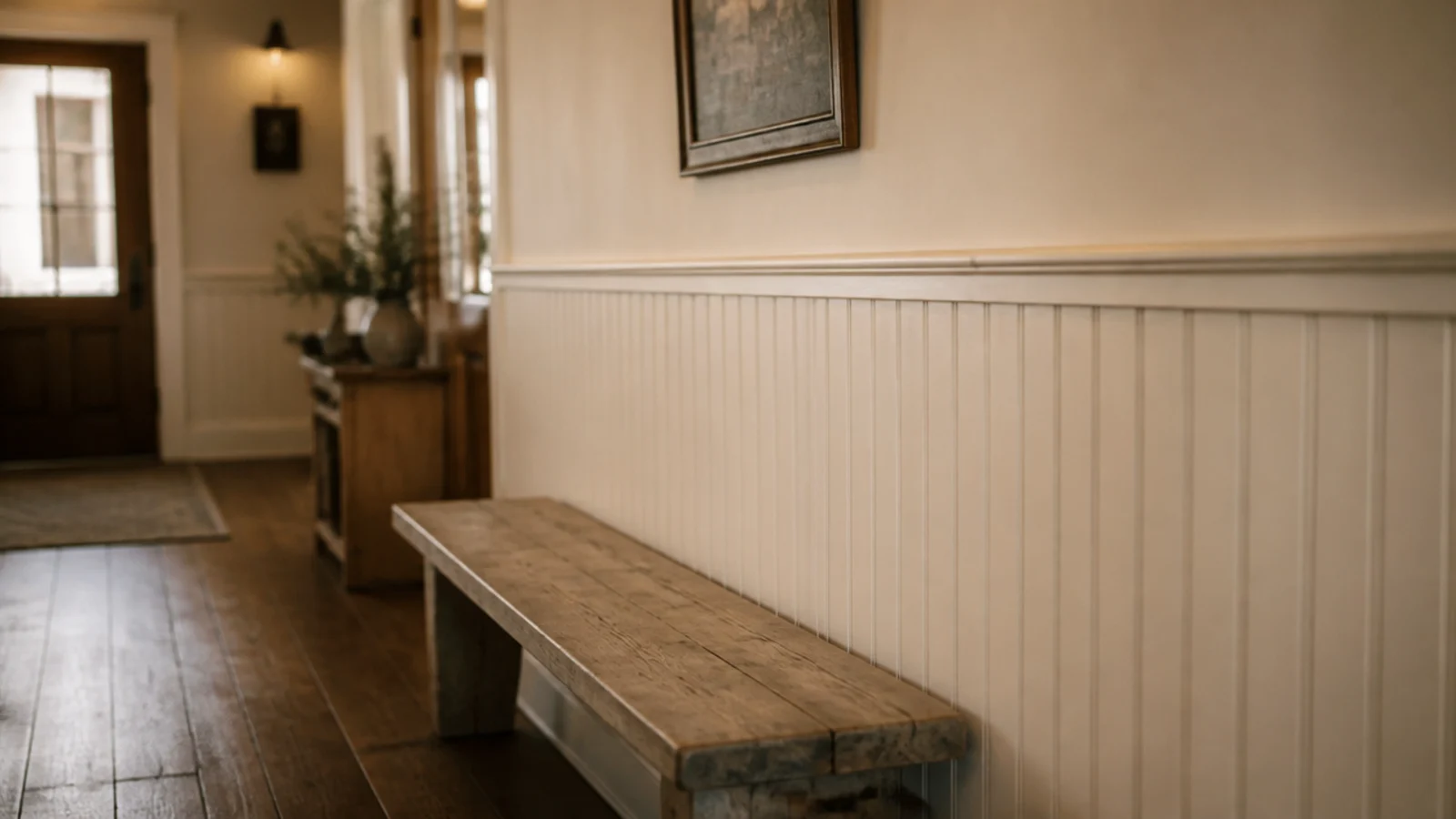
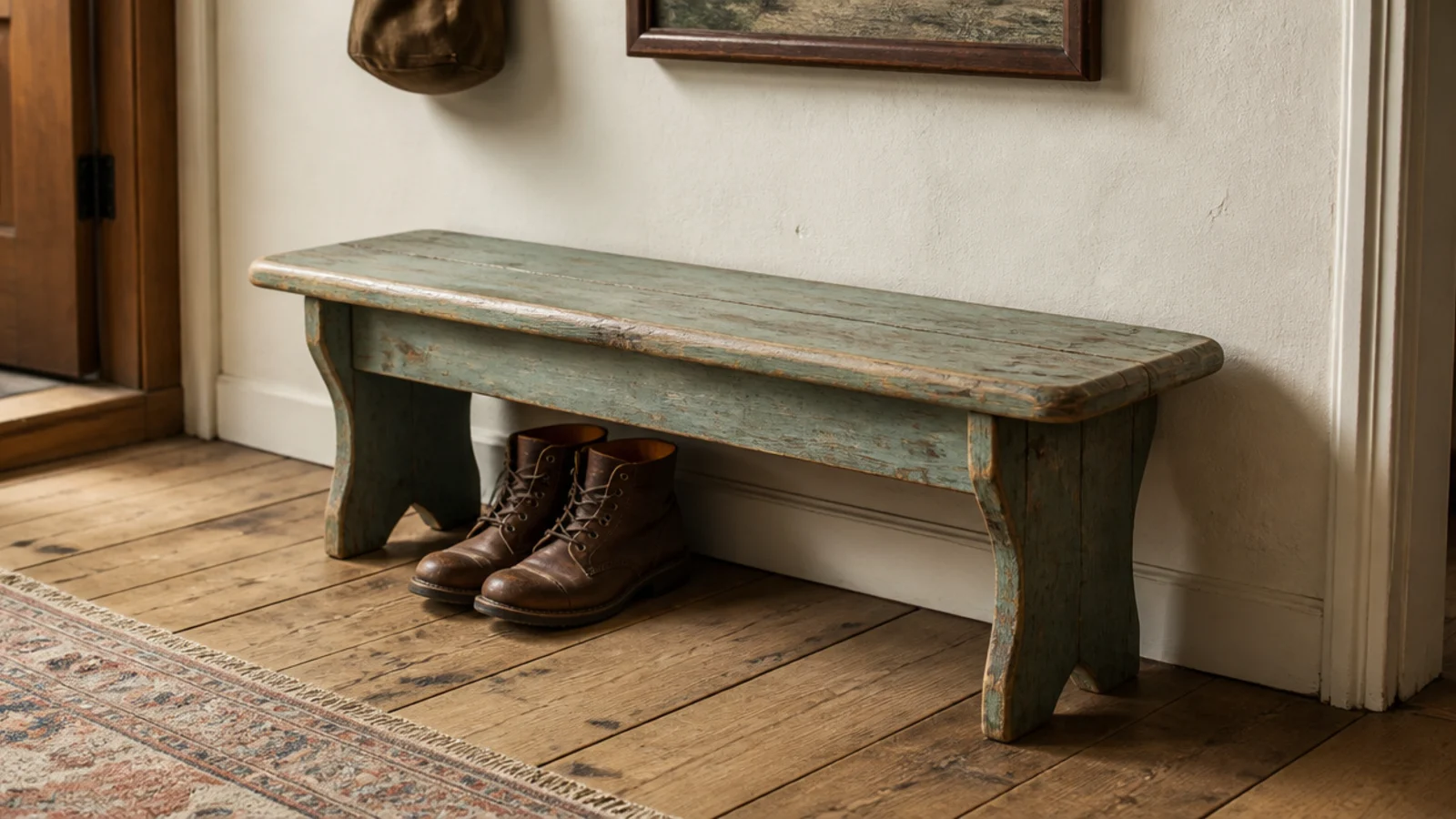
3. A bench with a real patina
Look for softened edges, an uneven old paint finish and honest wear on the seat. Those marks are the whole style, and no distressing kit reproduces them convincingly.
Eighteen inches high and 14 to 16 deep is the usable size. Secondhand pine and oak benches run $40 to $120, and a scrub, a wax and nothing else is usually the right amount of restoration. $–$$
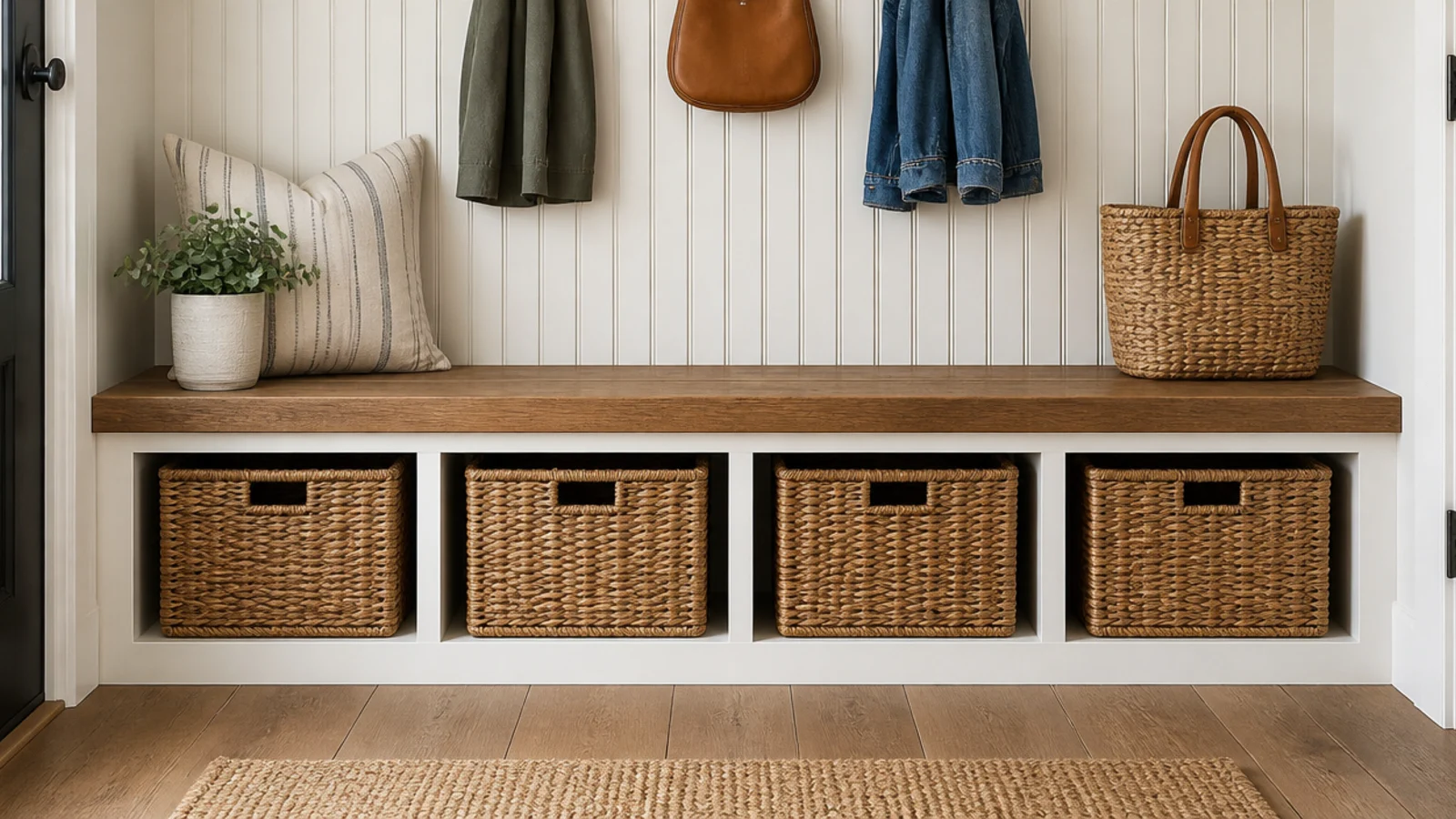
4. Cubbies under the bench, one per person
Open cubbies beneath the seat give every household member a named space, which is the change that actually stops the pile coming back.
Size each opening around 13 inches deep, 12 wide and 12 high. Open, not doored — every door is a step people skip, and shoes end up on the floor beside a beautiful empty cabinet. $$–$$$
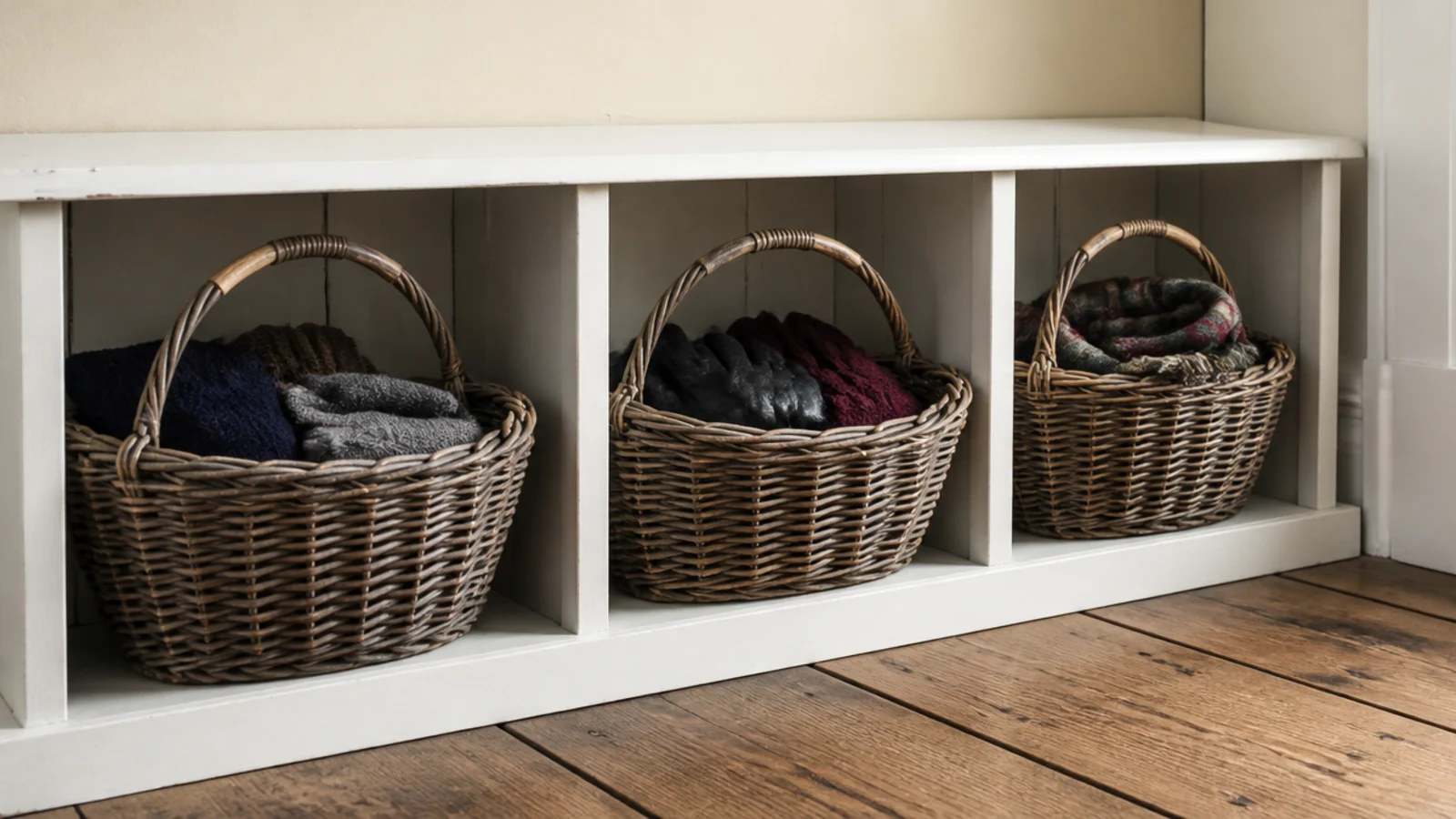
5. Woven baskets instead of bins
Willow, seagrass and rattan age into the look; plastic bins never do. One basket per cubby, or two under an open bench.
Roughly 16 by 12 by 10 inches fits most bench footprints. Garden centres sell them for about half what the home storage aisle charges. Check the handles are woven in rather than glued on, since these get pulled daily. $
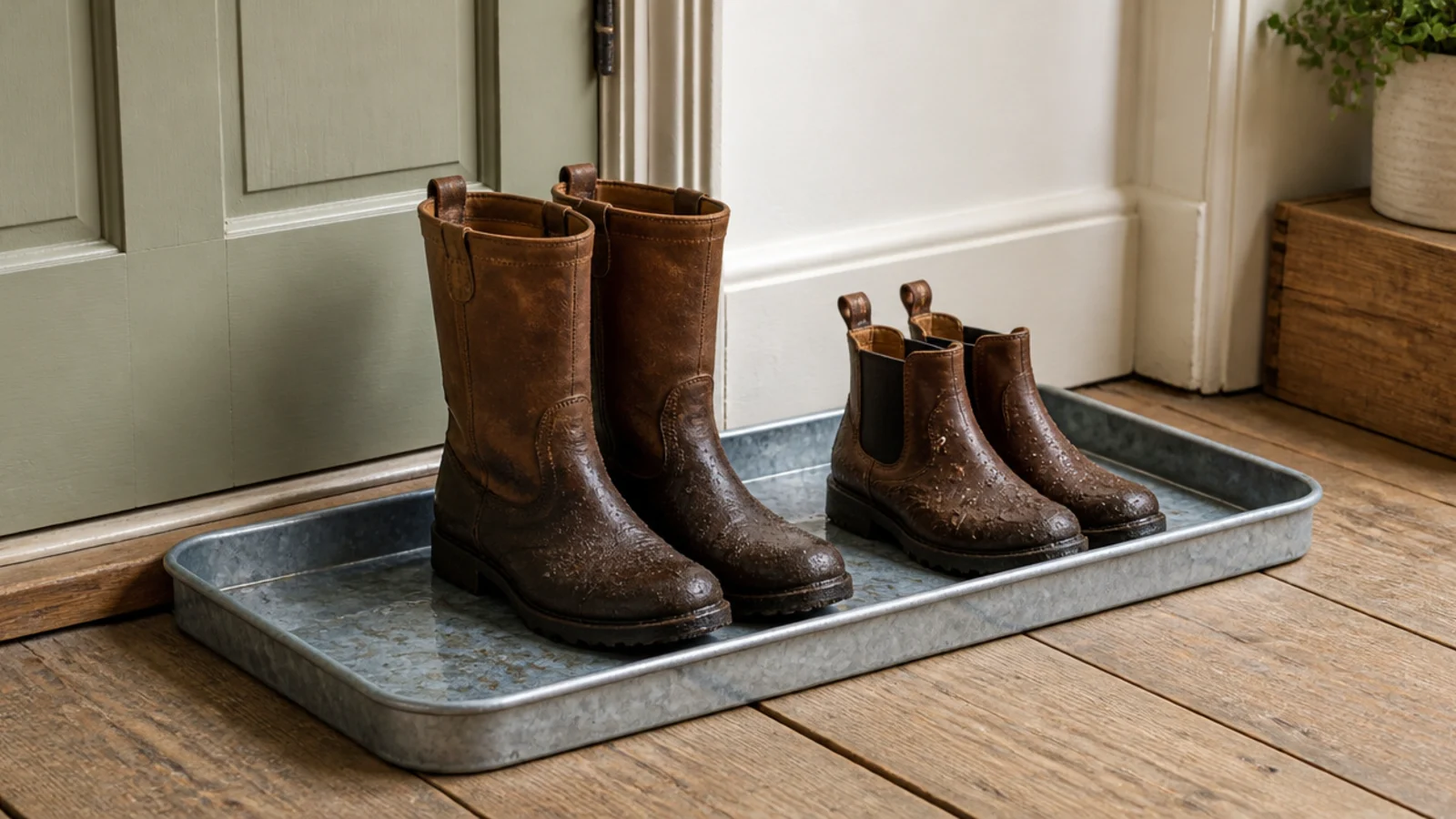
6. A galvanised boot tray by the door
Wet boots need a drip zone on the floor, never an enclosed cabinet where they stay wet and pass the damp to everything beside them.
A galvanised or heavy rubber tray with a raised lip, at least 15 inches deep, holds two adult pairs. Metal beats thin plastic, which cracks in cold weather right when you need it. $
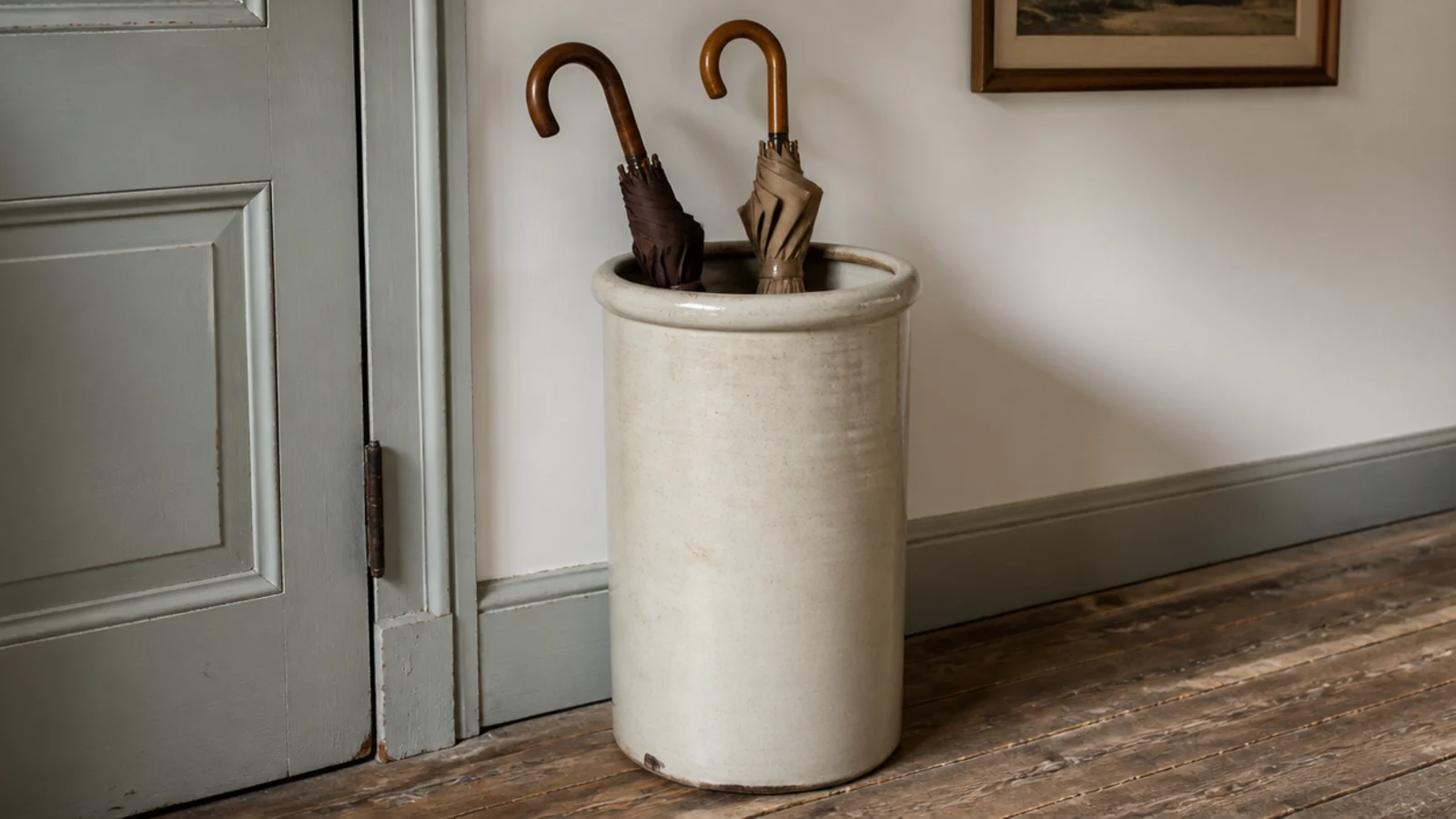
7. A stoneware crock for umbrellas
Purpose-made umbrella stands cost a surprising amount. A glazed stoneware or old enamel crock does the job for half and looks better empty.
Fourteen to 18 inches tall with a heavy base so it does not tip. Put a folded cloth in the bottom to catch drips, and swap it when it gets wet. Thrift shops and flea markets are full of them. $
8. A ticking stripe cushion on the bench
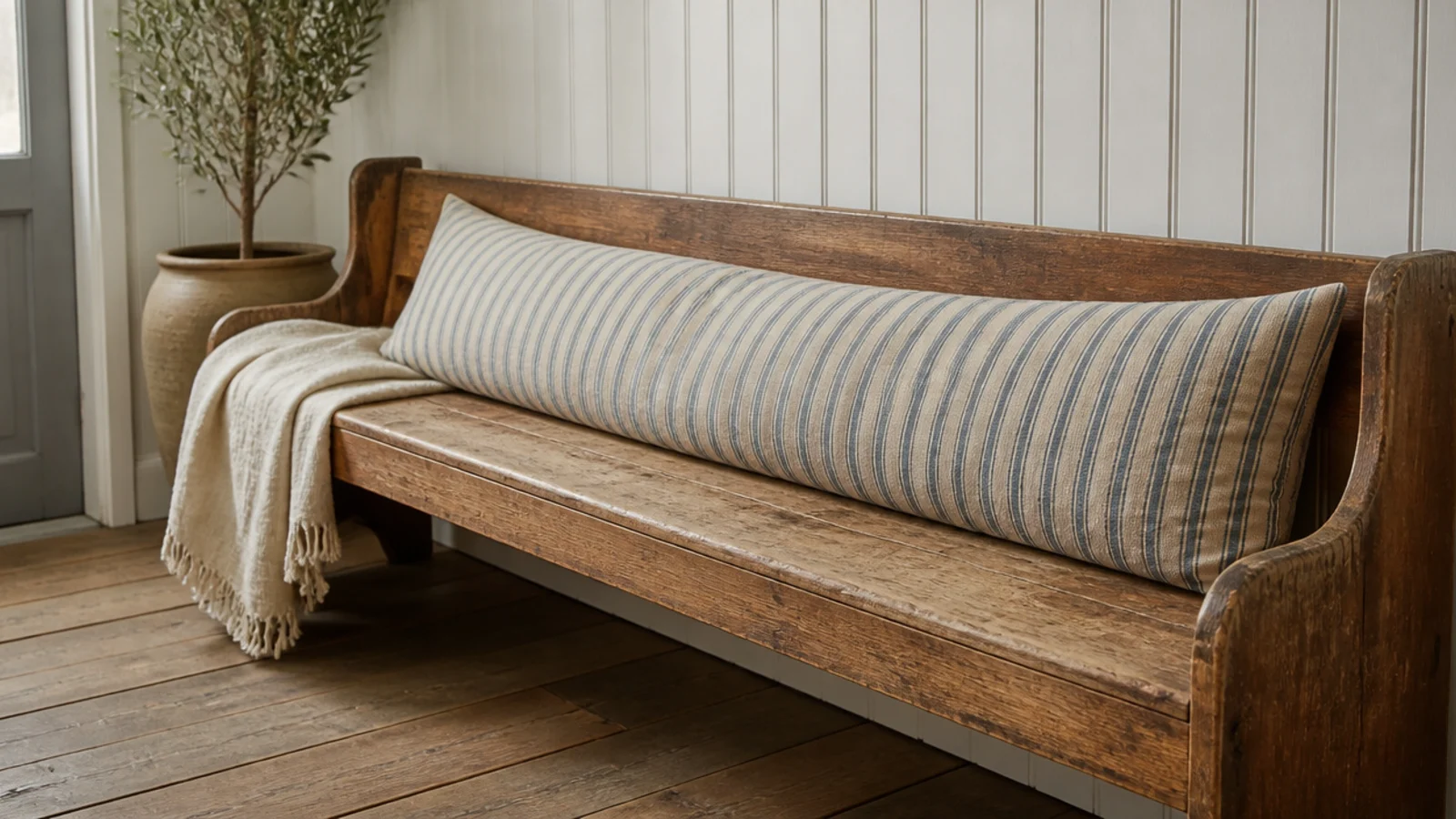
One striped textile is the right amount. Faded blue or black ticking on a bench cushion is the pattern most associated with the style and the easiest to live with.
Two striped textiles start to read as a theme. Buy a cushion cover you can wash, because a bench seat by a front door gets sat on in wet coats. $
9. A flat-weave runner in natural fibre
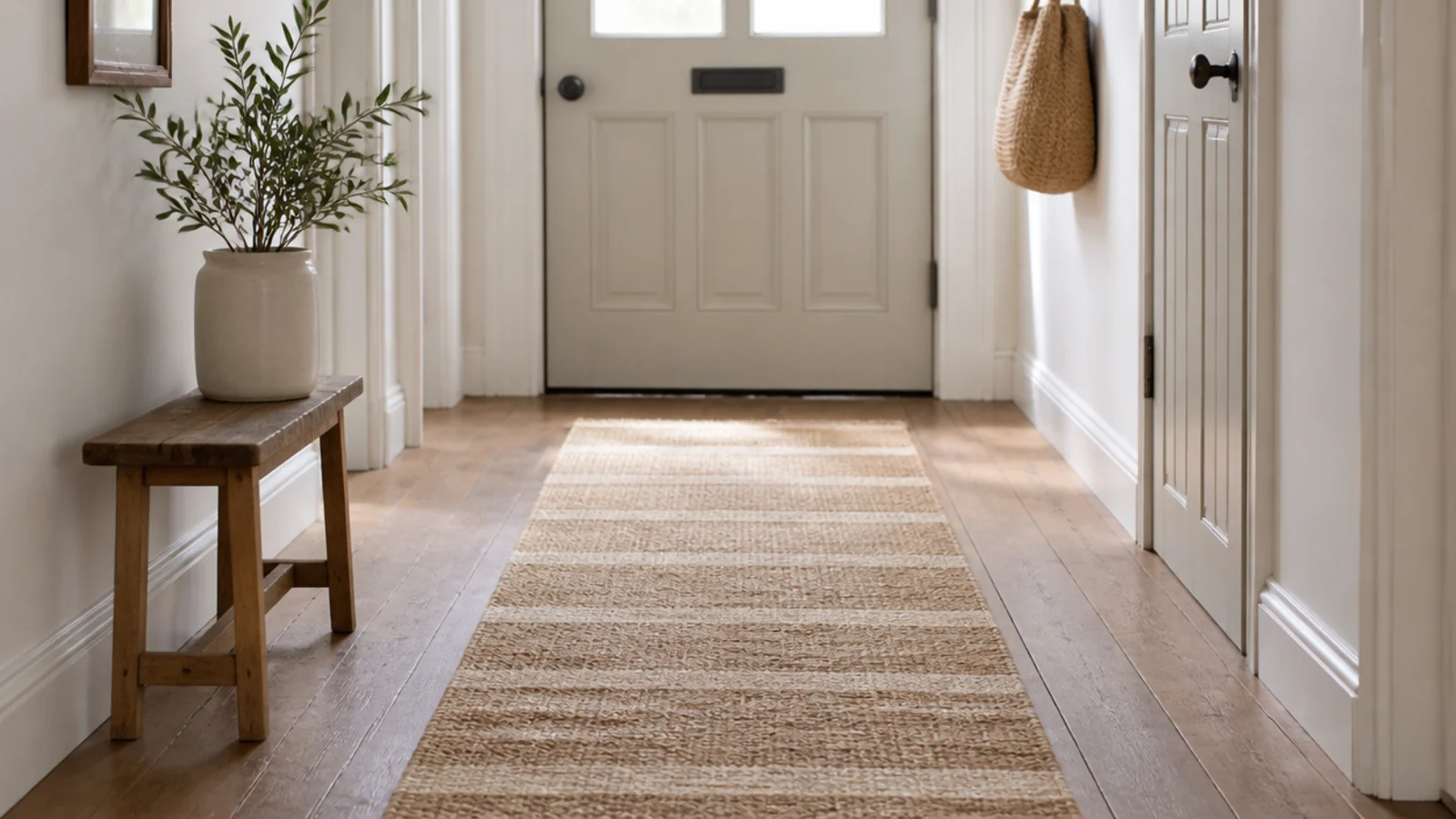
A flat-weave washable runner catches grit at the door and survives boots. Deep pile holds the grit at the base, mats in the traffic lane and looks tired within a winter.
Jute reads most naturally here and runs $40 to $60. Leave 4 to 6 inches of bare floor on each side, and use a thin non-slip pad regardless of what the label promises. $–$$
10. Black iron hardware throughout
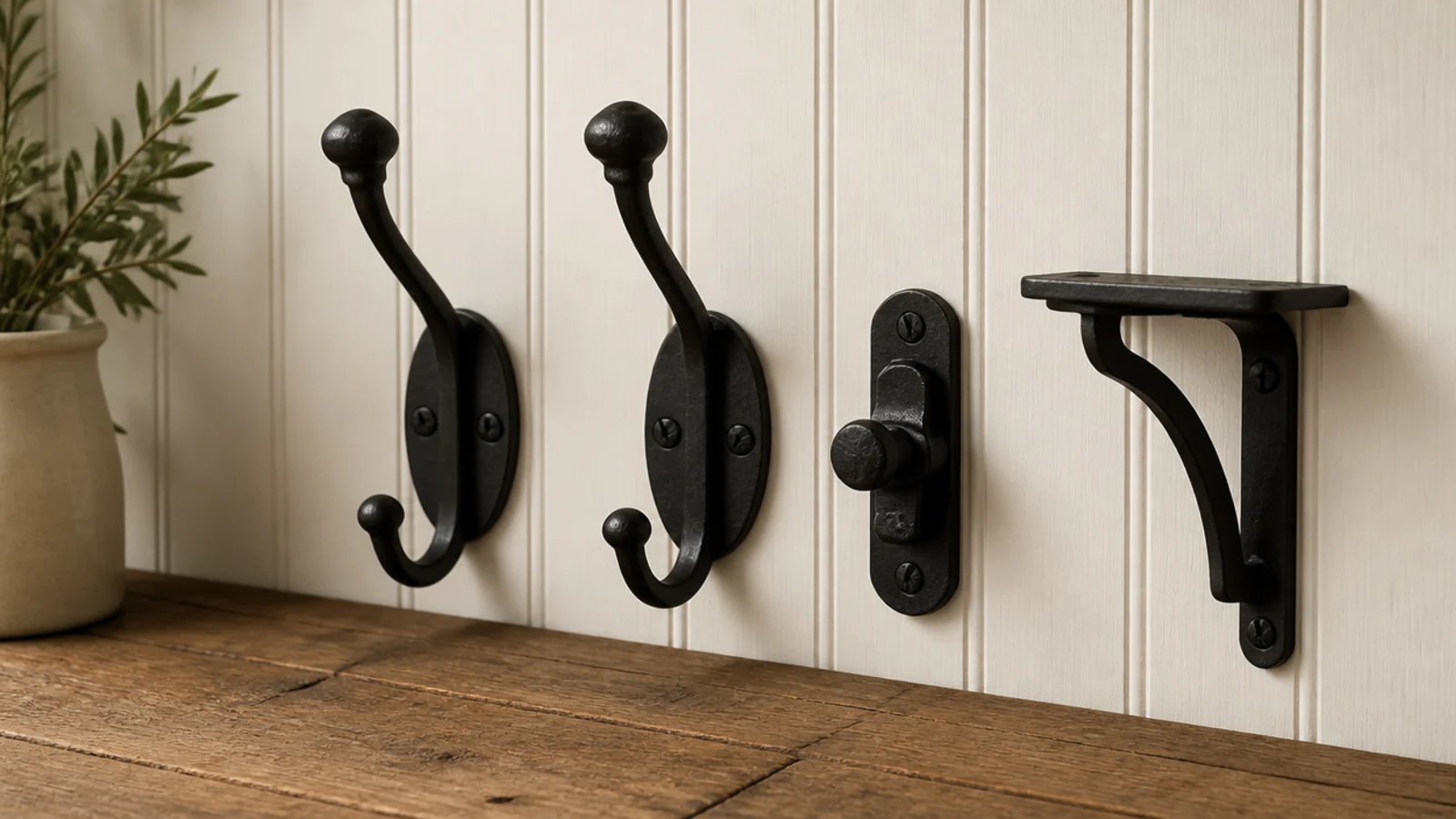
Pick one metal and repeat it: hooks, latch, shelf brackets, light fitting. Black iron and oil-rubbed bronze both suit warm wood, and repetition is what makes a mixed group look composed.
Plain utility hooks from the hardware aisle cost about a third of the decor aisle equivalents and usually carry more weight. $
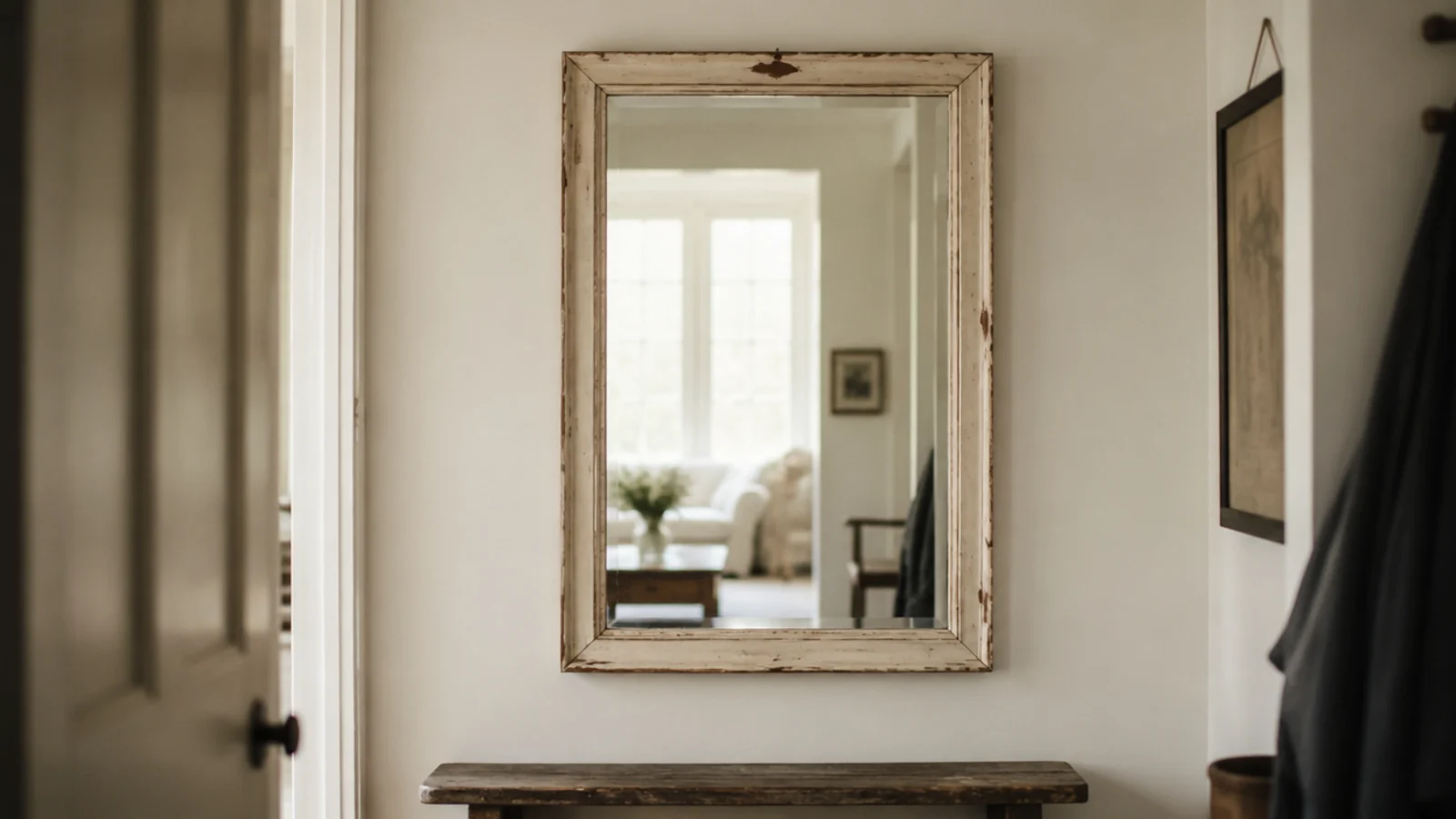
11. A vintage mirror with a chipped painted frame
An old painted frame with genuine chipping is worth far more to this look than a new distressed one, and secondhand mirrors are cheap because dated frames put people off.
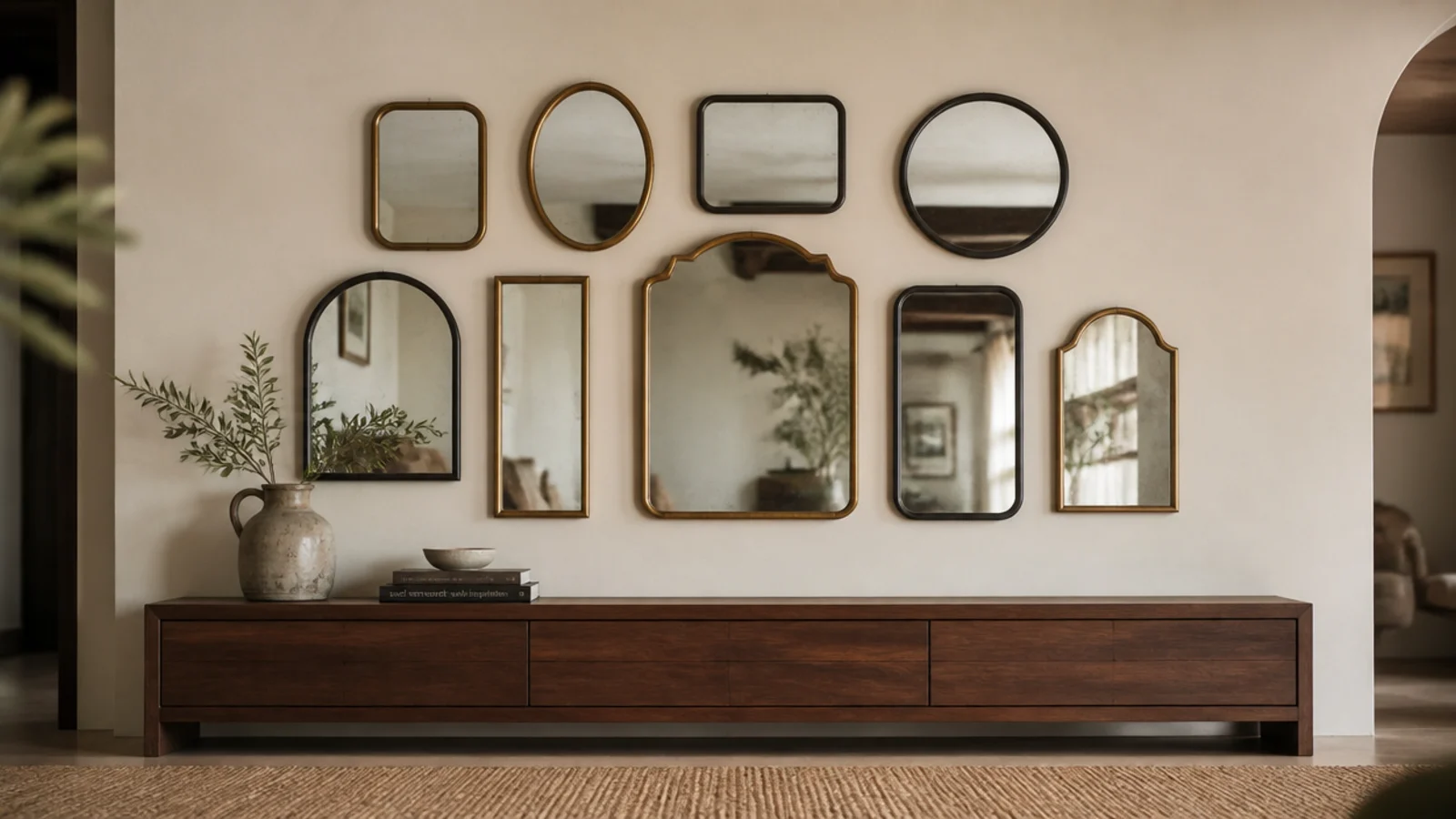
Centre the glass at 57 to 60 inches. If the frame is too ornate, a flat cream repaint calms it right down. There are more framing options in vintage mirror wall decor. $–$$
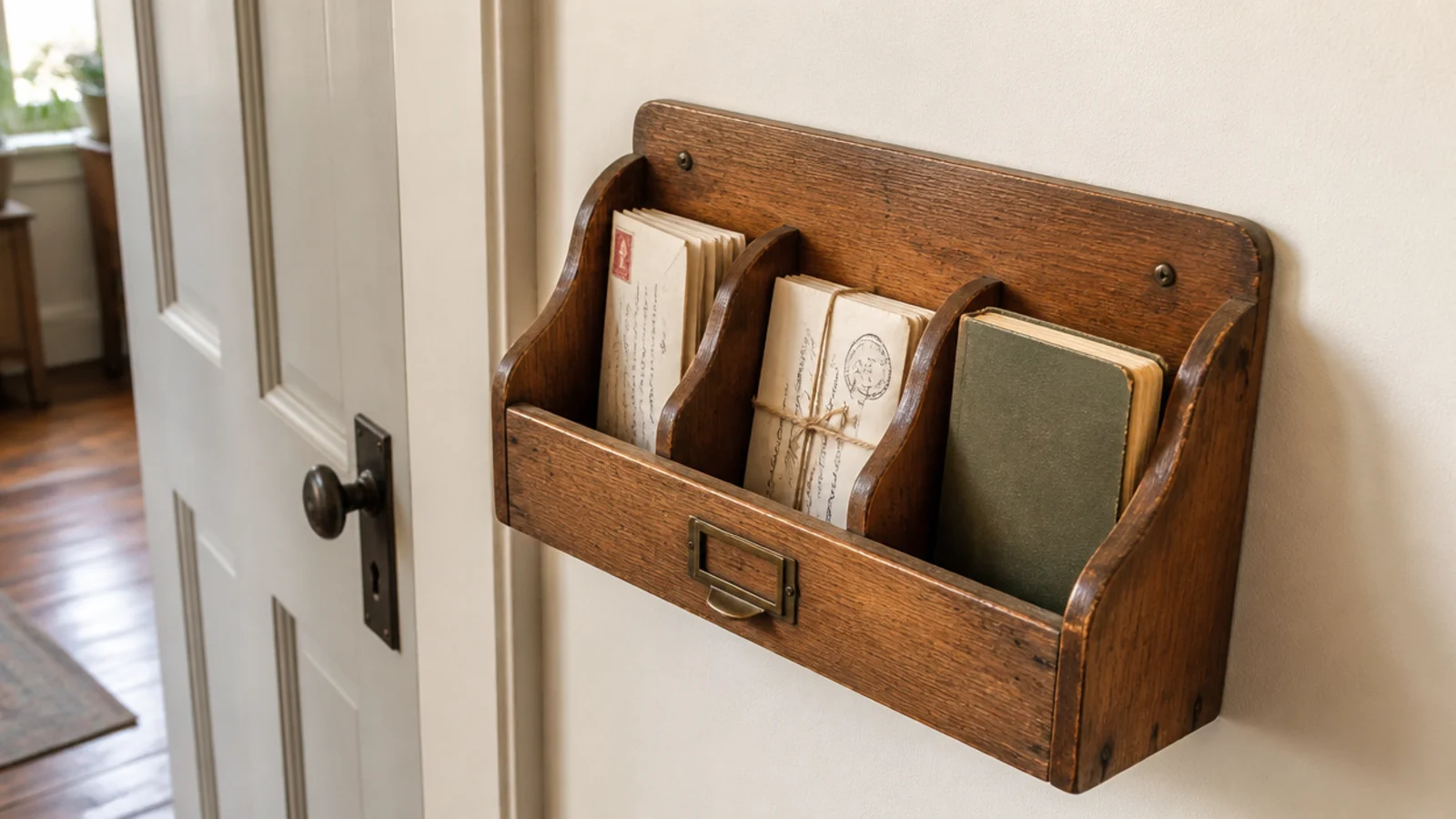
12. A wall-mounted wooden mail sorter
Post is what turns any entry surface into a mess. A slotted wooden sorter takes it vertically instead, so no horizontal surface ever collects it.
Mount it at 48 inches, clear of the coat zone. Empty it weekly — a sorter is a queue, not a filing system, and an overflowing one is worse than a pile. $
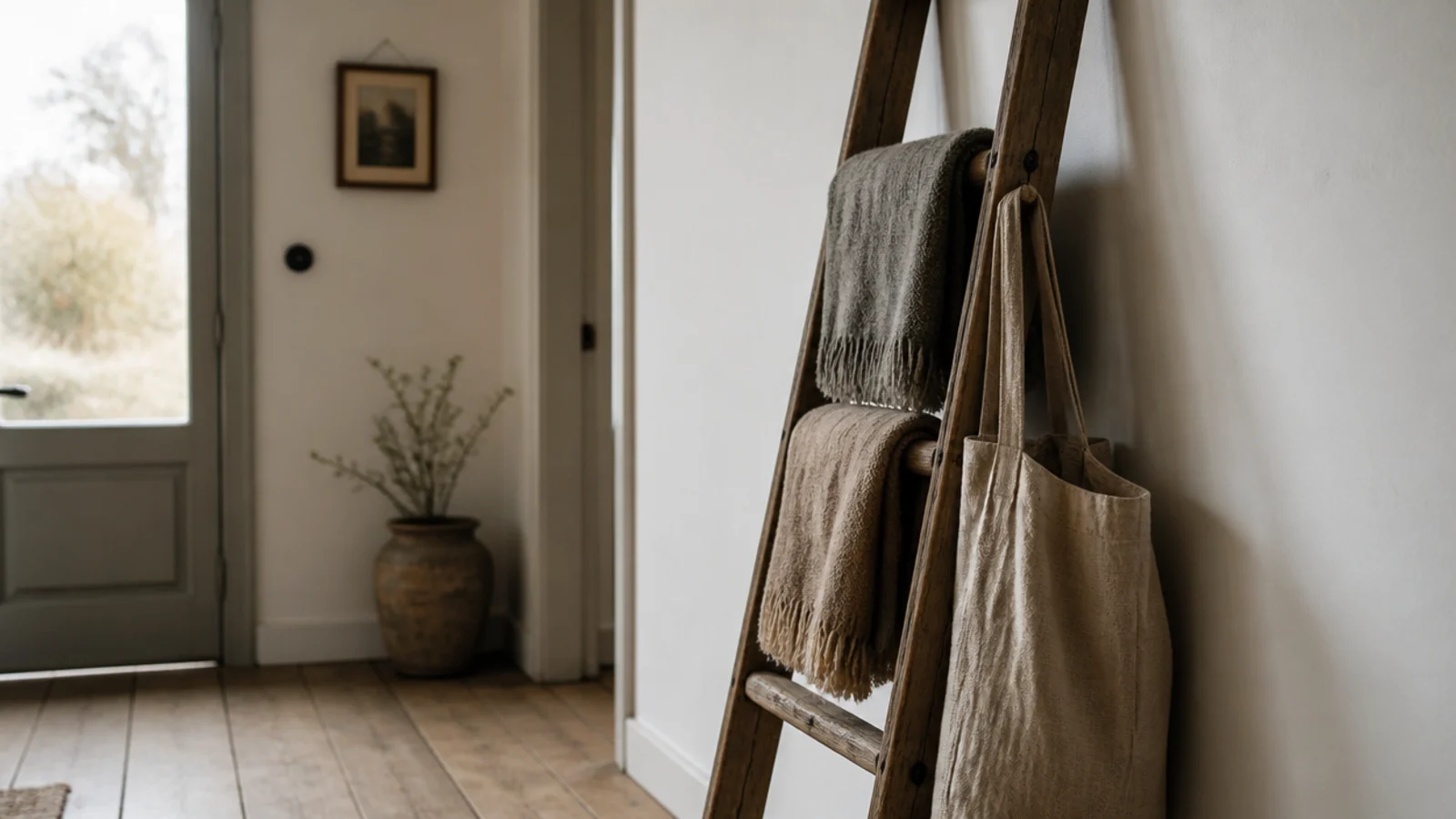
13. An old ladder as a blanket rack
A weathered wooden ladder leaning in a corner holds blankets, totes and scarves with no fixings at all, which makes it the easy renter answer.
Lean it at about 15 degrees with felt pads under the feet so it does not walk on a wood floor. Flea market ladders run $20 to $50. Sand any splinters and leave the finish alone. $
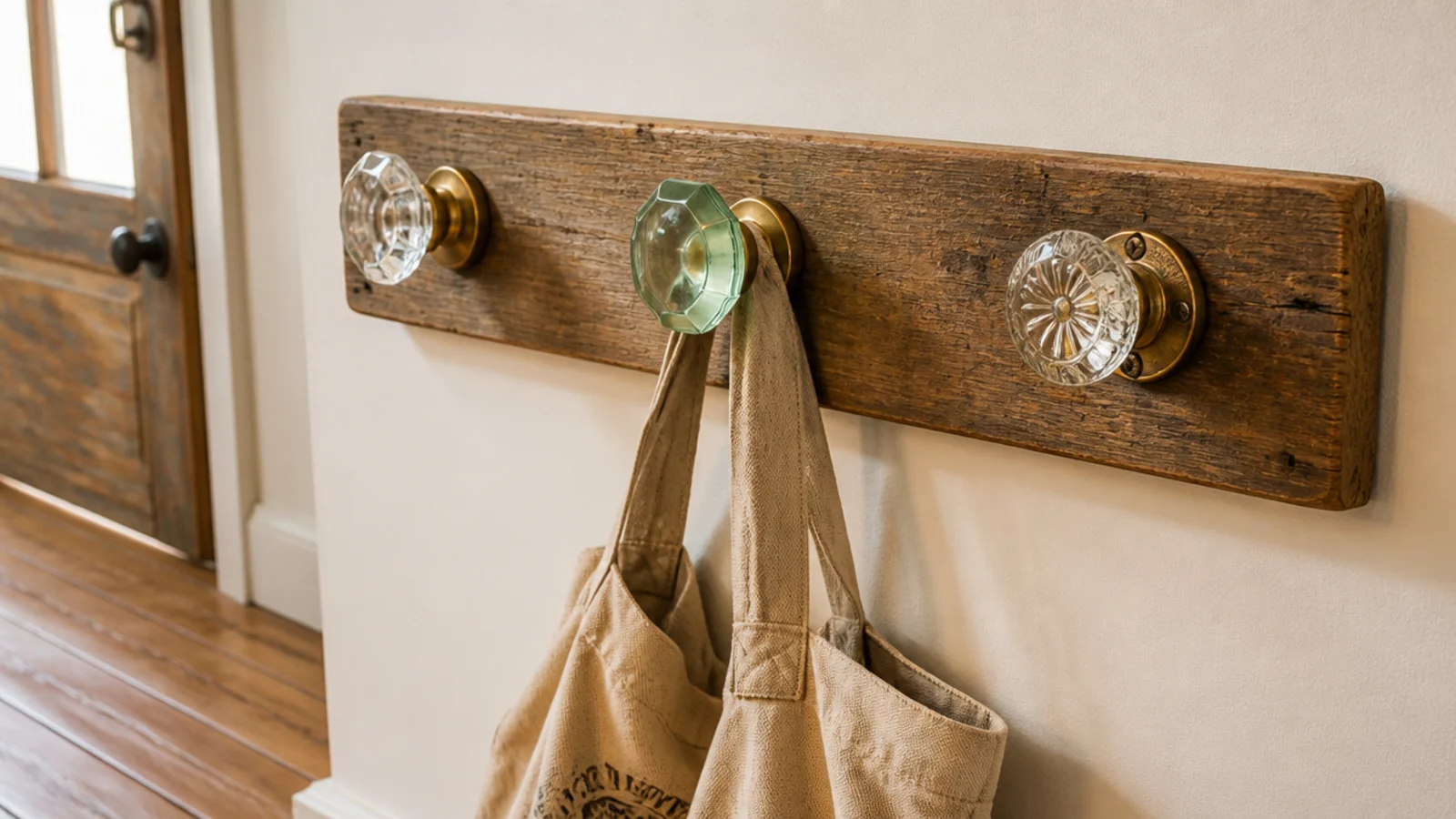
14. Antique doorknobs turned into hooks
Mismatched glass and brass doorknobs mounted along a reclaimed board make a coat rail that nothing new can imitate.
Flea markets sell them for $2 to $6 each. You need a threaded rod or a long bolt through the board for each one, and studs behind it, because these carry real weight once four coats are on them. $
15. A schoolhouse pendant overhead
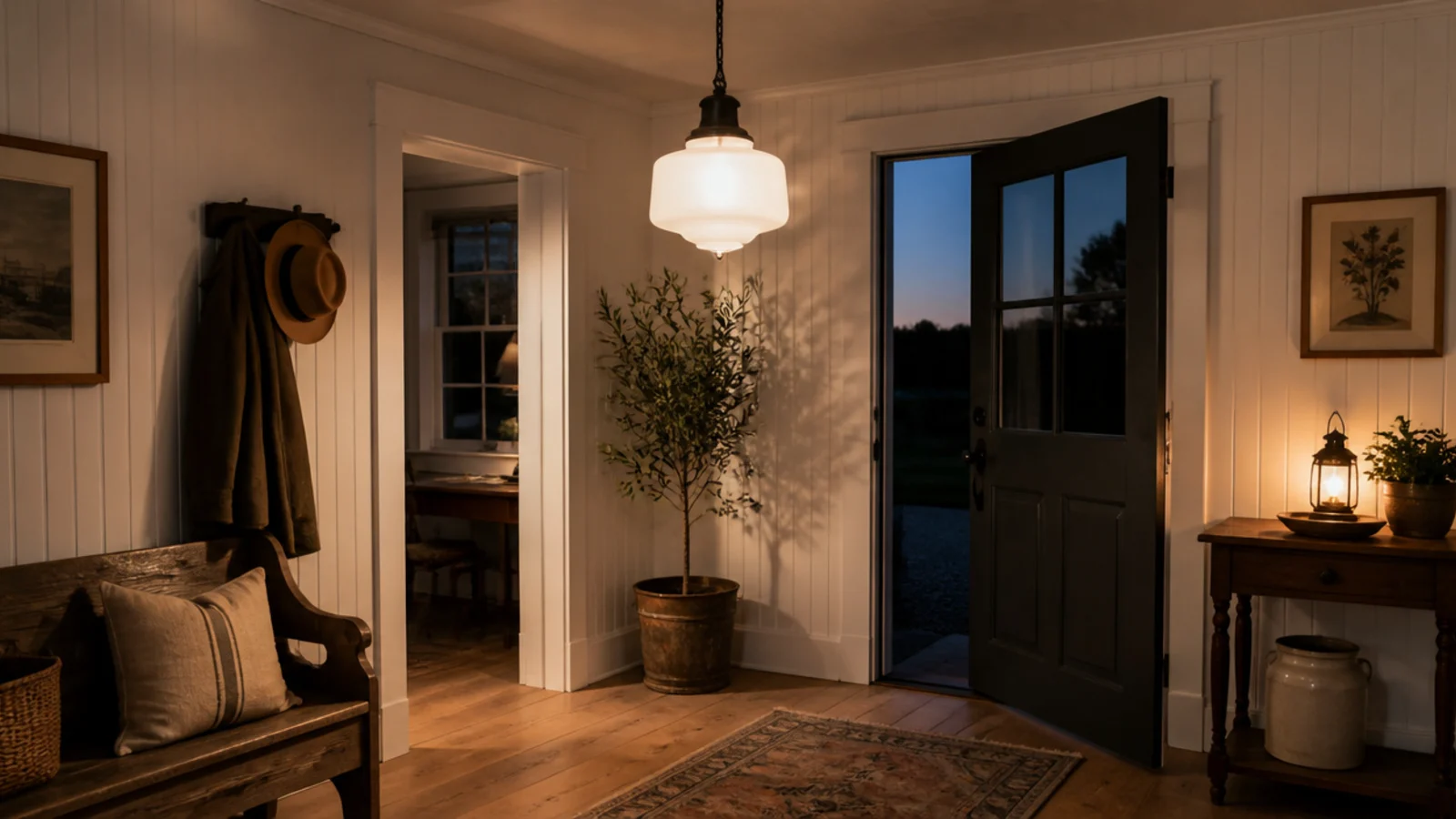
An opal glass schoolhouse fixture is the most fitting overhead light for this style and costs $50 to $120.
Keep the bulb at 2700K. Cool white light undoes every warm wood tone in the room, and a single ceiling fixture flattens an entry anyway, so plan a lamp or a picture light as a second layer. $$
16. A wooden bowl for keys
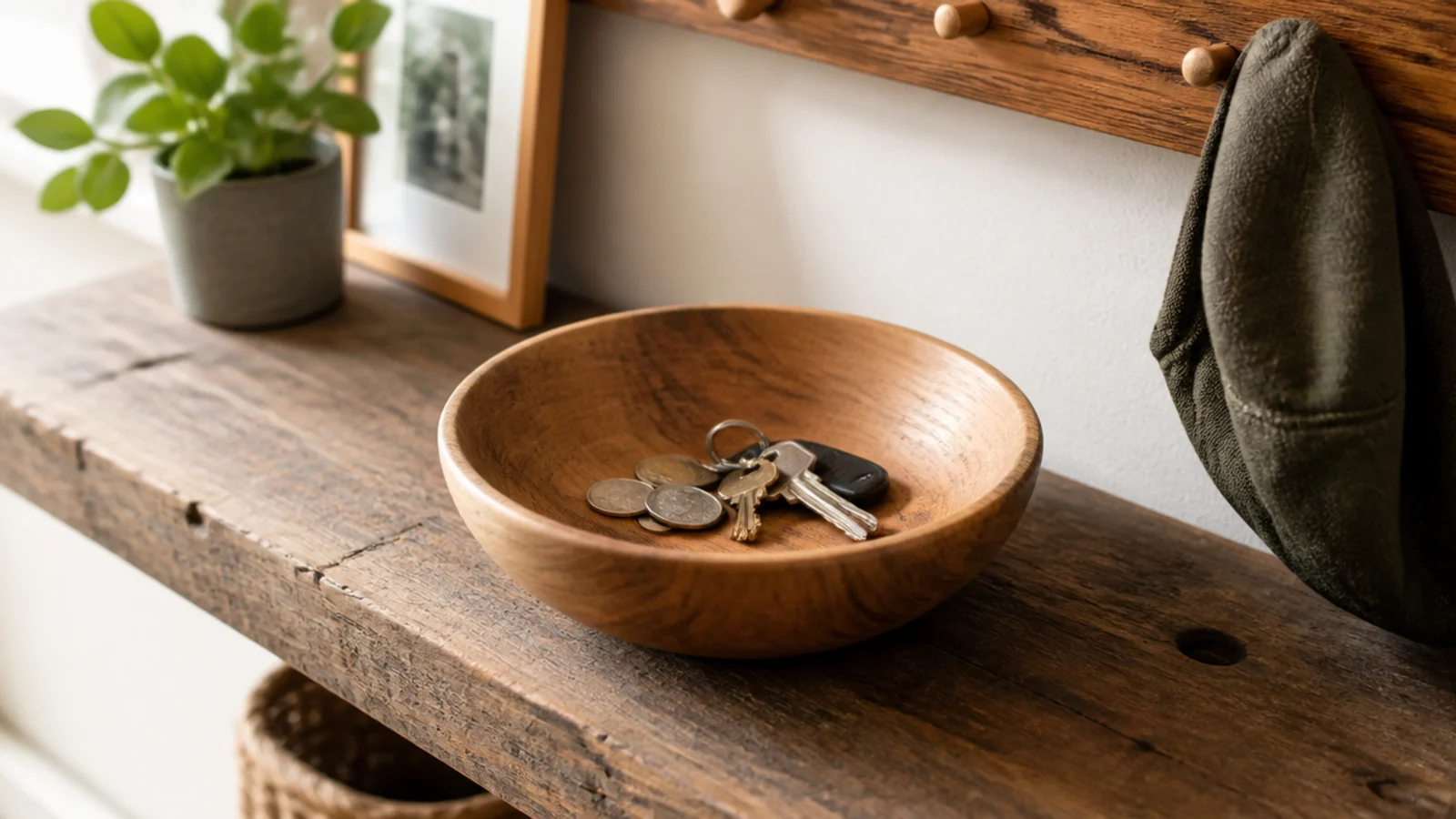
One shallow turned bowl on the shelf, and keys stop wandering the house. It is the farmhouse version of the tray rule.
Six to eight inches across is right — big enough for keys and sunglasses, small enough that it fills up and forces an edit. Secondhand wooden bowls cost a few dollars and improve with age. $
17. Oil-rubbed bronze on the front door
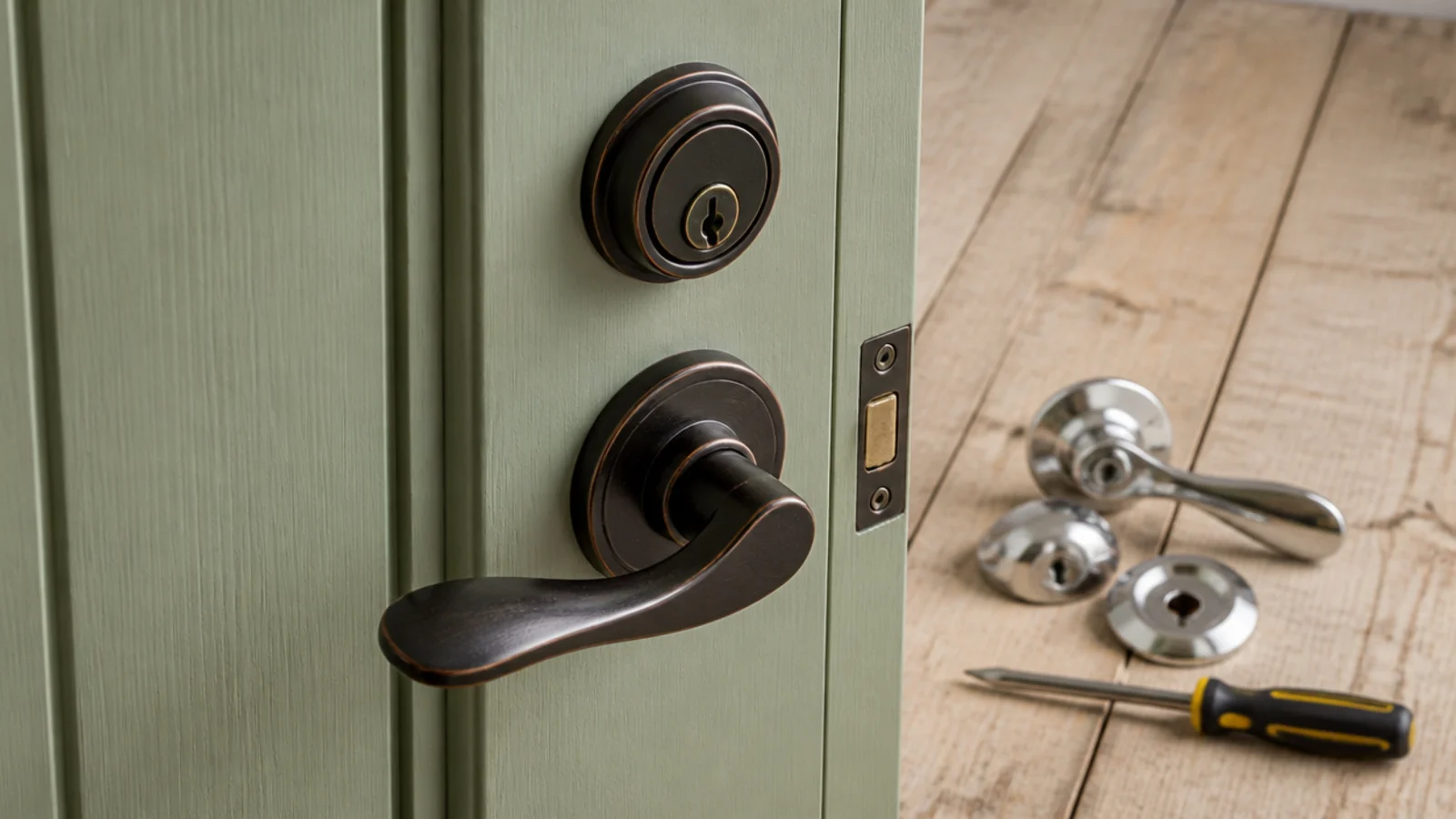
Match the lever and the deadbolt. Mixed finishes on a front door read as unfinished from six feet away, and it is a twenty minute fix with a screwdriver.
A matching set runs $35 to $60. Keep the original hardware in a labelled bag if you rent, so the swap costs you nothing at move-out. $
18. A slate or chalkboard for notes
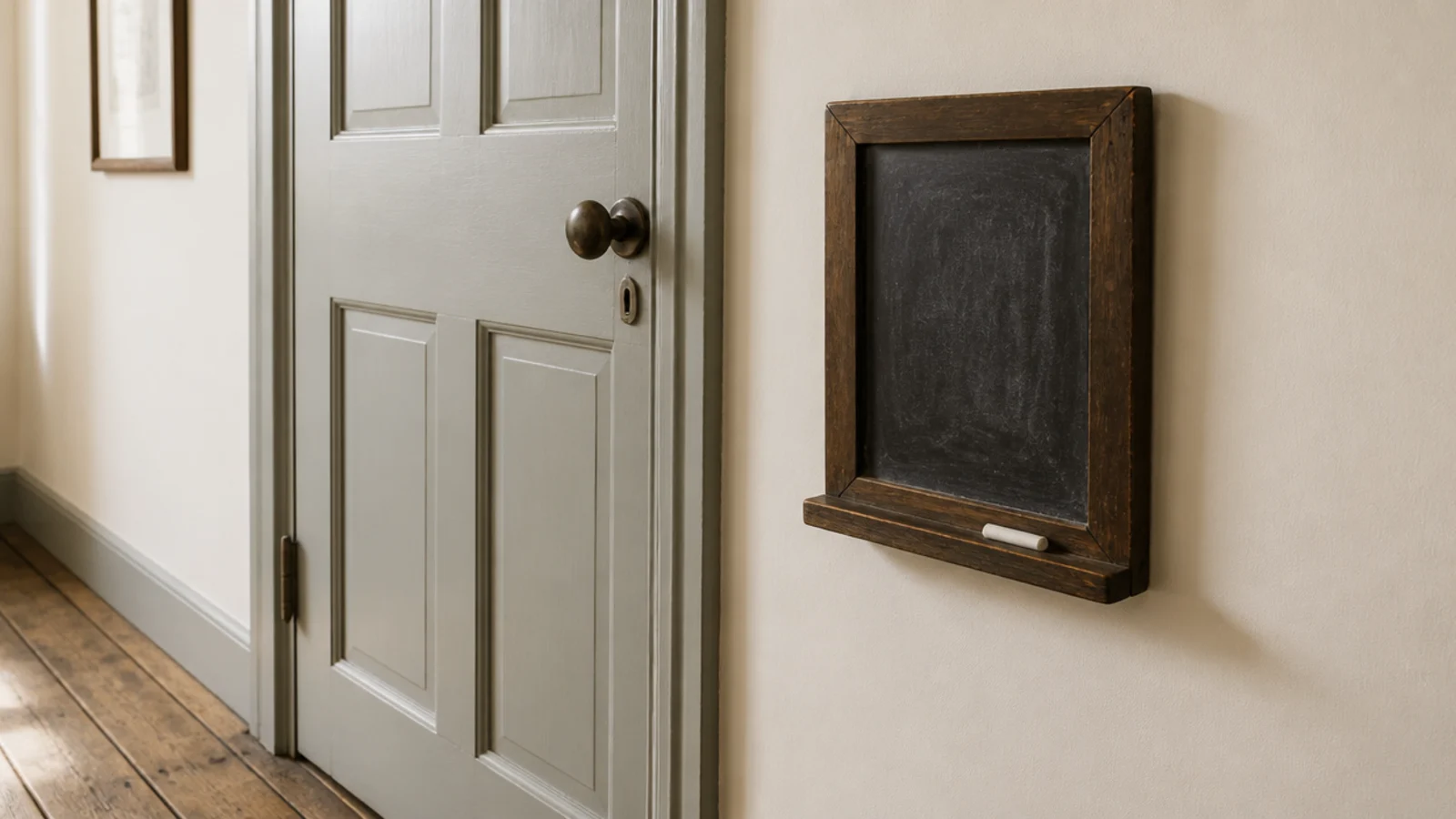
Something genuinely useful on the wall always looks better than something purely decorative. A small framed slate takes the school note, the reminder, the shopping list.
Keep it small, around 10 by 14 inches, and hang it beside the door at 54 inches. Anything larger tips over into signage, which is precisely what this style should avoid. $
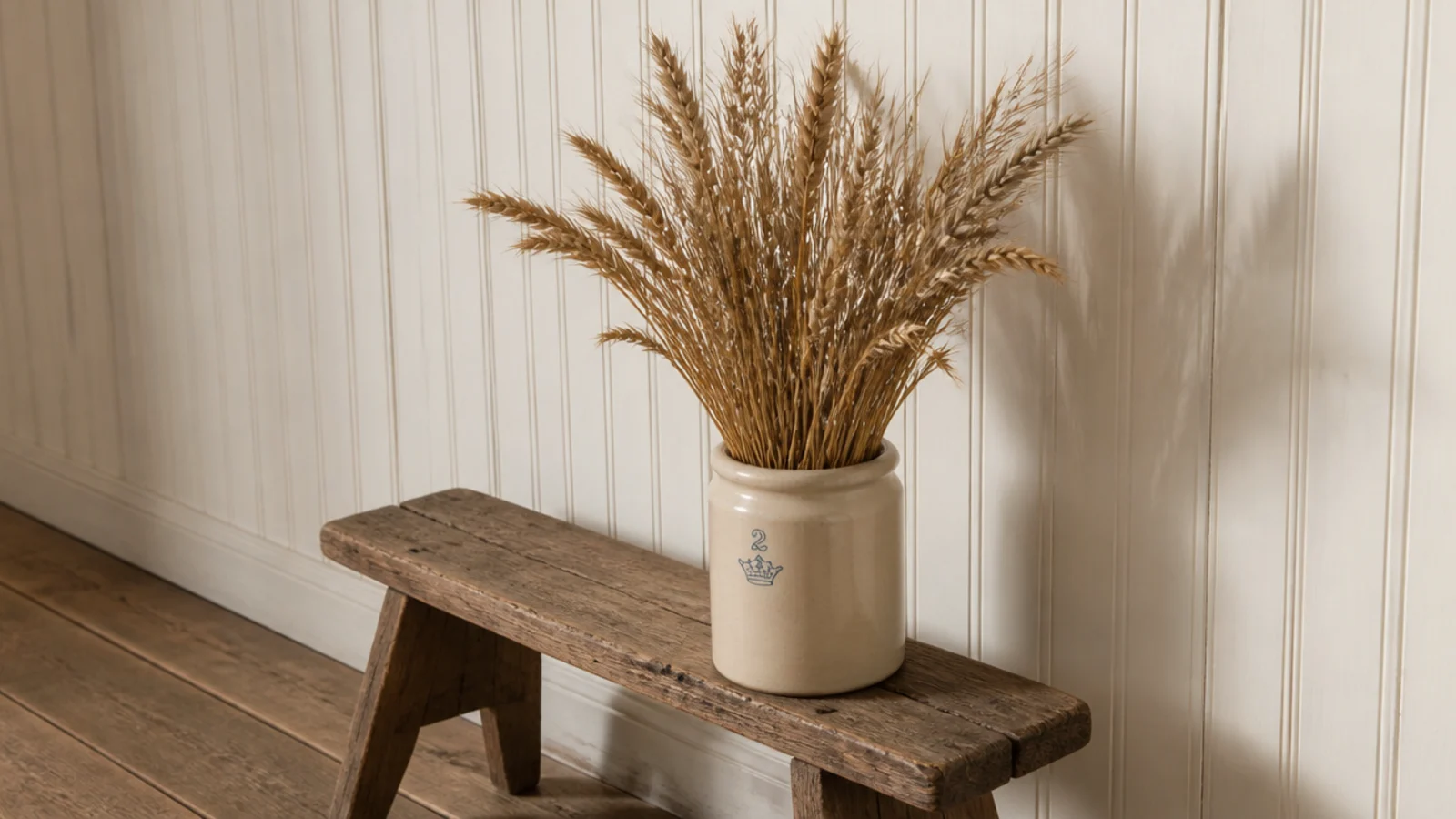
19. Dried wheat or eucalyptus in a crock
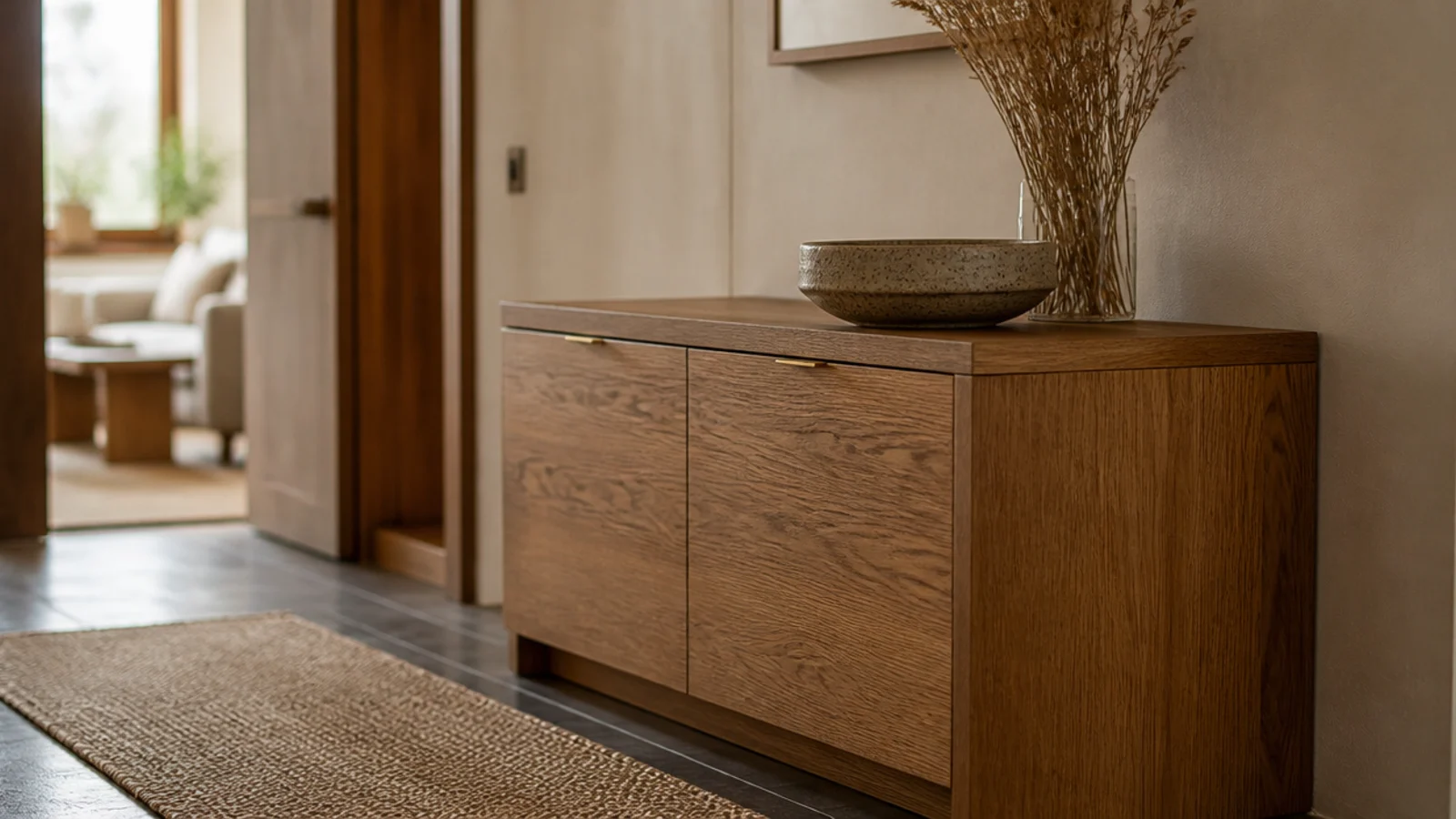
Dried stems cost about $12 and last two years; fresh flowers in a dim hall last four days. Wheat, bunny tails and eucalyptus all suit the palette.
Cut the stems to about 1.5 times the height of the crock. Shake them outdoors twice a year and they stay looking deliberate rather than dusty. $
20. Painted floorboards at the door
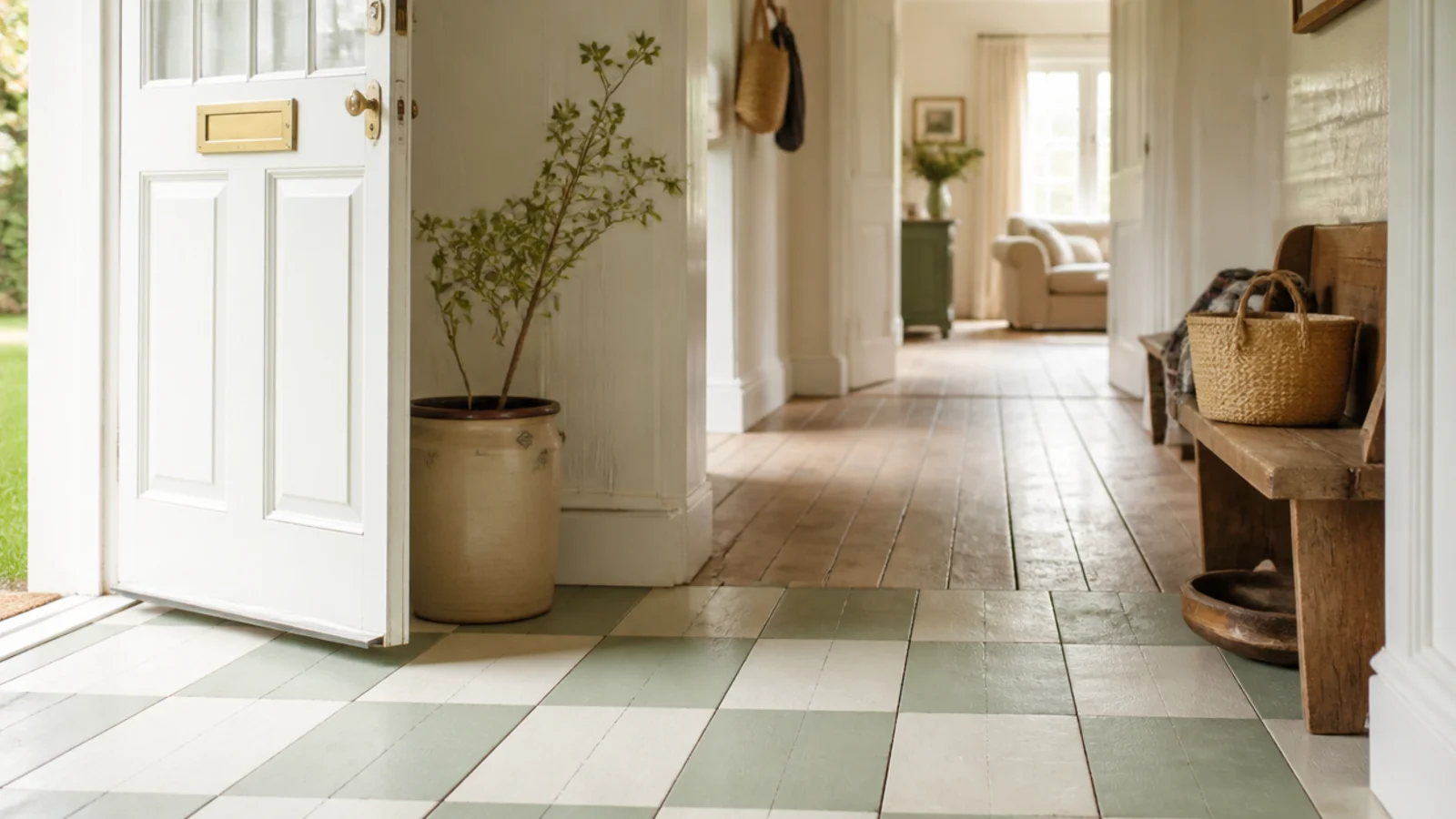
Paint is the most forgiving floor finish there is, and painted boards are historically accurate to the style rather than a trend.
A soft cream and sage checkerboard inside the door, or a plain painted section that stops in a straight line, marks the entry with no building work. Use floor paint and two thin coats, about $40 for a small hall. $
21. A dutch door for light and air
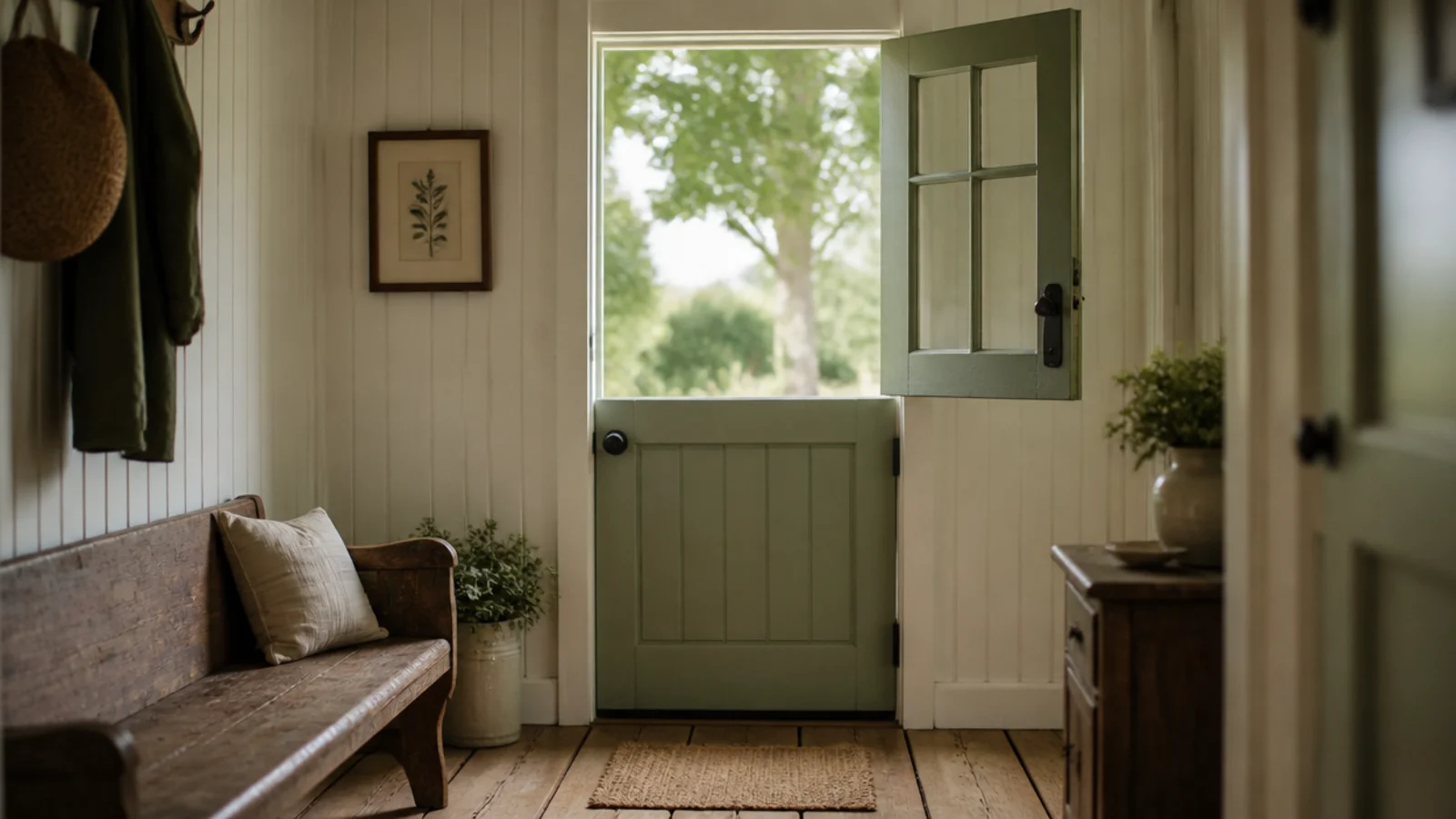
A split door with an openable top half is the most charming thing you can do to a farmhouse entry, and genuinely useful with a dog or a toddler.
Retrofitting an existing door costs $200 to $500 with a carpenter, plus new hinges and a bolt. It is the priciest idea here and the one people remember. $$$
22. A reclaimed wood floating shelf
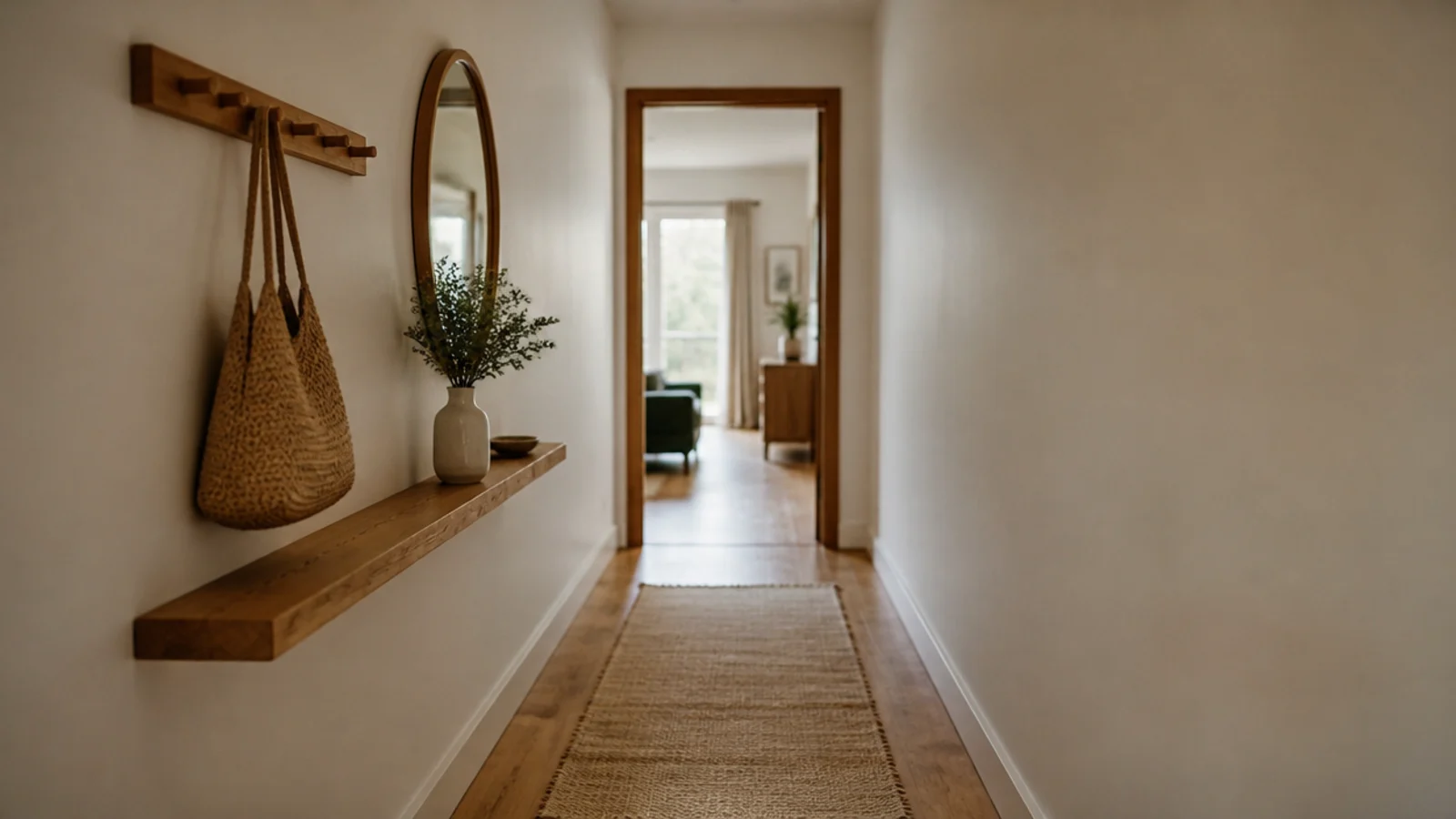
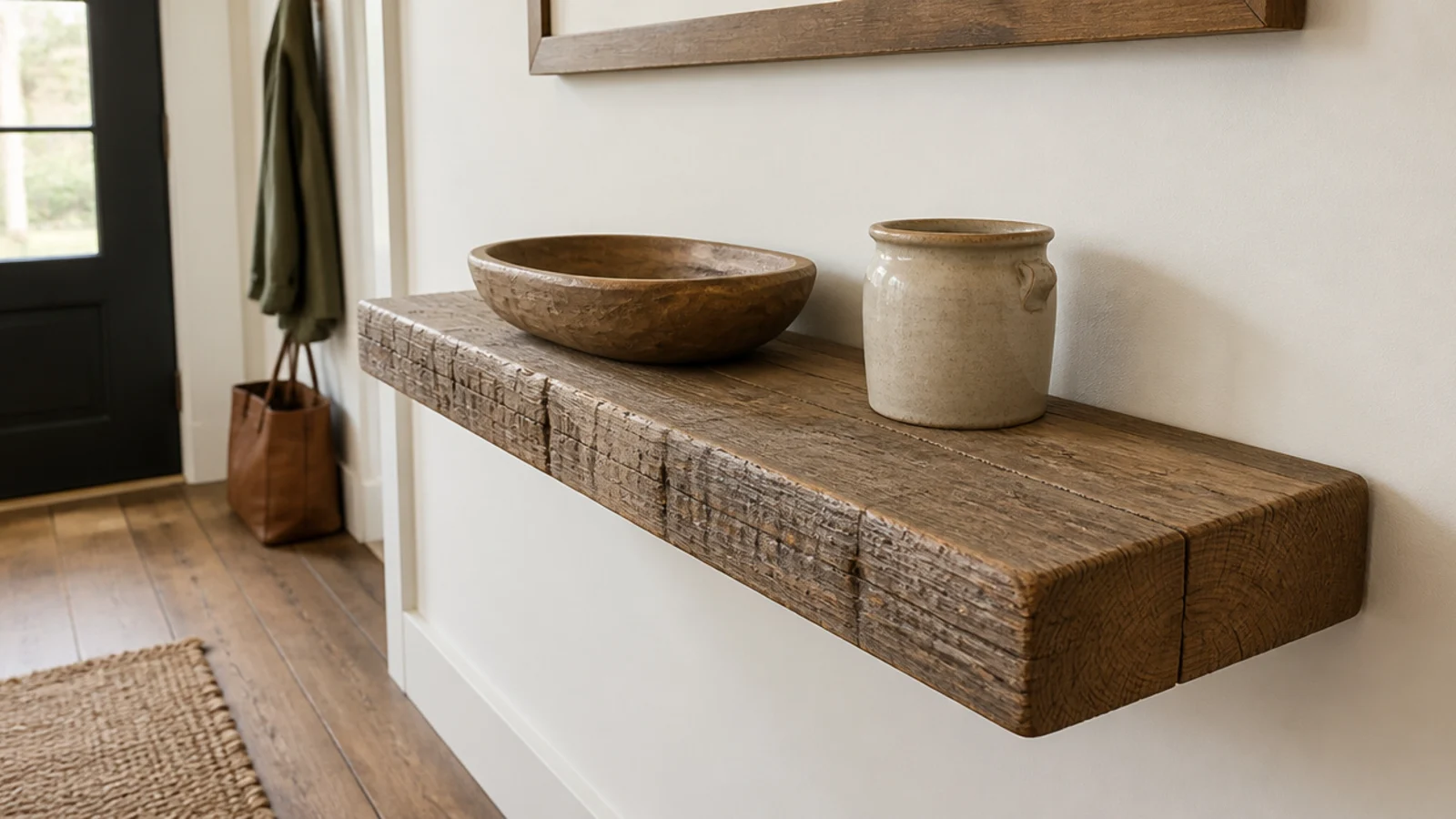
A thick reclaimed board on concealed brackets gives you a landing surface at 6 inches deep with no legs in the walkway.
Saw marks, nail holes and old paint are the features, not the flaws. Keep it under 36 inches long so it reads as a detail rather than furniture. About $45 to build from a salvaged board. $
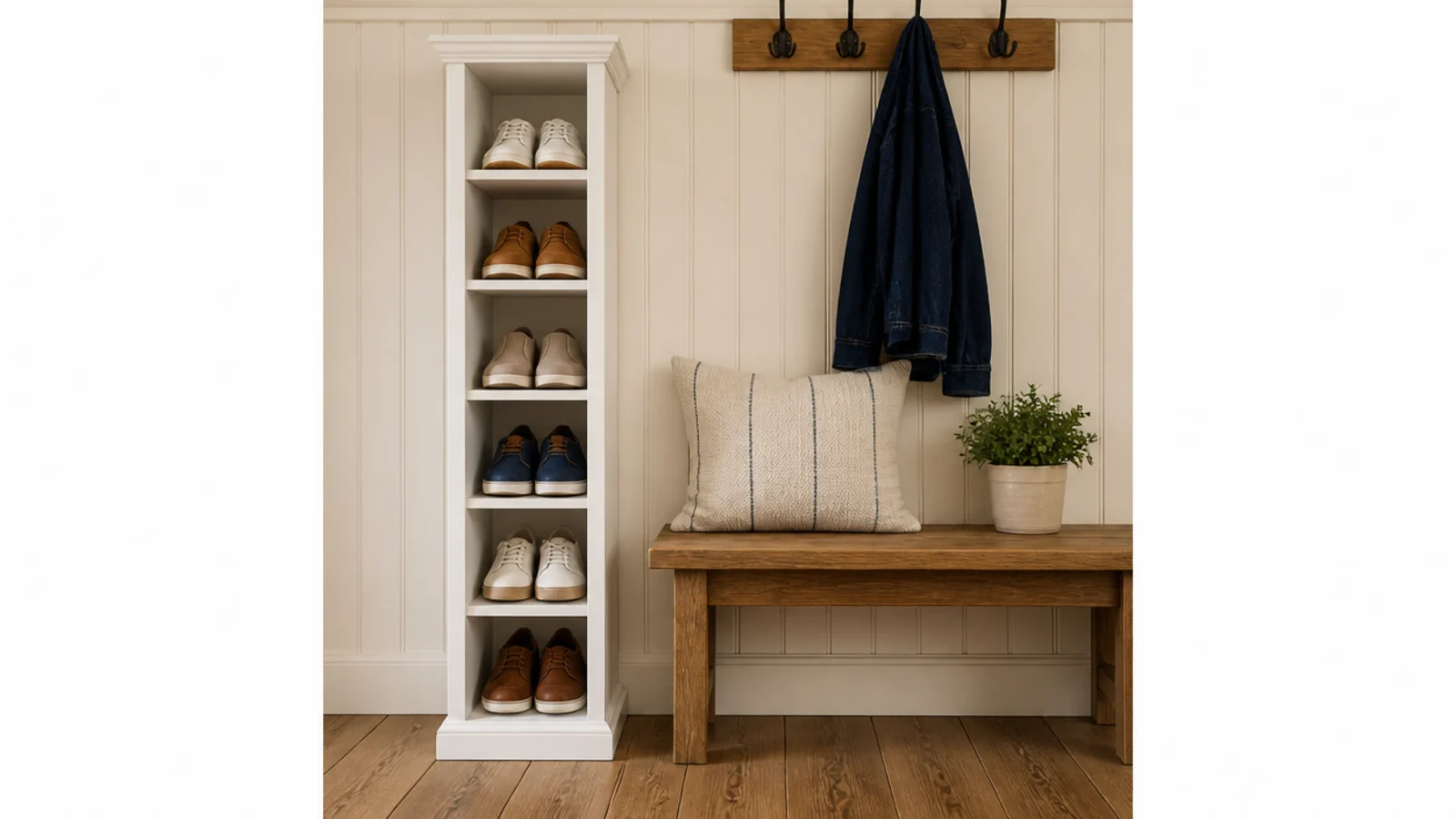
23. A shoe cubby column beside the bench
Where the bench cannot hold everything, a narrow column of cubbies beside it stacks the same storage vertically in about 14 inches of floor.
One pair per opening — the moment a cubby holds two pairs it becomes a shelf, and shelves become piles. Wooden shoe cabinets covers the closed versions. $$
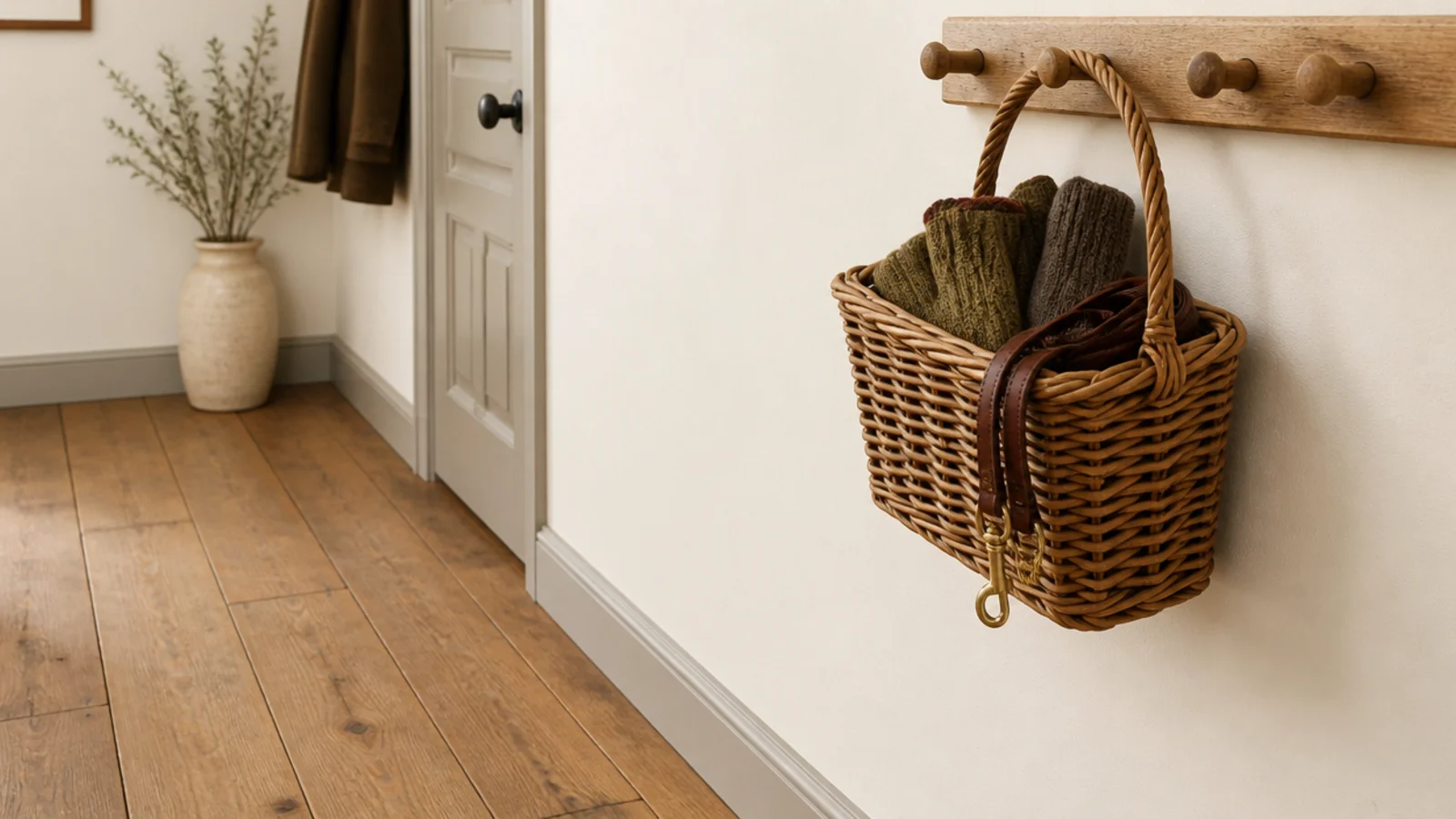
24. A basket hung on a peg
A basket on a peg at 40 inches holds gloves, hats and dog leads while leaving the floor completely clear, which matters in any hall under four feet wide.
Choose one with a flat back so it hangs close to the wall. Empty it seasonally. A basket nobody empties is a pile with sides, and this one hangs at eye level. $
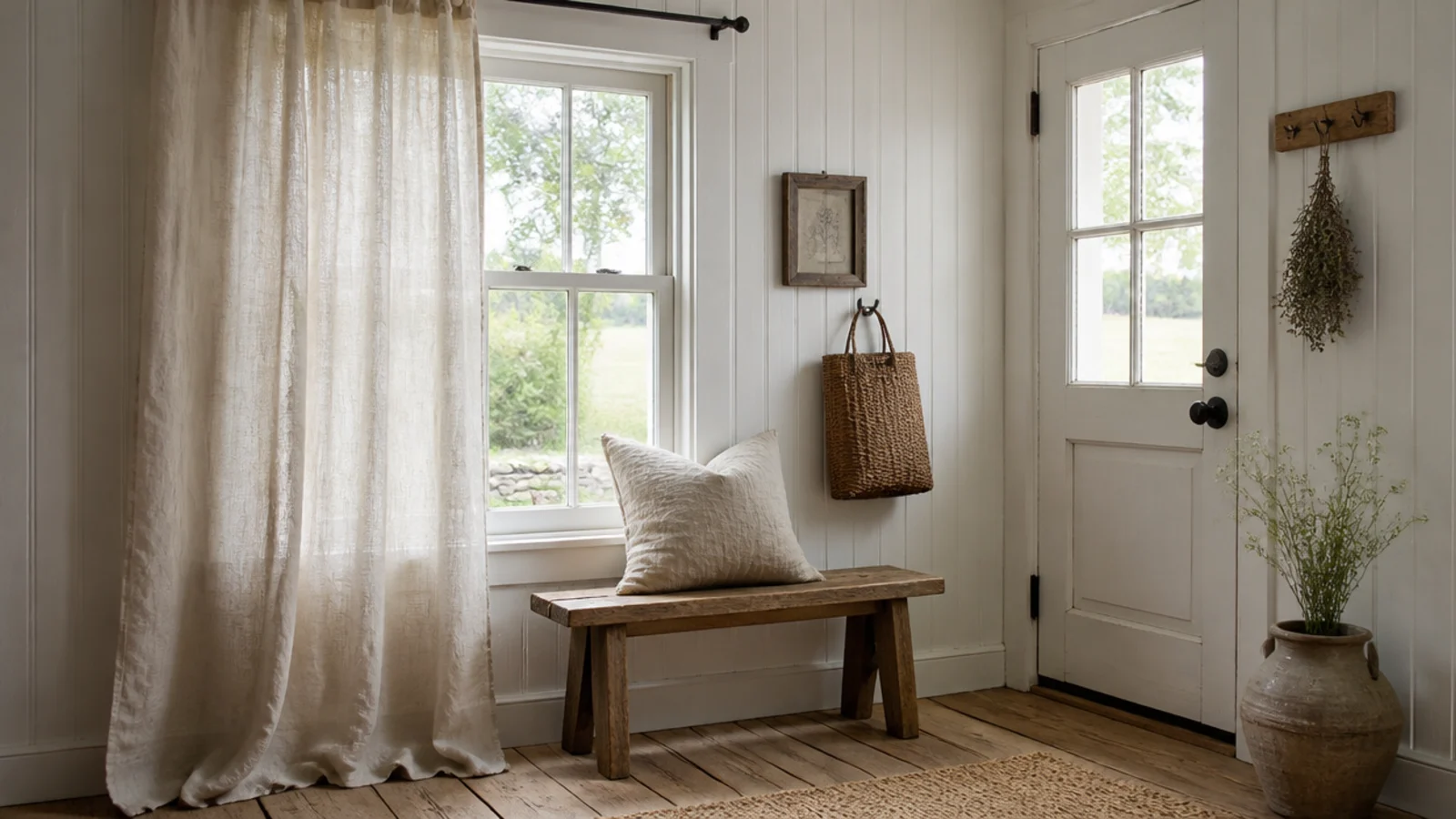
25. Linen instead of anything shiny
Washed linen creases, and the creases are the point. Curtains, bench cushions and a tote hanging on a peg all read warmer in linen than in any polished fabric.
Buy it washed rather than crisp. Remnant bins sell yard lengths for $8 to $15, which is enough for a bench cover with no sewing beyond one hem. $
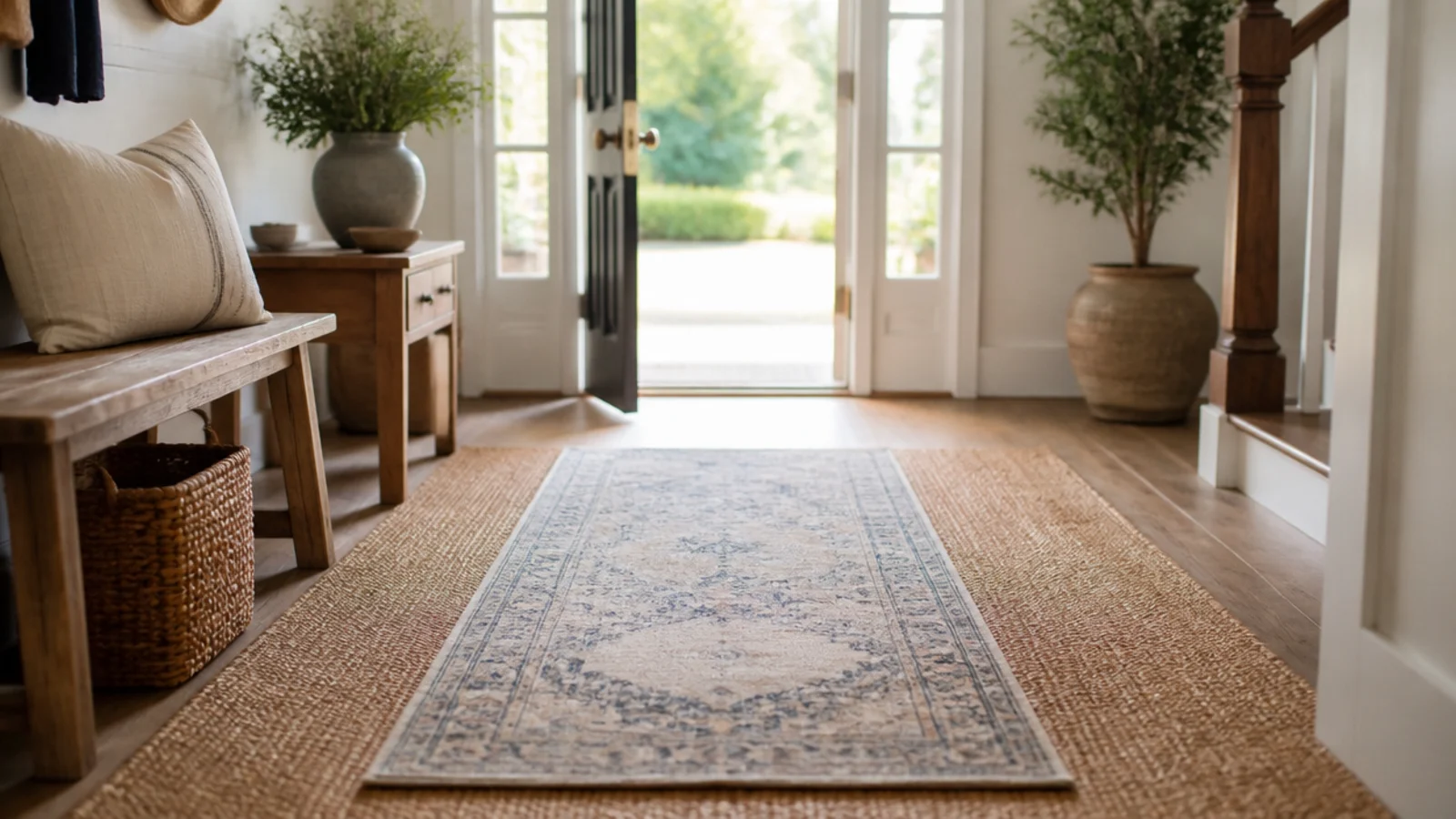
26. Layer a small runner over a jute base
A large jute rug as the base with a smaller faded runner on top gives depth that a single rug never quite manages.
Keep the top layer washable, since it takes all the traffic. The jute underneath acts as the pad and lasts years. Both together usually cost less than one good wool runner. $$
27. Warm white walls, warm wood trim
Cool grey fights every wood tone in this style. A warm white or soft greige on the walls lets honey oak and pine sit comfortably beside it.
If you want more depth, paint the panelling a muted sage or clay and keep everything above it neutral. Test the sample on the actual wall at the time of day you use the hall most. $
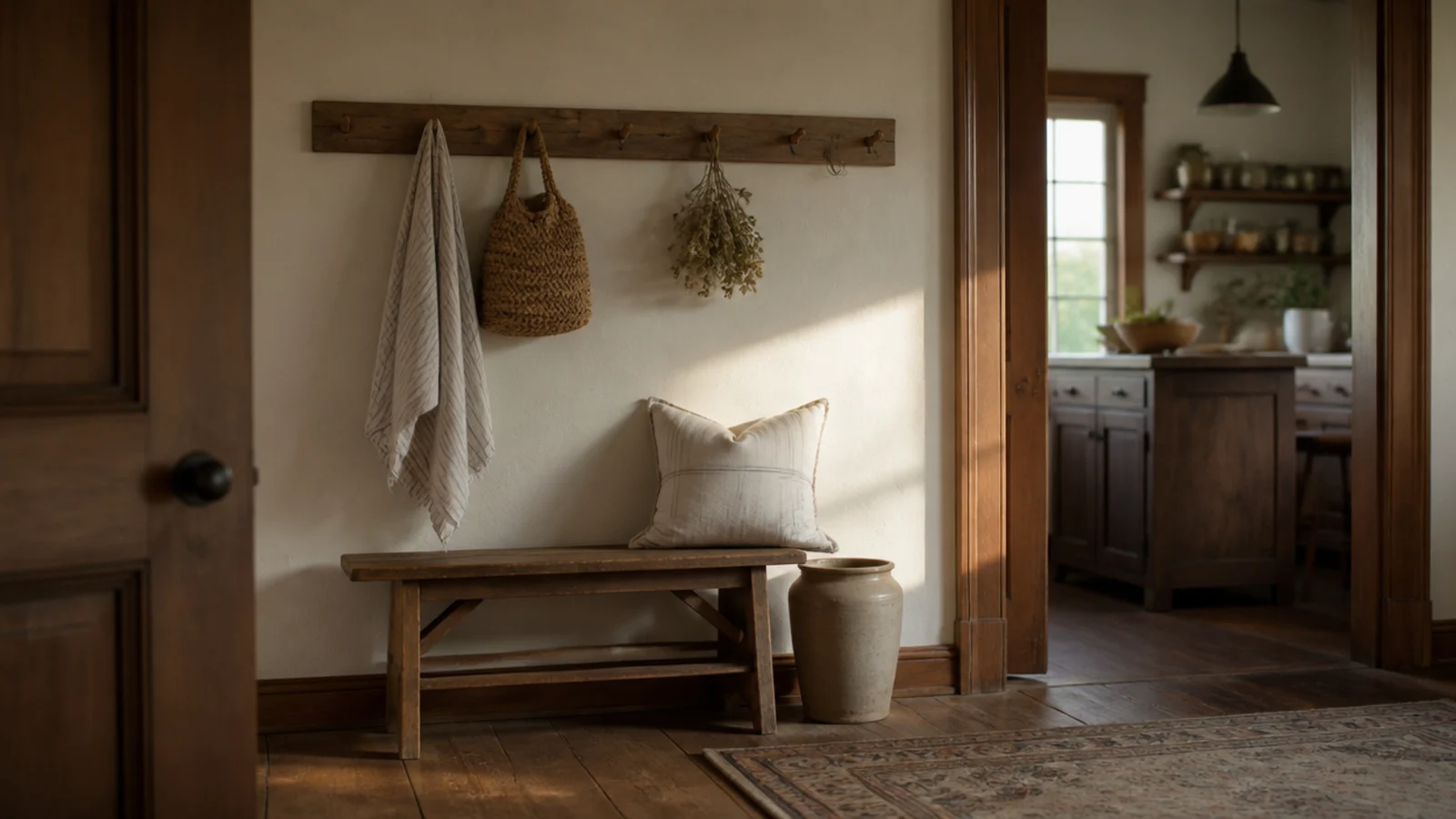
28. One wreath, on the inside of the door
The inside face of the front door is the version you actually see every day, and almost nobody decorates it.
A simple dried wreath on a plain iron hook is enough. Skip anything with a printed word on it — the moment an entry starts explaining itself it stops feeling like a home. $
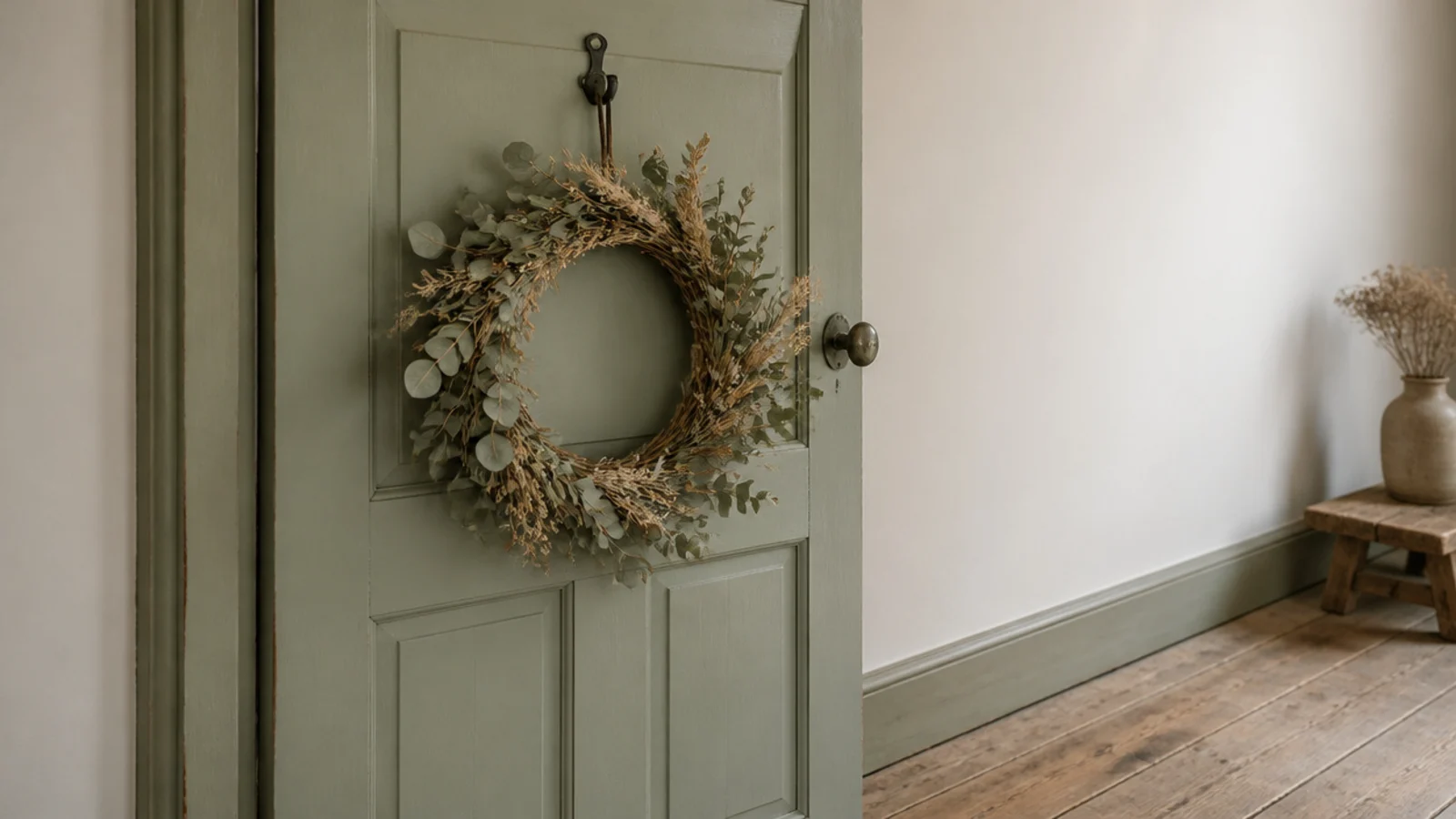
29. Three tones and no more
Warm white, one wood tone, black iron. That is the whole palette, and adding a fourth is where farmhouse entries tip into looking like a set.
If you want variation, get it from texture instead — beadboard, woven willow, washed linen, worn paint. Texture repeats read as collected; extra colours read as busy. Free
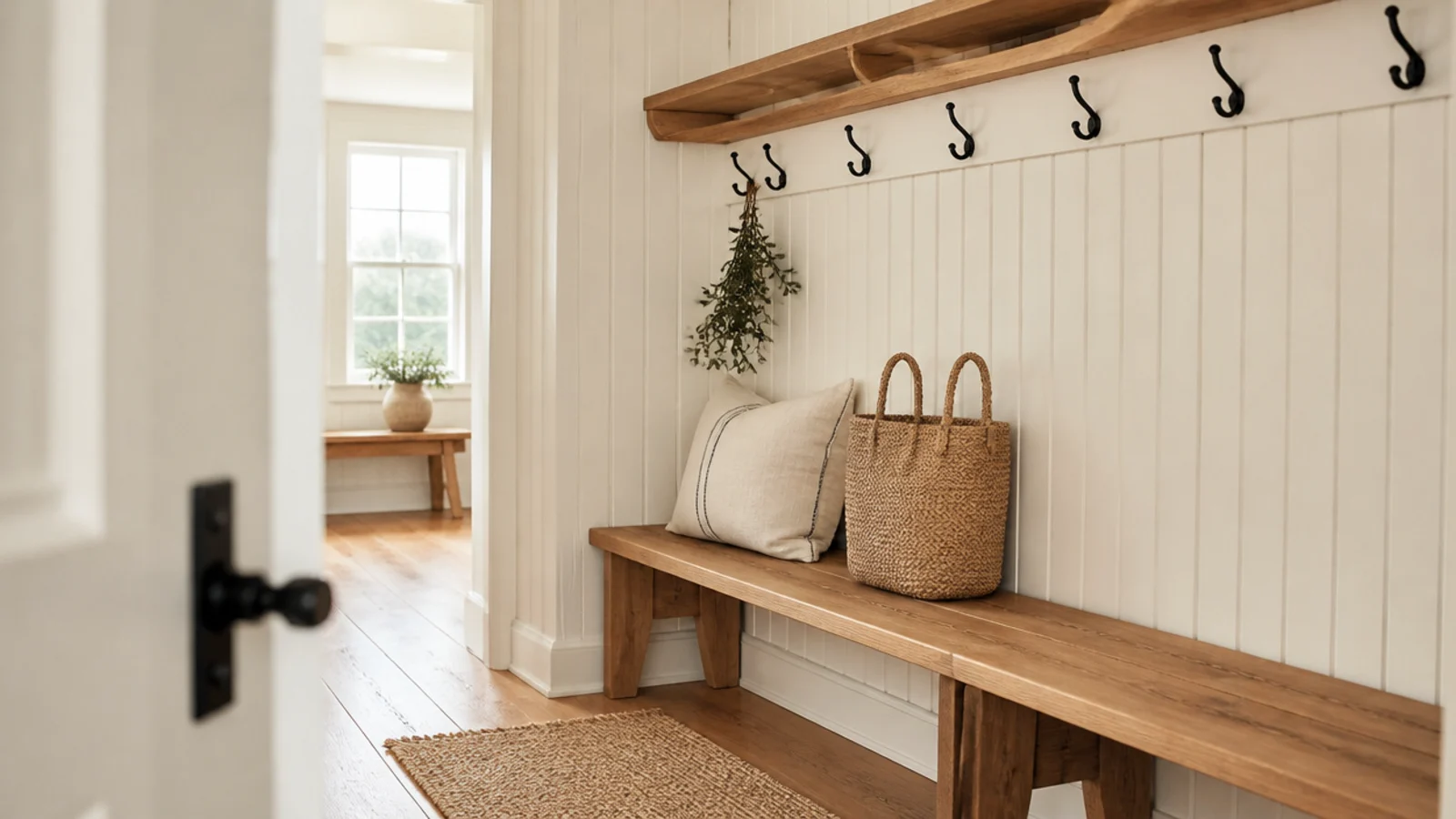
30. Let one thing be genuinely old
Buy one real antique and let everything else be plain and new. A worn milking stool, an old crock or a set of glass doorknobs carries the entire look.
New distressed furniture reads as new distressed furniture from across a room, every time. One genuinely old object costs less than most of them anyway. For the underlying heights and clearances, fifteen entryway ideas has the numbers. $–$$
Mistakes to Skip
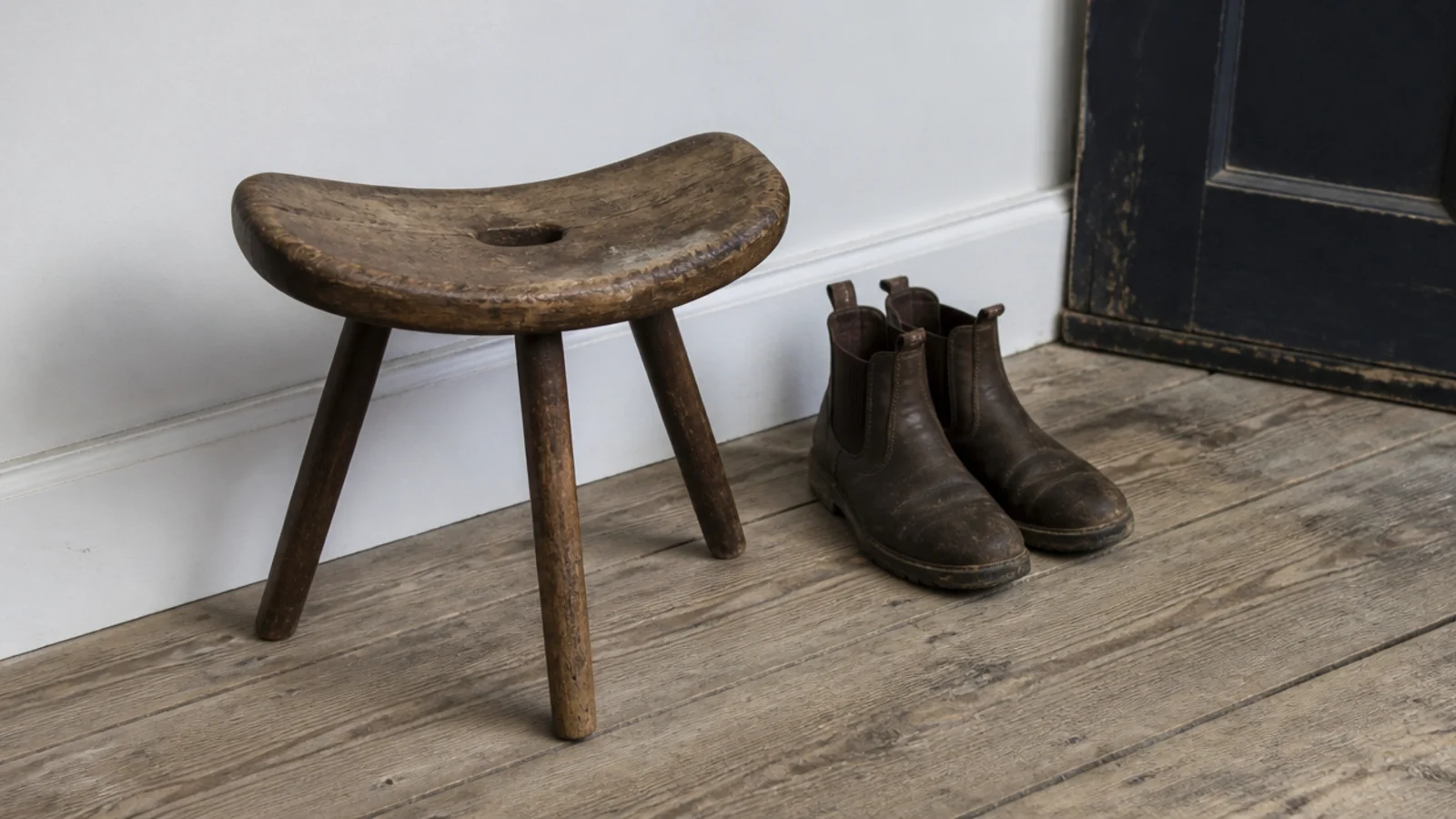
- Buying new distressed furniture. It reads as new distressed furniture from across the room, and a genuinely old piece usually costs less at a flea market.
- Painting the walls cool grey. It fights every warm wood tone in the space, and it is the single most common reason a farmhouse entry looks flat in photos.
- Choosing closed shoe storage for a household with children. Every door is a step people skip, and shoes pile up beside a beautiful empty cabinet.
Frequently asked questions
What makes an entryway look farmhouse?
Worn wood, simple utilitarian hardware and honest storage, in that order. A shaker peg rail, a bench with a real patina and baskets that get used every day do more than any decorative sign. The style comes from things that look used rather than from motifs, which is why one genuinely old object beats ten new ones.
How high should a farmhouse peg rail go?
Fifty-two inches from the floor for adults, with a second rail at 40 inches if there are children. If you are running beadboard or shiplap beneath it, cap the panelling at 48 to 52 inches and mount the rail on the cap so the two lines relate. That relationship is what makes it look built rather than added.
Does farmhouse style work in a small entryway?
Very well, because the core pieces are shallow. A peg rail projects about 2 inches, beadboard adds half an inch, and a wall-mounted shelf can be 6 inches deep. Skip the bench if your walkway clearance is under 36 inches and put a single stool at 18 inches high instead.
What colours suit a farmhouse entryway?
Three tones is the ceiling: a warm white or soft greige on the walls, one wood tone, and black or oil-rubbed bronze hardware. Adding a fourth colour is where farmhouse entries start to look like a theme. If you want more depth, paint the panelling a muted sage or clay and keep everything else neutral.
How do I get farmhouse style without it looking staged?
Buy fewer things and let one of them be genuinely old. A real worn bench, an antique doorknob turned into a hook or a chipped enamel crock carries the look on its own. Skip anything with a printed word on it — the moment an entry starts explaining itself it stops feeling like a home.
Start with the peg rail, the bench and one honestly old thing, and the rest can arrive slowly over years — which is how these entries are supposed to come together anyway. For the surface styling, entryway table decor covers trays, bowls and ratios, and entryway wall decor handles what belongs above the pegs. Save the pin so the heights are with you at the next flea market.
Want more like this? Browse all 15 entryway & foyer ideas guides — they all use the same measurements and budget tiers.
Pin it for later
Save this to your Entryway & Foyer Ideas board
Pin it now so it is waiting for you when the tape measure comes out — and so the next person hunting for this idea can find it too.
Save this pinKeep going
More ideas worth saving while you have the tape measure out.