Living Room Built-In Shelves · Review
25 Best Living Room Built-Ins Picks Worth Buying

Some links on this page may become affiliate links in future. I only recommend pieces I would put in my own home — see the affiliate disclosure.
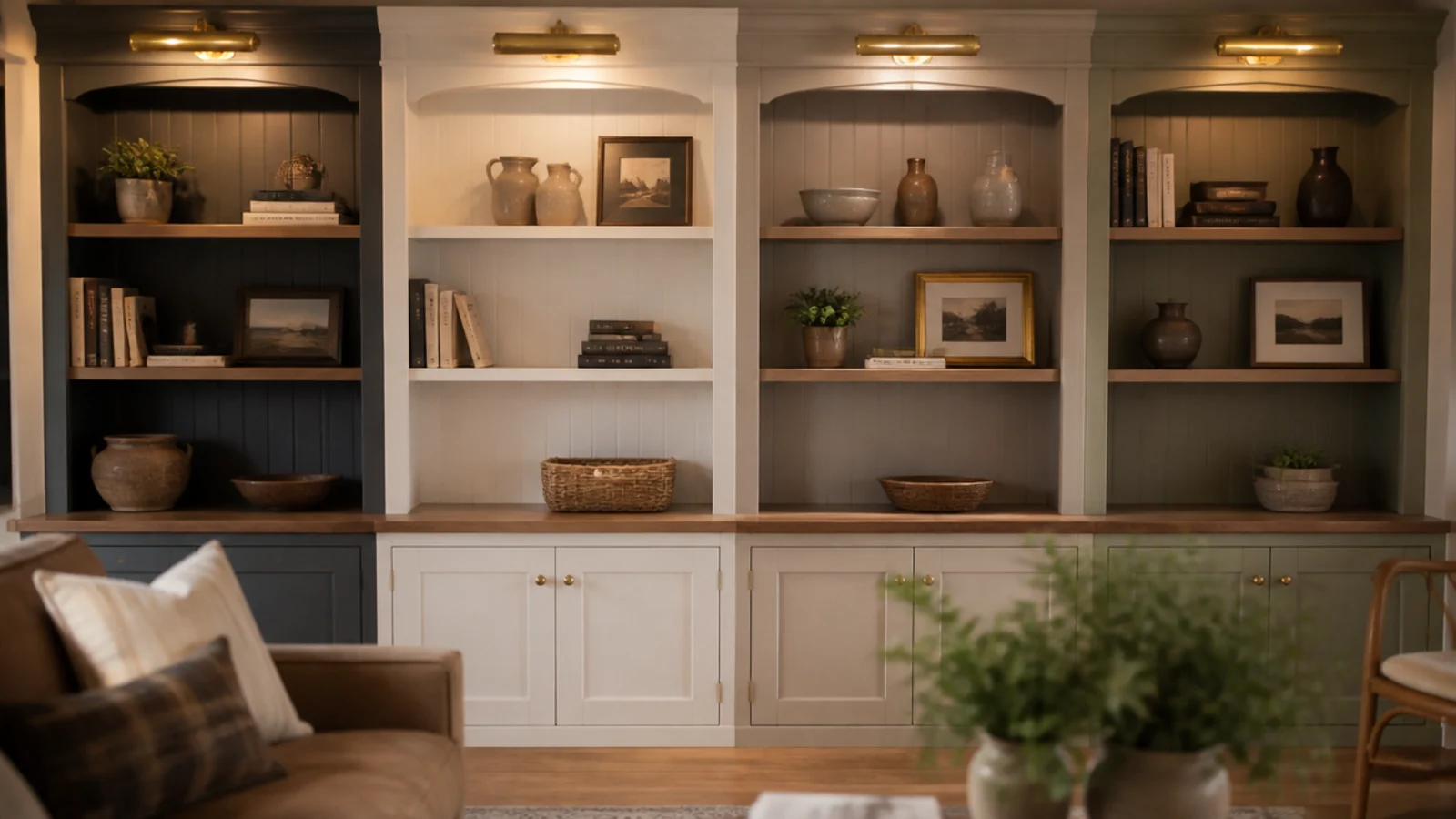
The best built in shelf styling tips are wasted on a shelf that is nine inches deep or bowing in the middle, which is why this list starts with structure and works up to the pretty things. I have built, trimmed and restyled shelving in four living rooms and a long list of other people's. Below is every category worth spending on, compared honestly, plus the eight I buy every time.
In this guide11 sections — tap to openHide
- 1.How I Chose the Best Built-In Shelf Styling Tips and Picks
- 2.The Full Comparison: 25 Living Room Built-In Picks
- 3.The shaker-front base cabinet with an adjustable upper
- 4.The freestanding bookcase pair sized for trimming in
- 5.Solid shelf boards at 11.25 inches
- 6.The one-by-two face frame and front lip
- 7.The rechargeable brass picture light
- 8.The oak worktop offcut counter
- 9.Aged brass pulls and soft-close hinges
- 10.Paintable caulk, filler and a scribe strip
- 11.What to Check Before You Buy
How I Chose the Best Built-In Shelf Styling Tips and Picks
I judged every category on five things, in this order.
- Does it fix a structural problem or a visual one? Structural first, always. Depth, span and spacing decide what a wall can hold, and nothing decorative rescues a shelf that sags or a bay nothing fits into.
- Cost per unit of change. Sixty dollars of baseboard and face frame changes whether a bookcase reads as furniture or as joinery. Sixty dollars of pottery changes almost nothing. I weighted that ratio heavily.
- Reversibility. How much of it survives a move, and how many holes it leaves. Trim pinned to the unit travels with you; trim pinned to the wall does not.
- Whether it still works in year three. Open shelving photographs beautifully on day one and quietly fills with routers and paperwork. Closed base storage is the category that keeps performing.
- Whether the numbers are honest. Three-quarter-inch plywood sags past a 32-inch span under books, no matter what the product page says about load rating.
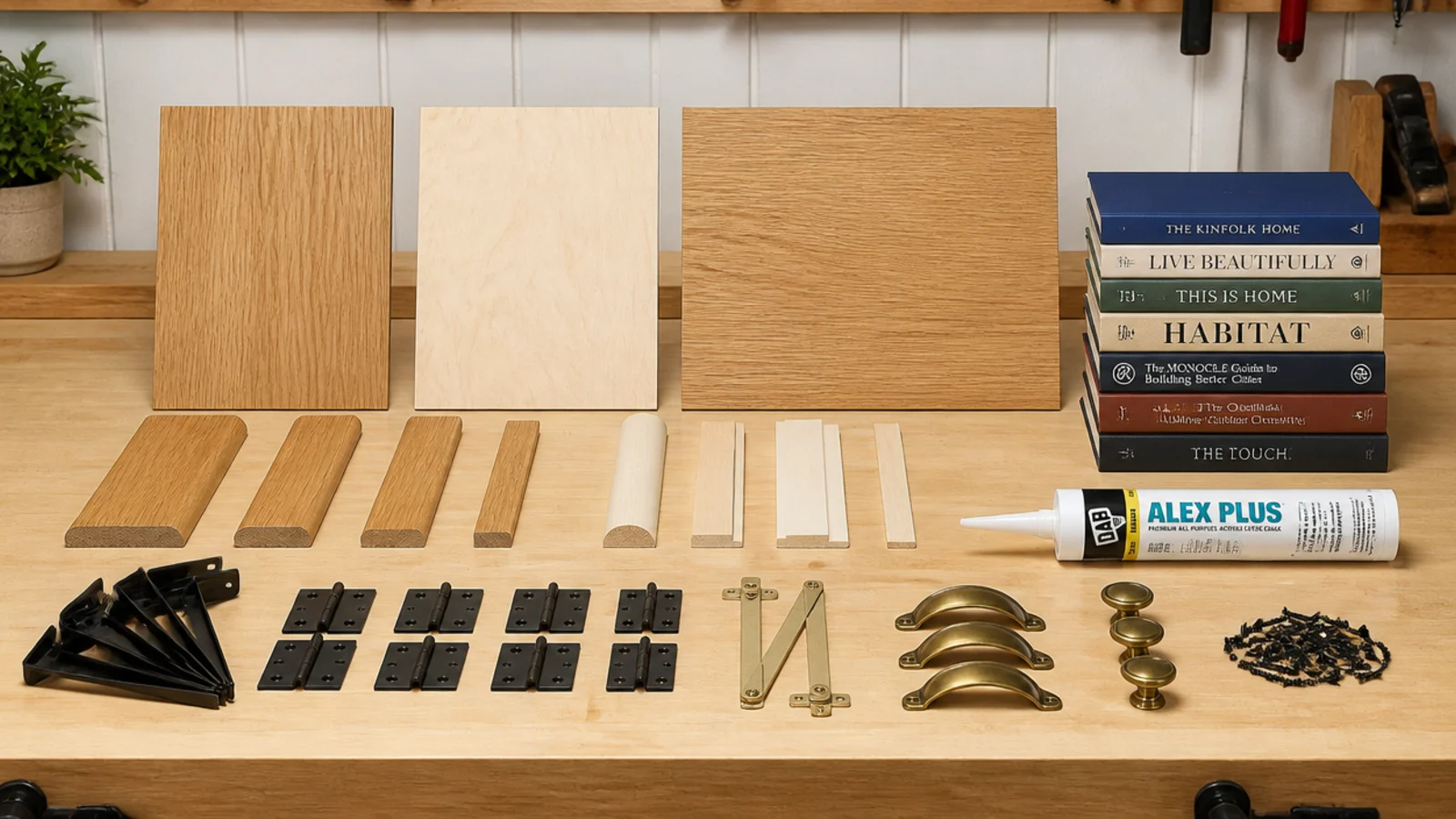
Everything is described by type and construction rather than by product name, because the same build shows up under a dozen labels at Target, IKEA, Wayfair, Amazon, Home Depot and the local salvage yard. The construction is what you are actually paying for.
The Full Comparison: 25 Living Room Built-In Picks
Price tiers: $ under $50 · $$ $50–$150 · $$$ $150+. Depths assume a living room rather than a hallway.
| Pick | Best for | Price | Why it wins |
|---|---|---|---|
| Shaker-front base cabinet with adjustable upper | The default built-in bay | $$$ | Closed storage below, flexible shelving above |
| Slab-front media base with vented door | Televisions and receivers | $$$ | 16 inches deep, airflow built into the door |
| Full-height painted bookcase tower | Serious book storage | $$$ | Floor to ceiling reads as architecture |
| Freestanding bookcase pair for trimming in | Renters and tight budgets | $$ | Cheap carcass, all the money goes into trim |
| Solid shelf boards at 11.25 inches | Book shelving anywhere | $ | Exact book depth straight off the rack |
| Three-quarter-inch birch plywood sheet | Wide custom runs | $$ | Cheapest square footage once cut to size |
| One-by-two poplar face frame stock | Every shelf front edge | $ | Hides plywood edges and triples stiffness |
| Pre-primed baseboard matched to the room | Killing the furniture toe gap | $ | Continuity with existing trim sells the illusion |
| Slim cove moulding for the ceiling line | Closing the gap at the top | $ | Removes the loudest DIY tell there is |
| Shiplap or beadboard back panelling | Farmhouse and cottage rooms | $ | Texture that hides behind books and objects |
| Metal shelf standards and clip brackets | Adjustable shelving without a jig | $ | Move shelves in seconds, no drilling |
| Shelf pin drilling jig | Clean concealed adjustability | $ | Forty aligned holes without measuring each |
| Levelling feet and hardwood shims | Uneven old floors | $ | A quarter inch of lean shows badly across a run |
| Anti-tip brackets and straps | Any tall unit, always | $ | One screw against a bookcase tipping forward |
| Toggle bolts and structural screws | Drywall without studs | $ | 25 to 35 pounds each versus 10 for plastic plugs |
| Rechargeable brass picture light | Dark corners and rentals | $ | Warm light with no wiring and no holes |
| Warm 2700K LED strip with diffuser | Continuous shelf lighting | $ | Even wash instead of visible hot dots |
| Soft-close European hinges | Retrofitting flat-pack doors | $ | Same cup hole, instantly better feel |
| Aged brass cup pulls and knobs | Painted cabinet fronts | $ | The cheapest jewelry a built-in can wear |
| Full-extension drawer runners | Deep base drawers | $ | Nothing gets lost at the back again |
| Oak worktop offcut counter | Linking two base cabinets | $$ | One continuous plank reads custom |
| Seagrass and jute storage baskets | The messy bottom shelf | $ | Matching baskets organize better than doors |
| Cable grommets and cabinet power strip | Media bays | $ | One hole per bay ends the visible tangle |
| Paintable caulk and lightweight filler | Every gap and nail hole | $ | Eight dollars decides bought versus built |
| Peel-and-stick shaker door trim kit | Upgrading slab doors | $ | Shaker fronts for a fifth of the price |
Eight of those are the ones I buy on every single build.
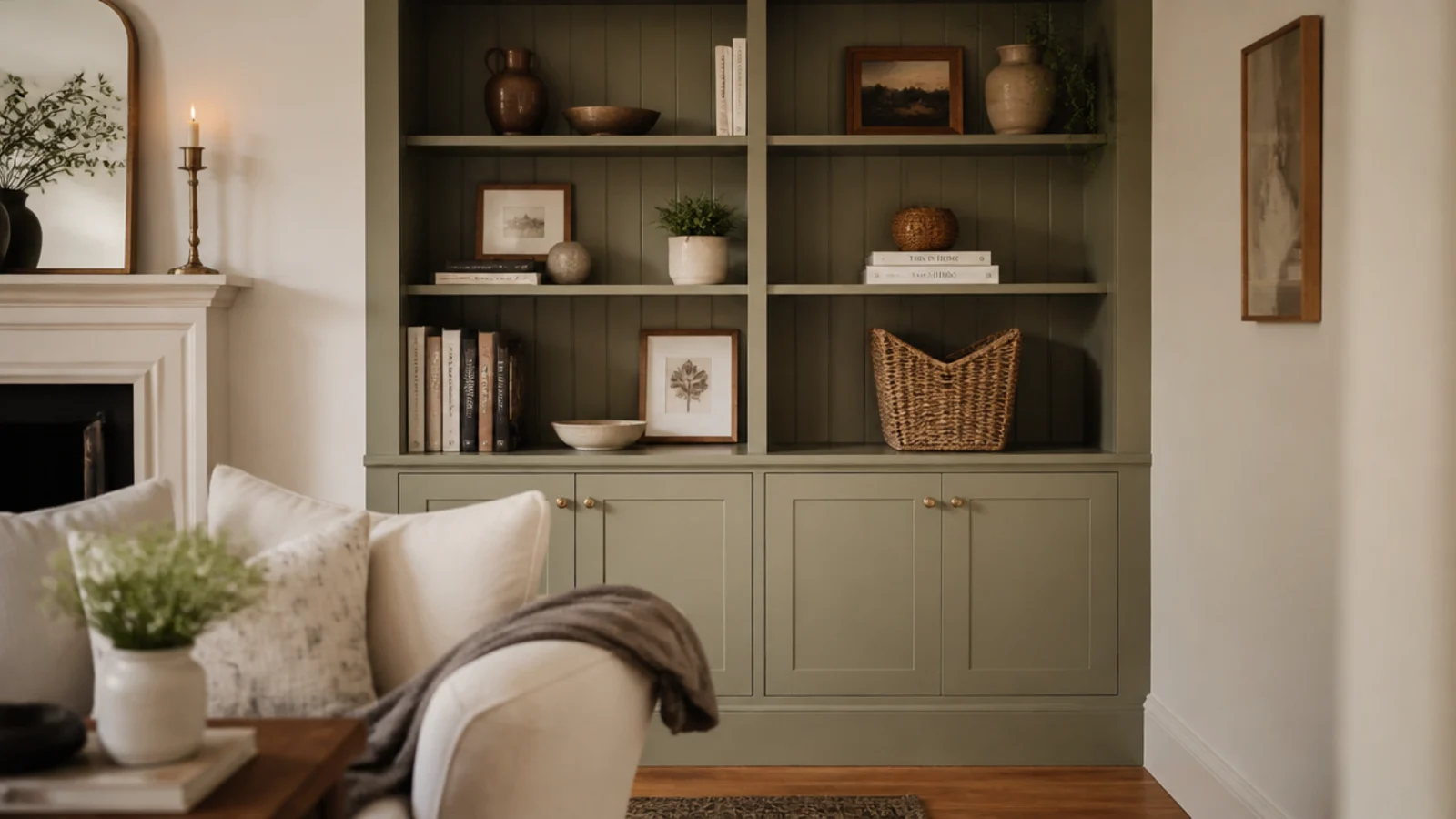
1. The shaker-front base cabinet with an adjustable upper
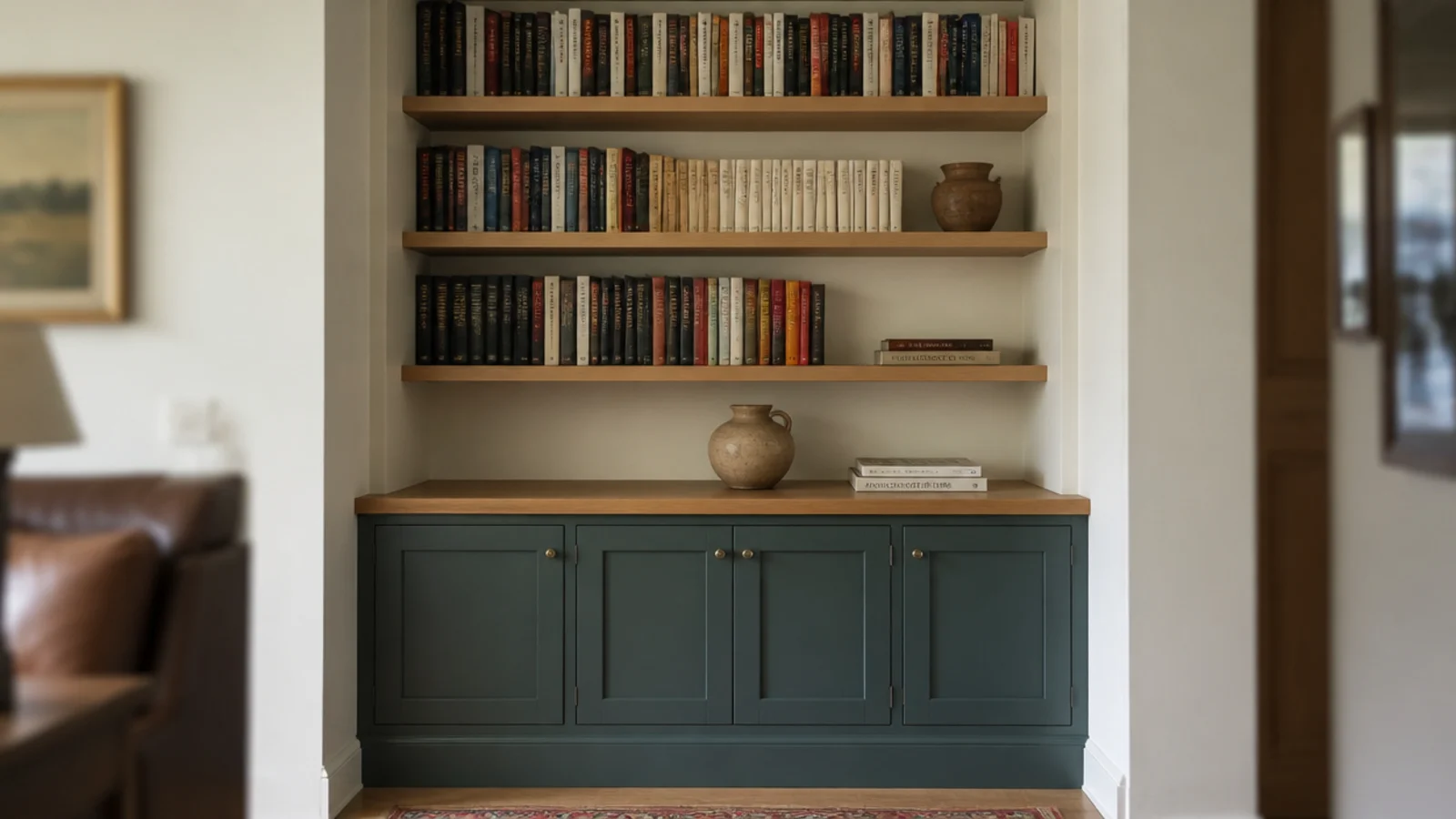
The workhorse of the whole category, and the layout I default to unless a room argues otherwise.
A base cabinet at 14 to 16 inches deep with a full-height shaker door, an oak or painted counter on top, and four adjustable shelves above at 11 to 12 inches deep. The step back between the two depths is what gives the wall a shadow line and a usable surface. Expect $250 to $400 in materials per bay, or roughly $700 to $1,200 for a flanking pair. The full cabinet layout guide covers the variations.
2. The freestanding bookcase pair sized for trimming in
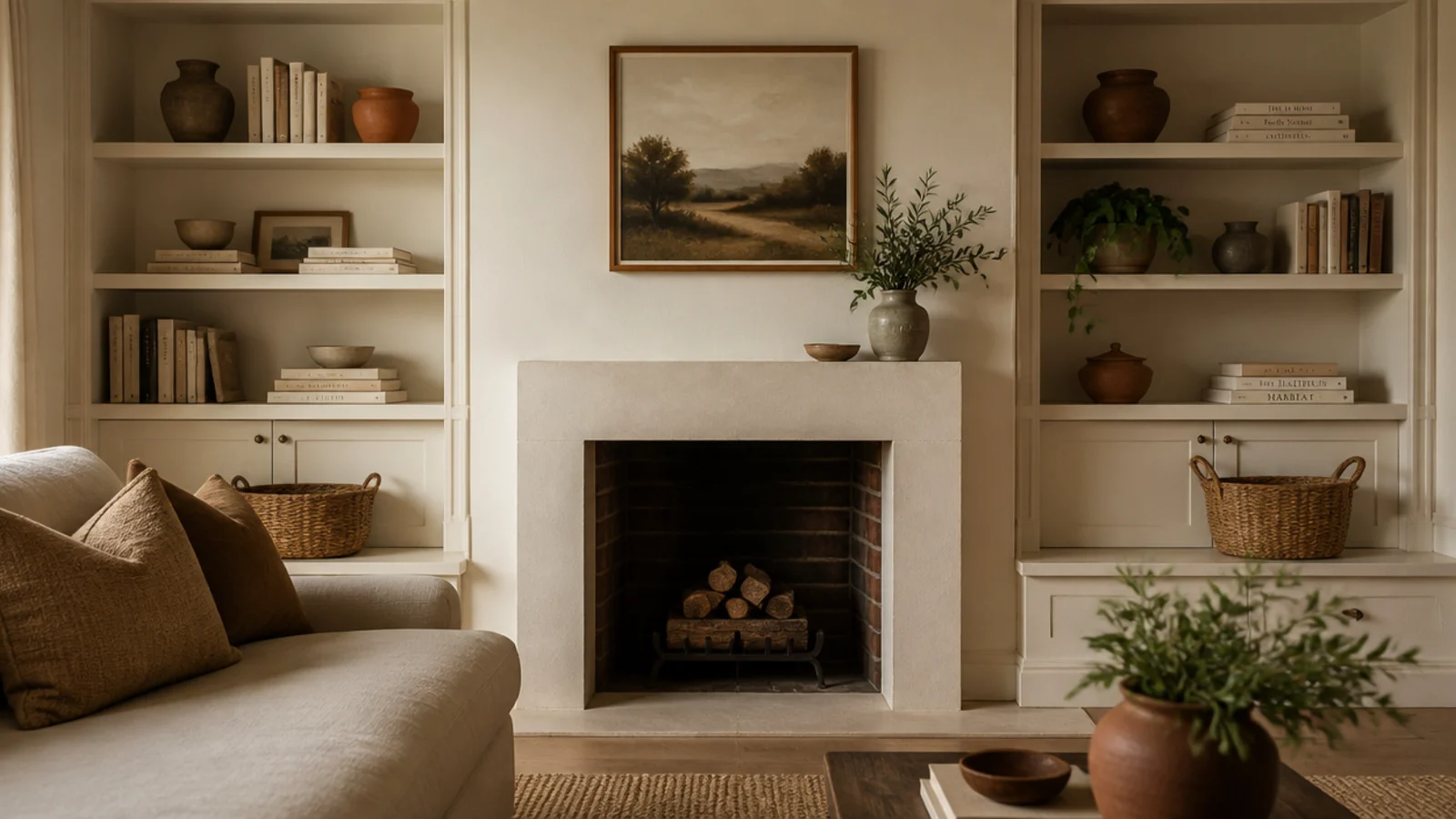
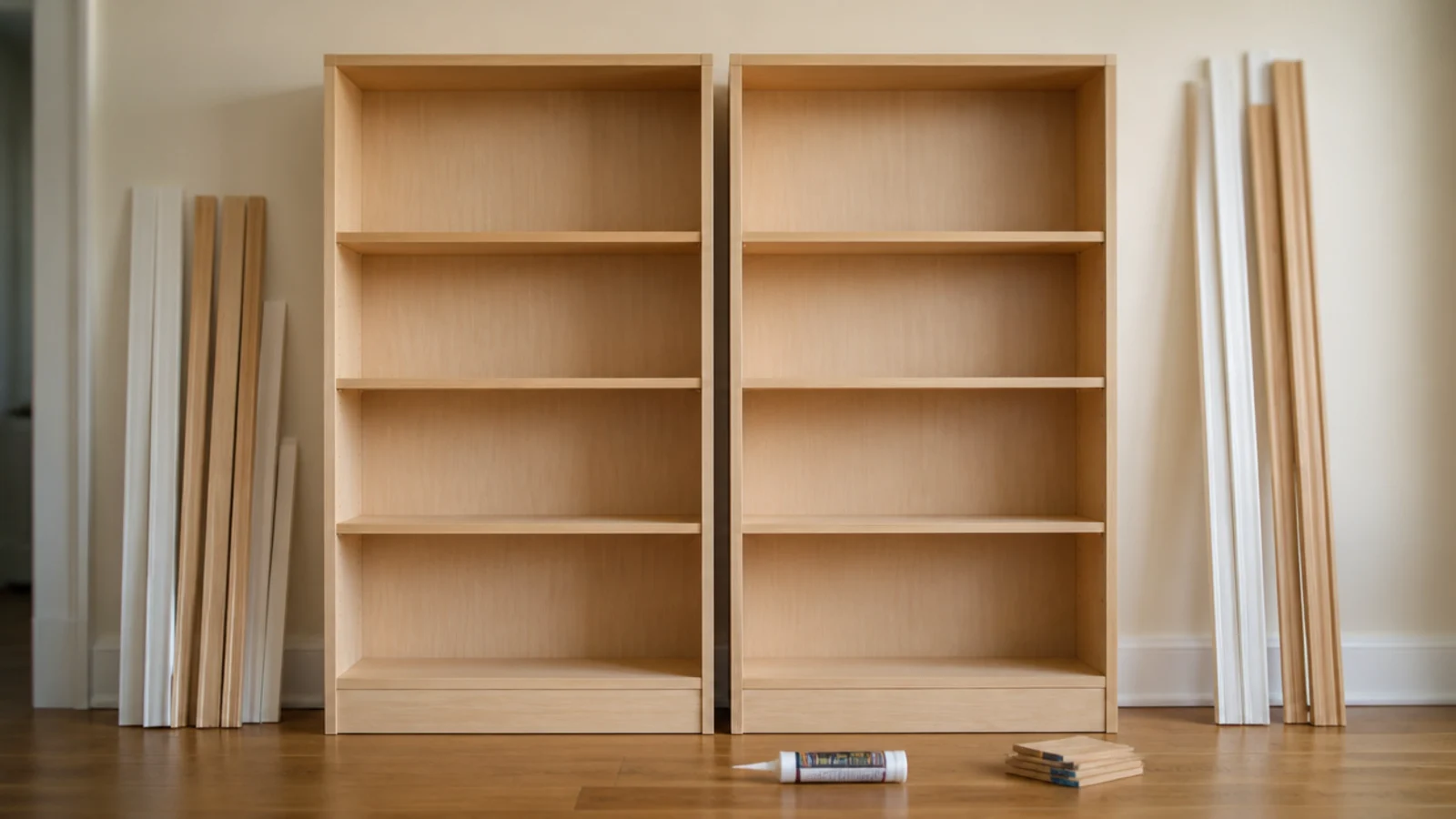
If money is tight or you rent, this is the honest answer, and it beats a mid-priced bookcase every time.
Buy the cheapest solid case with three-quarter-inch shelves you can find, then spend the difference on baseboard, face frame and cove. A $90 case plus $60 of trim reads better than a $250 case alone, because the expensive-looking parts of joinery are the joins with the room. Measure the alcove at three heights before you buy — walls commonly taper three-eighths of an inch over seven feet.
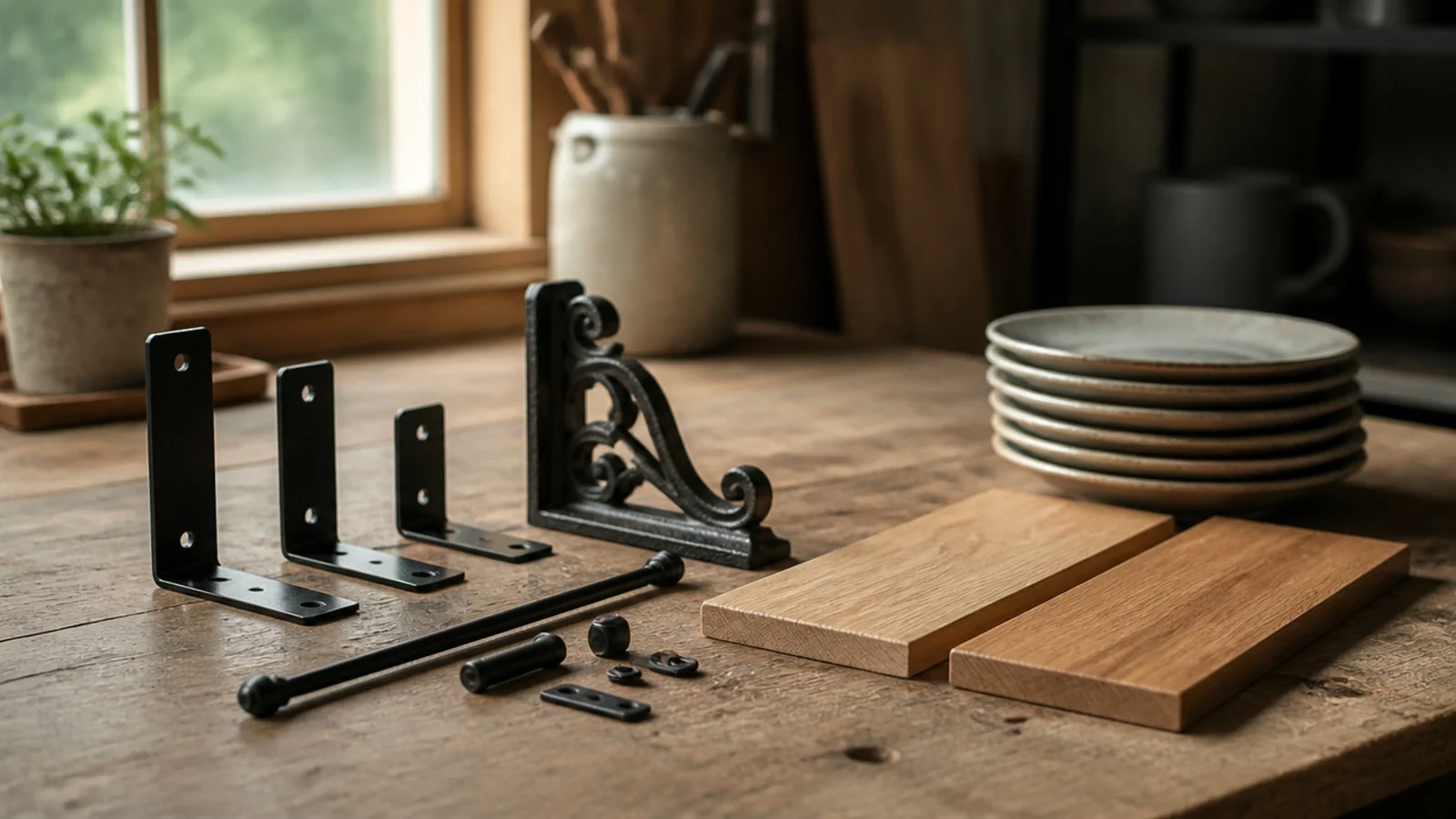
3. Solid shelf boards at 11.25 inches
Stock 1x12 comes off the rack at 11.25 inches, which is almost exactly the depth a hardback wants.
No ripping, no panel saw, no edge banding, and the front edge takes paint or oil without any preparation. Sort the stack and reject anything cupped by sighting down its length. Seal any knots with shellac primer before painting or they ghost through white within a month. Budget $18 to $30 for an eight-foot board in pine, or $40 to $70 in oak.
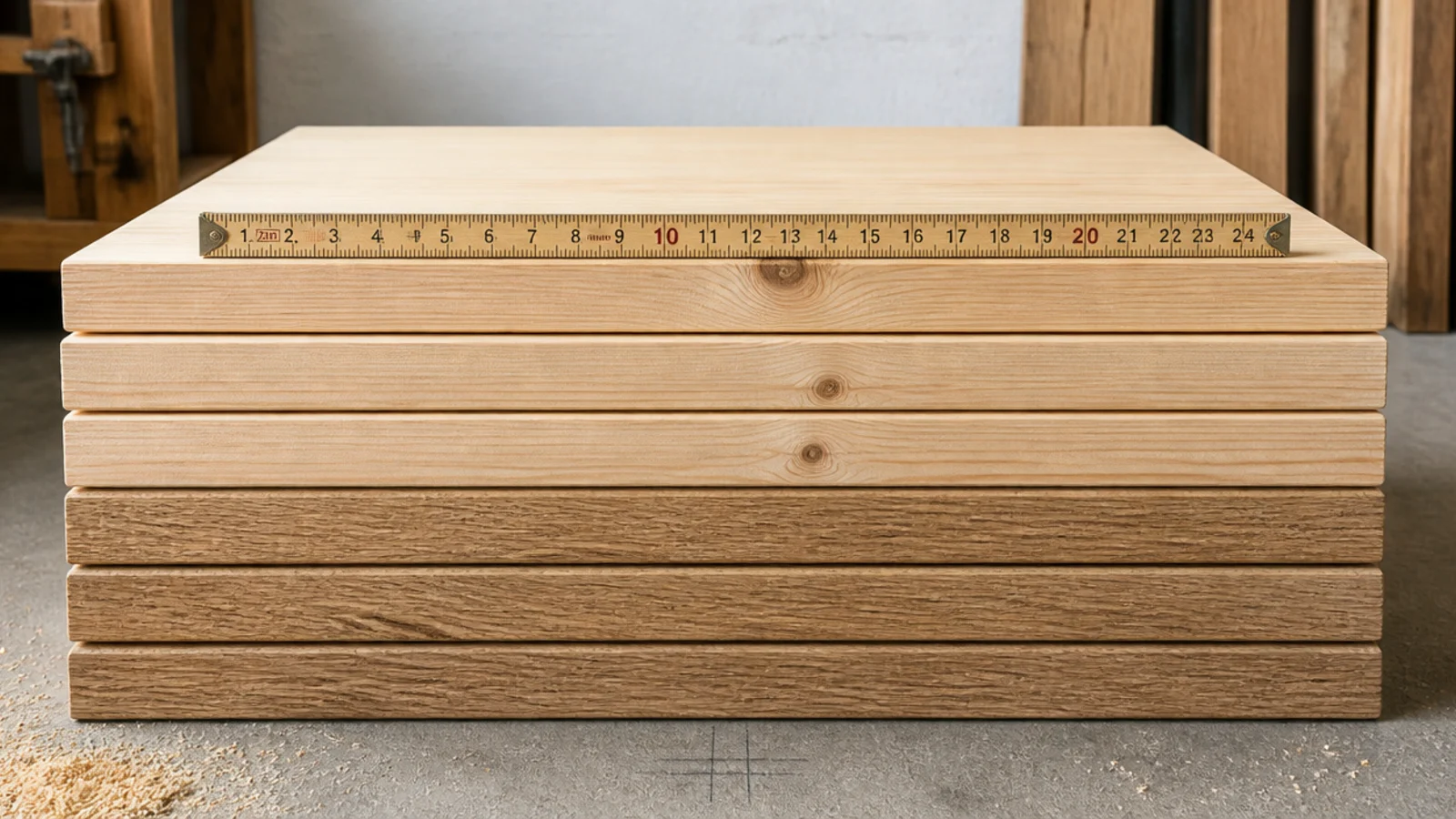
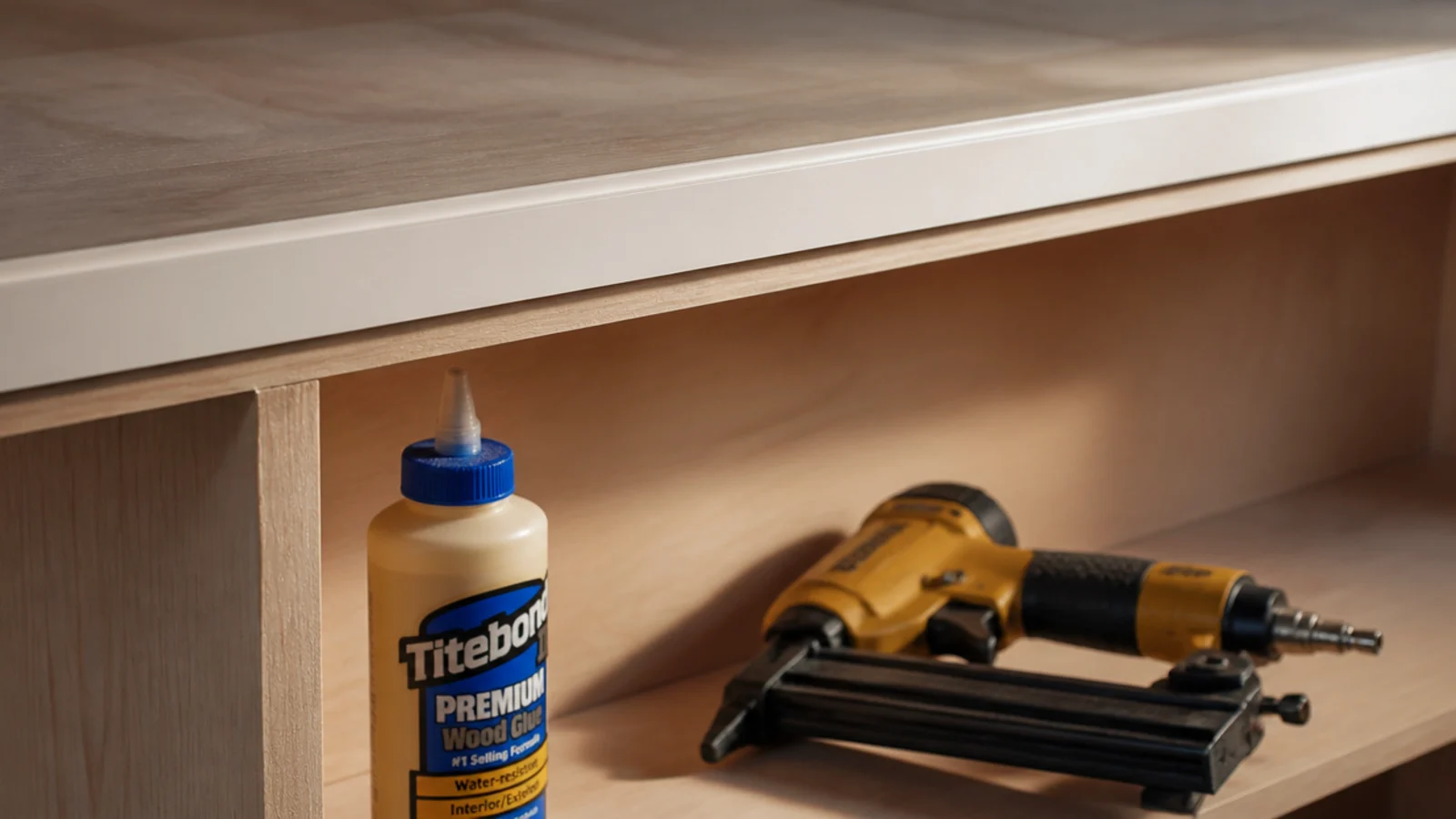
4. The one-by-two face frame and front lip
The cheapest item on this list and the one that does the most structural and visual work at once.
Glued and pinned along the front edge of every shelf, a 1x2 covers the raw plywood edge, throws a shadow line that reads as thickness, and roughly triples the stiffness of the board. That last part matters: three-quarter-inch plywood bows past a 32-inch span under books, permanently. About $4 a shelf in pine or poplar, and $25 for a five-foot run including the vertical stiles.
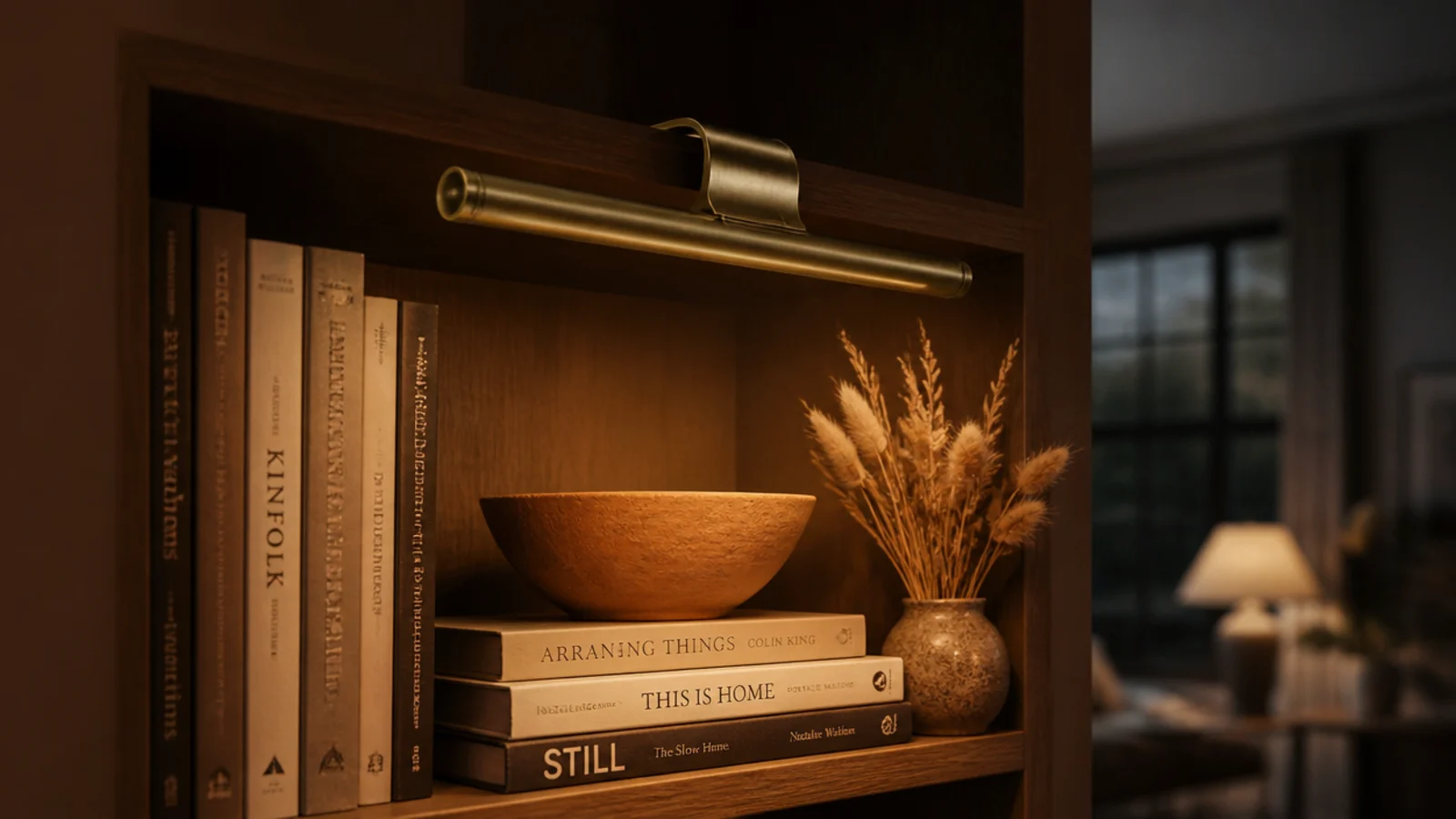
5. The rechargeable brass picture light
Wired shelf lighting means an electrician and a channel cut into the wall. A rechargeable picture light means a magnet and a USB cable.
Buy 2700K and nothing cooler — cool white turns cream paint grey and drains the warmth out of oak and clay by evening. Aim the beam down the face of the shelves rather than out into the room. Expect $20 to $40 a light and a recharge every four to six weeks. Two of these transform a dark corner more cheaply than any other purchase here.
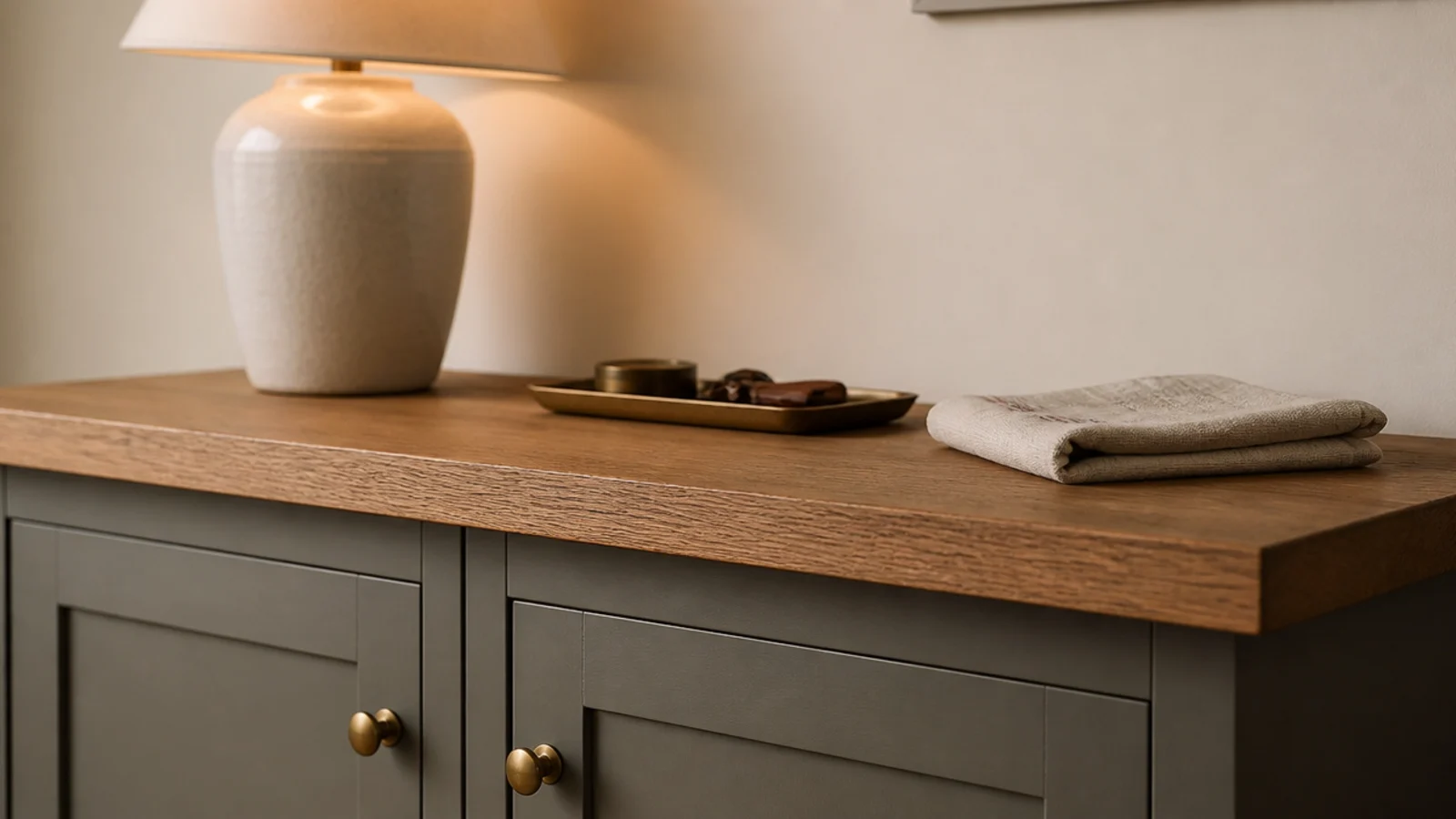
6. The oak worktop offcut counter
Countertop fabricators and home centers sell short lengths cheaply, and a two-foot piece is exactly what a built-in counter needs.
One continuous plank across the top of two base cabinets is what turns separate boxes into a single run. Overhang the fronts by three-quarters of an inch so the edge casts a shadow, and oil it twice before anything sits on it. Expect $40 to $150 depending on species and thickness. It becomes the lamp position and the place everything lands.
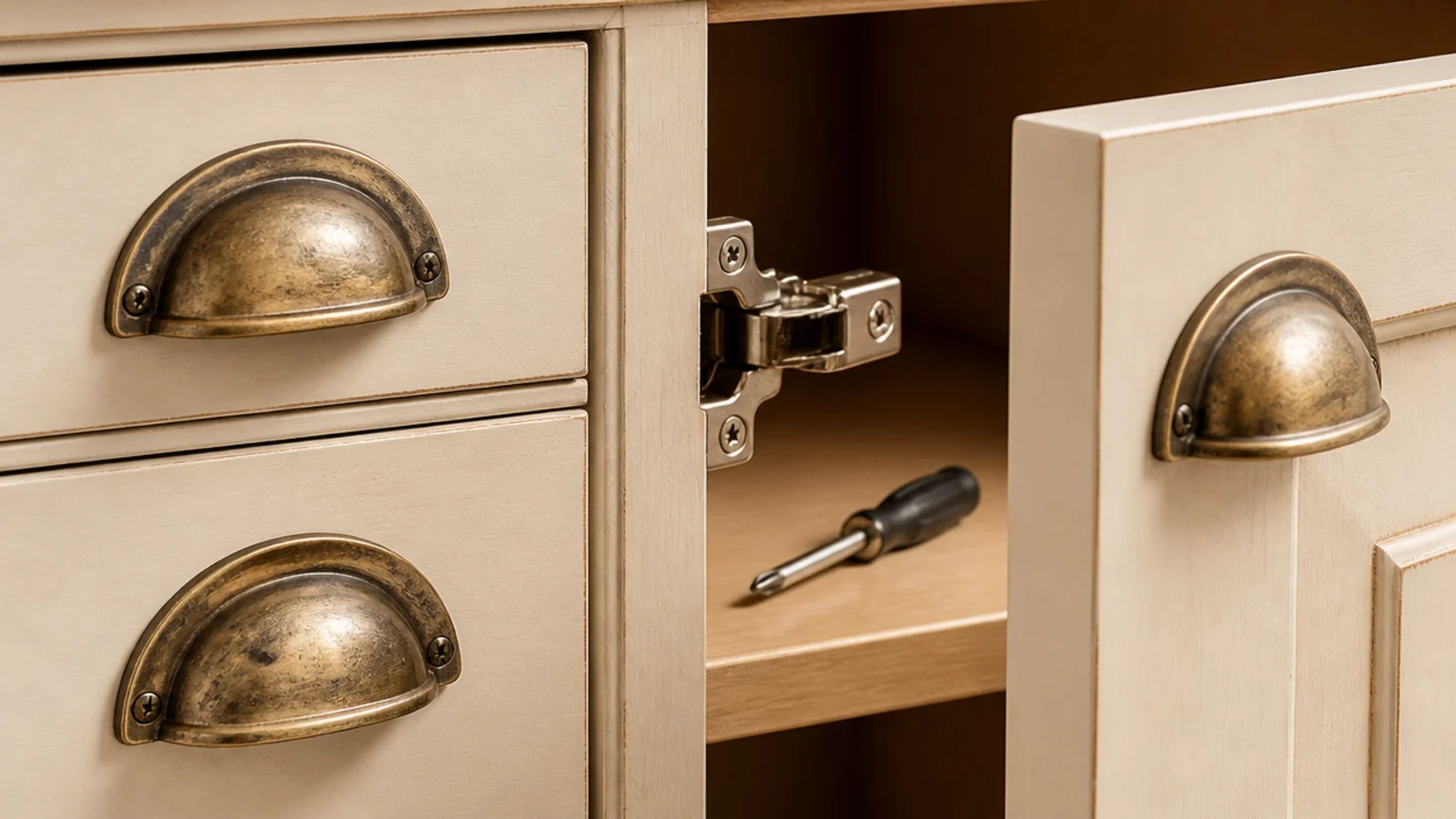
7. Aged brass pulls and soft-close hinges
Hardware is where a run of painted doors stops looking like flat-pack, and both halves of this are cheap.
Unlacquered or aged brass develops a patina rather than wearing through, and it warms painted white beautifully at $6 to $14 a piece. Soft-close hinges fit the same 35mm cup hole as standard ones at $8 to $14 a pair. Keep every visible metal on the wall in one finish, hinges included, or the run reads as assembled from spare parts rather than built.
8. Paintable caulk, filler and a scribe strip
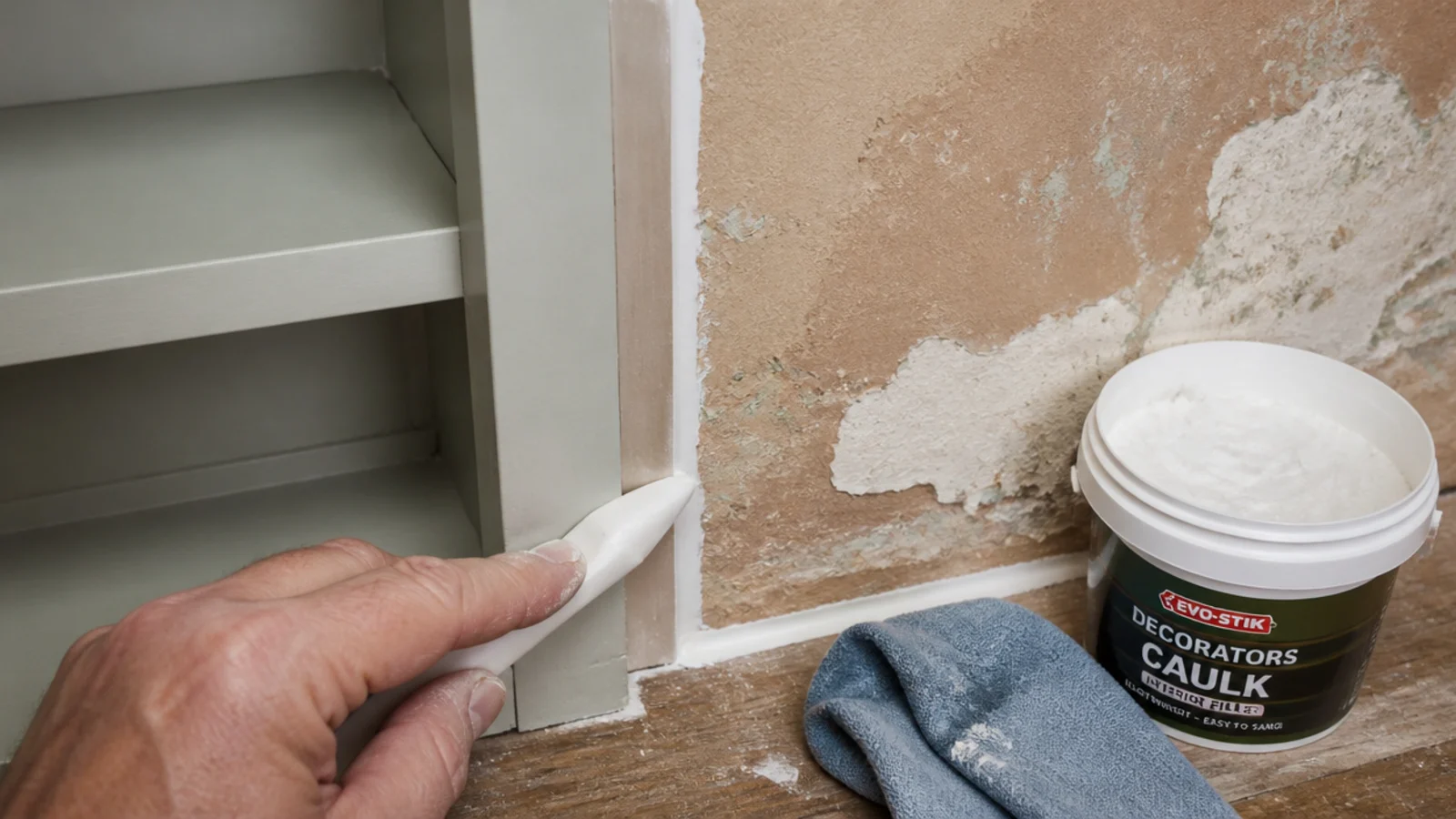
Eight dollars of consumables, and they decide whether people think the shelving came with the house.
Fill every nail hole, sand flush, then caulk every joint where the unit meets a wall, floor or ceiling. Where the wall is genuinely wavy, scribe a filler strip to follow it rather than trying to caulk a gap wider than a pencil line. Scribe and caulk every gap you can reach — an open gap is the clearest DIY tell there is, and it is also the easiest one to fix.
What to Check Before You Buy
Measure the deepest thing you own first. Receivers run 15 inches, storage baskets run 14, and a hardback runs nine. Those three numbers set your cabinet and shelf depths far better than any published standard does.
Check the shelf thickness, not the load rating. Anything under three-quarters of an inch will bow, and any span over 32 inches will bow regardless unless you add a front lip or a mid support. Load ratings on product pages assume evenly distributed weight over a short span, which is not how books work.
Look at the front edge in the photos. A visible seam where edge banding meets the face means veneer over particle board, and it chips within a year of normal use. Painted solid pine costs about the same and ages honestly.
Confirm the color temperature of any light. If the listing does not say 2700K or warm white, assume it is not, and expect every wood tone on the shelf to read grey after dark.
Map the outlets before you buy cabinets. Building a sealed carcass flat against the only socket on that wall is a mistake you discover after the caulk is dry, and it means extension leads for years.
Near a fireplace, read the appliance label. Keep combustible material at least 6 inches from the firebox opening and follow the clearance label on the appliance itself, because that label overrides any general rule.
Buy the anti-tip bracket with the bookcase. It costs about five dollars, needs one screw, and no styling decision on this page matters more than a tall loaded unit staying upright.
Frequently asked questions
What should I buy first for living room built-ins?
Trim, before anything decorative. Baseboard wrapped across the base and a face frame over the shelf edges cost about $60 and change whether the eye reads the unit as furniture or as architecture. Lighting, hardware and baskets all improve a wall that already reads as joinery, and none of them rescue one that does not.
How deep should I buy shelves for a living room?
Eleven to twelve inches for books and 14 to 16 inches for baskets, media gear or records. Stock 1x12 pine comes off the rack at 11.25 inches, which is why it suits book shelving so well. Anything under ten inches leaves hardbacks overhanging the front edge, and that reads as an error from across the room.
Are expensive shelf boards worth it over plywood?
Only where you see the edge. Solid oak or ash at three-quarters of an inch looks better than plywood and needs no edge banding, but a painted plywood shelf with a 1x2 front lip performs identically for a third of the price. Spend on the boards you leave unpainted and save on the ones you do not.
What lighting should I buy for built-in shelves?
Anything at 2700K. Warm white keeps oak, clay and cream paint reading as themselves, while cool white turns all three grey by evening. Rechargeable picture lights at $20 to $40 give almost the same result as wired fittings, and they need no electrician and leave no holes in a rental.
Do I need soft-close hinges on living room cabinets?
They are the cheapest upgrade that makes flat-pack carcasses feel expensive. They fit the same 35mm cup hole as standard hinges, so swapping them is a five-minute job per door at $8 to $14 a pair. Adjust the door after fitting, because the rear screw controls the in-and-out position most people never touch.
How much should I budget for a living room built-in wall?
Materials for a single trimmed alcove run $120 to $220. A flanking pair on flat-pack carcasses runs $250 to $450. A full wall with cabinet doors, a counter and lighting runs $1,500 and up. Quoted joinery for the same wall usually starts near $3,000, so almost every line here is worth buying rather than outsourcing.
Buy structure first and decoration last, and the wall will look finished at every stage rather than only at the end. Trim, then paint, then light, then hardware — that order has never let me down. If you want the arrangement side rather than the shopping side, built-in shelf styling covers what goes on the shelves, budget built-in shelves has the cheapest route to each step, and mirror wall decor ideas helps with the wall above a half-height run. Save the pin for the next shopping trip.
Want more like this? Browse all 15 living room built-in shelves guides — they all use the same measurements and budget tiers.
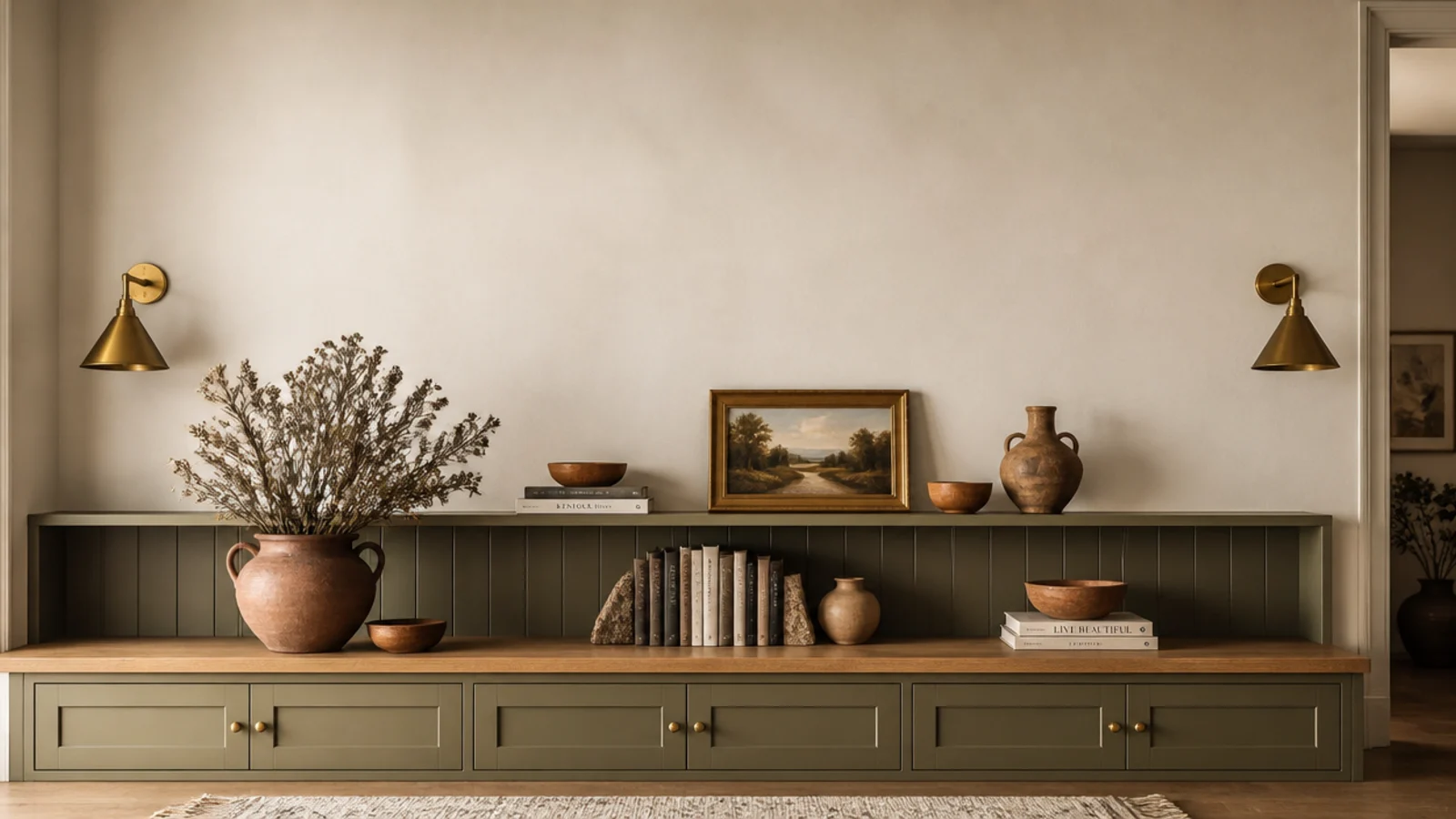
Pin it for later
Save this to your Living Room Built-In Shelves board
Pin it now so it is waiting for you when the tape measure comes out — and so the next person hunting for this idea can find it too.
Save this pinKeep going
More ideas worth saving while you have the tape measure out.