Bedside Table Ideas · Listicle
30 Stylish Bedside Table Ideas Modern Rooms Need

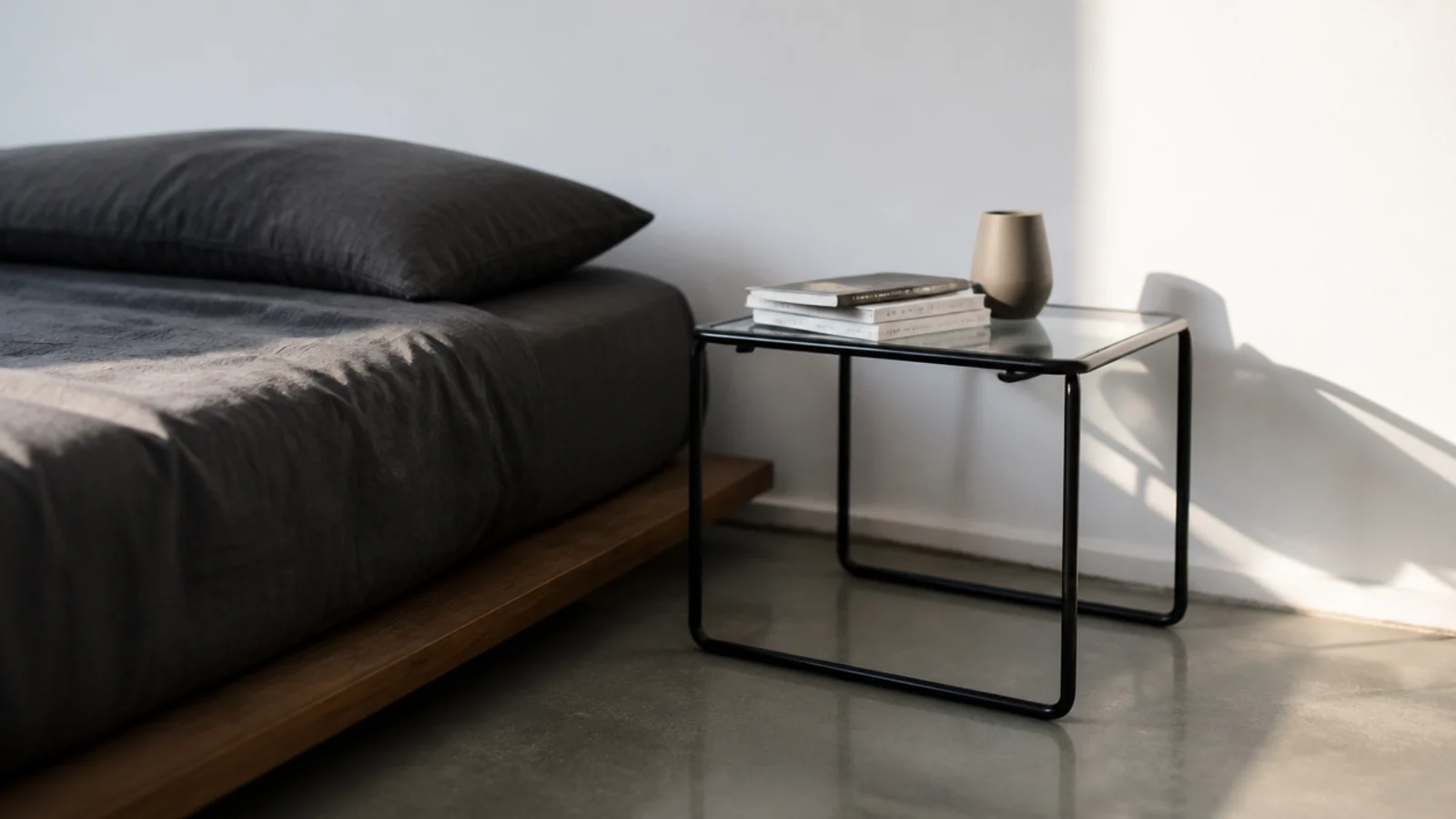
Bedside table ideas modern bedrooms get right almost always start with silhouette rather than surface. A traditional nightstand advertises its legs, its handles and its joinery; a contemporary one reads as a single volume with the hardware hidden and the cable gone. The materials that follow — steel, glass, cast stone, plywood, micro-cement — are consequences of that decision rather than the decision itself. Below are thirty details worth borrowing, with the weights, thicknesses and light outputs that matter, because a minimal object is unforgiving about the numbers.
In this guide32 sections — tap to openHide
- 1.What bedside table ideas modern rooms get right
- 2.A tube steel frame with a tempered glass shelf
- 3.A concrete cube, and the weight it actually brings
- 4.Powder-coated steel in one flat saturated colour
- 5.A seamless drum with no visible joints
- 6.Waterfall plywood with the laminations showing
- 7.A perforated metal front that hides clutter
- 8.A terrazzo top with fine aggregate
- 9.A pill-shaped top with a fifty-millimetre radius
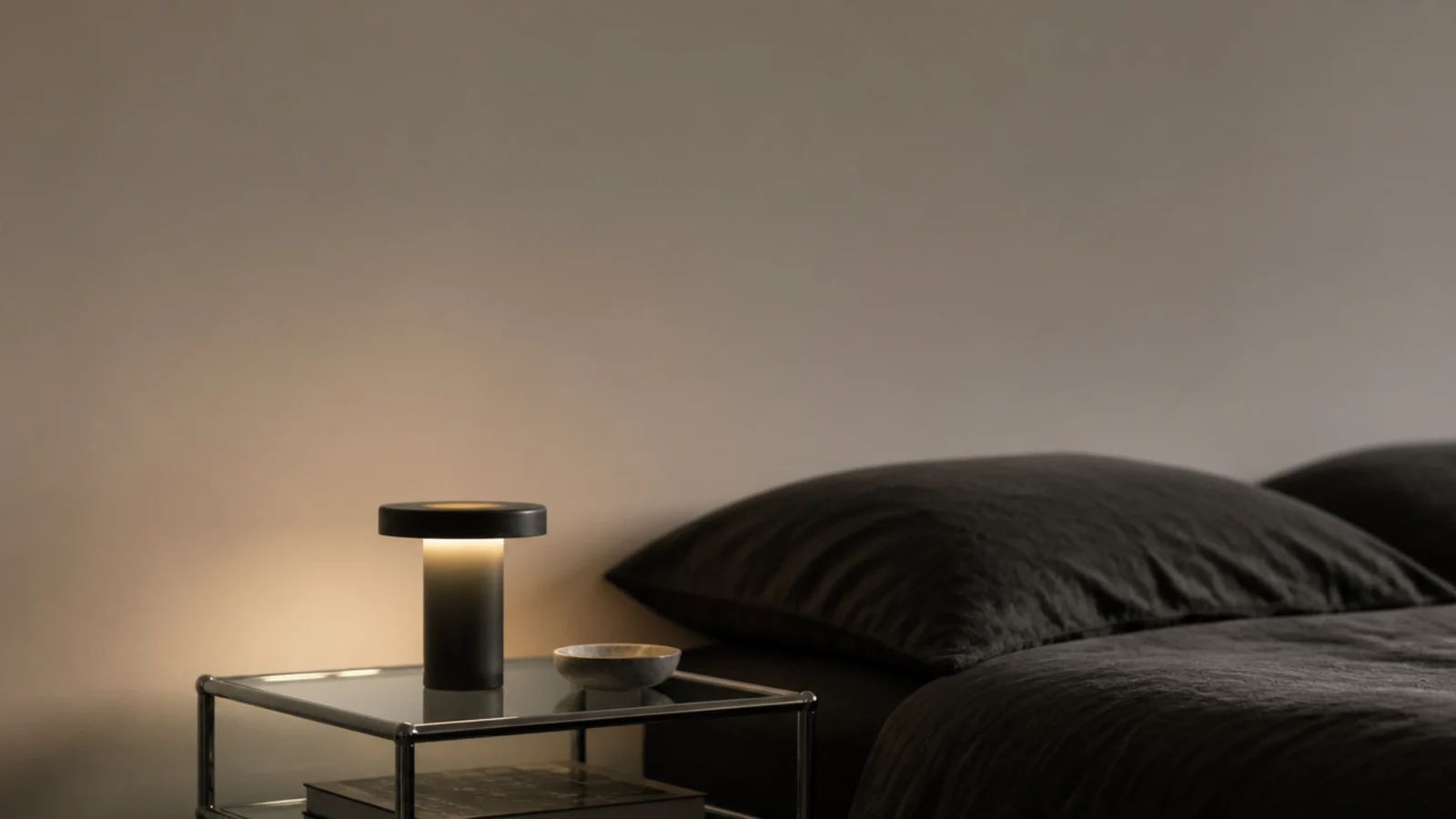
- 10.A single-tube pedestal in matte black
- 11.A charging pad routed flush into the surface
- 12.A smart bulb on a timed fade instead of a switch
- 13.Fluted glass fronts lit from behind
- 14.Two offset cylinders stacked
- 15.A micro-cement finish over a plywood carcass
- 16.Bent plywood in one continuous curve
- 17.A frosted acrylic box that glows from within
- 18.A cantilevered top on one side support
- 19.Corrugated metal wrapped around a drum
- 20.A honed black granite disc
- 21.A recessed finger channel instead of a pull
- 22.A rechargeable cordless lamp and no socket at all
- 23.A modular cube system that stacks as you need
- 24.Polished stainless for reflected light
- 25.A slatted front with eight-millimetre gaps
- 26.A wall rail with movable hooks and a tray
- 27.A recycled glass block top with visible bubbles
- 28.A stoneware pedestal fired as one piece
- 29.A boucle-wrapped drum for softness
- 30.A top that oversails the base by two inches
- 31.Strip the pair back to one horizontal and one vertical
- 32.Mistakes to Skip
What bedside table ideas modern rooms get right
Three things separate a contemporary nightstand from a plain one.
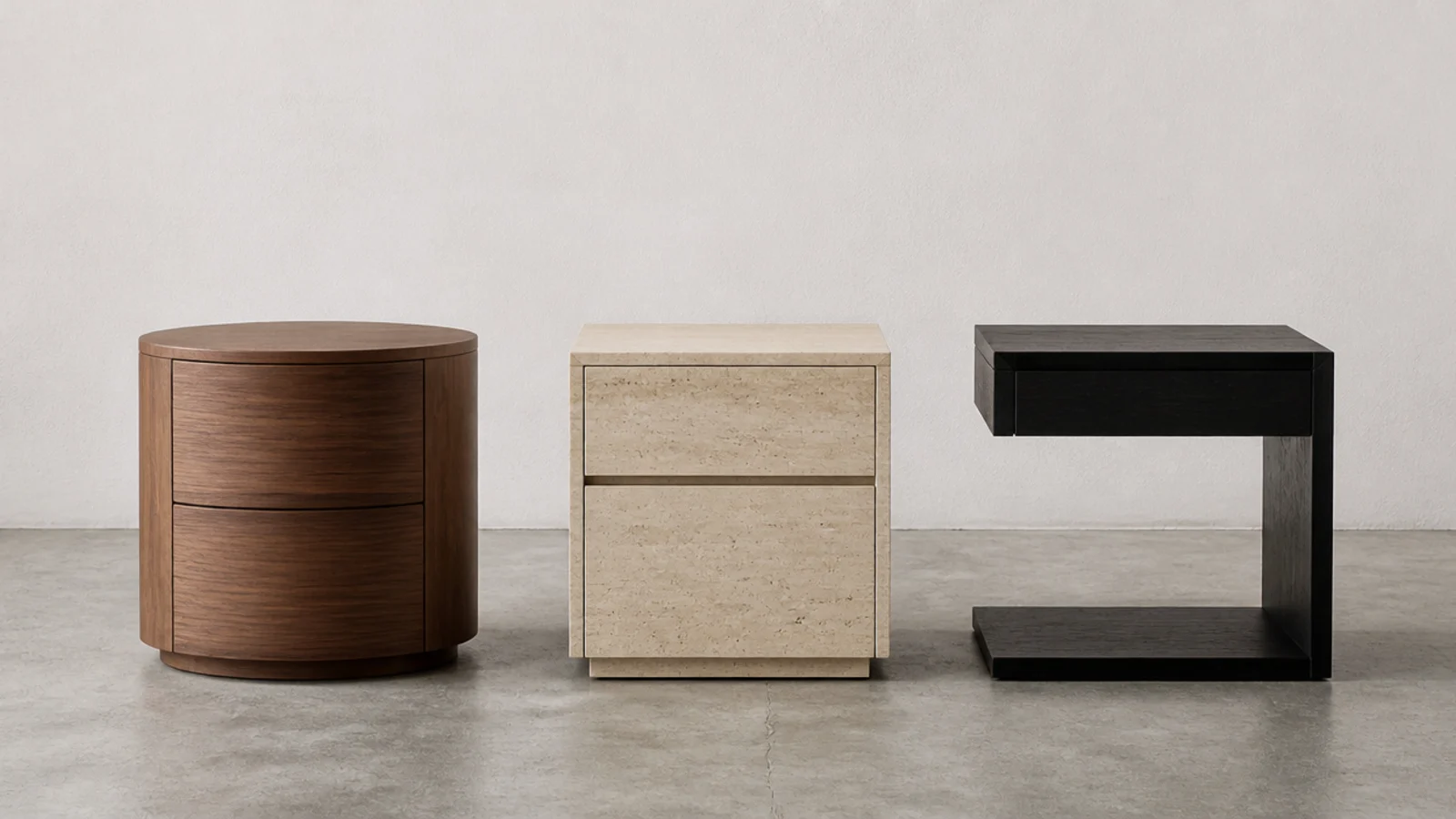
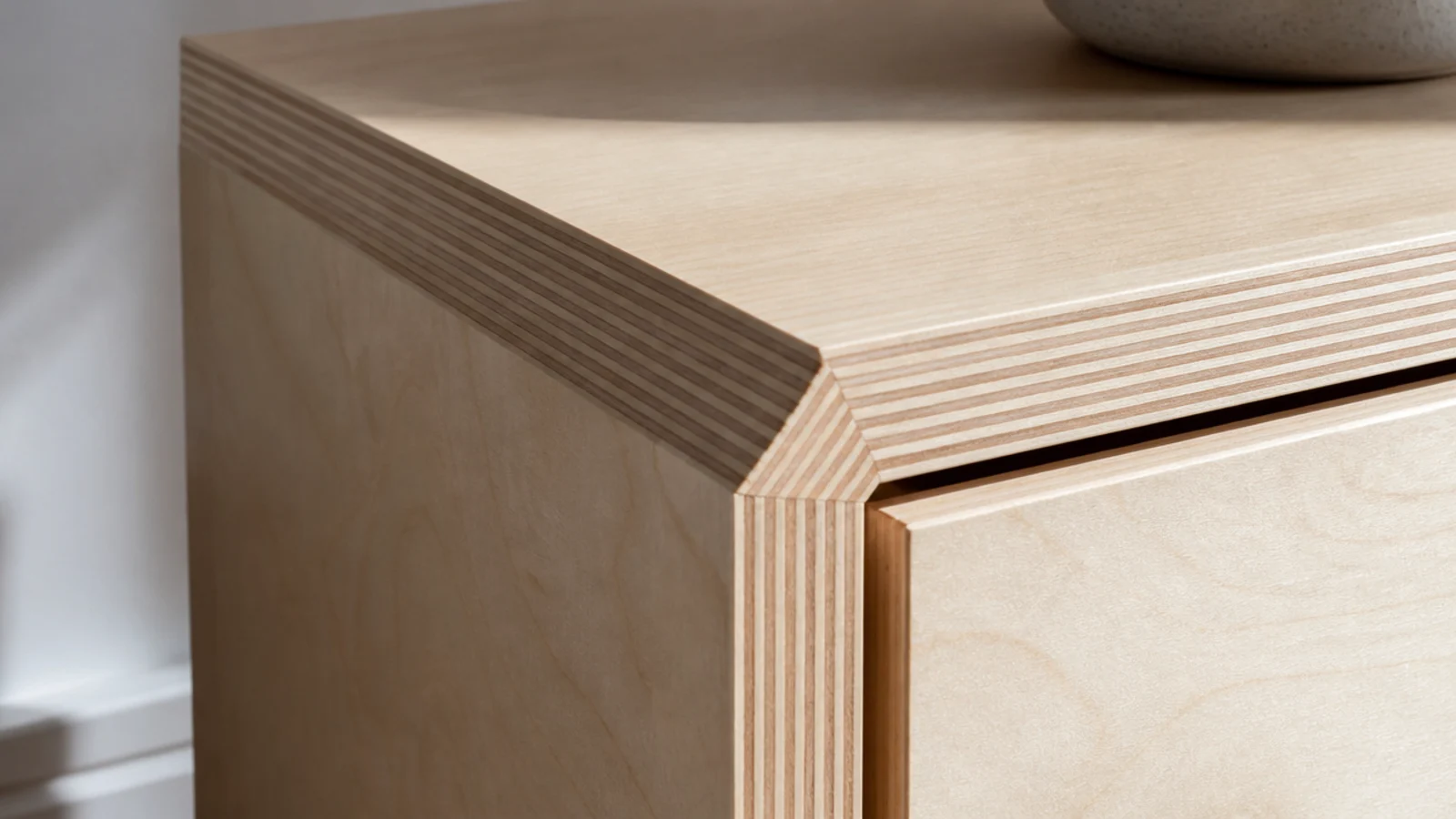
The first is continuity. Modern forms tend to be cylinders, cubes, waterfall planes or cantilevers — shapes where the eye cannot find a joint. That is why plywood is mitred at the corner so the laminations turn together, and why a drum table with a visible seam looks cheap immediately.
The second is absent hardware. Recessed finger channels, push latches and touch releases mean the front face stays uninterrupted. Where a knob does appear it is usually a single machined cylinder rather than a decorative pull.
The third is cable discipline, and it is the one people skip. A visible white flex undoes every other decision. Solve it with a cordless rechargeable lamp, a recessed charging pad, an LED strip under the lip, or a cable channel routed into the back panel — but solve it before you buy anything.
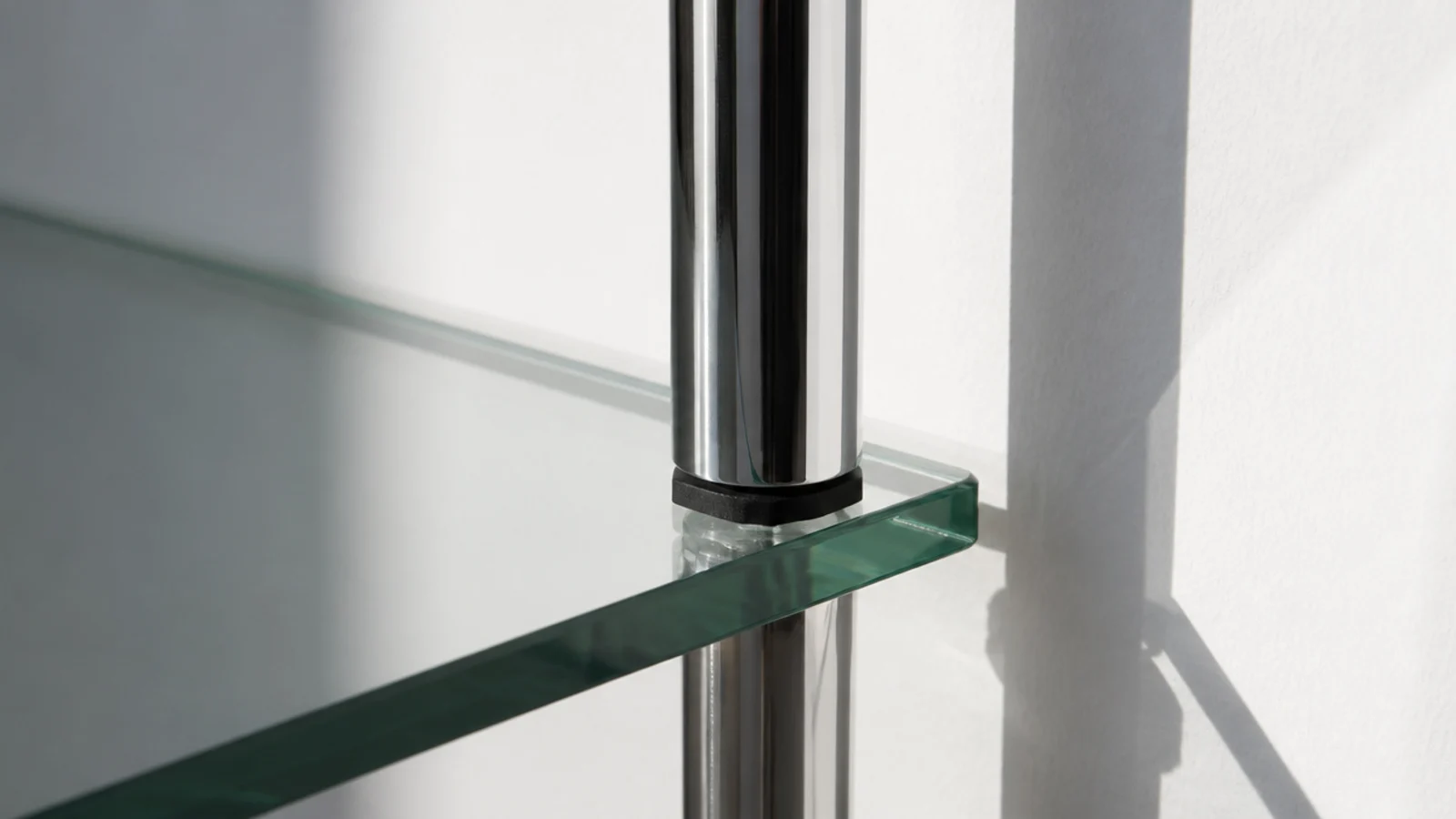
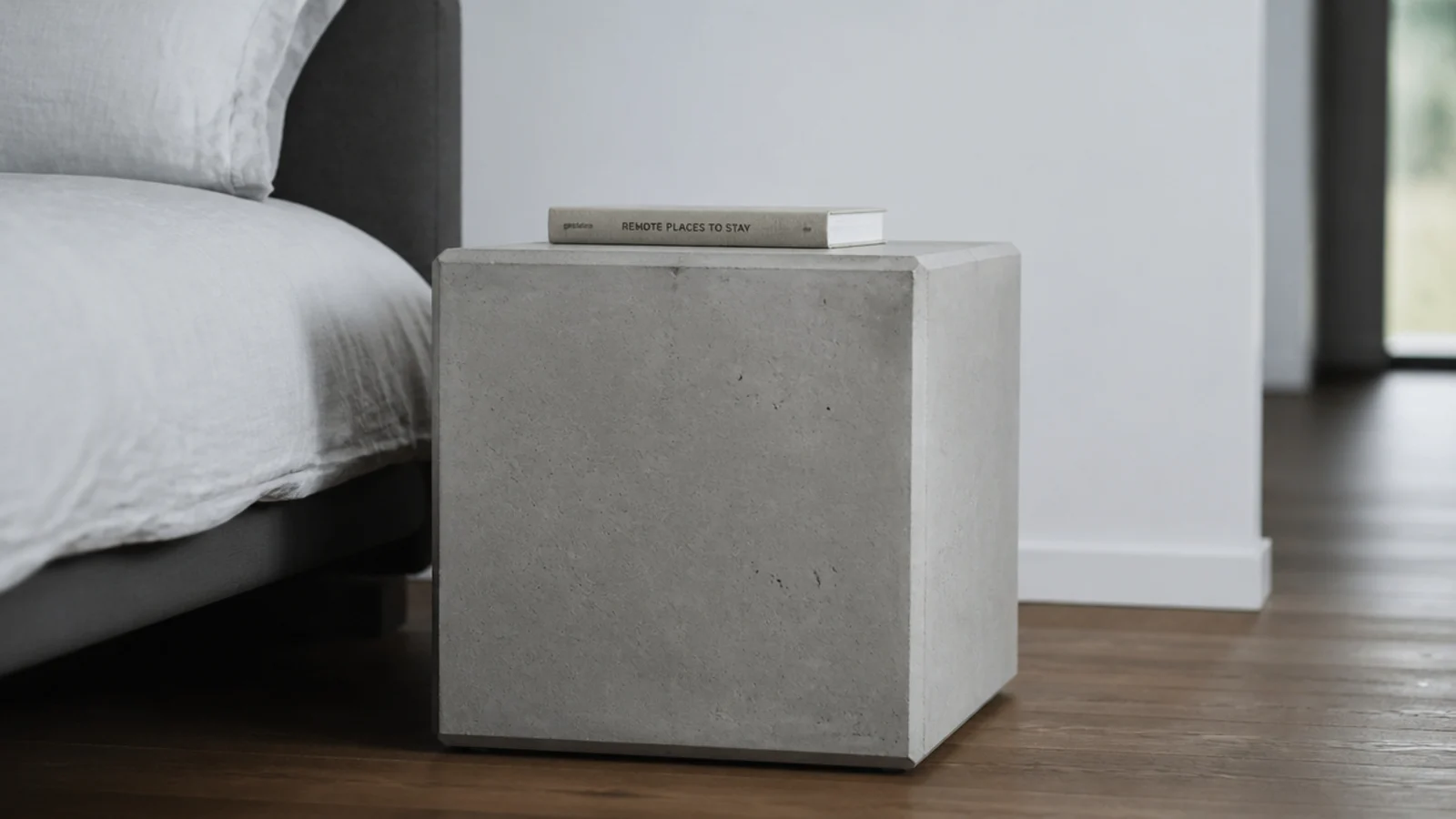
Two practical numbers to carry into a showroom. Tempered glass wants to be 10 to 12mm thick beside a bed, both for stiffness and because tempered glass fails into blunt granules rather than shards. And a genuinely solid concrete cube at 16 inches per side weighs about 250 pounds, which is a two-person lift and a real question in an upstairs flat — most retail versions are a thin shell over a light core at 25 to 60 pounds instead. Start with the core table decisions if you have not fixed the height yet.
1. A tube steel frame with a tempered glass shelf
The lightest visual footprint available. A 12mm tube steel frame and a 10mm tempered glass shelf give you a full-size surface that almost disappears in a small room, because you see the floor and the wall straight through it. Set the glass on small rubber blocks so it does not click on the steel, and expect fingerprints.
2. A concrete cube, and the weight it actually brings
Cast concrete gives a matte grey with fine pinholes that no paint replicates. Buy on weight: a shell-cast piece at 25 to 60 pounds is liveable, a solid cube is not. Seal it, because unsealed concrete stains permanently from a single glass of red wine, and put felt pads underneath before it meets a timber floor.
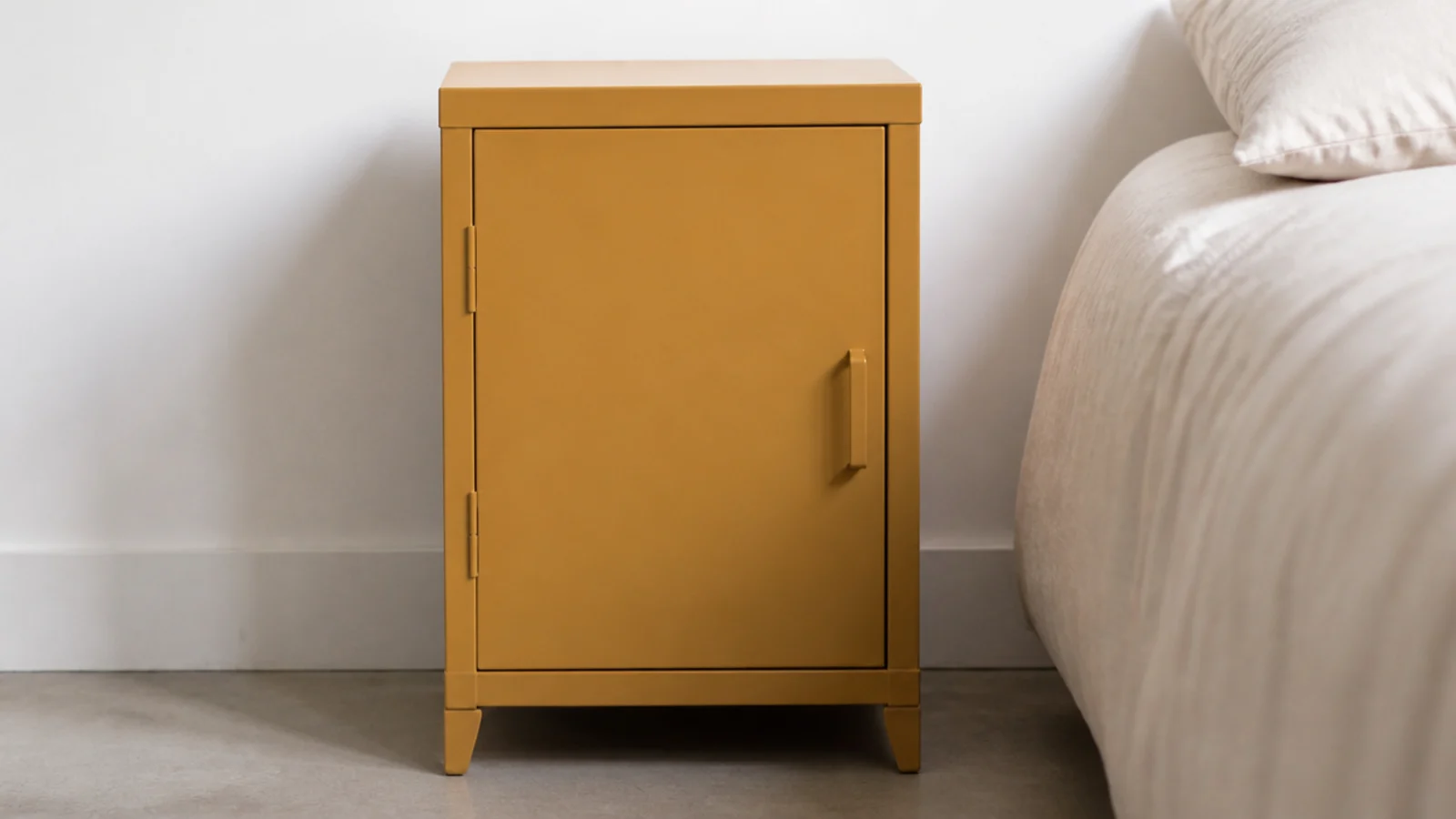
3. Powder-coated steel in one flat saturated colour
Powder coat is baked on rather than sprayed, which gives a genuinely flat, grainless colour with no sheen and no brush texture. In a room of timber and linen, one saturated steel volume in ochre, oxblood or deep green does more than three neutral objects. Folded steel cabinets run about 200 to 500 dollars.
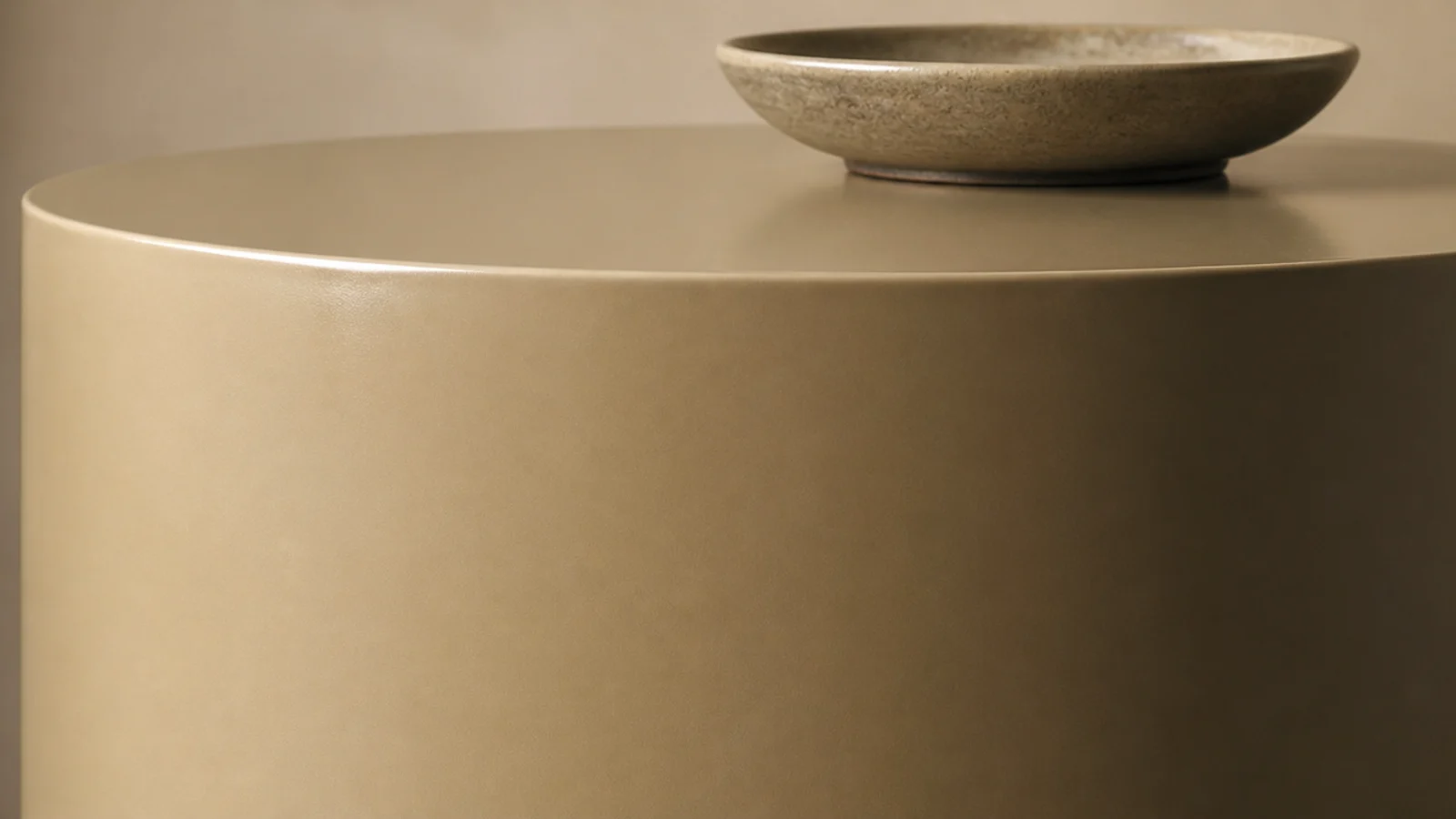
4. A seamless drum with no visible joints
A drum table is a cylinder with no corners, no legs and no edges, so the eye finds nothing to catch on. The whole effect depends on the seam: a well-made drum hides it at the rear or has none at all. Check it by rotating the piece before you buy, because photographs never show the back.
5. Waterfall plywood with the laminations showing
Mitre the corner of a plywood panel and fold it down, and the striped core runs continuously around the edge. Those laminations become the only ornament the piece needs. Birch ply with 13 plies in 18mm reads finest; construction ply with five thick plies and voids looks like site material. Seal the end grain or it will fur.
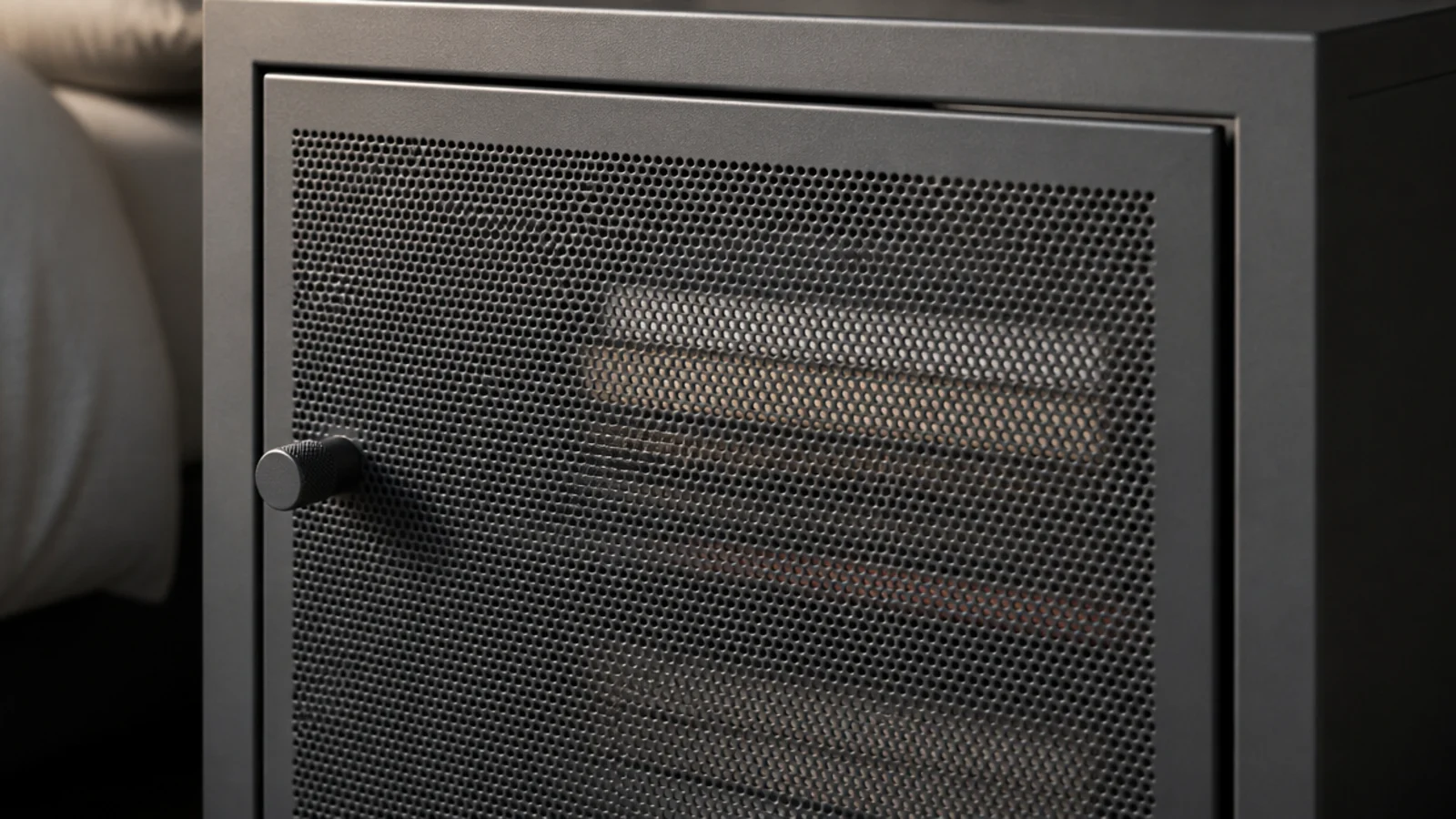
6. A perforated metal front that hides clutter
Perforated steel at 3mm holes on 5mm centres blurs whatever sits behind it. From three feet you read a soft grey field rather than a stack of books and a charger. It also ventilates, which suits anything electronic living inside. Powder-coat it in the wall colour and the cabinet reads as a shadow.
7. A terrazzo top with fine aggregate
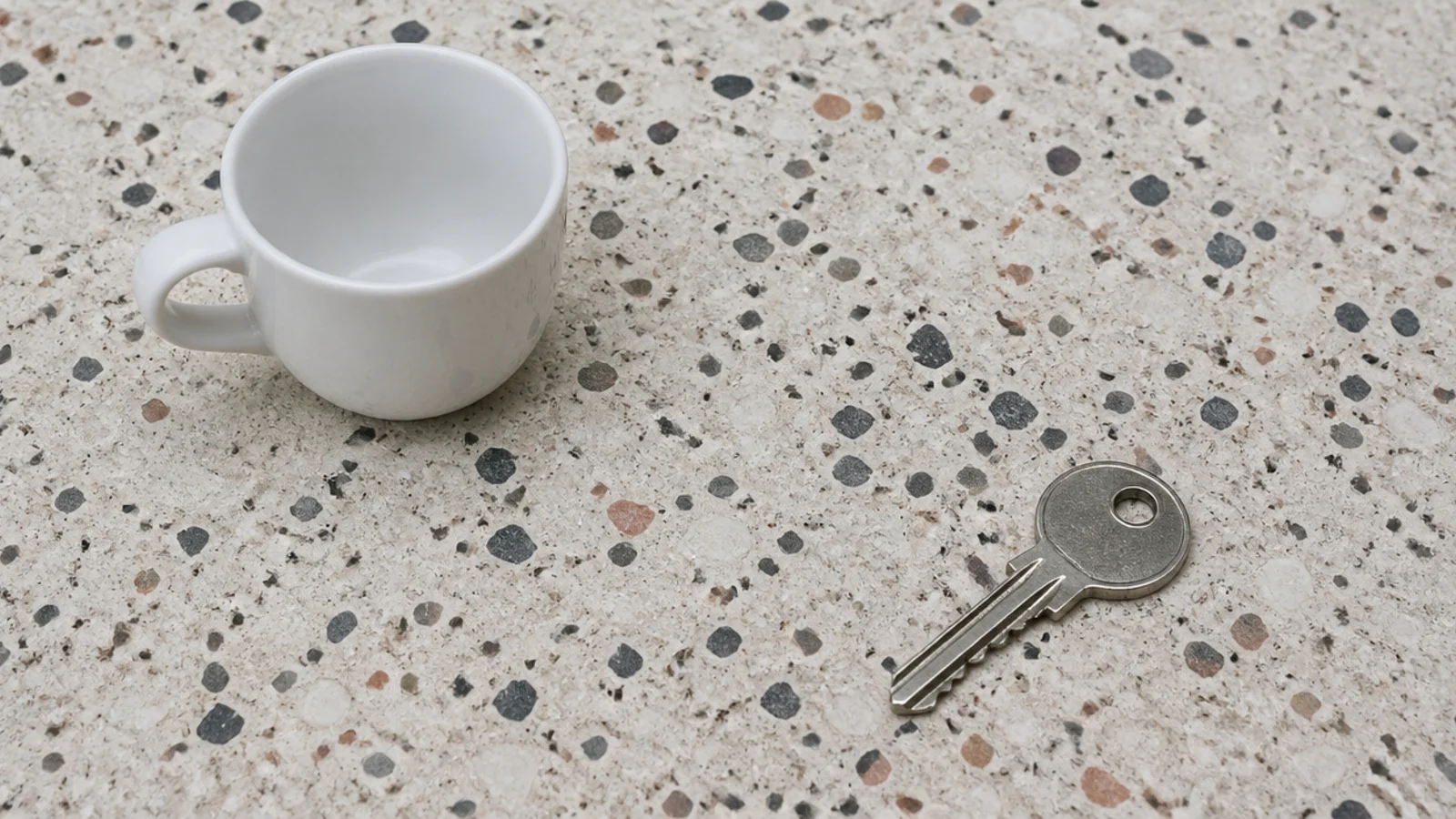
Aggregate size sets the volume. Fine chips under 5mm read as a calm speckled field and suit a bedroom; the large chunky aggregate sold for kitchen islands looks restless at close range. Cement-based terrazzo needs sealing annually, resin-based does not. Expect a top to add 100 to 300 dollars over plain timber.
8. A pill-shaped top with a fifty-millimetre radius
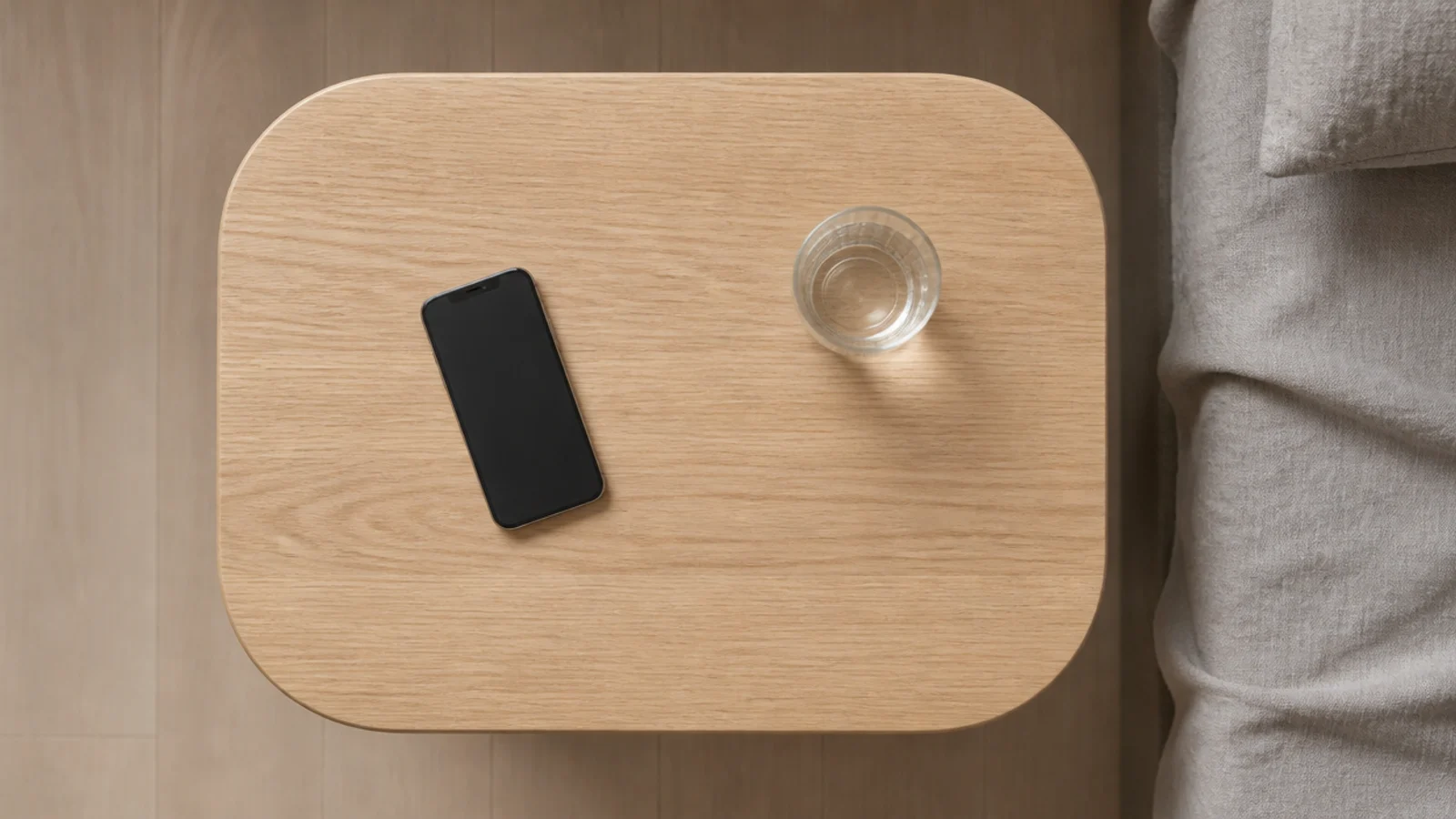
A large corner radius is what stops minimal furniture reading as clinical. Fifty millimetres is generous enough to register from across the room, where a 6mm eased edge simply looks like a manufacturing default. It also removes the corner that catches a hip, which matters at bedside more than anywhere else in the house.
9. A single-tube pedestal in matte black
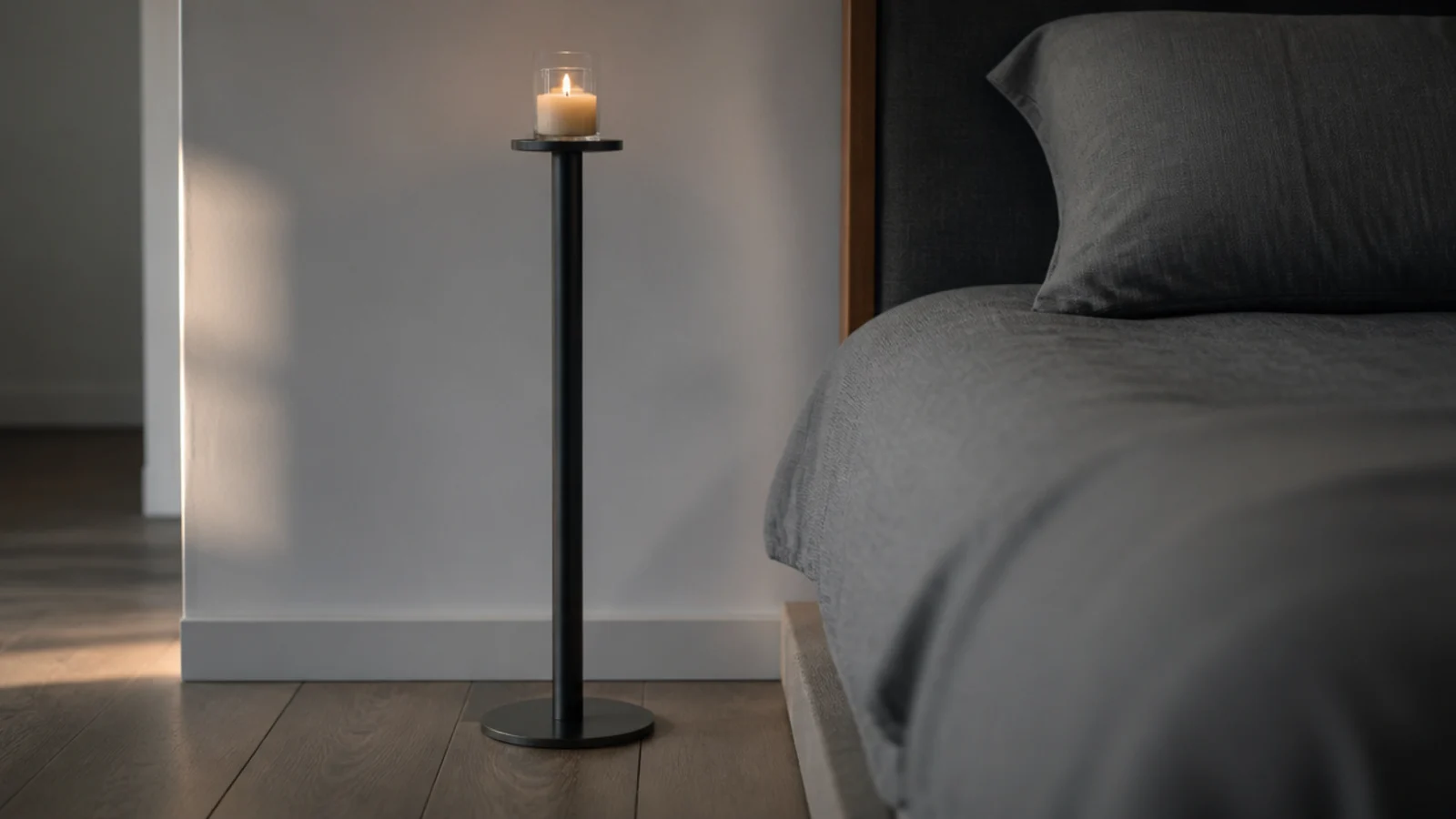
One vertical line instead of four splayed legs. A slim column on a weighted disc base clears the floor visually and vacuums around in one pass. Check the base diameter is at least sixty percent of the top diameter, or the table tips when you lean on the edge — which is exactly what happens reaching for a glass.
10. A charging pad routed flush into the surface
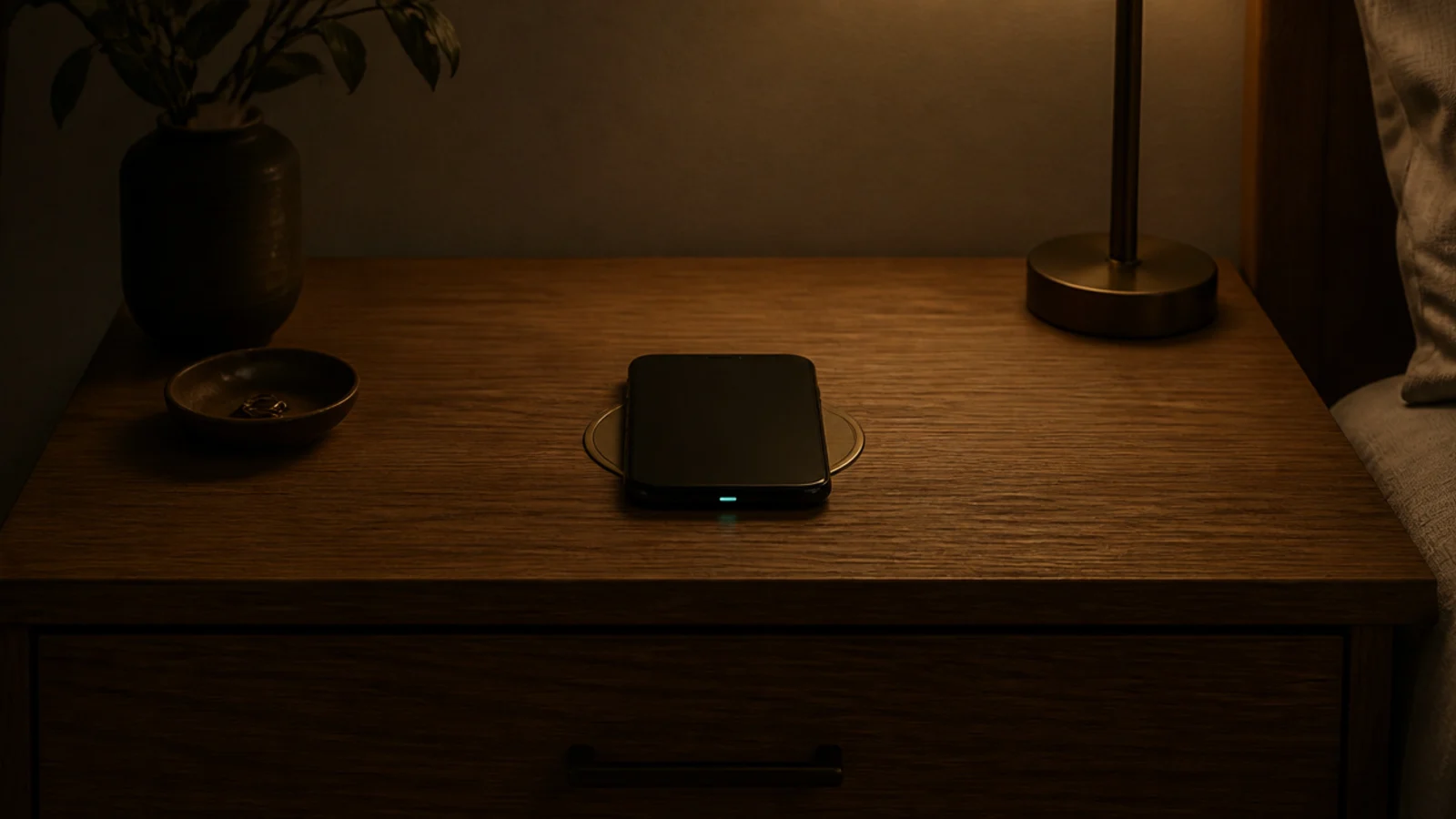
A pad recessed into the underside of the top charges through up to about 8mm of timber or stone at 10 to 15 watts. The catch is alignment: without a visible marker you will miss the coil half the time. Inlay a brass ring, a leather patch or a shallow dish to mark the spot. Kits run 25 to 60 dollars.
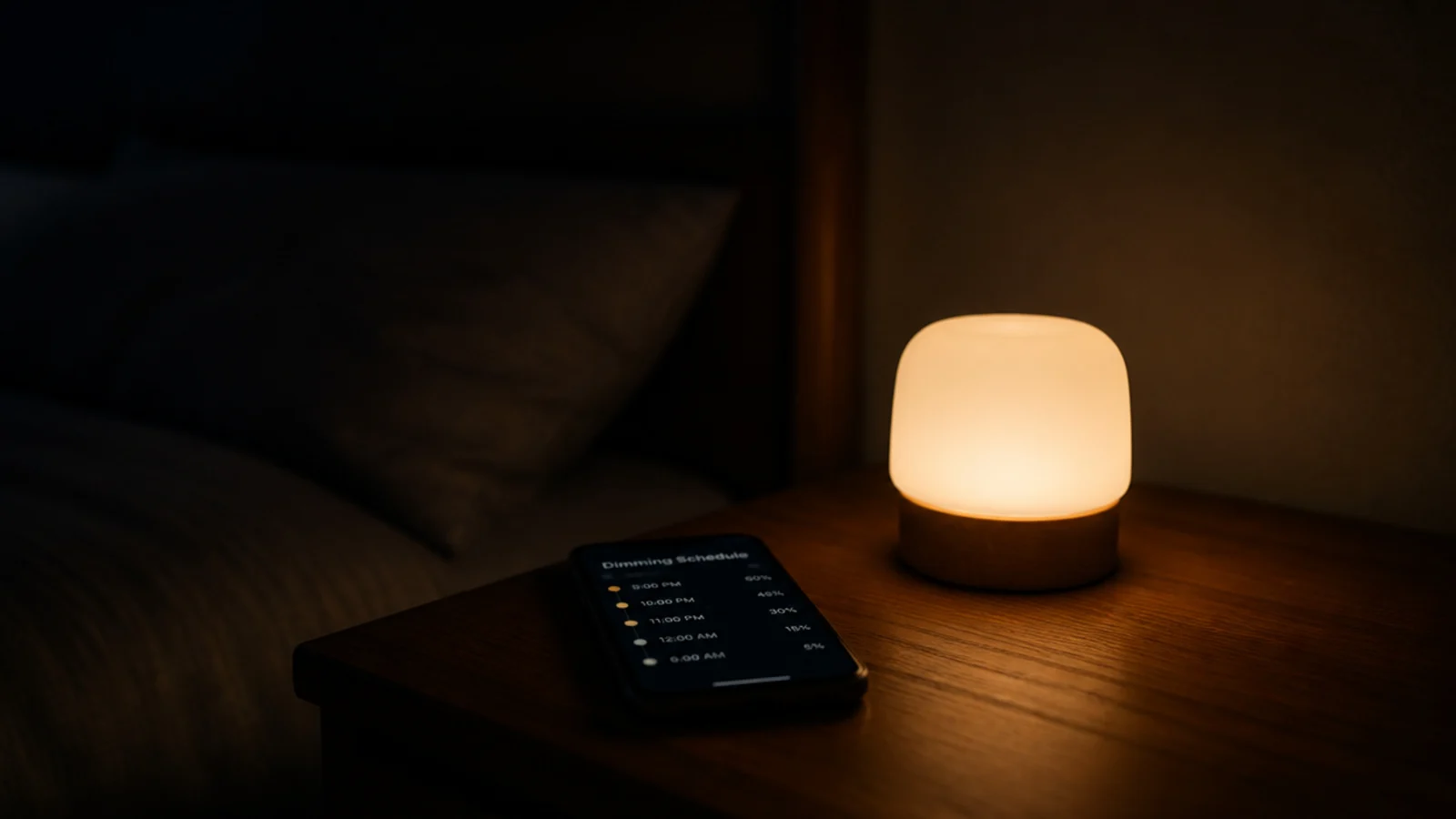
11. A smart bulb on a timed fade instead of a switch
Set a warm bulb to drop from full to about ten percent over thirty minutes and the room dims while you are still reading, rather than going dark in one step. Keep it at 2700K. Cool white in a bedroom is the single most common lighting error in otherwise well-designed modern rooms.
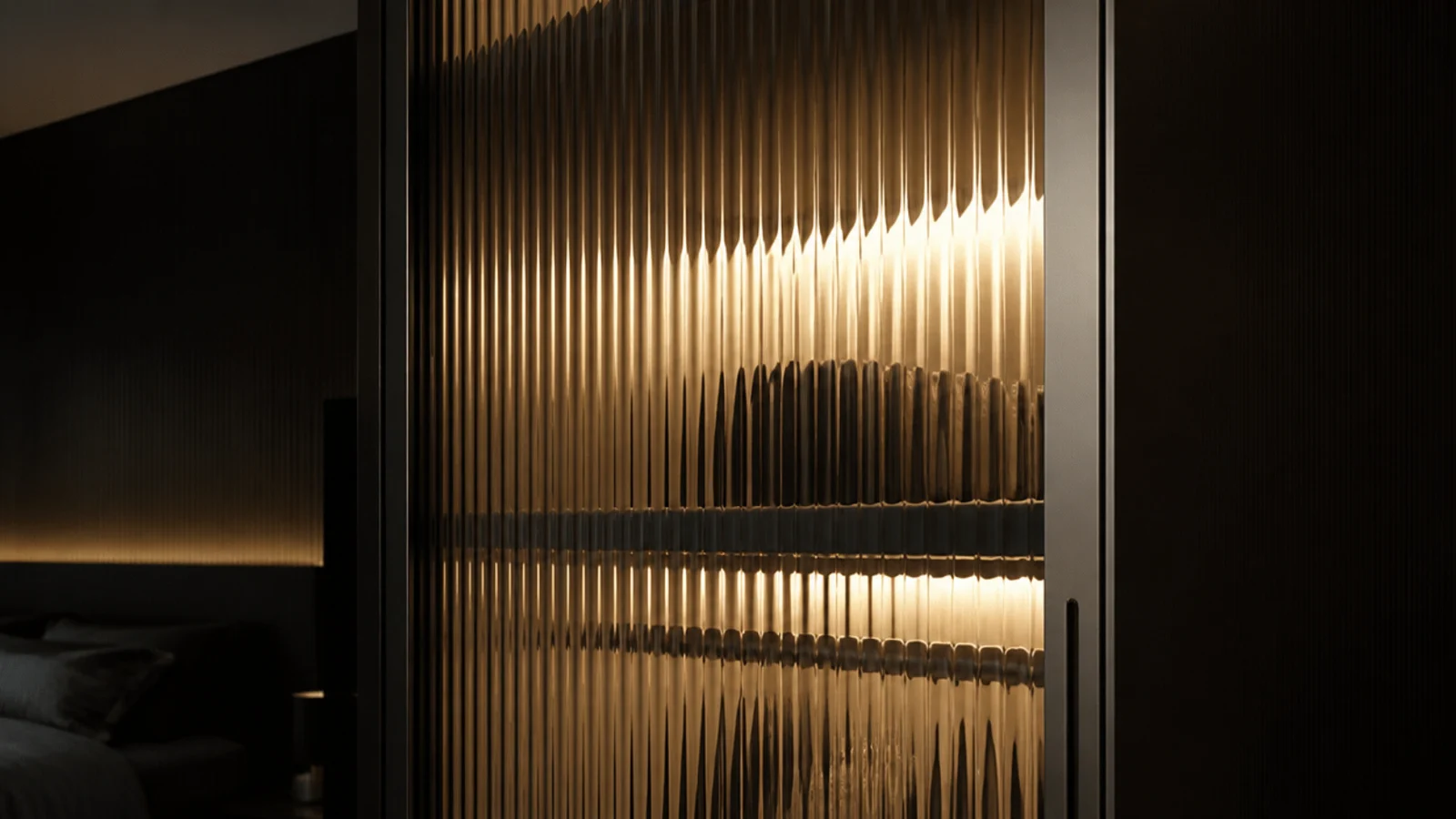
12. Fluted glass fronts lit from behind
Reeded or fluted glass breaks a single light source into a repeating band of vertical highlights, and it obscures the contents of a cabinet without hiding them. Backlight it with a low-output warm strip and the front becomes a soft glowing panel at mattress height. It suits a room with no space for a second lamp.
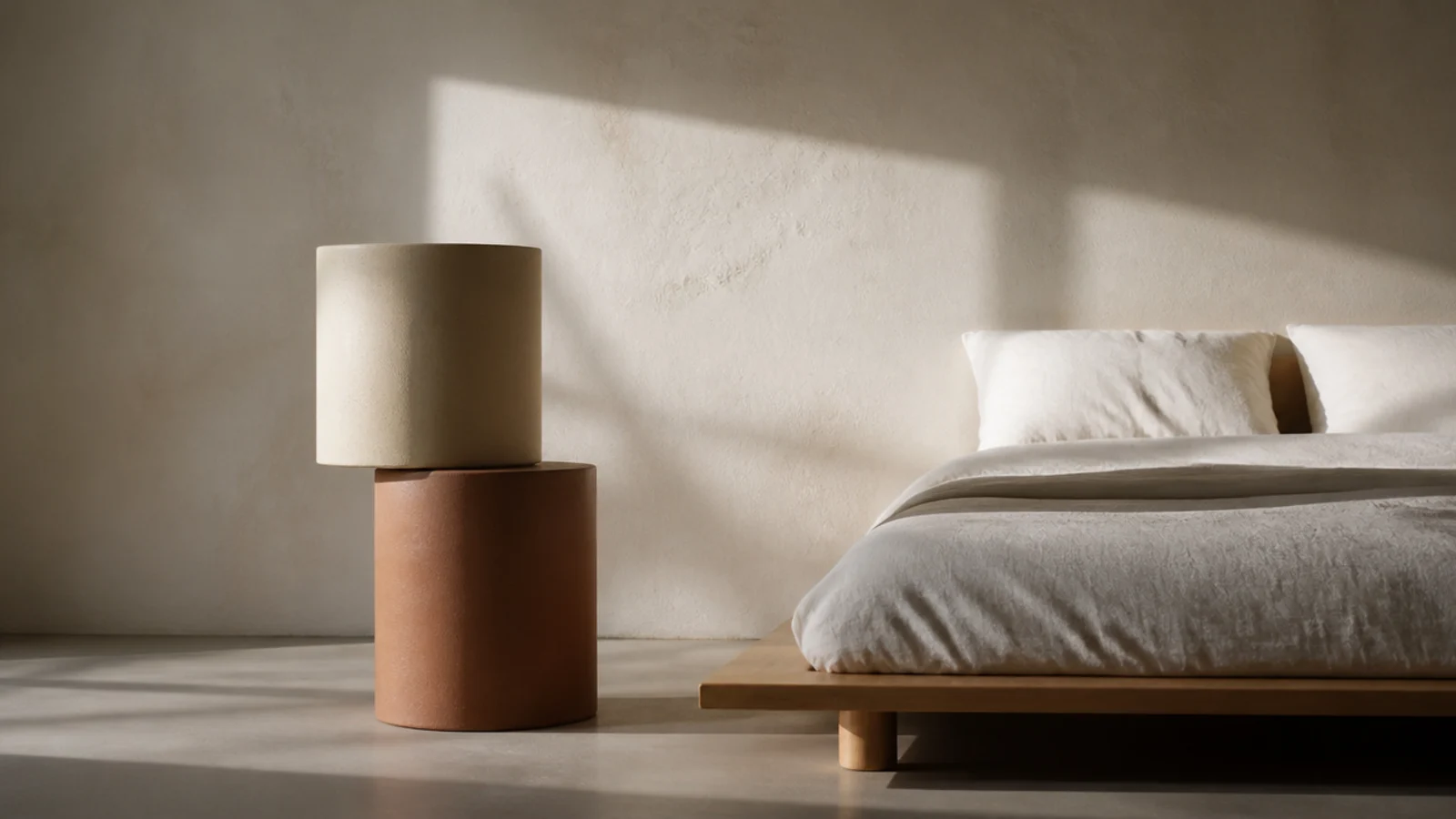
13. Two offset cylinders stacked
Stack two cylinders concentrically and it looks like packaging. Offset the upper one by a third of its diameter and it becomes a considered form with a usable ledge on the lower volume. Keep the two in contrasting tones rather than matching, and check the combined centre of gravity sits over the base.
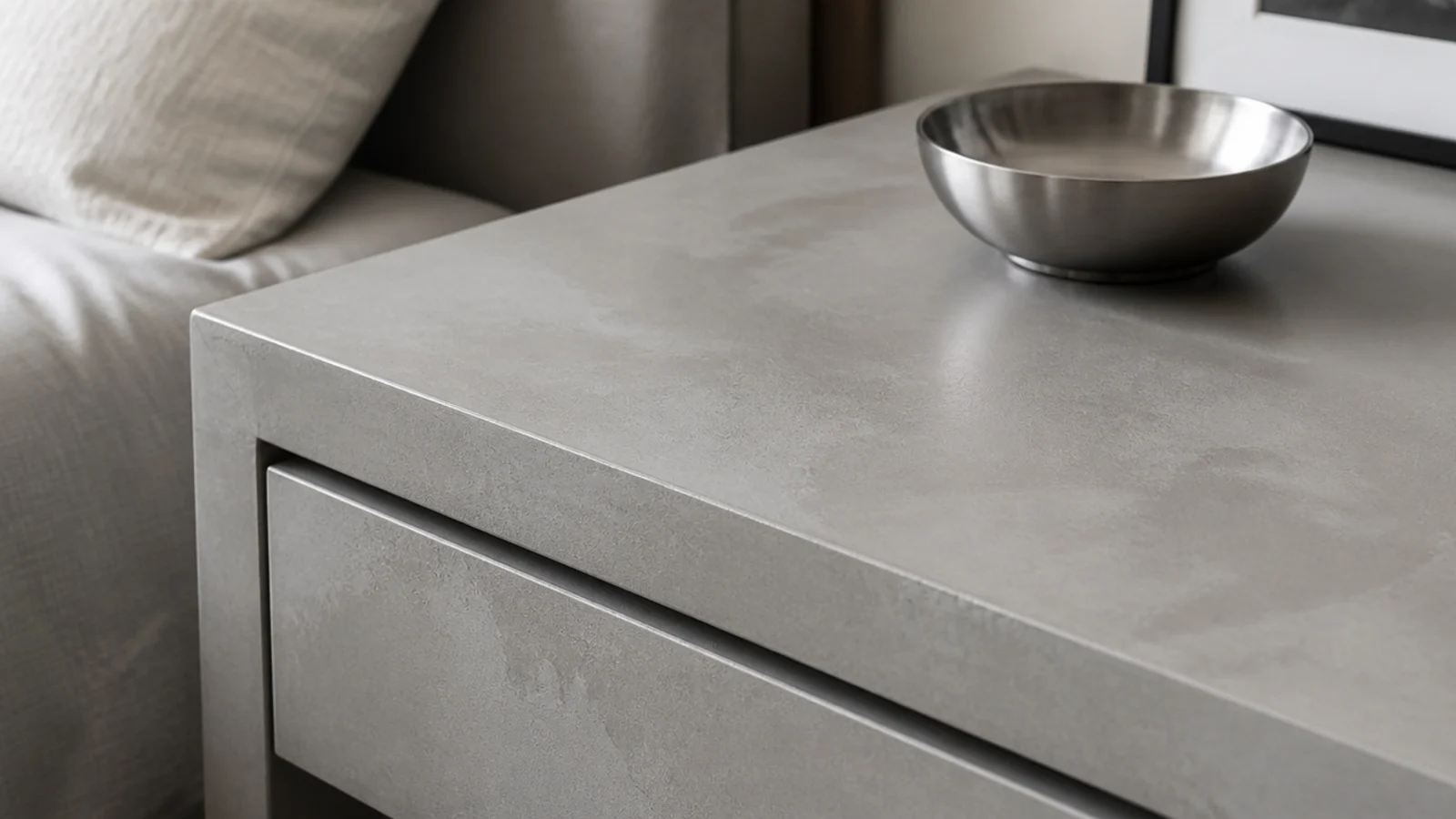
14. A micro-cement finish over a plywood carcass
Micro-cement is a trowelled polymer-cement coat about 2 to 3mm thick, applied over plywood or MDF. You get the tonal variation and matte depth of concrete at a fraction of the weight, on a carcass you can actually lift. It must be sealed, and the seal is what determines whether a water ring appears. Budget 150 to 400 dollars for a small piece.
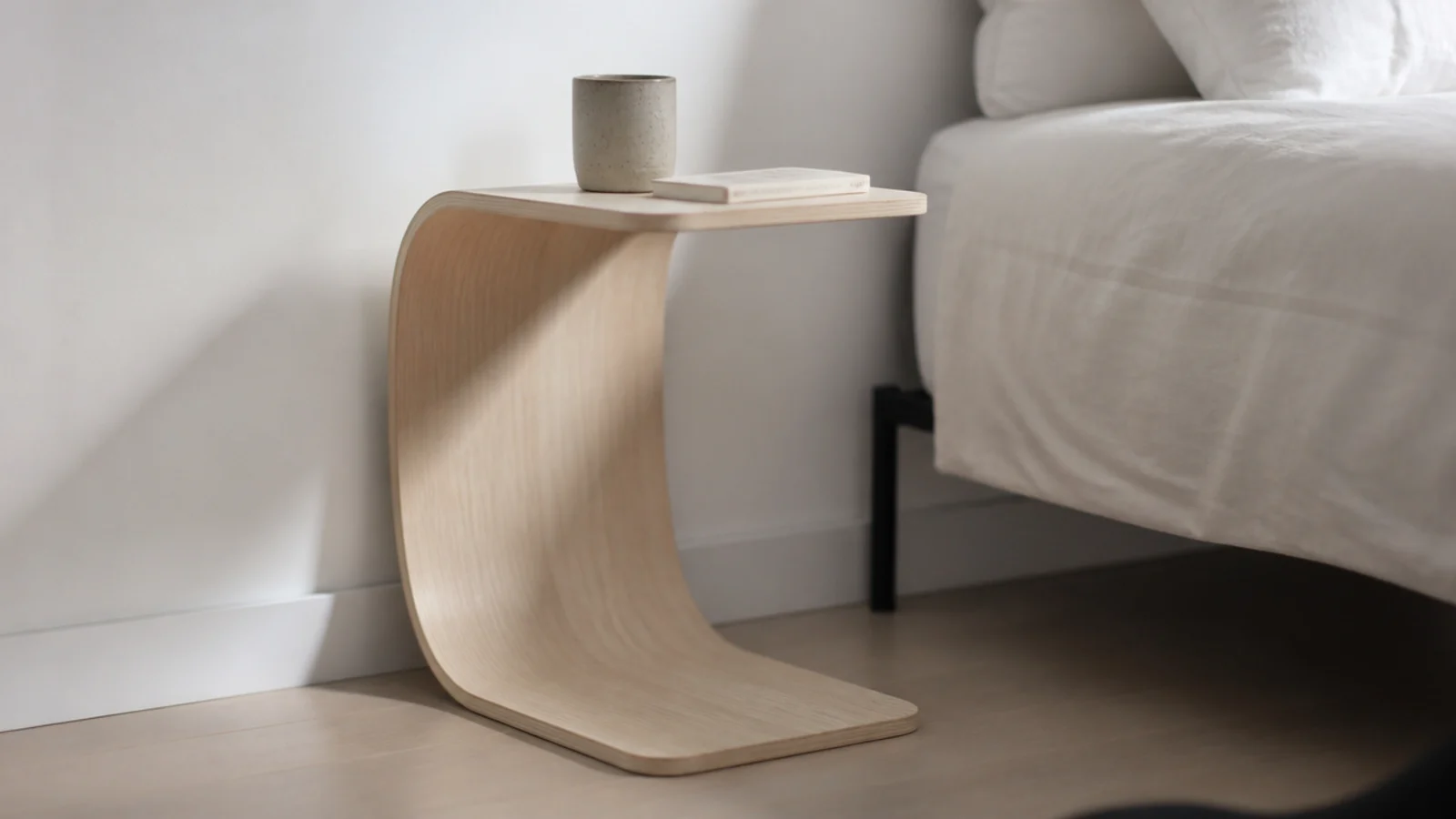
15. Bent plywood in one continuous curve
A single formed sheet sweeping from the floor into a horizontal top is a shape furniture has chased since the 1930s and it still reads as modern. Look for a laminated bend rather than a kerf-cut one, since kerfing shows a row of fine cracks on the inside of the curve within a year of use.
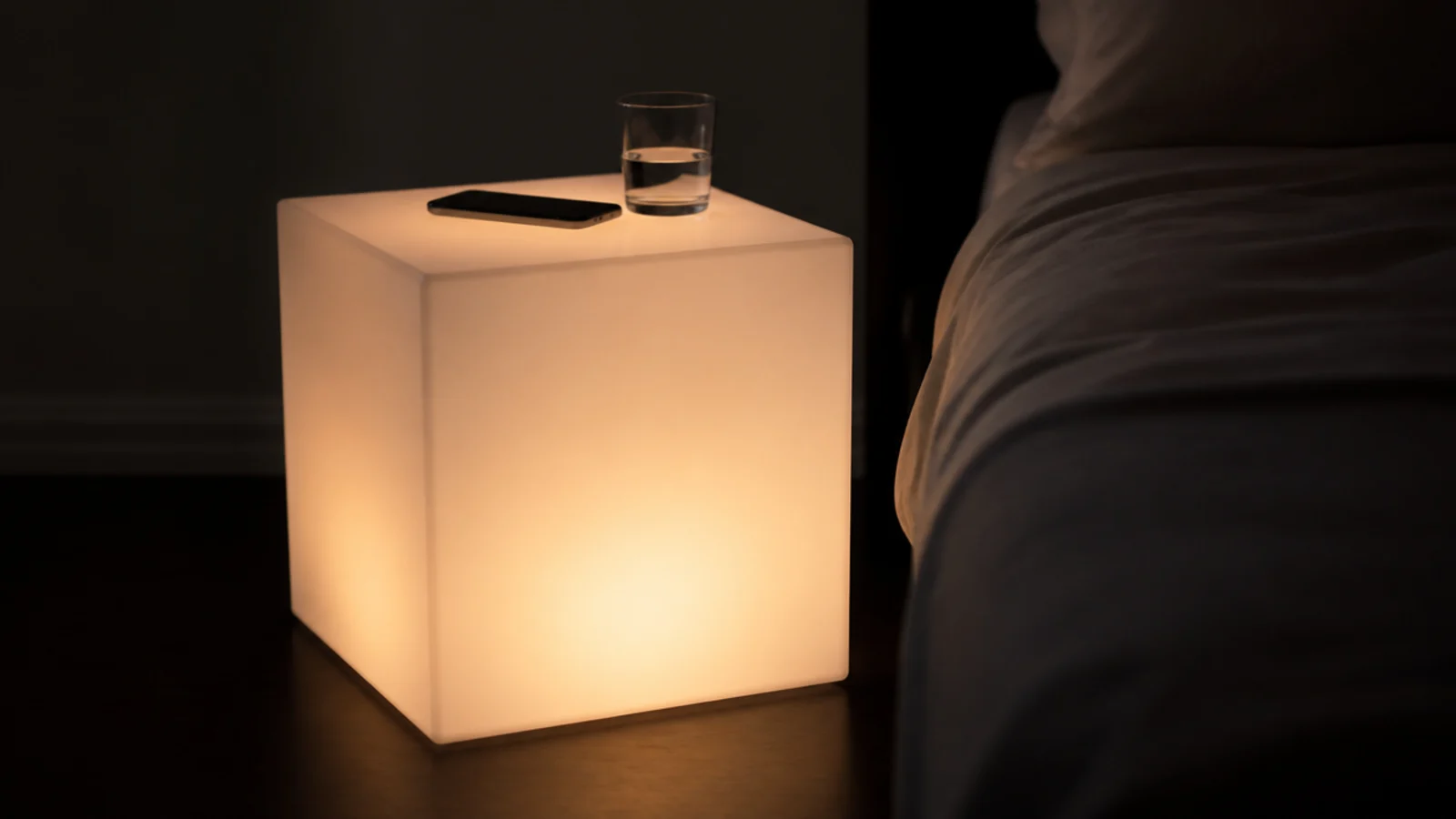
16. A frosted acrylic box that glows from within
Put a low-output warm LED inside a frosted acrylic cube and the whole nightstand becomes a soft light source at floor-to-mattress height. It works as a night light in a child's room or a hallway-facing bedroom, and it removes the lamp from the surface entirely. Use LED only — nothing that generates heat inside a sealed plastic box.
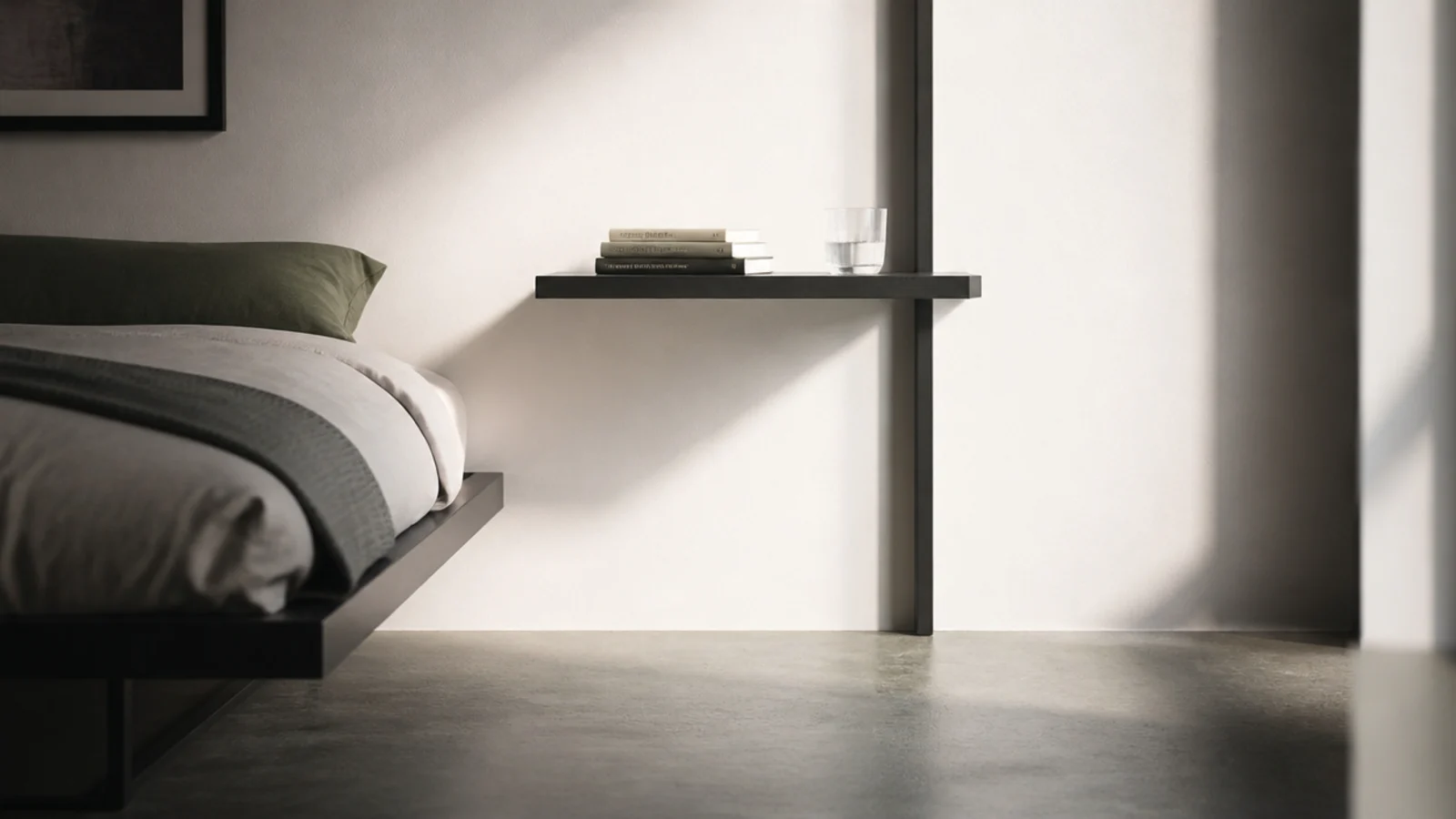
17. A cantilevered top on one side support
Supporting a surface from one side only leaves the other side completely open, which reads as weightless and makes a small floor area look larger. The engineering matters: the upright needs to be fixed to the wall or heavily weighted at the base, and the top should not project more than about fourteen inches unsupported.
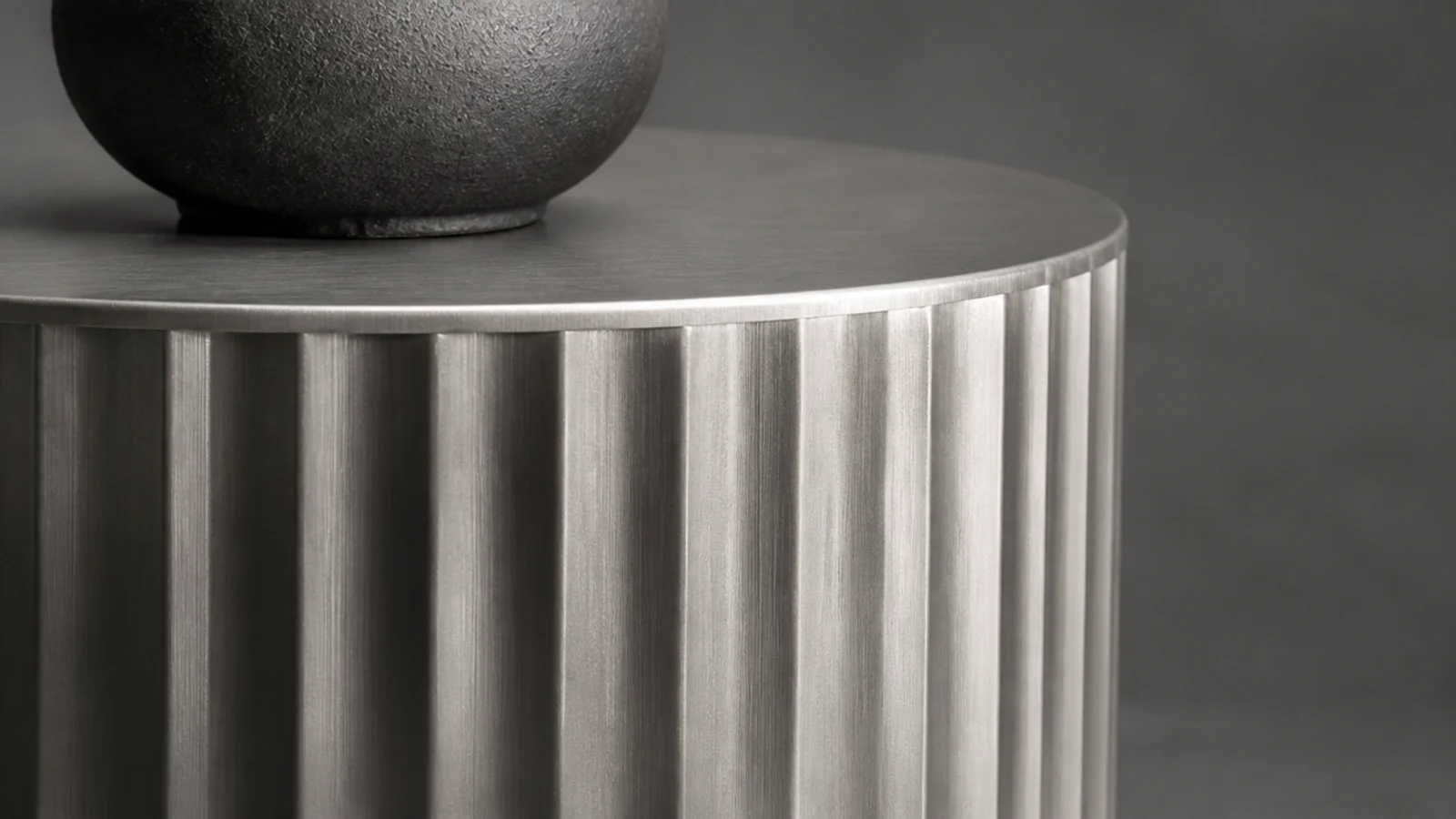
18. Corrugated metal wrapped around a drum
Corrugation turns a plain cylinder into a surface that catches and loses light around its curve, so the piece changes as you move past it. Brushed aluminium stays quiet; polished chrome does not. It is also forgiving of dents, since the ribs distribute a knock that would leave a visible dish in flat sheet.
19. A honed black granite disc
Honed stone has been ground flat and left matte, so it absorbs light where polished stone throws it back as glare. On a bedside, that difference is the whole point — polished black granite reflects the ceiling light straight into your eyes. Honed granite also hides fingerprints far better, though it needs sealing to resist oil.
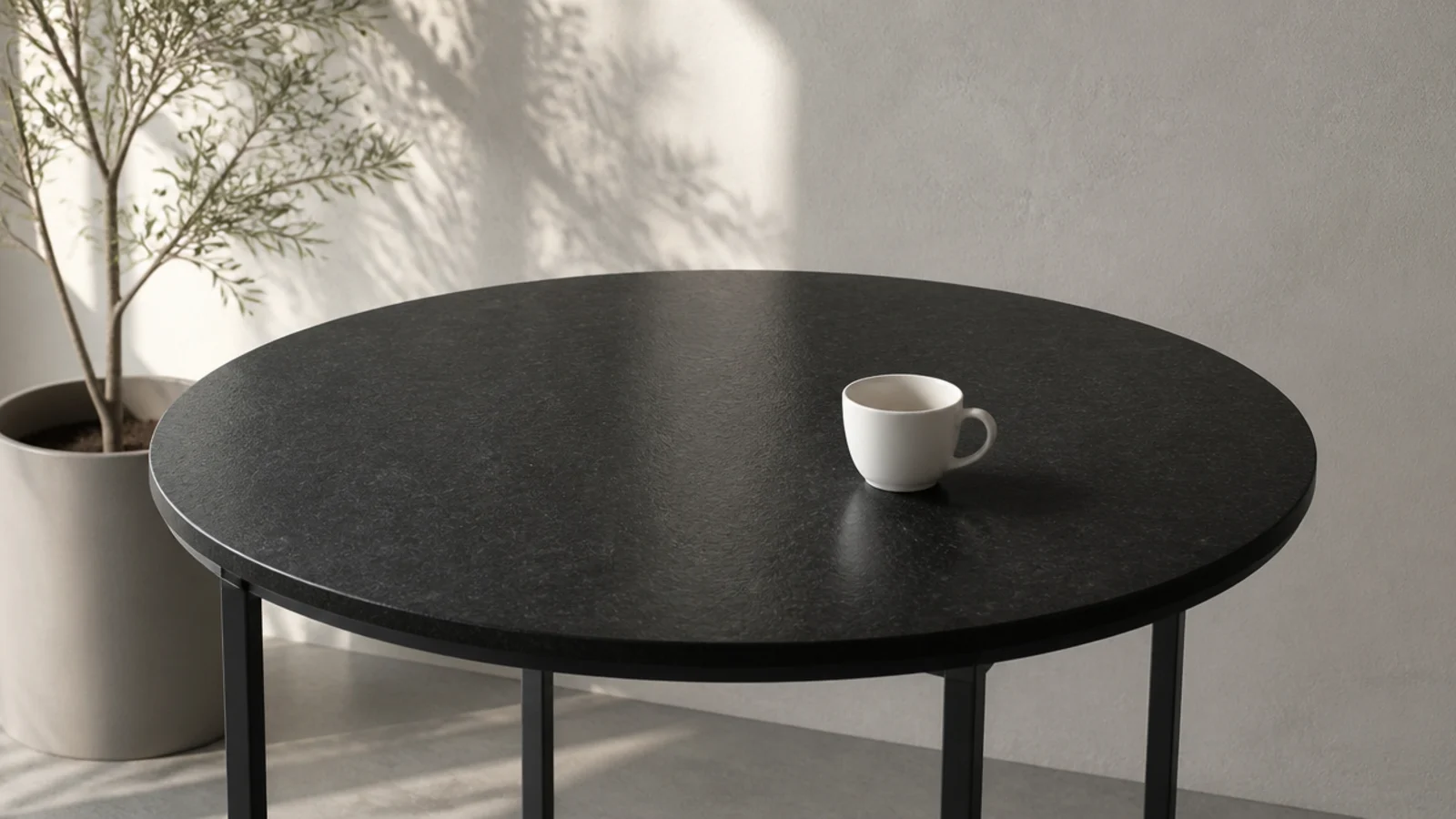
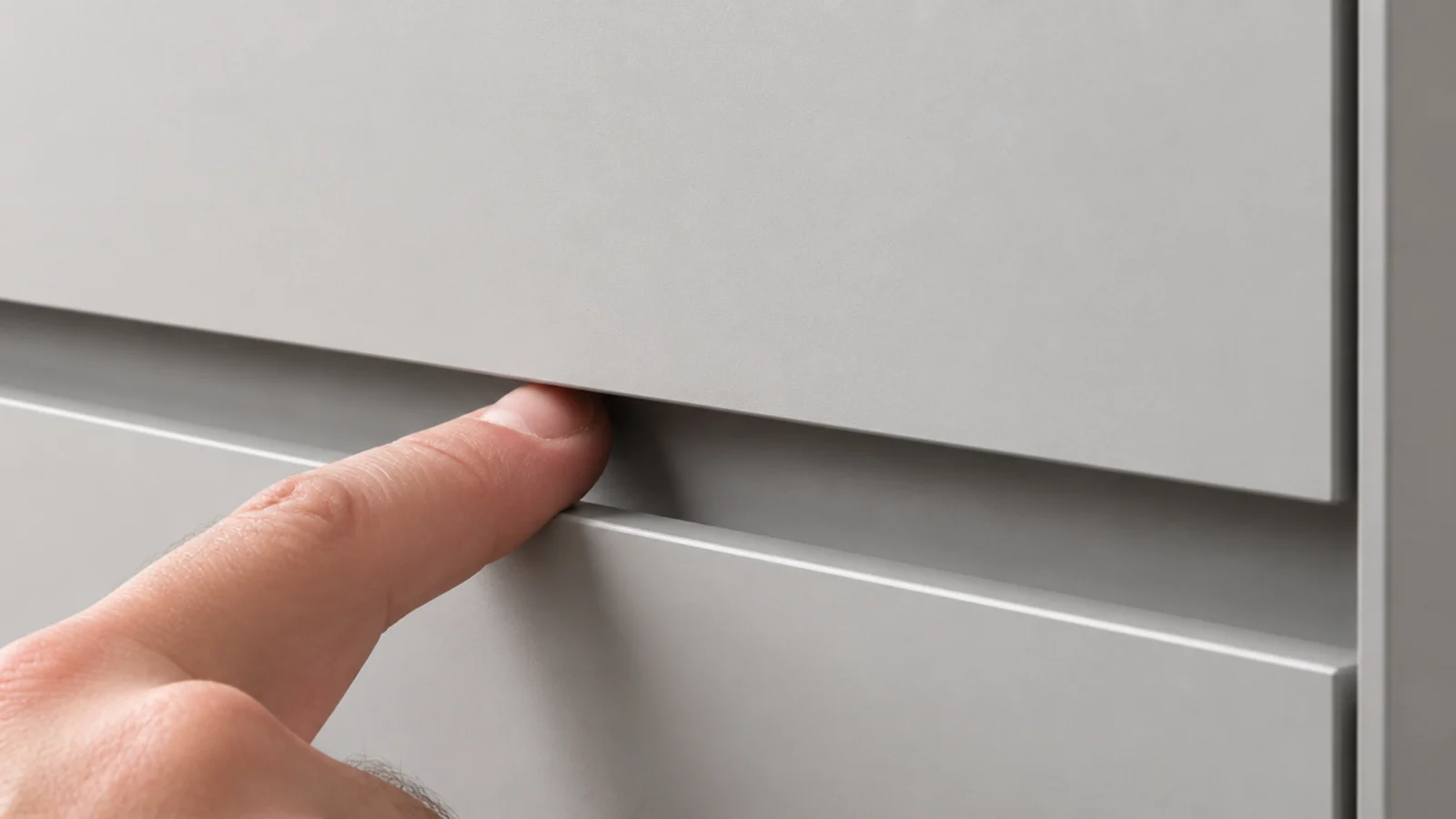
20. A recessed finger channel instead of a pull
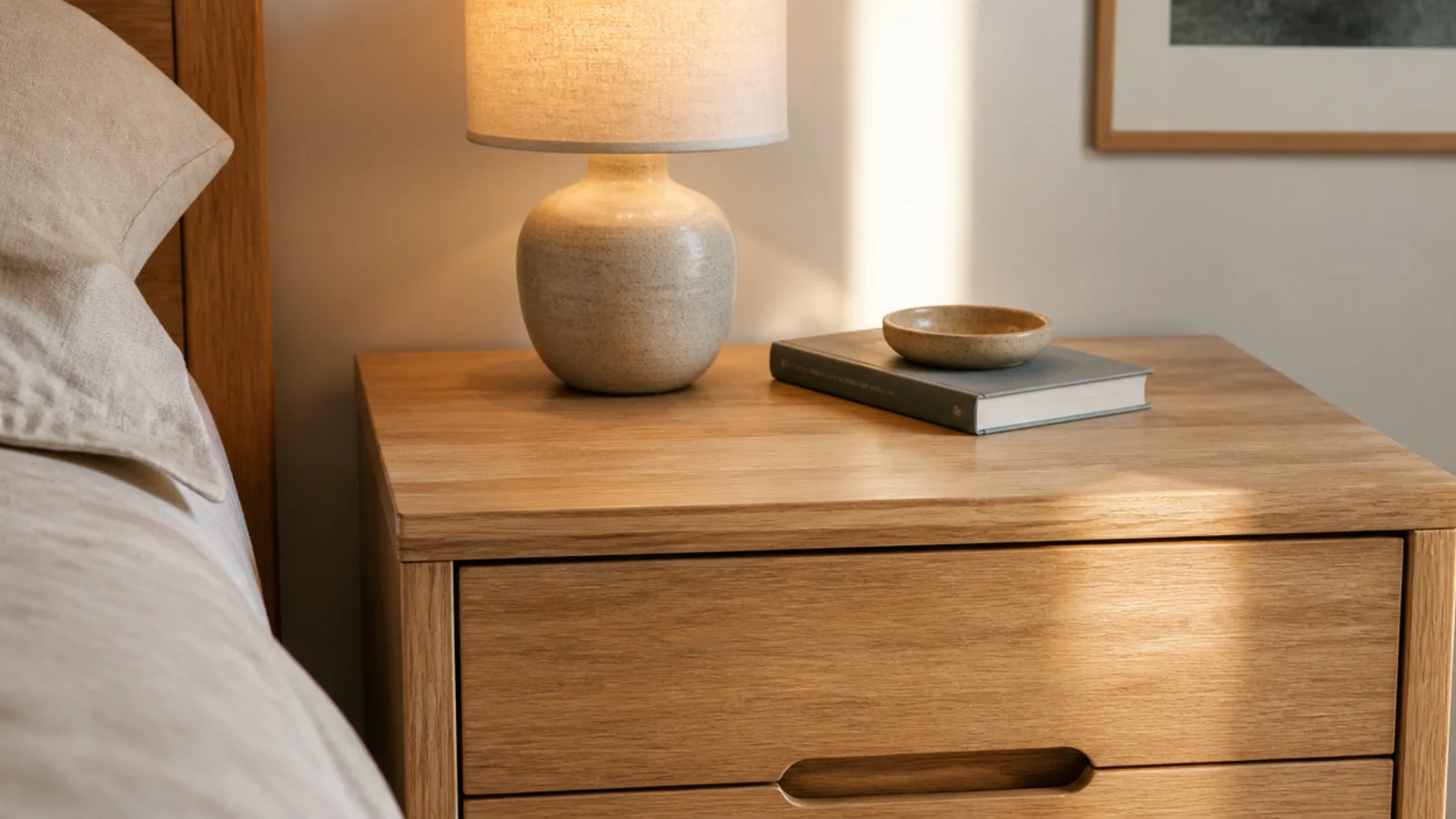
A channel routed under the top edge of a drawer front removes the hardware entirely while staying easier to open half asleep than a push latch. Aim for 20mm deep and 25mm tall so a finger fits without hunting. It is also the detail that lets a run of drawers read as one uninterrupted plane.
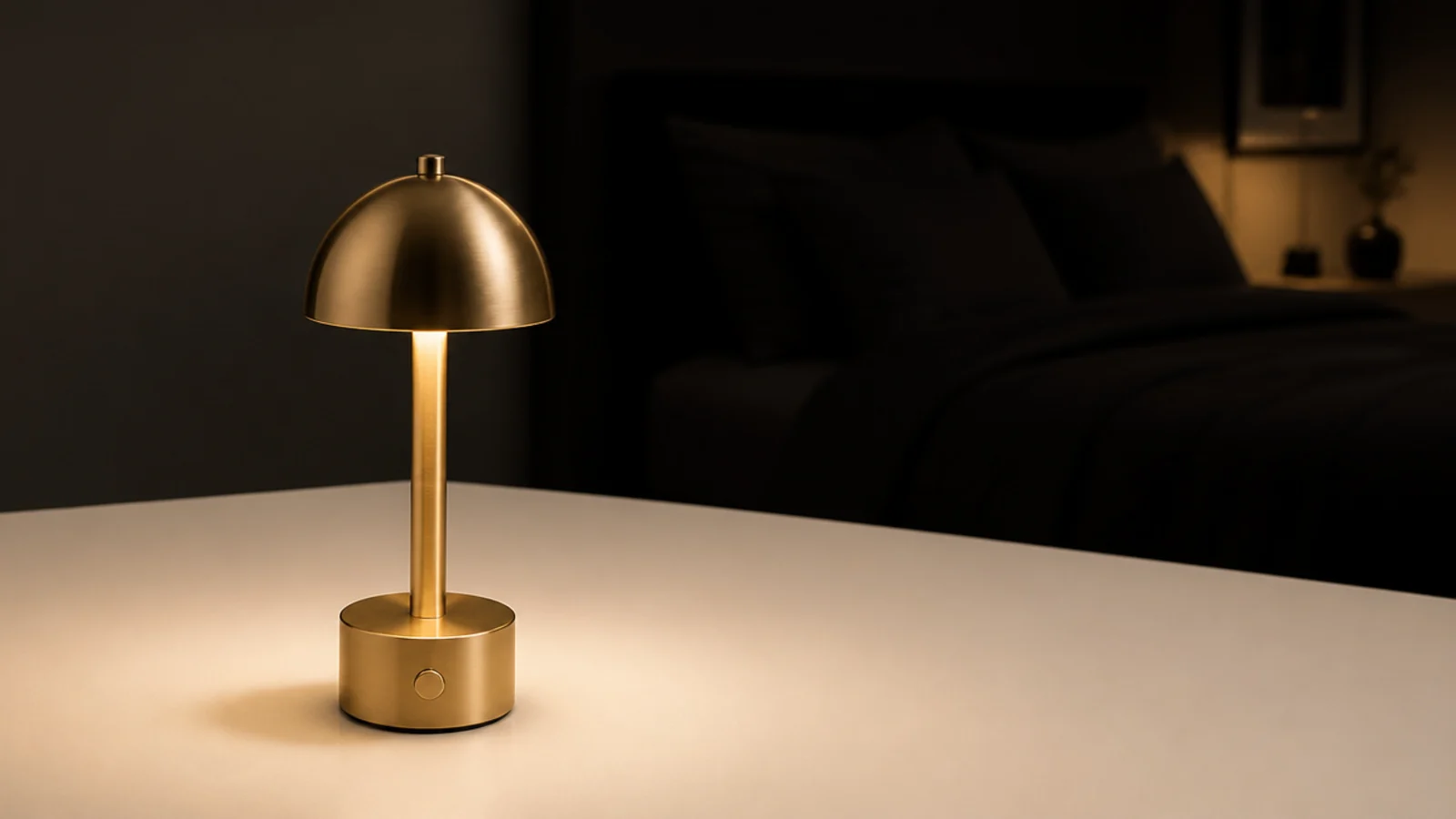
21. A rechargeable cordless lamp and no socket at all
Portable rechargeable lamps have gone from a restaurant gimmick to genuinely good light — most give 8 to 20 hours on a charge with two or three brightness steps. Beside a bed they remove the flex, the socket and the switch position problem simultaneously, and they move to the bath or the balcony. Expect 60 to 200 dollars.
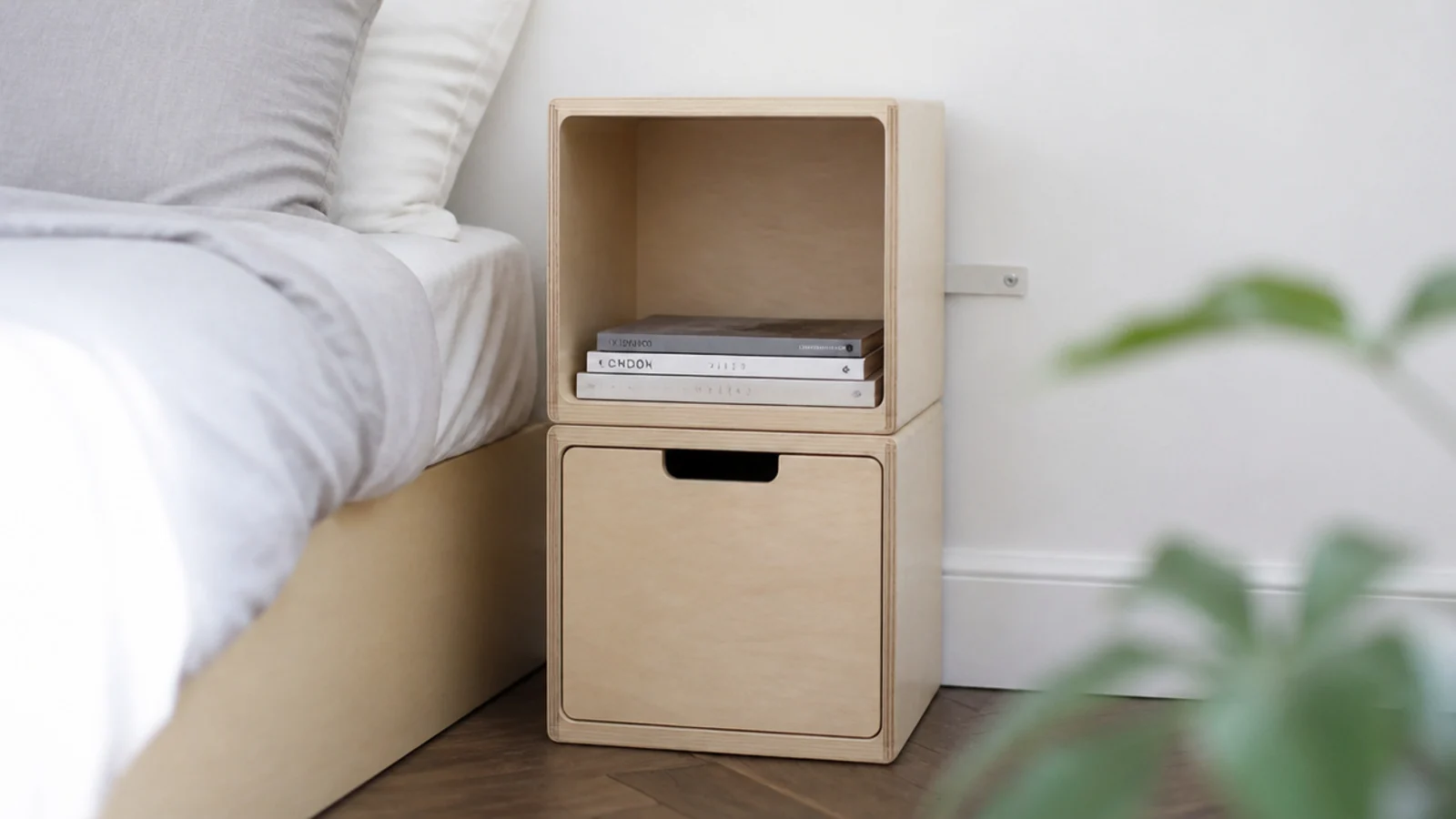
22. A modular cube system that stacks as you need
Two stacked cubes give you an open shelf and a closed box in one footprint, and the arrangement changes when the room does. Anything two cubes high beside a bed should be strapped to the wall, because a stack that is not mechanically joined will walk apart. Anti-tip kits cost under ten dollars.
23. Polished stainless for reflected light
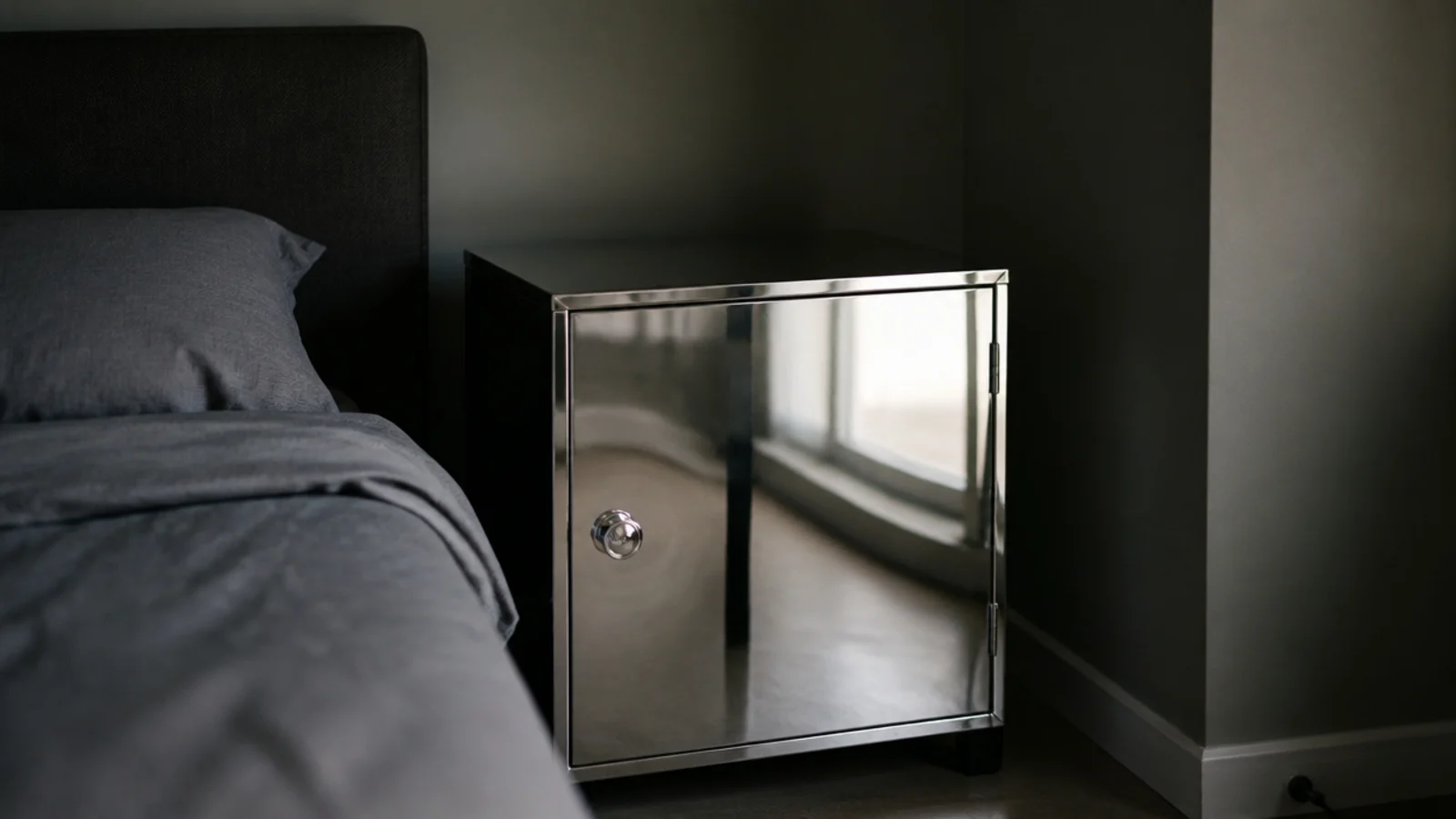
A polished stainless box in a dim corner picks up whatever daylight the room has and throws it back, which is the same trick a mirror does with less commitment. Keep it small — a full-height reflective cabinet becomes a distraction. Brushed finishes hide fingerprints; mirror-polished stainless shows every single one.
24. A slatted front with eight-millimetre gaps
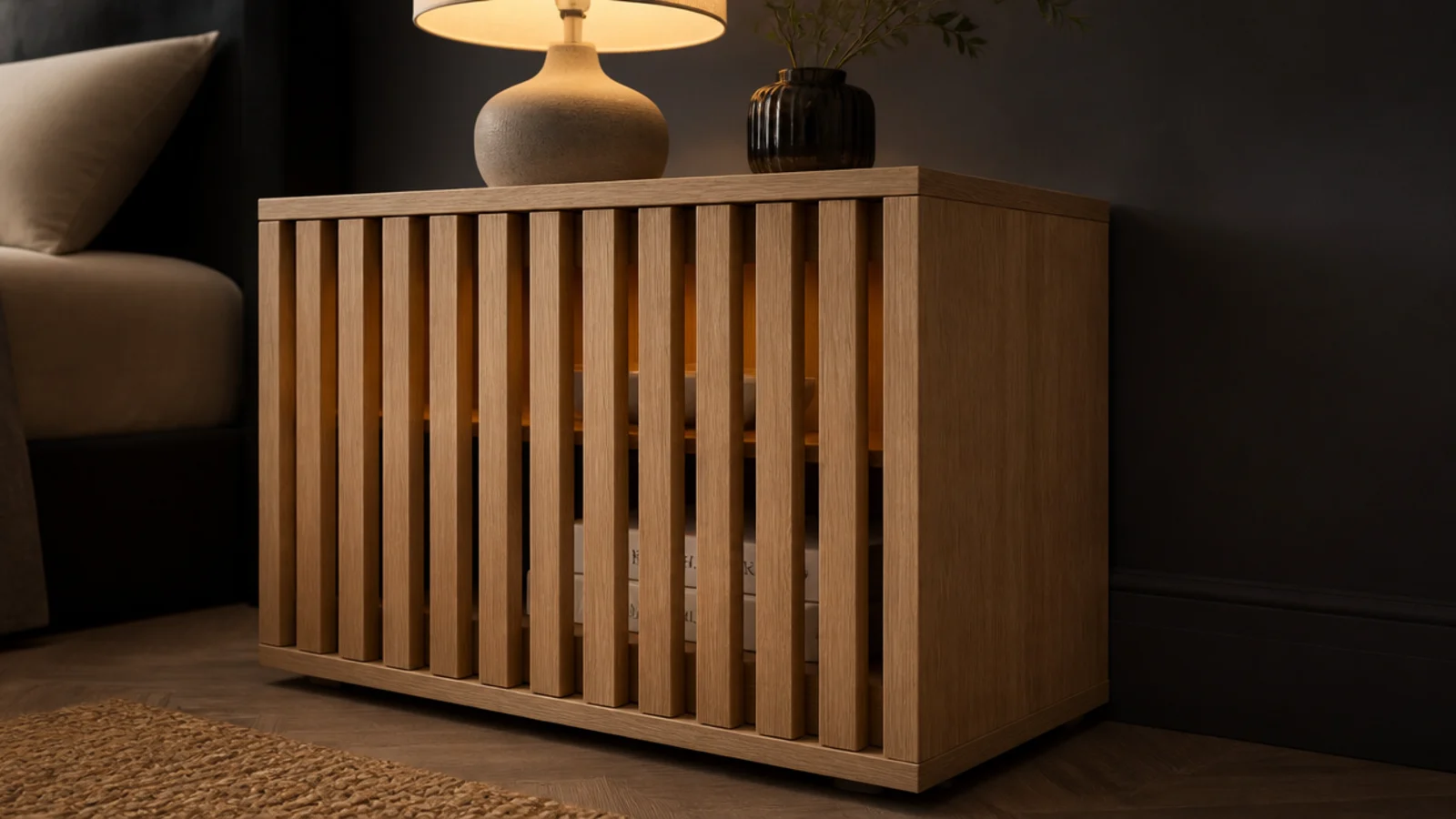
Vertical slats at 8mm gaps read as a solid plane straight on and open up as you move to the side, so the cabinet is both closed and airy depending on where you stand. Slats also let a charging device vent. Keep the slat width and gap in a consistent rhythm — irregular spacing looks like a repair.
25. A wall rail with movable hooks and a tray
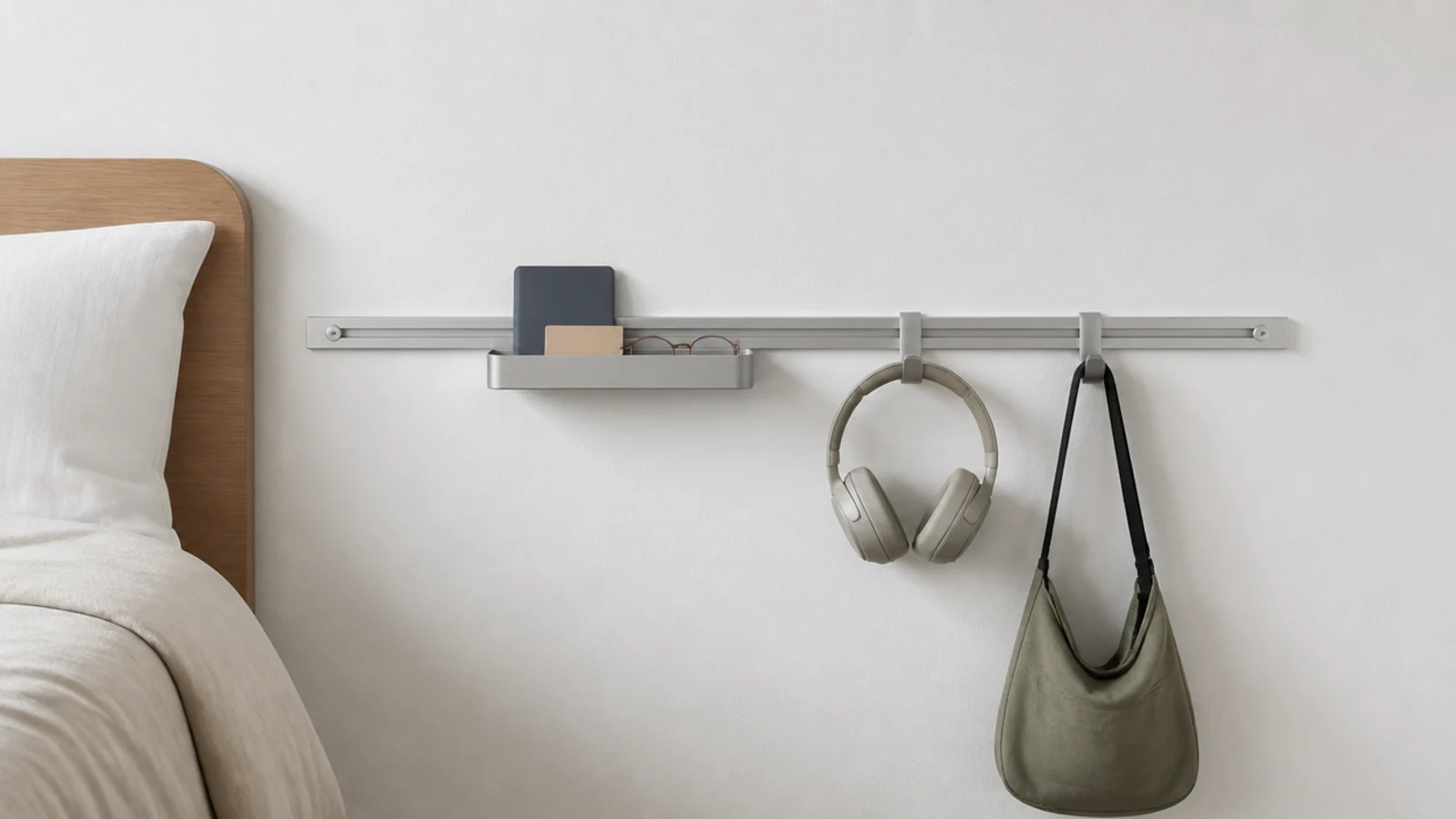
A rail system replaces the nightstand with a horizontal line and a set of clip-on parts: a shallow tray, a hook for headphones, a small shelf. Nothing touches the floor, and the arrangement changes in seconds without new holes. Fix into studs or use toggles rated 25 pounds each. The floating shelf guide covers the fixings in detail.
26. A recycled glass block top with visible bubbles
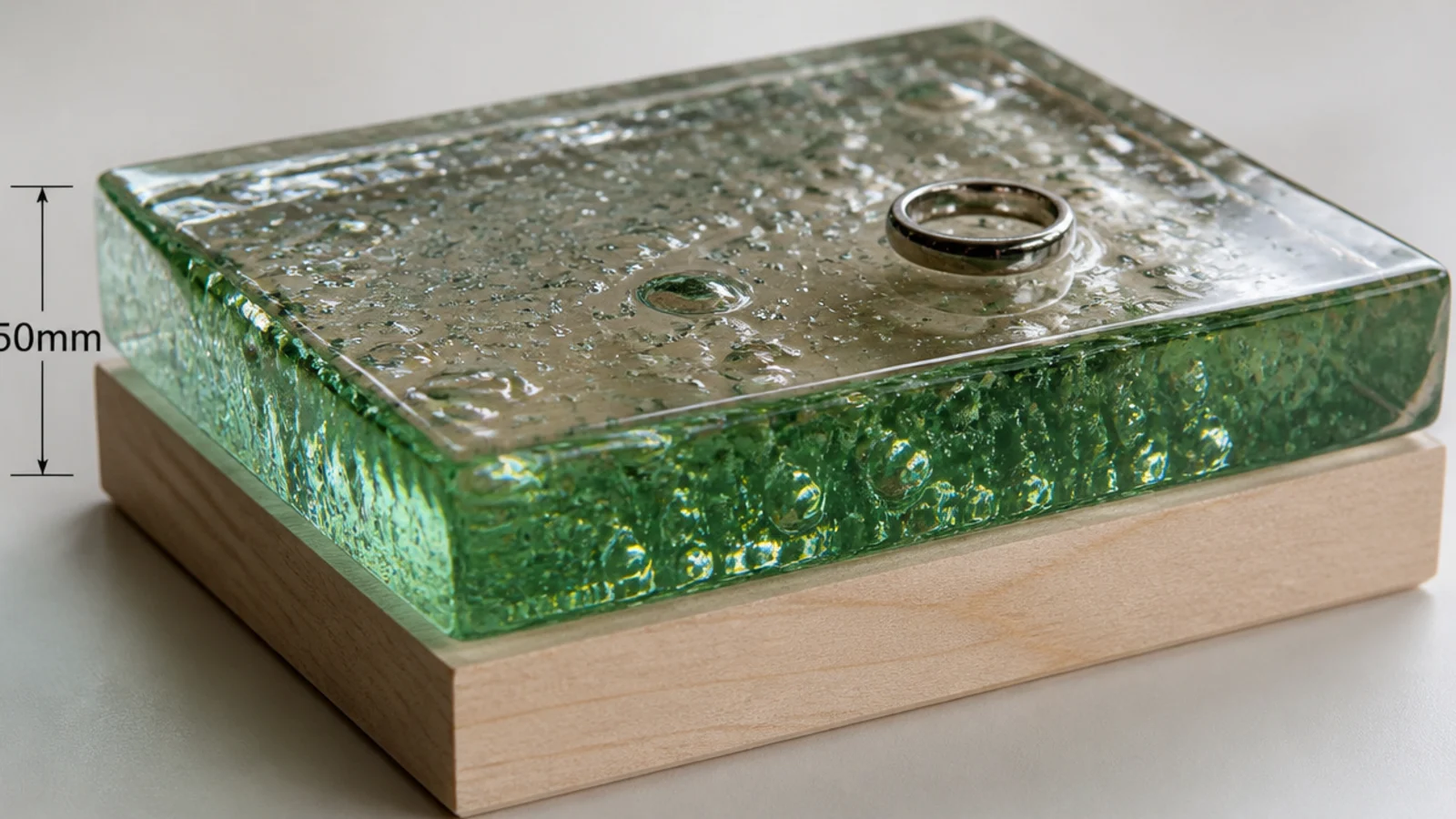
Cast recycled glass carries trapped air bubbles and a green edge tint that clear float glass never has, so it gives you transparency with visible depth. It is heavy for its size and the edges are usually left as cast, so check they are eased rather than sharp before it sits at elbow height beside a pillow.
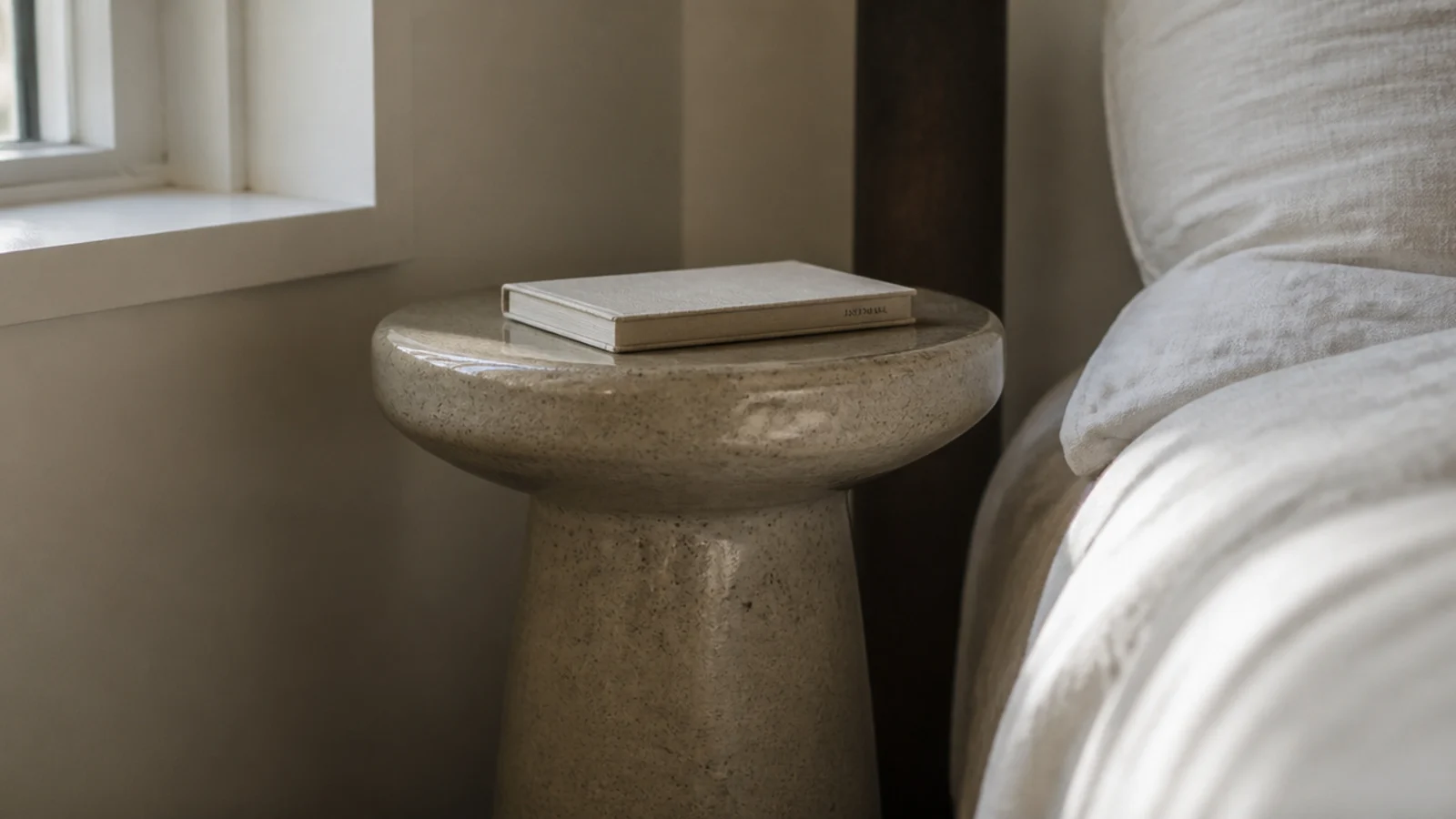
27. A stoneware pedestal fired as one piece
A ceramic pedestal has no joints, no fixings and no finish to fail — the glaze is the surface. Slight asymmetry from hand forming is what stops it reading as mass-produced. Check the base is flat and glazed-free underneath so it does not scratch a timber floor.
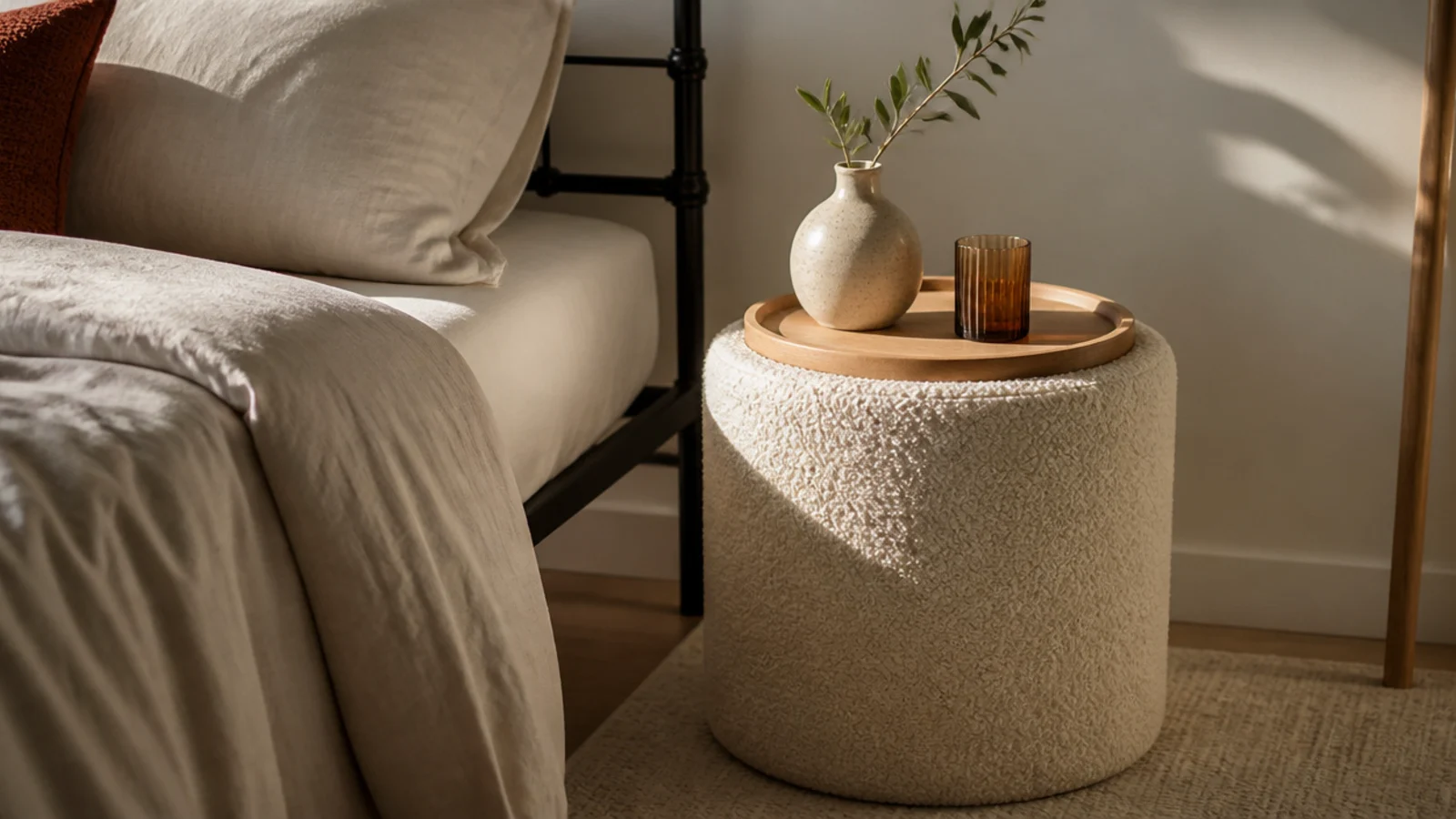
28. A boucle-wrapped drum for softness
An upholstered drum table in boucle or thick wool introduces the one thing a hard modern bedroom usually lacks. Add a removable timber or metal tray on top so a glass has a firm level base, since fabric alone means every drink sits at a slight angle. Choose a removable cover if the room sees any traffic.
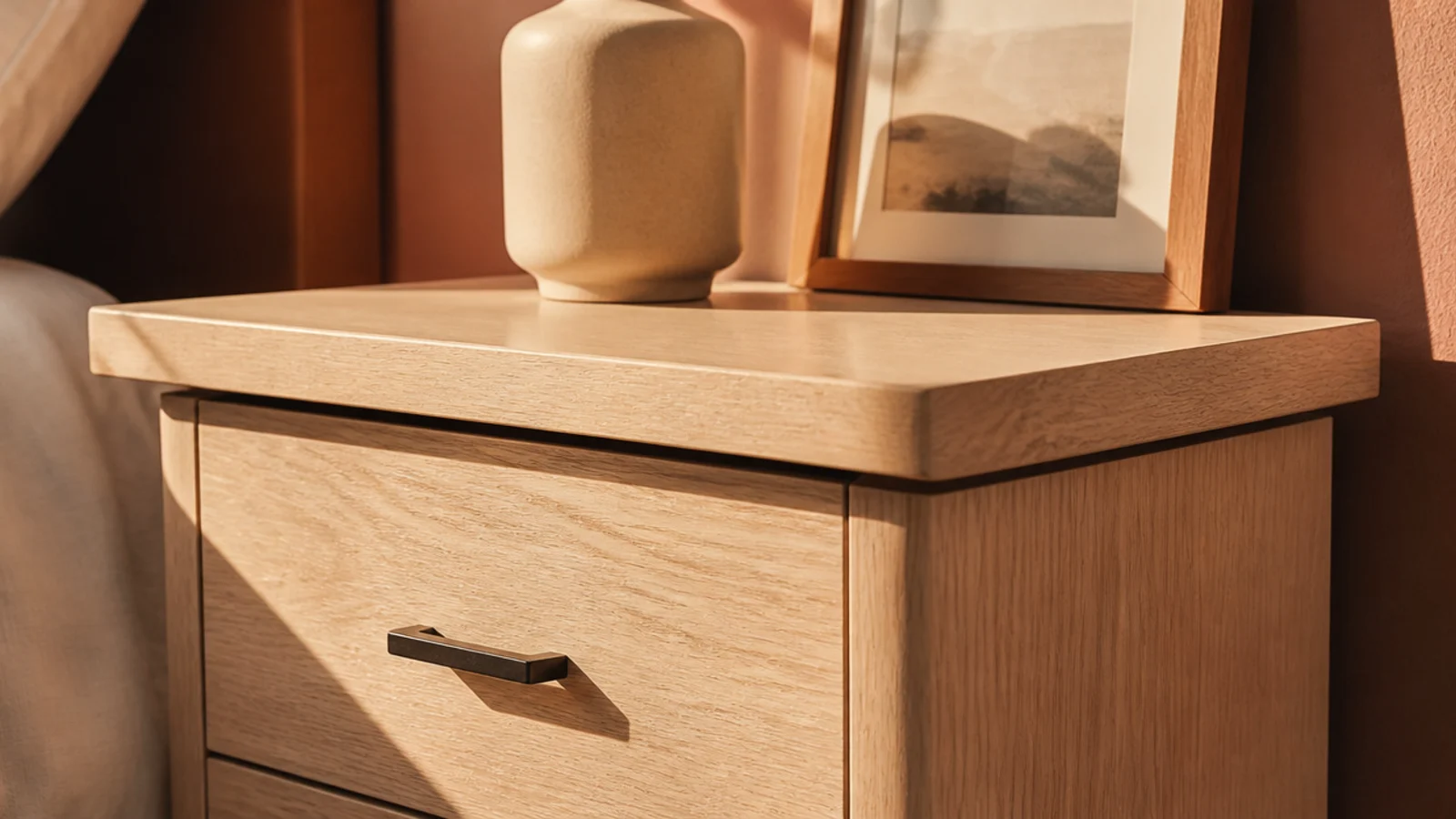
29. A top that oversails the base by two inches
Setting the top proud of the carcass on all four sides creates a continuous shadow line underneath that separates the two volumes. It is a small move — two inches is plenty — and it makes a plain box read as a designed object.
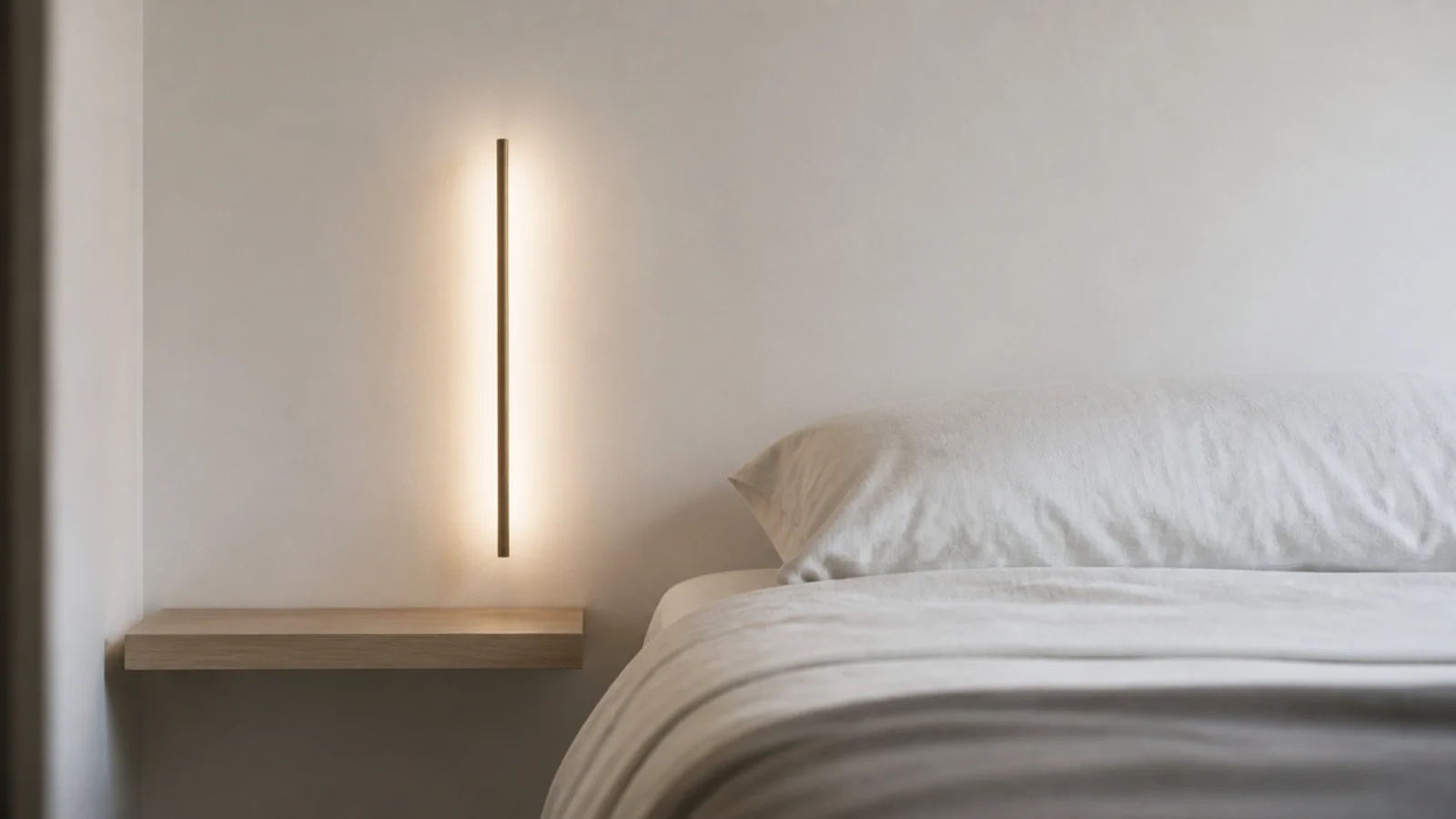
30. Strip the pair back to one horizontal and one vertical
The most modern arrangement available is subtraction. One flat plane at mattress height, one vertical light on the wall, and nothing else — no lamp base, no frame, no plant. It only works if the storage genuinely lives elsewhere, which is why this is the last idea on the list rather than the first.
Where the floor needs to stay completely clear, the wall-mounted builds cover cleats, load ratings and cable routes. For overhead light that removes the lamp entirely, ceiling pendant options explain drop heights beside a bed.
Mistakes to Skip
- Buying a concrete or stone piece without checking the weight. Delivery to an upstairs bedroom is a two-person job and some floors genuinely should not take it.
- Leaving the cable visible. Every other modern decision on the table is cancelled by one white flex looping down to a socket.
- Using untempered glass. Ordinary float glass beside a bed breaks into shards, and the price difference over tempered is small.
- Choosing a pedestal with a base under sixty percent of the top width. It tips the first time you lean on the edge reaching for a glass.
- Stacking modular cubes without strapping them. An unjoined stack shifts every time a drawer is pulled and eventually walks apart.
Frequently asked questions
What makes a bedside table look modern rather than traditional?
Continuous form and absent hardware. A modern nightstand tends to read as one geometric volume — a cylinder, a cube, a cantilevered plane — with recessed finger pulls or push latches instead of knobs. Traditional pieces announce their joinery, their legs and their handles; modern ones hide all three and let the silhouette do the work.
How heavy is a concrete bedside table?
A solid concrete cube sixteen inches on each side weighs roughly 250 pounds, which is a two-person lift and a genuine floor-loading question in an upper-floor flat. Most retail versions are cast as a thin shell over a foam or fibreglass core and land between 25 and 60 pounds, which is what you actually want beside a bed.
Is glass a practical material for a bedside table?
Yes, if it is tempered and at least 10mm thick. Tempered glass breaks into blunt granules rather than shards, which matters enormously beside a bed. It shows every fingerprint and every water ring, so it suits a household that wipes surfaces down, and it visually disappears in a small room where a solid box would dominate.
Do wireless charging pads built into furniture actually work?
They work through timber or stone up to about 8mm thick, which is why they are routed into a recess from underneath rather than sat on top. Expect around 10 to 15 watts, slower than a cable. Alignment matters more than people expect, so mark the sweet spot on the surface with a small inlay or a dish.
What lighting suits a modern bedside table?
A cordless rechargeable lamp, a recessed wall light, or an LED strip concealed under the front lip. All three remove the visible flex, which is the single most old-fashioned looking element on a contemporary nightstand. Keep the output between 300 and 450 lumens at 2700K so it stays readable without lighting the whole room.
Want more like this? Browse all 15 bedside table ideas guides — they all use the same measurements and budget tiers.
Pin it for later
Save this to your Bedside Table Ideas board
Pin it now so it is waiting for you when the tape measure comes out — and so the next person hunting for this idea can find it too.
Save this pinKeep going
More ideas worth saving while you have the tape measure out.