Under Stairs Storage · Review
15 Under Basement Stairs Storage Kits Compared

Some links on this page may become affiliate links in future. I only recommend pieces I would put in my own home — see the affiliate disclosure.
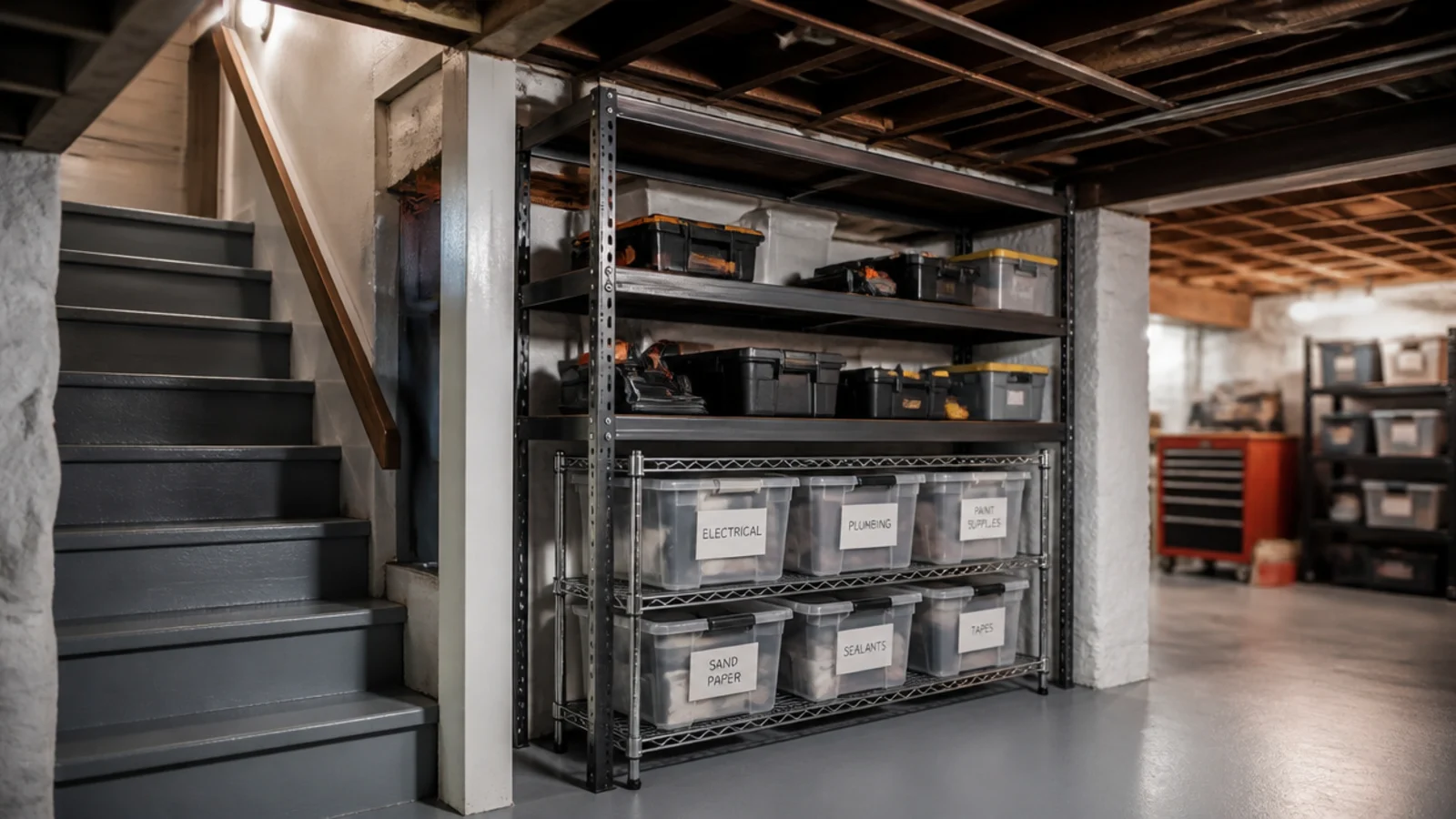
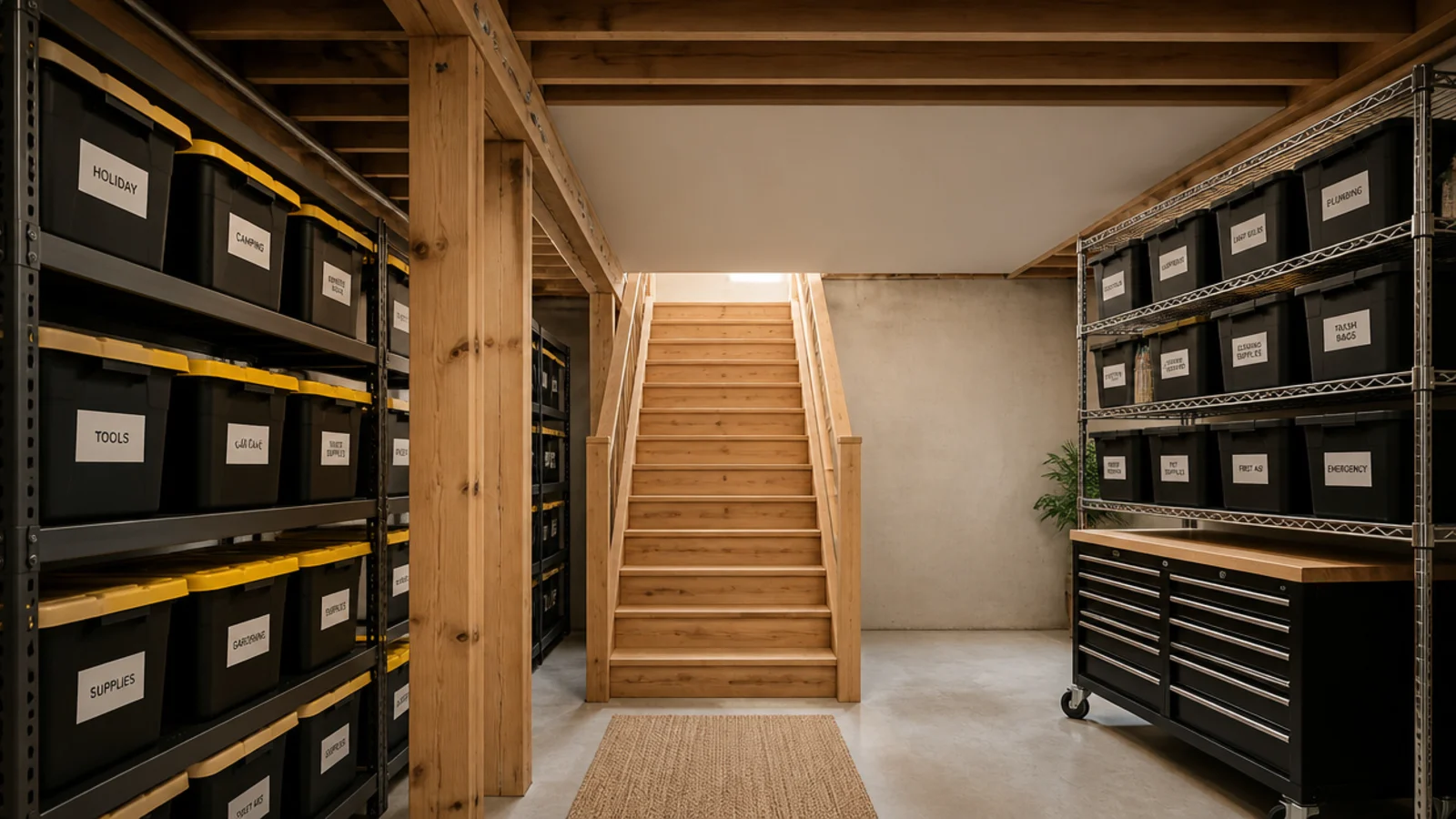
The wedge under a basement staircase is a different problem from the one in a hallway. It is cooler, usually damper, almost always sitting on a slab that wicks moisture upward, and there is a reasonable chance the electrical panel is mounted right in the middle of it. Under basement stairs storage kits should therefore be judged on humidity tolerance and load rating long before looks. Below is every type worth considering, compared on the numbers that decide it, plus the eight I would buy again.
In this guide11 sections — tap to openHide
- 1.How I Chose These Under Basement Stairs Storage Kits
- 2.The Full Comparison: 15 Under-Stair Kit Types
- 3.The boltless rivet steel shelving kit
- 4.The chrome wire shelving unit on castors
- 5.The powder-coated utility shelving kit
- 6.The resin modular cabinet
- 7.The ventilated wire wall rail system
- 8.The rolling triangular drawer kit
- 9.The stackable clear bin tower
- 10.The overhead joist-mounted rack
- 11.What to Check Before You Buy
How I Chose These Under Basement Stairs Storage Kits
I judged every kit on five things, in this order.
- How it copes with damp. Basements sit at 50 to 60 percent relative humidity when they are behaving and well above that when they are not. Open wire and coated steel survive; bare particleboard decks swell, and chrome pits within a couple of years in a genuinely wet basement.
- Load rating per shelf, honestly stated. Rivet steel shelving with proper decks carries several hundred pounds a shelf. Moulded plastic cabinets carry 50 to 100. Both are useful, and buying the wrong one for tools and paint is how a shelf ends up bowed.
- Whether it lifts everything off the slab. Concrete wicks moisture continuously. Anything that keeps boxes four inches clear of the floor solves a problem that no amount of tidying will.
- Footprint against the rake. Most kits are 18 or 24 inches deep and 72 inches tall. Under a stair only the tall third takes a full-height unit, so shorter kits and adjustable rail systems earn their keep.
- Assembly and reversibility. Boltless kits go together with a rubber mallet in twenty minutes. Anything requiring the wedge to be framed and lined is a bigger commitment, and in most codes an enclosed under-stair space has to be lined with half-inch gypsum board on the walls, soffit and underside.
I did not weight brand or finish trends. Everything below is described by construction type, because the same kit appears under a dozen labels and the construction is what you are actually buying.
The Full Comparison: 15 Under-Stair Kit Types
Price tiers: $ under $100 · $$ $100–$300 · $$$ $300+. Load figures assume evenly distributed weight on a level floor.
| Kit type | Best for | Price | Why it works |
|---|---|---|---|
| Boltless rivet steel shelving | Tools, paint, heavy bins | $$ | Several hundred pounds a shelf, mallet assembly |
| Chrome wire shelving on castors | Damp basements, frequent access | $$ | Air moves through every shelf, rolls out |
| Powder-coated utility shelving | Long-term damp exposure | $$ | Coating resists the pitting chrome suffers |
| Resin modular cabinet | Chemicals and wet items | $ | Ignores moisture, wipes clean, doors close |
| Melamine closet kit | Finished basements only | $$ | Looks built-in, needs a genuinely dry room |
| Ventilated wire wall rail system | Following the stair rake | $$ | Every shelf sets at its own height |
| Rolling triangular drawer kit | The unreachable low wedge | $$$ | Purpose-cut to the slope, comes out whole |
| Heavy-duty pull-out drawer frame | Tools at full extension | $$$ | Full extension hardware, no hidden back third |
| Stackable clear bin tower | Seasonal decorations | $ | Front-opening bins need no unstacking |
| Unfinished pine cubby kit | Dry basements, light loads | $ | Cheap, cuts down easily, takes paint |
| Track and bracket wall shelving | Uneven masonry walls | $ | One track line does the levelling for you |
| Overhead joist-mounted rack | Flat, rarely used items | $$ | Uses ceiling volume, costs no floor |
| Slatwall panel kit | Tools and hanging gear | $$ | Hooks reposition in seconds, no re-drilling |
| Covered garment rack | Off-season clothing | $ | Zip cover keeps dust and damp off fabric |
| Locker-style steel cabinet | Lockable household storage | $$$ | Doors, a lock, and a genuinely rigid carcass |
Eight of those are the ones I keep specifying.
1. The boltless rivet steel shelving kit
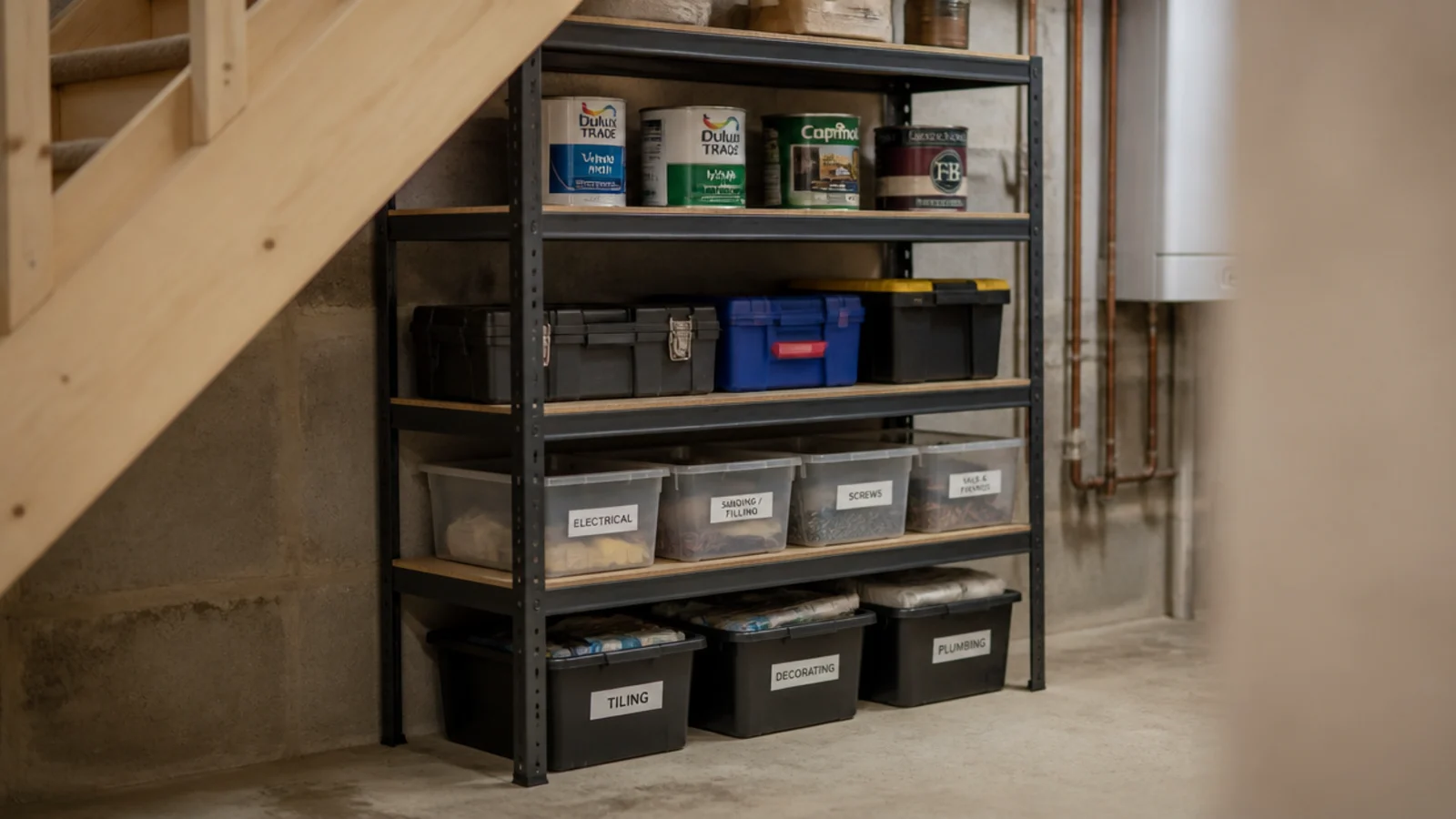
The default answer for a basement and the one I would buy first. Uprights, beams and decks assemble with a rubber mallet in about twenty minutes, with no bolts to work loose.
A unit 48 by 24 by 72 inches carries several hundred pounds a shelf evenly distributed, which is more than the contents of a garage. Two things to check: ask for wire or steel decks rather than particleboard if the basement runs damp, and get levelling feet, because a basement slab is almost never flat. Expect $80 to $200 depending on width and deck type.
2. The chrome wire shelving unit on castors
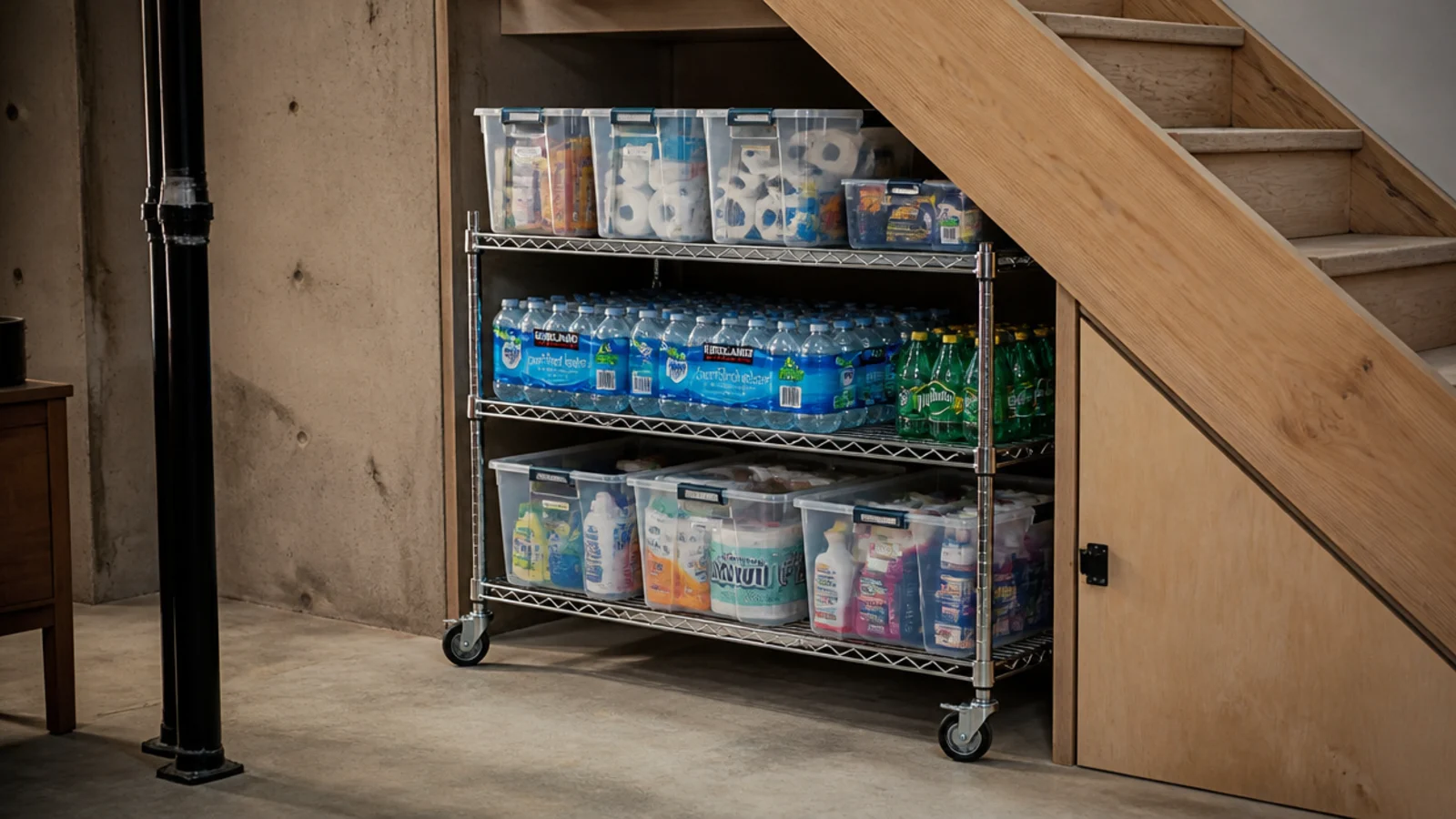
The right choice where humidity is the problem rather than weight. Open wire lets air move around every stored item instead of trapping it against a solid deck.
On locking castors it rolls out from under the stair completely, which turns the awkward middle band into something you can actually load. Buy the version with four locking wheels rather than two, and accept that chrome will eventually show spotting in a basement above 60 percent humidity. Around $70 to $180.
3. The powder-coated utility shelving kit
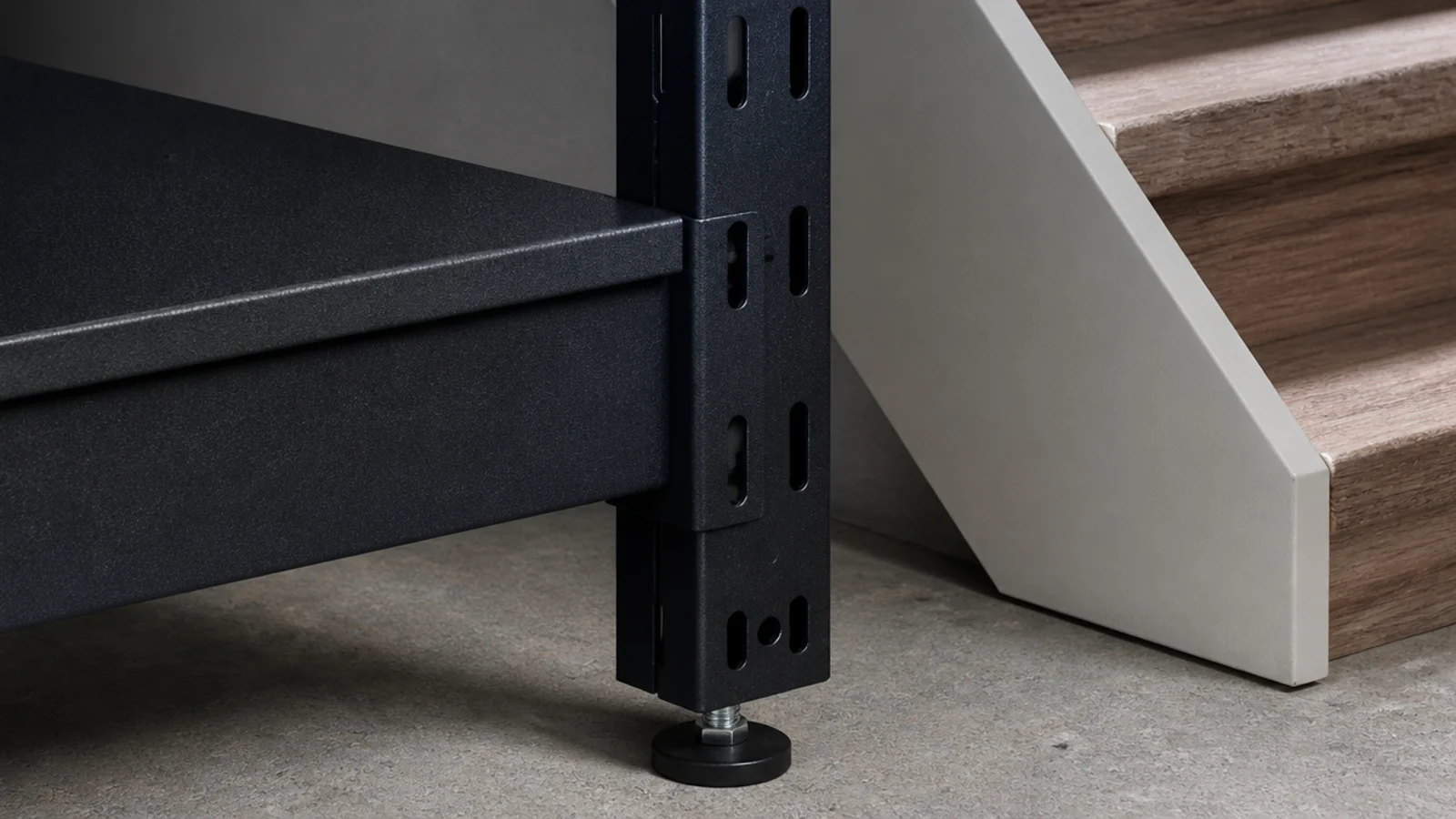
If you have ever pulled a rusted chrome shelf out of a basement, this is the upgrade worth paying for. Powder coat over steel handles condensation far better than plating does.
It costs roughly 20 to 30 percent more than the chrome equivalent for the same load rating, and the difference shows in year three rather than year one. Look for units where the uprights are also coated inside, since that is where corrosion usually starts. Budget $100 to $250.
4. The resin modular cabinet
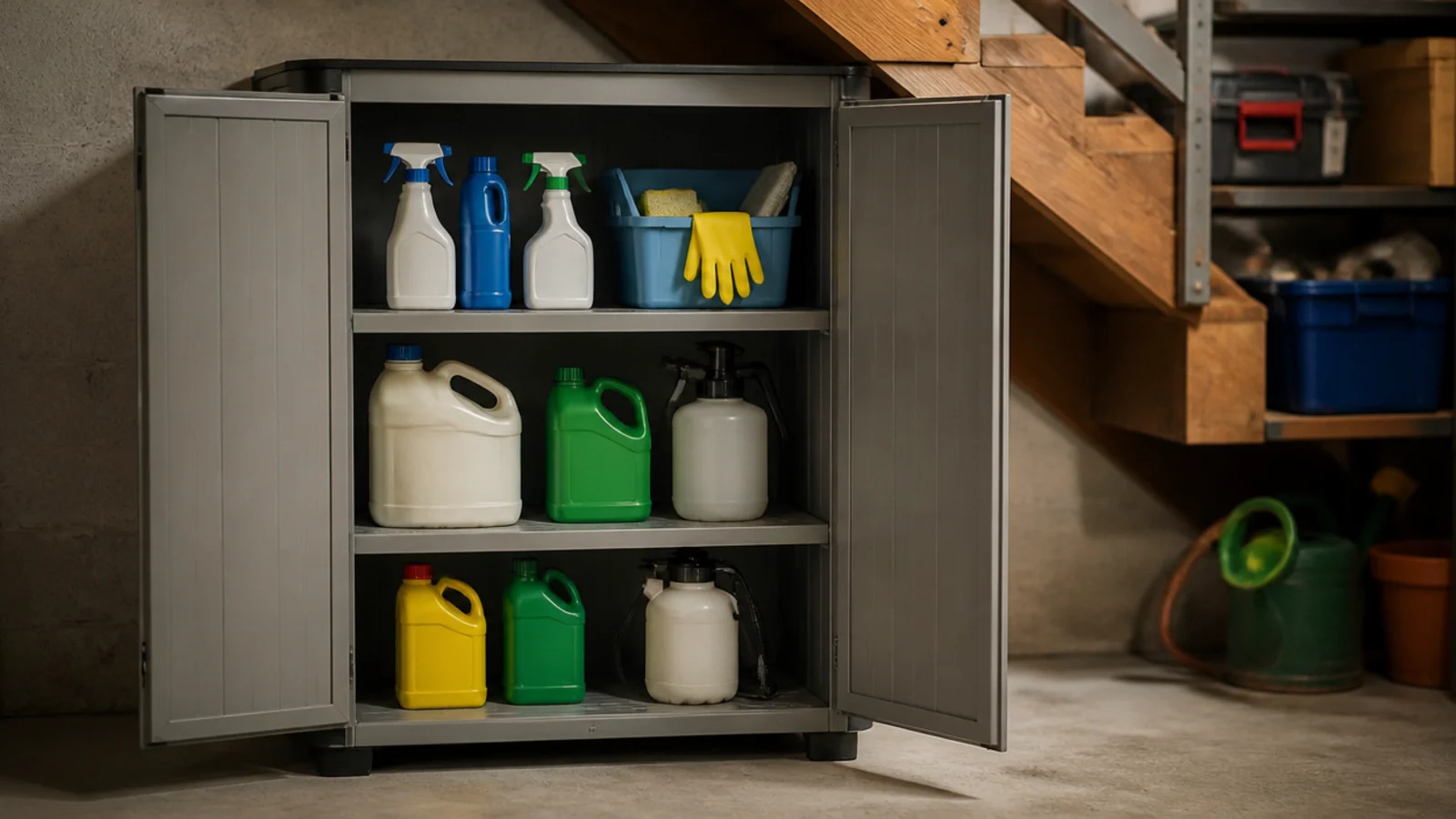
The honest answer for anything that leaks, drips or freezes. Moulded plastic cabinets do not care about moisture, wipe clean, and give you doors, which matters for garden chemicals and cleaning products.
Load rating is the trade-off — usually 50 to 100 pounds per shelf, so this is not where the tools go. Keep it well clear of the furnace or water heater, and never put anything flammable in a cupboard that opens onto a basement stair. Around $90 to $200.
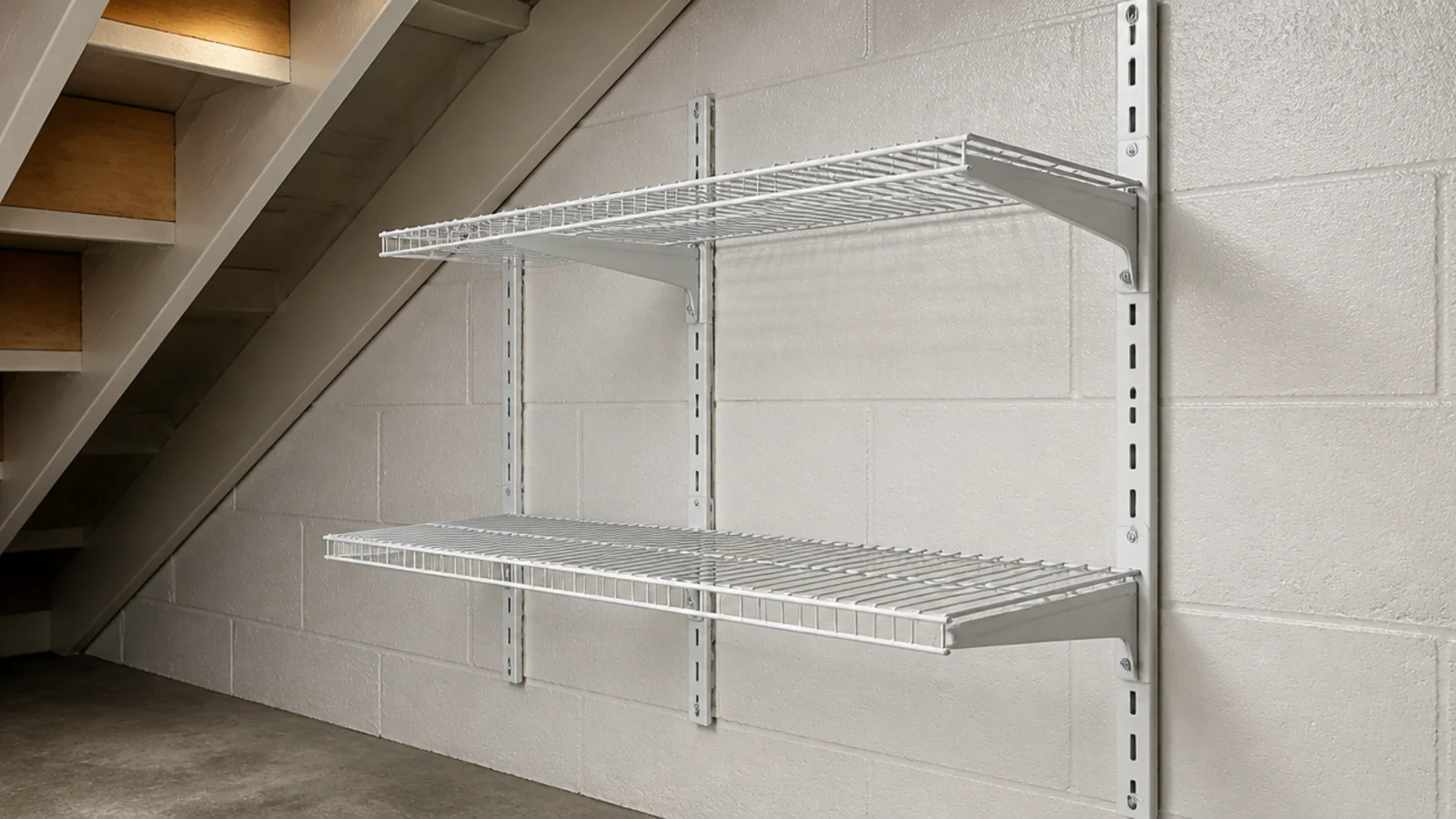
5. The ventilated wire wall rail system
The only kit that genuinely follows a rake, because every bracket sets at its own height on a vertical rail. Under a sloping soffit that is worth more than any amount of load rating.
Fix the rails into studs or into masonry with proper anchors, and check the bracket rating — most are 20 to 40 pounds per pair rather than per bracket. Ventilated shelves also keep air moving, which is exactly what a damp basement needs. Expect $60 to $180 for a run.
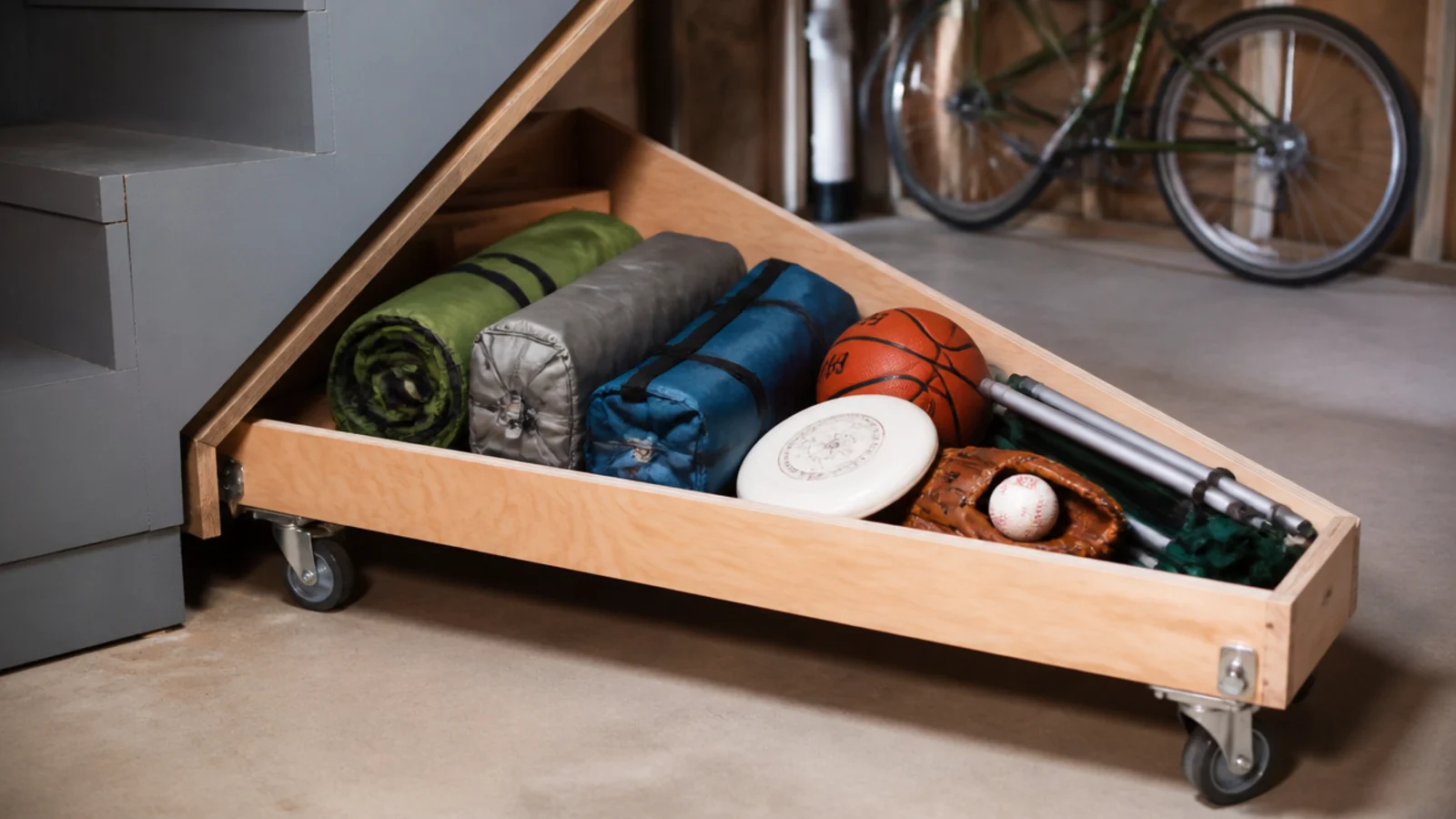
6. The rolling triangular drawer kit
The most expensive option here and the only one that uses the low wedge properly. A triangular carcass on heavy castors rolls out complete, so the two feet nearest the floor stop being dead space.
Look for full-extension hardware or true castors rather than glides, and check the floor: a slab with a slope will fight a rolling unit every time. On a basement stair with 9 to 11 feet of run this recovers a genuinely useful volume. From $300, and often twice that custom built. The under stairs storage solutions guide covers building one yourself.
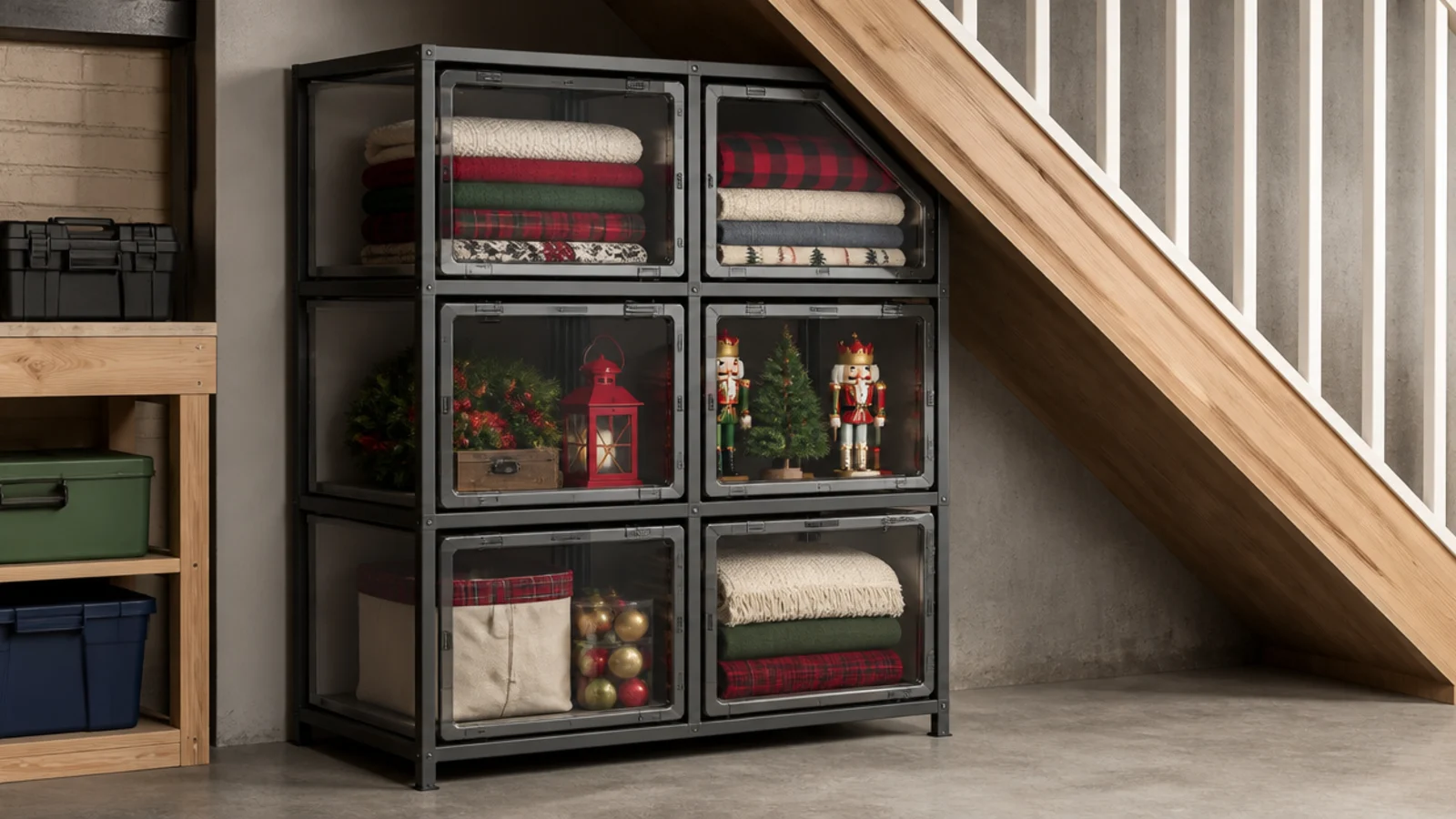
7. The stackable clear bin tower
The best value on this list for seasonal storage. Front-opening bins in a steel frame mean you never unstack four boxes to reach the bottom one, which is the reason most stacked storage stops being used.
Clear sides let you identify contents without labels, though labelling on two faces is still worth doing under a stair where you read boxes at an angle. Keep the tower off the slab on the frame feet. Around $60 to $150 for six bins with a frame.
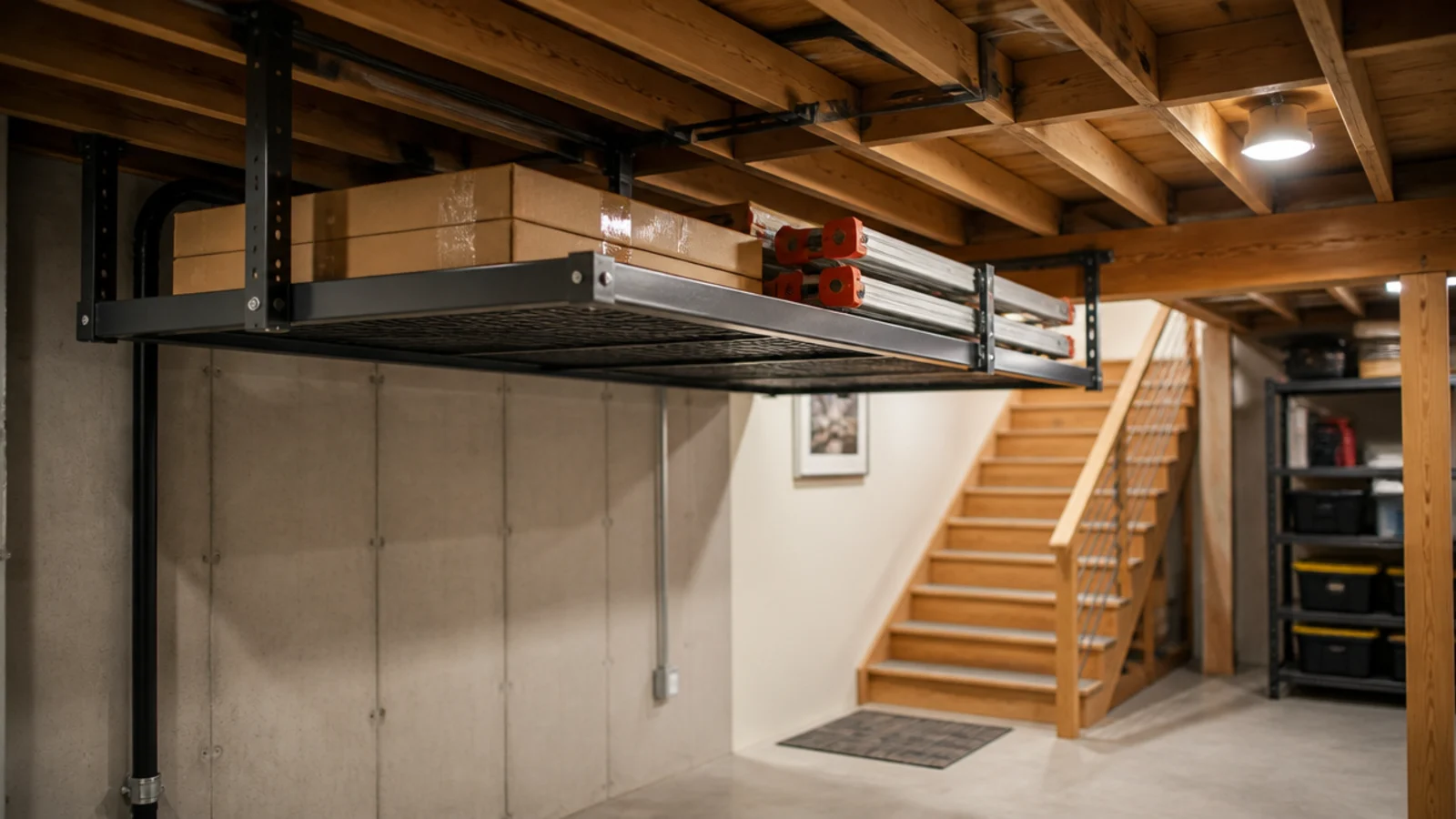
8. The overhead joist-mounted rack
Not strictly under the stairs, but the volume above the basement stair landing is usually completely empty. A steel rack bolted through exposed joists takes flat, light, rarely used items and costs no floor area at all.
Bolt into at least three joists, keep the load under the stated rating with a wide margin, and never hang anything above where people walk on the stairs themselves. Check headroom before fitting, because a rack at head height on a landing is a genuine hazard. Expect $80 to $250.
What to Check Before You Buy
Find the electrical panel first. Code generally requires a clear working space in front of a panel of about 30 inches wide by 36 inches deep with full headroom, and it must stay permanently clear. Basement panels are very often under the stairs. Measure that zone, mark it on the floor, and plan around it.
Leave the furnace, boiler and water heater alone. Every one of them has manufacturer service and combustion air clearances, and none of them may be boxed in. The same applies to a gas meter. If they share the wedge, that section is not storage — it is a service zone with a removable panel at most.
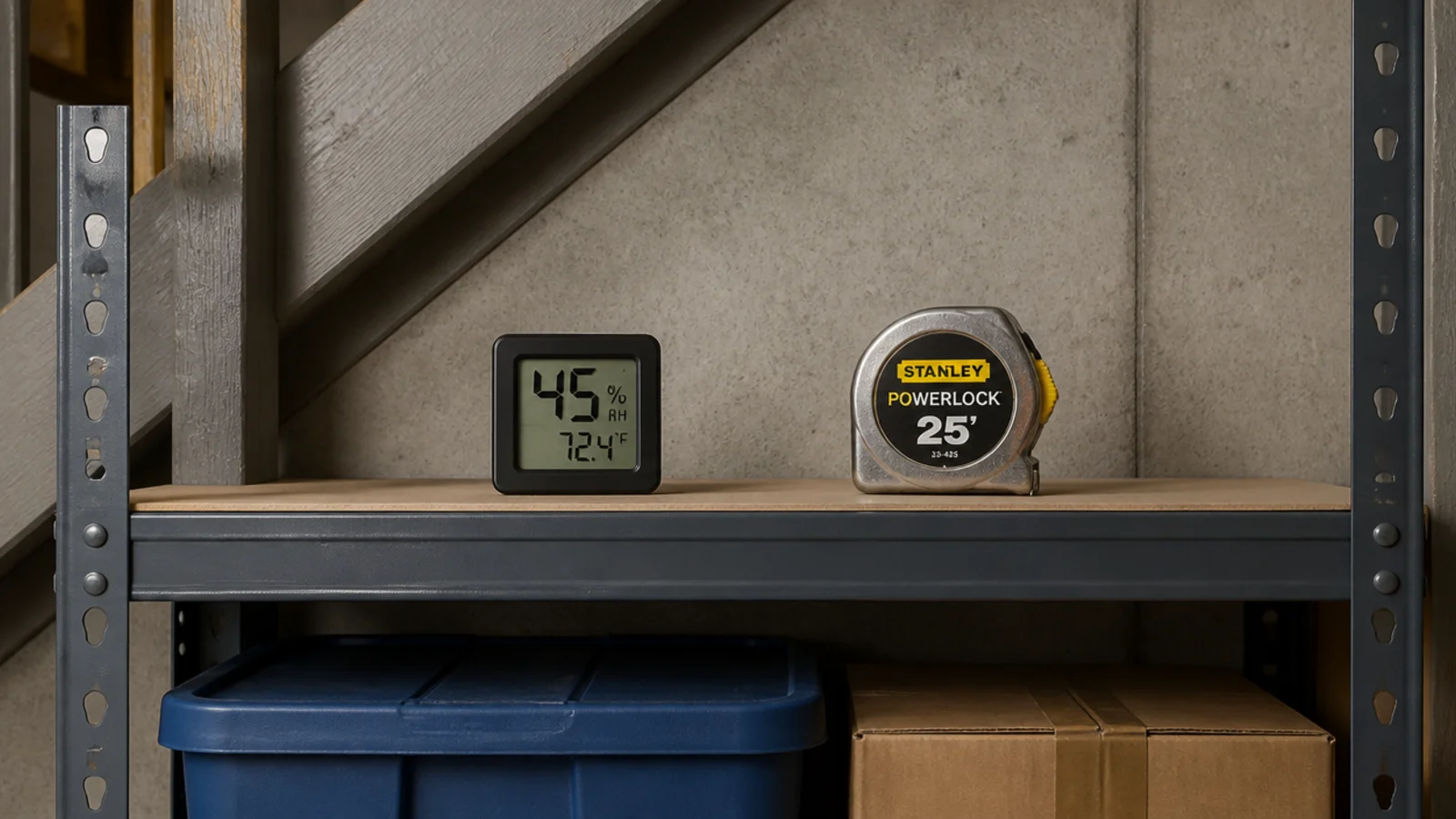
Measure the humidity before choosing materials. A cheap hygrometer for a week tells you whether you are buying wire and plastic or whether melamine will survive. Above 60 percent relative humidity, particleboard decks and unfinished timber are a false economy.
Get everything four inches off the slab. Concrete wicks moisture upward continuously. Levelling feet, a plinth or castors solve it; cardboard boxes sitting directly on the floor do not, and the damage starts at the bottom corner where you cannot see it.
Check the fire lining rule if you plan to enclose it. Most residential codes require an enclosed accessible space under a stair to have its walls, the stair underside and any soffit protected with half-inch gypsum board. Open shelving under an open stair avoids the question entirely.
Keep the stair itself and its landing clear. A basement stair is an escape route, and in many homes it is the only one from that level. Nothing stores on the treads, on the landing or in the walking line at the bottom, however tempting the space looks.
Frequently asked questions
What is the best storage kit for under basement stairs?
Boltless rivet steel shelving for weight and open wire shelving for damp. Rivet units carry several hundred pounds a shelf and assemble with a rubber mallet, while wire lets air move around everything stored on it. In a basement that runs above sixty percent humidity, airflow matters more than capacity.
Can I put storage in front of my electrical panel?
No. Electrical code requires a clear working space in front of a panel, generally thirty inches wide by thirty-six inches deep with full headroom, and it has to stay clear permanently. Basement panels very often sit under the stairs, so measure that zone first and design the rest of the wedge around it.
Is it safe to store cardboard boxes on a basement floor?
Not directly on concrete. A slab wicks moisture upward continuously, and cardboard sitting on it goes soft and mouldy from the base up. Keep everything at least four inches off the floor on shelving feet or a plinth, and use sealed plastic bins for anything fabric or paper.
Does an enclosed space under basement stairs need fire protection?
In most residential codes, yes. An enclosed accessible space under a staircase generally has to have its walls, the underside of the stair and any soffit protected with half-inch gypsum board. Leaving the framing exposed is common in older basements and is exactly what an inspection will pick up.
How much should I spend on under basement stairs storage?
A basic steel or wire shelving unit runs under a hundred, a good rivet or heavy-duty wire kit a hundred to three hundred, and a custom rolling drawer system three hundred upward. Spending more mostly buys load rating, corrosion resistance and full-extension hardware, all three of which are worth it in a damp basement.
Buy for the humidity you actually have rather than the basement you wish you had — that single decision separates shelving that lasts a decade from shelving you replace in three years. The under stairs storage guide covers the hallway version of the same wedge, small utility room ideas has appliance clearances if the basement doubles as a laundry, and floating shelf ideas covers the wall above the stair once the floor is sorted. Save the pin for the next hardware run.
Want more like this? Browse all 14 under stairs storage guides — they all use the same measurements and budget tiers.
Pin it for later
Save this to your Under Stairs Storage board
Pin it now so it is waiting for you when the tape measure comes out — and so the next person hunting for this idea can find it too.
Save this pinKeep going
More ideas worth saving while you have the tape measure out.