Shoe Cabinet Ideas · Listicle
30 Simple Shoe Cabinet Ideas on a Budget

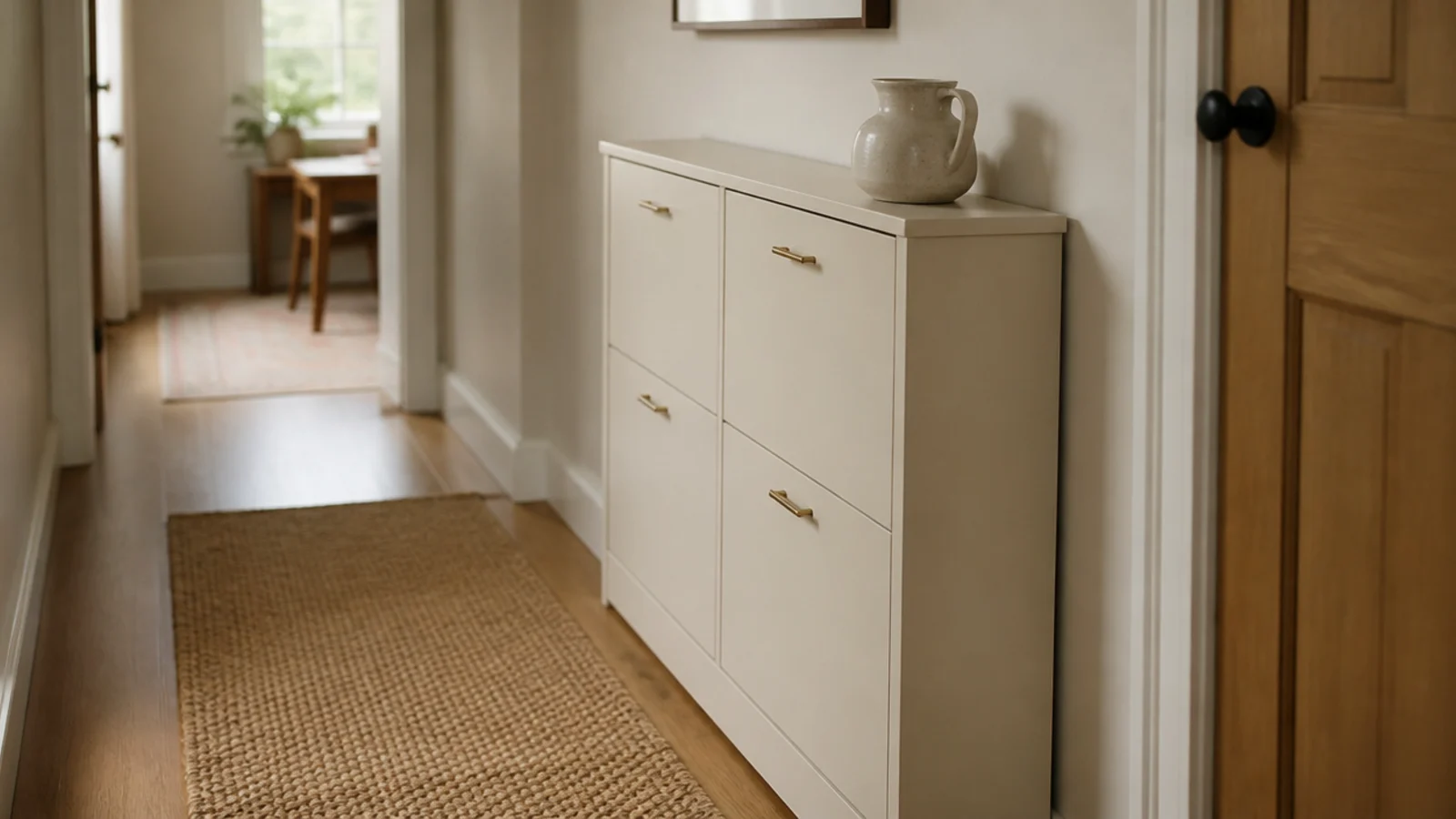
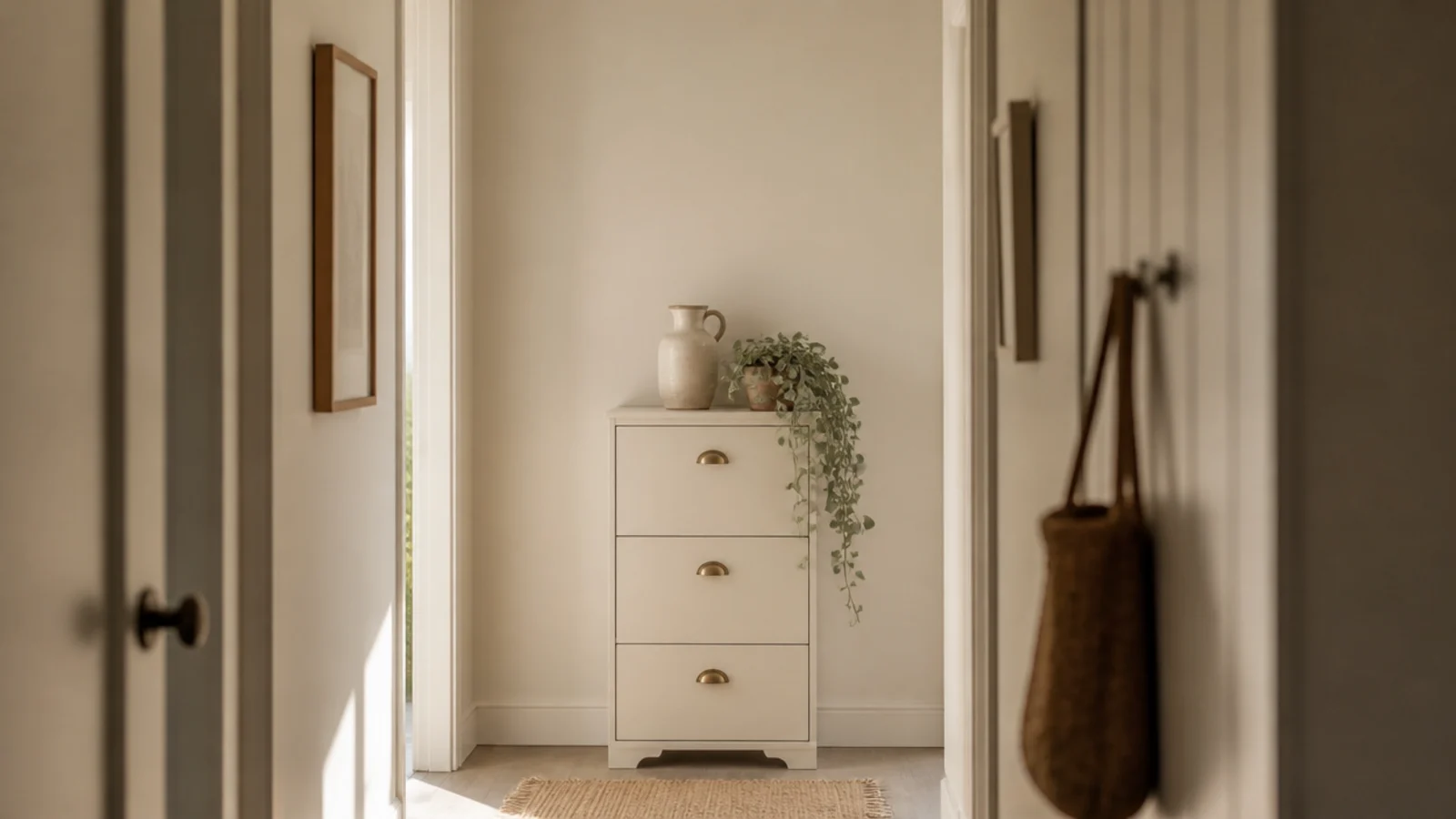
A slim shoe cabinet is the only closed storage that works in a hallway under 40 inches wide, and the reason it works is geometry rather than clever engineering. Tilt a 12.5-inch sneaker to 45 degrees and it fits inside 9 inches of depth. These 30 budget setups all live in that shallow band, and every one names its pair count and where the air gets in.
In this guide32 sections — tap to openHide
- 1.How a slim shoe cabinet fits where nothing else will
- 2.The nine-inch tilt-out is the whole category
- 3.Measure the walkway, not the wall
- 4.Two drawers, not three, in a short hall
- 5.A six-inch cabinet for flats only
- 6.Wall-hung so the floor stays clear
- 7.The strip behind the open door
- 8.A slim tower beside the doorframe
- 9.Half-depth shelves for a household of small shoes
- 10.Slide it under a floating console
- 11.A slim cabinet as a bedroom nightstand
- 12.Recess it into a stud bay
- 13.Slim doors, deeper top
- 14.Push-latch fronts instead of handles
- 15.A slim cabinet under a window sill
- 16.Use the radiator gap depth
- 17.Two slim units flanking a doorway
- 18.A mirror front to widen a narrow hall
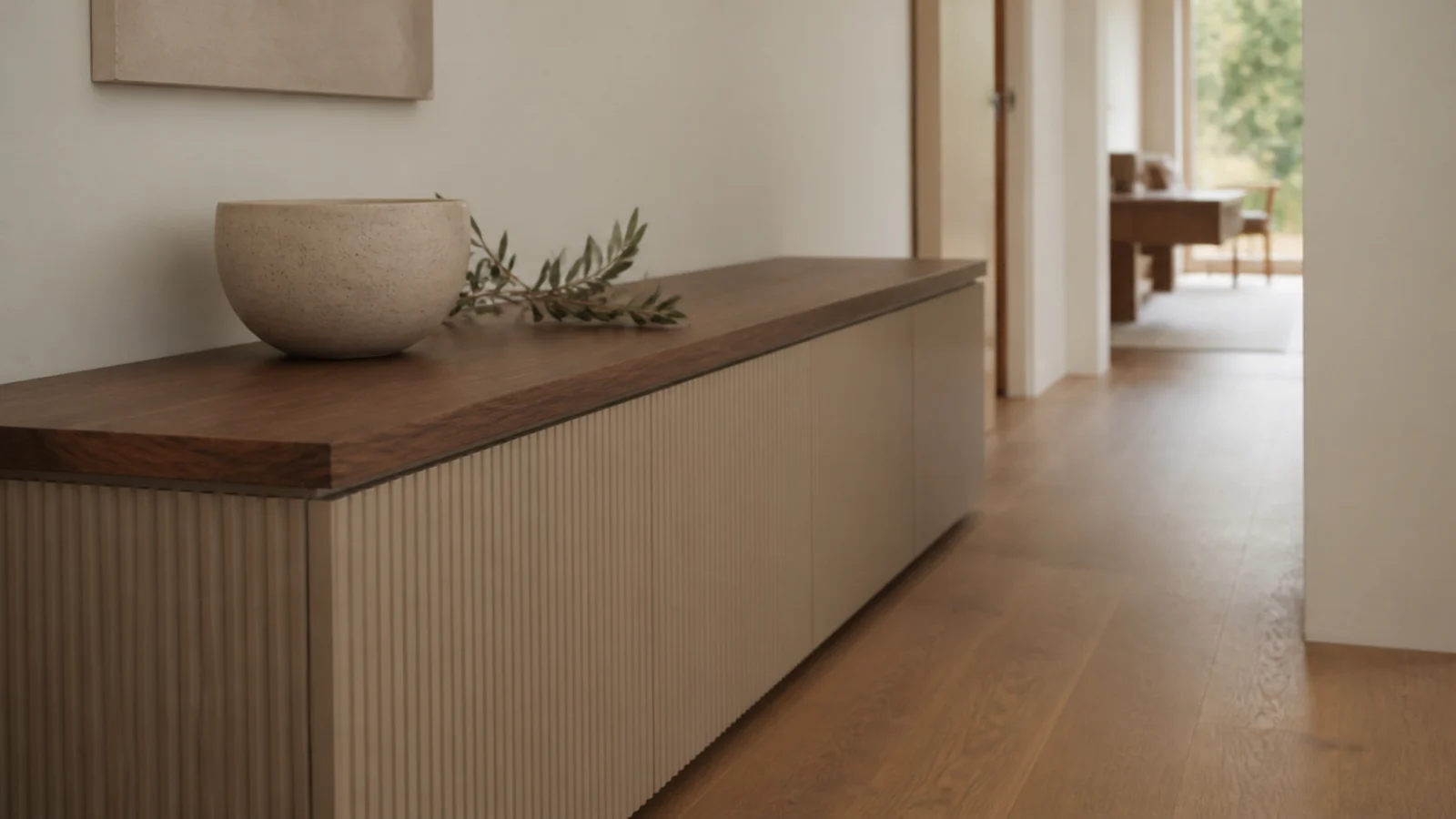
- 19.Vertical grain to lift a low box
- 20.Leave the toe kick open for air and toes
- 21.A sixteen-inch boot bay at the bottom
- 22.Cut the plinth so it clears the baseboard
- 23.A pull-out drying tray at the base
- 24.An angled end panel for a tight turn
- 25.Paint the front, paper the side
- 26.Slide a slim cabinet under a stair run
- 27.Fit it wall to wall in an alcove
- 28.Interior lighting for a shallow bay
- 29.Soft-close on every front
- 30.Strap any tower over forty inches
- 31.Wet tray on the floor, never inside
- 32.Mistakes to Skip
How a slim shoe cabinet fits where nothing else will
Start with the walkway. A hallway needs 36 inches of clear passage, so measure from the wall out to that line and whatever remains is the depth you can spend. In most small entries that is 9 to 12 inches, which is exactly why this category exists. Standard hallway cabinets run 9 to 15 inches deep and the shallow end is where most people actually live.
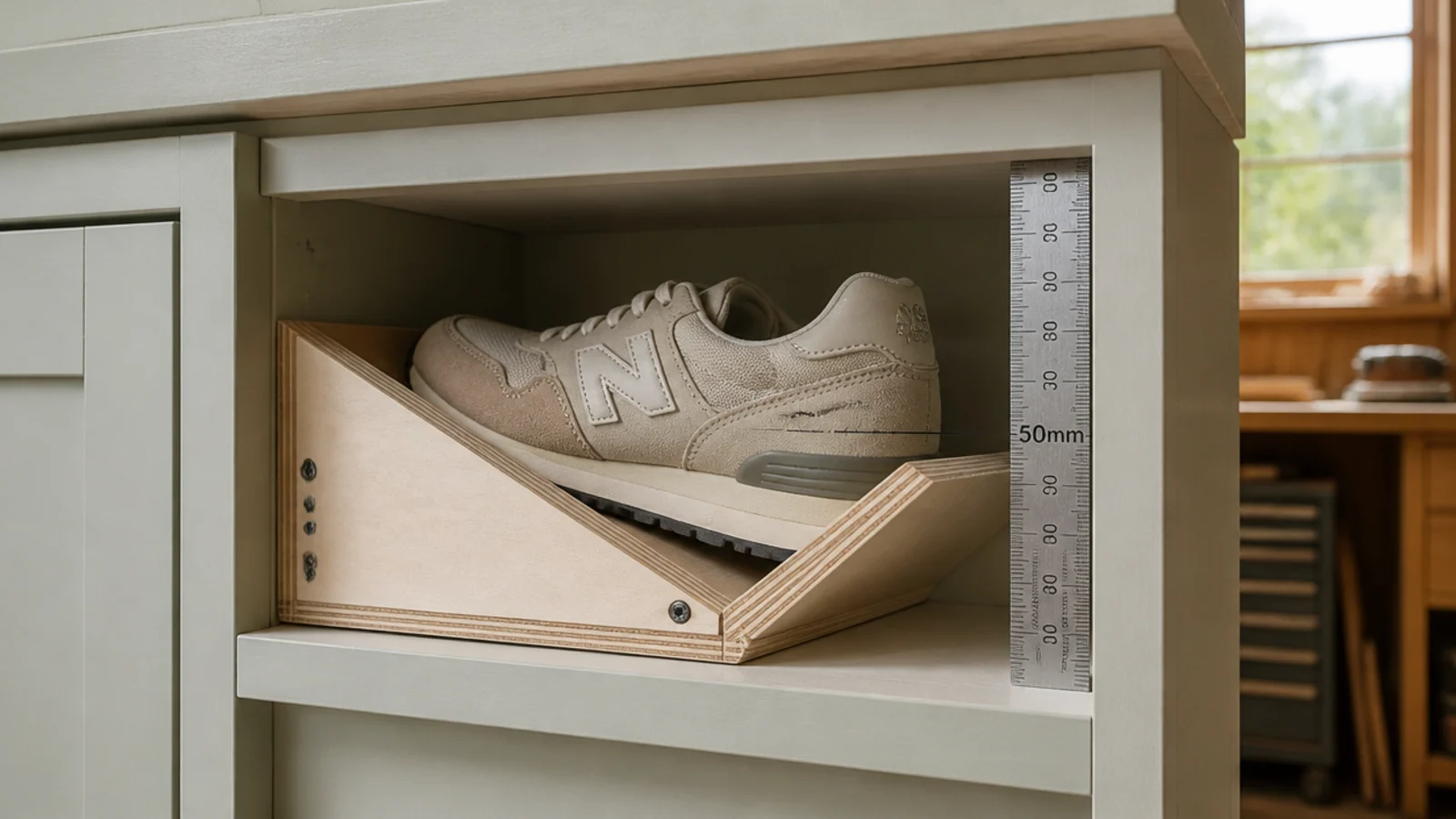
Flat shelves need 13 inches of internal depth to lie an adult sneaker down — internal, because a door and a back panel eat close to an inch between them. A tilt-out drawer holds that shoe on its side at 45 degrees and needs only 9. That single angle is the entire trick.
The trade is honest and worth knowing before you buy. Each tilt-out drawer takes six to eight pairs of flats, sneakers and loafers, and no boots at all. Boots need a bay 16 inches tall for ankle heights and 20 for knee-highs. If boots live at your door, plan for them separately rather than hoping.
And ventilate. A sealed box with damp shoes inside smells within a fortnight, every time. Drilled holes, slatted doors or an open toe kick — pick one before the cabinet arrives.
Budget tiers: $ under $60, $$ $60–$150, $$$ $150+.
1. The nine-inch tilt-out is the whole category
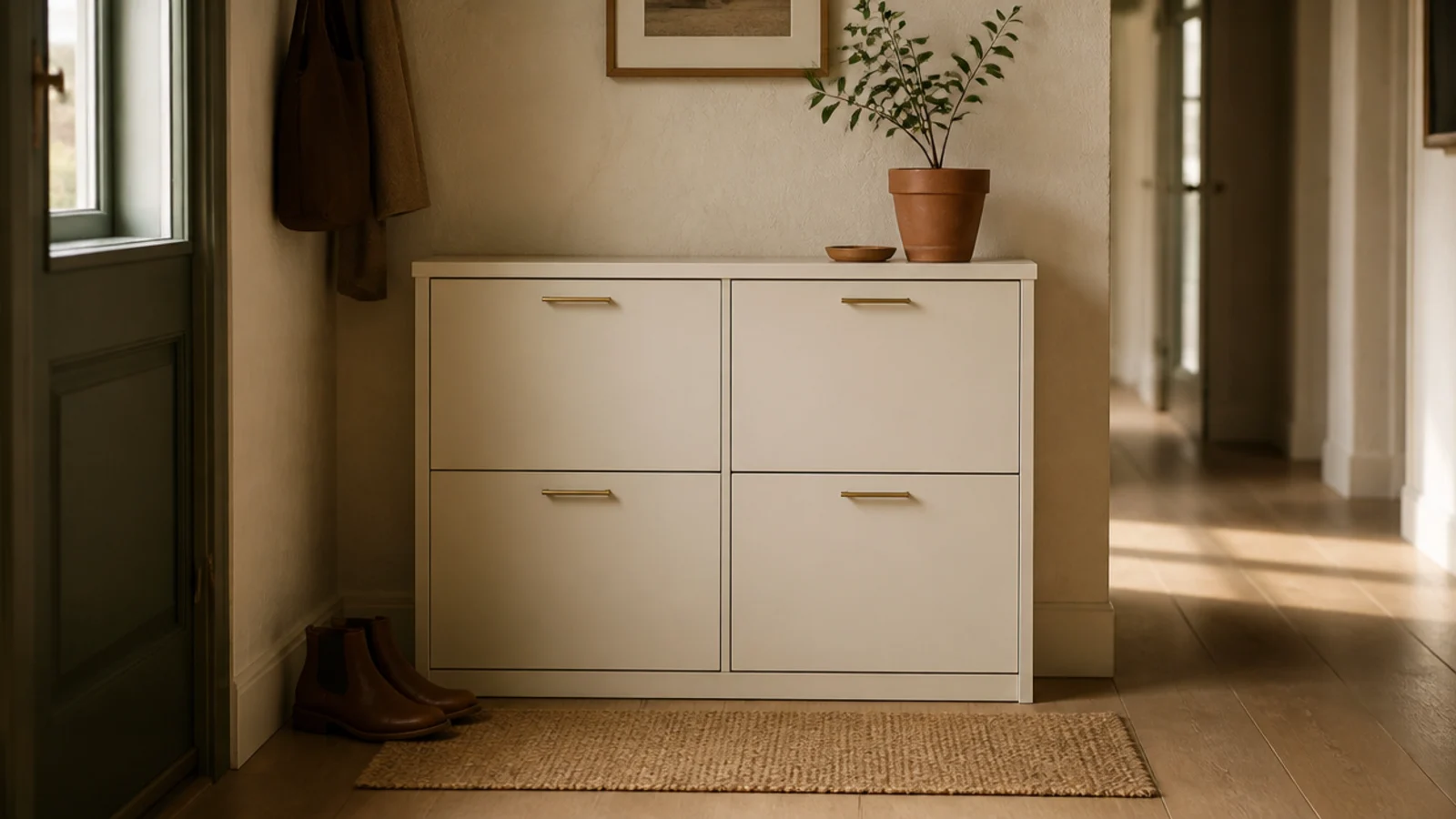
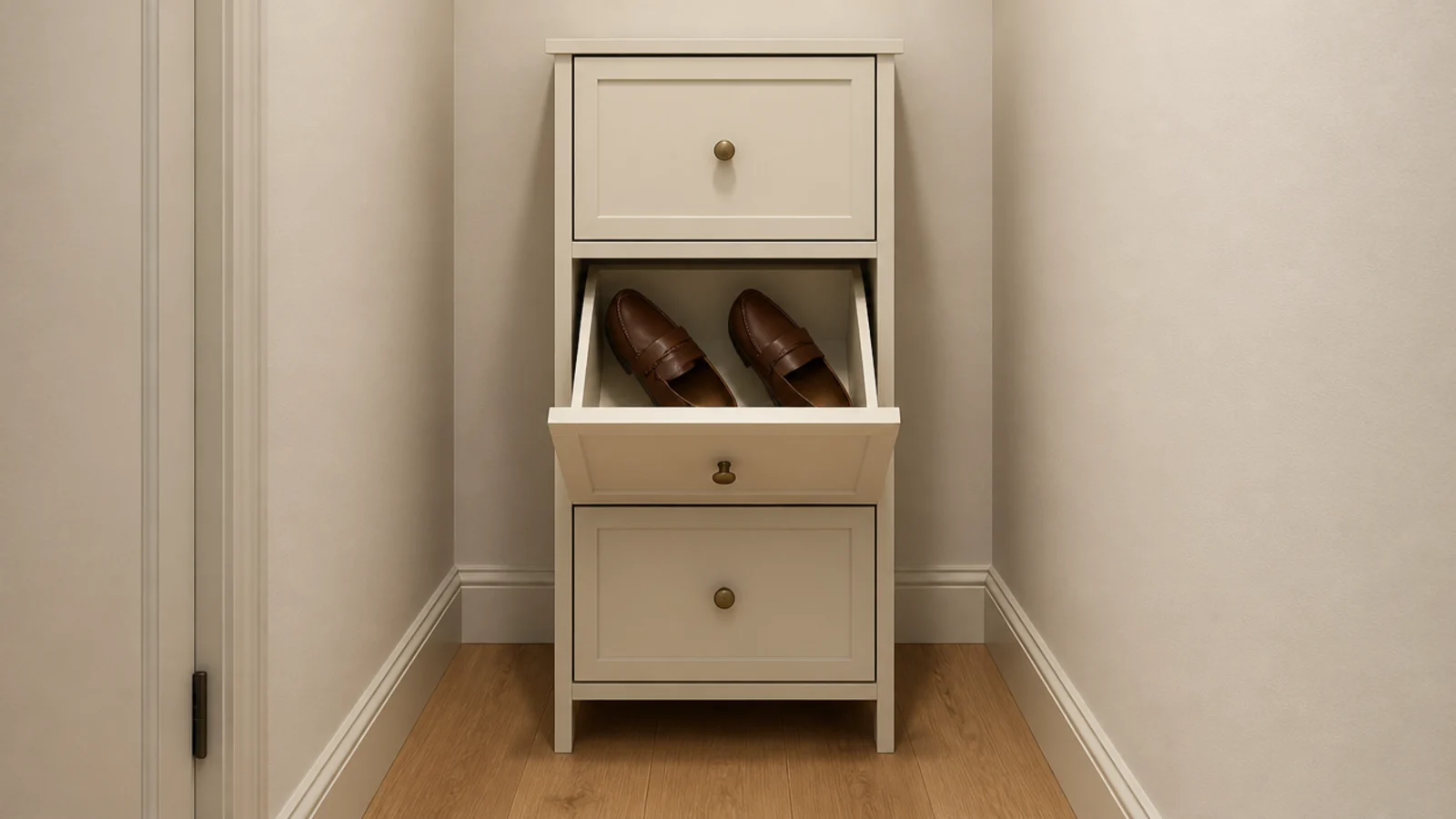
Almost every slim cabinet worth owning is a tilt-out, because nothing else fits an adult shoe into that depth.
Look for a metal drawer stop rather than plastic — it is the part that fails first, and once it goes the front drops open by itself. Two drawers hold twelve to sixteen pairs. $$
2. Measure the walkway, not the wall
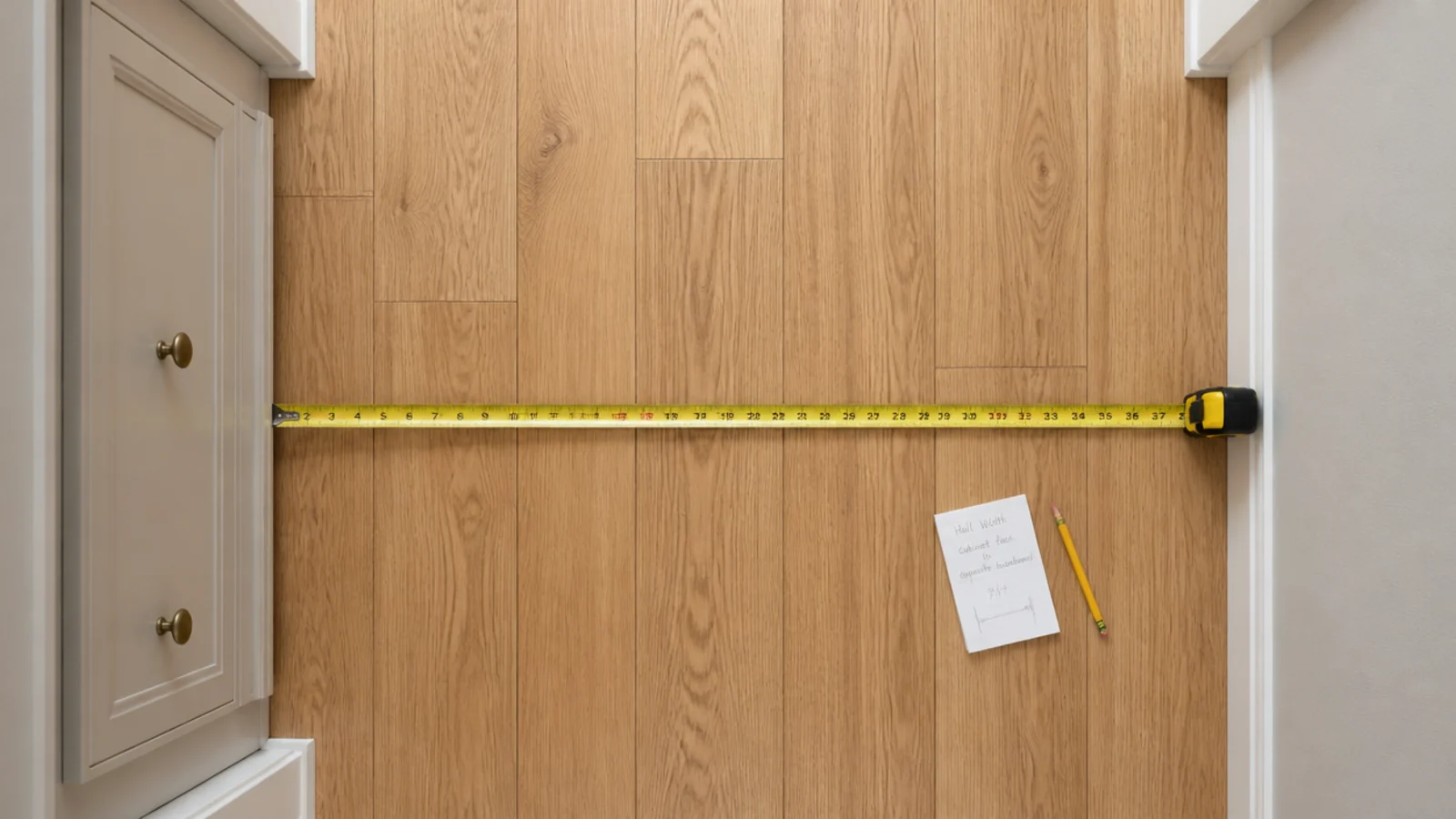
Stand where the cabinet will go and measure to the nearest thing you walk around. Subtract 36 inches and you have your maximum depth.
Nobody regrets a cabinet an inch shallower than the maximum. Everybody regrets the one they turn sideways past every morning. Free
3. Two drawers, not three, in a short hall
In a hall under 8 feet long, a 30-inch-tall cabinet reads as furniture and a 44-inch one reads as a wall.
Two drawers still hold twelve to sixteen pairs. Stopping below the light switch line keeps the whole corridor feeling open. $$
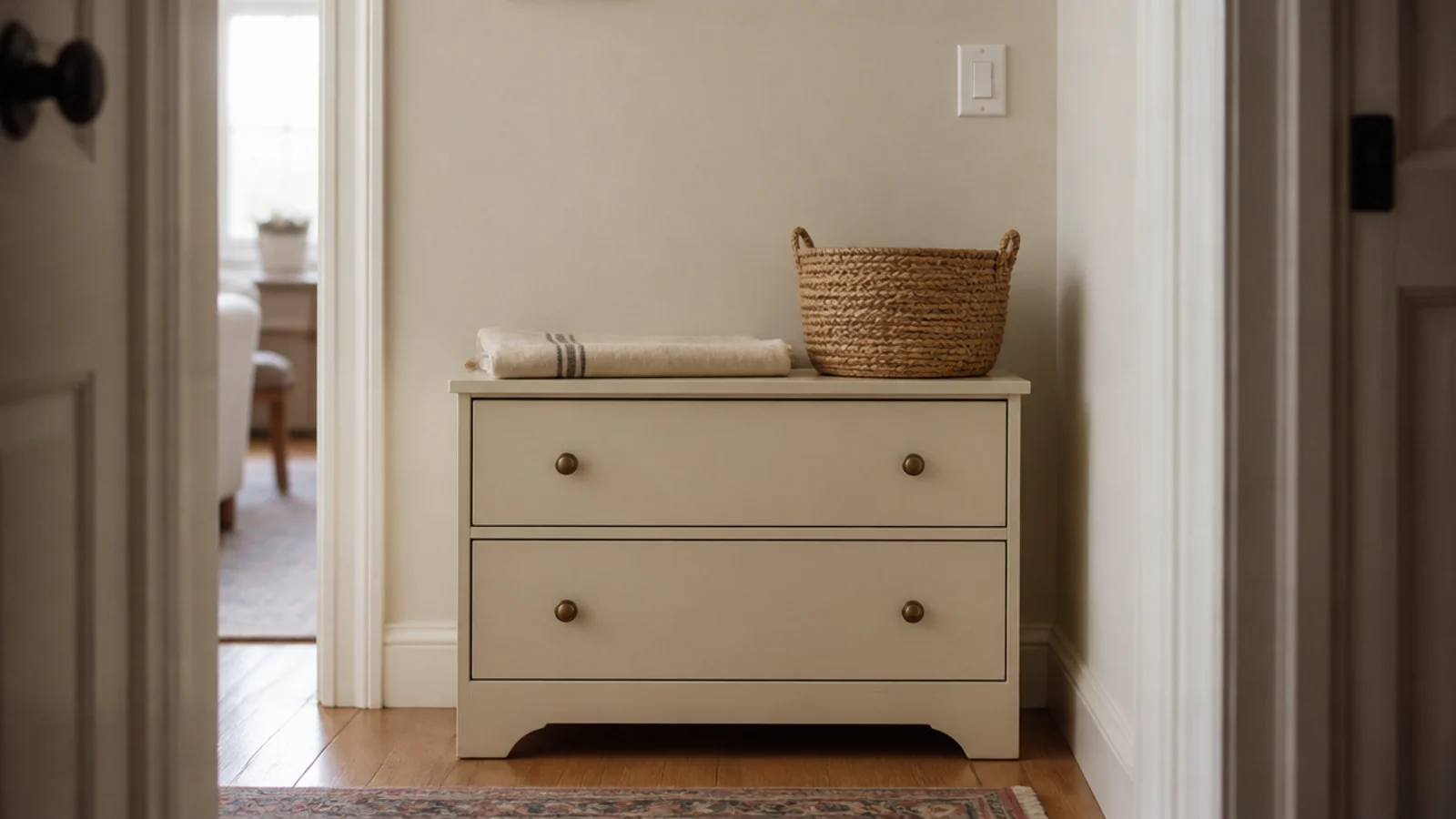
4. A six-inch cabinet for flats only
Six-inch units exist and they are honest about their limits: sandals, canvas shoes, ballet flats and children's shoes standing on edge.
Nothing with a structured sole fits. Treat it as summer storage or a second cabinet, never the only one. $
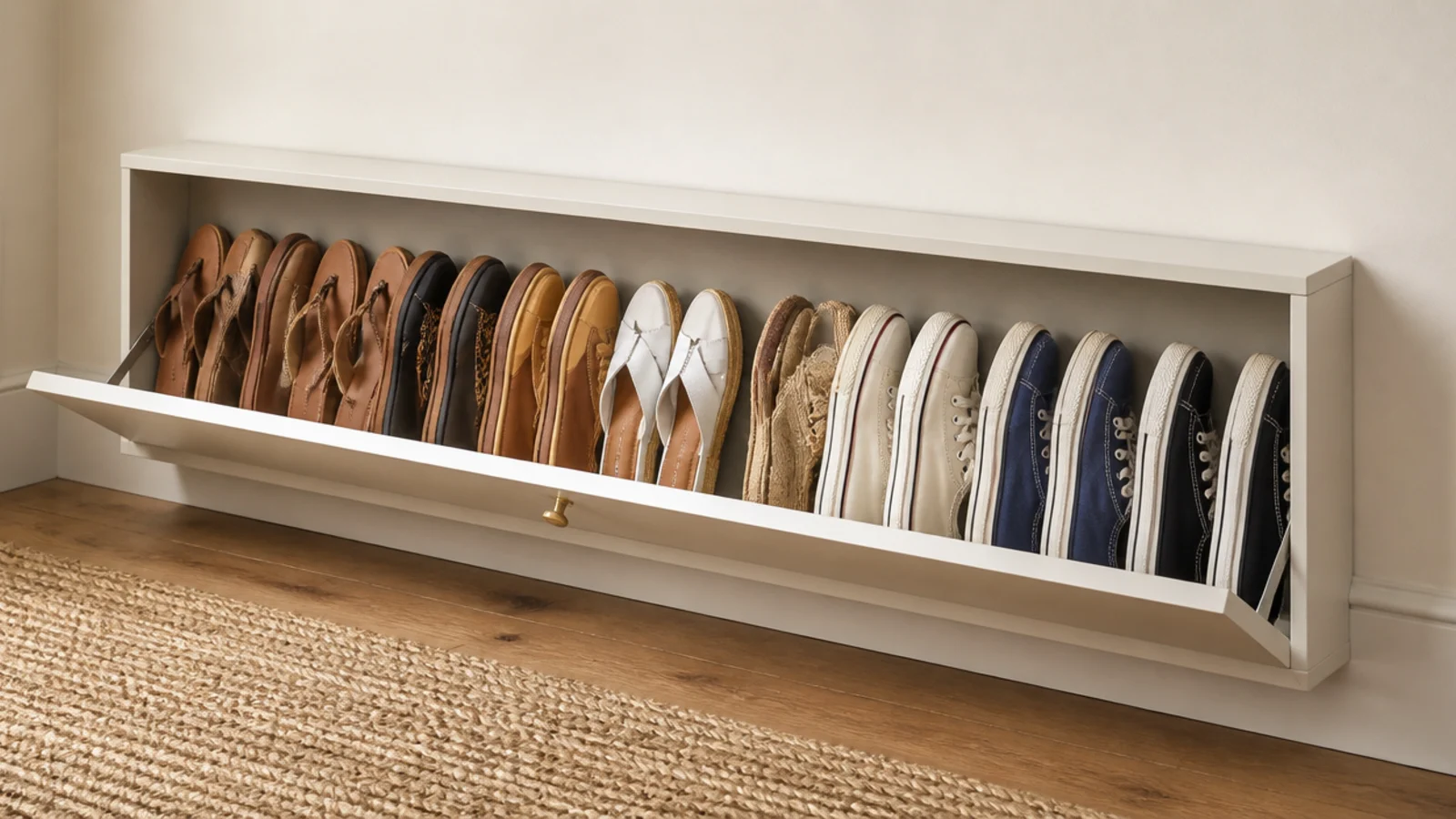
5. Wall-hung so the floor stays clear
Mounting a shallow cabinet on the wall with a continuous cleat leaves the floor unbroken, which makes a narrow hall read noticeably wider.
Into studs only, or heavy-duty toggles rated well above the loaded weight. Keep the base 8 inches up so a vacuum passes under. $$
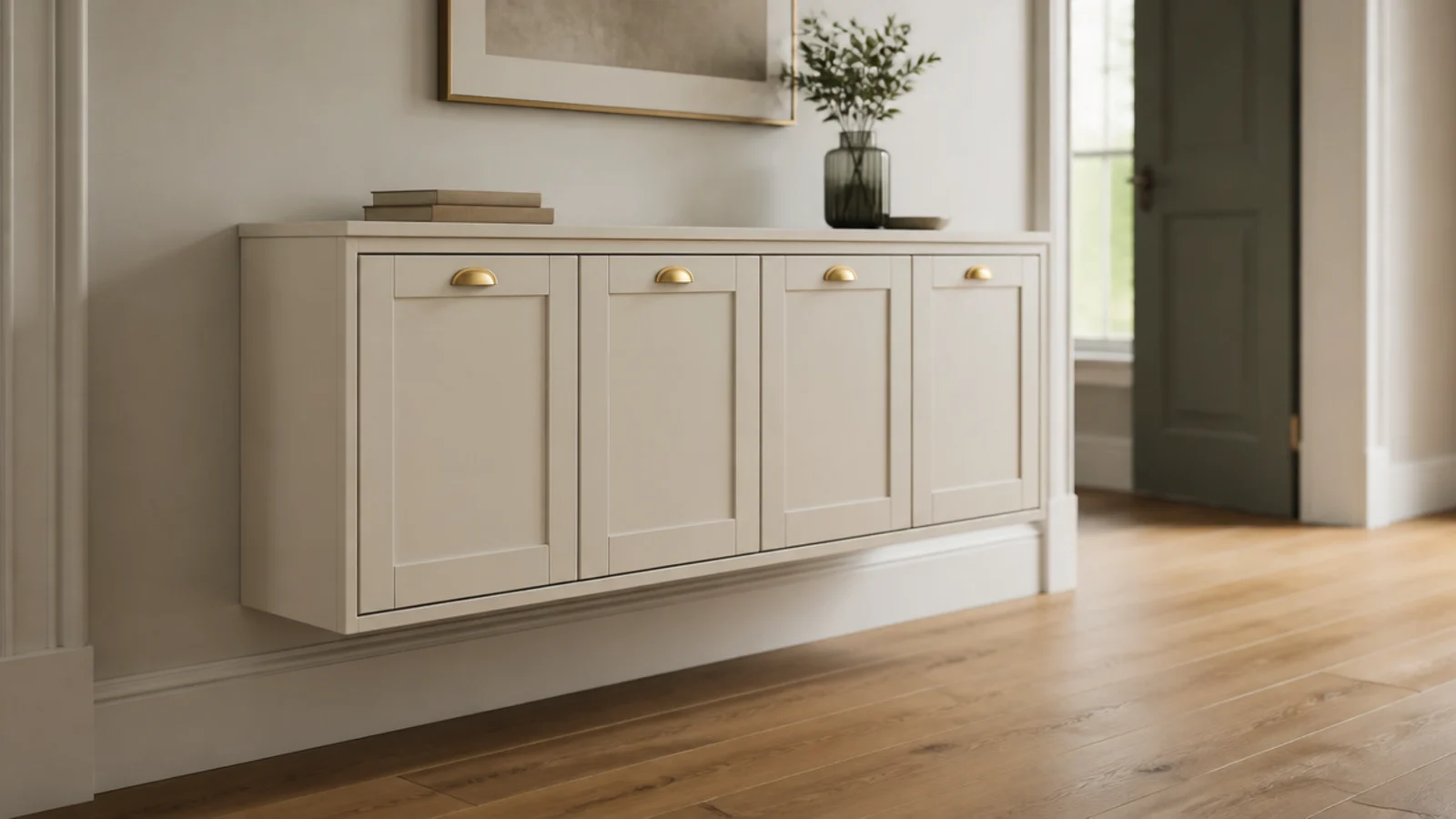
6. The strip behind the open door
Open the front door fully, measure from the wall to the door face and subtract two inches. That is usually 6 to 9 inches of completely free storage.
Nothing here touches the walkway, and the cabinet is invisible whenever the door is open. $$
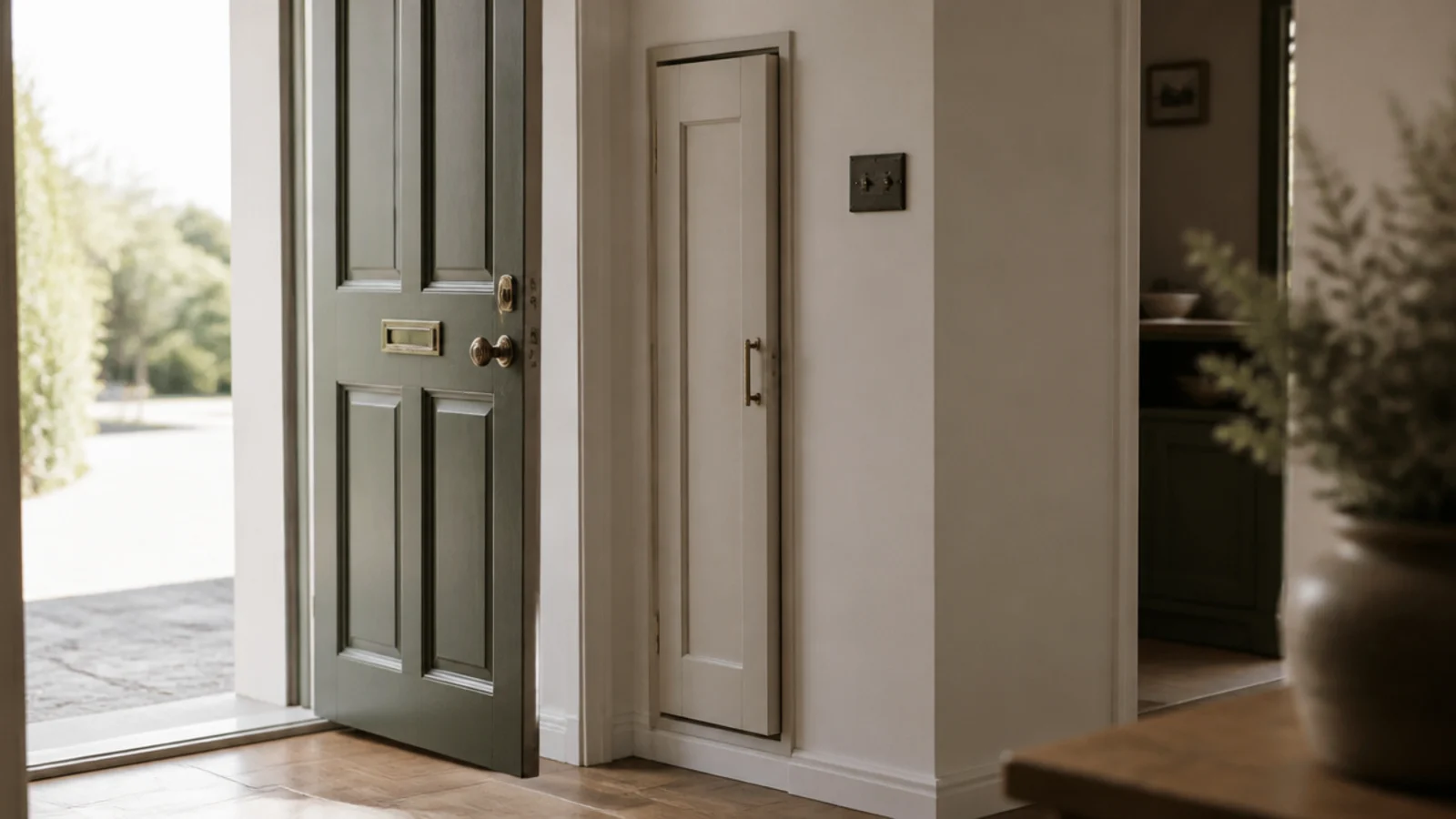
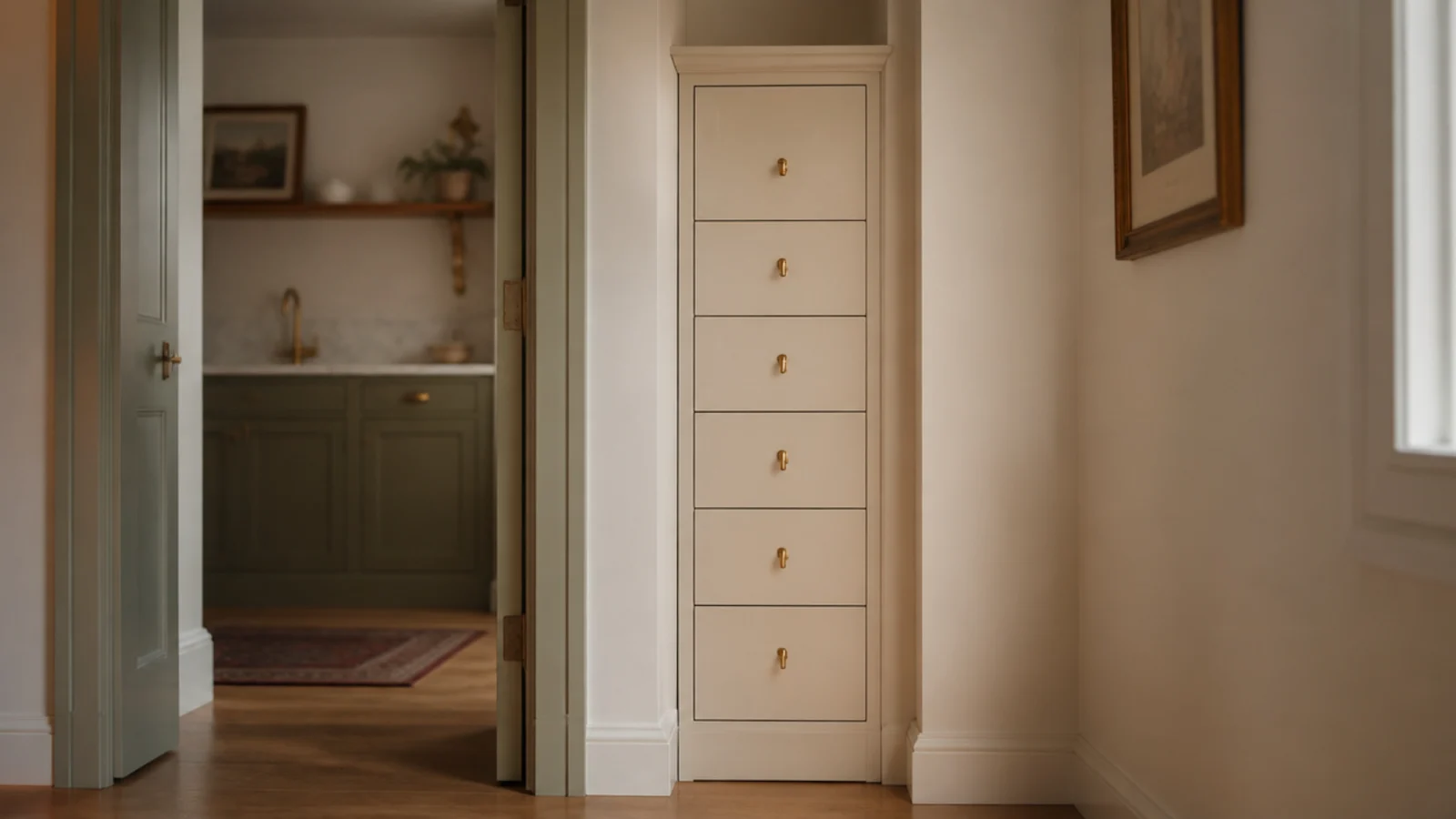
7. A slim tower beside the doorframe
The 16-inch strip between a doorframe and a corner holds about twenty pairs in 1.3 square feet of floor.
Daily shoes at knee height, out-of-season pairs up top. Over 40 inches tall it gets an anti-tip strap into a stud. $$
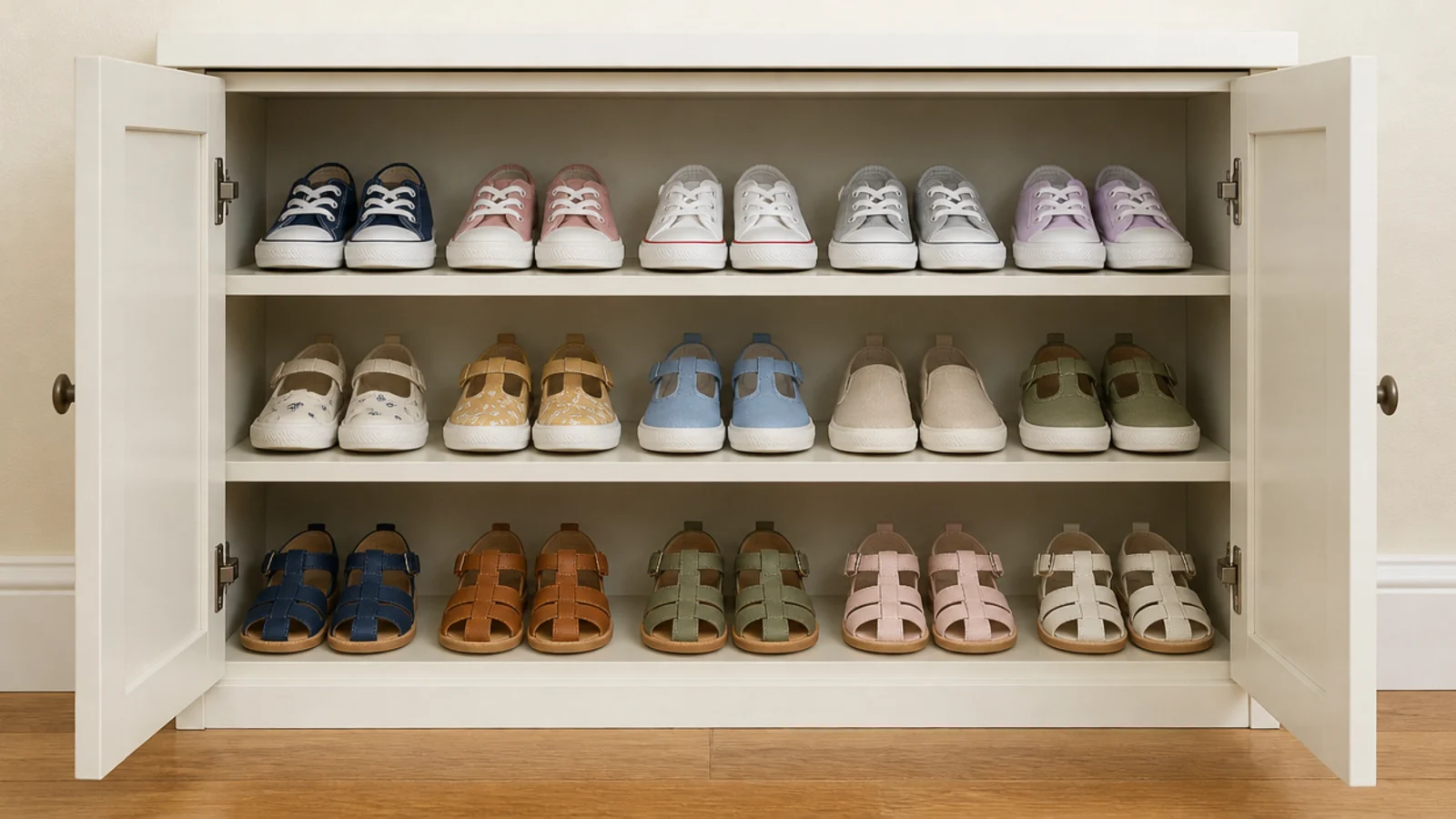
8. Half-depth shelves for a household of small shoes
A child's shoe is 7 to 9 inches long, so a cabinet built for children can be genuinely shallow and still use flat shelves.
Space the shelves 6 inches apart and you fit five tiers into a 32-inch carcass. It stops being useful the year they turn twelve. $$
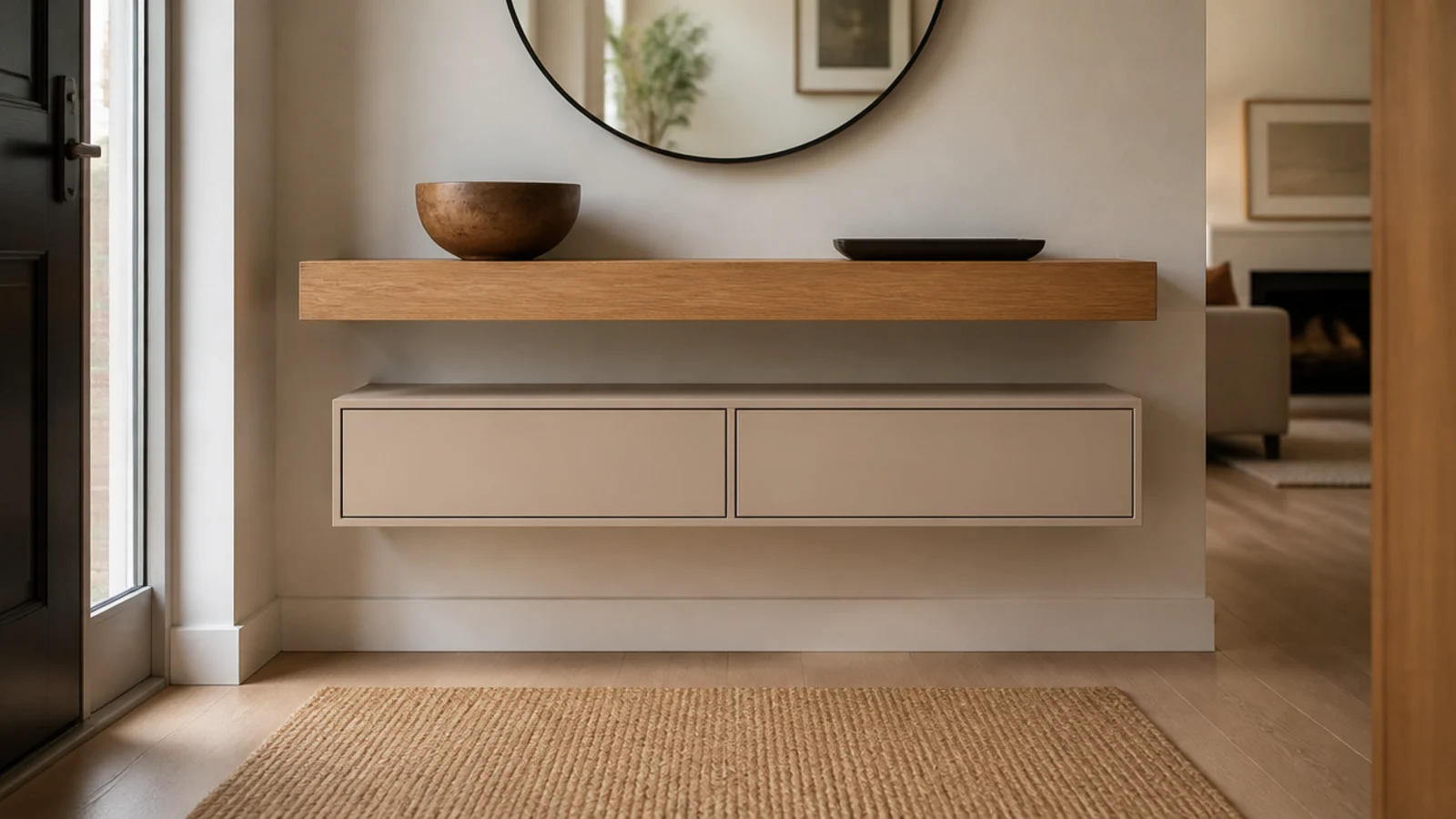
9. Slide it under a floating console
Float a console shelf at 32 inches and tuck a shallow cabinet beneath. Keys and post land on top, shoes go behind the doors.
Leave an inch of clearance above the cabinet so you can pull it forward to sweep behind it. $$
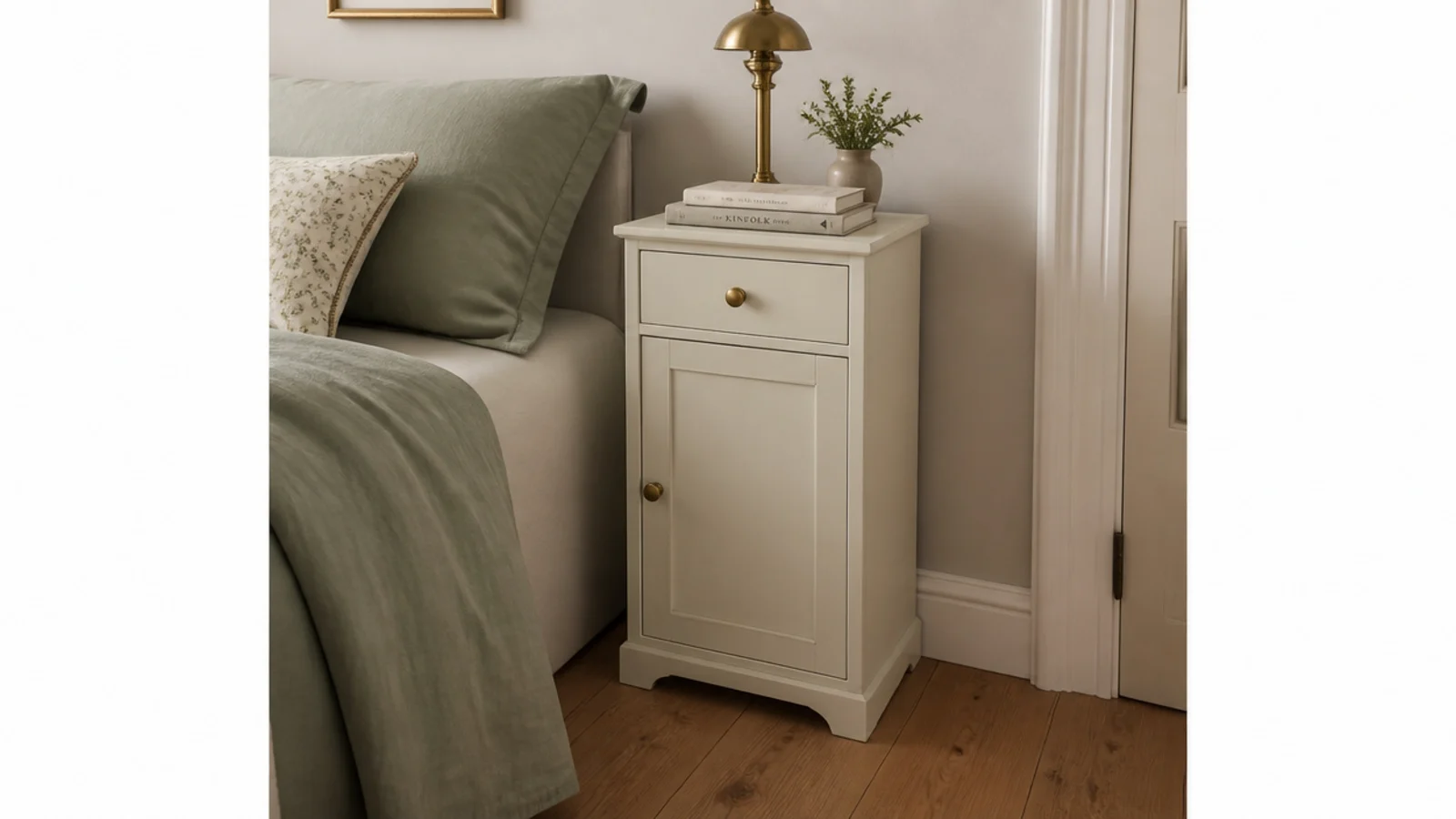
10. A slim cabinet as a bedroom nightstand
Shallow cabinets are close to nightstand proportions, and using one bedside gets shoes out of the entry entirely.
A 9-inch depth suits a small room where a standard 16-inch nightstand blocks the walk past the bed. Lamp on top, shoes inside. $$
11. Recess it into a stud bay
A standard stud bay gives you 3.5 inches of free depth inside the wall. Combine that with a 6-inch carcass and the cabinet projects only two and a half.
Non-structural interior walls only, and check for cables and pipes before you cut. $$$
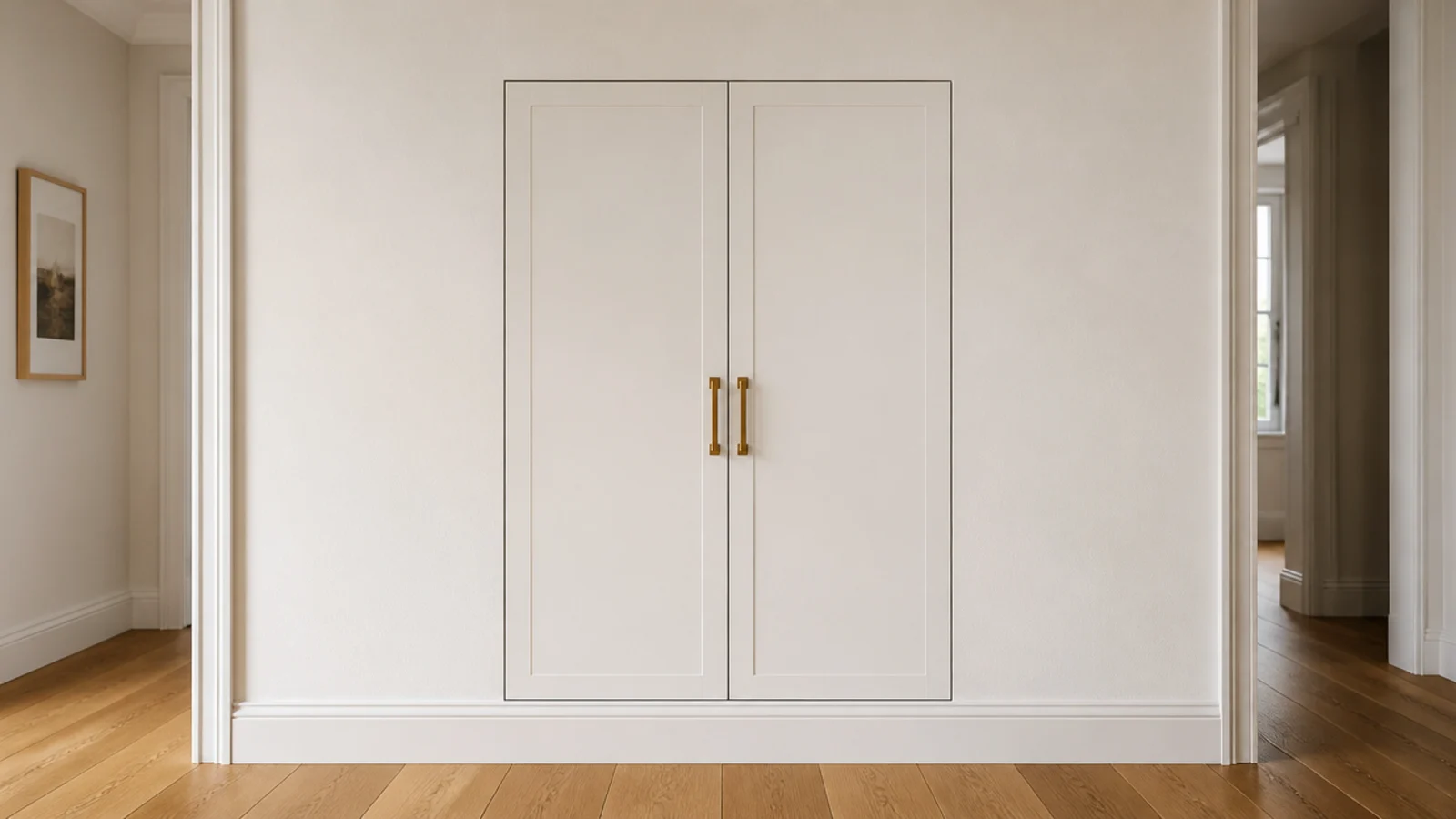
12. Slim doors, deeper top
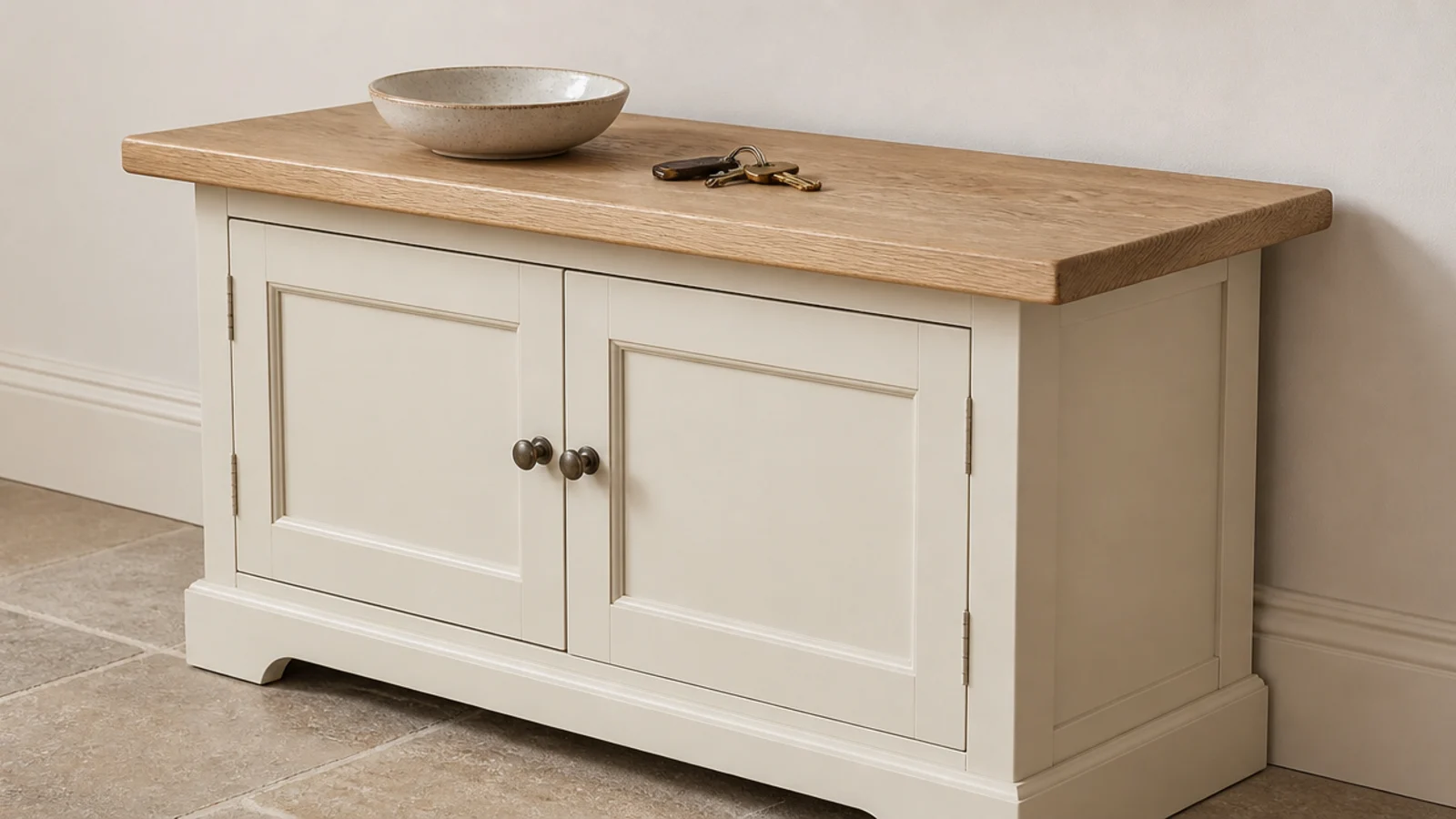
Keep the carcass at 9 inches and fit a top that overhangs to 13. You get a usable landing surface without giving the walkway any depth below hip height.
The overhang is where your keys go. The doors stay out of your way. $$
13. Push-latch fronts instead of handles
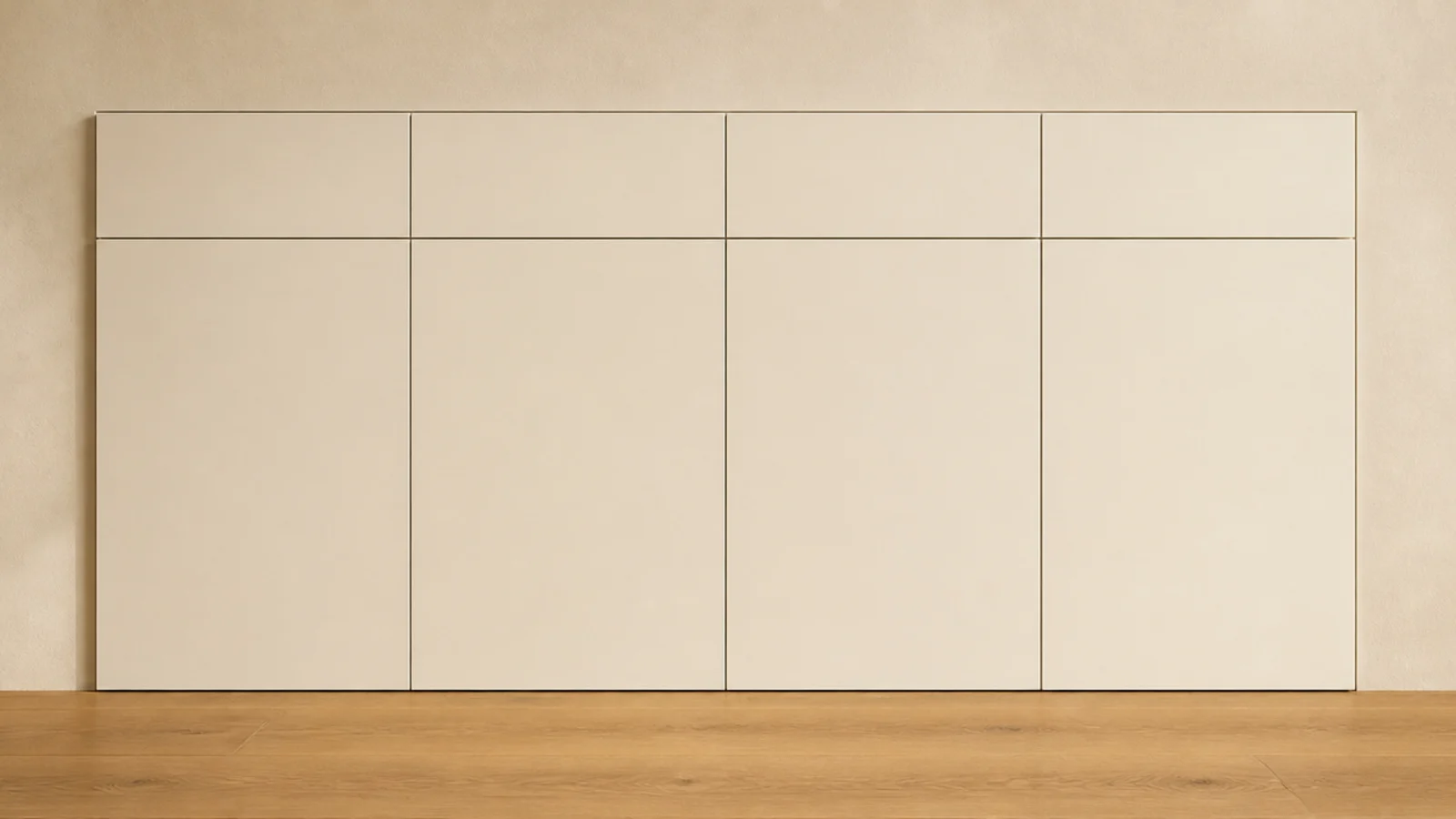
In a hall you turn sideways to pass through, handles are what catch hips and coat pockets. Push latches remove them entirely.
Fronts must be rigid enough not to flex — solid wood or 3/4 inch ply, not thin panel. Budget $4 per latch. $–$$
14. A slim cabinet under a window sill
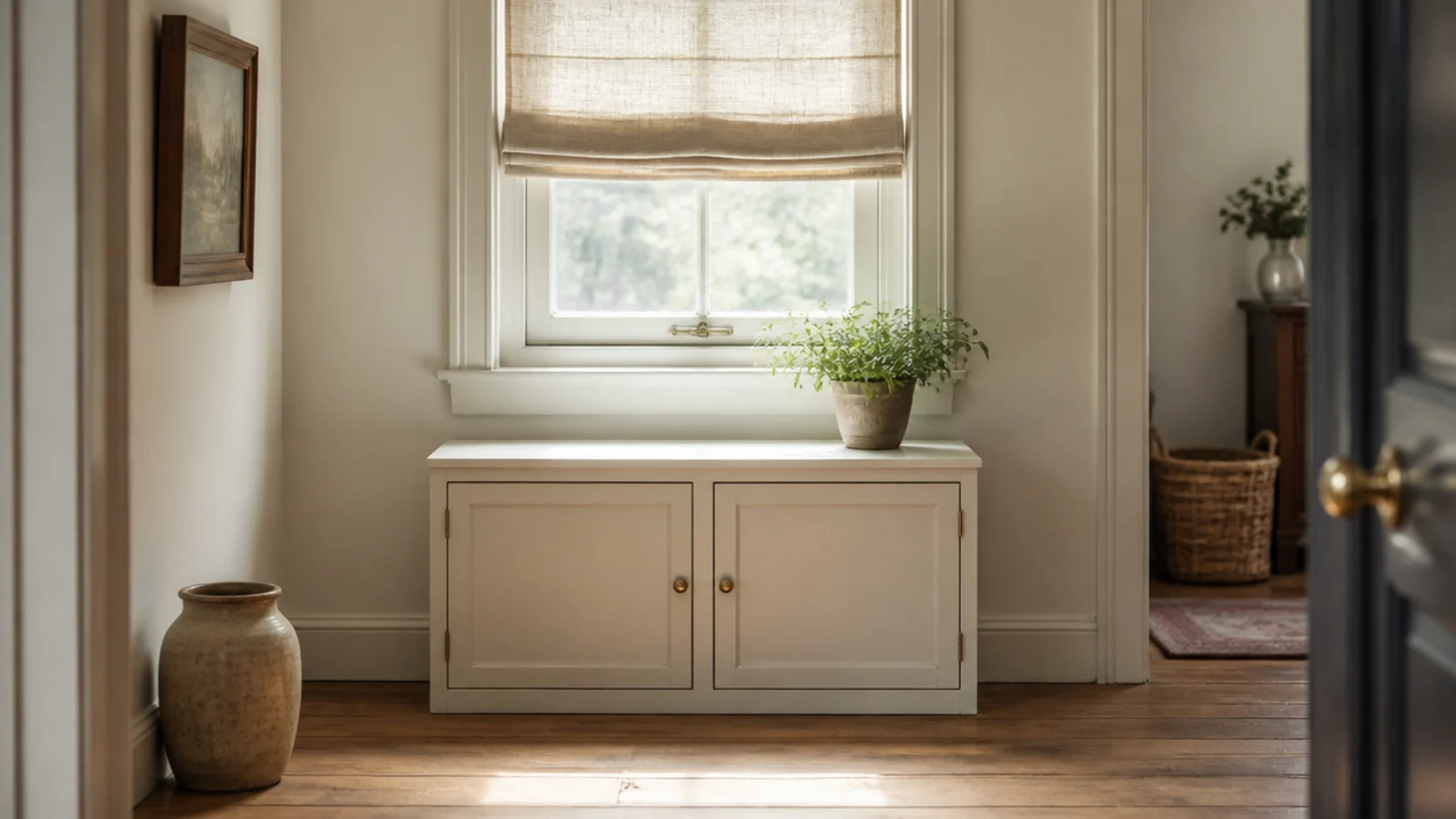
Stop the cabinet top three inches below the sill and the window frame still reads as a clean rectangle rather than something you built up to.
That three-inch band of wall is doing real visual work in a narrow space. $$
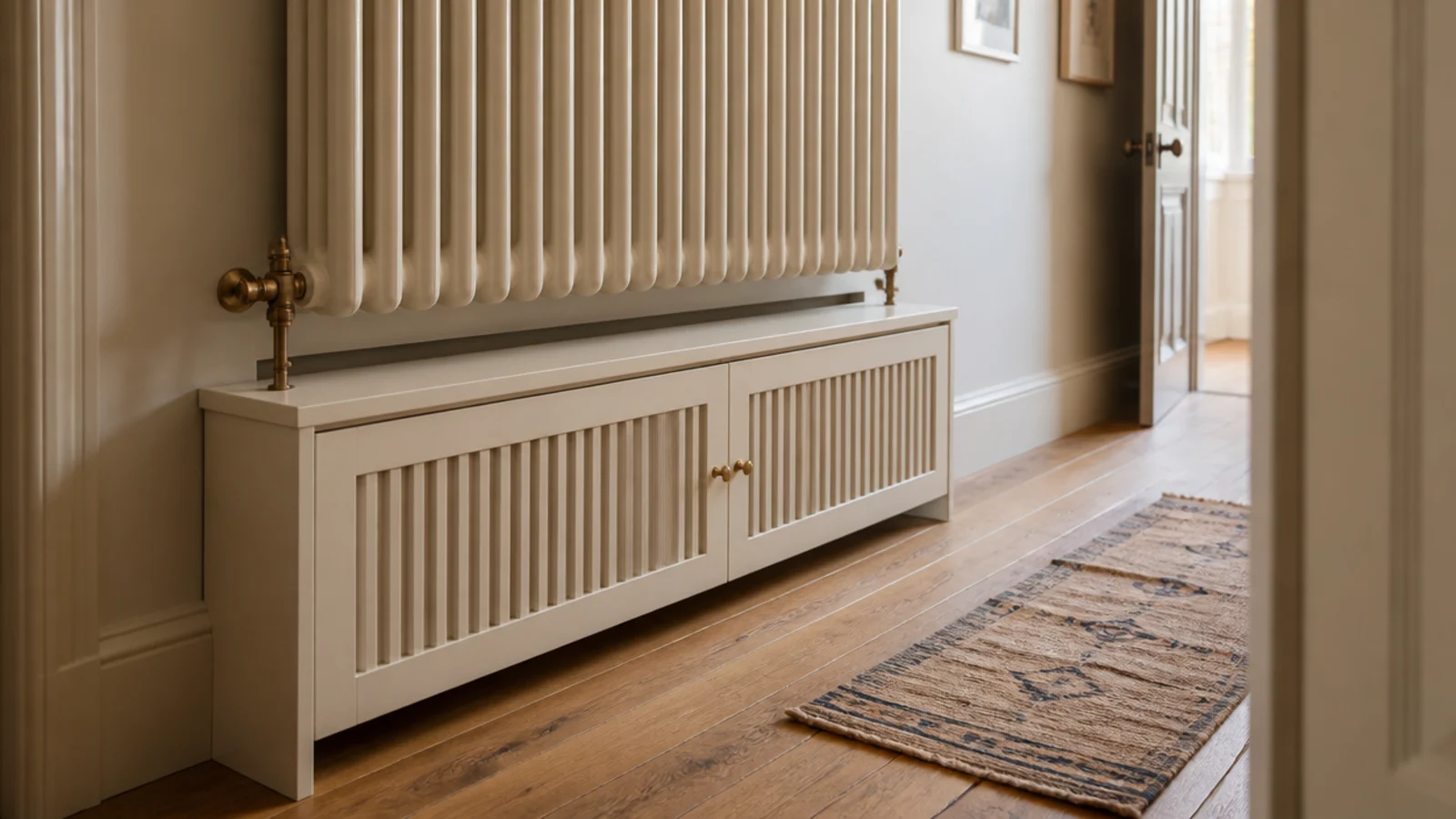
15. Use the radiator gap depth
The space under a hallway radiator is dead in most homes and usually about 12 inches deep — perfect for a shallow cabinet.
Leave 4 inches of clear air below the radiator, and use solid timber rather than veneer, whose edges lift under repeated heat cycling. $$
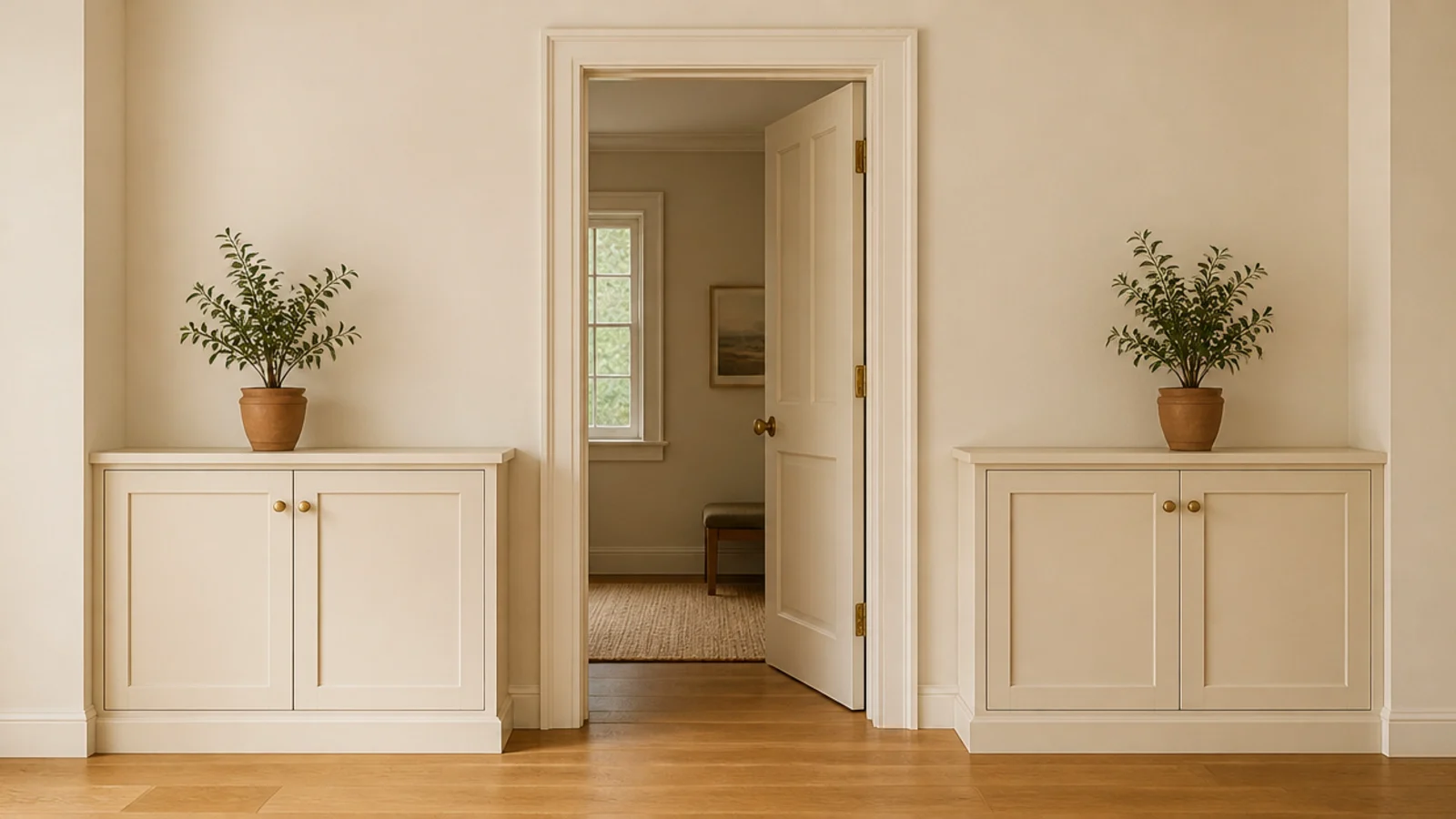
16. Two slim units flanking a doorway
Symmetry does a lot of work for shallow furniture. Two identical low cabinets either side of an interior door read as a deliberate pair rather than as storage.
Match the heights exactly, even if the widths differ. The eye reads the top line. $$–$$$
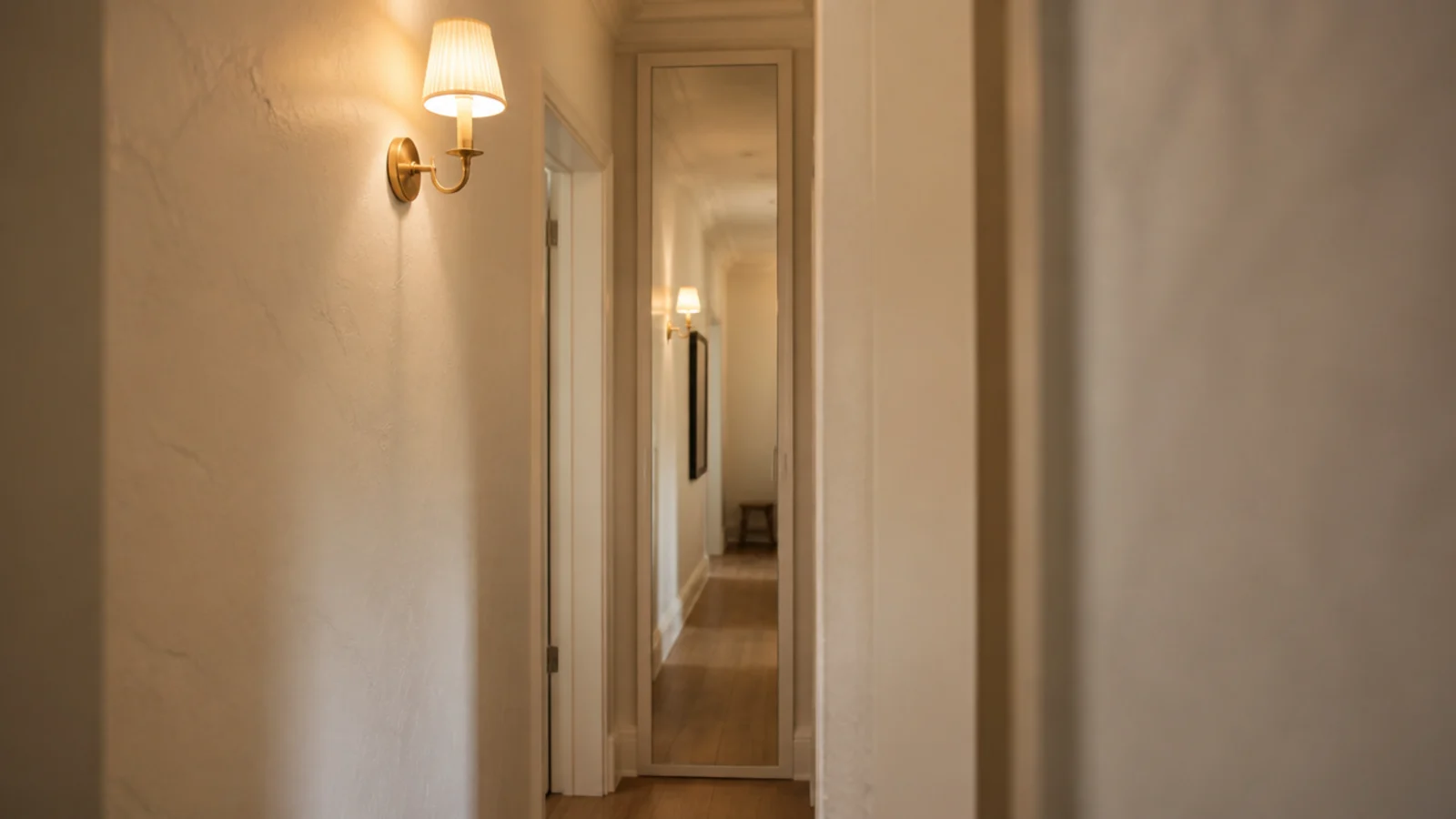
17. A mirror front to widen a narrow hall
A mirrored door on a shallow cabinet is the closest thing to free square footage a corridor can get.
Mirror glass is heavy, so use three hinges per door. Position it to reflect a doorway or a light source, not the opposite blank wall. $$$
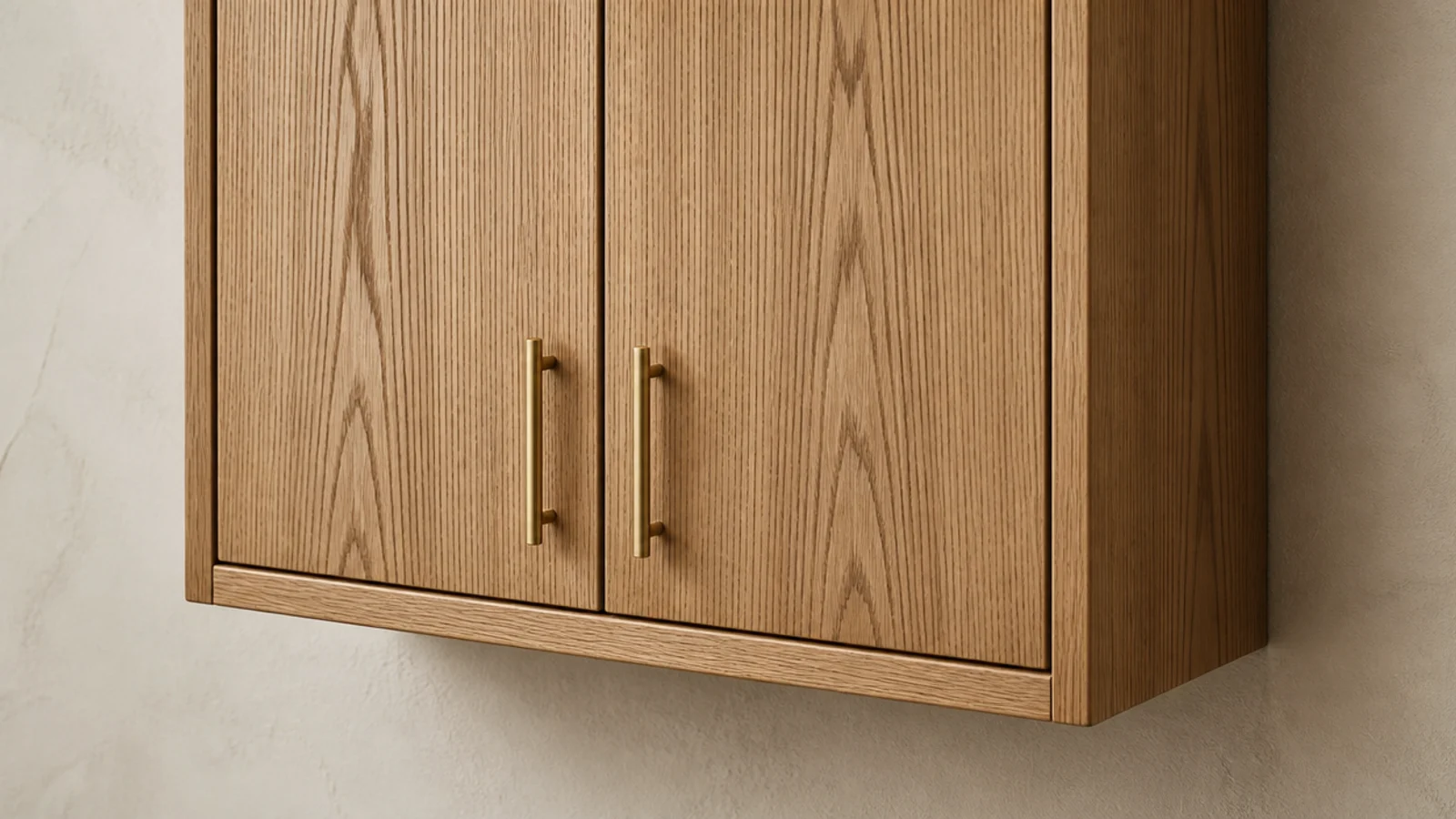
18. Vertical grain to lift a low box
On a cabinet under 32 inches tall, running the door grain vertically stretches it visually. Horizontal grain does the opposite and squats it down.
Cut both fronts from one board so the figure runs continuously across the pair. It is a free decision at the lumber rack. $$
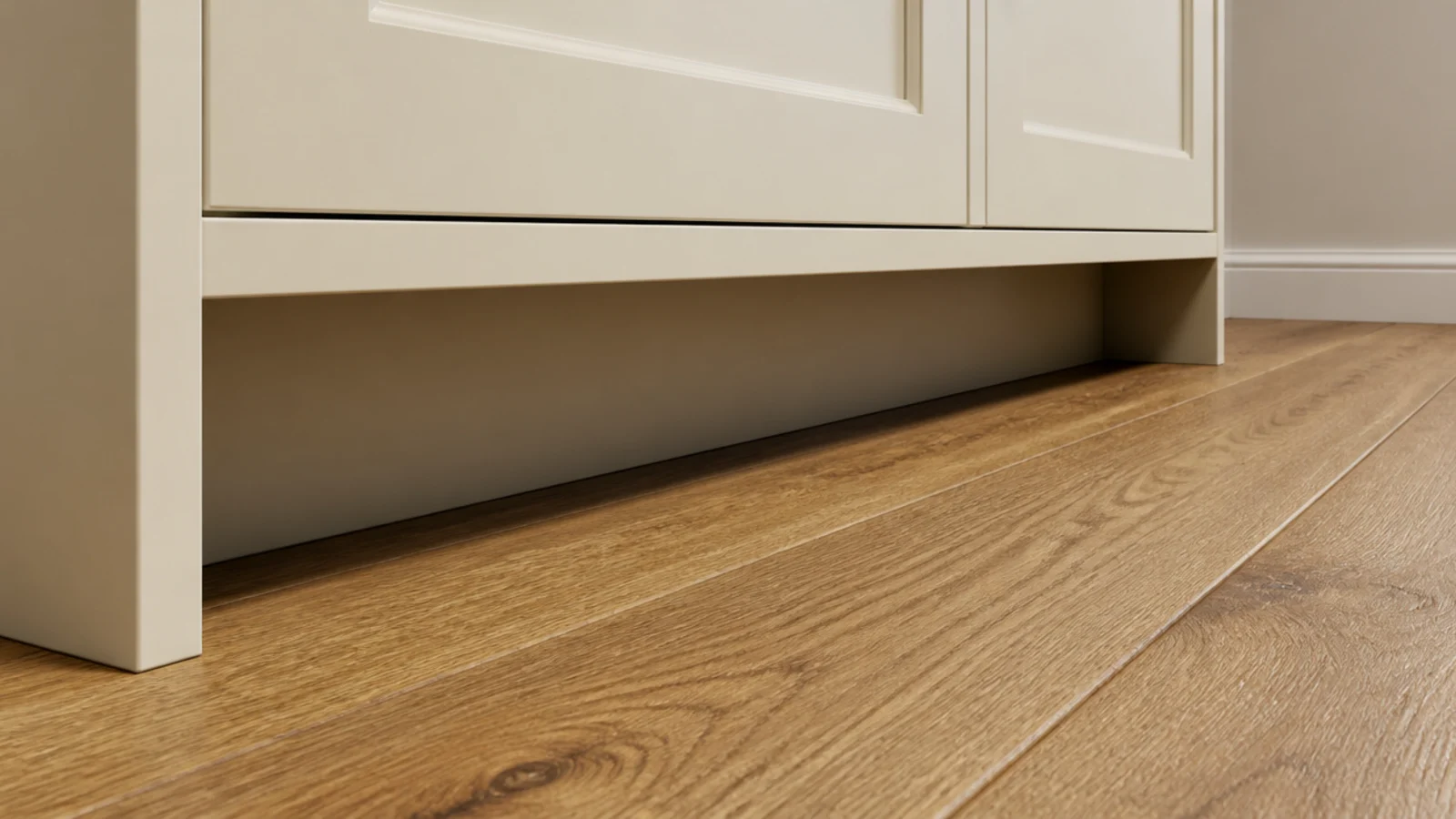
19. Leave the toe kick open for air and toes
Recess the base 3 inches and leave the gap open rather than boxing it in. You get ventilation from below and somewhere for your feet when you stand close.
It also makes a freestanding cabinet read as built-in, which is the cheapest illusion here. $
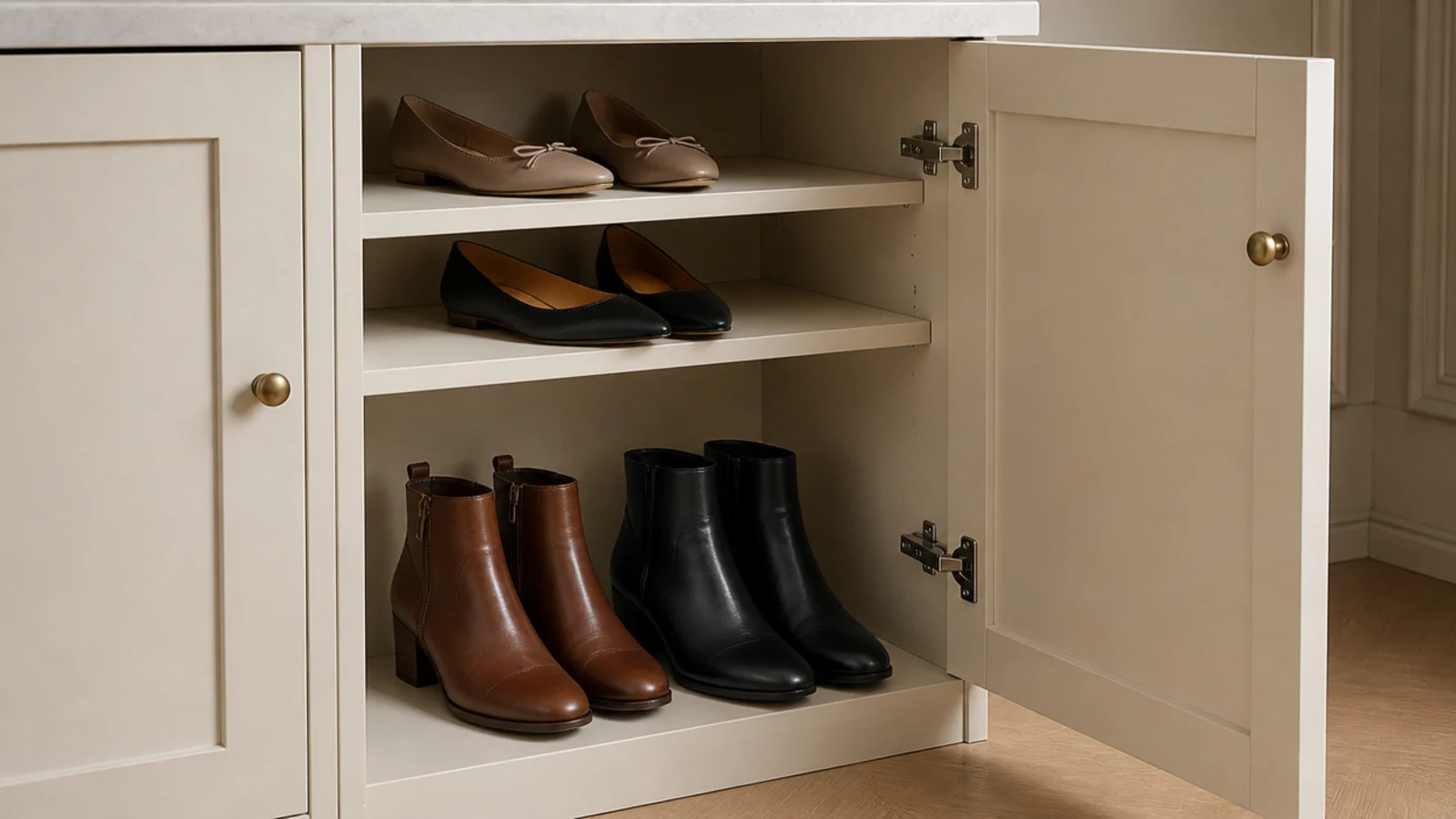
20. A sixteen-inch boot bay at the bottom
If the cabinet has shelf pins, drop one shelf to give a single bay 16 inches of clear height for ankle boots.
Bottom bay always: wet soles do least damage there and the weight belongs low. Knee-highs need 20 inches and usually a different cabinet. $$
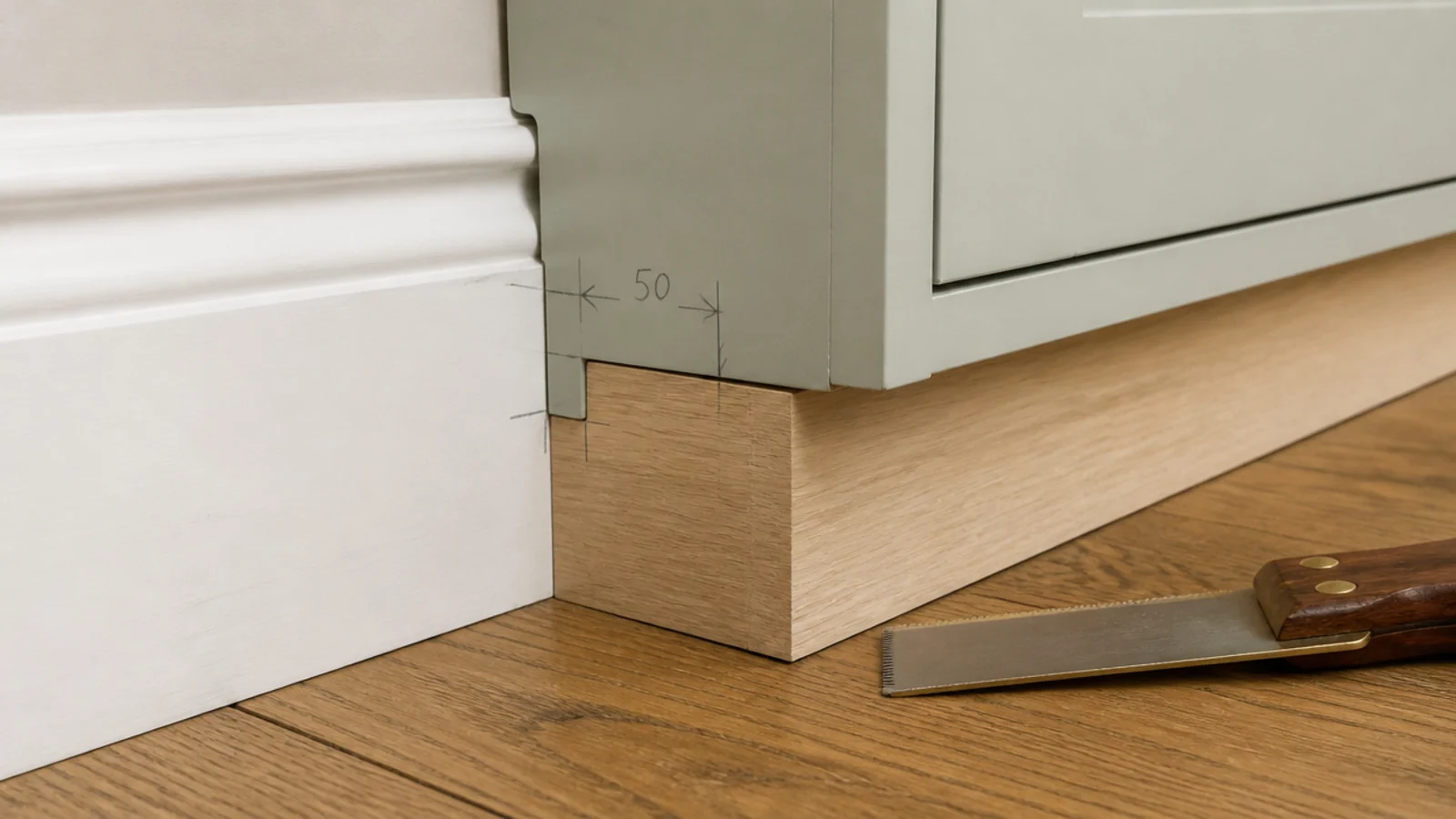
21. Cut the plinth so it clears the baseboard
Baseboard is why so many cabinets sit half an inch proud of the wall. Notch the plinth or the back edge of the side panels around it.
Ten minutes with a hand saw buys back half an inch of walkway in a hall that has none spare. Free
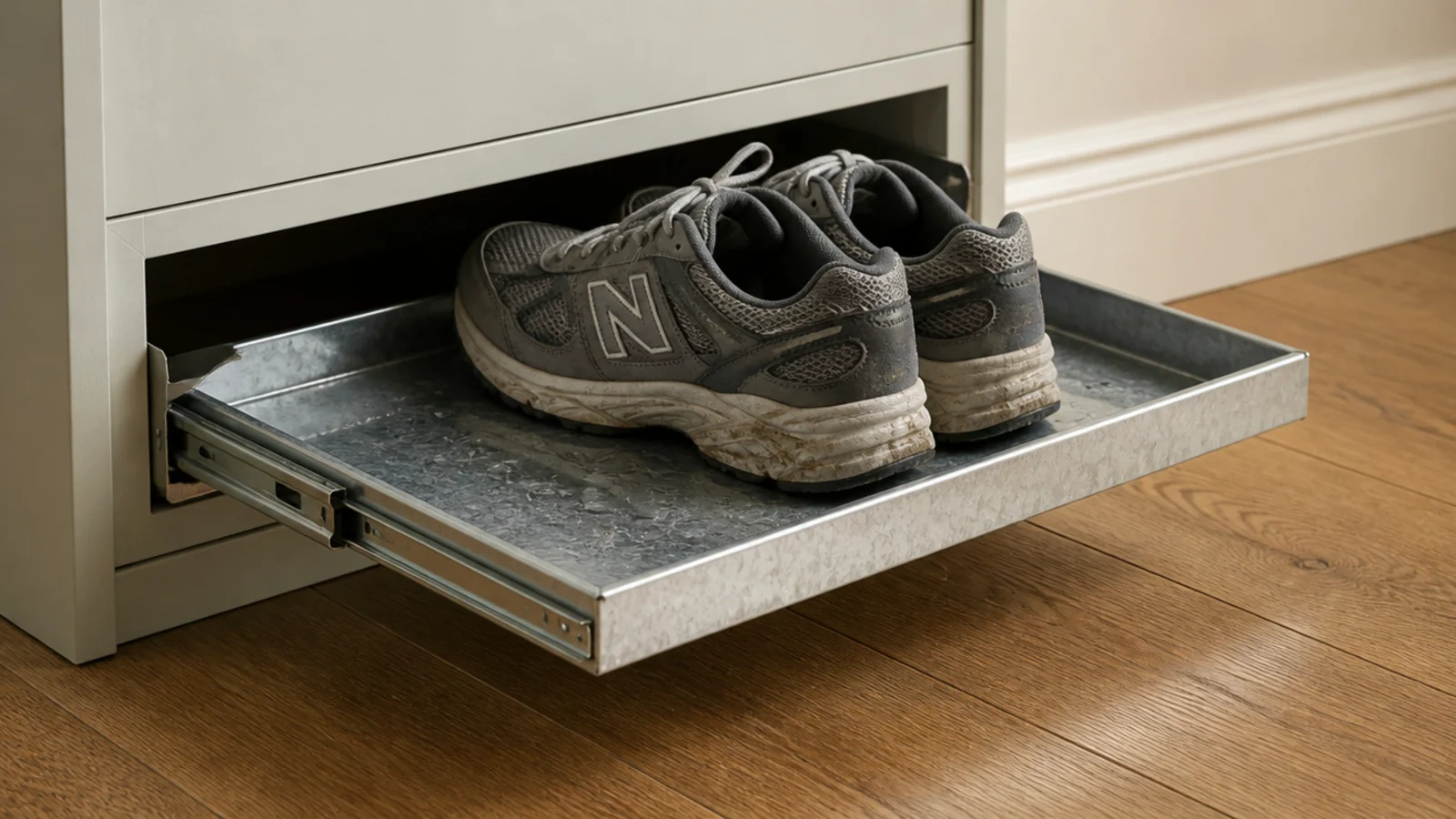
22. A pull-out drying tray at the base
A slim galvanised tray on runners at the very bottom gives damp shoes somewhere to sit without occupying floor you walk on.
It only works if it stays open while they dry — a closed drawer with wet shoes in it is exactly what you are trying to avoid. $$
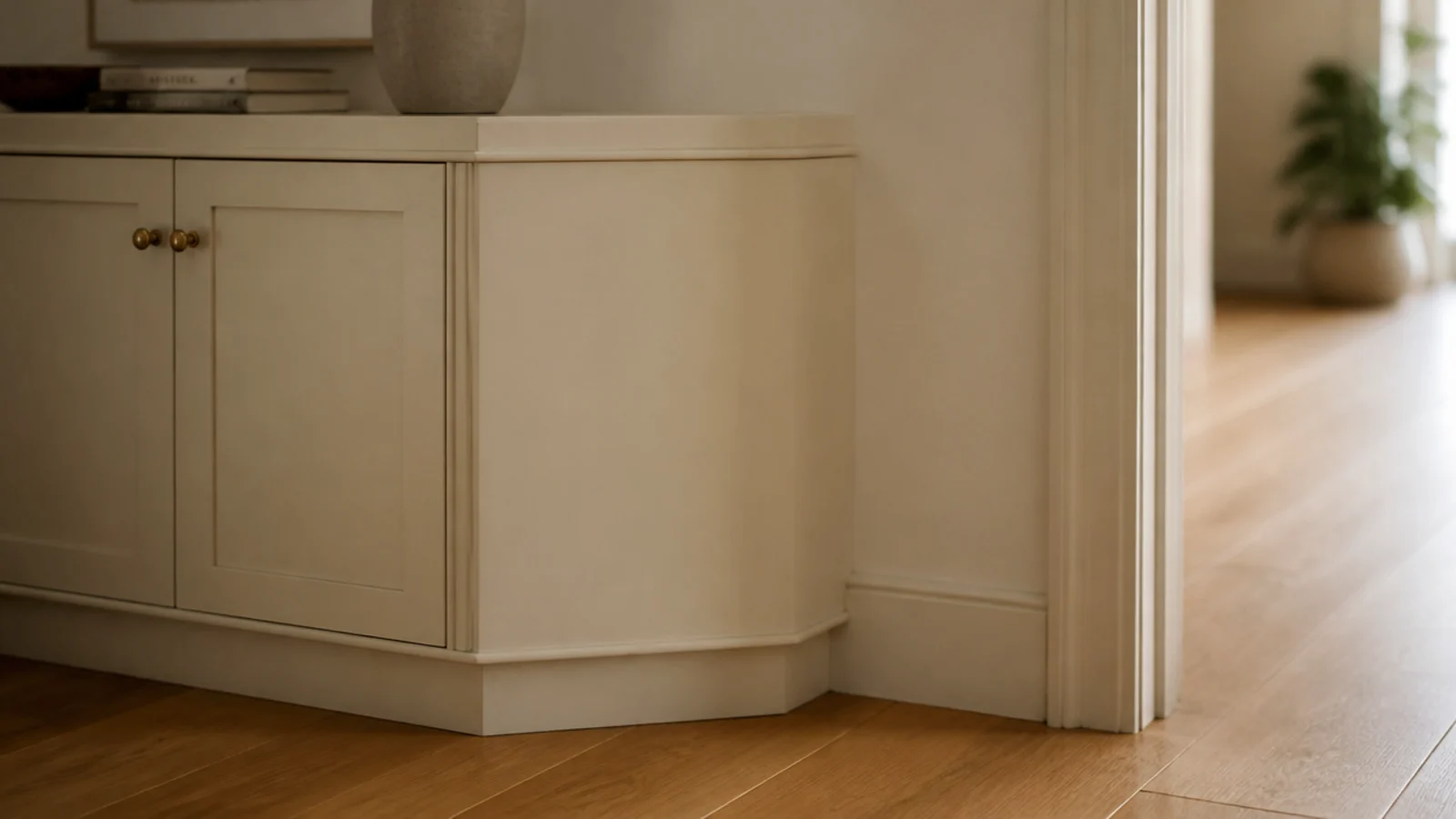
23. An angled end panel for a tight turn
If the cabinet ends where the hall turns, chamfer that corner at 45 degrees instead of leaving a square edge.
You lose about two pairs of capacity and stop catching your hip on it several times a day. Easy trade. $$
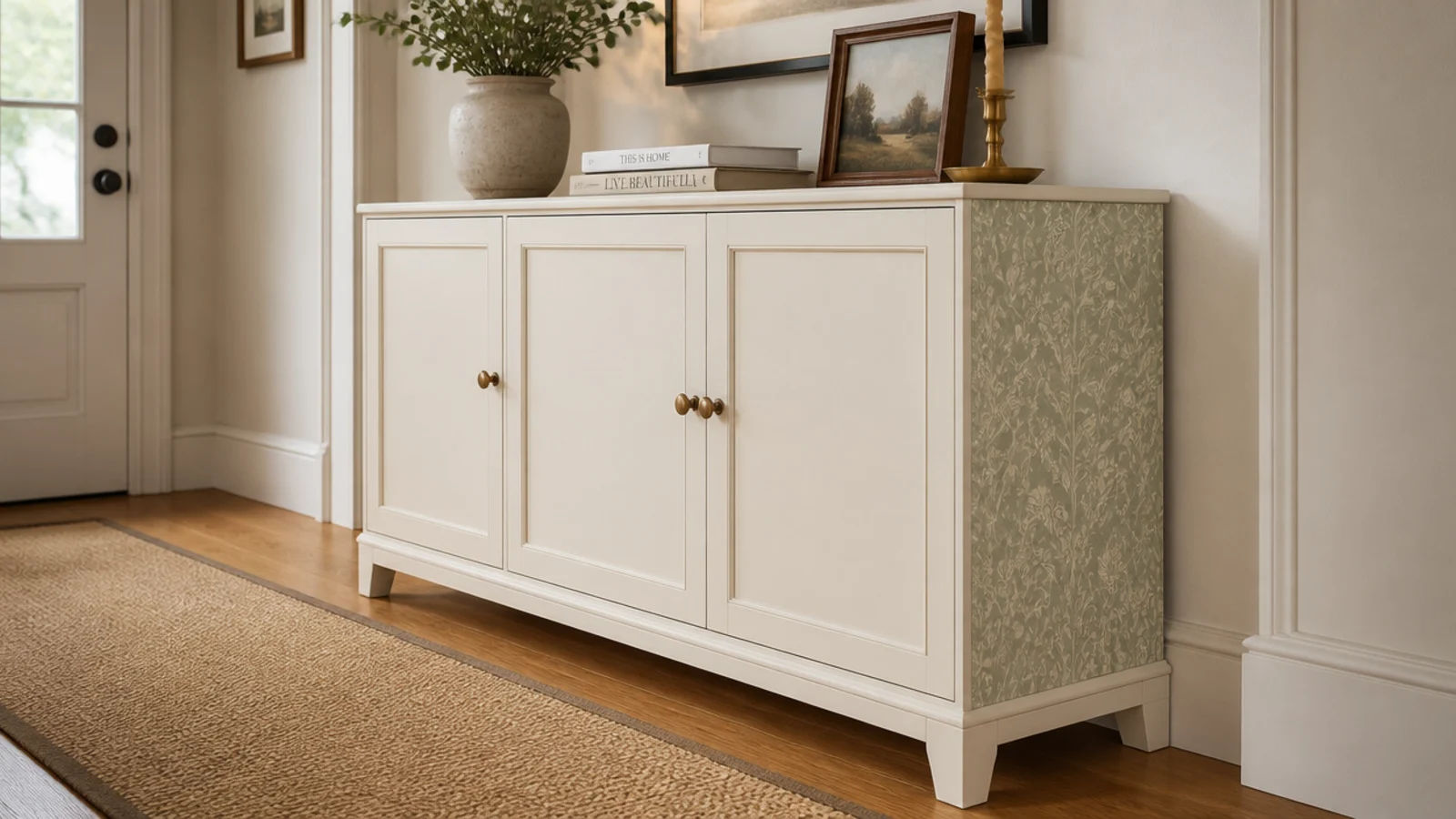
24. Paint the front, paper the side
In a narrow hall you see the side panel of a cabinet before you see the front, because you approach it end-on.
Paint the fronts the wall color and give the exposed side a patterned paper or a contrasting paint. It is the panel actually doing the decorating. $
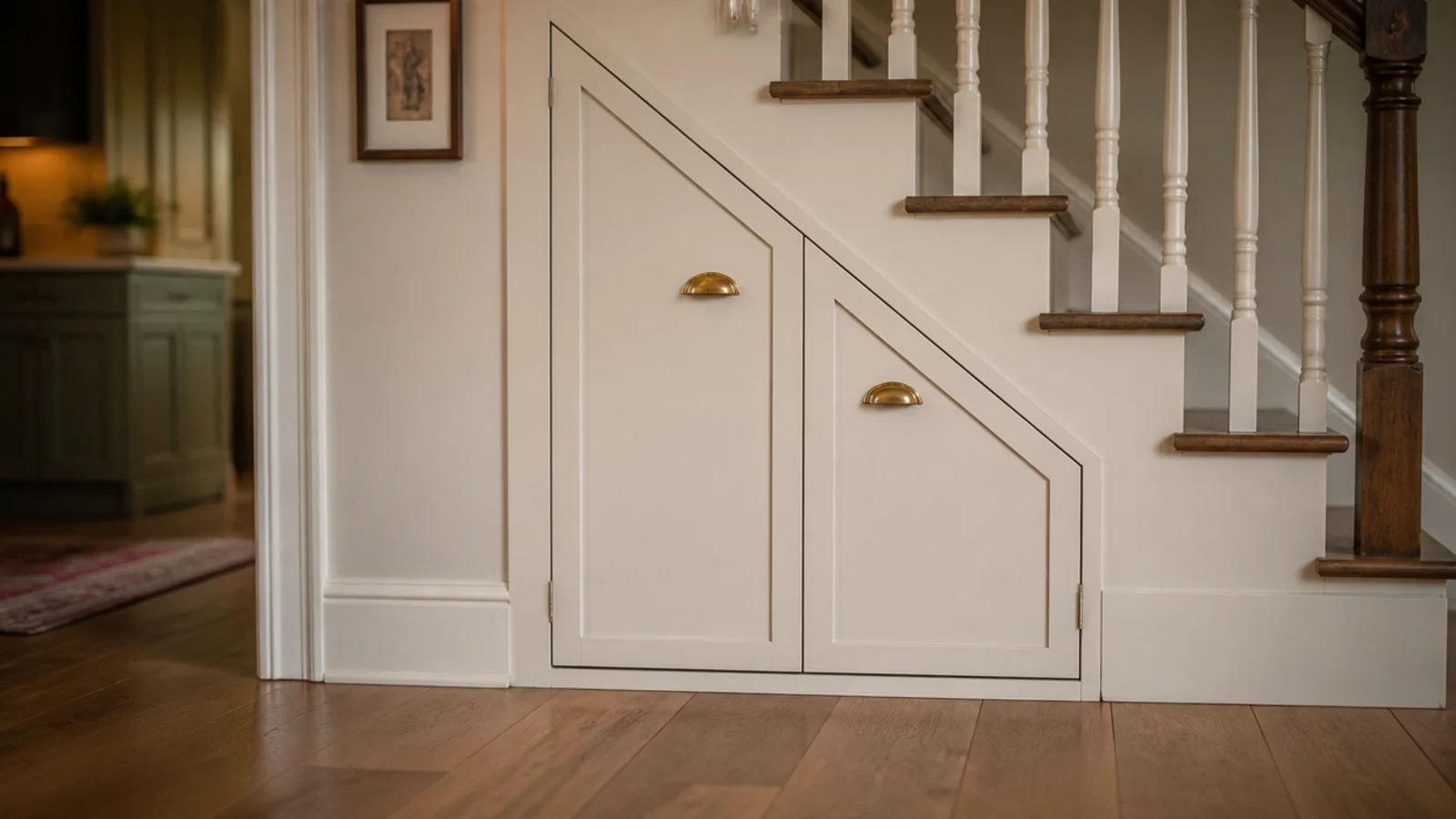
25. Slide a slim cabinet under a stair run
The lowest steps of a staircase leave a wedge of space that a shallow cabinet fits beautifully, with its top cut to the stringer angle.
Understair spaces are often cool and slightly damp, so ventilation matters here more than anywhere else in the house. $$
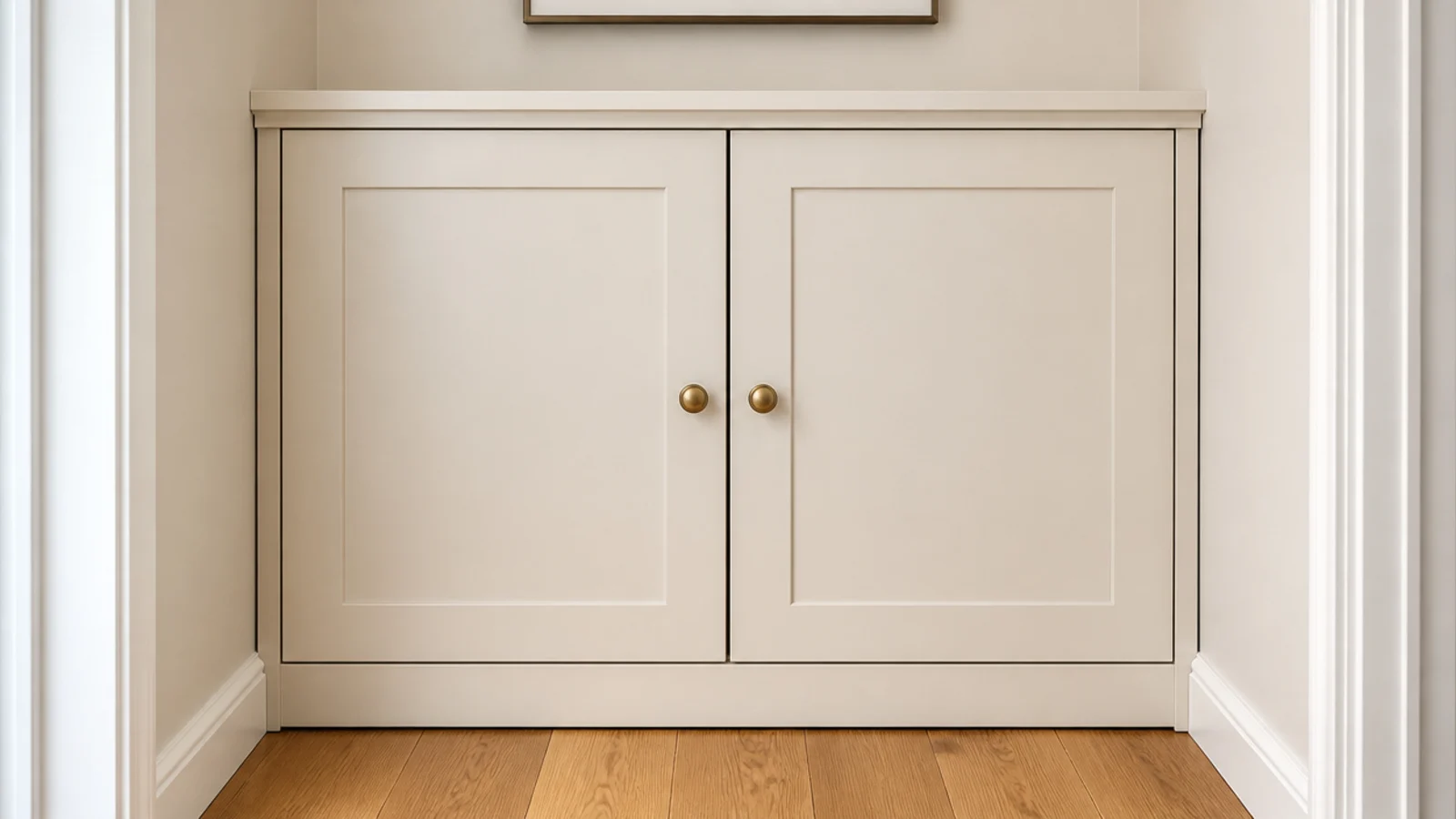
26. Fit it wall to wall in an alcove
A cabinet that touches both walls of an alcove reads as joinery. One with a two-inch gap either side reads as leftover furniture.
Measure the alcove at three heights before cutting — walls are almost never parallel, and the difference is often half an inch. $$
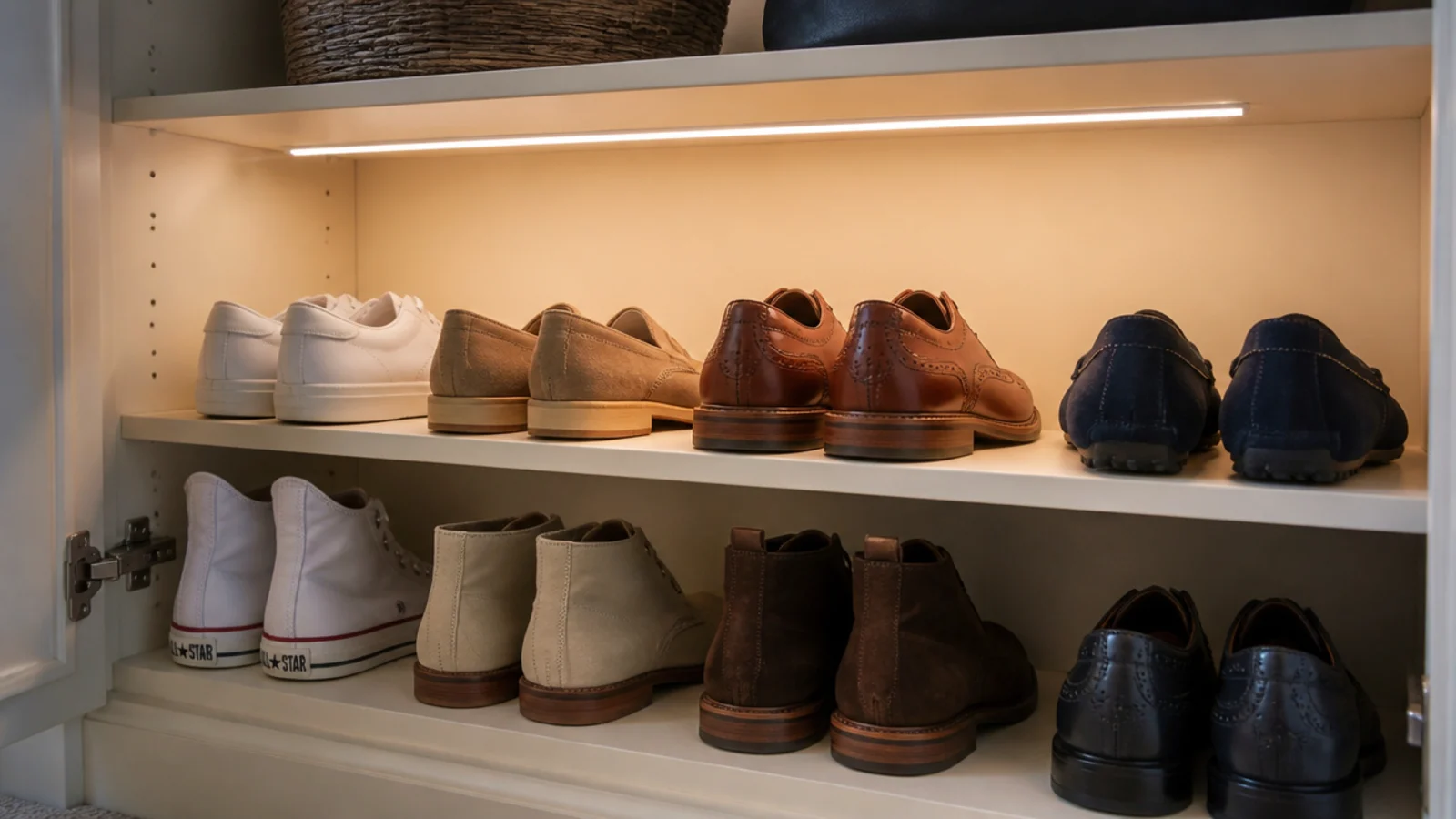
27. Interior lighting for a shallow bay
Shallow does not mean visible. A warm battery strip light under the top shelf turns rummaging into reaching.
Stick-on rechargeable strips cost about $15 and last months on a charge. Warm white only — cool white makes a hallway look like a stairwell. $
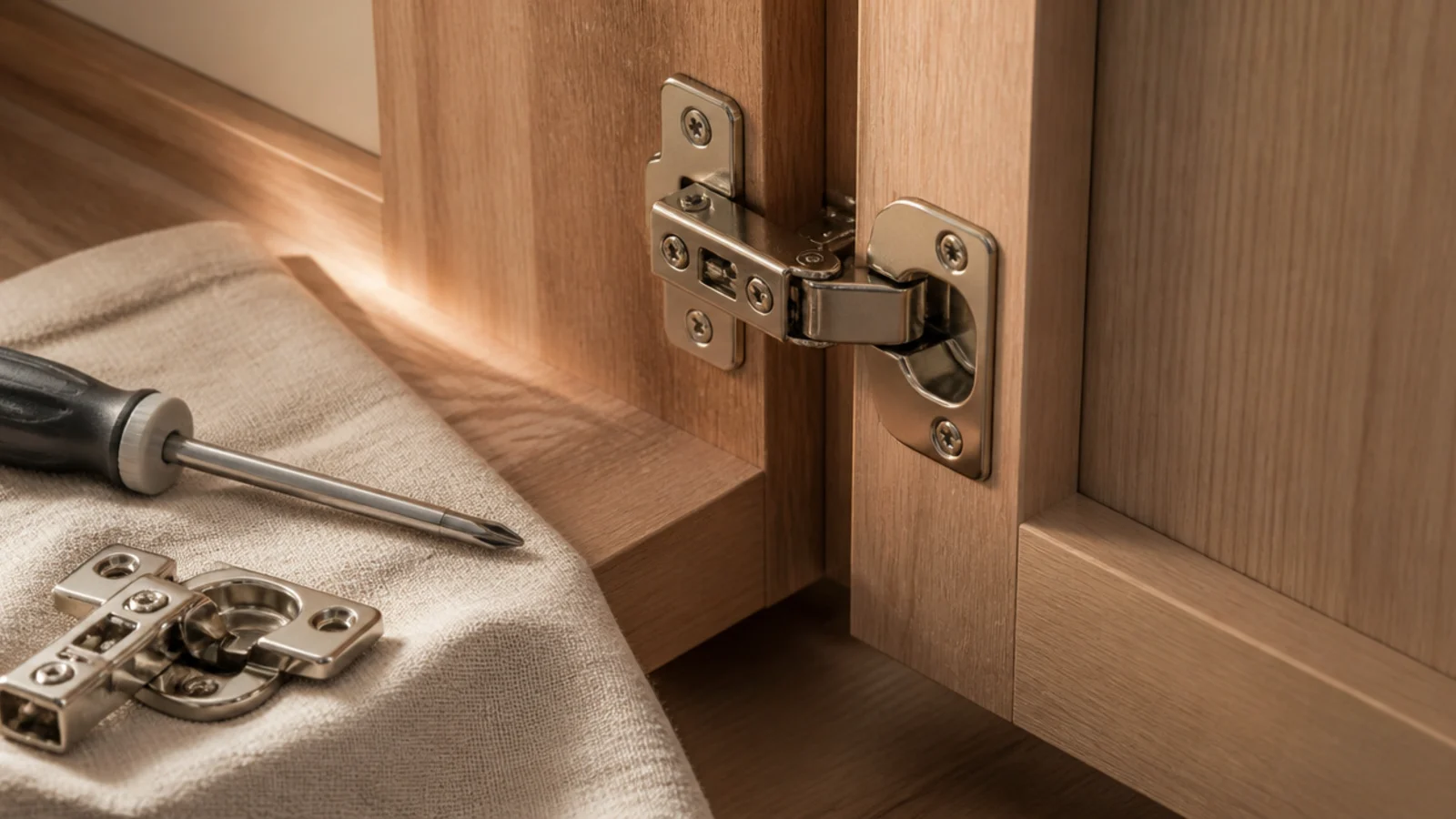
28. Soft-close on every front
These doors get closed with a foot, twice a day, for years. Standard sprung hinges work loose and the fronts start sitting crooked.
Concealed soft-close hinges cost about $8 a pair and drop into standard 35mm cups. It is the best money in this list. $
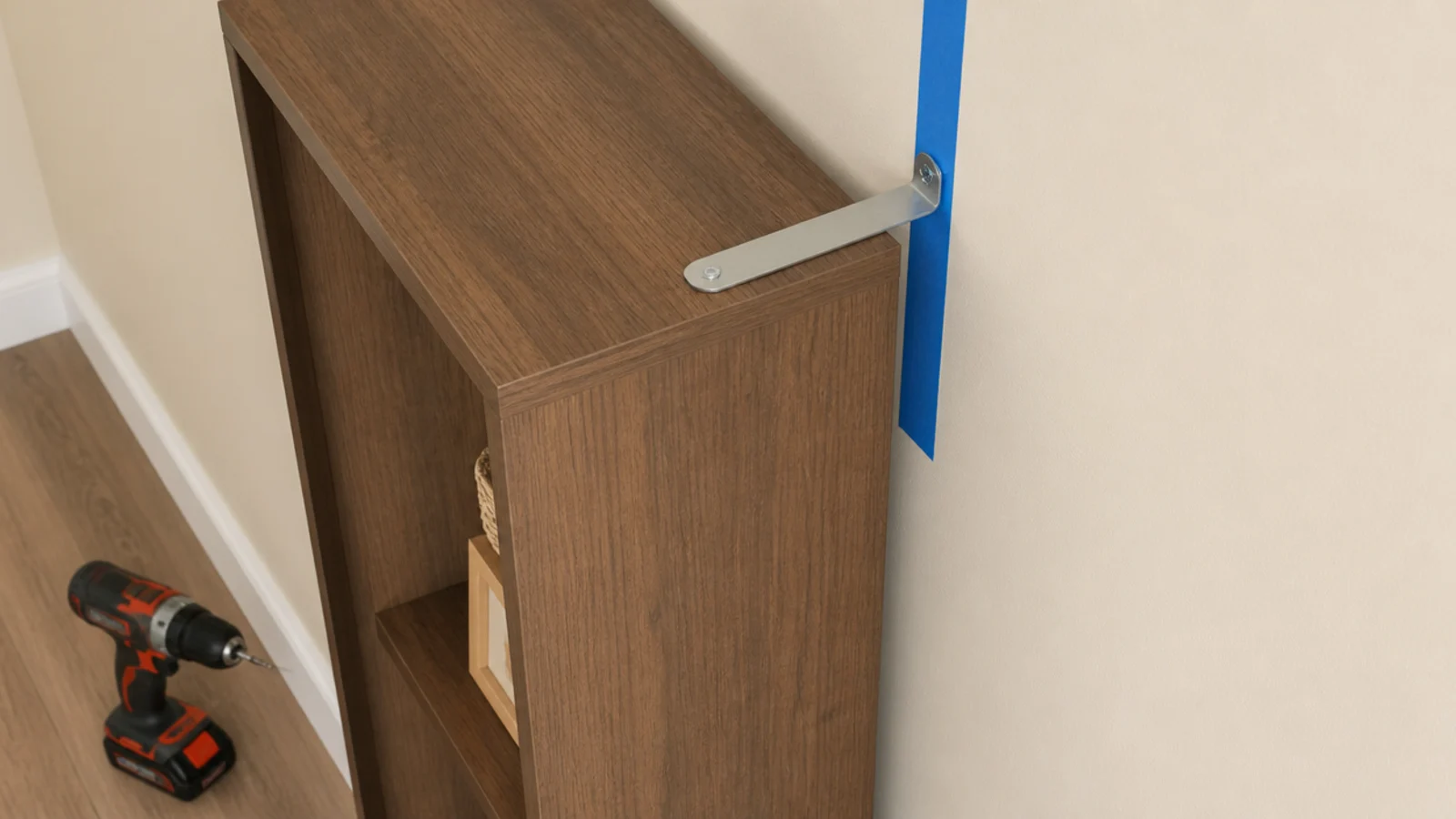
29. Strap any tower over forty inches
A narrow footprint plus an open tilt-out drawer moves weight forward fast, and slim cabinets are the tippy ones.
Anything over 40 inches tall gets the supplied strap screwed into a stud. Two screws, ten minutes, one small hole to fill when you move out. Free
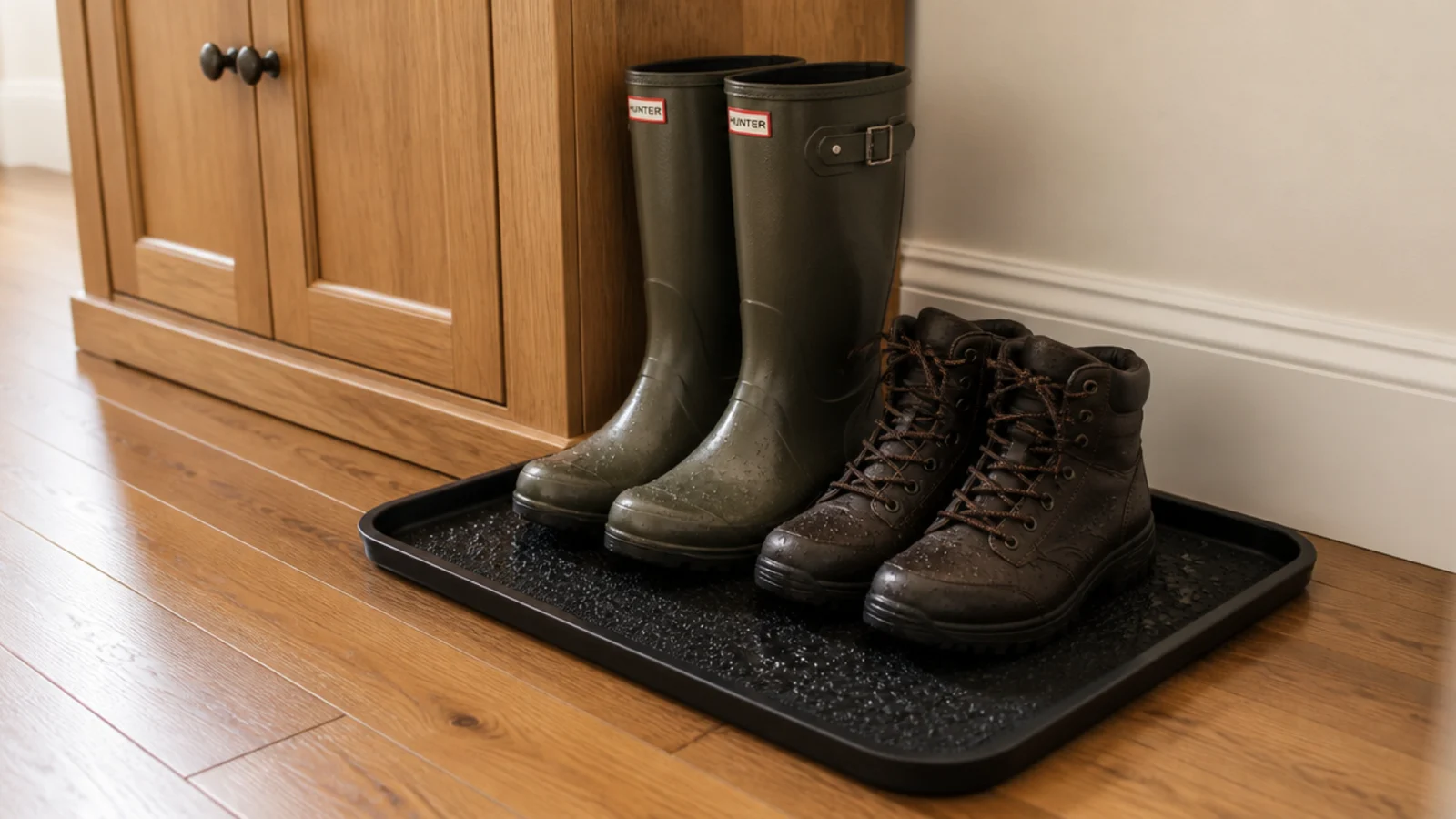
30. Wet tray on the floor, never inside
Nothing damp goes behind a closed door. It stays damp, the moisture spreads to every pair beside it, and the cabinet smells within two weeks.
A raised-lip metal or heavy rubber tray at least 15 inches deep, beside the cabinet. Shoes go in the next morning. $
Mistakes to Skip
- Buying on external depth. A cabinet sold as 10 inches has about 9 inside, and that is a tilt-out, not a shelf you can lay a sneaker on.
- Expecting a tilt-out to hold boots. They will not fold into the cradle, they jam the front, and the drawer stop breaks trying.
- Sealing a shallow box completely. Less internal air volume means less forgiveness, so an unventilated slim cabinet smells faster than a deep one.
Frequently asked questions
How slim can a shoe cabinet actually be?
Nine inches deep is the practical floor for adult shoes, because a tilt-out cradle holds a 12.5-inch sneaker at 45 degrees inside that depth. Six-inch cabinets exist and they only take flats, sandals and children's shoes. Below six inches you are buying a wall rack with a door on it, not a cabinet.
How many pairs does a slim shoe cabinet hold?
Six to eight pairs of flats, sneakers and loafers per tilt-out drawer, so a three-drawer unit holds eighteen to twenty-four pairs. None of them can be boots. Rated capacities printed on the box assume small shoes packed perfectly, so discount whatever the label claims by roughly a third before you buy.
Where do boots go if the cabinet is only nine inches deep?
Somewhere else, honestly. Boots need a bay 16 inches tall for ankle heights and 20 for knee-highs, plus enough depth to stand upright, which a tilt-out cannot give. Give them a floor tray, a bottom bay in a deeper unit elsewhere, or a closet. Trying to force boots into a slim cabinet jams the front.
Do slim shoe cabinets tip over?
They can, which is exactly why they ship with an anti-tip strap. A narrow footprint plus a tilt-out drawer hanging open moves the weight forward fast. Anything over 40 inches tall gets strapped into a stud with two screws. It takes ten minutes and renters can fill the single hole on the way out.
How do I stop a slim cabinet smelling in a small hall?
Ventilate and never store anything damp. Drill a row of half-inch holes through the back panel about 4 inches apart, or choose slatted doors, and leave the toe kick open. A sealed box with wet shoes inside smells within a fortnight. Wet pairs belong on a raised-lip tray on the floor beside the cabinet.
Measure the walkway, subtract 36 inches, and buy the cabinet an inch shallower than whatever is left — that one habit solves most narrow-hall storage. For the full range of closed options see shoe cabinet ideas, for budget-first setups see entryway shoe cabinet picks, and if you would rather build to an exact alcove, the DIY shoe cabinet steps cover it. Open shelving suits some households better, and hidden shoe storage covers that. Save the pin before you measure your hallway again.
Want more like this? Browse all 15 shoe cabinet ideas guides — they all use the same measurements and budget tiers.
Pin it for later
Save this to your Shoe Cabinet Ideas board
Pin it now so it is waiting for you when the tape measure comes out — and so the next person hunting for this idea can find it too.
Save this pinKeep going
More ideas worth saving while you have the tape measure out.