Corner Shelf Ideas · Review
25 Best Corner Shelf Picks Worth Buying

Some links on this page may become affiliate links in future. I only recommend pieces I would put in my own home — see the affiliate disclosure.
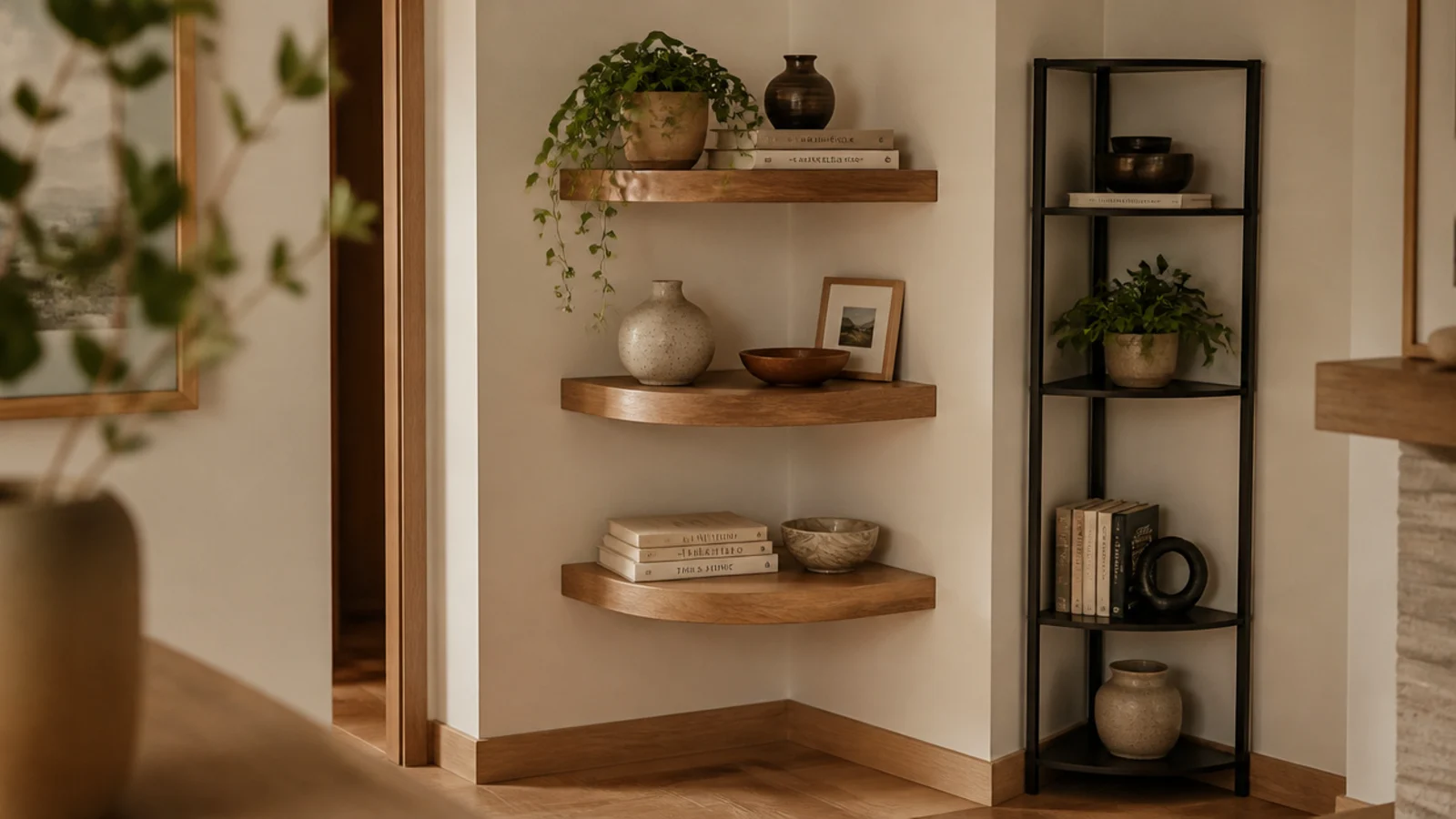
The best corner shelves are not the ones with the nicest product photos — they are the ones whose depth suits your walkway and whose brackets suit your wall. I have bought, built and returned a lot of these. Below is every type worth considering, compared on the numbers that actually decide whether a shelf works, plus eight I would buy again.
In this guide11 sections — tap to openHide
- 1.How I Chose the Best Corner Shelves
- 2.The Full Comparison: 25 Corner Shelf Types
- 3.The three-tier solid oak floating set
- 4.The single deep walnut shelf
- 5.The freestanding corner etagere
- 6.The slim bathroom corner shelf
- 7.The corner picture ledge pair
- 8.The industrial metal and wood corner unit
- 9.The floor-to-ceiling corner column
- 10.The adhesive-mount corner caddy
- 11.What to Check Before You Buy
How I Chose the Best Corner Shelves
I judged every type on five things, in this order.
- Load path. Where does the weight actually go? A shelf whose bracket reaches a stud will always beat a cleverer one that relies on drywall alone. This single factor separates shelves that last from shelves that sag.
- Real depth versus stated depth. Manufacturers quote the board width, not the usable surface. A shelf sold as eight inches often gives seven once the back edge sits against a wall that is not quite square.
- Front edge durability. Solid wood, powder-coated steel and painted hardwood survive a shoulder brush. Veneered particle board does not, and the failure is permanent and visible.
- Renter reversibility. How many holes, how big, and how easily patched. A single anti-tip screw is a very different proposition to six toggle bolts.
- Price per useful inch. A cheap shelf you cap at ten pounds is not cheap. I weighted anything under $50 that carries real load very highly.
I did not weight brand, finish trends, or whether something photographs well empty. Everything below is described by type rather than by product name, because the same construction shows up under a dozen labels at Target, IKEA, Amazon, Wayfair and HomeGoods, and the construction is what you are actually buying.
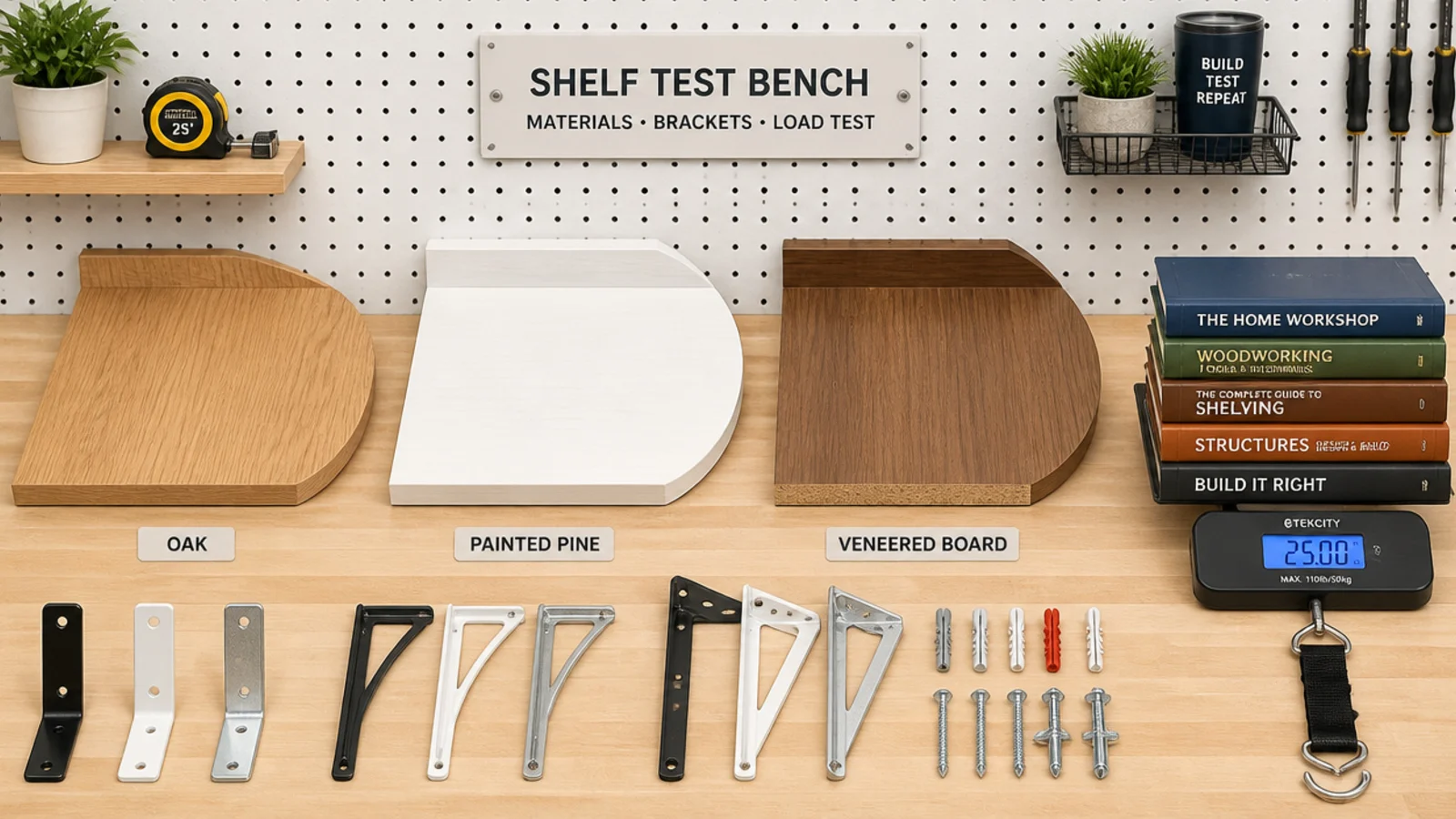
The Full Comparison: 25 Corner Shelf Types
Price tiers: $ under $50 · $$ $50–$150 · $$$ $150+. Weight figures assume correct anchors for the mounting type.
| Pick | Best for | Price | Why it wins |
|---|---|---|---|
| Three-tier solid oak floating set | Living room corners | $$ | Staggered lengths, real load capacity into studs |
| Single deep walnut shelf | Above a reading chair | $ | One shelf exactly where your hand lands |
| Freestanding corner etagere | Renters with real weight | $$ | Carries 40 lb+ per tier, zero wall holes |
| Slim 5-inch bathroom shelf | Showers and small baths | $ | Sealed finish, clears the door swing |
| Corner picture ledge pair | Art without hole commitment | $ | Restyle endlessly, three-inch footprint |
| Industrial metal and wood unit | Heavy books and plants | $$ | Steel frame carries what wood brackets cannot |
| Floor-to-ceiling corner column | Serious book storage | $$$ | Reads as architecture when painted wall color |
| Adhesive-mount corner caddy | Zero-hole rentals | $ | Genuinely no damage under 15 lb |
| Leaning ladder corner shelf | Sunny plant corners | $ | No drilling, stable against two walls |
| Tension-pole corner unit | Tall narrow corners | $$ | Uses floor-to-ceiling pressure, no anchors |
| Modular cube corner set | Changing needs | $$ | Reconfigures as the room changes |
| Reclaimed rustic wood shelf | Character and warmth | $$ | Grain and patina no new board can fake |
| Rope-hung corner shelf | Boho and light loads | $ | One anchor point, very forgiving of wall type |
| Corner shelf with integrated hooks | Entryway drop zones | $ | Two jobs in one footprint |
| Low kids-room corner shelf | Children under six | $ | Reachable at 36 in, anchors to wall |
| Over-desk corner shelf | Home offices | $ | Frees the whole desk surface |
| Tiered corner plant stand | Plant collections | $ | Stepped tiers give every pot light |
| Glass corner shelf | Small dark bathrooms | $ | Disappears visually, humidity-proof |
| Corner spice rack shelf | Kitchen prep corners | $ | Keeps daily items at eye level |
| Corner media floating shelf | TVs and consoles | $$ | Hides cables, holds real electronics weight |
| Wraparound picture rail | Whole-room gallery | $$ | Runs continuous across the corner line |
| Corner shoe shelf | Entryway floor clutter | $ | Angled tiers hold twice the pairs |
| Bedside corner shelf | Beds pushed into corners | $ | Replaces a nightstand with zero footprint |
| Paintable MDF built-in kit | Budget built-in look | $$ | Built-in appearance for a fraction of the cost |
| LED-lit corner display shelf | Dark corners, collections | $$ | Light is doing the work the corner cannot |
Eight of those are the ones I keep coming back to.
1. The three-tier solid oak floating set
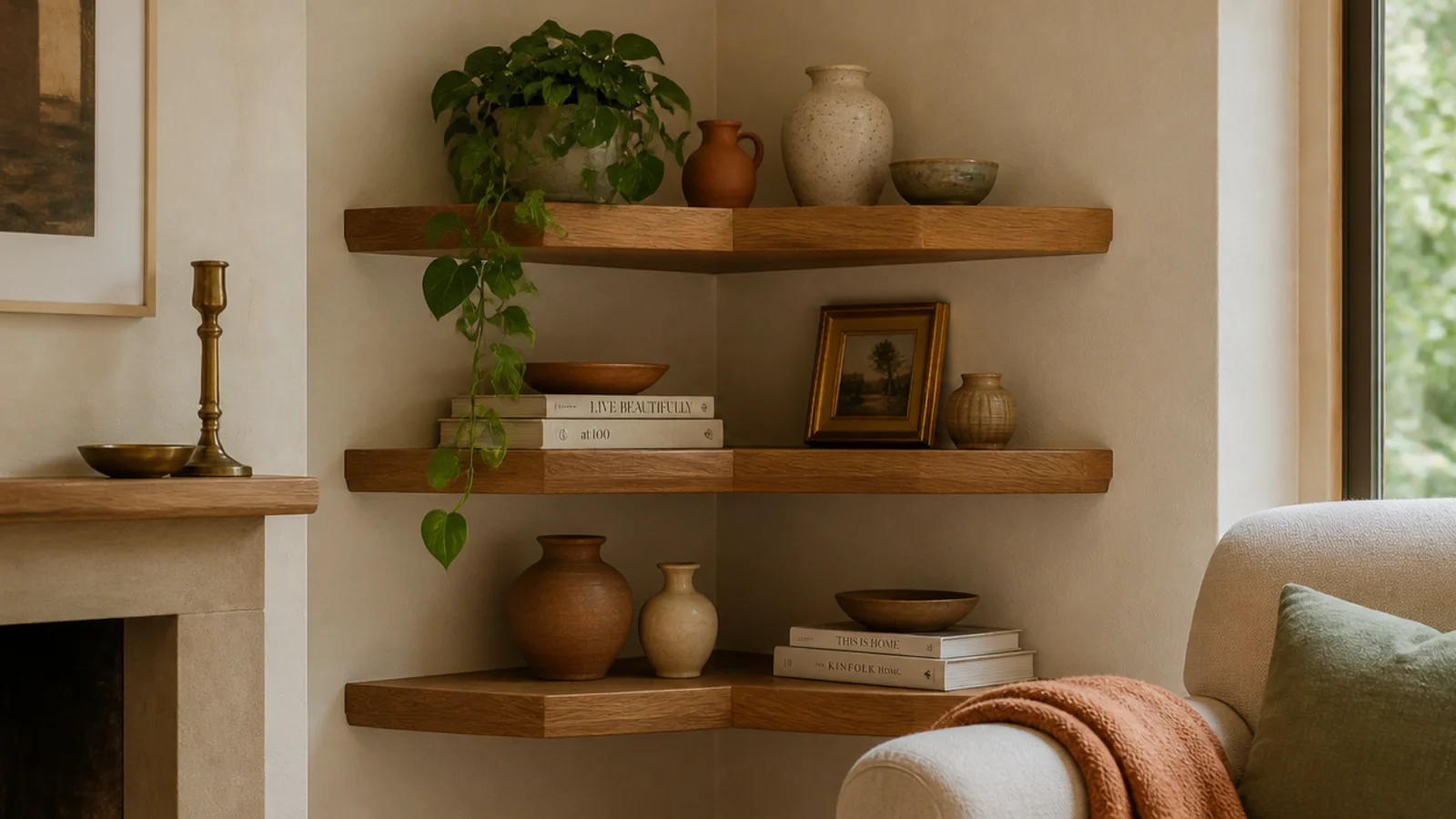
This is the default answer for a living room corner and deserves to be. Three boards at decreasing lengths — roughly 24, 20 and 16 inches — mounted 13 inches apart, in three-quarter-inch solid oak.
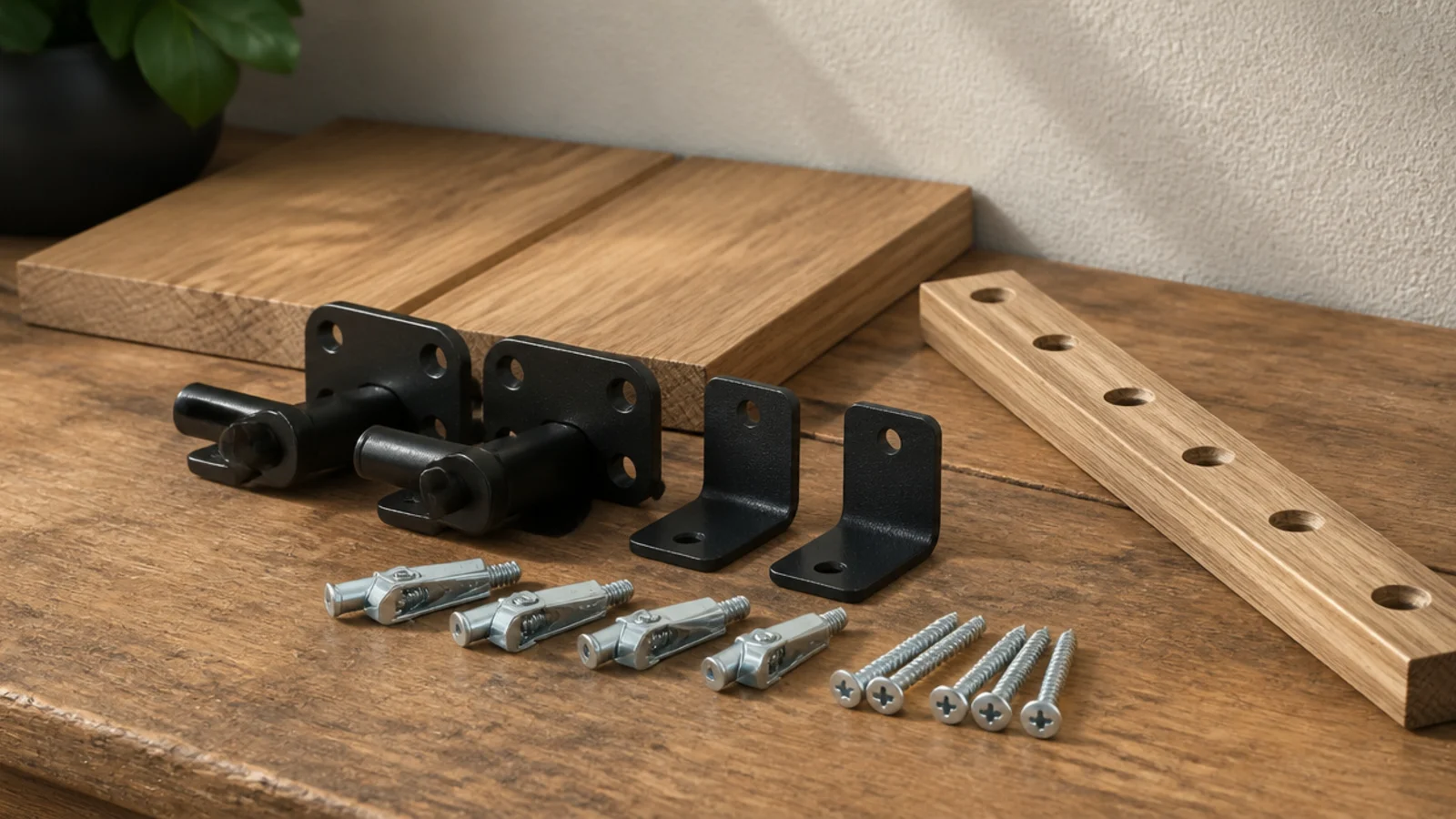
It works because the taper stops the stack reading as a block, and because solid oak at that thickness spans 24 inches with hardbacks on it without visible sag. Look for sets that ship with steel brackets rather than stamped aluminium, and check the bracket screw holes are countersunk. Expect $60 to $120 for a good one.
2. The single deep walnut shelf
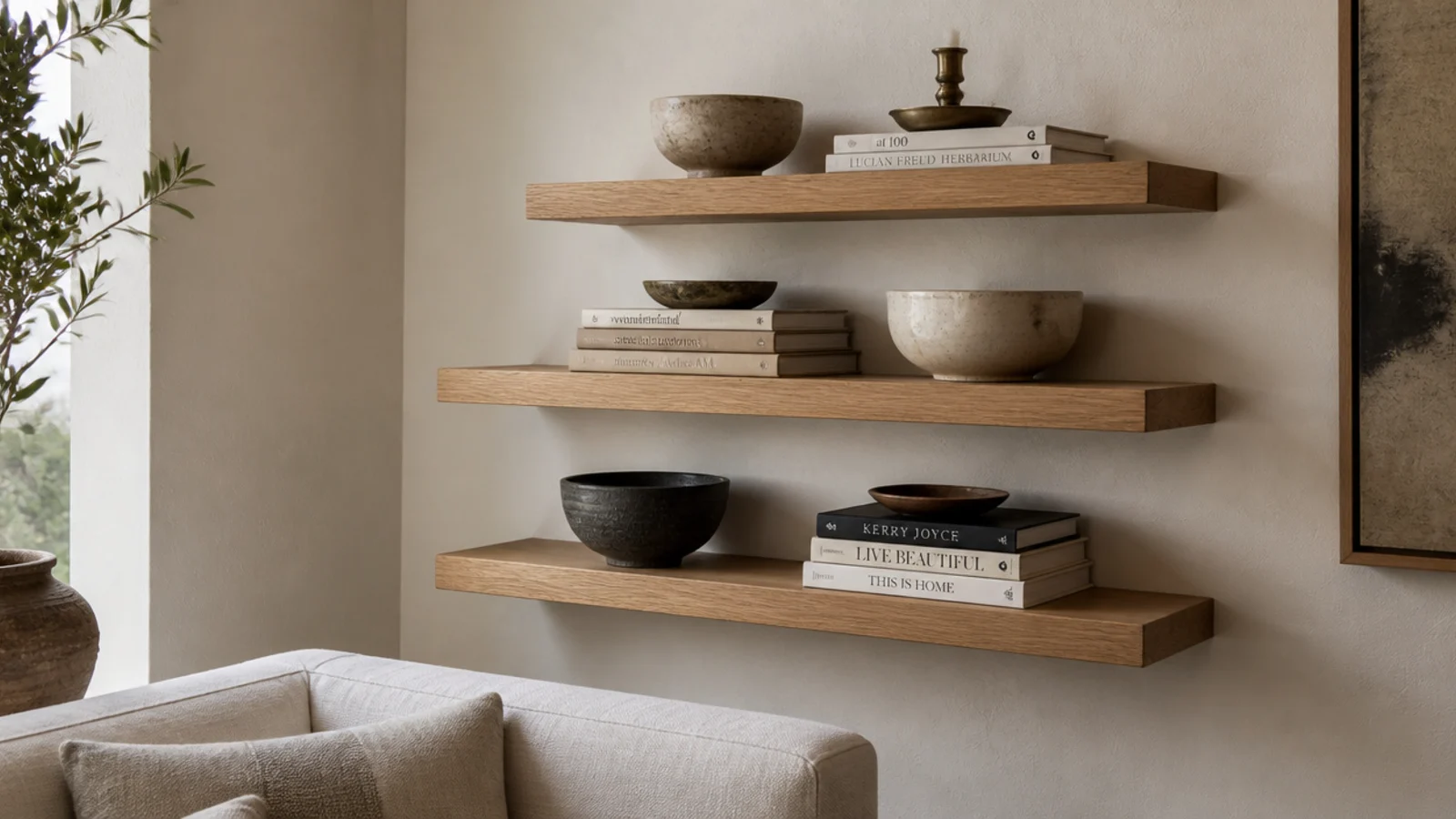
The most underrated purchase on this list. One shelf, 24 inches long and eight deep, mounted 16 to 18 inches above the back of a chair.
It costs a third of a three-tier set and gets used ten times more, because it sits exactly where you reach without a side table eating floor space. Walnut is worth the premium here specifically because a single shelf is a piece of furniture rather than storage — the grain is doing visible work. Budget $30 to $55.
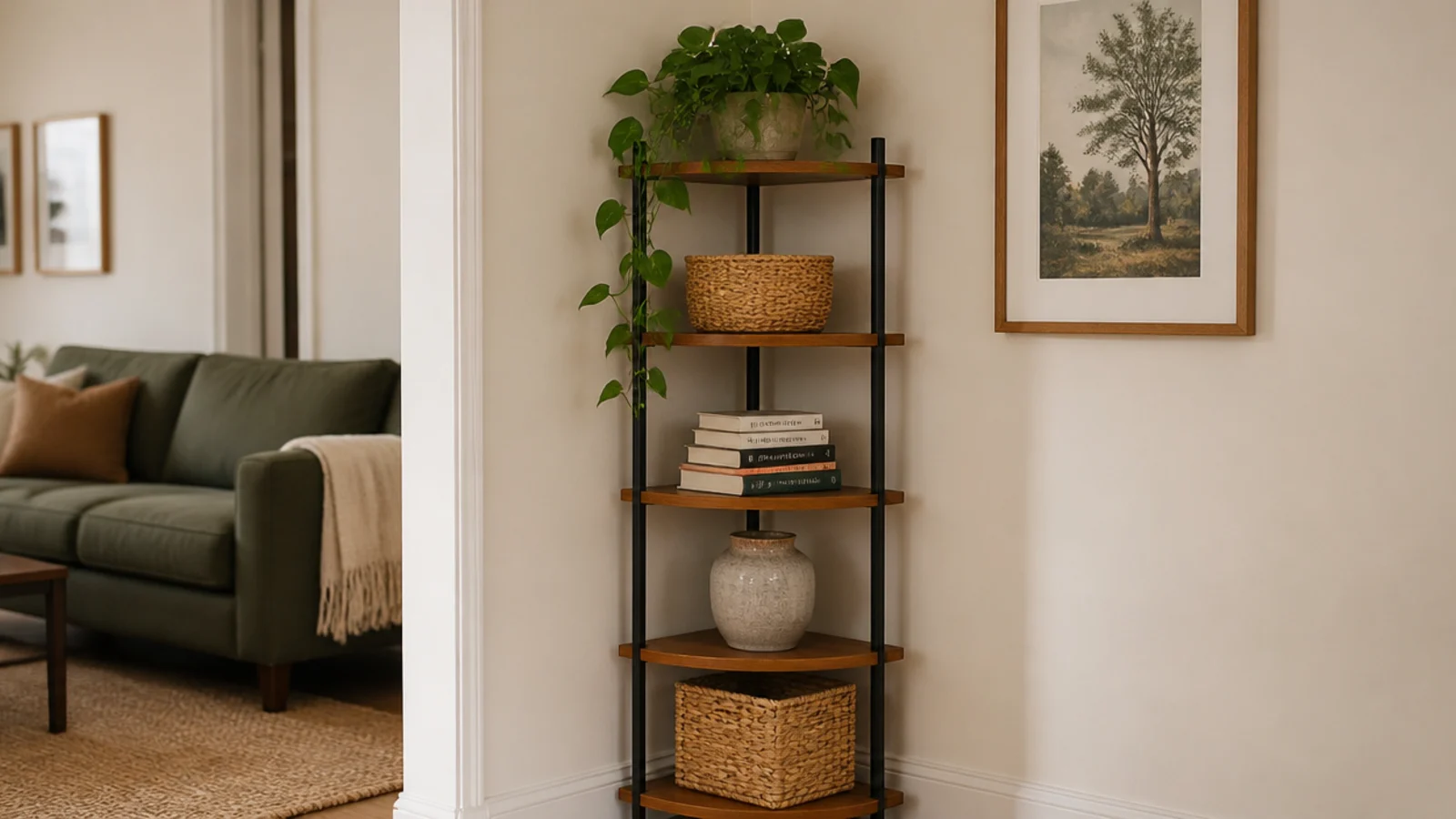
3. The freestanding corner etagere
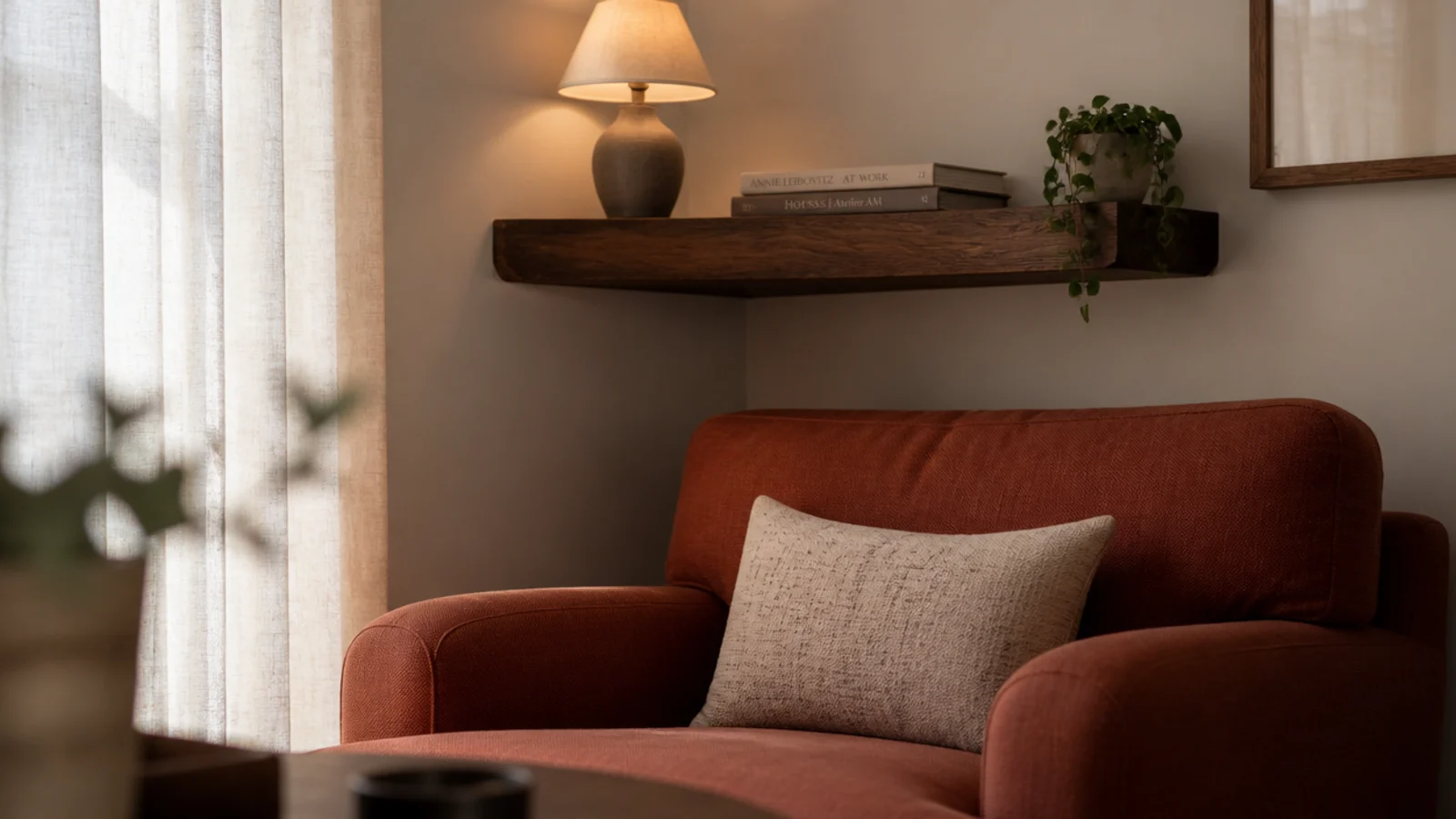
If you rent and you need to hold actual weight, this is the honest answer. Five tiers, roughly 68 inches tall, in oak and thin black metal.
Look for a triangular footprint rather than a square one; square units waste four inches of corner. Load the bottom two tiers heaviest to keep the center of gravity low. And run one anti-tip strap into the wall if there are kids or pets — a single small hole is not the same commitment as mounting a whole system. Expect $70 to $140.
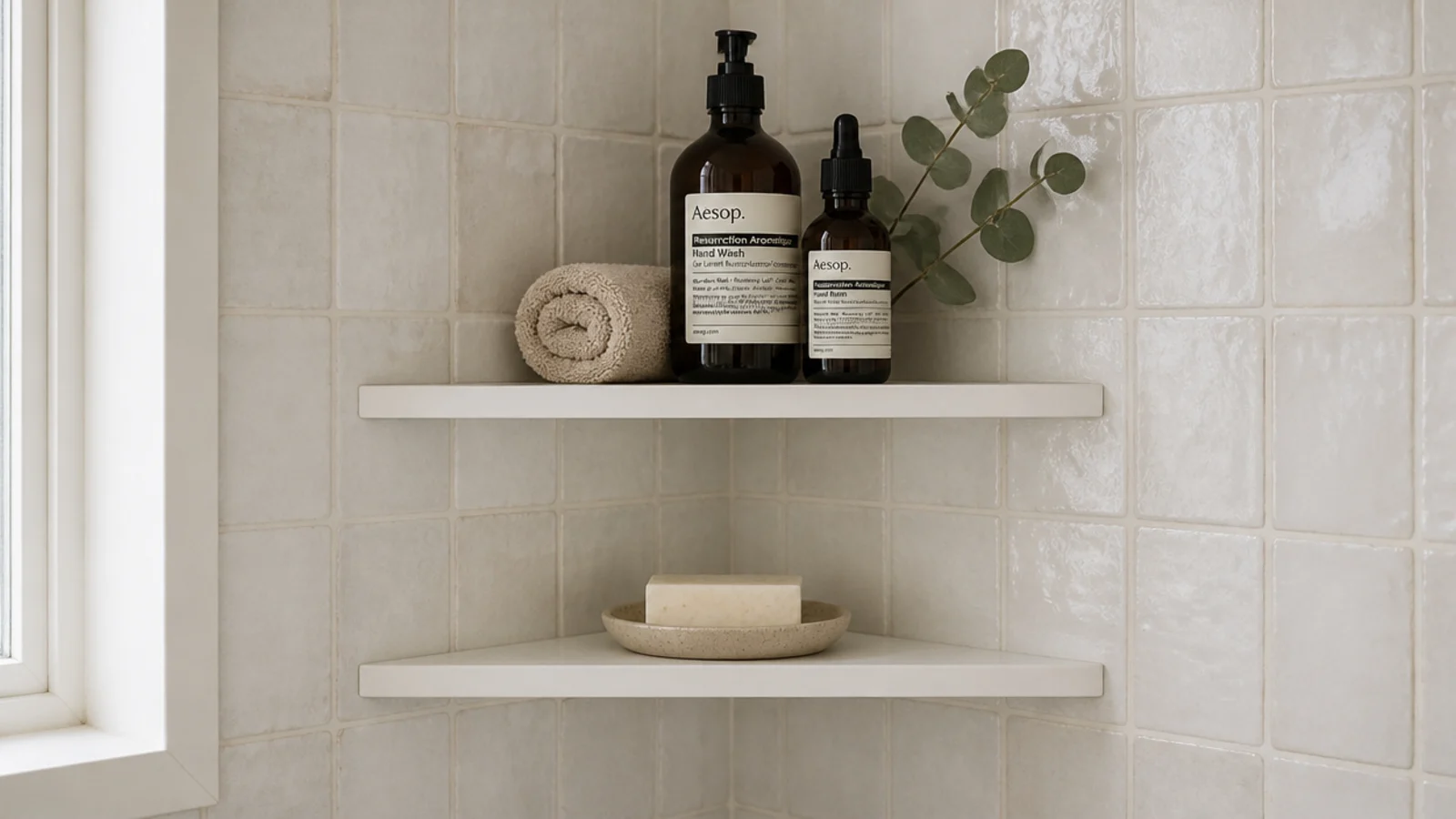
4. The slim bathroom corner shelf
Five inches deep, sealed finish, and that is the whole specification. Powder-coated steel or solid surface handles humidity; raw pine and unsealed MDF swell within a season in a room without a window.
Mount the lower shelf at 48 inches so a towel hanging from it clears the toilet tank. Five inches sounds tiny and holds a rolled towel, a soap dish and two bottles comfortably while staying clear of the shower door. There is more on this in bathroom corner shelves. Around $20 to $40.
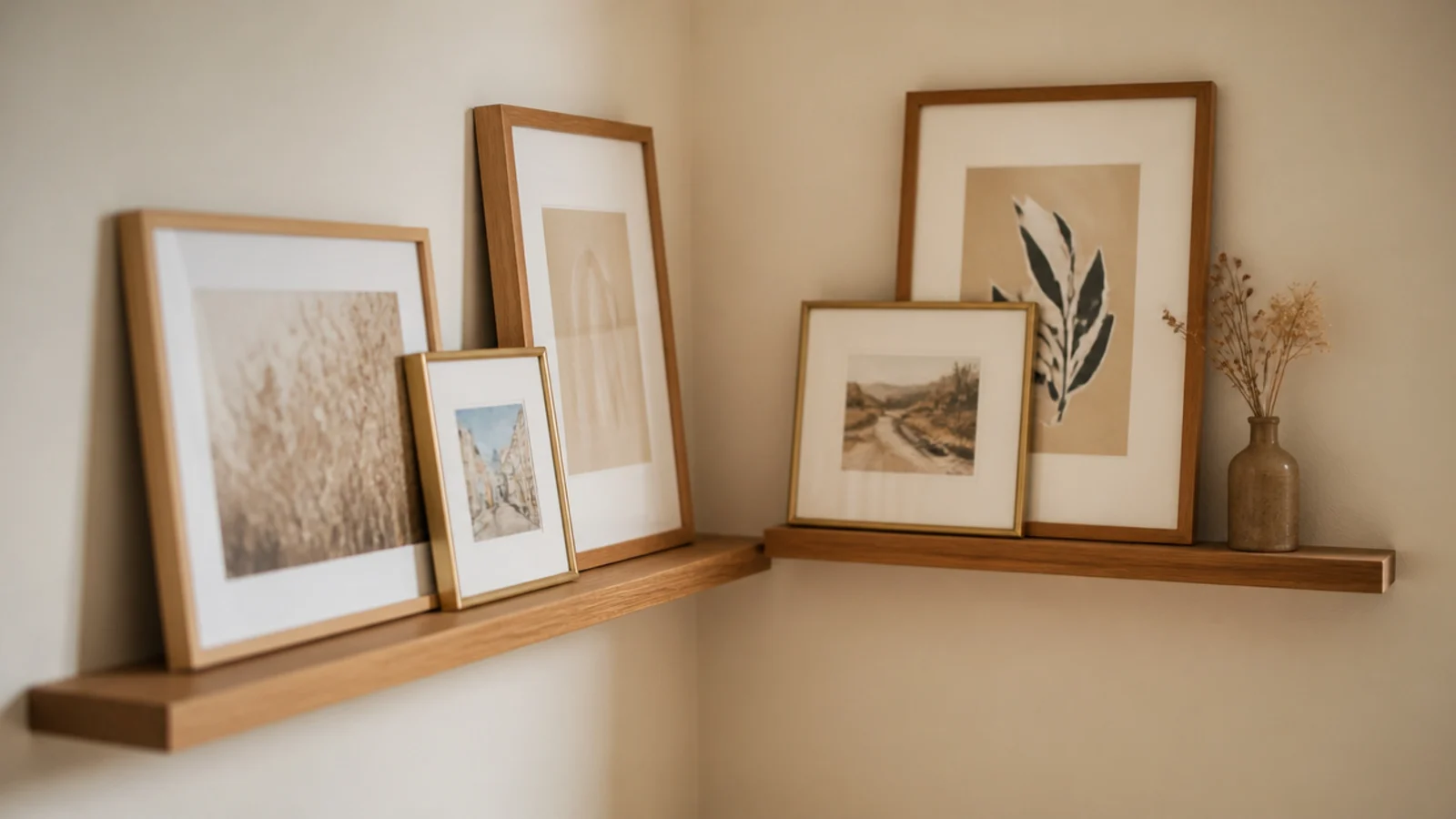
5. The corner picture ledge pair
Two narrow ledges, three inches deep with a front lip, running along both walls at the same height so framed art leans rather than hangs.
The value here is reversibility: you can restyle the entire corner in five minutes without patching anything. Overlap the frames slightly where they meet at the corner so the eye reads one continuous line instead of two separate walls. Keep to two frame finishes. Around $25 to $45 for a pair.
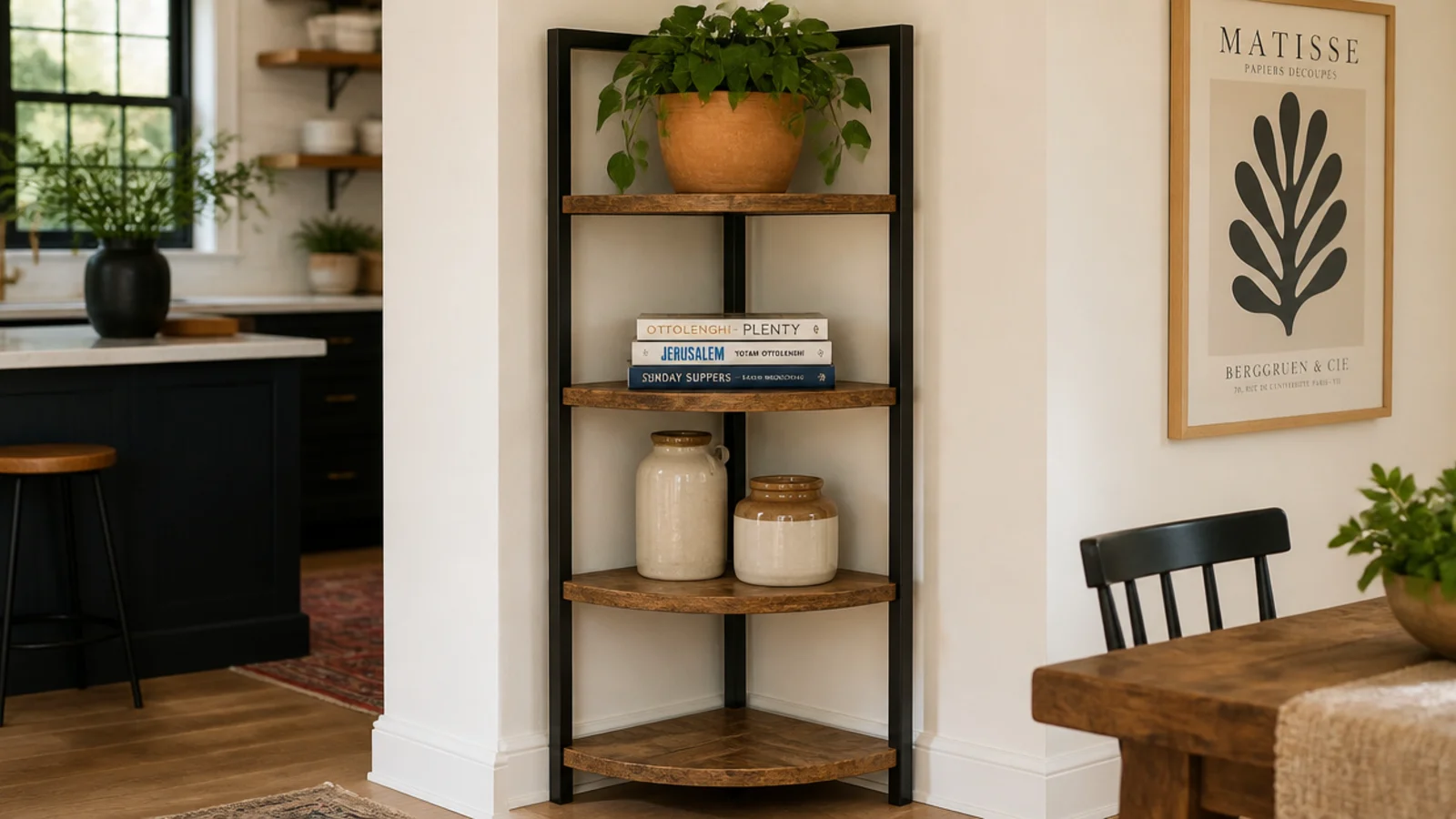
6. The industrial metal and wood corner unit
When the load is genuinely heavy — cookbooks, a large planter, a record collection — a welded steel frame carrying wood boards outperforms any bracket-and-board arrangement at the same price.
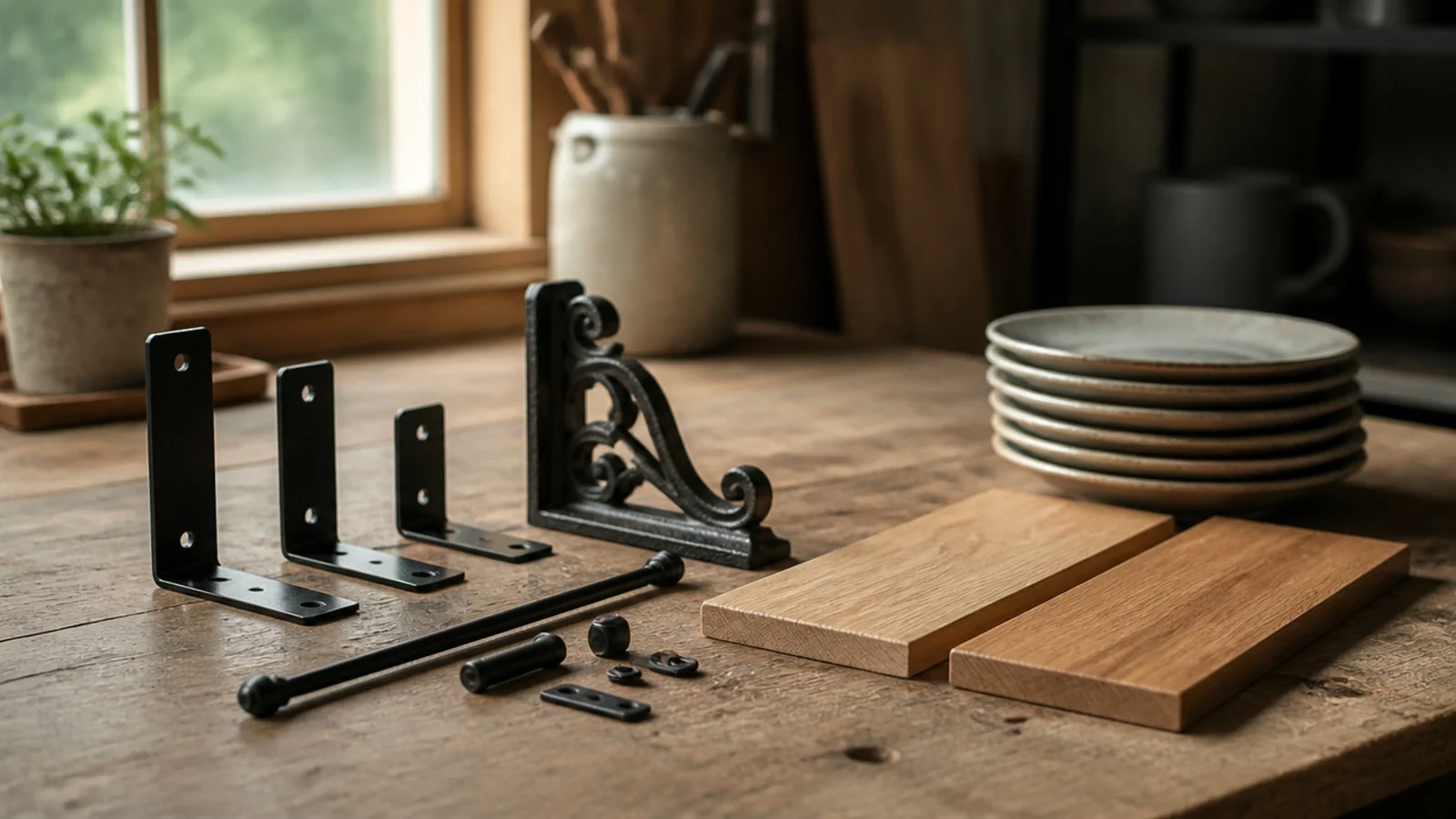
The frame distributes weight across four wall points instead of two, and the boards sit in the frame rather than hanging off it. Check the boards are solid wood and not wood-look laminate over MDF, which is where cheaper versions of this style cut cost. Expect $80 to $150.
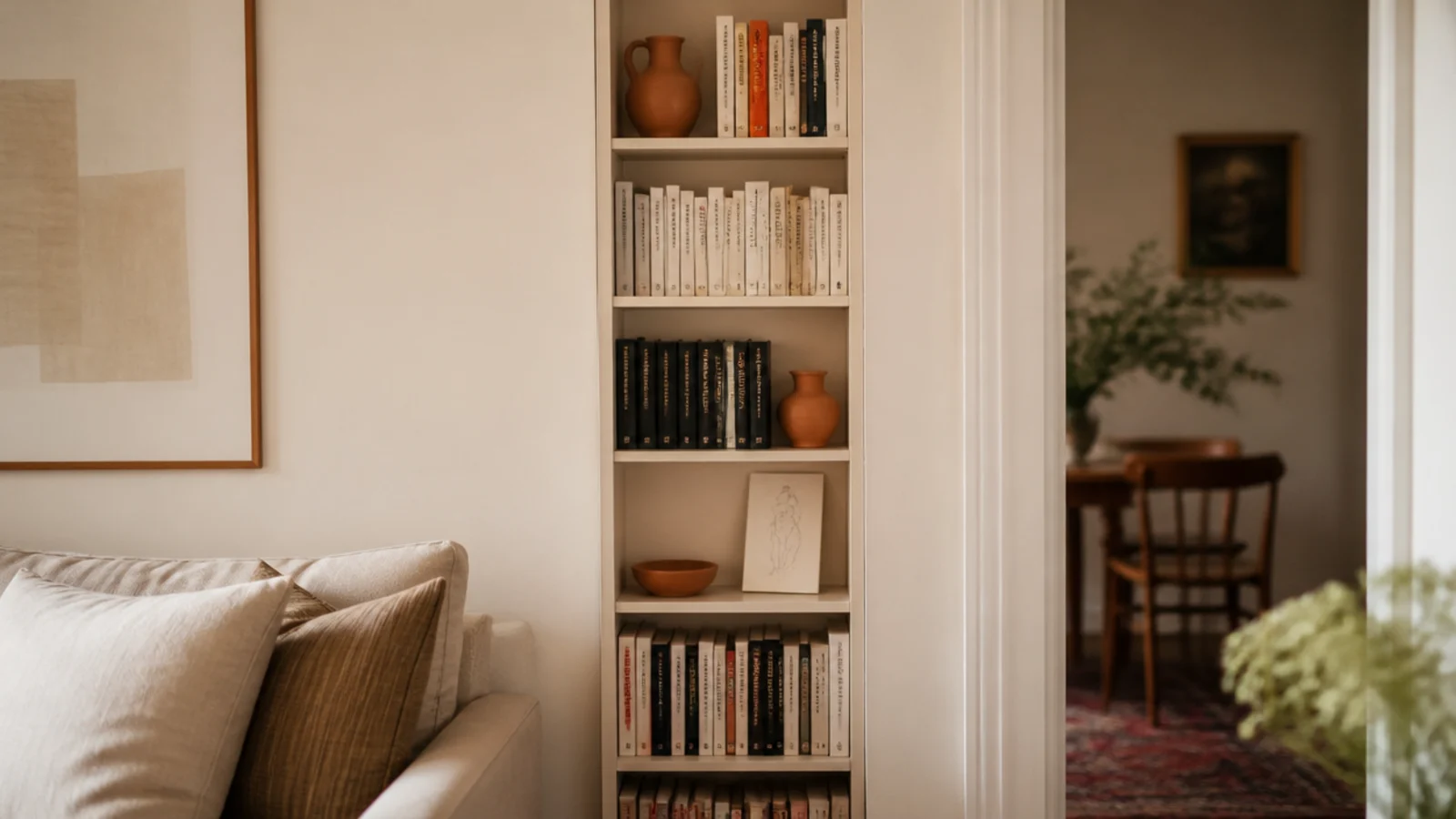
7. The floor-to-ceiling corner column
The most expensive option and the only one that changes how a room reads. Ten inches deep, running floor to ceiling, in a corner genuinely out of the traffic path.
Paint it the exact wall color. A column that matches the wall reads as architecture; a column in a contrasting color reads as furniture crammed into a corner. Leave one shelf two-thirds empty for a piece of pottery — that gap stops the whole column feeling heavy. Materials run $300 and up.
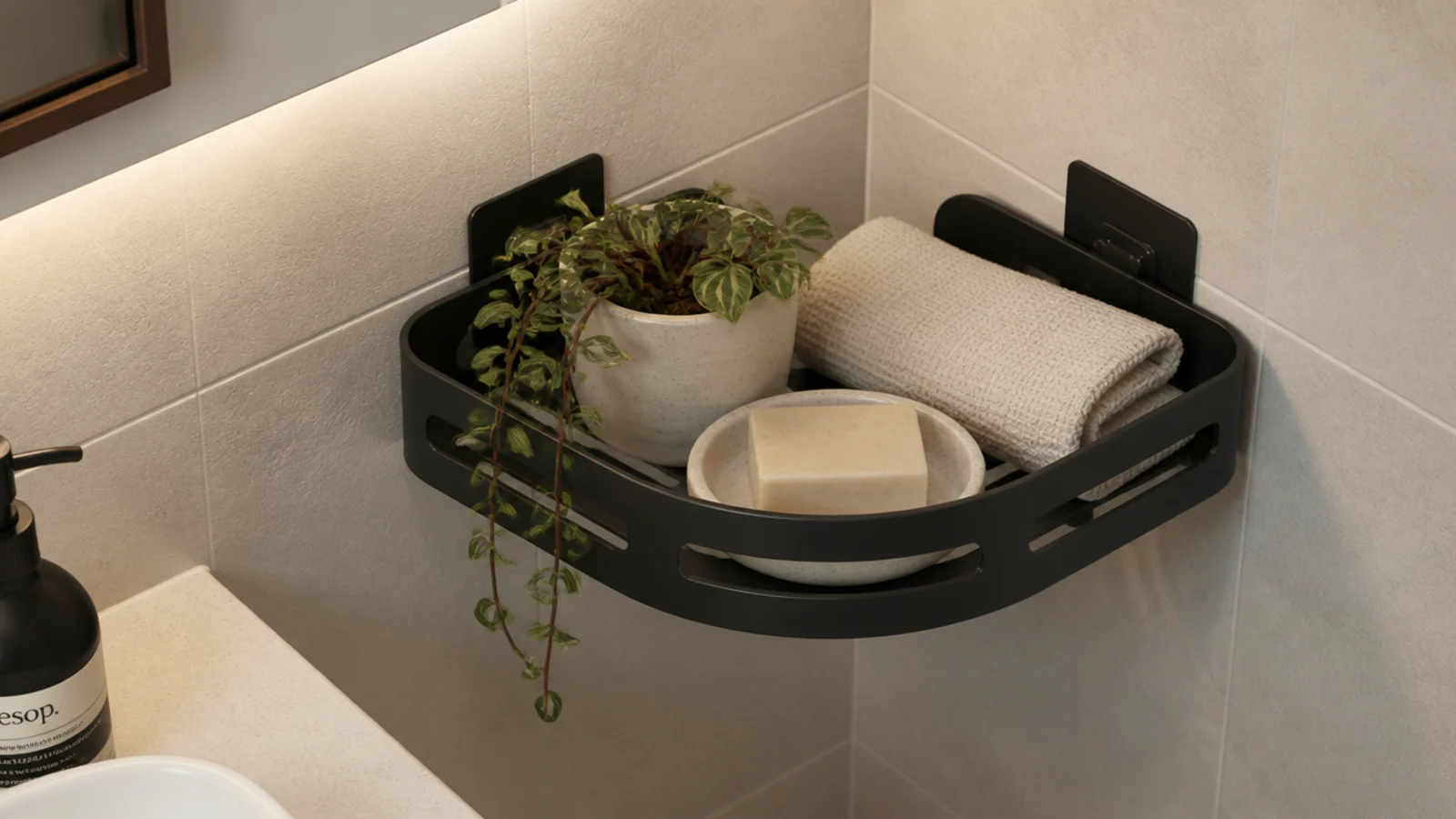
8. The adhesive-mount corner caddy
The true zero-hole option, and the one most often oversold. Heavy-duty strips rated to 15 pounds per pair are genuine, but that is the honest ceiling — a bathroom caddy or a few light ceramics, not books.
Clean the wall with rubbing alcohol first, press for 30 seconds, and wait an hour before loading. Test on hidden paint: flat builder-grade paint peels off with the strip. Remove with a hair dryer on low, pulling slowly at a 45-degree angle. Around $15 to $30.
What to Check Before You Buy
Measure the walkway, not the wall. Stand in the corner and measure to the nearest thing you walk around. Under 30 inches means six-inch depth. Thirty to forty allows eight. This is the decision you cannot undo with styling later.
Check what anchors are included, then plan to replace them. Almost every shelf ships with plastic plugs rated around 10 pounds. Toggle bolts cost about a dollar each and carry 25 to 35 pounds in half-inch drywall. Buy them on the same trip.
Read the stated depth as the board width. Once the back edge meets a wall that is not quite square, you lose up to an inch of usable surface. If eight inches is your maximum, buying a nine-inch board is not the mistake people assume it is.
Look at the front edge in the product photos. If you can see a seam line where the edge banding meets the face, it is veneer over particle board and it will chip.
For anything freestanding, check the footprint shape. Triangular footprints use a corner properly. Square ones waste roughly four inches on the diagonal, which in a small room is the difference between fitting and not.
If it holds anything above 30 pounds, plan for a stud. No drywall anchor is as good as a screw into framing, and corners usually have framing within an inch and a half on both sides.
Frequently asked questions
What is the best type of corner shelf for a renter?
A freestanding corner etagere, because it carries real weight, needs no holes and moves house with you. Adhesive-mount caddies are the true zero-hole option but cap out around 15 pounds per pair of strips, so they suit a bathroom or a few light ceramics rather than books. Tension-pole units work well but need a true 90-degree corner with solid floor and ceiling.
How much should I spend on corner shelves?
A single solid wood shelf with decent brackets runs $25 to $45, a three-tier floating set runs $60 to $120, and a full floor-to-ceiling column is $300 and up in materials. Spending more mostly buys you solid wood instead of veneer and steel brackets instead of stamped ones — both worth it. Past about $150 for a three-tier set you are paying for brand, not performance.
Are floating corner shelves strong enough for books?
Yes, if the bracket reaches a stud and the board is at least three-quarters of an inch thick. A hidden-bracket floating shelf into drywall alone is the weakest common configuration and the one most likely to sag. For a shelf of hardbacks, visible steel brackets into studs beat any concealed system.
What depth should I buy for a small apartment?
Six inches for hallways, bathrooms and anywhere within reach of a doorway. Eight inches for living rooms and bedrooms with at least 30 inches of walkway. Six inches sounds small on paper and holds far more than people expect — it takes paperbacks, mid-size pottery and framed photos comfortably.
Is solid wood really worth it over veneer?
For any shelf whose front edge you will look at daily, yes. Veneer over particle board photographs identically on day one and chips at the front edge within a year of normal use, exposing pale board underneath that cannot be repaired invisibly. Painted solid pine costs about the same and ages honestly.
Do I need different corner shelves for a bathroom?
You need different materials, not a different shape. Sealed wood, powder-coated metal, glass or solid surface all handle humidity. Raw pine and unsealed MDF swell and stain within a season in a room with no window. Keep bathroom corner shelves to five inches deep so they clear the shower door swing.
Buy for the wall you have rather than the room you want — depth and anchor decide whether a corner shelf lasts, and everything else is styling you can change on a Sunday. The full corner shelf ideas guide covers placement room by room, wooden corner shelves goes deeper on species and finishes, and if your wall is straight rather than cornered, the best floating shelf brackets covers the same ground. Save the pin for the next shopping trip.
Want more like this? Browse all 15 corner shelf ideas guides — they all use the same measurements and budget tiers.
Pin it for later
Save this to your Corner Shelf Ideas board
Pin it now so it is waiting for you when the tape measure comes out — and so the next person hunting for this idea can find it too.
Save this pinKeep going
More ideas worth saving while you have the tape measure out.