Apartment Balcony Ideas · Listicle
20 Creative Apartment Balcony Ideas Anyone Can Do

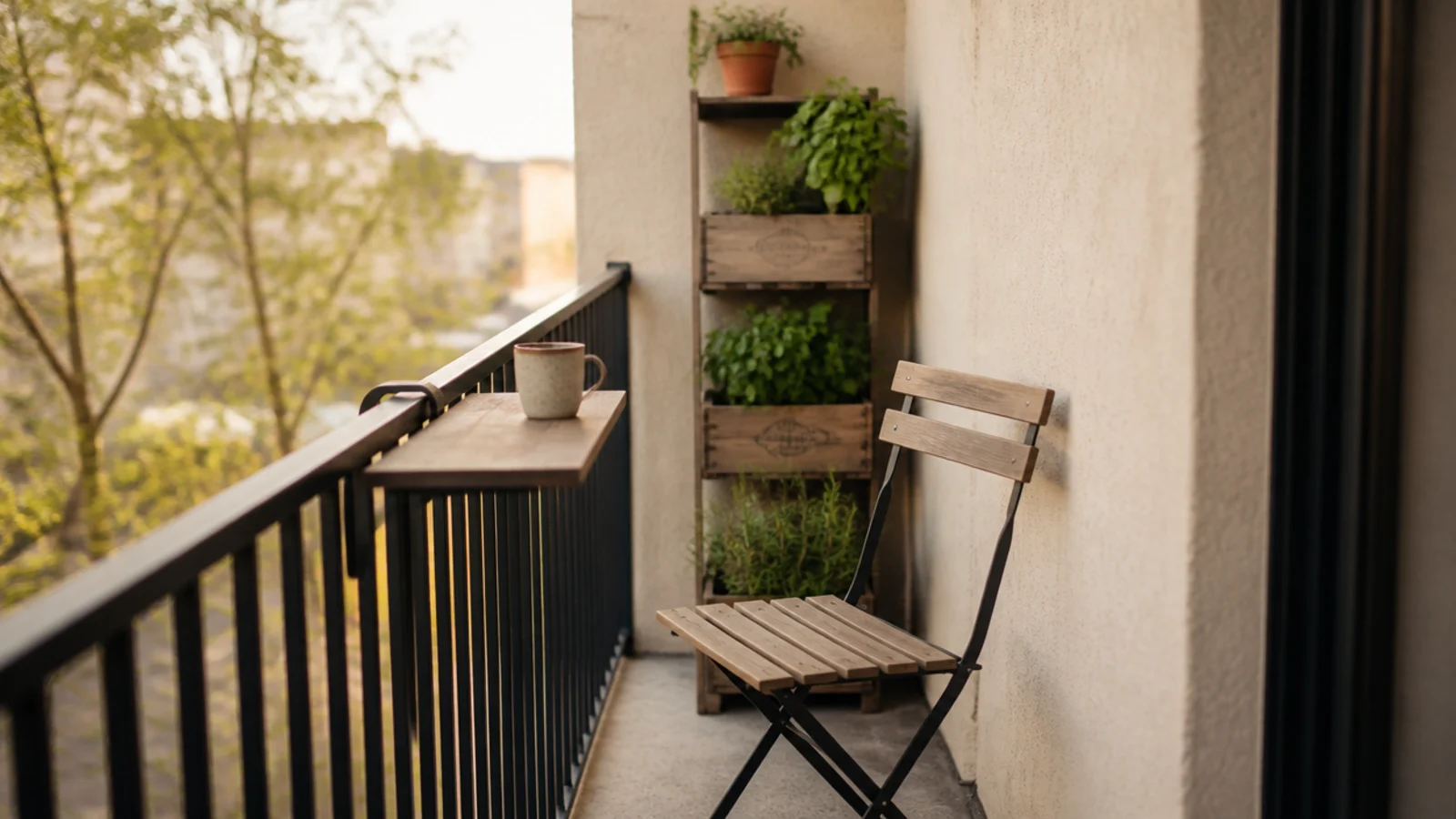
Tiny apartment balcony ideas have to solve a maths problem before they solve a styling one. On a slab three or four feet deep, every piece you add takes something away, and the pieces that survive are the ones that fold, stack, nest or hang inside the rail. I have worked on balconies as small as 14 square feet. All twenty of these fit that, cost little, and will not put you sideways with the building.
In this guide22 sections — tap to openHide
- 1.Tiny apartment balcony ideas begin with the depth you actually have
- 2.Measure the usable depth, not the slab depth
- 3.Give a tiny balcony one job and refuse the second
- 4.Use the diagonal, because it is the longest line you have
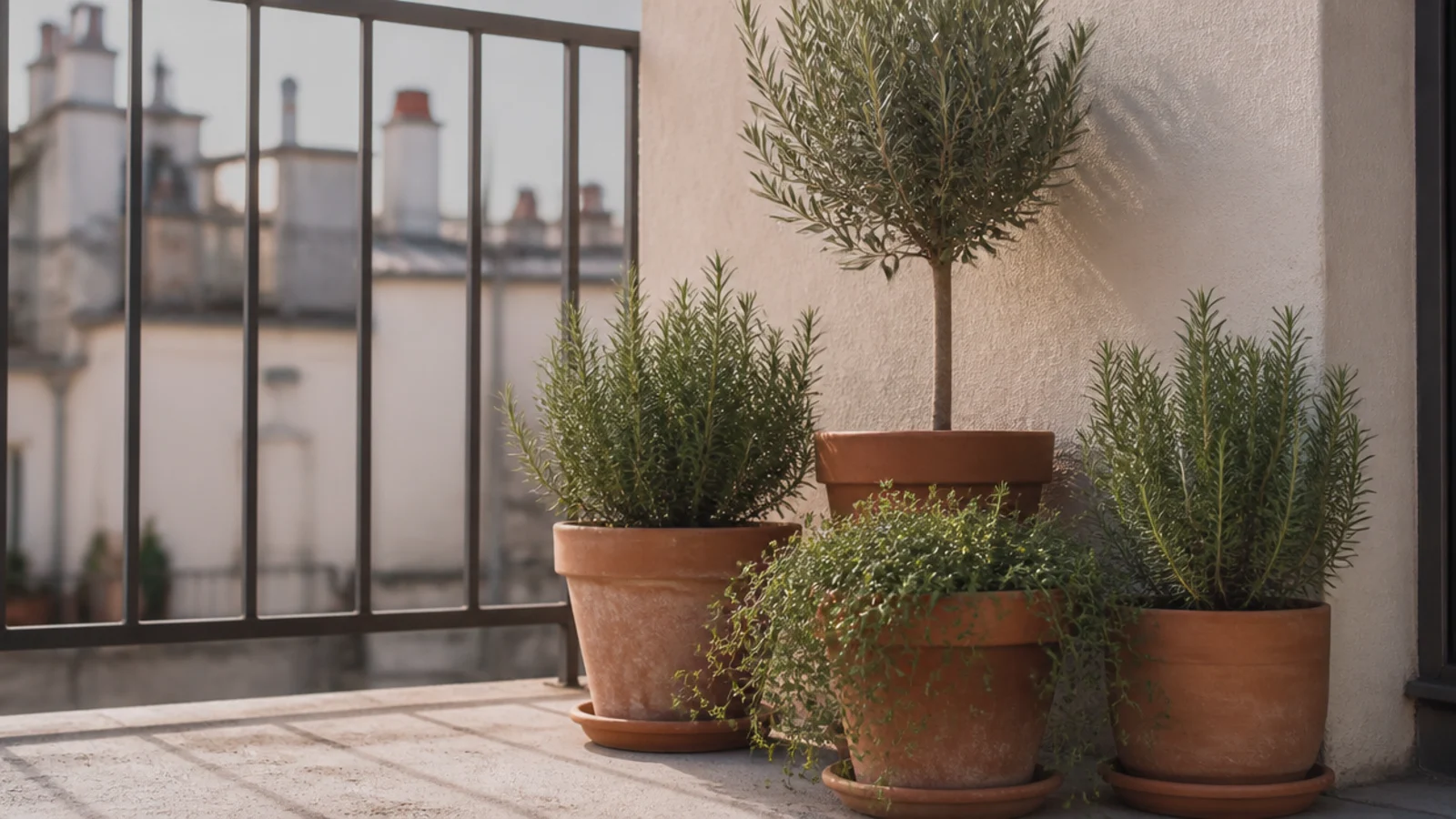
- 5.Nesting stools that stack into one footprint
- 6.A drop-leaf table hooked over the inside of the rail
- 7.Bench seating along the short wall at 14 inches deep
- 8.A ten-inch console against the building wall
- 9.Plant the corner triangle, not the whole edge
- 10.A freestanding trellis weighted in its own planter
- 11.Pocket planters hung on a leaning A-frame
- 12.Round tables have no corners to catch your hip
- 13.Floor cushions and one pouf instead of two chairs
- 14.A shatter-resistant acrylic mirror on the wall
- 15.Stack crates into a tower instead of spreading them
- 16.Tall narrow pots beat wide ones on a shallow slab
- 17.Put the baskets under the seat, not beside it
- 18.Pale floor, dark rail, and the slab reads deeper
- 19.Keep the rail sight line clear at seated eye height
- 20.A tension rod curtain between the side walls
- 21.Plan for the whole balcony to store flat in winter
- 22.Mistakes to Skip
Tiny apartment balcony ideas begin with the depth you actually have
Take three measurements before anything else. Slab depth wall to rail. Slab width. And the arc the door sweeps when it opens, because a hinged door can eat 30 inches of a 40-inch balcony and nobody counts it until the chair will not fit.
Subtract a 24-inch walkway from the door to the far end and keep it clear. That path is a fire egress route in most buildings, and it is also the difference between a balcony you step onto and one you look at.
Then read the balcony clause in the lease. Drilling the wall, ceiling or slab is prohibited almost everywhere, attaching anything to the railing is usually prohibited too, and screens above rail height are commonly banned. Nothing on this list needs a fixing.
Two safety rules run underneath all twenty. Nothing ever mounts on the outside face of the railing — a pot that works loose four floors up lands on a sidewalk. And above the third floor, wind decides what stays: weight low, profiles low, and anything tall tethered or taken in.
Budget tiers: $ under $25, $$ $25 to $80, $$$ $80 to $200.
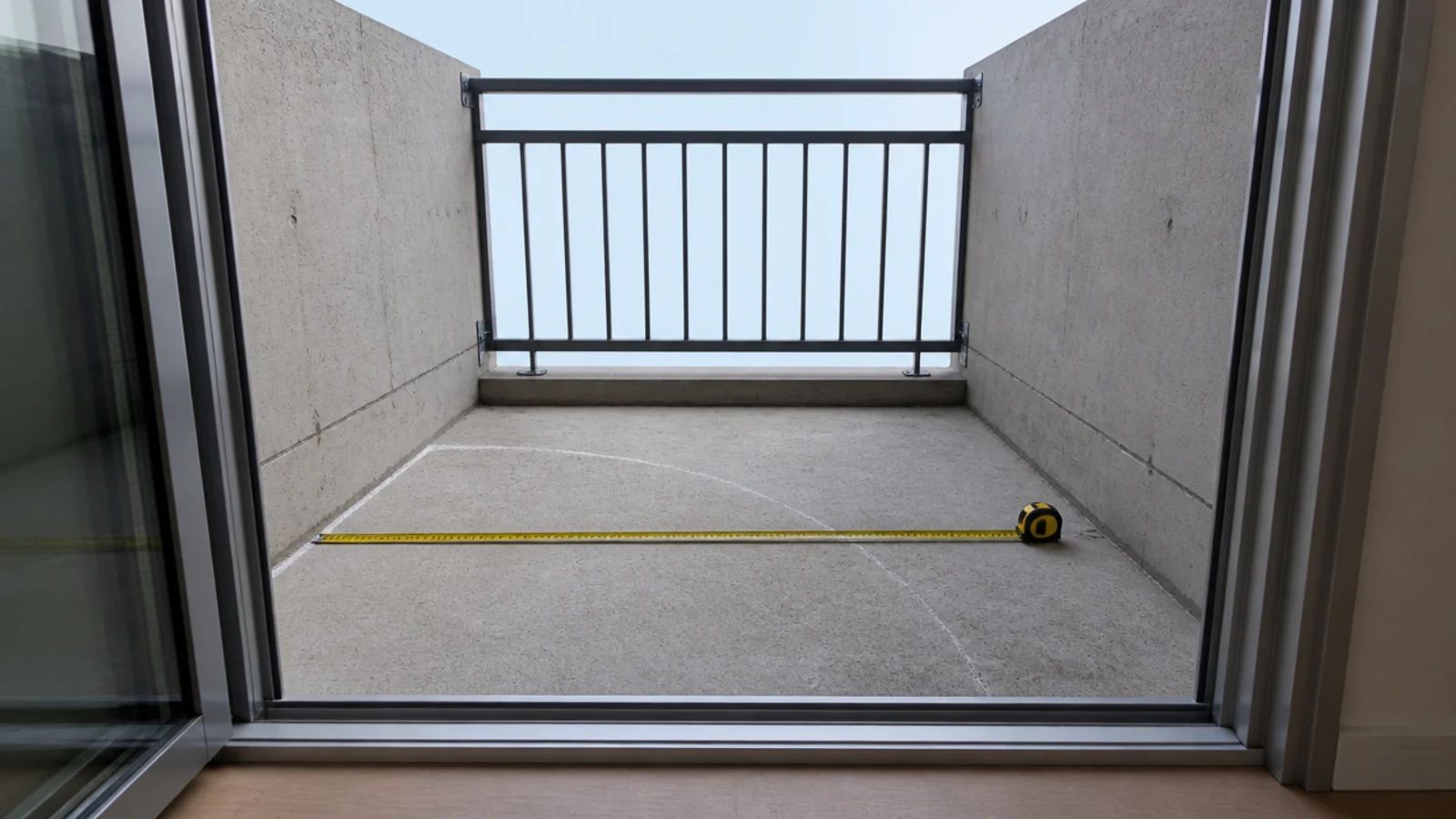
1. Measure the usable depth, not the slab depth
A balcony listed as 4 feet deep is rarely 4 feet of usable floor. Subtract the door swing, subtract any AC condenser or drain hump, and subtract the 4 to 6 inches of bare concrete you want to leave along the rail so water reaches the drain.
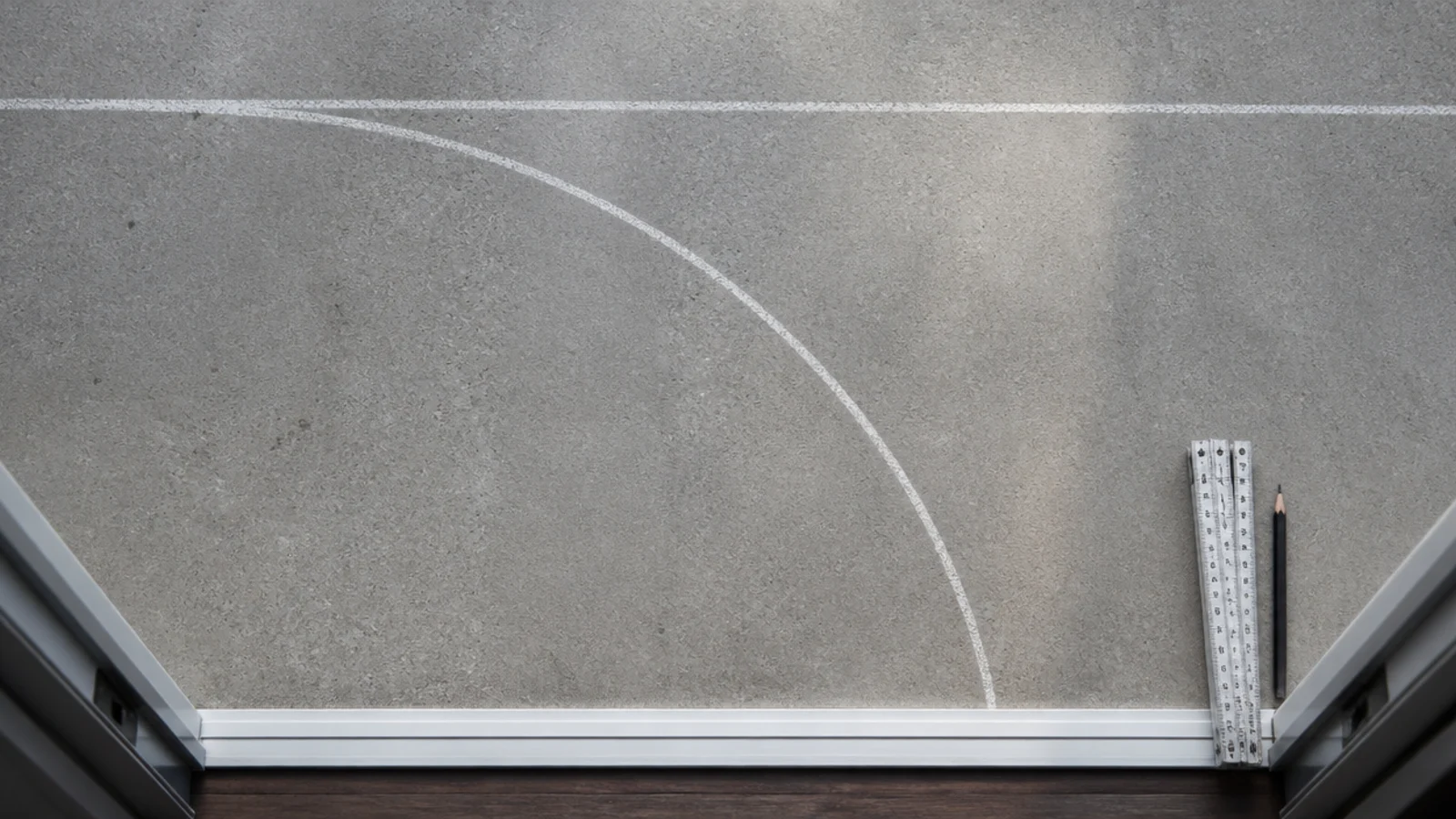
Chalk the real rectangle on the slab and stand in it. On most small balconies you will find one workable furniture position, which answers the shopping question before you spend anything.
Do this on a Saturday morning with a tape and a piece of chalk. Free
2. Give a tiny balcony one job and refuse the second
The fastest way to ruin 20 square feet is to ask it to be a dining spot, a garden, a laundry drying area and a reading nook at once.
Pick one. Morning coffee, evening drink, plants, or reading. Then buy only what that job needs — usually one seat, one surface, one light. Everything else lives inside or does not exist.
I have never regretted a balcony that did one thing well, and I have regretted every one that tried to do three. Free
3. Use the diagonal, because it is the longest line you have
On a 4 by 8 foot slab, the diagonal runs about 9 feet. Turning a chair 45 degrees into a corner buys real legroom that square placement never gives you.
Angle the seat toward the best view and let the front corner of the chair sit toward the rail. A small round side table tucks into the triangle beside it.
The trade is that a diagonal chair blocks more of the walkway, so keep it to one piece and check the 24-inch path still clears. Free
4. Nesting stools that stack into one footprint
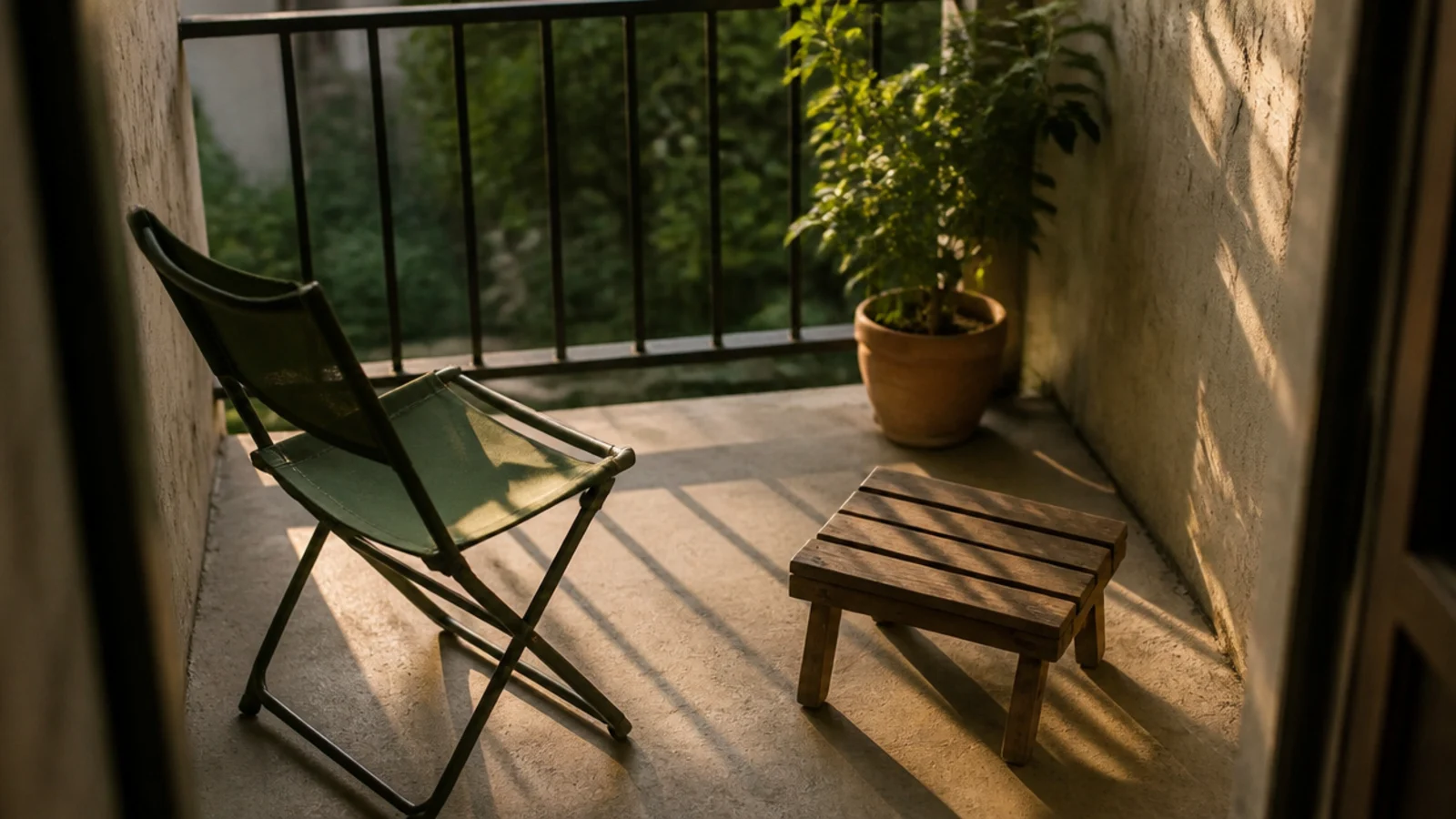
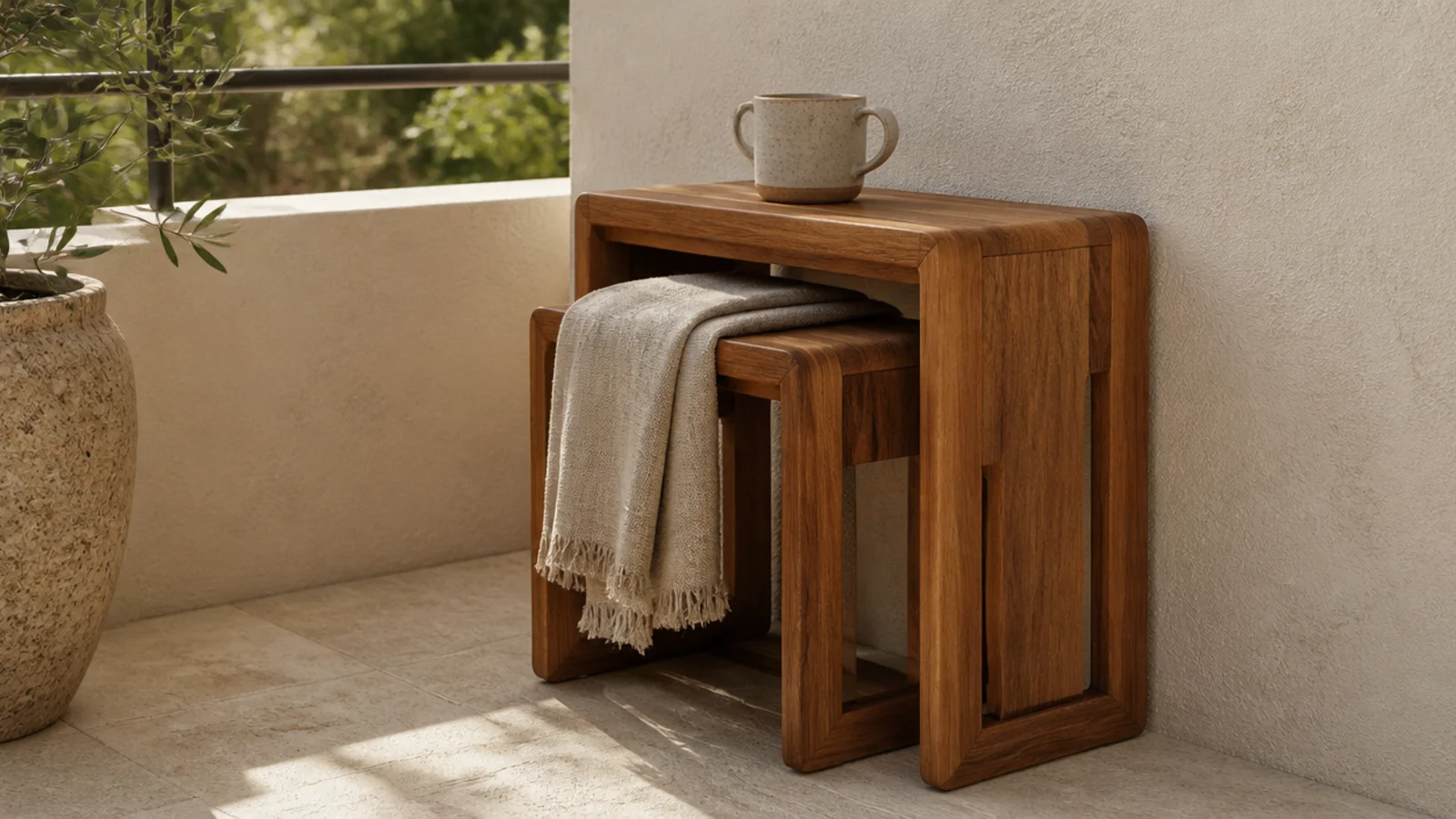
Two nesting stools do the work of two side tables and two spare seats while occupying the floor of one. Look for a pair at roughly 18 and 14 inches tall in acacia or powder-coated steel.
The taller one is a side table at seated height. The shorter is a footrest, a plant plinth or a seat for a guest. Pushed together against the wall they take about 14 by 14 inches.
Skip anything hollow or resin — it blows over and it cracks in the first hard frost. $$
5. A drop-leaf table hooked over the inside of the rail
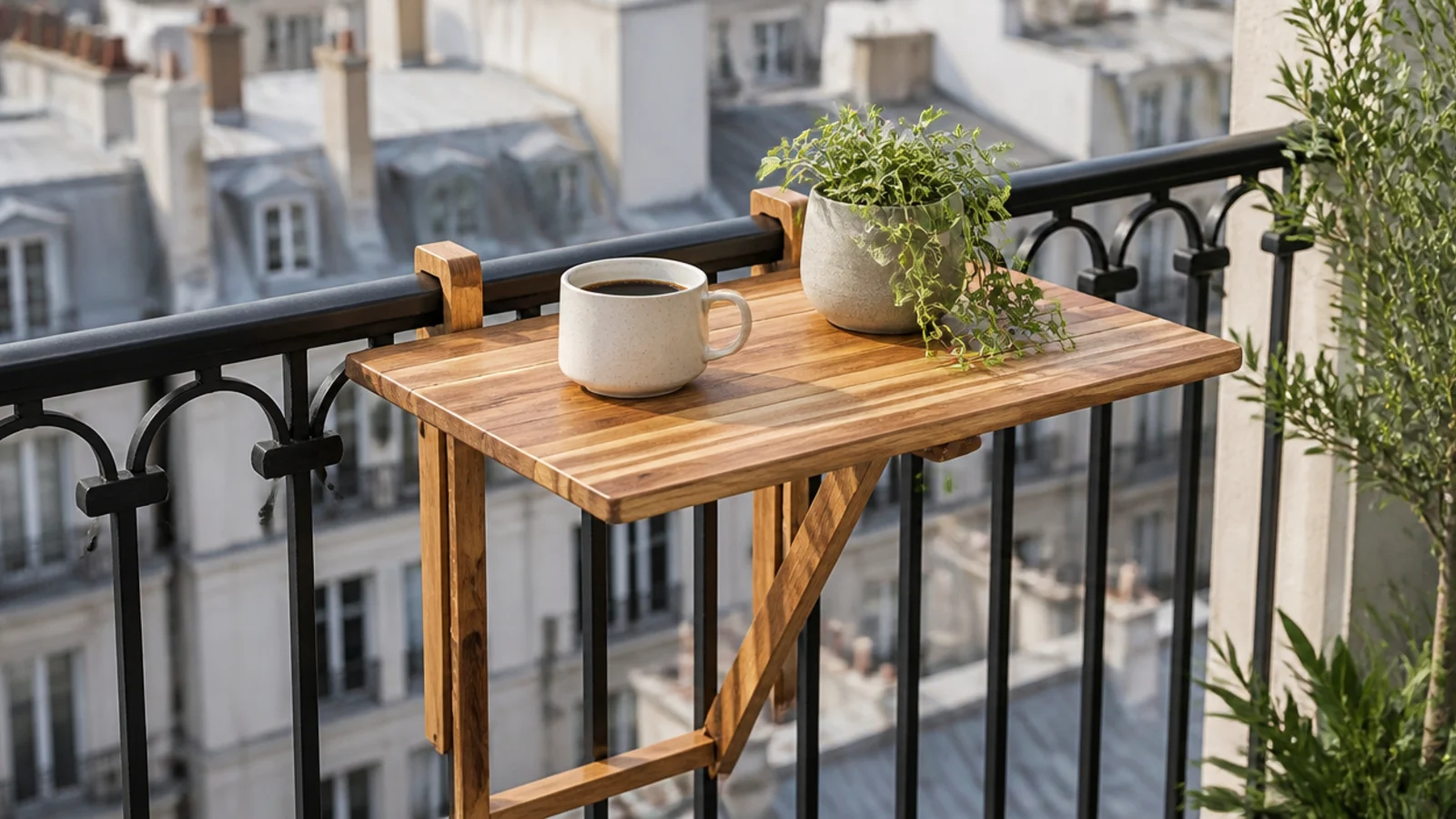
A hook-over rail table gives you a 10 to 14 inch deep surface that folds flat to about 2 inches. It is the single best purchase for a slab under 4 feet deep.
Fit matters: measure your top rail width and check the hook clears it, then tighten the thumb screws against the inside face only. Never the outside. Check the screws monthly and before any windy stretch.
Load it with a cup and a plate, not a laptop and a lamp. These are rated light. $$
6. Bench seating along the short wall at 14 inches deep
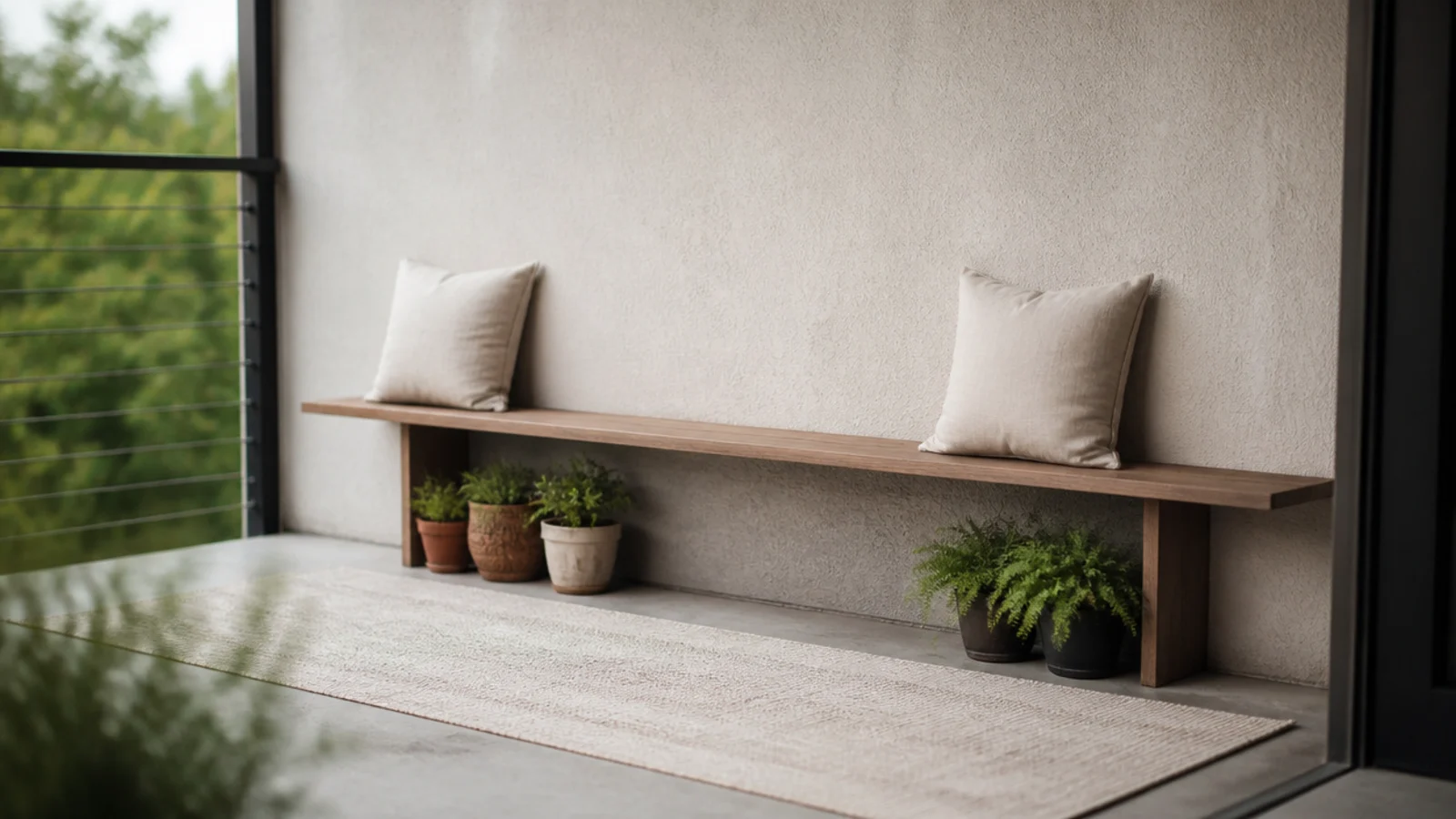
A bench 14 inches deep and as long as the end wall seats two people and leaves the whole floor clear in front of it. A pair of chairs in the same space leaves you a corridor.
Push it flat against the building wall so the mass sits where the slab is strongest, add two seat cushions and a folded throw, and store baskets underneath.
Fourteen inches is comfortable with a cushion. Below 12 inches you perch rather than sit. $$–$$$
7. A ten-inch console against the building wall
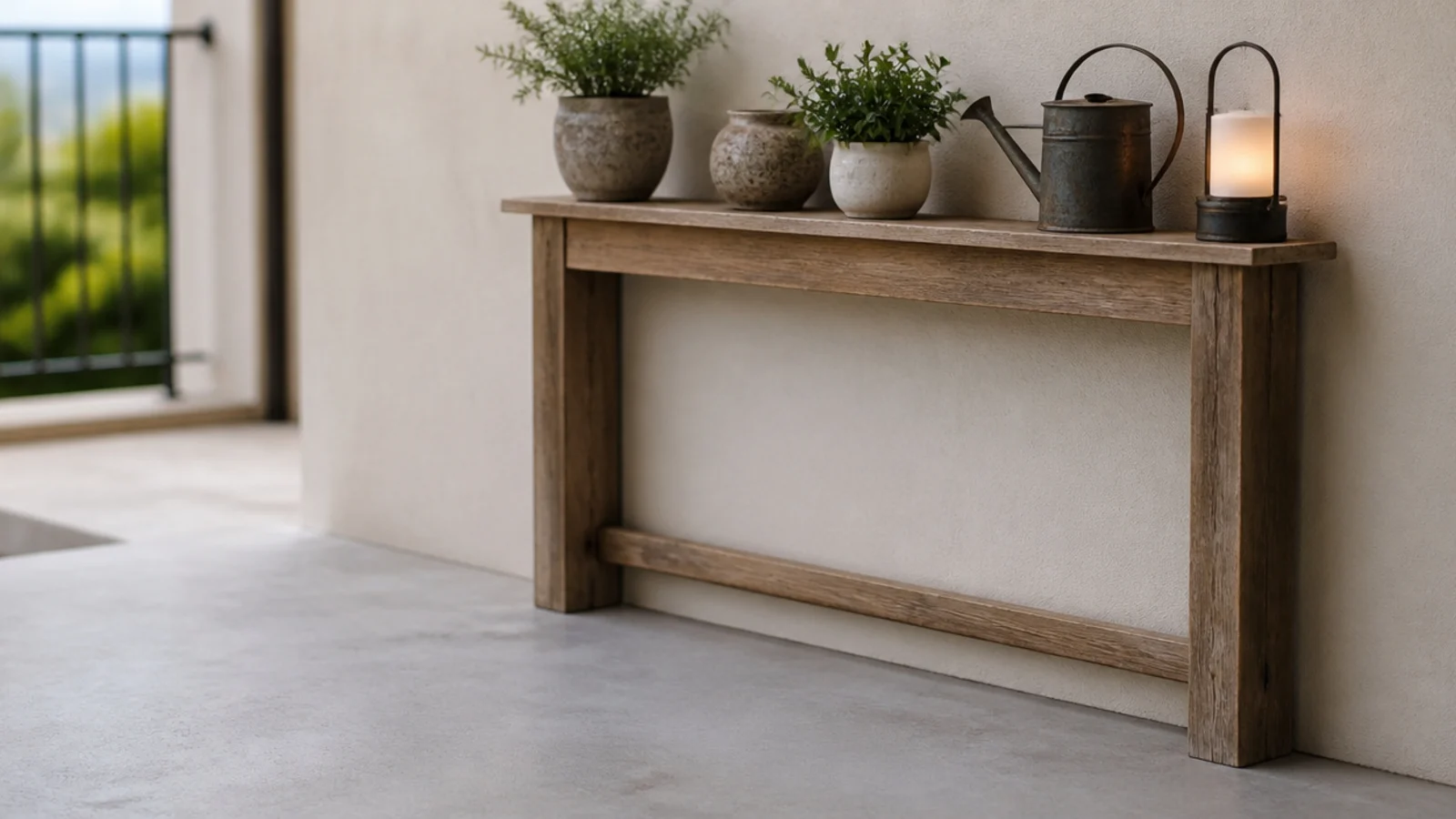
A shallow console is the surface a tiny balcony actually needs — somewhere for a mug, a watering can and three pots that never sits in the walkway.
Ten inches deep is the sweet spot. Anything deeper starts narrowing the path; anything shallower will not take a plant pot. Weathered teak, powder-coated steel or an old wooden shelf on two crates all work.
Keep the heaviest items on the lower shelf and against the wall. Apartment balcony seating covers what to pair it with. $$
8. Plant the corner triangle, not the whole edge
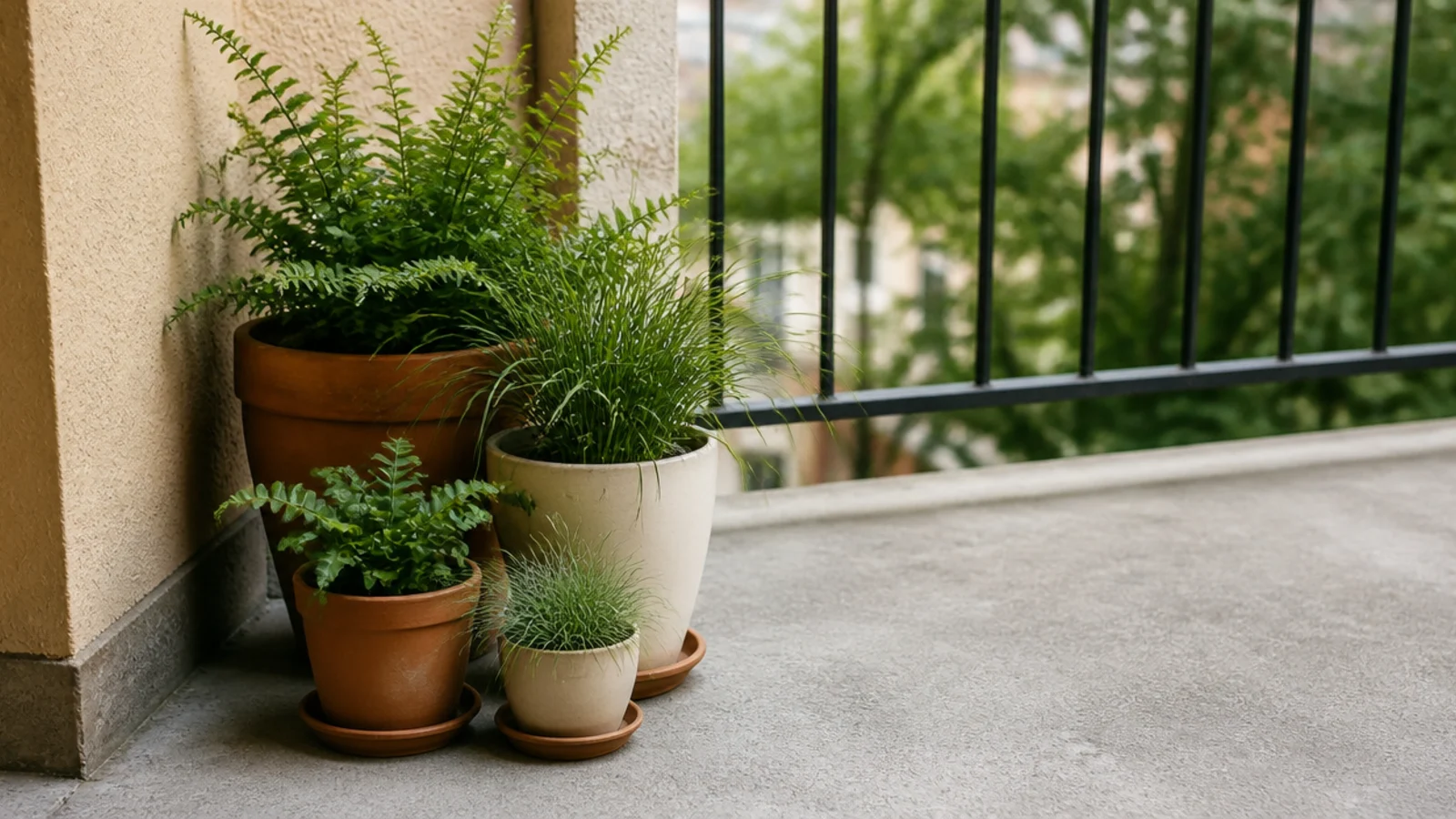
A thin line of pots along the whole rail reads sparse and eats the entire walkway. The same pots massed into one corner read like a garden.
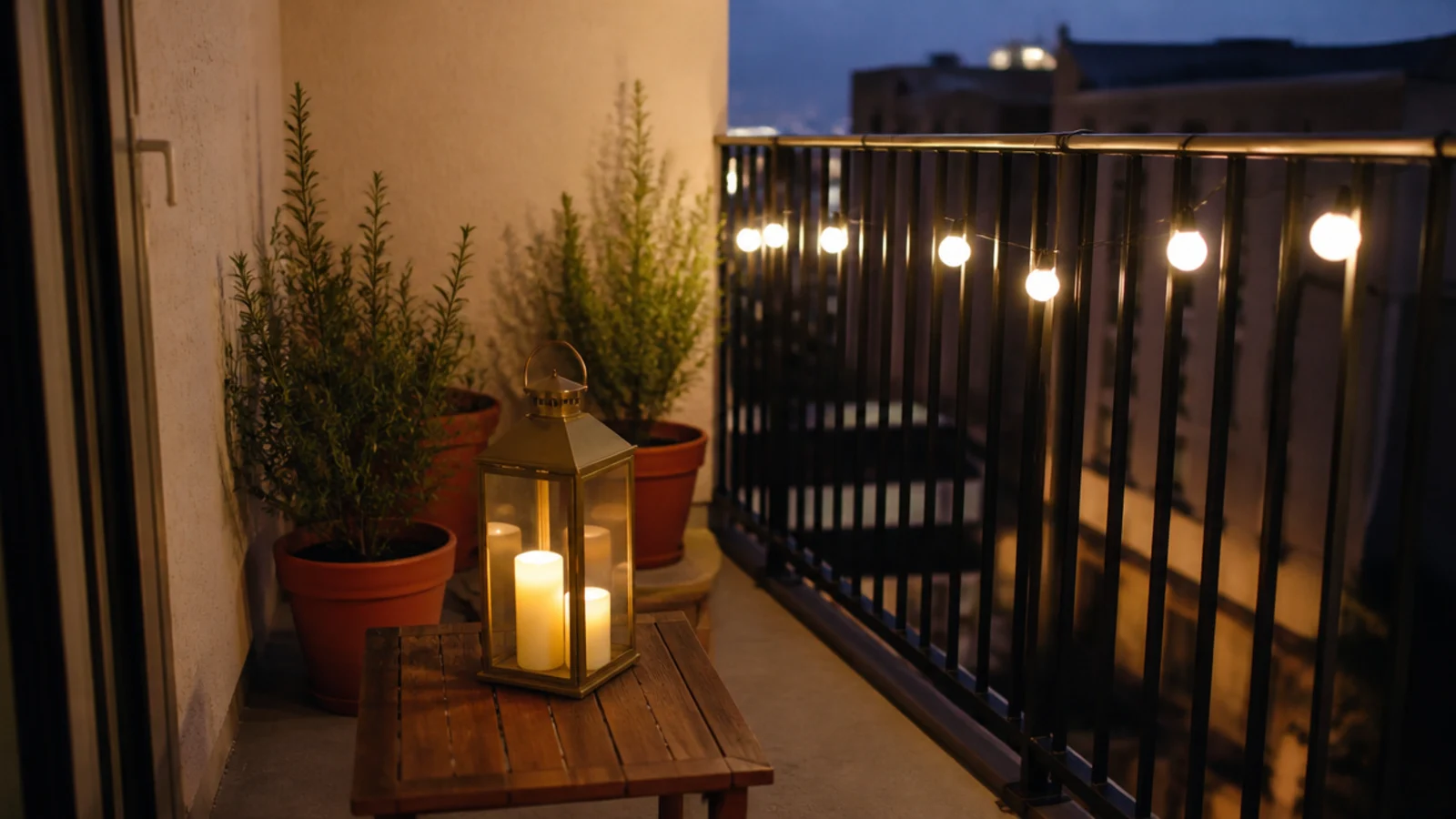
Build a triangle: tallest plant at the back corner, two mid-height pots stepping forward, three small ones at the front. Everything sits on saucers, and the heaviest container goes nearest the building wall.
The rest of the slab stays bare, which is what makes the planted corner look deliberate rather than crowded. $$
9. A freestanding trellis weighted in its own planter
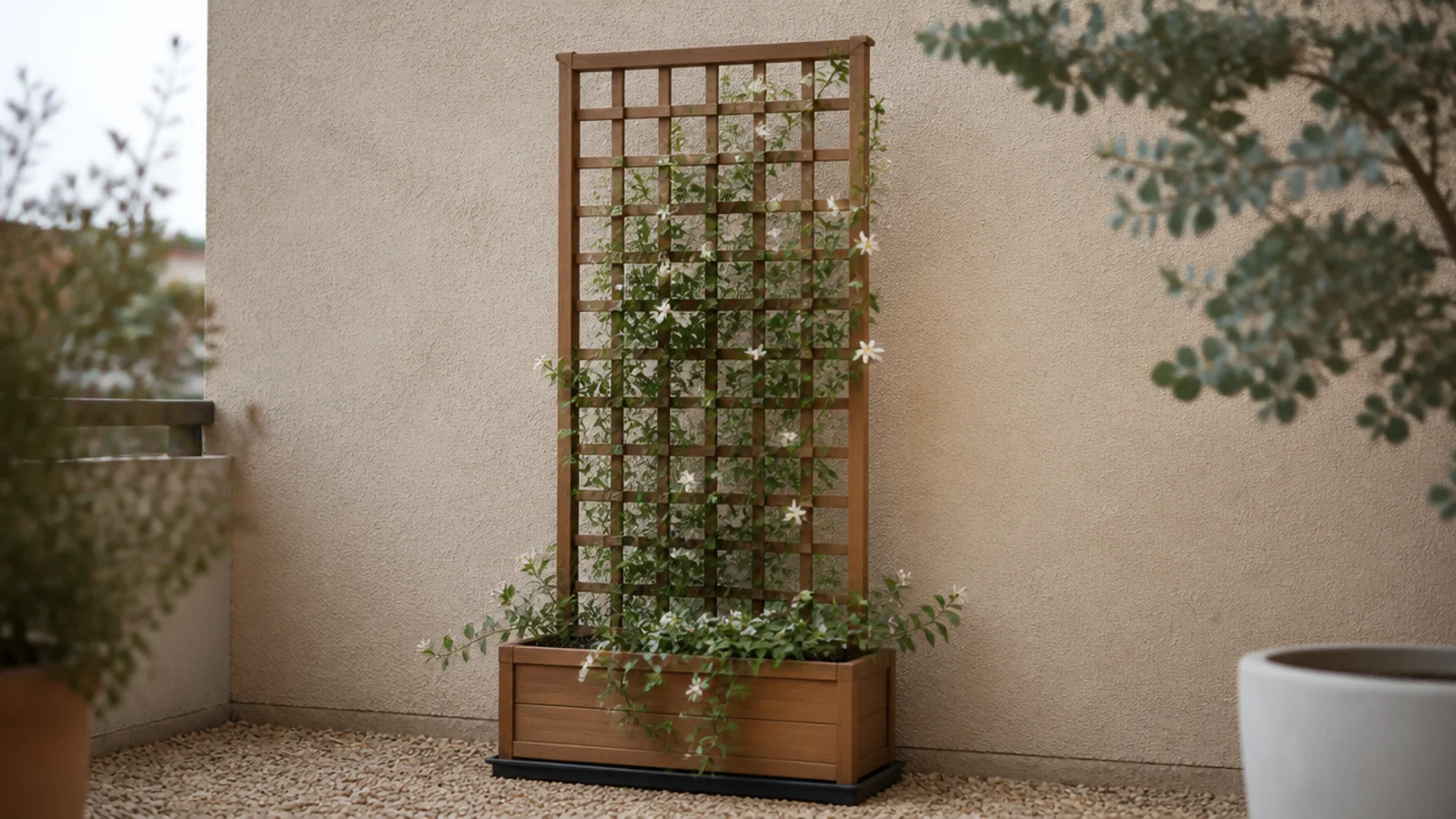
Vertical growing on a rental balcony has to stand on its own feet. A trellis panel set into a long rectangular planter uses the wet soil as ballast — around 60 to 80 pounds in a filled 30-inch trough.
Stand it against the building wall, never against the railing, and keep the panel slatted rather than solid so wind passes through. Jasmine, sweet peas and trailing nasturtium climb it happily in a season.
Above the third floor, add a strap from the frame to a heavy pot. $$–$$$
10. Pocket planters hung on a leaning A-frame
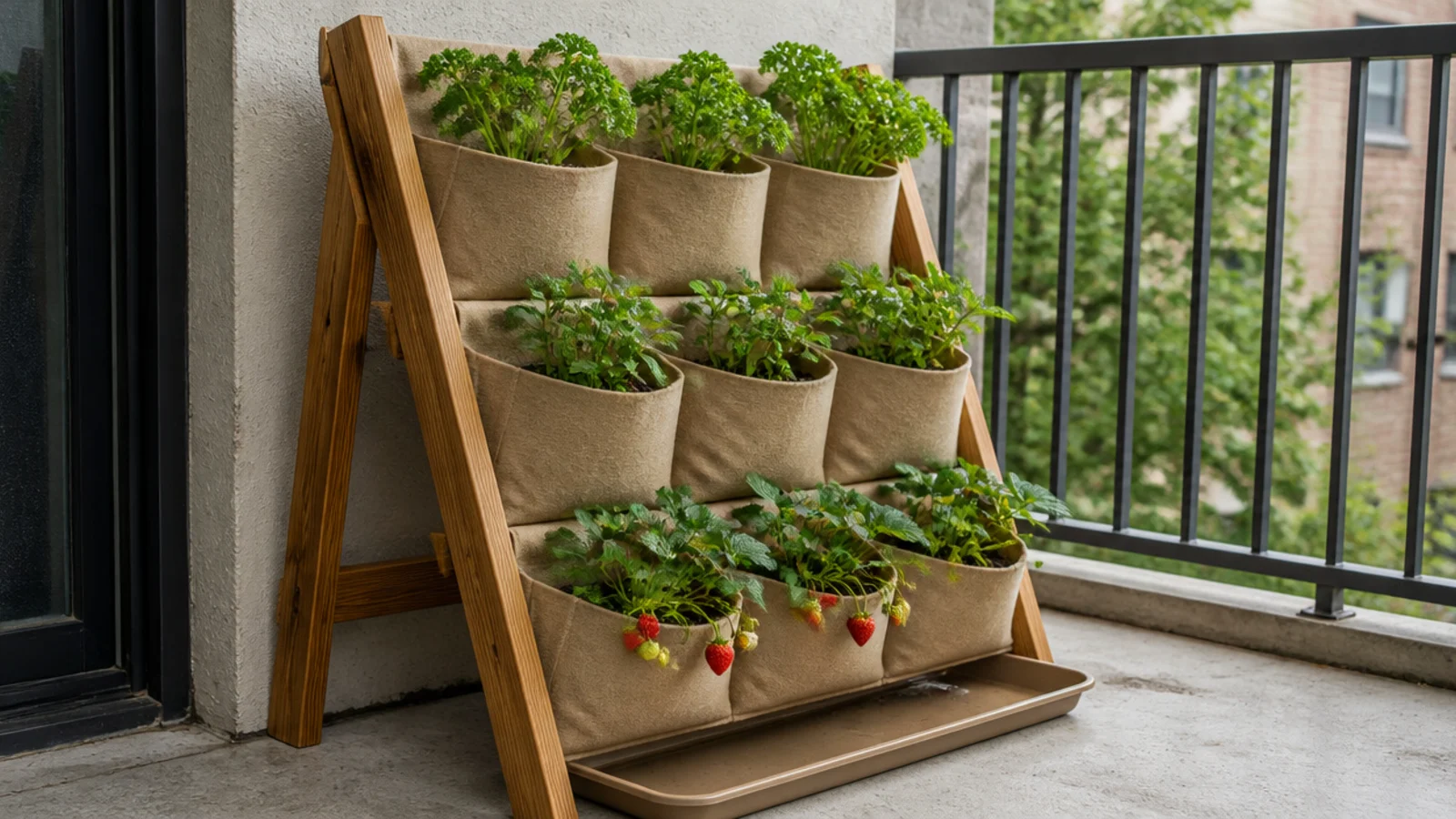
Felt pocket planters hold a surprising amount of herbs and strawberries in almost no floor space, but the common advice is to screw them to a wall or a railing. Do neither.
Hang them on a leaning wooden A-frame instead. The frame stands free, the pockets stay inboard, and the whole thing lifts off in ten seconds when a storm is forecast.
Put a shallow tray underneath. Felt pockets drip heavily for the first minute after watering. $–$$
11. Round tables have no corners to catch your hip
Swapping a 24-inch square table for a 24-inch round one removes four corners from a walkway that has none to spare, and it is the change people notice within a day.
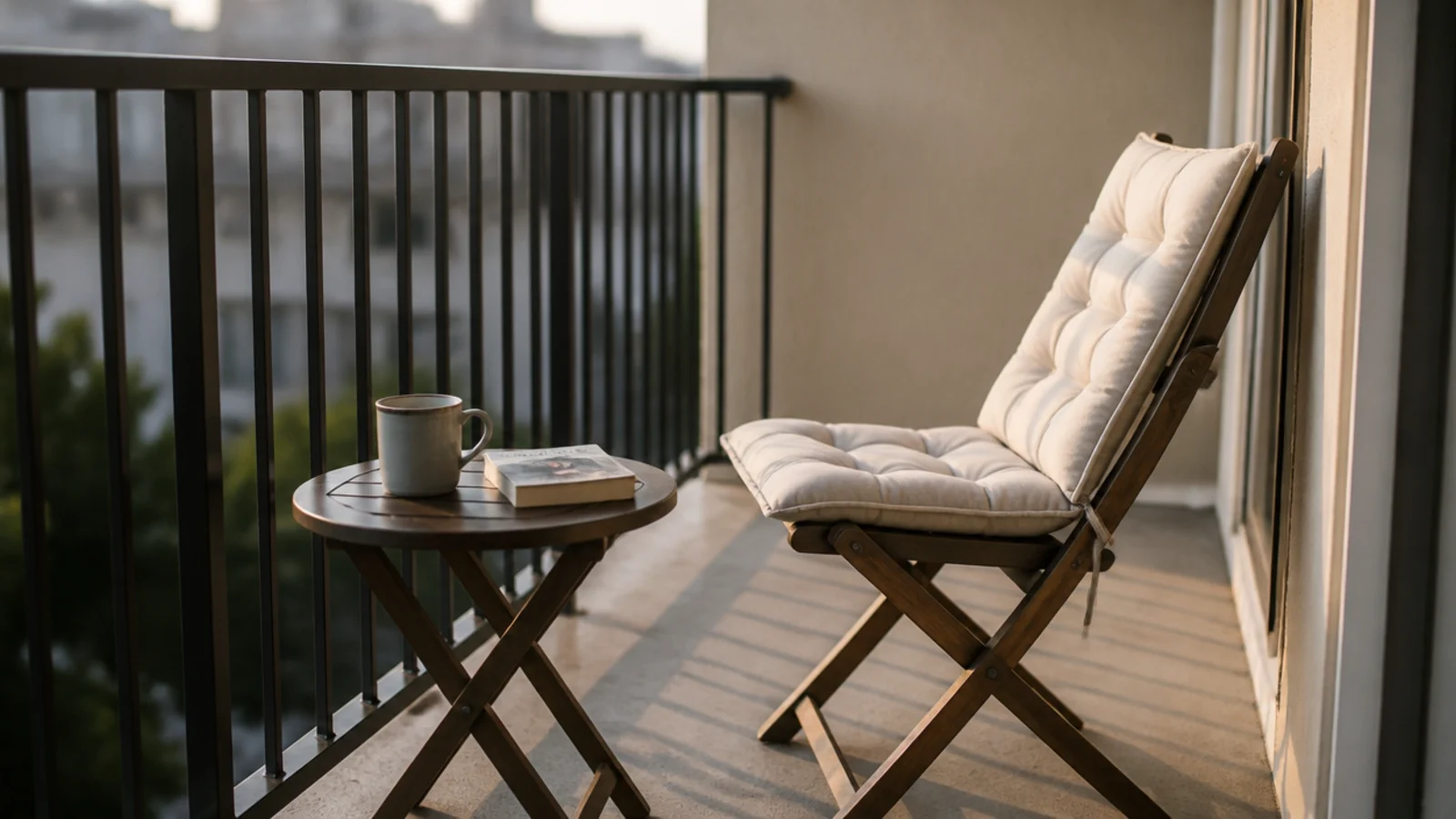
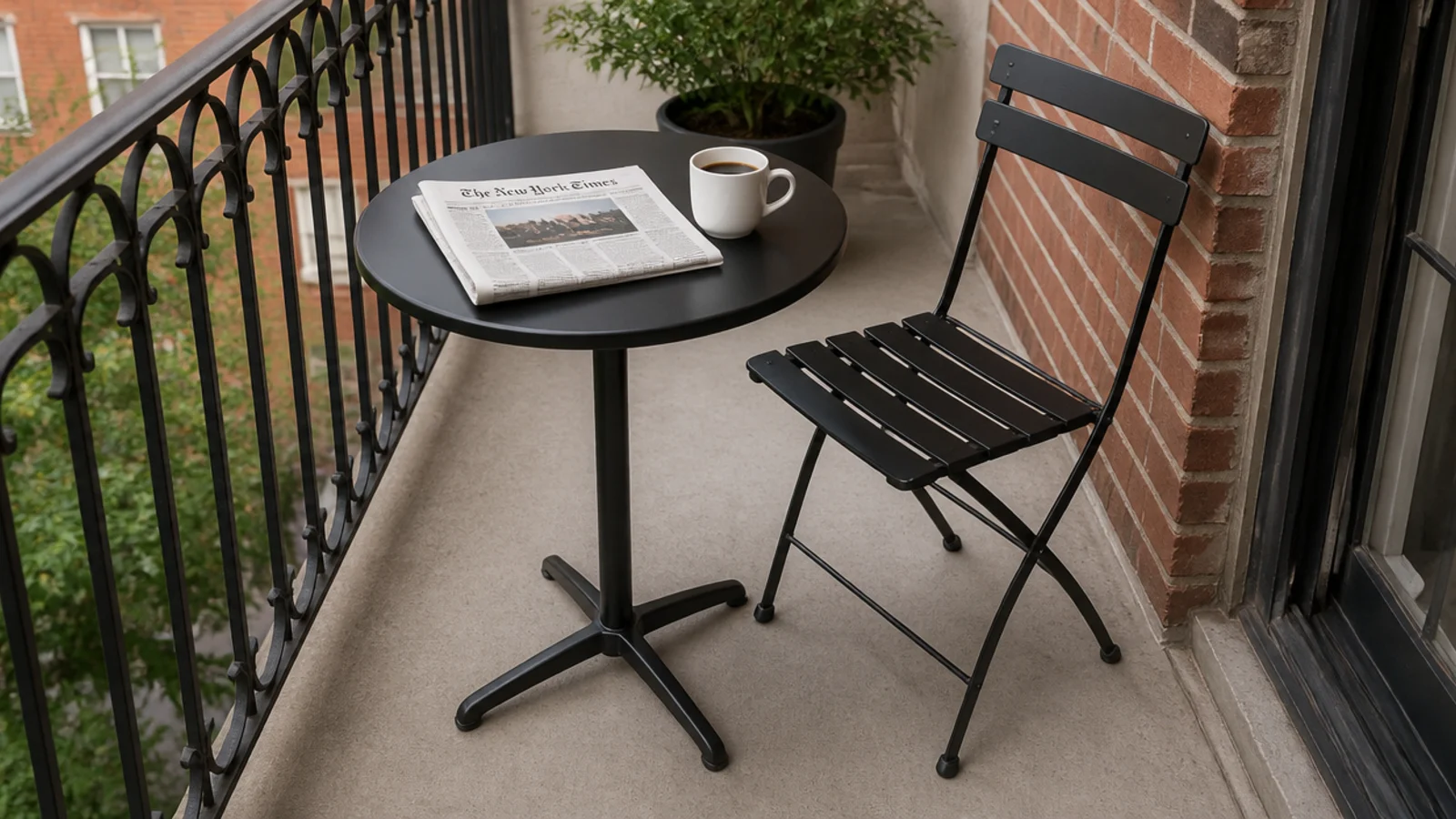
Round also lets two chairs sit closer without a corner between them. On a very narrow slab, a 20-inch round table with two folding chairs is genuinely comfortable where a square set is not.
Choose a heavy cast or weighted pedestal base rather than four thin legs. $$
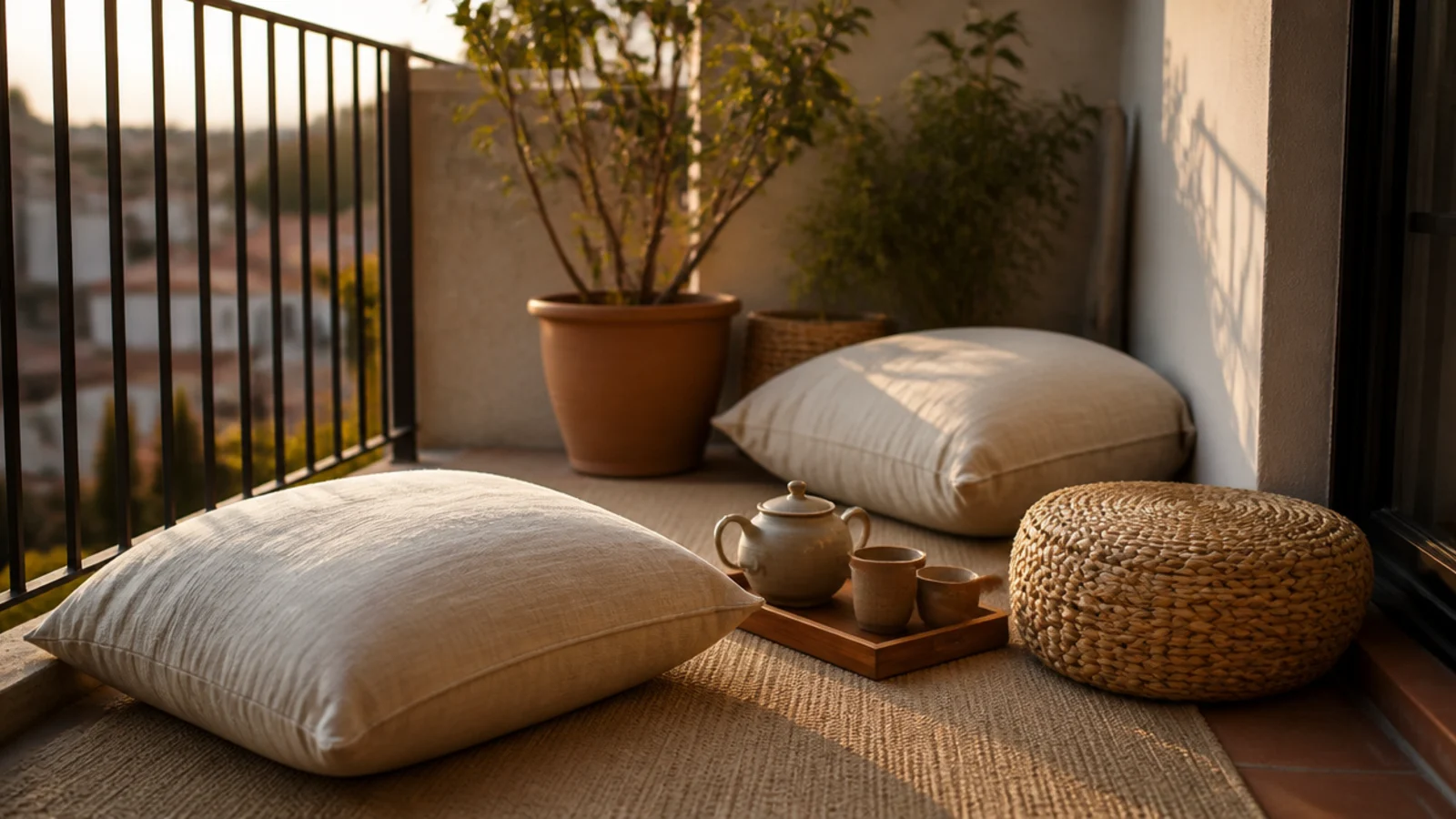
12. Floor cushions and one pouf instead of two chairs
Sitting low is the oldest trick for a small outdoor space, and it works because the vertical space above you suddenly reads as generous.
Two large solution-dyed outdoor floor cushions and a woven pouf take up less visual room than a chair, store inside in one armful, and cost less than a bistro set.
Put a low tray on the pouf for cups. Keep the cushions in a lidded basket by the door so ten seconds of rain does not ruin them. $$
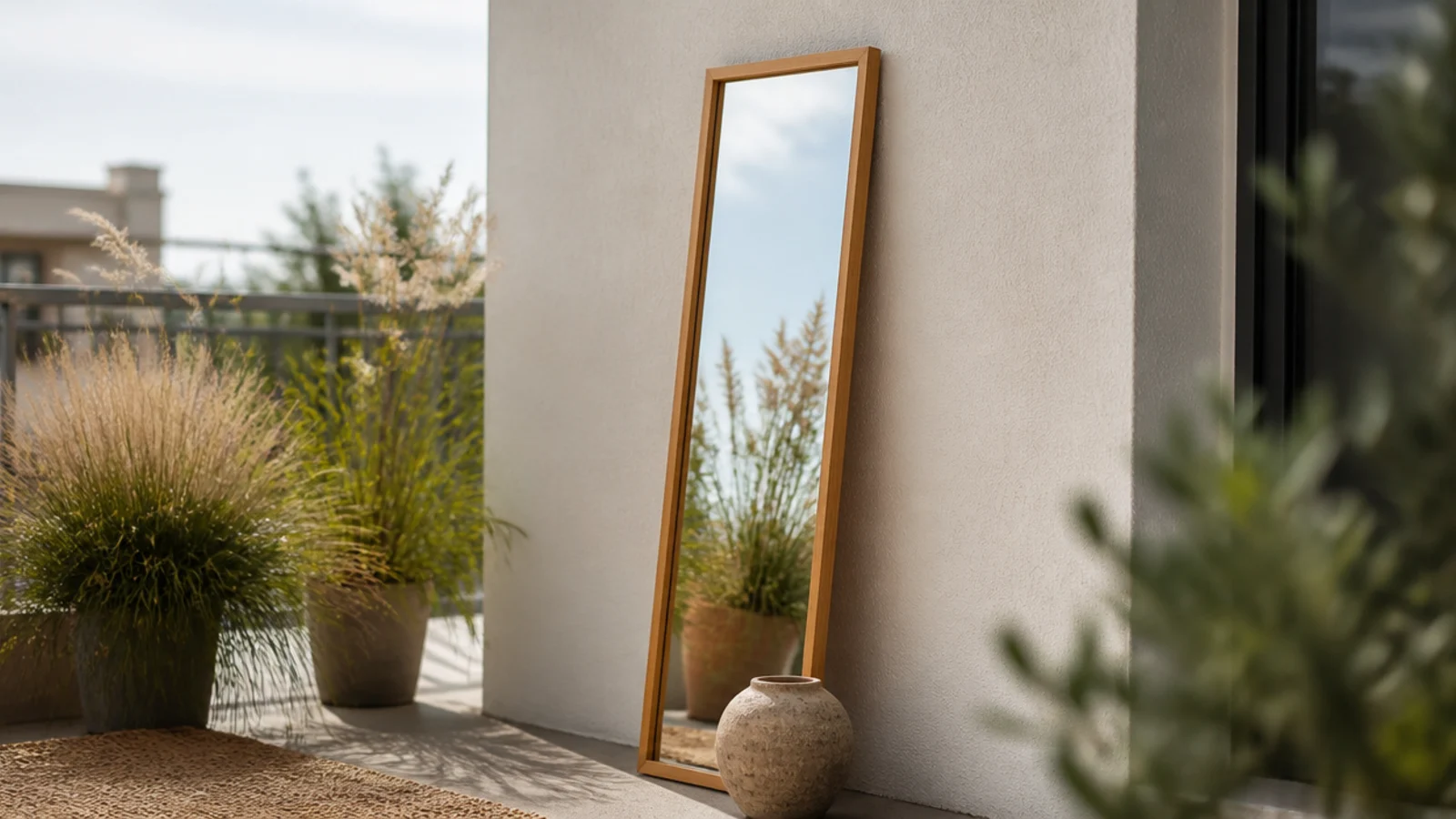
13. A shatter-resistant acrylic mirror on the wall
A mirror on the wall side doubles the apparent depth of a shallow balcony and bounces light into a slab that sits in the shade of the one above.
Acrylic only, never glass, and never anywhere near the railing. Lean it against the building wall with a heavy pot braced at the base, or set it inside a planter box so it cannot walk in wind.
Angle it slightly downward so it reflects planting rather than the sky, which reads as a hole in the wall. $$
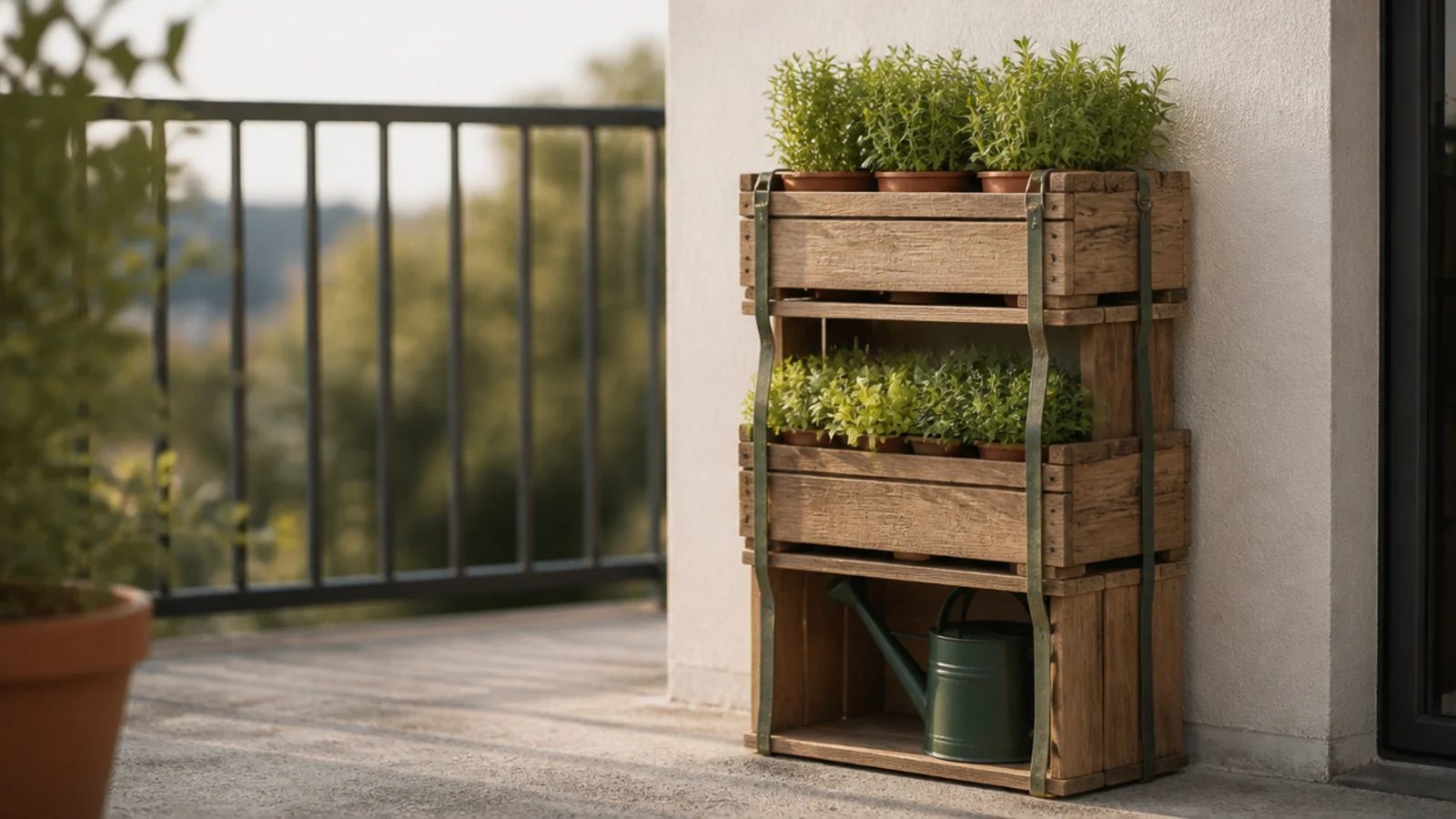
14. Stack crates into a tower instead of spreading them
Four crates spread along a wall use four crate footprints. The same four stacked and strapped use one, and give you a plant tower with storage in the bottom opening.
Strap or bolt them together rather than trusting friction, and keep the tower under 4 feet on a windy floor. Load the heavy pots on the bottom two levels and light trailing plants up top.
Seal untreated crates with an outdoor oil or they go grey and soft in a season. $
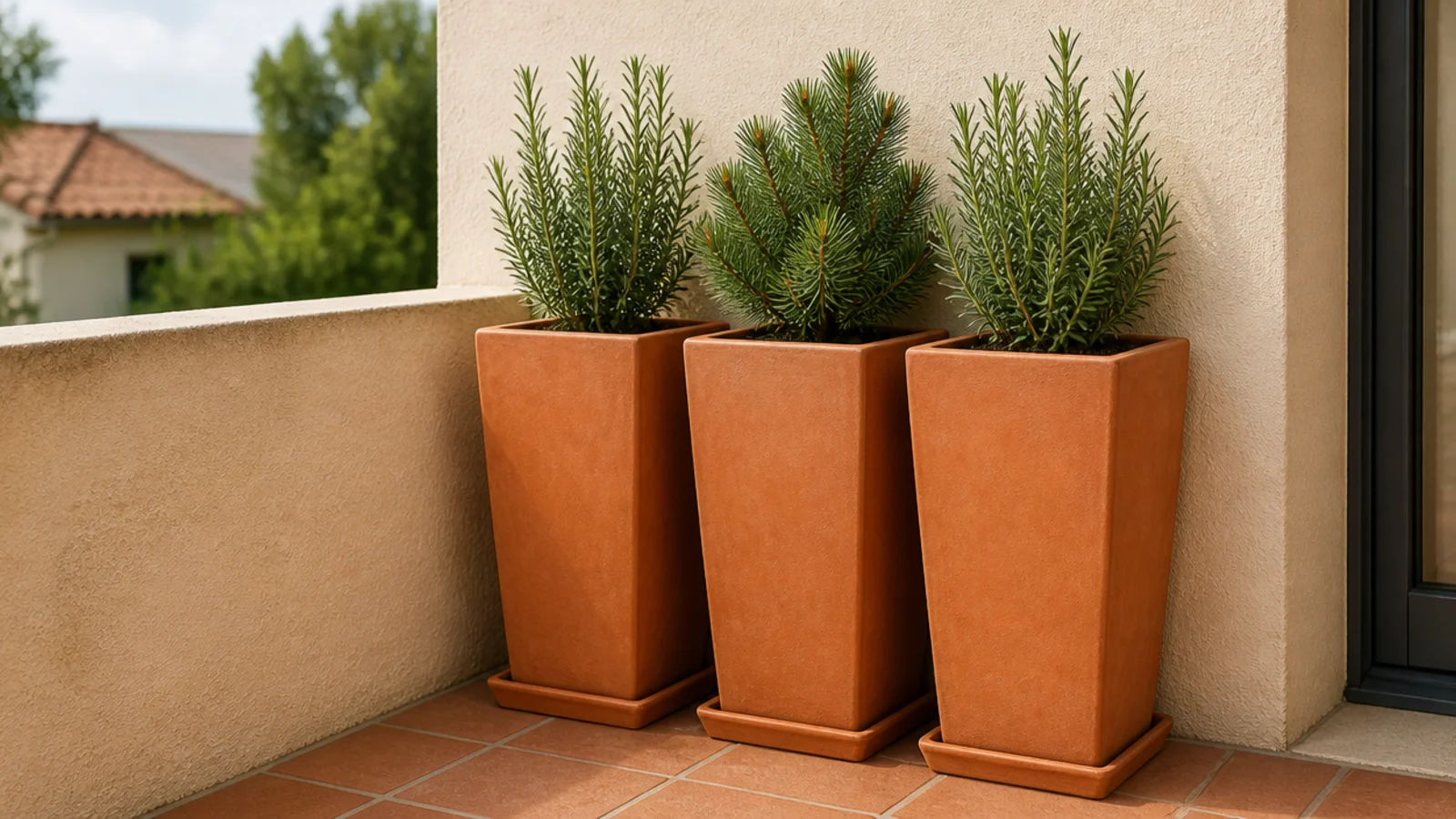
15. Tall narrow pots beat wide ones on a shallow slab
Two pots of identical soil volume can have wildly different footprints. On a slab three feet deep, a 12-inch wide by 20-inch tall planter takes half the floor of a 20-inch wide bowl.
Tall pots also raise foliage to a height where you actually see it from inside the glass. Line three along the wall and you have a green edge that costs almost no walkway.
Tall and narrow does tip more easily, so keep them wall-side and fill the bottom third with gravel. $$
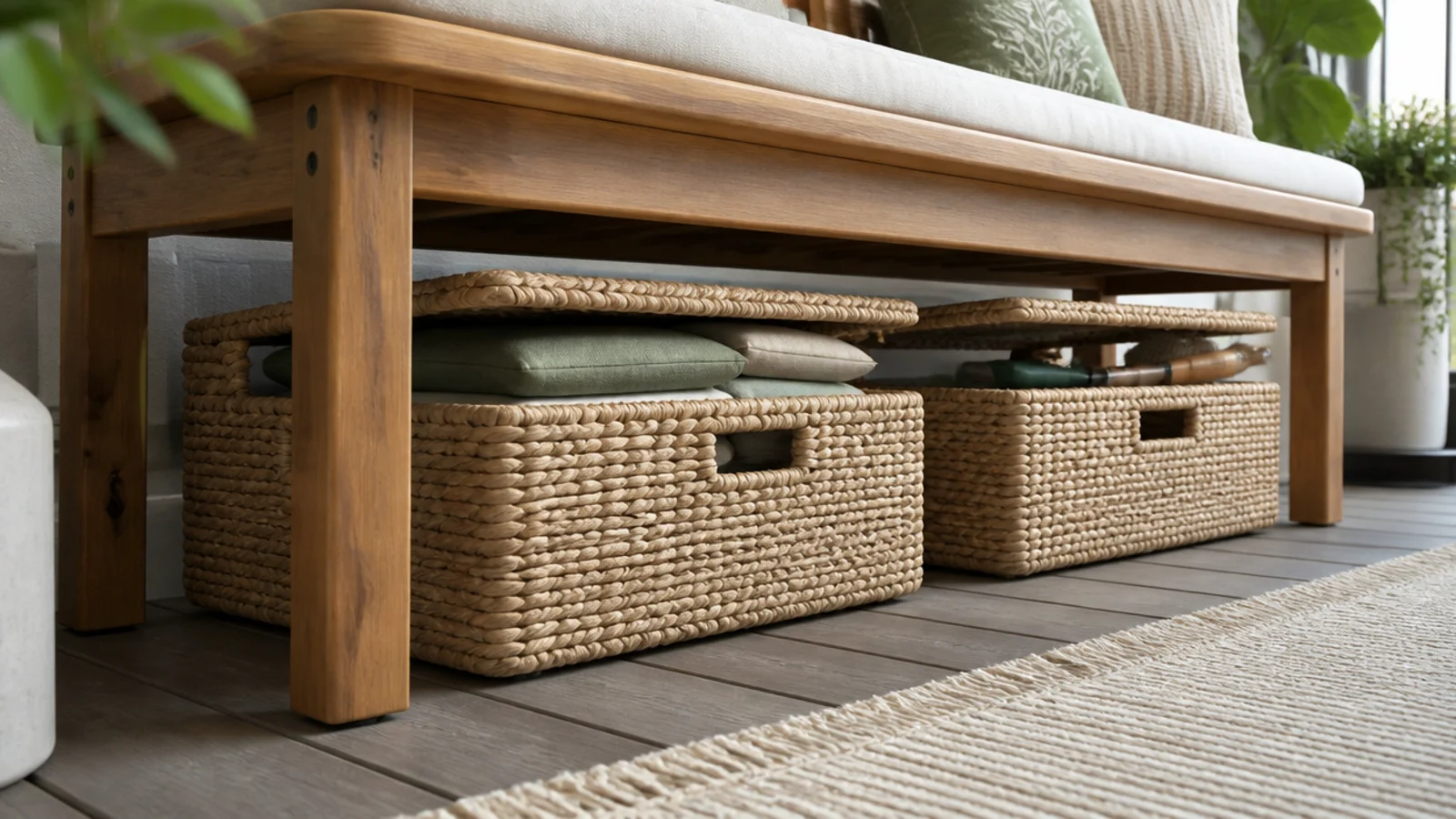
16. Put the baskets under the seat, not beside it
Every balcony accumulates cushions, a watering can, secateurs and a folded throw. On a tiny slab, that pile is what makes the whole thing look chaotic.
Two lidded baskets under a bench or console absorb all of it for about $30, and they cost no floor space at all because that space was dead.
Choose lidded and lined rather than open weave. Open baskets fill with rain, leaves and city grit, and everything inside them stays damp. $–$$
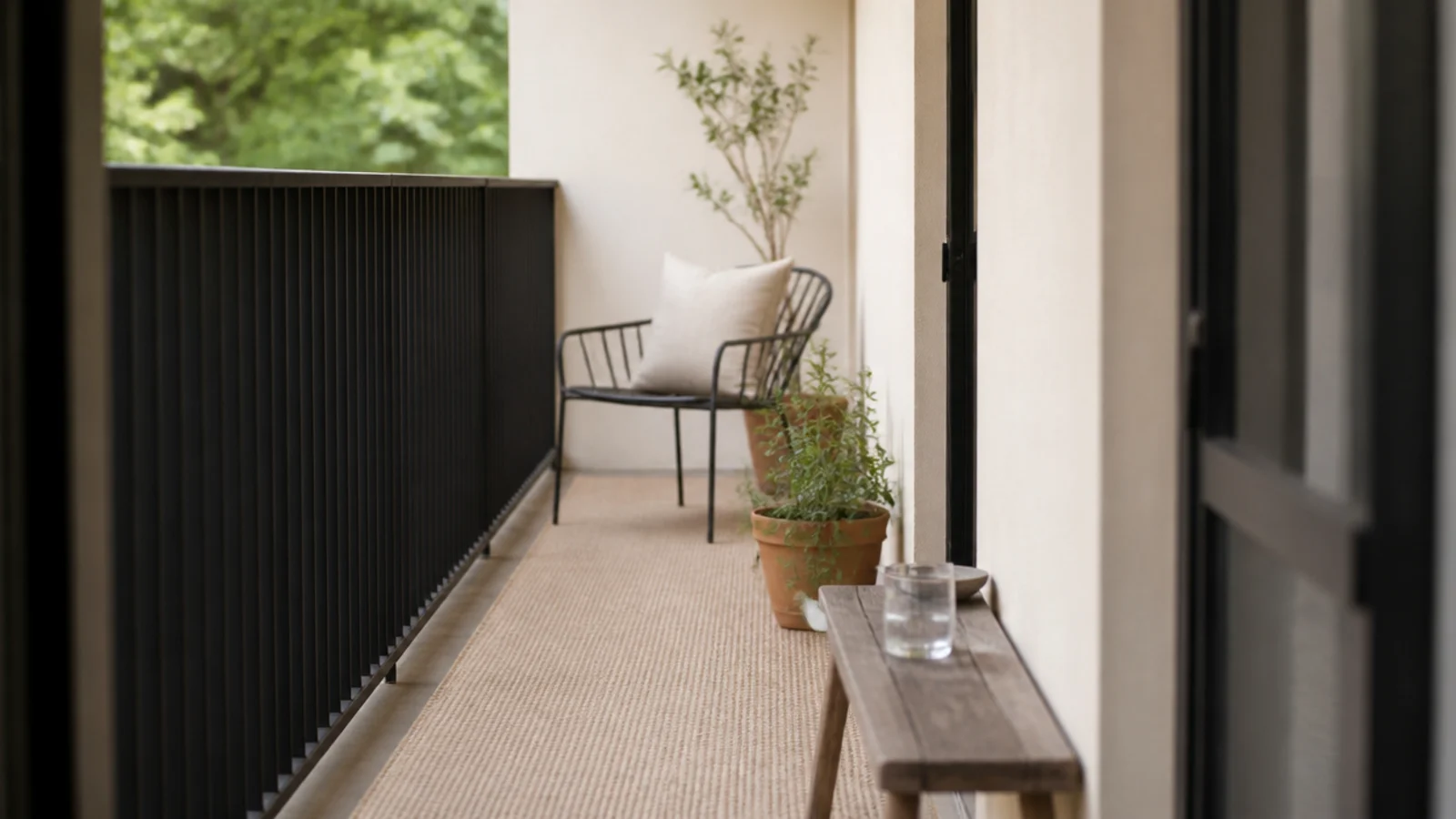
17. Pale floor, dark rail, and the slab reads deeper
Value contrast does real work on a small balcony. A pale floor advancing toward you with a dark railing at the far edge pushes the boundary visually backward.
Lay a sand or cream open-weave runner and leave the railing its original dark finish. If your rail is already pale, keep the floor paler still and add one dark object at the outer edge instead.
Avoid a dark floor on a shaded balcony. It reads as a hole and makes the whole slab feel smaller. $$
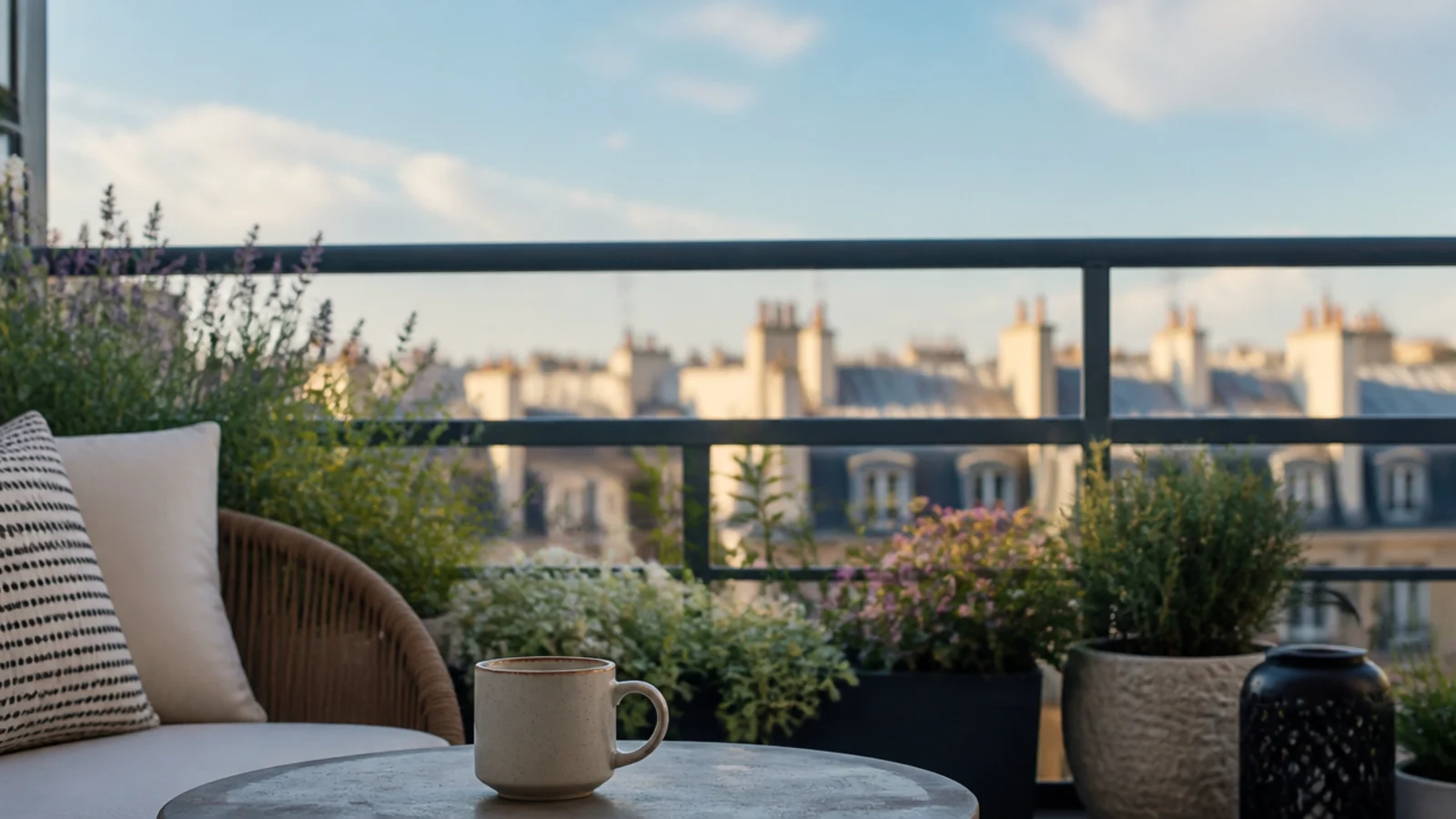
18. Keep the rail sight line clear at seated eye height
Sit down in the chair before you decide what can be tall. On most balconies, seated eye height falls between 40 and 46 inches, and anything at that level across the rail closes the space completely.
Keep planting and screening either below 36 inches or above 54, and leave the band in between open. You get privacy where you need it and a view where you sit.
There is more on this in apartment balcony privacy ideas, which covers the panel heights properly. Free
19. A tension rod curtain between the side walls
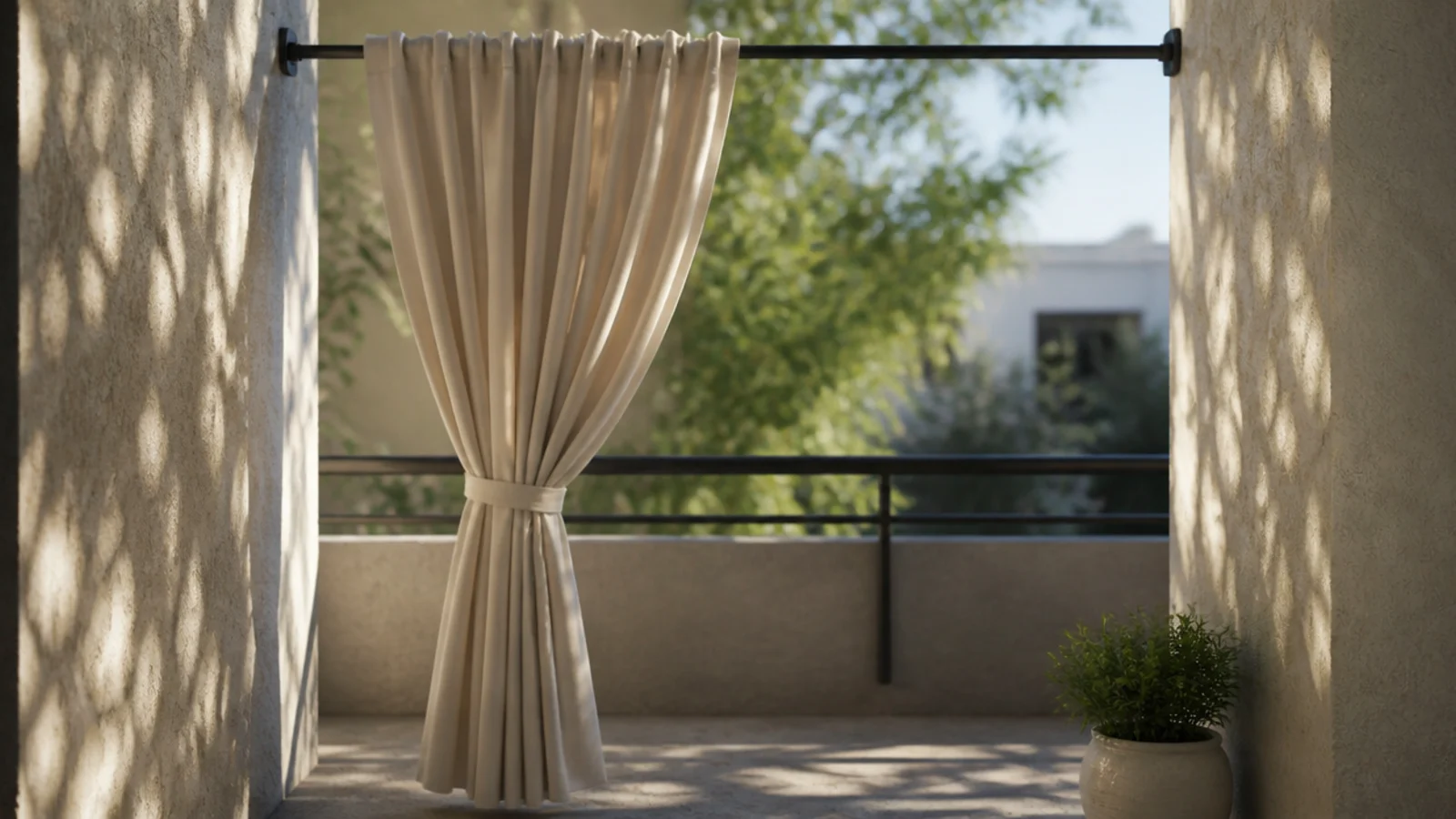
If your balcony has solid side walls, a tension rod wedged between them takes a light outdoor curtain with no drilling at all — the only genuinely renter-safe way to get soft fabric out there.
Use one panel, not two, tied back most of the time. Outdoor-rated fabric in a sand or cream tone, hemmed short of the floor so it does not wick water.
Take it down before any forecast wind. A loose curtain on a high floor is a sail, and tension rods do not argue with gusts. $$
20. Plan for the whole balcony to store flat in winter
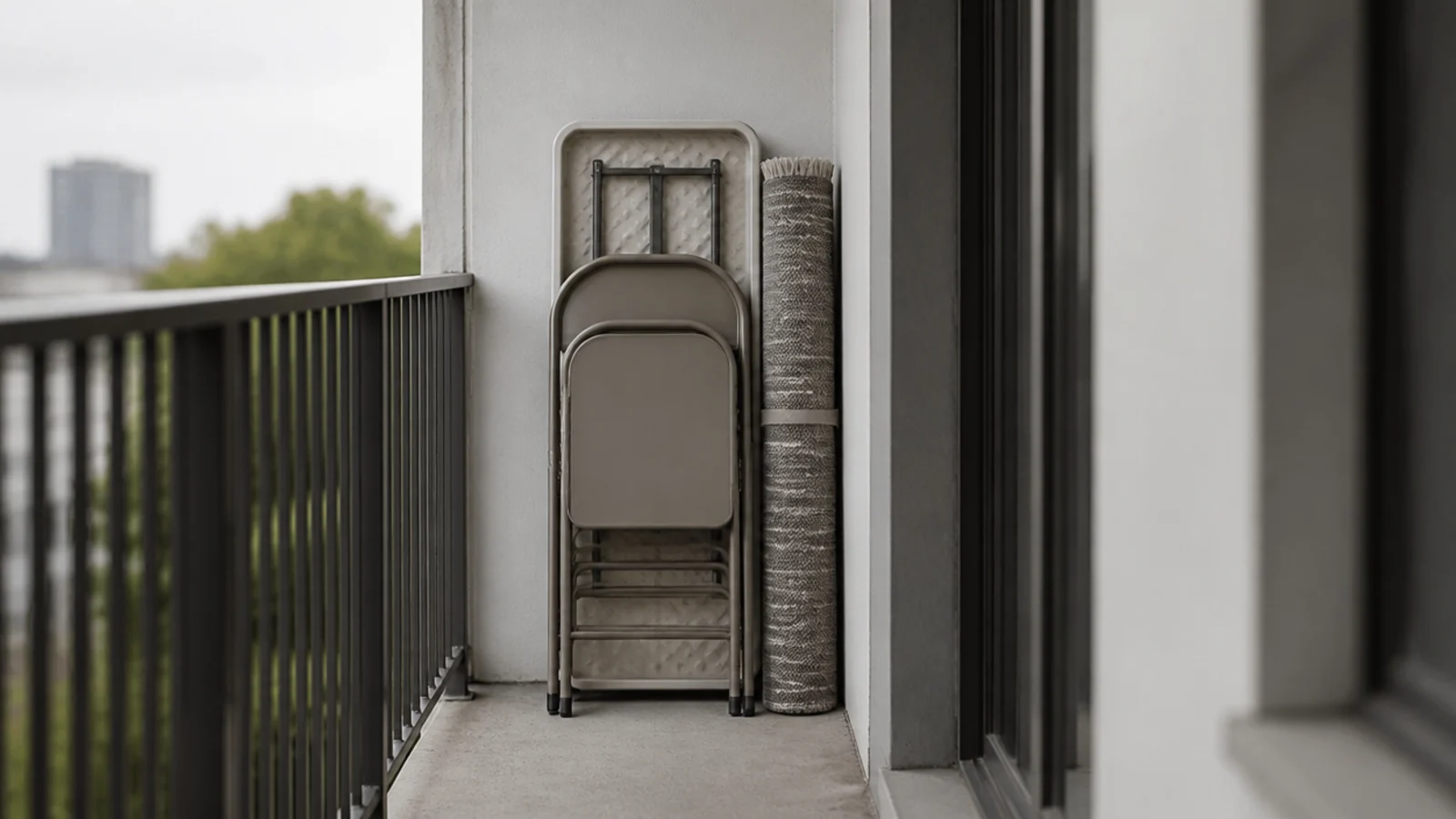
The test of a tiny balcony scheme is whether it packs away. Everything I buy for a small slab has to fold, stack or nest into about 18 inches of wall.
Two folding chairs at 5 inches each, a collapsed table at 2 inches, a rolled runner and a stacked pair of stools. That is a whole balcony, stored against a wall, off the wet concrete for four months.
Furniture that cannot be stored gets weathered, then replaced. Folding is cheaper over five years than fixed. Free
Mistakes to Skip
- Buying furniture before you chalk the floor. A set that measures fine in the listing routinely leaves no room to stand up, and returning outdoor furniture is a genuine ordeal.
- Mounting pocket planters, hooks or screens to the railing. Most leases prohibit it outright, and anything on the outer face can fall several floors onto people.
- Filling the slab edge to edge because the space is small. A tiny balcony needs bare floor more than a big one does, not less.
Frequently asked questions
What is the smallest balcony you can actually furnish?
About 3 feet deep by 5 feet wide, which is roughly 15 square feet. At that size you get one chair, one small side table and a narrow strip of planting against the wall, with a walkway left over. Anything shallower than 3 feet is a standing balcony, and it is better styled as a view with plants than as a room.
How deep does a balcony need to be for a table and two chairs?
Roughly 4 feet by 4 feet of clear floor once the chairs are pulled out. A 24-inch round bistro table plus two chairs with 18 inches of pull-back behind each one is the real footprint. On a slab under 4 feet deep, a rail-hung drop leaf with two stools works far better than any bistro set.
How do I make a tiny balcony feel bigger?
Keep the floor pale and continuous, hold everything below rail height except one tall element, and leave the sight line through the railing clear at seated eye height. Furniture that lets light pass — slatted, wire, glass-topped — reads smaller than solid pieces of the same size. Clutter on the floor is what shrinks a slab.
Can I use vertical space on a rented balcony?
Yes, but freestanding only. Leaning A-frames, trellis panels weighted in a planter and stacked crates give you height with no fixings at all. Do not drill the wall, the ceiling or the slab, and never mount anything to the railing itself. Above the third floor, load tall frames heavy at the bottom or they tip.
What furniture works best on a very small balcony?
Anything that folds, stacks or nests. Two folding chairs collapse to about 5 inches of wall, nesting stools store as one footprint, and a hook-over rail table folds to nothing. Fixed patio furniture owns the slab whether you use it or not, which on 20 square feet is a decision you feel every single day.
Should I put a rug on a tiny balcony?
A runner rather than a full rug. Open-weave flatwoven polypropylene in a 2 by 6 foot runner defines the walkway, leaves bare concrete at the edges so water reaches the drain, and dries in an hour. Dense pile traps water against the slab, stains it permanently and is very often what a deposit gets deducted for.
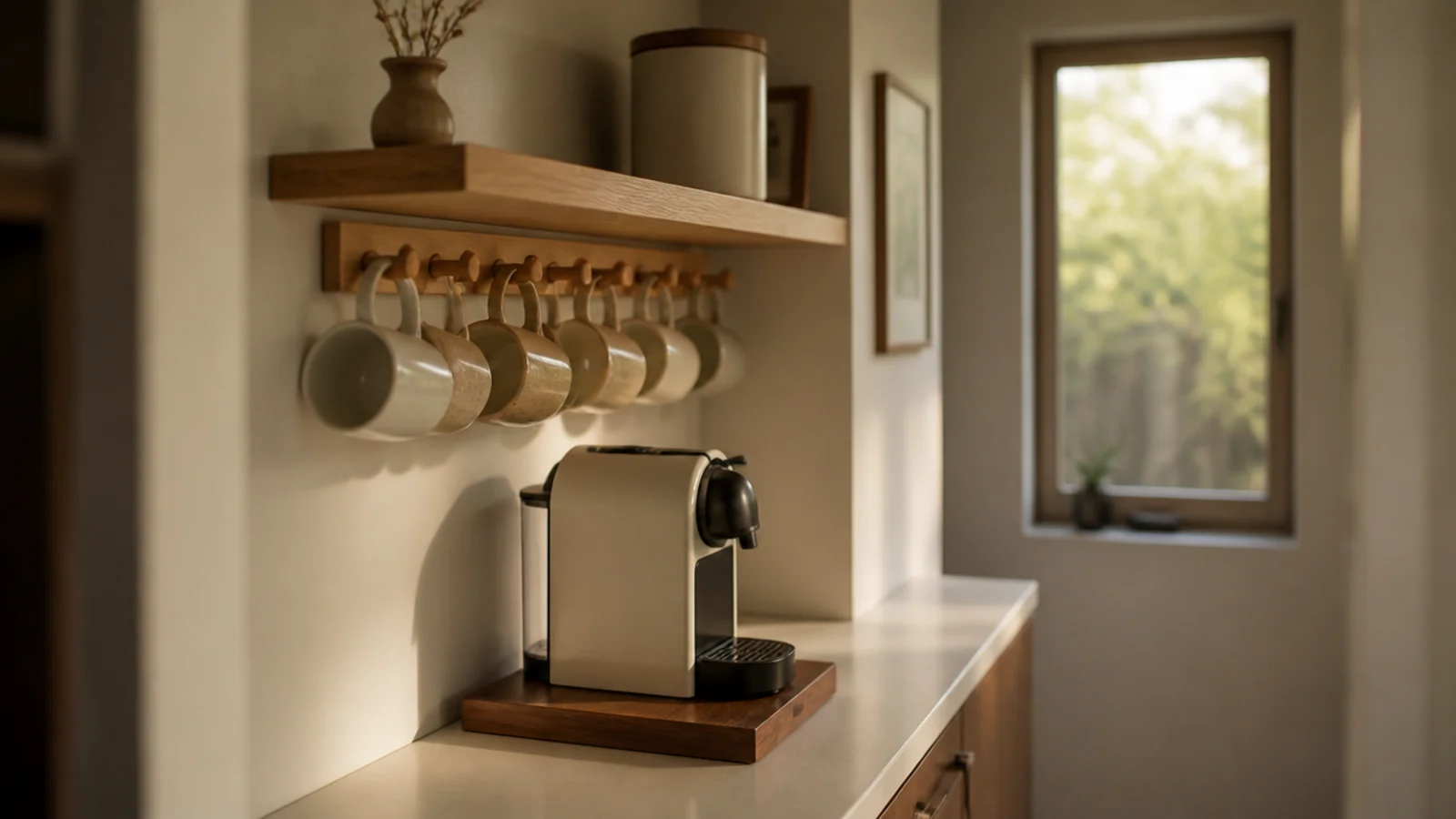
Chalk the real rectangle first, decide the one job, then buy the smallest thing that does it. On a slab this size, restraint is not a compromise — it is the only version that works. For the pieces themselves, apartment balcony seating has the dimensions, and if the balcony is where your morning cup happens, a coffee corner for small spaces uses the same square-inch thinking just inside the door. Save the pin so the measurements come shopping with you.
Want more like this? Browse all 15 apartment balcony ideas guides — they all use the same measurements and budget tiers.

Pin it for later
Save this to your Apartment Balcony Ideas board
Pin it now so it is waiting for you when the tape measure comes out — and so the next person hunting for this idea can find it too.
Save this pinKeep going
More ideas worth saving while you have the tape measure out.